Analysis of the Effect of Dispersion Forces on the Dielectric
Film Properties Using Parallel Computing
Kirill A. Emelyanenko1, Ludmila B. Boinovich1,
Alexandre M. Emelyanenko1
c
The Authors 2018. This paper is published with open access at SuperFri.org
The paper presents the analysis of dispersion forces effect on local properties in thin free films. Using a Coupled Fluctuated Dipole Method with developed methods for numerical calculations of dielectric properties, the films with different lateral sizes and thicknesses were studied. In par-ticular, the molecular polarizabilities at different distance from the film interface were analyzed. It was shown that dispersion interaction between the molecules, even for the case of nonpolar liquid with weak intermolecular interactions, causes a notable variation in dielectric properties of thin film, which is associated with the boundary layer formation. This variation, in turn, causes a strong dependence of polarizability accuracy on the cut-off radius. It is demonstrated that parallel computing algorithms can be effectively applied for obtaining the reliable data on properties of liquids in wetting films and boundary layers even under resource-imposed constraint on the size of ensemble of molecules to be handled in the numerical studies.
Keywords: CFDM, thin film properties, dispersion forces, local polarizability.
Introduction
The properties of contacting phases vary continuously upon transition from one phase to another. This variation of different properties of both phases caused the appearance and the development of a concept of boundary layer, as the layer adjacent to the interface, the anomalous properties of which result from the manifestation of long-range effects from the confining body [1]. The investigations of rheological and optical properties of boundary layers of liquids in the vicinity of interfaces as well as in wetting films indicated special structure and anisotropy of boundary layers extending from the interface into a liquid phase far beyond the monomolecular dimensions. The mechanisms of such effects are poorly studied so far. As discussed in [1] the most significant effect of deviation of boundary layer properties from those in the bulk is expected for polar liquids strongly interacting with the confining phase. In this study, we show that the formation of boundary layer is a universal phenomenon induced by the van der Waals interaction between the molecules. Using a nonpolar hexane we show the significant variation of its molecular polarizability near interface with air. Besides, it is demonstrated that parallel computing algorithms can be effectively applied for obtaining reliable data on optical properties of liquids in wetting films and in boundary layers near single interfaces even under resource-imposed constraint on the size of ensemble of molecules to be handled in the numerical studies.
1. Coupled Fluctuated Dipoles Method
Coupled fluctuated dipoles method (CFDM) is a microscopic method for calculation of the dispersion interactions. Introduced by Renne and Nijboer [4] in 1967, it considers a system of interacting bodies as an aggregation of three-dimensional oscillators; each oscillator can be asso-ciated with an individual atom, a molecule or an elementary unit of the corresponding material. At the time of invention, the applicability of CFDM was hindered by lack of computational power. However, it was revived in series of articles by Kim and Velegol in the recent decade.
where n¯ij andrij are unit normal vector and distance between elementary units iand j.
Considering all oscillators in the system we get a system of equations for eachi-th oscillator:
¯
pi−αi N
X
j=1
Tijp¯j =αiE¯0(¯ri). (3)
Particular solution of this system of inhomogeneous equations can be found if we note that for static electric field αi should be substituted with α(0)i. This solution corresponds to static
dipole moments induced by an external field. These individual dipole moments can be used for finding local polarizability and other local dielectric properties.
1.1. Numerical Methods
Basic computational routines required by CFDM for calculation of both the dipole moments and the frequency spectra are standard and can be found in LAPACKand ScaLAPACK libraries. However, since systems of interest for microscopic dispersion interactions consist of tens and hundreds of thousands of atoms, a set of special numerical methods should be used.
Studying the system infinite in one or more directions can be done much more effectively, that is, with substantially less amount of computation, by using periodic boundary conditions. It eliminates the impact of spatial confinement in undesired dimension; for instance, for film studies it eliminates effects of lateral constraints, while periodicity length effectively becames a cut-off radius, that is, a distance beyond which interactions are neglected. Another approach which substantially decreases the size of equations system for calculating individual dipole moments, is exploiting symmetries in the systems. Since for some oscillators, a translation symmetry leads to equal moments, these oscillators can initially be separated into equivalence classes with de-creasing number of equations from one-per-oscillator toone-per-class. It becomes an especially effective technique in combination with the abovementioned periodic boundary conditions. Fi-nally, iterative methods of finding eigenfrequencies by calculating traces of interaction matrix in corresponding exponent enable trade-off between accuracy and performance.
2. Results and Discussion
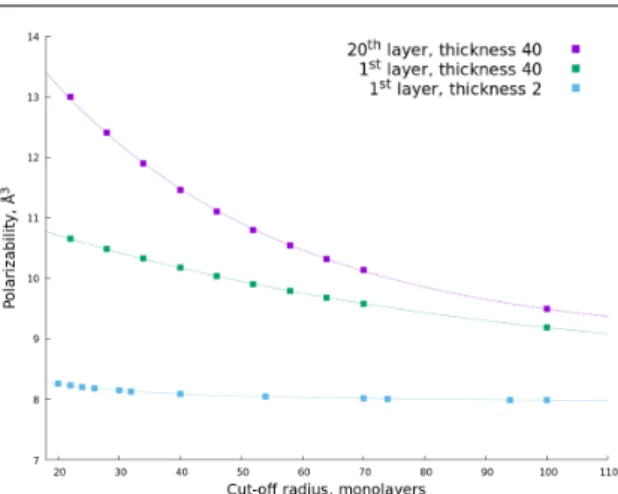
Figure 1. Characteristic dependence on cut-off radius for polarizability of 1st layer in
bi-layer (blue) and 40 bi-layer (green) system; po-larizability of 20thlayer in film 40 monolayers
thick (violet)
Figure 2. Processor time required for
ob-taining given accuracy of local polarizabil-ity values for different layers of the free film. Calculations were performed on 256 cores at Lomonosov supercomputer
demonstrated previously [3], in absence of periodical boundary conditions, long-range nature of dipole-dipole interactions hinders the applicability of microscopic approaches for evaluating properties of bulk materials or systems infinite in one or more dimensions. Thus, for our case when laterally infinite films were simulated by periodical boundary conditions, it was impor-tant to study how cut-off radius affects the results, and which periodicity length is optimal under trade-off between the computing performance, defined by the size of the system, and the accuracy.
Typical dependences of local polarizability (in the layer adjacent to the interface and in the film midplane) on cut-off radius for films with different thicknesses are shown in Fig. 1. The notable difference detected in the values for the first monolayer adjacent to hexane/air interface in the bilayer film and for the film of 40 monolayers thick convincingly illustrates the effect of boundary layers overlapping on the local polarizabilities. The dispersion interactions cut-off associated with setting the periodic boundary conditions for the finite lateral size of film result in notable variation of the numerically obtained values of local polarizability. As expected, films with higher thicknesses require much larger lateral sizes to reach properties corresponding to laterally infinite films. It was found that approaching to infinite values is exponential with convergence rate dependent both on film thickness and layer depth.
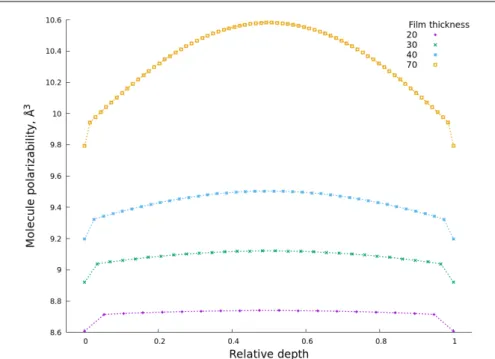
Figure 3. Polarizability distribution in the free hexane films with different thicknesses. Cut-off radius is 100 monolayers
Conclusions
The developed method of numeric calculations of the film properties based on the values of polarizability of individual molecules allows to obtain reliable results for the films of different lateral sizes and thicknesses. Using this approach we have shown that dispersion interaction between the molecules causes notable variation in dielectric properties of thin liquid film even in case of nonpolar liquid with weak intermolecular interactions.
Acknowledgments
The research is carried out using the equipment of the shared research facilities of HPC computing resources at Lomonosov Moscow State University supported by the project RFMEFI62117X0011.
This paper is distributed under the terms of the Creative Commons Attribution-Non Com-mercial 3.0 License which permits non-comCom-mercial use, reproduction and distribution of the work without further permission provided the original work is properly cited.
References
1. Derjaguin, B., Churaev, N., Muller, V.: Surface Forces (Consultants Bureau, New York, 1987). Springer, Boston, MA (1987), DOI: 10.1007/978-1-4757-6639-4
2. Emelyanenko, K.: Influence of Dicrete Nature of Charge and Material on the Surface Forces in Nanosystems (rus.). PhD dissertation (2018)
4. Renne, M., Nijboer, B.: Microscopic Derivation of Macroscopic Van der Waals Forces. Chem-ical Physics Letters 1(8), 317–320 (1967), DOI: 10.1016/0009-2614(67)80004-6