295
USE OF LIQUID FERTILIZERS BASED ON HUMATES EXTRACTED
FROM LIGNITE IN WASTE DUMPS RECULTIVATION
Dumitru M., Sîrbu Carmen, Mărin Nicoleta, Vrînceanu Nicoleta *National Research and Development Institute for Soil Science, Agrochemistry and Environment – ICPA Bucharest Corresponding author email: [email protected]
Key words: re-cultivation, waste dump, fertilizers, maize, alfalfa.
ABSTRACT
Four liquid fertilizers based on humates obtained from lignite were developed and tested. The fertilizers were applied on the waste dump resulted from lignite open cast covered with fertile soil, at maize and alfalfa crops. The application of liquid fertilizers based on humates led to very significant increase of maize grain and alfalfa yields. The production reached the level of yields obtained in the area on land that was not affected by mining activities. The alfalfa plants concentration of macro elements and micro elements belongs to the ”normal” domain. The maize leaves had scarce nitrogen, potassium, copper, iron, and manganese contents and normal phosphorus and zinc contents.
INTRODUCTION
In the Oltenia mining field (Vâlcea, Gorj, and Mehedinți Counties) 18,443 ha have been degraded by open cast of which 13,680 ha agricultural land and 4,763 ha forest land (Cărăbiș, 2013).
Mining excavations, especially the open cast ones, severely degrade the environment through: taking out of agricultural and forestry use large areas, geo-morphologic changes, hydrographic and hydro geologic changes, air, water, and soil pollution, flora and fauna losses, micro climate changes, historic and archeologic sites losses, human settlements and transport systems displacement, and affecting social state and inhabitants (Munteanu, 1998; Ianc, 1999; Dumitru et al., 1999; Corici, 2006; Pascovici, 2006; Tatomir, 2010; Cărăbiș, 2013).
Alfalfa is considered the most adequate pioneer plant for waste dump valorization due to its high yields, wind and water erosion diminishing process, crop substratum improvement effect, ensuring a great part of the needed nitrogen in a substratum poor in this element by fixing it from the atmosphere, its high nutritional value, drought resistance, good quality as preceding crop, etc. Ferner et al. (1984) showed that alfalfa ensures high yields and rapid augmentation of soil fertility. The alfalfa crops and alfalfa together with perennial cereal in Germany ensure the best conditions in the process of building up waste dumps fertility. Alfalfa is used as early as the first year to ensure a rapid covering with vegetation in order to avoid erosion. On the uncovered waste dumps alfalfa is used first of all to obtain seeds because the waste dump doesn't contain weed seeds so it ensures a high crop purity.
Researches carried out by Tatomir et al. (2010) on the Gârla waste dump not covered with fertile soil showed that the best yields were ensured by alfalfa, mash, fingers-and-thumbs, greensward, and sorghum, and when covered with 30-40 cm fertile soil the best results were ensured by mash, greensward, alfalfa, fingers-and-thumbs, and peas.
296
flower (140%), soya (125%), greensward (34%), alfalfa (29%), fingers-and-thumbs (26%), and mash (24%) (Tatomir et al., 2010).
Literature data highlight that waste dumps resulted from open cast activities have a very diverse structure, low nutritional elements contents, scarce air and water condition, and a very low biologic activity. In these conditions the fertilization systems becomes especially important as it has to reduce the organic matter, N, P, K, and micro elements shortage and ensure a yield close or equal to that obtained on un-degraded land of the area and with similar prices. Organic fertilizers, green fertilizers, mineral fertilizers, and organic mineral fertilizers were used to this end.
WORKING METHOD
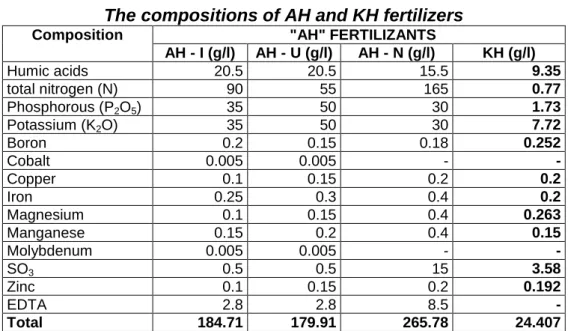
In the experiment organized on the Balta Unchiașului waste dump, covered with topsoil, four fertilizers were tested for maize and alfalfa crops, based on liquid humates extracted from lignite in doses of 100 and 150 l/ha. The experiment included nine variants with four replications. The process for the preparation of tested liquid fertilizer was the neutralization of phosphoric acid 85% with potassium carbonate 98%, leading to a solution containing monopotassium and dipotassium phosphate, the reaction taking place under continuous agitation and at a constant temperature of 25-30ºC. During stirring the amide nitrogen source, nitrate and ammonia, is slow added, keeping constant the temperature of reaction, resulting in a complex mixture of macro-elements. In the complex solution of macro-elements a solution of trace elements (Fe, Cu, Zn, Mg, Mn, and B) was added, chelated with EDTA disodium salt, and then a solution of potassium humate, obtained by extraction of the mass of coal (lignite), with a solution of potassium carbonate. The liquid fertilizer is applied with 400-500 liters of water.
Table 1. The compositions of AH and KH fertilizers
Composition "AH" FERTILIZANTS
AH - I (g/l) AH - U (g/l) AH - N (g/l) KH (g/l)
Humic acids 20.5 20.5 15.5 9.35
total nitrogen (N) 90 55 165 0.77
Phosphorous (P2O5) 35 50 30 1.73
Potassium (K2O) 35 50 30 7.72
Boron 0.2 0.15 0.18 0.252
Cobalt 0.005 0.005 - -
Copper 0.1 0.15 0.2 0.2
Iron 0.25 0.3 0.4 0.2
Magnesium 0.1 0.15 0.4 0.263
Manganese 0.15 0.2 0.4 0.15
Molybdenum 0.005 0.005 - -
SO3 0.5 0.5 15 3.58
Zinc 0.1 0.15 0.2 0.192
EDTA 2.8 2.8 8.5 -
Total 184.71 179.91 265.78 24.407
A basic fertilization was done with N90P90K90 (NPK 15:15:15 type solid fertilizer)
297
RESULTS AND DISCUSIONS
The literature data recommend that the fertile soil horizon be removed in the beginning of open cast activity and then waste dumps be covered with fertile soil to reduce the time of these surfaces improvement (Dumitru et al., 1999; Nastea et al., 1980) and increase the efficiency of the fertilization system.
Research results are presented in Figures 1-3 regarding the influence of liquid fertilizers based on humates extracted from lignite upon maize and alfalfa yields grown on the Balta Unchiașului waste dump covered with 30-40 cm fertile soil.
DL 5% = 606 kg/ha; DL1% = 824 kg/ha; DL 0.1% = 1,103 kg/ha Figure 1. Influence of the liquid fertilizers based on humates upon
maize grain yield
The data presented in Figure 1 highlight the following:
- Maize yield level in the control variant is high due to covering with a 30-40 cm fertile soil layer, and is close to the yield levels obtained on un-degraded land of the area.
- Most of the yield was obtained by fertilization with 150 l/ha KH in 450-500 l water. The yield increase as compared to the un-fertilized variants was 183%.
- The lowest yield increases were obtained in the variants fertilized with AH-U and the highest in those fertilized with KH.
- The AH-N liquid fertilizer offered better yield results. - The corn cobs yield followed the grain yield level.
- Similar yields with those of the un-degraded land were obtained following fertilization. The very favorable effect of the liquid fertilizers based on humates proceeded from lignite is mainly due to the nitrogen presence in several forms: nitrate, ammonium, amide, and to fertilizers applying in fractions which reduces very much losses by leaching and maintains a high soluble nitrogen concentration in soil; the maize plants develop the best when both nitrate and ammonium nitrogen are available in good nitrification conditions; the form in which nitrogen is to be found in soils presents less importance for maize growth (Bîlteanu and Bîrnaure, 1979).
Researches results are presented in Table 2 regarding the influence of the fertilization system with liquid fertilizers based on humates upon the chemical composition of the maize leaves cultivated on the Balta Unchiașului waste dump covered with 30-40 cm fertile soil.
5480
7110 8160 7263 5797
9210
7700 8630 10030
0 2000 4000 6000 8000 10000 12000
298
Table 2. Influence of fertilization with liquid fertilizers based on humates on chemical composition of maize leaves cultivated on Balta Unchiașului Waste dump covered
with fertile soil Fertilization
system
N (%)
P (%)
K (%)
Ca (%)
Mg (%)
Cu (mg/kg)
Zn (mg/kg)
Fe (mg/kg)
Mn (mg/kg)
Unfertilized 1.17 0.68 2.54 0.67 0.30 2.4 13 430 35
AH-I – 100 l/ha 0.97 0.63 2.69 0.79 0.40 3.5 16 526 42
AH-I – 150 l/ha 1.17 0.69 2.78 0.64 0.38 3.5 14 490 37
AH-U – 100 l/ha 1.15 0.60 2.69 0.78 0.38 2.9 16 430 43
AH-U – 150 l/ha 0.90 0.63 2.68 0.68 0.31 2.4 10 432 31
AH-N – 100 l/ha 0.97 0.68 2.74 0.56 0.25 2.3 9 406 27
AH-N – 150 l/ha 0.96 0.49 2.88 0.78 0.32 2.8 12 549 39
KH – 100 l/ha 1.21 0.73 2.79 0.65 0.65 3.1 14 461 34
KH – 150 l/ha 1.19 0.55 2.44 0.55 0.55 2.4 13 350 26
DL 5% 0.16 0.07 1.1 7 136 10
DL 1% 0.22 0.10 1.5 9 185 14
DL 0.1% 0.30 0.14 2.0 12 247 19
The data presented in Table 2highlight the following:
- The great variability of maize leaves nitrogen content is due to non-uniformity of the growing substratum explored by the root system; the maize plants roots usually develop at over 80-100 cm depth; Bîlteanu (1998) assessed that maize root system is however much more developed and penetrates the soil down to 2.4 m. A plant explores approximately 6 m3 soil. In soils with lower humidity maize root system is more developed and has a bigger absorption surface than in humid soils. In fertile soils the root mass is bigger. We assess in these conditions that a great part of the root system developed under the 30-40 cm cover which led to a high heterogeneity of the nutritional conditions hence to very different yields. - We assess that the lower nitrogen content of the maize leaves in the variants where higher doses of liquid fertilizers (150 l/ha) were applied are due to the dilution process because both the cobs and grain yields were higher in these variants.
- No statistically significant changes were noticed of the maize leaves phosphorus contents; the values varied between 0.49 and 0.73% phosphorus which shows, after Răuță and Chiriac (1980), a high plant phosphorus content; after Davidescu et al. (1974) the maize leaves P2O5 content varies between 0.5 and 1.2% which shows that the
increased phosphorus content in the maize leaves grown on the Balta Unchiașului waste dump covered with fertile soil is normal.
- The potassium content of the maize leaves varied between 2.44 and 2.88% and didn't change statistically significant under the influence of the fertilization system; after Răuță and Chiriac (1980) the leaves potassium level falls within normal limits.
- Potassium activates especially the enzymes that participate in substances forming with high molecular weight (starch, proteins) from products with low molecular weight. The potassium deficiency brings about many fundamental enzyme reactions blocking up (Davidescu and Davidescu, 1979).
299
without toxic effect. The calcium ion affects the absorption of phosphate, nitrate, chlorine, and bromine ions but increases the sulphate ion absorption (Davidescu et al., 1984). - The studies showed the importance of the K/Ca ratio: when it favors the calcium the protidic nitrogen content and amide accumulation increase and when it favors the potassium the amino acids quantity increases. Potassium improves not only plants nutrition conditions with ammonium nitrogen but also those with nitrate nitrogen but much lesser (Davidescu et al., 1976). In our case the ratio favors potassium which explains the good maize growth and the high grain yield.
- The maize leaves magnesium content didn't change significantly under the influence of the applied treatments; magnesium variation between 0.25 and 0.40% falls in the normal contents domain; only the application of 100 l/ha AH-I liquid fertilizer led to statistically ensured increase of the maize leaves magnesium content.
- The maize leaves copper content varied between 2.3 and 3.5 mg/kg, a low level (values beneath 5 mg/kg after Răuță and Chiriac, 1980); after Lăcătușu (2000) the copper deficiency level in the maize leaves is below 3 mg/kg; copper influences the plants sugars and proteins balance and it favors sugars, lipids, protids, and vitamins contents increase; it encumbers the physiologic aging process and favors leaves vital activity prolongation. The alkaline reaction, the high calcium content and copper sequestering by soil organic substances are the factors that mitigate the mobility and availability of copper for plants (Lixandru et al., 1990);
- The zinc values in the maize leaves varied between 9 and 16 mg/kg, level assessed by Răuță and Chiriac (1980) as scarce (below 15 mg/kg); in the central Moldova area maize yield decrease was obviously reported because of the unsuitable plants nutrition with zinc on soils with high pH values on which high phosphorus quantities were applied; the chemical composition of the maize leaves proceeded from plants with deficiency showed a low zinc content and a higher phosphorus one; calcium also can determine zinc deficiency in maize (Bîlteanu and Bîrnaure, 1979); all conditions were met on the waste dump to block zinc availability for plants: high pH, high mobile phosphorus content, high calcium values.
- The iron level in the maize leaves varied between 350 and 549 mg/kg, level assessed by Răuță and Chiriac (1980) as high or excessive; after Bergman and Neubert (1976), cited by Mocanu and Dodocioiu (2007), the over 250 mg/kg iron level in maize leaves is excessive.
- The maize leaves manganese content varied between 26 and 43 mg/kg and is assessed to be normal; the manganese has an essential role in plant nutrition as it is directly or indirectly implied in numerous biochemical processes based on oxidation-reduction due to its capacity to transfer electrons through valence reversible changes; It activates the enzymes systems which act by photosynthesis, proteic substances and fatty acids synthesis; of the activated enzymes implied in metabolic processes different oxidases, dehydrogenases, decarboxylases are mentioned; it also takes part in nucleic acids synthesis, chlorophyll formation, and in physiologic processes which catalyze the Fe2+ ions oxidation to Fe3+ ions (if a manganese excess exists iron in-solubilization takes place in a trivalent form) (Mocanu and Dodocioiu, 2007).
The data presented in Figure 2 regarding the influence of liquid fertilizers based on humates upon alfalfa crop in the first year highlight the following:
- Alfalfa ensures satisfying yields on waste dumps even in unfertilized conditions.
300
The alfalfa yield was better in the second year in all variants treated with liquid fertilizers based on humates. The highest yield was ensured by the AH-I fertilizer which gave a 127% increase at the 100 l/ha dose and 150% at the 150 l/ha dose. The average yield augmentation in the second year was 138% for I, 130% for U, 131% for AH-N, and 127% for KH.
DL 5% = 5,042 kg/ha; DL 1% = 6,853 kg/ha; DL 0.1% = 9,178 kg/ha
Figure 2. The influence of fertilization with liquid fertilizers based on humates extracted from lignite upon alfalfa yield in the first year
DL 5% = 3,367 kg/ha; DL 1% = 4,577 kg/ha; DL 0.1% = 6,130 kg/ha
Figure 3. The influence of fertilization with liquid fertilizers based on humates extracted from lignite upon alfalfa yield in the second year
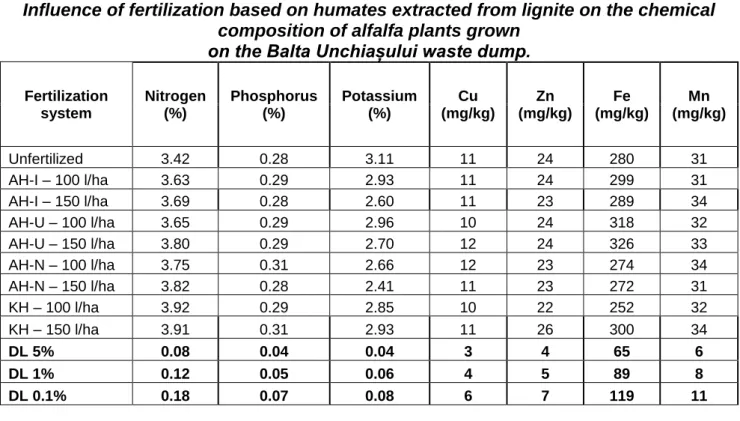
The influence of fertilization with liquid fertilizers based on humates extracted from lignite upon the chemical composition of the alfalfa plants grown on the Balta Unchiașului waste dump covered with fertile soil is presented in Table 3. The data highlight the following:
- Fertilization with liquid fertilizers based on humates led to nitrogen significant increases and potassium decreases in the alfalfa plants.
- The NPK macro elements and Cu, Zn, Fe, Mn micro elements levels fall within the normal concentrations values (after Răuță and Chiriac, 1980).
- No statistically significant differences were noticed of the plant P, Cu, Zn, Fe, Mn concentrations.
37656
54125
48937 48219
46156 46513
54063 55313 55000
0 10000 20000 30000 40000 50000 60000
Alfalfa year I (kg/ha)
48531
61656
73062
60750 65563 57406 70219 57156 66470
0 10000 20000 30000 40000 50000 60000 70000 80000 90000
301
Table 3. Influence of fertilization based on humates extracted from lignite on the chemical
composition of alfalfa plants grown on the Balta Unchiașului waste dump.
Fertilization system
Nitrogen (%)
Phosphorus (%)
Potassium (%)
Cu (mg/kg)
Zn (mg/kg)
Fe (mg/kg)
Mn (mg/kg)
Unfertilized 3.42 0.28 3.11 11 24 280 31
AH-I – 100 l/ha 3.63 0.29 2.93 11 24 299 31
AH-I – 150 l/ha 3.69 0.28 2.60 11 23 289 34
AH-U – 100 l/ha 3.65 0.29 2.96 10 24 318 32
AH-U – 150 l/ha 3.80 0.29 2.70 12 24 326 33
AH-N – 100 l/ha 3.75 0.31 2.66 12 23 274 34
AH-N – 150 l/ha 3.82 0.28 2.41 11 23 272 31
KH – 100 l/ha 3.92 0.29 2.85 10 22 252 32
KH – 150 l/ha 3.91 0.31 2.93 11 26 300 34
DL 5% 0.08 0.04 0.04 3 4 65 6
DL 1% 0.12 0.05 0.06 4 5 89 8
DL 0.1% 0.18 0.07 0.08 6 7 119 11
CONCLUSIONS
- Fertilization with liquid fertilizers based on humate led to very significant increases of the maize grain and alfalfa yields grown on the Balta Unchiașului waste dump covered with fertile soil. The obtained yields raised up to the level of yields obtained on land of the area un-degraded by mining activities.
- The plants macro elements and micro elements concentrations lies within the ”normal” domain.
- The maize leaves had scarce nitrogen, potassium, copper, iron, and manganese contents and normal phosphorus and zinc ones.
REFERENCES
1. Bîlteanu Gh., Bîrnaure V., 1979, ”Phytotechny”, CERES Publishing House, Bucharest
(published in Romanian).
2. Bîlteanu Gheorghe, 1998, ”Phytotechny”, Vol. I, Second Edition, CERES Publishing
House, Bucharest (published in Romanian).
3. Cărăbiș Augustina Delia, 2013, ”Ecologic Rehabilitation of Waste Dumps”, PhD Thesis, USAMV Bucharest (published in Romanian).
4. Corici Sorin, 2004, ”Environment Engineering Studies in the Jiu Hydrographic Basin
Regarding Degradation Brought About by Mining and Energetic Activities”, PhD Thesis, USAMV Bucharest (published in Romanian).
5. Davidescu D., Borlan Z., Davidescu Velicica, Hera C., 1974, ”Phosphorus in
Agriculture”. The RSR Academy Publishing House (published in Romanian).
6. Davidescu D., Davidescu Velicica, Calancea I., Handra Margareta, Petrescu O., 1976, ”Nitrogen in Agriculture”, The RSR Academy Publishing House (published in Romanian).
7. Davidescu David, Davidescu Velicica, 1979, ”Potassium in Agriculture”, The RSR
Academy Publishing House (published in Romanian).
8. Davidescu D, Davidescu Velicica, Lăcătușu R., 1984, ”Sulphur, Calcium, and
302
9. Dumitru M., Popescu I., Blaga Gh., Dumitru Elisabeta, 1999, ”Degraded Land
Re-cultivation of Land Degraded by Mining Activities in the Oltenia Coalfield”, Transylvania Press Publishing House, 298 p (published in Romanian).
10. Ianc Ion, 1999, ”Soil Evolution in the Rovinari Coalfield Following Uncovering, Rearangement, and Re-cultivation with Fruit Trees and Vine”. PhD Thesis, ASAS (published in Romanian).
11. Lăcătușu Radu, 2000, ”Agrochemistry”, Helicon Publishing House, Timișoara (published in Romanian).
12. Lixandru Gh, Caramete C., Hera Cr., Marin N., Borlan Z., Calancea L., Goian M., Răuță C., 1990, ”Agrochemistry”. Teaching and Educational Publishing House, Bucharest (published in Romanian).
13. Mocanu Romulus, Dodocioiu Ana Maria, 2007, ”Agrochemistry”. SITECH Publishing
House Craiova (published in Romanian).
14. Munteanu Nicolae, 1998, ”Researches Regarding Vine Growing on Land Degraded by
Open Cast in the Rovinari Area – Gorj”, PhD Thesis, Craiova University, Agriculture Faculty (published in Romanian).
15. Nastea St., Răuță C., Dumitru M., Cârstea St., Marin N., Olaru V., Blaga G., 1980, ”Re-cultivation of Land Degraded by social and economic activities in RSR. Sources of Soil Degradation and Directions of Re-cultivation of Degraded Land. Re-cultivation of Waste Dumps Resulted from Coal Open Cast in the Rovinari Coalfield”, Vegetal Production – Cereals and Industrial Plants, No.7 and 10 (July, October) (published in Romanian).
16. Pascovici Nicolae Ioan, 2006,”Lignite Exploitations Impact of the Husnicioara – Mehedinți Basin and the Ecologic Reconstruction Possibility of the Natural Habitat”, PhD Thesis, Polytechnic Institute of Timișoara, Hydrotechnik Faculty (published in Romanian).
17. Răuță Corneliu, Chiriac Aurelia (Coord. Eds.), 1980, ”Plant Analysis Methodology to Assess Mineral Nutrition State”, ICPA Bucharest (published in Romanian).
18. Totomir Cristina, Dumitru M., Popescu I., 2010, ”Impact of Lignite Exploitation and Use
upon Environment”, SITECH Publishing House, Craiova, 233 p. (published in Romanian).