ECONOMIC ASPECTS OF ACTIVITY
AT FOREST DISTRICT CARACAL
Medelete D.M., Pânzaru R.L.
Faculty of Agronomy, University of Craiova
Key words: forest district, forest stock volume of wood harvested, revenues, expenses, profit
ABSTRACT
Forest is a component of the environment, without which human life and not only can not be conceived, serving as its conservation and improvement.
Knowledge and characterization of national forest is performed using a system of indicators, including: size of land; the species composition of forests; age class structure of forests; treatment regimes applied in household forests; production and productivity of forests; existing reserve foot timber; availability forests.
By their nature, the forests have many functions with direct and indirect implications social and economic life of man. To better understand how the manifestation of forest functions, these (forests) were systematized into two groups.
The first group includes social functions of forests with protection of water, soil, climate and the objectives of national forests for recreation, forest protection and ecofund genofund, forests and natural monuments and reservations.
In the second group are the forests with production functions and protection that aims to achieve mainly the wood of superior quality and other forest products and protecting environmental quality.
INTRODUCTION
The main functions which the forests have: the function of water protection, protective function of land and soil protection function against climatic factors and industrial pollution, recreational function, the function of scientific interest and conservation of the genetic fund forest function of production.
Material goods offered by forest can be summarized into two groups woody and non-woody.
Wood products have the largest share in the forest economy, natural phenomenon, if we consider that one of the functions of forests is "the production of wood."
Wood products of the forest are considered the following: product resulting from forest main cuts regeneration; products resulting from caring young trees; product resulting from accidental disasters deforestation and forest legally approved; hygiene products resulting from the normal process of routing natural forest; other products, trees and ornamental shrubs, osier and various wood products.
Non-wood products get a lower rate compared to wood products in the forest economy, but it does not mean that they can be neglected.
Their importance is clear if we consider that these products, valuable food and pharmaceutical, are the raw materials for many specialized companies in the industrialization of these products.
Non-timber products that are specific to forest fund: venison contained in those the fish in mountain streams; berries; edible mushrooms; medicinal and aromatic plants; forest seeds; resins etc.
METHOD AND MATERIAL
Preparation of the study called for documentation method. The documentation was based on searches performed in the virtual environment, and movement in the territory and meaningful discussions with experts from the Forestry and the Forestry Department Caracal, Olt, regarding aspects of production within the observation unit.
For this paper we used the following indicators: indicators in natural expression: forest (ha) volume of timber harvested by economic operators and for local needs (m3), the number of seedlings produced, the amount of berries harvested etc .; indicators in terms of value: income (lei) expenditures made (lei) gross profit (lei) gross profit ratio (%), tax (lei), net profit (lei), net profit rate (%) - overall and by type of activity.
RESULTS AND DISCUSSIONS
Forest District Caracal is a component unit of the Forestry Department Olt, within the National Forest - ROMSILVA. As entity whose hand is Forest District Caracal is a unit that has its operation principle of economic management and financial autonomy, following the implementation of the national strategy in the field of forestry, which seeks to protect, conservation and sustainable development of forests ( regardless of form of ownership) and proper management of hunting assigned.
Geographical the unit is located in Plain Romanaţiului subdivision Plain Oltenia during mid-lower basin of the Olt River and its tributary Oltet.
Forests across Forest District Caracal are summarized in two floors of vegetation: 81% lowland forest, forest steppe 19%.
Forest District Caracal is bordered to the north with the Forest Department Balş (limits River Olteţ, DN 64, DJ 643, DJ 644, DC 161) to the east with the Forest Department Drăgăneşti (limits River Olteţ, DJ 642), south of Forest District Corabia (administrative boundaries of communes Bucinisu and Studina) west with the Forest Department Amaradia and Forest district Sadova (Dolj county administrative limit).
Administrative territory of Caracal Forest District (4539.12 ha - public property) is divided into three production units: UP I Vlădila 705.2 ha (15.54%); UP II Cezieni 1482.35 ha (32.66%); UP III Reşca 2351.57 ha (51.80%).
Forest District Caracal for wood products has a potential of 10985 m3 / year, of which 8833 m3 / year principal products and Conservation (80.41%), 822 m3 / year secondary products (7.42%) and 1 330 m3 / year hygiene products (12.11%) - fig. 1. There are more other wood products resulting from the processing timber (0.06%).
produse principale și de
conservare
produse
secundare produse de
igienă alte produse 80,41
7,42 12,11
In terms of non-wood products are distinguished: hunting products; berries; forest guard services for private forestry; transport - from third parties; forest tourism.
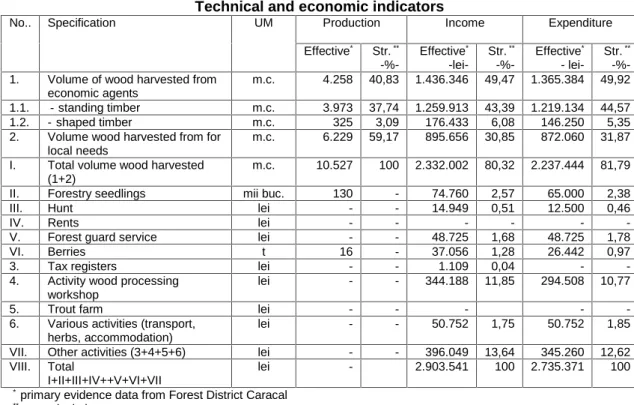
Table 1 shows the indicators of production units natural - present and income situation.
Table 1. Technical and economic indicators
No.. Specification UM Production Income Expenditure
Effective* Str.**
-%-Effective*
-lei-Str.**
-%-Effective* -
lei-Str.** -%-1. Volume of wood harvested from
economic agents
m.c. 4.258 40,83 1.436.346 49,47 1.365.384 49,92
1.1. - standing timber m.c. 3.973 37,74 1.259.913 43,39 1.219.134 44,57 1.2. - shaped timber m.c. 325 3,09 176.433 6,08 146.250 5,35 2. Volume wood harvested from for
local needs
m.c. 6.229 59,17 895.656 30,85 872.060 31,87
I. Total volume wood harvested (1+2)
m.c. 10.527 100 2.332.002 80,32 2.237.444 81,79
II. Forestry seedlings mii buc. 130 - 74.760 2,57 65.000 2,38
III. Hunt lei - - 14.949 0,51 12.500 0,46
IV. Rents lei - - -
-V. Forest guard service lei - - 48.725 1,68 48.725 1,78
VI. Berries t 16 - 37.056 1,28 26.442 0,97
3. Tax registers lei - - 1.109 0,04 -
-4. Activity wood processing workshop
lei - - 344.188 11,85 294.508 10,77
5. Trout farm lei - - - -
-6. Various activities (transport, herbs, accommodation)
lei - - 50.752 1,75 50.752 1,85
VII. Other activities (3+4+5+6) lei - - 396.049 13,64 345.260 12,62 VIII. Total
I+II+III+IV++V+VI+VII
lei - 2.903.541 100 2.735.371 100
*primary evidence data from Forest District Caracal **own calculation
Regarding the indicators that highlight the volume of production related data obtained shows the volume of wood harvested, the business of obtaining seedlings and harvesting activities and collecting berries.
The volume of wood harvested was 10527 m3, of which the main categories were: 40.83% volume of timber harvested by the firms, and 59.17% respectively 4258 m3 volume of timber harvesting for local needs - 6229 m3. The first component mentioned, the volume of timber harvested by economic divides in two parts: 3973 m3 standing timber - ie 37,74% in structure shaped timber 325 m3 - 3.09% respectively.
Production of seedlings reached a total of 130000 pieces, and at berry harvesting was managed and collected 16 tons.
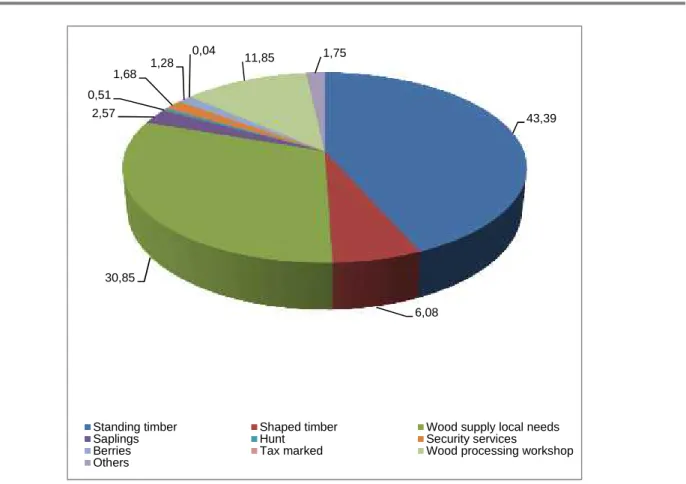
When referring to indicators of income, it can be seen that the total level of the indicator reached 2903541 lei, a level which is based on a number of components such as the total volume of wood harvested 80.32%, or 2332002; Forestry seedlings 2.57% respectively 74760 lei; the hunt 0.51% respectively 14949 lei; forest guard services in respect of 48725 lei 1.68% respectively; related activity recovery berries 1.28% respectively 37056 lei; income from other activities 396049, 13.64% respectively lei.
Fig. 2. Income earned - structure (%)
Total expenditure reached a value of 2735371 lei contributed by the following activities: 2237444 lei timber harvest - 81.79%; Other activities 345260 lei - 12.62%; production of planting material 65000 lei - 2.38%; security activities 48725 lei - 1.78%; berries capitalization 26442 lei - 0.97%; hunting 12500 lei - 0.46%.
Regarding the items of expenditure for other activities are individualized: Shop floor expenses of woodworking - 294508 lei (10.77%); expenses for various activities - 50752 lei (1.85%). Figure 3 shows the structure of total expenditures.
43,39
6,08 30,85
2,57 0,51
1,68 1,28 0,04
11,85 1,75
Standing timber Shaped timber Wood supply local needs
Saplings Hunt Security services
Berries Tax marked Wood processing workshop Others
44,57
5,35 31,87
2,38 0,46
1,78 0,97
10,77 1,85
Standing timber Shaped timber Wood supply local needs
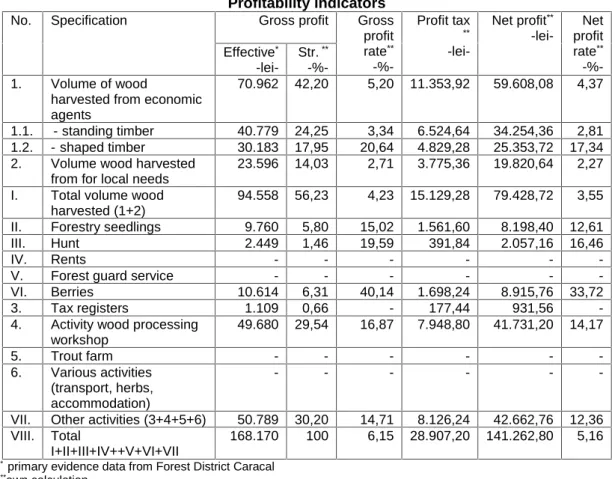
Table 2 shows information on profitability indicators.
Table 2. Profitability indicators
No. Specification Gross profit Gross profit rate** -%-Profit tax **
-lei-Net profit**
-lei-Net profit rate** -%-Effective* -lei-Str.** -%-1. Volume of wood
harvested from economic agents
70.962 42,20 5,20 11.353,92 59.608,08 4,37
1.1. - standing timber 40.779 24,25 3,34 6.524,64 34.254,36 2,81 1.2. - shaped timber 30.183 17,95 20,64 4.829,28 25.353,72 17,34 2. Volume wood harvested
from for local needs
23.596 14,03 2,71 3.775,36 19.820,64 2,27
I. Total volume wood harvested (1+2)
94.558 56,23 4,23 15.129,28 79.428,72 3,55
II. Forestry seedlings 9.760 5,80 15,02 1.561,60 8.198,40 12,61 III. Hunt 2.449 1,46 19,59 391,84 2.057,16 16,46
IV. Rents - - -
-V. Forest guard service - - -
-VI. Berries 10.614 6,31 40,14 1.698,24 8.915,76 33,72 3. Tax registers 1.109 0,66 - 177,44 931,56 -4. Activity wood processing
workshop
49.680 29,54 16,87 7.948,80 41.731,20 14,17
5. Trout farm - - -
-6. Various activities (transport, herbs, accommodation)
- - -
-VII. Other activities (3+4+5+6) 50.789 30,20 14,71 8.126,24 42.662,76 12,36 VIII. Total
I+II+III+IV++V+VI+VII
168.170 100 6,15 28.907,20 141.262,80 5,16
*primary evidence data from Forest District Caracal **own calculation
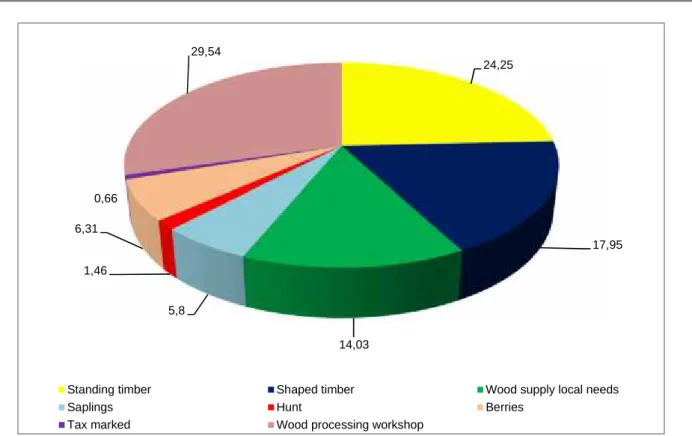
When setting total of 168170 lei profit, helped several types of components, as follows: timber harvesting activities carried out for 94558 lei (56.23%); other activities 50789 lei (30.20%); activities related to recovery berries 10614 lei (6.31%); the activity of obtaining seedlings 9760 lei (5.80%); the hunt in 2449 lei (1.46%).
Regarding the first category of activities, there is profit values grouped by product type as follows: 23596 lei harvested timber for local needs (14.03%); 30183 lei shaped the wood (17.95%); Standing timber 40779 lei (24.25%).
The profit earned as a result of the development of other types of activities, it was based on the following elements: 1 109 lei tax registers (0.66%); 49 680 lei of woodworking activity (29.54%).
Gross profit structure is shown in Figure 4.
Fig. 4. Gross profit - structure (%)
Based on gross profit levels were calculated at the tax rates in each activity. The total tax paid by the unit was 28907.20 lei, a level which was constituted as follows: 6524.64 lei for standing timber; 4829.28 lei for the wood shaped; 3775.36 lei for the timber for local needs; 1561.60 lei and recovery in case of seedlings; 391.84 lei at hunting activities; 1698.24 lei to capitalize berries; 177.44 lei for the tax registers; 7948.80 lei when of woodworking business.
On groups of activities are found taxes variables, as follows: for the wood exploited by traders 11353.92 lei; when total timber 15129.28 lei; other activities 8126.24 lei.
When analyzing the net profit, it is found that it has reached the general level of activity 141262.80 lei, the value of which is based on the following elements: 79428.72 lei activity related to timber harvesting; 42662.76 lei generated by other activities; 8915.76 lei from the sale of berries; 8198.40 lei for the recovery of seedlings; 2057.16 lei from the hunting.
Net profit for the volume of wood harvested is based on a value of 59608.08 lei from wood exploitation by operators (lei 34254.36 standing timber and 25353.72 timber shaped lei) and a value of 19820.64 lei adjacent to the volume of wood harvested for current needs. Regarding the value of net profit generated by other activities, it consists of 931.56 lei tax related registers and 41731.20 lei generated by the processing of wood.
Last indicator to which we refer, as the synthetic indicator, the net profit rate, which highlights the gains remain available to unity after tax and total expenditure expressed per 100 lei. It appears variation limits from 2.27% for harvested timber for local needs, up to 33.72% if adjacent recovery activities berries - a general level of the indicator of 5.16%. For the remaining types of activities, net profit rate was of 4.37% harvested timber operators; 2.81% standing timber; Shaped timber 17.34%; 3.55% Total timber; 12.61% of capitalization of seedlings; 16.46% for hunting; 14.17% for of woodworking business; 12.36% other
24,25
17,95
14,03 5,8
1,46 6,31
0,66
29,54
Standing timber Shaped timber Wood supply local needs
Saplings Hunt Berries
CONCLUSIONS
concerning the surface of Forest District Caracal of 4517 ha, it appears that this represents over 14% (14.53%) of the existing surface in the county of Olt 31083 ha, is an important organizational subdivision in Olt Forestry Department. In these circumstances subdivision is one of medium size in the county surpassed the Forest ranges Corabia (5714 ha) and Balş (8581 ha) but was higher than the forestry districts Drăgăneşti Olt (3924 ha) Slatina (4141 ha) and Vultureşti ( 4206 ha);
the volume of timber harvested 10527 m3 represents only 13.24% of the total harvest level of 79 500 m3 county;
the unit contributes to the state budget through a flat tax of 28907.20 Lei, which is based on contributions -in particular- timber harvesting activities (15129.28 lei) and other activities (8126.24 lei);
net profit rate is lower than the gross profit ratio (normal situation) - 5.16% general level. Variation limits were 2.27% for timber harvesting activity to local needs, ie 33.72% for the activity of assessing berries;
it must be stressed, in line with previous statements lowest rate of recovery activities of raw materials (timber) compared to the specific situation of the processing activities (3.55% vs. 14.17%);
diversification is necessary and conduct operations that come to enrich the basic concerns and better management of expenditure items, all combined with an appropriate investment strategy.
BIBLIOGRAPHY
1. Milescu I. and others, 2005, Forester book, Publisher Milyrom, Reghin, republication
2. Moga T., Rădulescu Carmen Valentina, 2010, Complex development of the countryside, Part I, Digital Library ASE Bucureşti
3. Roua C., Ştefănescu E., Mihăilă I., Pafnote M., 1976, Ergonomics of the forest, Publisher Ceres, Bucureşti
4. X X X, 1965, Multilingual Forest Dictionary, Publisher Ministry of Forests, Bucureşti
5. http://www.rosilva.ro/unitati_silvice/olt__l_28.htm
6. http://slatina.rosilva.ro/