SGFreemium model: modeling solution for attaching a
learner via Serious Games
Chaimae MEFTAH*1, Asmaâ RETBI*2, Samir BENNANI*3, Mohammed Khalidi Idrissi*4
*RIME Team- Networking, Modeling and E-learning – LRIE Laboratory- Research in Computer Science and
Education Laboratory – EMI- Mohammadia School of Engineers – University Mohammed V in Rabat av Ibn Sina postbox 765, Agdal-Rabat, Morocco.
1[email protected], 2[email protected], 3[email protected], 4[email protected]
ABSTRACT
Recently, Serious Games have become a crucial strategy to improve e-learning. Nowadays, they play an important role in connecting the player and the learner to learning through fun while retaining pedagogical information as well. Consequently, it is necessary to extend the life cycle of an SG, enrich it with important pedagogical content. Moreover, working on an appropriate model is also necessary in order to
increase the learner's performance and
profitability while avoiding the boredom of SG in the future.
In our article, we will discuss the effectiveness of Serious Games in the world of education. Then, we propose a study on the Freemium model while analyzing its mobility and contribution to the on learning’ evolution via games. Later on, we will discuss the strengths of the existing model that we intend to develop in future communications.
CCS Concepts
Applied computing --> Education ---> E-learning
Keywords
E-learning; Serious Games; SG; effectiveness; education; Freemium model.
1. INTRODUCTION
Serious Games have been of great importance because they contain compiled elements that are intended to simply transfer information and
education. These Serious Games have many standards that control educational challenges by combining games and monitoring e-learning and motivation. In other words, Serious Games is a certain type of applications extracted from advanced video game technologies that use the same design and approaches as traditional games (3D real-time, object simulation, individuals, environments...). However, it goes beyond the sole dimension of entertainment. They provide to adapt the learning process to the learner's profile
and must necessarily include learning
objectives.
In other words, the importance of using Serious Games has been integrated with the direct use of e-learning that the learner maintains from the educational process. They are integrated in order to solve the pedagogical problems that have an impact on the skills of the learner and to gain experience through practical uses. To illustrate, The Serious Games provides immediate feedback to players to enable them to show remarkable progression. This is done through giving them the opportunity to explore and test new things and take risks without fear of being judged. The main objective of these educational games is to preserve the subordination between pedagogy and history.
achieve the goal and increase its performance. Playing Serious Games has a very important role. It is an application of an effective strategy that increases the profitability and popularity of the game. To achieve this goal, it is necessary to adopt a model, this model will contribute to the improvement of this strategy and to the fame of the game, whatever the budget foreseen for its creation. The Freemium model offers a good solution to solve many problems. It allows players / learners to play for free and to purchase virtual products to increase their performance and get rid of boredom. However, a learner's attachment to an SG requires good rewards, strong seduction, increased performance and good educational content in the form of an attractive scenario. All this is done to extend the life cycle of an SG, make it more fun and ensure the appearance of suspense and novelty. For this reason, the Freemium model must be oriented to meet this need to enrich its content by promoting the standard IMS LD specification and by providing perspectives that meet long-term needs.
The potential of mobility in the world of information and technology is thus evident in the context of the exploitation of the mobile in society, which is in line with certain mobile perspectives in the field of education [1]. Mobility opens new possibilities to enrich the experience of players by using real objects (eg plants, buildings, animals) in their natural context (eg archaeological or geological site, company, forest). Therefore, it is necessary to extend learning through SG to mobility, in order to facilitate its use and increase its performance and attachment of learners, since mobility presents several advantages to the benefit of the player / learner.
This paper presents a study of SGs with particular emphasis on the Freemium model. While the first section discusses the context that contains many subsections: the first subsection gives attention to the most common types of SG, the second and third subsections focus on the use of SG in different
domains and its evolution. We will also study the effectiveness of SG and its links to existing standards in the fourth subsection. With regard to the fifth and sixth subsection, attention is given to the study of existing models in the field, including the Freemium model. Finally, we will
explain the enrichment of Freemium Model
(SGFreemium Model).
2. CONTEXT
2.1 Brands of Serious Games
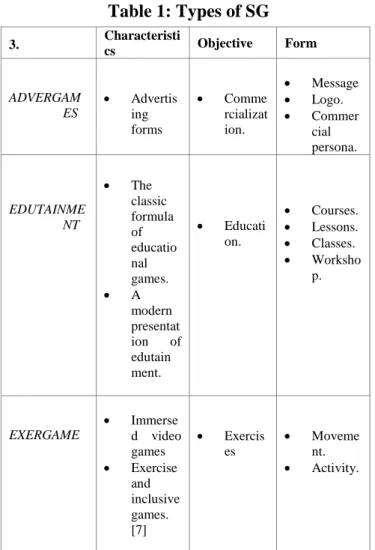
Serious Games extend in different domains and are composed of several types described in (table 1).
2.1.1 Advergames
Advergames are certain type of games that represent the new form of advertising. Their aim lies in the marketing of a brand or a product [3]. These digital games are precisely designed to foster a service, brand or product through entertainment [4].
2.1.2 Edutainment
Edutainment are traditional formulas that are used in the production of educational computer games that are based on learning theories [5]. They offer a characteristic of the technological inclusion of modern forms of entertainment in traditional courts, lessons, classes, workshops and master classes.
2.1.3 Exergame
Table 1: Types of SG
3. Characteristi
cs Objective Form
ADVERGAM ES
Advertis ing forms
Comme
rcializat ion.
Message Logo.
Commer
cial persona.
EDUTAINME NT
The
classic formula of educatio nal games.
A
modern presentat ion of edutain ment.
Educati on.
Courses. Lessons. Classes.
Worksho
p.
EXERGAME
Immerse
d video games Exercise
and inclusive games. [7]
Exercis es
Moveme
nt. Activity.
Having both an educational and entertainment goals, Serious Games play an important role in the educational process. To implement Serious Games in education, one must:
• Fasten the player with a precise goal and
provide him/her with a description of the system’s instructions.
• Provide the player with a suitable
education of the game.
• Show the usefulness of the game by
concrete matches that demonstrate the
generality and abstraction of the
experiment with the use of models.
• Encourage the player to be
self-independent in following his own trajectory through simple and rich
interfaces in terms of components to guarantee the player's attachment.
It is noticeable that the Advergames have developed a crucial place in the world of games. Even though different companies have employed this method to effectively publicize their products, the edutainment is also beginning to take place in the world of games especially in the world of teaching. Regarding the Exergames, it remains relative only for those who are interested in the exercise of the game.
We will now detail the real utility of Serious Games to improve and facilitate the interaction between entities of a field of work and teaching.
3.1 The use of Serious Games
3.1.1 The use of SG
To recreate the atmosphere of the real classes, the resources mix exercises, games, discussions and simulations to offer a dynamic and interactive teaching with 3D animations - for educational purposes. The Serious-Games market has reached maturity. The serious-games have a good image with users: 61% judge the seriosoids as being of a very good quality, and gives them a score of 16, 3 / 20, against an average of 13, 2 / 20 of the other modes of learning. The ability of serious-games to simulate specific situations is very appreciable for practical training. They are interactive and plunge the player into a scenario. They allow, to playfully, in skill thanks to levels validated in the form of games.
The company Renault uses this type of games to boost its sales force. A serious-games, the "Renault Challenge" aimed to give back to the group's 18,000 salespeople the desire to be trained, via a serious game. This game creates the buzz. The satisfaction rate was 100% within Renault Algeria, and the game was played on the steering committee in the Netherlands!
3.1.2 Serious game and recruitment
aptitude characteristics of the candidate that are more difficult to detect with other tests. There are Serious Games, like Decide wise for example, which puts the candidate in the shoes of a new manager having to make choices. For example, launching activities abroad and new products to stay alive during a limited period of time.
Serious Games have a future potential for teaching and evolve gradually. This evolution has become remarkable and proves its imperious utility. The following paragraph describes the evolution of the SG themes.
3.2 Evolution of serious-games themes
Alongside the Serious Games, which involved training managers to conduct annual appraisal interviews (with fairly simple mechanics and coded scenarios), there are now other Serious Games that are more focused on logic Behavioral dynamics of commercial dynamics and the reception of clients, which require more personalization and scripting. The new generation of Serious Games tells stories and the learner himself writes his script! It is even possible to make "tailor-made" games. The service providers are now very reactive to produce a serious game, which brings the concept into a logic of
industrialization of creative processes.
Undoubtedly, a concept that goes to the future! The next section is devoted to discuss the different aspects that can attach the learner with an aim and ensure the effectiveness of an SG.
3.3 The importance of Serious Games in
education
The effectiveness of an SG lies in its ability to motivate a player/learner to the completion of the various episodes of the game. It is implemented to help him/her retain all the necessary pedagogical information that the educator wants to transfer via the SG. SGs contribute positively in the learning process. There are three criteria that should be reconsidered to ensure the development of learning by the use of a video game in education. Firstly, it is necessary to ensure agreement with the learner who is
supposed to use the game to learn. Secondly, attention should be paid to the different forms of learning problems. Last but not least, emphasis should be put also on both the positive and the negative effects that game exercises over the learner. [2]
In order to augment the effectiveness of an SG, there are several dimensions that should be taken into consideration: the player's context, profile, age, level, style ..., mode of representation and
pedagogy: methods, theories, models,
frameworks... (figure 1)
Taking into consideration the mode of
representation, design is pivotal to attract the attention of the learner. This process must be
standardized to ensure the educational
effectiveness and a good communication between the educator and the game designers who must include mechanisms, history, technology, and aesthetics. These are elements related to the learner's experience that controls the game easily, to venture its imagination into the World of the game.
Whereof, the standards and models must be provided to ensure the effectiveness of education and guarantee good communication between educators and game developers. Standardization of the education process enables interoperability, reusability, sustainability, and accessibility.
Figure 1: SG’ Conditions of efficiency
3.4 Norms and Standards
Standardization of the education process allows for interoperability, reusability, sustainability, and accessibility. Norms exist to standardize this process as it is shown here:
Table 2: IEEE LOM Specification
4. IEEE LOM
• Metadata’s standard for describing learning objects (syntax and semantics) [8].
• Conceptual Schema of data for defining the structure of a metadata.
• 9 categories: General, Lifecycle, Meta-metadata, Technique, Educational, Rights, Relation, Annotation and Classification [9].
Since the aim of this research is to exhibit the
coordination between education and
entertainment (table 2), as well as to enable the learner to reach the objective of each episode in the game, the IEEE LOM norm can help us in several phases. It specifies the style of interaction between the game and the player, the level of mastery of a player's game, which will subsequently facilitate the detection of his progress, the level of reception of the information and his attachment to Serious Games. The standard also helps in defining exactly the
existent relationship between player-game,
player-player, and player-educational
relationship. It enables also in defining the techniques that are effective in ensuring the learner’s reception of educational information, as
well as the annotations used and the
categorization adopted.
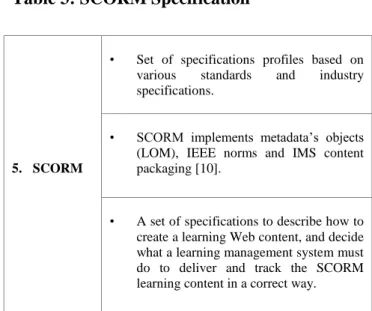
Table 3: SCORM Specification
5. SCORM
• Set of specifications profiles based on various standards and industry specifications.
• SCORM implements metadata’s objects (LOM), IEEE norms and IMS content packaging [10].
• A set of specifications to describe how to create a learning Web content, and decide what a learning management system must do to deliver and track the SCORM learning content in a correct way.
According to the study on the SCORM norm (table 3), we have concluded that this set of specifications help in directing the pedagogical content to be presented by a serious game. This follows a predefined categorization, which will become a resort for an attractive and promising presentation.
Table 4: IMS Learning Design Specification [11]
6. IMS Learning Design
• A conceptual framework for modeling a Learning Unit.
• A specification for entering the orchestration into a learning scenario.
Learning Design determines three levels of implementation [2]:
• Level A: constitutes of all the necessary
vocabulary to support pedagogical diversity.
• Level B: subjoins properties, conditions,
supervising services and global elements to Level A, which allows customization, adaptation, sequencing, feedback, directing the learning activities and the recording of the results.
• Level C: adds the notification to level B
which is triggered by a given result and makes a new activity available to be executed.
Specifically, IMS LD manages the learning unit modeling, the information/result relation, the customization and the creation of the new executions (table 4). It is much effective in enabling modeling a serious game during its conception, facilitating the design process, improving the learning objectives and allowing us to adapt educational content to the player/learner profile.
IMS LD seems to be a good solution to attach it the learner, but it consists of the integration of a more specific model that will be generalized thanks to this specification. We will analyse it in a deep way in this study to see the possibility of its use. In the next section, we will explain the models that will be used to improve the player / SG relationship.
6.1 Models
In order to have a model that successfully manages the process of advancing information through a serious game, it is necessary to have a standard or a specification, but this does not prevent us from studying the existing models that will be presented in the following paragraphs:
6.1.1 GCM Model
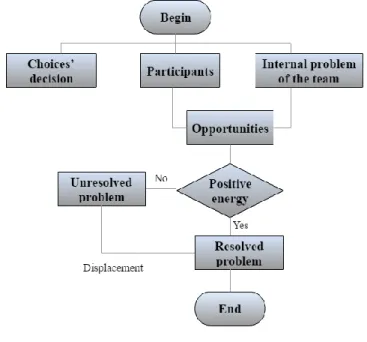
The GCM is Cohen's Garbage Can Model which was incorporated in the field of organizational theory to explain the anarchy of organizational behaviors. He represents a simplified nonrealistic
model in order to extricate the crucial characteristics and to understand the underlying mechanisms and the logics of the objective phenomena [12].
The main components of the GCM are (figure 2): issues that concern people within the team, opportunities for choices that are occasions where a team must produce behavior that can be called a decision, and participants who are considered as human resources of the team contributing to decision-making.
Figure 2: GCM Model
Therefore, we deduce that this model is based on the psychology, behavior, and management of the team which works to achieve the intended objectives.
6.1.2 SECI Model
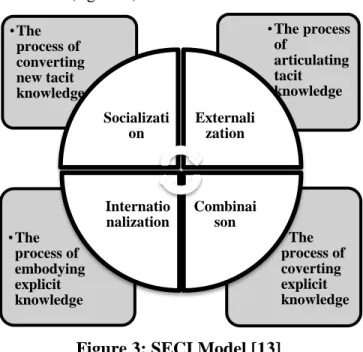
The SECI (Socialization, externalization,
in formal and systematic language, for example, shared in the form of data, however, the tacit knowledge is much more complicated to articulate (figure 3).
Figure 3: SECI Model [13]
To illustrate, tacit knowledge can be spread among people as a common understanding that emerges from working as a team. We could then use this model to shed light on the evolvement of knowledge in a serious game since social interactions are a good indicator to assess the flow of knowledge that should be part of the tacit knowledge transfer process.
6.1.3 FREEMIUM Model
The Freemium model is designed to permit users to play for free and purchase virtual goods to develop their performance. In this model, SG developers need to take into account four key questions: virtual property creation, sociability, potential income streams and statistics [14].
Figure 4: FREEMIUM Model
The Freemium model is basically used in the field of social gaming. In fact, the model needs several iterations before starting up the payment of income streams. It is quite essential for virtual goods to be designed in an appropriate way to encourage users to buy them. The essential part of the Freemium model lies in its ability to include measures, to monitor the players ' behavior as well as their preferences (figure 4). As any study, this paper has the following limitations: there is no long-term conclusion for the Freemium model because the general attitude towards the model may change in the future, and the data are insufficient to come up with sufficient conclusions.
The basic factors of this model are as follows:
Virtual property request
Sociability and loyalty of players
Virality
Lifecycle and Game Statistics
• The process of coverting explicit knowledge •The
process of embodying explicit knowledge
•The process of
articulating tacit knowledge •The
process of converting new tacit knowledge
Socializati on
Externali zation
Combinai son Internatio
6.1.3.1 Virtual property request
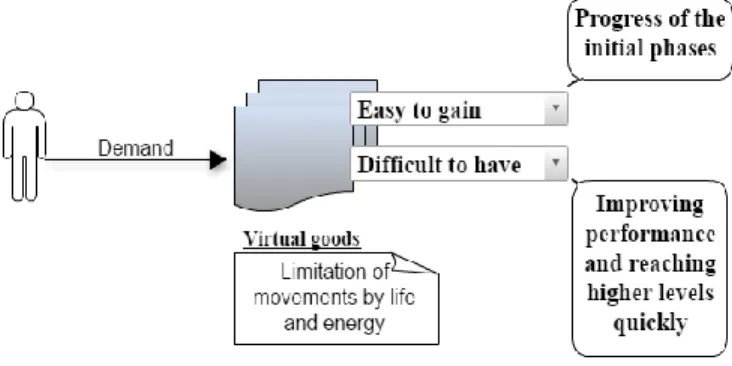
Virtual products are integrated into a game as part of the game dynamics and stories. The virtual money earned by players in the game allows them to buy different products to improve their performance (figure 5). It is common that in this sense that players can buy almost every item with real money. It is therefore essential that designers can create opportunities for certain products so that users can actually buy them.
Figure 5: Demand for virtual goods
The figure presents two types of winnings the first one is for an ordinary player: In which money is hard to get and this aims at improving the player's performance and allows him to reach faster levels. While for the second one money is easy to win and this presents a relevant element in the initial phases, and easy to reach to attract players who are at low levels. Thus, player movements are limited by the concepts of lives, energy, number of plots, etc.
6.1.3.2 Sociability and Player Loyalty
The sociability of casual games is bound to several factors, which are of paramount importance in increasing the popularity of the game:
• Number of players
• Ability to communicate between players in
the game,
• The spirit of competition, neighborhood ...
• Sending/exchange of gifts, goods ...
• Player preferences, extracts of information,
impatience ...
6.1.3.3 Virality
Maintaining a connection between the
distinguished developed games that support the discovery of new games from the same company, virality is linked to the sociability factor and requires an augmentation in the number of players.
6.1.3.4 Lifecycle and Game Statistics
The need for advanced research is also essential in the implementation of an efficient data mining and optimization technique. In turn, it will be used for the creation of new products or levels and thus, expanding the life cycle of the game (figure 6).
Figure 6: Lifecycle of SG
With the regular updates and the addition of new designers of substantial content, games can extend the phase of late maturity and earn more yield. Nevertheless, they do not have to alter the elements that players have bought with real money or reorganize the personalized space of each player [15].
Our contribution on the model aims at ensuring its compatibility with the needs of the game's modelers as well as its users.
6.1.4 Enrichment of Freemium Model: SGFreemium Model
To make the Freemium model more efficient, we have enriched it with two new components, these components will make this model more
Life cycle of SG
Introduction Growth Maturity
compatible with the need for a learner who uses Serious Games. We added the quality of the pedagogical content as the first attribute, and we have generalized the attribute "sociability of the player" by all the characteristics of the player. The SGFreemium model is presented as follows:
6.1.4.1 Quality of educational content
For a serious game to be rich and motivating, it must first be associated with a well-planned educational process that will help or assist players / learners to understand, learn or act. Practices of formations through a normal channel must be practiced throughout the scenario of a serious game in order to ensure the total reception of the pedagogical information. The quality of educational information then lies in the acquisition of the totality of competences; it must result at the same time:
The development and monitoring of the
set of standards that mark the course of Serious Games.
The application of the law of the
orientations and preferences chosen by a learner interested in learning via SG
• The objectives of each season of the
game and the enrichment of the rewards at the end of the season.
The desire to pursue learning by focusing
on Serious Games
The will and the objectives of each
educational game that determine priorities according to its strategy and the evolution of the competitive universe in which it operates.
The state of mind that drives each player / learner to the learning / entertainment network applied by the action of the game. An educational game deserves the label "good pedagogical quality" if it subscribes to all of these requirements and if it meets both the expectations identified in the candidate learners, real customers of the serious game. The perceived quality also depends to a large extent on the attitude of the learners towards the training, its content and the game's modelers. This quality, as the experience of our doctoral laboratory shows, depends on A delicate alchemy between the modeler, his style, his techniques and the feel of the learners and their characteristic.
6.1.4.2 Characteristics of the learner
In order to train the learners and to tie them in order to pursue the learning by games, it is necessary first to know information about the player, it is necessary to know his name, his age, his orientation, his level of study, Initiative, its authority, its reflex, its capacity for commitment and communication ... Knowledge of these characteristics helps the learner feel more relaxed, motivated, ready to pursue training by having fun, and thinking of having more rewards through a more meaningful and remarkable advancement. The player can be courageous, intense, talented, intelligent, committed, honest, respectful, leader ... all these features must be handled and personalized, in order to improve the skills of players / learners and give them the opportunity to manage need, As they are the most knowledgeable of their will-to-have. It seems very cumbersome to be able to collect all this information at once and several players, but this collection improves the performance of the game,
Virtual property
request
Virality
Lifecycle and game statistics Quality of
pedagogical content Characteristic of
players
the percentage of reception of educational information, and reaching a good level of interested and motivated by the game through the variety of scenarios and rich content.
6.1.4.3 External Factors
In the same context of attachment of a player / learner, mobility remains a very important factor allowing the access to the SG easily, anywhere and at any time, Learn anywhere thanks to accessibility at any time on a portable device in order to optimize the time of the mobinaute / player / learner. Access to information must be simple and practical, shareable and playful, adapted to a wide audience. The players / learners are numerous: the mobility within the framework of the Serious Games is addressed to any public eager and curious to enrich his knowledge on a particular field. The learner is always an actor of the game, he attaches to training through accessibility at all times, the quality of the content and the particularity and difference of the scenario what is in favor of the learner. The mobility of the devices has several advantages, among them we find:
The Internet connection
Personal autonomy
The variation of the context
Learning
The form
Personal access
Varied technology
Data management
Multiplatform.
When one returns to the notion of games, it is imperatively associated with pleasure, on the other hand, the notion of education is related to effort and learning. Among the missions of education is the learning of the effort as long as any teacher demands of his pupils rigor, concentration, tenacity ... the recourse to the game is thus allowed if it contributes to advancing its learners. Wanting to use the game in teaching is justified by the knowledge of the
interest of the game for the learner. In fact, gambling is both a source of motivation and pleasure (call function) and a means of exercising language / specialty skills in live situations where the player is involved as an actor ( Association of saying and doing. The game allows to memorize by the oral practice based on the repetition of the structures. Despite the diversity of devices currently available on the market and their constant evolution, there are still several major mobile technologies: mobile phones, touch tablets, digital players, portable players and manual game consoles.
Being an actor of a serious game, we will now call the player / learner a learner / mobinaute, to mark the choice of mobility as a solution of attachment of learner for our future publications.
7. DEBATE
The SGs are spread all over the world for pedagogical and fun reasons. Their problems are manifested in entertainment. In words, if the game generates pleasure, educational content can become limited. While, if the game is full of educational content, it can become boring for the learner. Next, the problem is how we will associate a learner with a 100% educational game with a scenario, interactions and interesting activities. To achieve the educational objectives of the SG, it is essential to improve its modeling. Jesse Schnell discussed the importance of modeling in his book and said: "The design of the game is the act of deciding what should be the game, that's all. On the surface it seems too simple ... To decide what the game is, you have to make hundreds, usually thousands of decisions. "JESSE SCHNELL, THE ART OF GAME DESIGN. Serious Games often require that different actions be taken to achieve a
pedagogical objective. It replicates the
important notions of learning in a safe and inexpensive way. Let's think, for example, of astronauts who have to do special maneuvers in space. The skills required to perform this type of tasks are developed by simulation devices, by Serious Games. Closer to the academic world, a serious game on the theme of business management, for example, could bring various situations to the learner who must try to solve problems specific to his field. Confronted with these situations in virtual mode, the learner develops skills that he can transfer when these situations occur in reality. As a result, decision-making and the choice of the applicable effective model are essential to ensure the transfer of information, the improvement and adaptation of education to the life cycle of SG and the fixation of a player / Learning to continue the course, taking into account Considering that the player is the main factor of success or failure of receiving information. What is difficult is choosing the right model that will process the information and transfer it to the learner by motivating and linking it to the game reliably. All these requirements are
designed to benefit the learner and ensure that the
The game must serve it appropriately according to its profile: character, gender, age, psychology ... To illustrate, free games are games in which the player is not obliged to pay money to play, including Serious Games, hence the idea of using the Freemium model for SG modeling is To allow agreement between the developers and developers of the Game, as well as between the marketing and the customers of the game in order to implement an efficient technique of data mining and optimization. This will eventually benefit from the creation of new products or levels and will extend the life cycle of SG. Thus, market research ensures that players prefer free games, which means that they are an effective way to succeed by joining players / learners to SG. Therefore, a qualitative and quantitative analysis is necessary in order to discover the factors that prompt the player / learner to focus
on an SG. The hypotheses that can be proposed
are: on the one hand, an appropriate
customization of the game is necessary according to the profile, the interest and the character of the player. On the other hand, there must be rewards designed for learners at the end of the relevant phases. For example, providing certification at the end of training or rewards can be an effective way to encourage learners. In order to successfully develop a certain model, we must improve it according to a standard specification, and specifically IMS LD. In addition, we need to address the specifications that integrate the relationship between the learner and the game and implement its pedagogical approaches in order to favor the modeling of the SG. The application of Level A of IMS LD will fertilize the content of the vocabulary and will broaden the pedagogical diversity on all the episodes of the game. By applying the standards of level B, we could attach the scenarios of the game by properties, conditions, services and different elements to level A, and finally the application of level C will allow us to trigger notifications due to the results of Level B and prepare the role that should be executed thereafter.
Mobile learning is a new area of research. This is an area whose practice has not yet been standardized in terms of research frameworks, methods and tools. Fortunately, mobile learning has much in common with related research areas, including enhanced learning through technology
and human-computer-mobile interaction.
Borrowing frameworks and methods have been a common practice for mobile learning research, providing researchers with useful starting points. As the concepts and understanding of mobile learning deepen, these "borrowed" frameworks and tools may no longer be adequate. Thus, mobile learning is not only learning that is facilitated by mobile technology, but also as a process of knowledge through conversations and
explorations in multiple contexts among
(Sharples et al., 2007a ). And introduce challenging challenges to all aspects of mobile learning research, including evaluation. As the field matures, our executives and tools meet these challenges. For mobile learning, interest is not only in the way learning occurs in different contexts, but also in how people create new contexts to learn through their interactions and contexts. In order to establish, document and evaluate learning in and through contexts, a researcher must analyze: the physical framework and the layout of the learning space (where); the social framework (who, with whom, from whom); Objectives and learning outcomes (why and what); Learning methods and activities (how); Learning progress and history (when); and learning tools (how).
Learning through mobile games refers to the limitations of mobile devices, such as their small displays, short life, intermittent connectivity, and associated human factors, which affects their usability (see, for example, Corlett et al., 2005). Research moves from technology mobility to learner mobility, additional problems arise as learners move on multiple, rapid devices, both personal and public, possibly over short periods
in several locations. Extracting learning
interactions from technological interactions requires synchronization of capture and analysis of data across multiple devices and interfaces.
Evaluate the user-friendliness of mobile
technology and the effectiveness of its integration with mobile technology. The practice of mobile learning remains a high priority for evaluation. Thus, the challenges of mobile human-computer
interaction arising from the complexity
introduced by physical movements and changing variables (Kjeldskov & Stage 2004) and the small scale and ubiquitous nature of mobile devices (Hagen et al., 2005) , Add to the challenges facing Evaluation of Mobile Learning.
8. CONCLUSION
If we want to discuss the benefits of using SG, we can cite the positive impact of the SG process
on learners' motivation and attachment to gambling. Therefore, the adoption, generalization and development of Model Freemium is an adequate solution that addresses the following needs: the assurance of achieving intimacy between the learner and the game, learning by trial and error, taking into account the differences that exist in learning rhythms , The stimulation of pedagogical interactions between pupils, the effective integration of pedagogical information and the regular return of pupils to their actions, while motivating the player's learning process. Keeping in mind that the model is very attractive, however, it is necessary to several iterations before starting the payment. It is crucial that virtual products are appropriately designed to attract users to purchase them and attach them to the SG. Given the essential elements of the Freemium model which includes measures, monitoring the player's behavior and knowledge of the preferences of different user groups, this study suffers from various limitations. First, it does not cover the US market. Second, there are no long-term conclusions for the Freemium model and the possibility of changing the general attitude towards the model. Third, there is a lack of sufficient survey data to draw general conclusions. However, the study has succeeded in
providing general strategies for the
implementation of the Freemium model which can be beneficial for serious long-term activities. This is why we will link this Freemium model to IMS levels.
Specification LD which will be a starting point for the processing, development, realization and guarantee of the proper functioning of the actions of the game. In addition, they will ensure the effective fixation of the learners to the pursuit of the studies thanks to the SG and the " Assurance of the reception of the information and hence of the achievement of the desired objective. All
systems improve over time, and such
devices incorporate all the ingredients needed to motivate the new generation of learners. However, the design of a coherent game scenario, combining playgrounds, mobility, collaboration and educational activities, are very complex. However, it is necessary to measure the limits of gambling activities. The game takes place at a specific point in the learning process and cannot represent a lesson in itself. It allows the assimilation of concepts already clarified, or their long-term memorization. The learner in a game situation exercises his skills, mobilizes his knowledge and puts them at the service of the activity for which he seeks above all a pleasure. This point is particularly important to emphasize: the game constitutes a valuable pedagogical tool for deepening and appropriation. One cannot hope to use it to introduce new notions because it would miss a time in the process of the process,
the clarification of understanding, and
assimilation through several contexts. On the other hand, gambling cannot be a favorable time for individual assessment, emotional factors and the competitive aspect of certain games that modify the behavior of learners in the face of a task to be accomplished. The classroom game also brings a number of constraints for the teacher. The playing time of a game must be well calculated to enter the schedule, to avoid weariness or frustration, to be productive! Do not
hide that the game induces a certain
effervescence when it involves a competition or a challenge, because the learners are unreservedly involved in a motivating game. Rules of conduct should be established from the outset. Predicting and preparing the necessary material for the game can be very simple or require a real investment of time and imagination (card games). The use of
games in the classroom is thus very
advantageous, limited in its objectives and
sometimes constraining in its material
organization. However, it is an irreplaceable tool at certain points in learning by the attractiveness and involvement of learners. For the next development of this work, we will develop a
model for Serious Games in order to propose a SG management meta-model. We will enrich it with components and standards in order to evaluate its compatibility with existing SGs in different domains. We could also study the adaptability of educational content with the game, in order to prove the strength and support of the model on the sustainability of an SG, as well as the total acceptance of educational information.
9. REFERENCES
[1] Zurita, G., & Nussbaum, M. (2004). Computer supported collaborative learning using
wirelessly interconnected handheld
computers. Computers & education, 42(3), 289-314.
[2] HAMDAOUI, N., IDRISSI, M. K., & BENNANI, S. (2014). Serious Games in Education towards the standardization of the teaching-learning process. ADVANCES in EDUCATIONAL TECHNOLOGIES, 174.
[3] Bellman, S., Kemp, A., Haddad, H., & Varan, D. (2014). The effectiveness of advergames compared to television commercials and
interactive commercials featuring
advergames. Computers in Human
Behavior, 32, 276-283.
[4] Vashisht, D. (2015). Impact of nature of advergames on brand recall and brand attitude among young Indian gamers: moderating roles of game-product congruence and persuasion knowledge. Young Consumers, 16(4), 454-467.
[5] Aksakal, N. (2015). Theoretical View to the Approach of the Edutainment. Procedia-Social and Behavioral Sciences, 186, 1232-1239.
model based on the influence of the self avatar. Computers in Human Behavior, 59, 350-357.
[7] Oh, Y., & Yang, S. (2010). Defining exergames & exergaming. Proceedings of Meaningful Play, 1-17.
[8] IEEE, “The Learning Object Metadata (LOM)
Specification,” available from
http://ltsc.ieee.org/wg12/
[9] Friesen, N. (2005). Interoperability and learning objects: An overview of e-learning standardization. Interdisciplinary Journal of Knowledge and Learning Objects, 1(1), 23-31.
[10]Hadi, A. S., Yukawa, T., & Murakami, Y. (2013). A Support System for Generating SCORM Compliant Open Source Software
Usage Manuals. Procedia Computer
Science, 22, 544-550.
[11]de-la-Fuente-Valentín, L., Pardo, A., & Kloos, C. D. (2011). Generic service integration in adaptive learning experiences using IMS learning design. Computers & Education, 57(1), 1160-1170.
[12]Sawaragi, T., Fujii, K., Horiguchi, Y., & Nakanishi, H. (2016). Analysis of Team Situation Awareness Using Serious Game and Constructive Model-Based Simulation. IFAC-PapersOnLine, 49(19), 537-542.
[13]Bachvarova, Y., Bocconi, S., van der Pols, B., Popescu, M., & Roceanu, I. (2012). Measuring the effectiveness of learning with serious games in corporate training. Procedia Computer Science, 15, 221-232.
[14]Georgieva, G., Arnab, S., Romero, M., & de Freitas, S. (2015). Transposing freemium business model from casual games to serious games. Entertainment Computing, 9, 29-41.