83
MEDICINAL PLANTS FROM GREENHOUSES COLLECTION "AL. BUIA"
BOTANICAL GARDEN OF THE UNIVERSITY OF CRAIOVA (NOTE I)
BORUZ VIOLETA, CRUCERU SONIA
University of Craiova, “Al. Buia” Botanical Garden,
C-tin Lecca Street, No. 32, Craiova, Dolj County
e-mail: [email protected]
Keywords: medicinal plants, greenhouses, Botanical Garden
ABSTRACT
In this paper are presented the medicinal plants from the greenhouses Botanical
Garden "Al. Buia" of the University of Craiova. In the greenhouses collection there are
exotic plants, well identified, obtained over time from seed or cuttings in the exchange of
plant material between the Botanical Garden and other similar institutions in the country or
abroad. Knowledge of all aspects of these exotic plants and disseminating information to
both specialists and the general public is one of the objectives of University Botanical
Gardens.
The species with therapeutic potential existing in collection Botanical Garden
greenhouses are known in particular as ornamentals
and less from the point of view of
their use as medicinal plants.
INTRODUCTION
Mission botanical gardens in biodiversity conservation is a necessity in the current
degradation of the natural environment. To achieve this mission Botanical Garden "Al.
Buia" has a number of means, such as collection of plant material containing collection of
plants grown in greenhouses or outdoors, plants preserved in herbarium, collection of
fruits and seeds, and an extensive literature on plants.
Greenhouses contain collections of taxa with origin in different regions of the globe.
There are exotic plants, which in addition to ornamental role can have other uses:
medicinal plants, aromatic, dyeing, textile plants etc. Herbs play an increasingly important
place, being known that they can be successfully used in therapy, such that in recent
years an increasing number of studies are made on the chemical composition of the plant,
for the identification of new taxa with curative properties.
Based on these considerations, this paper presents plants with therapeutic
properties identified in the collection of the "Al. Buia" Botanical Garden greenhouses.
MATERIAL AND METHOD
A modern speciality literature was consulted to identify medicinal plants in
greenhouses Botanical Garden "Al. Buia". These are plants from different geographical
regions and can deliver active ingredients useful in treating certain diseases. Medicinal
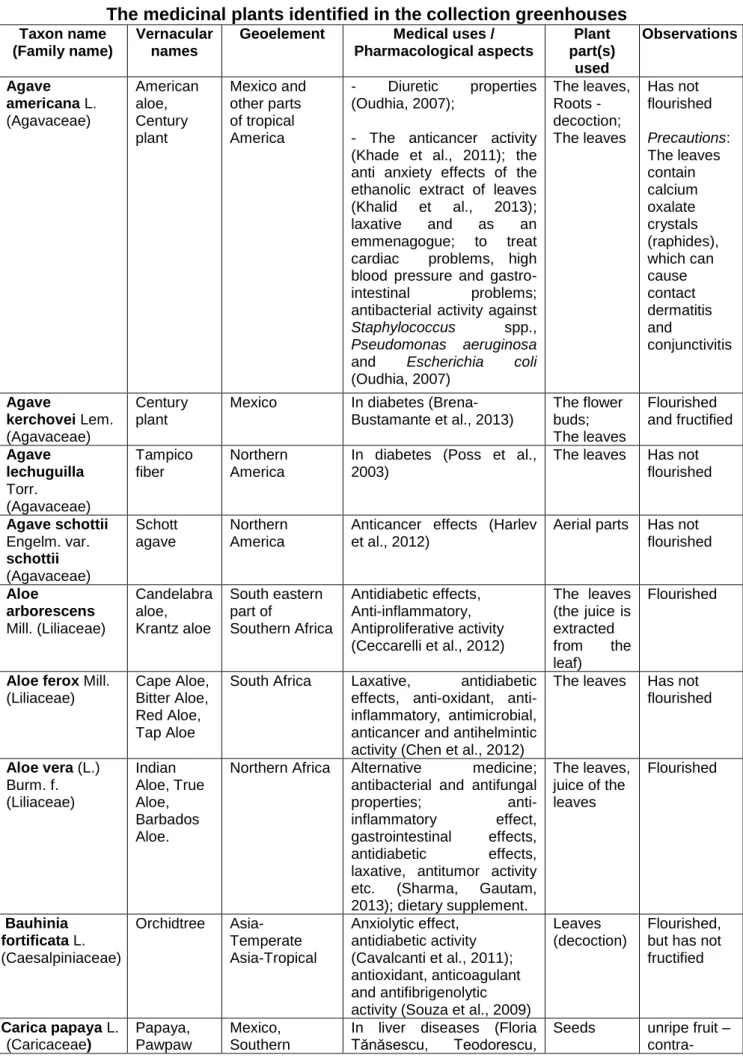
plants in the collection are presented in a table in alphabetical order, as follows: scientific
name and family specified for each taxon, vernacular names, geoelement, plant part(s)
used for therapeutic purposes, medical uses and observations (phenological data, and
where appropriate if any precautions in the use of plants for medical purposes).
Nomenclature is presented according to international databases (The Plant List,
GRIN).
RESULTS AND DISCUSSIONS
84
Table 1
The medicinal plants identified in the collection greenhouses
Taxon name (Family name)
Vernacular names
Geoelement Medical uses / Pharmacological aspects Plant part(s) used Observations Agave americana L. (Agavaceae) American aloe, Century plant Mexico and other parts of tropical America
- Diuretic properties (Oudhia, 2007);
- The anticancer activity (Khade et al., 2011); the anti anxiety effects of the ethanolic extract of leaves (Khalid et al., 2013); laxative and as an emmenagogue; to treat cardiac problems, high blood pressure and gastro-intestinal problems; antibacterial activity against
Staphylococcus spp.,
Pseudomonas aeruginosa
and Escherichia coli
(Oudhia, 2007) The leaves, Roots - decoction; The leaves Has not flourished Precautions: The leaves contain calcium oxalate crystals (raphides), which can cause contact dermatitis and conjunctivitis Agave kerchovei Lem. (Agavaceae) Century plant
Mexico In diabetes (Brena-Bustamante et al., 2013)
The flower buds; The leaves Flourished and fructified Agave lechuguilla Torr. (Agavaceae) Tampico fiber Northern America
In diabetes (Poss et al., 2003)
The leaves Has not flourished Agave schottii Engelm. var. schottii (Agavaceae) Schott agave Northern America
Anticancer effects (Harlev et al., 2012)
Aerial parts Has not flourished Aloe arborescens Mill. (Liliaceae) Candelabra aloe, Krantz aloe South eastern part of Southern Africa Antidiabetic effects, Anti-inflammatory, Antiproliferative activity (Ceccarelli et al., 2012)
The leaves (the juice is extracted from the leaf)
Flourished
Aloe ferox Mill. (Liliaceae)
Cape Aloe, Bitter Aloe, Red Aloe, Tap Aloe
South Africa Laxative, antidiabetic effects, oxidant, anti-inflammatory, antimicrobial, anticancer and antihelmintic activity (Chen et al., 2012)
The leaves Has not flourished
Aloe vera (L.) Burm. f. (Liliaceae) Indian Aloe, True Aloe, Barbados Aloe.
Northern Africa Alternative medicine; antibacterial and antifungal properties; anti-inflammatory effect, gastrointestinal effects, antidiabetic effects, laxative, antitumor activity etc. (Sharma, Gautam, 2013); dietary supplement.
The leaves, juice of the leaves
Flourished
Bauhinia fortificata L. (Caesalpiniaceae)
Orchidtree Asia-Temperate Asia-Tropical
Anxiolytic effect, antidiabetic activity (Cavalcanti et al., 2011); antioxidant, anticoagulant and antifibrigenolytic
activity (Souza et al., 2009)
Leaves (decoction)
Flourished, but has not fructified
Carica papaya L. (Caricaceae)
Papaya, Pawpaw
Mexico, Southern
In liver diseases (Floria
contra-85
America 2006); Antihelmintic, Laxative, to increase visual acuity,
Cure of dyspepsia (Aravind et al., 2013)
Fruits Roots ceptive in some Asian countries (Aravind et al., 2013) Cereus jamacaru DC. (Cactaceae) Queen of the night, Mandacaru Brazilian northeast
It can be used as a tea, being prepared from the root and used to treat illnesses such as
rheumatism, wounds, boils, urinary infections and kidney inflammation (Lucena et al., 2013)
Fruit Marrow Root Flourished and fructified Cinnamomum camphora (L.) J. Presl (Lauraceae)
Camphor tree
China oriental, Japan
In respiratory diseases, treats stomachache (Star et al., 2003) Roots, whole aerian part Not blooming Citrus limon (L.) Burm. f. (Rutaceae)
Lemon Asia Vitamin supplement Aphrodisiac (Li, 2006)
Fruit Root (infusion) Flourished and fructified Citrus sinensis (L.) Osbeck (Rutaceae) Sweet orange
Asia Vitamin supplement (Floria Tănăsescu, Teodorescu, 2006)
Fruit Flourished and fructified
Coffea arabica L. (Rubiaceae)
Coffee tree Ethiopia Stimulating and anti-inflammatory effect, antioxidant activity (Pérez-Hernández et al., 2012)
Seeds Flourished and fructified
Cordyline fruticosa (L.) A. Chev. (Agavaceae) Tree of kings Asia-Temperate Stops bleeding,
stomachache (Li, 2006)
Leaves Flourished
Crinum asiaticum L. (Amaryllidaceae) Asiatic poisonbulb Africa, Asia-Temperate, Asia-Tropical, Australia, Pacific
Arthritis, injuries, skin infections and herpes, anti-infamattory effects, colic, emetic and purgative (Rahman et al., 2013)
Leaves Flourished The bulb is reputed to be poisonous Eriobotrya japonica (Thunb.) Lindl. (Rosaceae) Loquat, Japanese mosmon
China, Japan Antitussive, expectorant, treats bronchitis, cough, fever, nausea; externally applied to epistaxis, smallpox, ulcers (Li, 2006)
Fruit, Leaf, Flower Flourished and fructified Euphorbia tirucalli L. (Euphorbiaceae) African milkbush, Naked-lady
Africa Remove warts, cure skin diseases (Phani Kumar, Chaturvedi, 2010)
Latex Precautions: Poisonous plant for the Vertebrates: mammals Euphorbia tithymaloides L. (Euphorbiaceae) Japanese-poinsettia, Redbird flower, Slipperplant Mexico, Southern America Cure headache Cure skin diseases
Cure urinary problems (Phani Kumar, Chaturvedi, 2010) Latex Stem and root Whole plant Precautions: Poisonous plant for the Vertebrates: mammals Gloriosa superba L. (Liliaceae) Climbing-lily Africa, Asia-Temperate, Asia-Tropical
In traditional medicine: Asthma, tussis, amenorrhoea, as anti-inflammatory agent and arthritis (Li, 2006)
Anthelmintic (Lal, H. S., Mishra, P. K., 2011)
Rhizome (are rich in the alkaloid colchicine), flowers Whole plant Caution: every part of the plant is poisonous, especially the rhizomes (Lal, H. S., Mishra, P. K., 2011)
86
(L. f.) R. Br.(Asclepiadaceae)
Temperate, Asia-Tropical
flourished, but has not fructified Laurus nobilis L.
(Lauraceae)
Laurel Mediterranean Digestive, carminative and antiseptic (Akbulut, Sefa, Bayramoglu, M. M., 2013)
Leaves and fruit Not blossoming Lophophora williamsii (Lem. ex Salm-Dyck) J. M. Coult. (Cactaceae) Divine cactus, Diabolic-root, Indian dope Northern America Antirheumatic, analgesic, tonic (Smith, 2002)
Aerial parts Hallucinogen - contain mescaline Mimosa pudica L. (Mimosaceae) Sensitive- plant
Brazil Is used in tooth ache (Barukial, Sarmah, 2011)
Roots Flourished and fructified
Myrtus communis L. (Myrtaceae)
Myrtle Southern Europe, North Africa
Antidiabetic, astringent, haemostatic (Sabiha et al., 2011)
Leaf Fruit
Not
blossoming
Olea europaea L. (Oleaceae)
Olive Mediterranean In liver diseases (Floria Tănăsescu, Teodorescu, 2006)
To treat breast cancer, others take it to prevent colorectal cancer and in cardiovascular
complications (Akbulut, Sefa, Bayramoglu, M. M., 2013). Leaves, Fruit Flourished and fructified Ophiopogon japonicus (Thunb.) Ker Gawl. (Liliaceae) Mondograss Dwarf lilyturf Asia- Temperate, Asia-Tropical Cardioprotective properties, anti-inflammatory, antioxidant effect,
antidiabetic effect (Li, 2006) Root (aqueous extract) Flourished and fructified Opuntia cochenillifera (L.) Mill. (Cactaceae) Prickly Pear
Mexico To treat mycoses (fungal skin infections) –(Lucena et al., 2013) The stem (extract) Flourished and fructified Opuntia ficus-indica (L.) Mill. (Cactaceae) Smooth prickly-pear, Tuna cactus, Indian-fig prickly-pear Mexico, much of Latin America, South Africa and the Mediterranean area
Antidiarrhoeal,
for treating diabetes (Poss et al. 2003); burns, bronchial, asthma, and indigestion (Lucena et al., 2013). Fruit Stem Flourished and fructified Origanum majoranum L. (Lamiaceae) Sweet marjoram
Asia temperate Digestive, mouth wash, bronch disorders (Floria Tănăsescu, Teodorescu, 2006) Leaves Aerial parts Flourished and fructified Pelargonium graveolens L’Hér.
(Geraniaceae)
Rose geranium
Africa Treatment of dysentery, haemorrhoids,
inflammation, heavy menstrual flows and even cancer; diabetes, gastric ulcers, sterility and urinary stones (Sharma, 2013). Antibacterial activity (Ghanadi et al., 2012)
Leaves Stems Flowers Flourished and fructified Pelargonium peltatum (L.)L’Hér. (Geraniaceae)
Hanging geranium, Ivy geranium
Southern Africa Antiseptic and astringent, antimicrobial activity, used in the treatment of sore throat and ulceration of the oral mucosa (Yannitsaros,
87
1996).Piper longum L. (Piperaceae)
Indian long pepper, Jaborandi pepper, Long pepper
Asia Tropical: North east India
To treat chronic bronchitis, asthma, constipation, gonorrhea, diarrhea, viral hepatitis, respiratory infections, stomachache, diseases of the spleen, cough, and tumors (Kumar et al., 2011).
Fruit Not
blossoming
Piper nigrum L. (Piperaceae)
Black pepper, Pepper
Asia Tropical: India
Can be used as
antiapoptotic, antibacterial, antidepressant, antifungal, antidiarrhoeal,
anti-inflammatory, antimutagenic,
antioxidative, antipyretic, antihypertensive,
hepatoprotective etc. (Ahmad et al., 2012)
Fruit Not
blossoming
Rosmarinus officinalis L. (Lamiaceae)
Rosemary Africa Asia- Temperate Europe
Antibacterial, antifungal activity (Floria Tănăsescu, Teodorescu, 2006)
Leaves Aerial part
flourished and fructified
Simmondsia chinensis (Link) C. K. Schneid. (Simmondsiaceae)
Jojoba, Goatnut
Northern America
Antimicrobial activity; For treatment renal colic, sunburn, hair loss, headache, wounds and sore throat, for treatment of psoriasis (Sharma, Singh, 2011)
Seeds Root
Not
blossoming