Finno-Ugric Languages and Linguistics Vol. 6. No. 1. (2017), 3-40. http://full.btk.ppke.hu ISSN: 2063-8825
using an auditory Implicit Association Test Andrea Deme, Katalin Gugán, Bálint Sass, Katalin Mády
Since the birth of sociolinguistics the localization of innovative speakers has been regarded as a key issue in the study of language change. For this purpose, researchers traditionally categorize the speakers of a speech community on the basis of demographic and socioeconomic features; however, these parameters prove not to be sufficient to identify innovative speakers in all cases. It may be argued, however, that the speaker’s implicit attitude towards linguistic innovations may also be captured and may be a good indicator of the speaker’s innovative linguistic behavior. This line of research is not yet well elaborated on, probably due to the complexity of the attitude construct (which makes the measurement of implicit attitudes a challenging task), and the difficulty of grasping attitude towards linguistic innovations as such. The present study aims at addressing the potentials present in this aspect of sociolinguistic investigation. We review the psychological literature on the attitude construct and propose that a method borrowed from social psychology, the Implicit Association Test (IAT), may be adapted for the measurement of implicit attitude towards linguistic innovations if used with a linguistic variable that is subject to an ongoing language change as the test variable (or target). We report a pre-test conducted for variable selection for the adaptation of the IAT, and analyze data gathered by means of this newly created method for capturing implicit innovative linguistic attitude. We propose that this new IAT may be a useful tool in language change studies.
Keywords: IAT, implicit language attitude, language attitude, innovative attitude, language change, sociolinguistics
1 Introduction
Traditionally gender, age and socioeconomic status are regarded as important factors of language change, as they are suggested to enable to us to designate innovative speakers, the key figures of linguistic change (see. e.g., Labov 1980). These factors, however, do not appear to be sufficient in the identification of innovative speakers in all cases (see also Labov 1980). As a possible solution to this problem we argue that new methods in the detection of innovative speakers are necessary which allow researchers to identify potentially innovative linguistic behavior.
Language attitude, in particular implicit language attitude is another factor that is often addressed in sociolinguistics, but mostly in studies where the issue of stereotypes and language-based prejudice is addressed through the investigation of implicit attitudes towards linguistic variation (e.g., towards dialectal or accented speech) (see e.g., Pantos 2010 and Pantos & Perkins 2013 amongst others). Accordingly (and also based on several other sociologically important reasons), there is a constantly growing body of research investigating implicit language attitudes, where language attitude is generally defined as a disposition that is evoked by language, because speech is assumed to provide cues based on which a listener may assign supposed group memberships to the speaker (see e.g., Preston 2003). In a relatively smaller amount of research, attitude is also
* We would like to thank Tamas Kaldi and Andras Barany for their valuable help in editing the
considered as a disposition towards linguistic variants, like, for instance, linguistic innovations, and according to these interpretations, attitude may also play an important role in language change (see e.g., Hopkins 1977). Yet, when it comes to this possible interpretation of attitude and what it may offer the investigation of language change, only the surface has been scratched.
In the present study we propose a solution to the problem of locating innovative speakers by expanding the most common (or perhaps the traditional) interpretation of language attitude, and by proposing that innovative speakers may be characterized by a specific implicit attitude towards linguistic innovations as such. In this paper we also propose a possible way of operationalizing this specific implicit attitude for linguistic research.
We argue that the implicit attitude a language user may hold towards language change and linguistic innovations may be a crucial component in the user’s involvement in language change processes and thus it should also be considered in studies of language change. To the authors’ knowledge, this interpretation of implicit attitude is so far rarely studied empirically, probably for the following two reasons. The first may be the duality
of attitudes and the nature of the implicit component (i.e., the nature of implicit attitude)
which makes attitude a very difficult phenomenon to examine. The second may be the difficulty of grasping attitude towards linguistic innovations as such, since linguistic attitudes are generally considered only with respect to socially well-defined speaker groups and not towards more abstract linguistic structures or concepts; we discuss both of these issues in more detail in the following sections. In the present study we argue that a specific aspect of implicit innovative language attitude may be captured by measuring the automatic (implicit) evaluative reactions to innovative linguistic forms, and we propose a possible solution for measuring this specific aspect of implicit attitude by adapting the Implicit Association Test (IAT), a measurement tool of social psychology. We also claim that by applying this test for measuring implicit attitudes, we also overcome the difficulty of grasping abstract linguistic categories (as innovative or conservative linguistic variants) for testing, as already demonstrated by previous research.
In accordance with the above, the aim of the present paper is to elaborate on the proposal of interpreting implicit attitudes as implicit attitudes towards linguistic innovations, and to report on the process of creating the IAT capable of capturing implicit attitude of language users towards Linguistic Innovations (this test will hereafter be referred to as LI-IAT). We argue that for this purpose, a linguistic variable that is subject to an ongoing language change must be identified and used in an auditory IAT paradigm. We suggest that through capturing this specific aspect of implicit attitude towards linguistic change, the LI-IAT may be a useful tool in the study of language change in the future: as the LI-IAT measure can be an indicator of implicit attitudes towards language change, it may enable us to identify potentially innovative language users and thus to investigate ongoing language change processes reliably. It seems to be appropriate to also anticipate the long-term objective of the authors: our goal is to map the specific aspect of implicit linguistic attitude captured by LI-IAT to several types of language change, e.g., sound change, morphological change, or syntactic change. This way, we plan to assess which types of language change the LI-IAT measure can be a reliable indicator of. The study presented here is the first step in this process.
the relatively small number of previous studies on implicit innovative language attitude, we conclude by formulating our aims and discussing how all the above lead to the implementation of the auditory IAT in the measurement of implicit attitude towards linguistic innovations. Section 3 and 4 present two experiments: the first is conducted for variable selection for the adaptation of the IAT, while in the second some preliminary data are analyzed which were gathered by means of this newly created LI-IAT for capturing implicit innovative linguistic attitude. Section 5 provides a brief overview and discusses possible applications of the LI-IAT in language change studies, as well as future work.
2 Background
2.1 The attitude construct
The attitude construct has continuously been a topic of interest in the psychological literature resulting in complex and to some extent even diverging definitions of the concept. However, it is beyond the possibilities of the present study to review and reflect on this diversity of research and theory; we can only venture to give a brief and basic (thus necessarily simplifying) description of it to provide the theoretical basis of the present study.
According to the most popular model, the expectancy-value model, attitude is a
summary of evaluation, where the evaluative meaning arises inevitably and spontaneously
as a result of cognitive processes, namely associations. In this model attitude can be
captured as an association between the attitude object and valued attributes: notions that
are eligible to express valence (i.e. evaluative meaning),1 such as the dimension of good–bad,
pleasant–unpleasant, or harmful–beneficial (Ajzen 2001). Attitude, namely the
evaluation-based categorization, or the measure of favorability is to be differentiated from
evaluation-free categorization or sorting (for instance sorting food made of vegetables and food made of non-vegetable ingredients; for evidence of this differentiation, see e.g. Cacioppo et al.
1996 with respect to the field of neuropsychology), and from the notion of affect, which
has been described as “states that contain degrees of valence as well as arousal” (Ajzen 2001: 29). In some theories affect is even assigned precedence to over cognition, i.e.
attitude formation (see the affective primacy hypothesis in Ajzen 2001 and its references).
2.2 The model of dual attitudes
In the literature of psychology there is general agreement that the evaluation of psychological objects is inevitable and spontaneous. However, attitude is not necessarily univalent, that is, many circumstances may facilitate the development and holding of more than one attitude towards the same attitude object. According to one of the most
influential theories, the model of dual attitudes, the duality of attitudes lies within attitude
change: when attitudes change, the new attitude may not fully replace the older, more habitual attitude, but the two may keep co-existing which results in dual attitudes, i.e., in two simultaneous but not necessarily congruent evaluative reactions to the same object (Wilson et al. 2000). For instance, early acquired (and even repressed) prejudice may
1 Valence in psychology is defined as the intrinsic attractiveness (positive valence) or
exist with later created egalitarian views. According to the theory of Wilson and his
colleagues this duality may be grasped by differentiating between explicit and implicit
attitudes. Implicit attitude is an evaluative disposition considered to be subconscious
(outside of conscious awareness) (see also Greenwald & Banaji 1995), it is habitual, it is based on unidentified (or inaccurately identified) traces of past experience (Greenwald & Banaji 1995) and environmental impact (Karpinski & Hilton 2001), and it shapes the interaction with the attitude objects remarkably (or at least influences implicit or uncontrollable responses that one might not make an attempt to control) (Greenwald &
Banaji 1995, Wilson et al. 2000). Explicit attitude, on the other hand, is considered to be
more recently constructed, deliberately formed, or in other words, consciously accessible. Consequently, explicit attitude is the disposition we can report on directly. This is the case when we answer questions about our preferences, for instance. In such a context, implicit attitudes are “unavailable”. Additionally, it should be emphasized again that implicit and explicit attitudes may diverge. Therefore, data gathered through explicit evaluative questions will necessarily be able to reflect consciously available, i.e., explicit attitudes exclusively, while implicit attitudes which may have the opposite valence of explicit attitude are almost always left unrevealed by direct questions and questionnaires (see e.g., Horwitz & Dovido 2015 on diverging explicit and implicit attitudes towards wealthy people or the results of Pantos 2010 and Pantos & Perkins 2013 on diverging explicit and implicit attitudes towards accented speech).
Before we further elaborate on the effect of the duality of attitudes on attitude measurements (and on other factors that may also have an impact), we briefly discuss
another aspect of attitude, namely ambivalence, that should clearly be differentiated from
duality described above. Ambivalence is the co-existing positive and negative disposition toward the same object, but in this case, the conflict does not stem from the different “layers” of attitude (that differ in conscious availability), but the evaluation of the same
objects on different dimensions resulting in a conflict within the cognitive component or in a
conflict between affect and cognition (see e.g., Ajzen 2001). We present one example that illustrates this differentiation. In one of their studies MacDonald and Zanna (1998) asked male participants to evaluate feminist candidates in a job interview situation on two
dimensions: admiration and affection. According to their results, males rated feminists
positively on the dimension of admiration, but negatively on the dimension of affection, that is, they were proved to be holding ambivalent attitudes toward feminists, which was not the result of the implicit–explicit opposition, since evaluation on both dimensions was assessed on the basis of self-report. Therefore, the concept of ambivalence is clearly out of the scope of the present discussion, and will not be further discussed in the present study.
their beliefs about what a socially more acceptable response is and not in a way that reveals how they actually feel or believe (Holtgraves 2004). To give a basic impression of what this statement means, we cite Holtgraves’ examples: according to studies conducted in the USA, people tend to overreport their engagement in socially desirable behaviors, such as attending religious services and voting, but underreport engaging in socially undesirable behaviors such as substance abuse (see Holtgraves 2004). According to Holtgraves (2004), social desirability operates as an “editing process”: participants retrieve the requested information (e.g. the answer to an explicit question), but they also evaluate it before responding: they assess whether the response would make them look good or not. If truthfulness interferes with social desirability, respondents may respond according to the latter. Generally speaking, both the duality of attitudes and the social desirability bias pose a serious problem to the investigation of implicit and even to explicit attitudes. As direct questions may only reflect explicit attitudes, attitudes in connection with stereotypes and prejudice are even more difficult to reveal, due to the fact that informants may often tend to respond according to socially more acceptable attitudes (i.e., according to social solidarity and equality), and the attitudes that are not in line with these ideal dispositions may remain “covered”.
Arriving at the focus of our present study, the consequences of the above factors can be summarized as follows. The measurement of explicit and implicit attitudes towards attitude objects, in our case, specific (innovative) language forms, is a demanding task, but it is of great importance. In certain areas of behavior, including language behavior or language use, some attitudes are a matter of prestige, while others are incorrect, substandard, not appropriate or stigmatized. Therefore, when investigating these areas the issue of socially desirable responding should also be taken into account. Moreover, in the case of innovative linguistic behavior, i.e., in the acceptance or use of innovative language elements it may well be assumed that implicit attitude is a key component. (Probably almost everyone had the experience of a friend who has expressed some negative opinion about a stigmatized linguistic form, and used it him- or herself just a few minutes later.). Implicit attitudes are, however, out of conscious awareness. These problems are serious, but can be overcome by using implicit attitude measures to detect innovative linguistic attitude.
2.3 Measurements of implicit attitudes: the Implicit Association Test
To gain access to implicit cognitions (a domain not reached by self-report measures) several solutions have been tested (for a short summary, see e.g. Karpinski & Hilton 2001). Among them, one of the most influential and widely used techniques is the Implicit Association Test (IAT). The IAT is a simple evaluation-free categorization task where implicit preference, i.e., positive attitude towards the attitude object is only deduced from response latency (i.e., reaction time, RT). The IAT is based on the notion
of attitude being an association between the attitude object (target) and attributes with
positive and negative valence (attribute). The principle of the method is that the ability to
quickly sort the target items and attribute items to their corresponding categories reflects the strength of association within the two pairs of opposing target–attribute categories that have to be sorted together. Accordingly, in the IAT paradigm RT data are considered to be correlates of attitude strength (see e.g. Greenwald et al. 1998).
Categories (and category labels) Items
Target BIRD cardinal, warbler, blackbird, robin
INSECT cicada, locust, bee, mosquito
Attribute PLEASANT cuddle, happy, smile, joy
UNPLEASANT abuse, crash, disaster, grief
Left Right
Block 1: BIRD INSECT
Block 2: PLEASANT UNPLEASANT
Block 3: BIRD OR PLEASANT INSECT OR UNPLEASANT Block 4: BIRD OR PLEASANT INSECT OR UNPLEASANT
Block 5: INSECT BIRD
Block 6: INSECT OR PLEASANT BIRD OR UNPLEASANT Block 7: INSECT OR PLEASANT BIRD OR UNPLEASANT
Figure 1: Illustration of the Implicit Association Test (IAT), adapted from Vande Kamp (2002, 3)
Before the test, participants familiarize themselves with the categories and the
corresponding items to be used in the test. There are always two opposing target
categories (here, BIRD vs. INSECT) and two opposing attribute categories (here, PLEASANT vs. UNPLEASANT), resulting in a total of four categories and four category labels. In Block 1 participants acquire the assignment of the left and right sides
(of the computer screen) to the two target categories (BIRD vs. INSECT) by sorting the
target items appearing in the middle of the screen, according to the target labels that are visible in the two upper corners (sorting administered by key press, usually E for left, and
I for right). Next, in Block 2 the participants also learn the assignment of the two attribute
categories (PLEASANT vs. UNPLEASANT) by sorting the corresponding attribute items according to the two attribute category labels visible in the upper corners again. In
Block 3 the attribute and target category labels appear together with the conjunction or
(e.g., BIRD OR PLEASANT on the left and INSECT OR UNPLEASANT on the right), and attribute and target items are to be sorted simultaneously: target items (e.g., cardinal) according to target labels, and attribute items (e.g., happy) according to attribute labels (note that although target and attribute items appear in succession, participants still sort target items according to target labels, and not attribute labels, thus no explicit evaluation is required). This task is repeated in Block 4. In Block 5 the inverse assignment of target labels is acquired by sorting target items again, according to the new (inverse) set-up of labels. In Block 6 attribute and target labels appear together again in the second attribute + target combination (since attribute labels are displayed unchanged), and participants sort all the target items and attribute items (similarly to Block 3 and 4). In Block 7 the task of Block 6 is repeated.
The IAT is based on the idea that if highly associated concepts share the same side (and the same key response), participants are able to categorize items much faster than in the opposite combination (when weakly associated concept share sides and key
responses). Therefore, to calculate the IAT effect the congruent (i.e., expected stronger
association, e.g., bird and pleasant) and incongruent (i.e., expected weaker association, e.g.,
predicted to be easier than the other attribute + target combination, Block 4, 5, 6 and 7 basically consists of “congruent” or ‘easy’ and “incongruent” or ‘hard’ blocks. The IAT
effect is quantified for each participant as a so called D measure: trials greater than
10,000 ms are deleted; “inclusive” (pooled) standard deviation for congruent blocks (Block 3 and 6, in the first setting), and incongruent blocks (Block 4 and 7) are computed; the mean latency of the congruent block is subtracted from the mean latency of the incongruent block (MeanBlock 6 − MeanBlock 3 and MeanBlock 7 − MeanBlock 4); each
difference is divided by the corresponding pooled (inclusive) standard deviation; D
equals the equal-weight average of the two resulting ratios (for further description see
Greenwald et al. 2003). The value of D is normalized between −2 and 2 where effect size
criteria meet the requirements of (and thus are interpreted similarly to) Cohen’s d: −.15 <
D < .15: no effect; .15 ≤ D < .35 or −.15 ≥ D > −.35: weak effect; .35 ≤ D < .65 or −.65 ≥
D > −.65: medium effect; .65 ≤ D or −.65 ≥ D:strong effect, where positive values represent
implicit bias in the congruent direction, and negative values reflect implicit bias in the
incongruent direction (see e.g., Greenwald et al. 2003).
IAT was originally designed for sorting visual stimuli (strings or pictures). This is because the majority of implicit attitude detection studies is concerned with the issues of prejudice detection and stereotypes (i.e., attitudes toward racial and ethnical minorities, overweight people, etc.), and stereotypical groups can easily be represented with typical names or faces. However, there is no doubt that in human interaction socially meaningful variation of linguistic forms is also a common way to identify group membership, thus activation of stereotypes triggered by linguistic forms is a key issue in sociolinguistics and social psychology and should not be neglected either (Campbell-Kilber 2012). Recognizing the above, the IAT paradigm was also tested (and tested successfully) with auditory prompts. In his dissertation, Vande Kamp (2002) demonstrated that the auditory IAT is a reliable and useful extension of the IAT that consists entirely of visual stimuli, either if the sounds to be sorted are words (as given in Figure 1), or if the speaking voices are socially meaningful (e.g., the voice of European-American or African-American speakers).
In some studies IAT was also used to address questions that are relevant particularly from a sociolinguistic perspective. Pantos (2010) and Pantos and Perkins (2013) investigated foreign-accented speech versus non-accented speech. Their findings demonstrated implicit bias toward the non-accented speech, that is, they provided evidence that speakers favor their native language and their own accent over foreign-accented speech. Furthermore, the authors also obtained explicit measures (by means of self-report) which indicated an explicit bias in the opposite direction, that is, explicitly informants seemed to favor the foreign-accented speaker. These findings demonstrate that implicit and explicit attitudes are separable and often also diverging constructs, and they also exemplify how the so called social desirability bias may exert its influence on linguistic attitudes.
Using the auditory IAT paradigm, Kathryn Campbell-Kibler (2012) provided further insights. She recognized that studying implicit associations in the research of attitudes should not necessarily be restricted to the investigation of attitude object–value alignment (as in the case of the accented–non-accented speech and good–bad category, for instance), but may also be used to investigate any kind of alignments that may be meaningful sociolinguistically. She claimed that sociolinguistics may also benefit from studying association strength between linguistic forms (which activate stereotypical groups) and stereotypically associated concepts (region, education, socioeconomic status,
stereotypes and associated them with professions and the names of prototypical northern
and southern states to gather some insight into the meaning of previously detected
stereotypes (reported by sociolinguistics in many previous studies). Campbell-Kibler created several IATs using visual and auditory stimuli, and she used abstract metalinguistic category labels referring to linguistic variants as e.g., –IN and –ING
(referring to the talkin’ versus talking opposition). Both of these solutions proved to be
appropriate for the categorization test the IAT is based on, and demonstrated that the difficulty of grasping abstract linguistic categories may be overcome by using the IAT paradigm and simple metalinguistic labels.
To summarize shortly, the above studies demonstrated that i. IAT is a useful tool in implicit attitude detection if used with auditory prompts, ii. IAT may be used to detect sociolinguistically relevant attitudes, and iii. that the use of IAT should not be restricted to the detection of stereotypes.
2.4 Attitude in linguistic studies and the interpretation of the concept proposed in the present study
In sociolinguistics the term language attitude is predominantly used for evaluative
disposition towards linguistic variants in language variation that may serve as cues for the listener to identify the speaker’s group membership (see e.g., Preston 2003). This is particularly true in the case of Hungarian sociolinguistics where language attitude is used and studied exclusively with respect to regional variants of Hungarian, or (to a lesser extent) foreign-accented Hungarian speech (see e.g., Kiss 2000 and references therein). This is most probably due to the fact that the study of language-based evaluation in sociolinguistic research is in many cases motivated by prejudice detection and detection of stereotypes associated with stereotypical groups, and activated by typical language use of the group members (e.g., accents or dialects).
In Hungarian research, most of the studies used explicit attitude measures to draw conclusions on attitude in general: they elicited the set of beliefs on language norms and standards combined with beliefs about socially expected responses to the assumed substandard forms. Additionally, some studies also introduced techniques to elicit a
manifestation of implicit attitude. Sándor et al. (1998), for instance, used the matched guise
listeners heard a speaker speaking only standard Hungarian, while another group heard him speaking only his native regional dialect of Hungarian. As expected on the basis of previous literature on language attitude and prestige forms, the speaker was preferred (assessed on the basis of evaluation on personality dimensions) when he used standard Hungarian.
It is important to note, however, that implicit methods, such as the matched-guise paradigm do not necessarily (or may not at all) reflect implicit attitudes, as one might always have the chance to catch his or her own stereotype activating while forming a reaction to an implicit question, and thus the social desirability bias may arise as an editing phase before giving a response to the question (as proposed by Holtgraves 2004). In order to detect implicit attitudes (and to overcome the limitation of self-reports), psychological methods may provide the optimal solution, as they do not require the participants to report on a subjective assessment, but infer attitude from other measures. One of these and probably also one of the most influential ones is, as already mentioned,
the IAT paradigm.2 In sociolinguistic studies, however, these psychological methods are
used only to a limited extent, at least with respect to the issues addressed by these implicit methods. To the authors’ knowledge, most of these applications involve the IAT (or a modification of it), and study only stereotypes or prejudice against linguistic variables that represent a stereotypical group of people (see e.g., the studies already mentioned: Pantos 2010, Pantos & Perkins 2013 investigating attitudes towards accented speech). Only a few studies ventured to further explore the potentials of these methods in sociolinguistics, like e.g., Campbell-Kibler who investigated sociolinguistic meaning by aligning the linguistic variables with concepts that did not “simply” express valence in an IAT (discussed above), but may index some other sociolinguistically relevant meanings.
Returning to the interpretation of the concept of language attitude in sociolinguistic studies, we argue that besides referring to the disposition towards the language use of stereotypical groups, this term’s use can be broadened to encompass attitude towards language itself (as indicated also by e.g., Hopkins 1977). More specifically, language attitude may also be interpreted as a disposition towards linguistic phenomena, for instance, linguistic innovations. In this interpretation, innovative language attitude is conceived as a disposition that is held against innovative linguistic variants (or even towards a group of innovative linguistic variants), and in this way it is interpreted as an attitude towards language change itself. But what would we gain if we interpreted language attitude as an attitude held against linguistic variants (and not towards a group of people they might represent if this group is existent at all), and innovative language attitude as an attitude towards linguistic innovations and language change?
As Labov pointed out (emphasized in the review of Milroy and Milroy 1985, referring to Labov 1980), there are certain groups of the society who use language innovations more than others, and these are the groups who basically initiate the diffusion of linguistic innovations (see e.g., Milroy and Milroy 1985). Hence, Labov (and a great number of scholars after him) concluded that the localization of these groups, i.e., the groups of innovative speakers is a key issue in the study of language change. However, Labov also demonstrated in his studies that these groups cannot be localized easily, as these groups are not easy to characterize only by means of some demographic features or the speakers’ socioeconomic status (see also the comments from Milroy &
2 There are, of course, many other implicit methods, like the Go/No-Go Association Task,
Milroy 1985). Luckily, demographic mapping is not necessarily the only solution to identify innovative speakers, if we assume that these speakers are characterized by a specific kind of implicit attitude towards linguistic innovations.
Based on what is known about attitude from social psychology, automatic preference and usage of certain linguistic forms can be considered as the manifestation of implicit attitude. Therefore, we argue that if we are able to identify some innovative forms in a given language (that are currently subject to an ongoing language change), and we are also able to detect speakers who prefer these forms, we basically managed to identify a group of innovative speakers without making the mistake of drawing misleading conclusions regarding innovative linguistic behavior purely on the basis of demographic data. In other words, we propose that a specific aspect of implicit innovative language attitude may be captured by measuring the automatic (implicit) evaluative reactions (i.e., the implicit attitudes) towards particular innovative linguistic forms, and this evaluative reaction then may be used as an independent variable in the investigation of language change processes.
Naturally, this interpretation of innovative language attitude, that is, the attitude towards a linguistic innovation cannot be understood as a direct predictor of innovative behavior in the production of this particular linguistic innovation, as implicit attitudes are never taken as predictors of behavior without further experimental evidence gathered in psychology either. To understand clearly how the implicit innovative linguistic attitude towards a specific linguistic innovation interacts with the production of the given linguistic form, a considerable amount of further empirical evidence would be needed (which would probably still not clarify the interaction fully, as is experienced in psychology). However, this interaction is actually of no great importance, if the measure of this implicit attitude is interpreted merely as an indicator of tolerance or acceptance of linguistic innovations as such. This way we may operationalize a specific aspect of implicit innovative linguistic attitude that may afterwards be also considered as a possible predictor of (perceptive or productive) innovative linguistic behavior in the case of other independent language change processes as an independent variable. In this sense, a new (and even numerical!) measure reflecting a particular aspect of implicit innovative linguistic attitude may inevitably be an unprecedented advance towards a research method that enables researchers to identify speakers of potentially innovative linguistic behavior. In summary, we argue that through interpreting implicit innovative language attitude as an implicit attitude towards linguistic innovations, the investigation of ongoing language change processes gains a new and useful aspect. Accordingly, we also propose to make an attempt to operationalize this implicit attitude to turn it into a numerically expressed independent variable.
concatenated a set of substandard linguistic forms3 into one audio file, and asked the listeners to spot the “incorrect" forms in it. Supposing that tolerance against substandard linguistic forms, that is, the lack of susceptibility to spot the “errors” is the manifestation of implicit innovative language attitude, Mády used the number of the spotted substandard forms as a measure of implicit conservative language attitude, while innovative attitude was basically defined as the lack of the susceptibility to spot these “errors”. The most important result found in the study was that the two groups of listeners separated on the basis of their performance in the implicit task also showed a tendency to perceive the quantity of vowels differently based on their tenseness (i.e., quality difference or spectral difference) which she considered to be a reflection of an ongoing sound change process. Based on these results, Mády also claimed that implicit attitude should be considered as a factor influencing perception, thus it should also be considered as a factor possibly affecting sound change processes. In a second study Mády and Rácz (2013) investigated the sustained /a i u/ (and also the production of /o u/ in embedded words) and found that both young and innovative speakers tended to increase their formant frequencies F1 and F2 for sustained vowels compared to old and conservative speakers (again, innovative attitude was defined on the basis of the evaluative test used in Mády (2012). Therefore, Mády and Rácz claimed that the lowering of the first two formants, i.e., the slightly centralized production of vowels is not purely a result of aging but also of implicit language attitude.
2.5 Aims of the study
The long-term purpose of the authors of the present paper is to follow up on the proposal of Mády (2012) and to develop a test that enables the detection of implicit innovative language attitude directly and reliably. It is suggested that such an implicit attitude test might allow future research addressing the issue of language change to identify innovative speakers independently of demographic data and also of the linguistic variants at question, thus opening up new possibilities in the investigation of language change processes. It is proposed that the reliability of the implicit attitude test used by Mády (2012) can be improved in two aspects. First, the efficacy of bypassing conscious control can be increased by using a completely implicit task (including no explicit evaluation). Second, the efficacy of the detection of innovators may be improved, if we do not detect the respondents’ susceptibility to identify speech errors, stable variations or substandard forms (as in Mády 2012), but we include an innovative linguistic form in the implicit method, a form that is assumed to be part of an ongoing language change. Therefore, to develop the implicit innovative language attitude test we propose the following.
First, we suggest the use of the auditory IAT design to detect implicit innovative language attitude directly. The auditory IAT is considered optimal (at least as a first attempt) for two reasons. On the one hand, this paradigm allows for the use of auditory stimuli which is probably the best solution if innovative linguistic forms are to be presented as target items, as innovative variants appear first in spontaneous speech and
3 i. Variables that show stable variation, such as e.g., the illative case marking suffix -ba/-be used
may thus appear more natural in an experimental situation if presented to listeners also in speech. On the other hand, we suppose that in the case of the tested opposing target categories, i.e., the innovative and conservative linguistic forms, the conservative is likely to be preferred over the other by conservative users, which is also the rationale behind the IAT paradigm.
Second, we claim that the IAT capturing the implicit attitude of language users towards Linguistic Innovations (referred to as the LI-IAT) should include a linguistic form that is assumed to be part of an ongoing change as test variable. Although, as argued above, this LI-IAT measure may not reflect or predict the production of this particular linguistic innovation we use in the LI-IAT, it should not be considered as a problem, since we only aim to operationalize potentially innovative attitudes towards linguistic innovations.
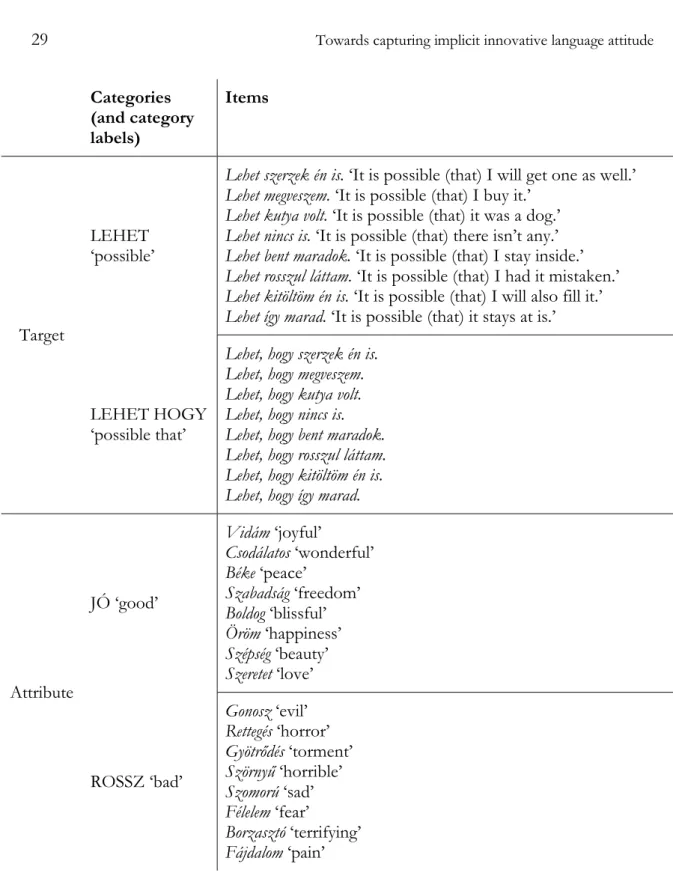
In line with the second claim, the first practical aim of the study is to carry out an experiment to identify a linguistic variable that is subject to an ongoing change. Based on the test results we create the LI-IAT: we use the innovative (“newer”) and conservative (“older”) forms of the chosen linguistic variable as contrasting target categories. As attribute categories that are eligible to express valence and thus to evaluate automatic preferences, we decided to opt for the most common good versus bad concept pair.
As a second practical aim of the present study we plan to test the functioning of the newly created LI-IAT, and gather data with randomly sampled informants. The most
common numeric output of an IAT is the so called D measure or D score (see Section
2.3) which is generally interpreted as preference of one target category (negative values) or the other (positive values) or no preference (around the value of zero) at a particular target-attribute alignment. However, in the case of the implicit innovative linguistic attitude it is not obvious how to interpret these values. While speakers with conservative implicit attitude may (perhaps straightforwardly) be conceptualized with a preference for the conservative linguistic form, speakers with an innovative implicit attitude may be expected to have a preference for the innovative form, or no preference whatsoever (for further discussion of this problem see the introduction of Section 4). Therefore, we argue
that the clarification of the optimal interpretation of the D measure is a long process; in
order to understand the nature of the implicit attitude captured by the LI-IAT we need to carry out several thorough empirical studies on language change processes already described for contemporary Hungarian using this new method. In this process we basically plan to map the specific aspect of implicit innovative linguistic attitude that is captured by the LI-IAT to several types of language change processes and also to innovative behavior regarding speech production and perception, in order to assess
which type of behavior this specific aspect of implicit attitude (i.e., the D measure of the
LI-IAT) can be a reliable indicator of. Consequently, the optimal interpretation of the D
scores obtainable by LI-IAT cannot be discussed here. However, we can raise questions regarding possible interpretations of the data and gain basic impressions on the basis of the first data set. Also, we plan to evaluate any design-related biases of the LI-IAT by means of testing normal distribution of the data which is an expected criterion if larger amount of data is collected.
3 Experiment 1
To build the LI-IAT, the first step is to identify language variables that are most probably subject to an ongoing language change, and thus have a new or innovative form and an older, conservative one which (in at least some speakers’ cases) are competing in language use. To recognize language change in progress, it is assumed that one has to show that a variant has started diffusing in a speech community. For this purpose in the
present study we conducted a survey applying the apparent time construct, that is, we
compared a younger and an older group of speakers’ evaluative responses to the linguistic variables at hand, so that we could detect if the evaluative responses differ across age groups.
Since the groundbreaking work of Labov, sociolinguistic literature follows the assumption that the difference in use or in the evaluation of language variables accompanying age is (or may be) an indicator of an ongoing language change (see e.g., Labov 1963, 1966 [2006]). However, it is certainly an issue whether the differences found between age groups should be regarded as “the linguistic change at the community level”, or rather “the linguistic change at the individual level”, or in other words, whether the
change that is bound to the individual’s lifespan, i.e., age grading (Wagner 2012, 371). The
main cause of this differentiation problem is that age grading is indistinguishable from generational change in progress when only apparent time data are available (Wagner 2012).
As it is an old debate in the literature, there is plenty of evidence for and against the reliability of the apparent time construct in the detection of generational change. Nevertheless, drawing on the research of Sankoff (2006), in the present paper we accept
the reliability of this method. Reviewing thirteen replication studies of previous research
(that used apparent time), Sankoff (2006) found that language change detected in apparent time was confirmed by real time (longitudinal) analysis in all cases. Therefore, she concluded that the apparent time construct is a valid and reliable means of language change detection in most cases. On this basis, although we subscribe to the idea to the fact that apparent time may reflect both age grading and language change to some extent, we assume that a difference found in the language use of older and younger age groups, more specifically, the difference found in the evaluation of particular linguistic variants between older and younger age groups, may be a reliable indicator of an ongoing language change.
As introduced in the previous section, implicit or habitual attitudes are in many cases non-accessible through explicit questions, i.e., questionnaires. Questionnaires, however, are a good means of identifying standards, as they reflect explicit attitude, and they also reflect the social desirability bias: they reflect recently constructed or deliberately formed dispositions and beliefs, and beliefs about what is “socially desirable”. Therefore, in Experiment 1 we used a questionnaire to identify the “standards” or explicit bias of speakers in the case of eleven linguistic elements that have two co-existing variants. (For further details, see Section 3.1). The aim of Experiment 1 was to test which of the studied elements proves to be part of an ongoing language change, and thus qualifies as an appropriate variable for the IAT.
3.1 The linguistic variables tested in Experiment 1
observations or according to the literature (most notably Nádasdy 2008). Then we carried out two pre-tests with these variables. On the one hand, we tested the occurrences of their variants in the Hungarian National Corpus (http://clara.nytud.hu/mnsz2-dev/bonito/run.cgi/first_form; for a description, see Oravecz et al. 2014) in order to see whether their distribution shows characteristic patterns. On the other hand, these variables were also tested with the help of informants. In what follows, we will give a brief structural description of each tested variable and summarize the results of the grammaticality judgement test conducted with informants. Throughout the discussion the variants of each variable will be uniformly labeled as “more frequent”/“less frequent”, and these labels were assigned on the basis of the corpus study. However, the detailed description of the corpus inquiry and a more thorough structural analysis of the variables would greatly exceed the limits of this paper; therefore, we have made these
additional materials accessible in a separate file.4
The test asking for native speaker judgement contained the following 11 structures. Each of these are illustrated below with a typical example, with the more frequent variant
highlighted in boldface.5
(1) Article drop in sentence-initial position:
a.
Az ajtók
a bal oldalon nyílnak.The door.PL the left side.SUP open.PRS.3PL
b. Ajtók a bal oldalon nyílnak.
door.PL the left side.SUP open.PRS.3PL
‘Doors open on the left’
(2) Article drop before names of institutions:
a. Bemegyek
a Nyugatiba
jegyet venni.stop.by.PRS.1SG the Western.ILL ticket.ACC buy.INF
b. Bemegyek Nyugatiba jegyet venni.
stop.by.PRS.1SG Western.ILL ticket.ACC buy.INF
‘I stop by Nyugati [=Western Railway Station] to buy tickets’
(3) Article drop in non-sentence-initial position:
a. Túrázni volt
a családjával
.hiking.INF was the family.3SG.INS
b. Túrázni volt családjával.
hiking.INF was family.3SG.INS
‘She went hiking with her family ’
4 http://full.btk.ppke.hu/index.php/FULL/article/view/50/61
(4) Presence or absence of the subordinator hogy in sentences with the verb lehet:
a.
Lehet, hogy
ő is eljön.be.MOD.PRS.3SG that (s)he too come.PRS.3SG
b. Lehet,
ő is eljön.
be.MOD.PRS.3SG (s)he too come.PRS.3SG
‘It’s possible that (s)he comes over, too’
(5) Presence or absence of the subordinator hogy in sentences with the sentence
adverbial természetesen ‘naturally’:
a.
Természetesen
pontosan érkezik.Naturally on.time arrive.PRS.3SG
b. Természetesen, hogy pontosan érkezik.
Naturally, that on.time arrive.PRS.3SG
‘Naturally, (s)he arrives on time.’
(6) Presence or absence of the subordinator hogy in sentences with the sentence
adverbial valószínűleg ‘probably’:
a.
Valószínűleg
holnap János is ott lesz.probably tomorrow John too there be.FUT.3SG
b. Valószínűleg, hogy holnap János is ott lesz.
probably that tomorrow John too there be.FUT.3SG
‘Probably John will be there tomorrow’
(7) Presence or absence of the subordinator hogy in sentences with the sentence
adverbial nyilván ‘obviously’:
a.
Nyilván
az én ebédemet ette meg.obviously the my lunch.1SG.ACC eat.PST.3SG<3SG PV
b. Nyilván, hogy az én ebédemet ette meg.
obviously that the my lunch.1SG.ACC eat.PST.3SG<3SG PV
‘Obviously it was my lunch (s)he ate’
(8) Optional hogy-deletion:
a. Azt
hittük, hogy
itt tilos a dohányzás.that.ACC believe.PST.3SG<1PL that here forbidden the smoking.
b. Azt hittük, itt tilos a dohányzás.
that.ACC believe.PST.3SG<1PL here forbidden the smoking
‘We thought that smoking was forbidden here.’
(9) Unmarked object:
a. Levittem a
kutyám-at
sétálni.take.PST.3SG<1SG the dog.1SG-ACC walk.INF
b. Levittem a kutyám sétálni.
take.PST.3SG<1SG the dog.1SG walk.INF
(10) Compounds of the type noun+verb:
a. Holnap egész nap
ügyeket intézek
.tomorrow whole day affair.PL.ACC manage.PRS.1SG
b. Holnap egész nap ügyintézek.
tomorrow whole day affair.manage.PRS.1SG
‘I will be managing affairs tomorrow the whole day.’
(11) Unmarked plurality of the possessor on the possessee:
a. A gyerekeknek nincs
étvágy-uk
.the children.DAT not.exist appetite-3PL
b. A gyerekeknek nincs étvágy-a.
the children.DAT not.exist appetite-3SG
‘The kids have no appetite’
The first three phenomena represent different types of article drop. The Hungarian
definite article a/az emerged during the Old Hungarian period through the functional
split of the distal demonstrative pronoun az ’that’, a grammaticalization change that was
attested in various languages (Heine & Kuteva 2004, Harris & Campbell 1995, Givón 2001). Its use displays gradual extension during Old Hungarian, appearing in more and more grammatical contexts where it marks definiteness (I. Gallasy 1991, 1992, Egedi 2014).
However, in the test we looked at examples which could (theoretically) be
interpreted as a change in the opposite direction:6 the article does not appear in
environments in which it would be compulsory, or at least preferable in MSH. One such example was observed by Nádasdy (2008), see (12).
(12) Nyugatiba bejössz […]
Western.ILL drop.in.PRS.2SG
‘You come into the Western (Railway Station)’
With respect to example (12), Nádasdy claims that while this form does not
confirm to MSH (and one reason for this is the lack of the article before Nyugati), it is still
generally observable in spoken language, and the environment that might trigger article drop is the sentence-initial position of the noun. We decided to test two aspects of this phenomenon, one of them being sentence-initial position (following Nádasdy), and the other the category of names of institutions (whether these show some tendency to be used without an article). In addition, we added sentences including nouns in medial position with or without articles as a third type. Naturally, the latter is too broad a category to be tested in general, therefore, we selected sentences to be tested in which we happened to observe article drop ourselves (e.g., the article-less version of example (3) was observed by the authors in spontaneous communication, although as native speakers we would strongly prefer the variant with the article).
Sentences 4-8 all target the presence or absence of hogy ’that’. This is the most general subordinator in Hungarian, a complementizer that developed presumably during
the Proto-Hungarian period through the reanalysis of the question word hogy ’how’ in
embedded questions or, alternatively, of the pronominal adverbial hogy ’as, the way that’,
which were homophonous at the time of this change (in MSH, the latter is ahogy; for a
general description of the grammaticalization process, see Haader 1991). Investigation of the earliest sources reveals that by Old Hungarian, the complementizer appears in all of the functions that it has in MSH (Haader 1995, Bácskai-Atkári & Dékány 2014). However, it was not an obligatory marker of finite subordination then, and its use is not
obligatory in MSH, either; for an overview of the conditions of hogy-deletion, see Kenesei
(1992, 673-679).
Out of the three tested environments, one contains examples where the complementizer could be freely omitted in MSH, as in example (8) above. Another tested type was the deletion of the complementizer in sentences in which the verb of the main
clause was lehet (‘it may be’). In contrast to the previous type, the subordinate clause of
this matrix verb would necessarily be headed by an overt complementizer (i.e., hogy) in
MSH. Still, especially in non-formal registers, hogy-deletion seems to be spreading. Finally,
the last set of sentences that focus on the presence or absence of hogy (phenomena 5, 6,
and 7 in the test) do not contain matrix verbs at all. The striking feature of the given structure is that there is an adverbial that seems to govern a subordinate clause in this case. This structure was first described in the seventies (see e.g., E. Abaffy 1976), but some highly sporadic instances can be attested already in Late Old Hungarian (Haader 2001). Owing to the truly unique nature of this pattern, there were quite a few attempts to provide a structural analysis and/or an account of its development; these are outlined in the supplementary material, and a thorough review is available in É. Kiss (2010).
Phenomenon 9 pertains to object marking. In MSH, all objects are marked with
the accusative suffix -t (13a-b).
(13) a. jön a hajó
come.PRS.3SG the ship
‘the ship is coming’
b. látom a hajó-t
see.PRS.3SG<1SG the ship-ACC
‘I see the ship’
There is one regular exception: its use is not obligatory with nouns marked with a Sg1 or Sg2 possessive suffix (14b, cf. 14a).
(14) a. jön a fia-m
come.PRS.3SG the son-1SG
‘my son is coming’
b. látom a fia-m
see.PRS.3SG<1SG the son-1SG
‘I see my son’
in this case is an archaic feature with parallels from e.g., Eastern Mansi (see Virtanen 2013).
As opposed to the age-old variation observable in phenomenon 9, phenomenon 10 seems to be a recent innovation: a type of compounding in which the first stem of the
compound is a noun, and the second is a verb, e.g., apróhirdet ‘to post small ads’, bájcseveg
‘to do small talk’, agymos ‘to brainwash’ (Kiefer 2000, 531). At first sight, these seem to
consist of a verb and one of its arguments, the latter losing its appropriate morphological
marker owing to the process of compounding, e.g., város-tACC néz ‘to go sightseeing’, lit.
‘watches the city’→ városnéz. However, this analysis would not be correct: these
noun+verb type of compounds are backformations from pre-existing derivations in
which the last stem is an action noun formed with the suffix -ás/-és, e.g., apróhirdetés,
bájcsevegés, agymosás. Kiefer (2000, 531) points out that sporadically, some compounds of this type may arise straight from a verbal phrase due to analogy, but this pattern of compounding is not (yet) productive in Hungarian. As these forms are morphologically transparent, all native speakers can interpret (and, theoretically, can produce) the innovative, noun+verb compounds.
Finally, phenomenon 11 is also an instance of long co-existing variants. In MSH possessive constructions the possessor (in all person-number variations) can be either in
the nominative (15a)or in the dative (15b). As opposed to the optionality of markedness
described above in the case of object marking, variation here is not arbitrary: the different cases are due to the different structures of these two patterns (for a detailed structural description of the possessive constructions, see Szabolcsi & Laczkó 1992).
(15) a. Péter ház-a
Peter house-3SG
‘Peter’s house’
b. Péter-nek a ház-a
Peter-DAT the house-3SG
‘Peter’s house’
If the plural third person possessor is encoded as a noun in the dative as in (16), the possessee can either have a singular third person possessor marker as in (16a) (this would be the general type with nominal possessors in the nominative), or it can be marked with a plural third person possessor marker as in (16b) (which would be the general type with pronominal possessors).
(16) a. a fiú-k-nak a ház-a
the boy-PL-DAT the house-3SG
‘the boys’ house’
b. a fiú-k-nak a ház-uk
the boy-PL-DAT the house-3PL
‘the boys’ house’
agreeing form both with the nominative and with the dative possessor, meaning that they must have been aware of the presence of competing variants, i.e., the agreeing and the non-agreeing form. It is also instructive to see how the authors of the handbook of normative linguistics interpret this variation concerning MSH: they note that the use of the non-agreeing form is spreading in MSH, but they also recommend the use of the plural-marked possessee with dative-marked possessors.
3.2 Participants, procedure
The 11 linguistic phenomena described in the previous section were represented by 5 examples in the grammaticality judgment test resulting in 55 test sentences which were presented in pairs and in a randomized order with 55 distractor sentences (that consisted of dialectal forms, cases of free variation in vowel harmony and ungrammatical sentences). 54 adult participants (12 male, 42 female) clustered in three age groups
provided data in the experiment: (17 ≤) x ≤ 21 year olds (14 participants), 21 < x < 50 year
olds (29 participants), and 50 ≤ year olds (11 participants). The groups were targeted directly through online social networks and mailing lists.
It was assumed that the evaluation of language variables, i.e., the recognition of the language variables as “correct” or “incorrect” forms should not necessarily require direct introspection (or any reflection on one’s own language use). It was suggested that evaluation of correctness automatically involves one’s own language norms in naïve speakers without further suggestion. Additionally, it was also desirable to reveal the relation of the two competing variants very clearly, that is, to see whether the acceptability of one variant arises at the expense of the other, or whether the two variants are accepted simultaneously and to categorize the fine scales of acceptability (obtainable for instance by means of a Likert-scale) into clear groups of acceptable and non-acceptable language forms, as this is an inevitable requirement for the use of the IAT. Last but not least, it was important to make sure that participants do not assess any other features of the tested sentences, but the phenomena in question. These aims were achieved by the following features of the questionnaire used in the experiment.
First, the attention of the participants was focused on the tested linguistic phenomena by presenting the contrasting sentences in pairs. Second, we excluded any aspect that might elicit any self-report (on the participants’ own language usage) and its conflict with the participants’ supposed language norms, while forcing them to give categorical answers: the task was narrowed down to answering the simple question which
of the two sentences the participants found to be correct (possible answers: a) first, b)
second, c) both – with the same meaning, d) both – with different meanings,7 or e) I do not know). At
the end of the questionnaire the participants answered some demographic questions (age, gender, education, etc.) and they could also add further comments. In the analysis no other demographic features but age were directly used, the rest of the responses were merely checked to assess the reliability of the grammaticality judgments. The survey was administered through the internet.
7 The categories both – with the same meaning and both – with different meanings were not considered to
3.3 Results
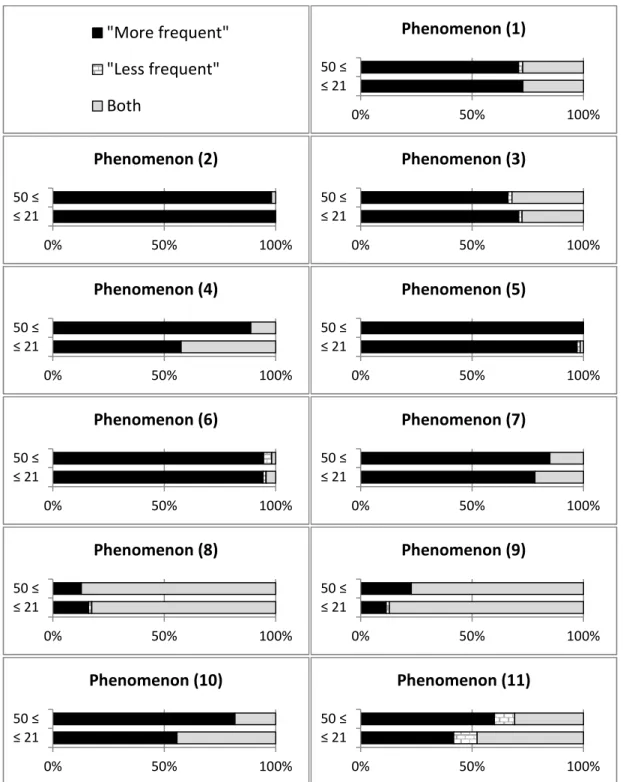
Figure 2 summarizes the results of the sentence evaluation task in the two outermost age
groups (≤ 21 year olds and 50 ≤ year olds).
Figure 2: The evaluation of the 11 phenomena (i.e., 22 contrasting sentence pairs) in the youngest and
oldest age group (answering the question “Which of the two sentences do you find to be correct?”). The label “more frequent” refers to the results of the corpus analysis
(see Section 3.1 and the Supplementary Material)
"More frequent"
"Less frequent"
Both
0% 50% 100%
≤ 21 50 ≤
Phenomenon (1)
0% 50% 100%
≤ 21 50 ≤
Phenomenon (2)
0% 50% 100%
≤ 21 50 ≤
Phenomenon (3)
0% 50% 100%
≤ 21 50 ≤
Phenomenon (4)
0% 50% 100%
≤ 21 50 ≤
Phenomenon (5)
0% 50% 100%
≤ 21 50 ≤
Phenomenon (6)
0% 50% 100%
≤ 21 50 ≤
Phenomenon (7)
0% 50% 100%
≤ 21 50 ≤
Phenomenon (8)
0% 50% 100%
≤ 21 50 ≤
Phenomenon (9)
0% 50% 100%
≤ 21 50 ≤
Phenomenon (10)
0% 50% 100%
≤ 21 50 ≤
Concerning the potential spread of a less frequent form, clear evidence for this was
found only in three cases: (4) (“Lehet, hogy… /Lehet…”), (10) (e.g. “ügyeket
intézek/ügyintézek”), and (11) (e.g. “a gyerekeknek nincs étvágyuk/étvágya”). At first it appears that (11) is very similar to (4) and (10). However, its case is most probably different from the other two phenomena, since (11) is the only phenomenon in which the exclusive acceptance of the less frequent form can be detected in a notable percentage (in almost 10% in both age groups).
Although it is not visible in the graphs, according to post-questionnaire comments of some of the participants (10) also turned out to be an “outlier” in some sense. It is clearly seen in Figure 2 that the younger group accepts the “less frequent” variant of (10) to a larger extent than the older group. However, according to their remarks, the participants do not accept the “less frequent” variant due to it being “innovative”, but rather because of a “difference in style” (relative to the phrasal expression). Namely, some participants noted that they found the “less frequent” forms of (10) to be funny expressions which they regard as correct if used only in jest (in joking, teasing or other highly informal or intimate interactions). The perceived stylistic difference was noted by participants from both age groups.
Phenomena related to article deletion (1), (2), and (3) seem to behave similarly to each other with respect to grammaticality judgments. However, (2) shows a different pattern than that of (1) and (3), i.e. proper noun phrases behave differently from common noun phrases with respect to the deletion of the definite article. It appears that deletion of the definite article of proper noun phrases (where the noun refers to institutions/buildings) is the least accepted phenomenon observable in everyday speech among the tested variables, along with (5), (6) and (7), i.e. the cases concerning the
presence or absence of the subordinator hogy in sentences with a sentence adverbial.
The results for (8) and (9) suggest that optional hogy-deletion and marked versus
unmarked object are examples of variables with widely accepted variants (the less frequent forms and the more frequent forms were equally accepted by 80% of the informants in both age groups), therefore, these forms most probably display stable variation.
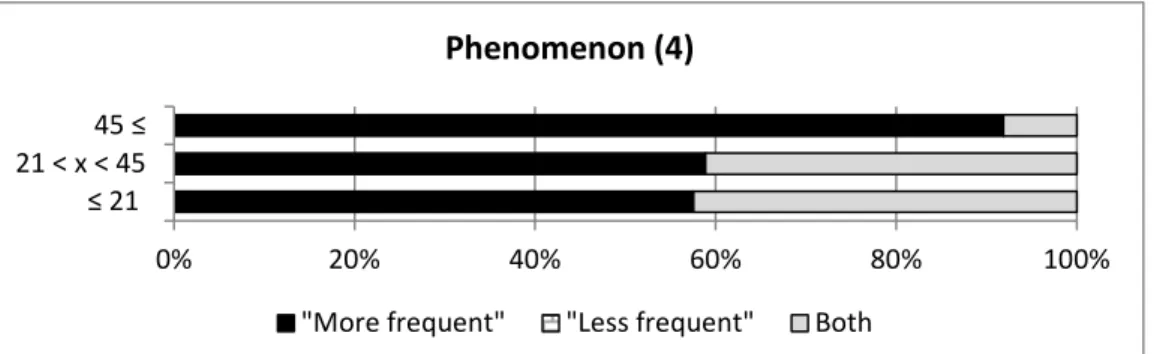
As phenomena (10) and (11), as discussed above, turned out to be more challenging to interpret, it was only phenomenon (4) that was chosen for further analysis.
The data were re-grouped into 3 age groups ≤ 21 year olds, 22 < x < 45 year olds, and 45 ≤
year olds that are more well-balanced in number (14, 24, and 16 participants respectively), to control for the effect that may be introduced by count differences of the original groups. As can be seen on Figure 3, the less frequent and most probably also innovative
form (“Lehet”) of phenomenon (4) is regarded as correct in less than 10% in the oldest
age group 45 ≤, while both variants are accepted in more than 55% in the group 21 < x
Figure 3: The evaluation of the sentences of Phenomenon (4) (answering the question “Which of the two sentences you find to be correct?”) if the data are grouped into 3 age groups 21 ≤ year olds,
22 < x < 45 year olds, and 45 ≤ year olds that are more well-balanced in number (14, 24, and 16 participants respectively)
3.4 Conclusions
We may draw the conclusion that, as expected, only some of the tested phenomena showed a shift in the apparent time, i.e., only some of the phenomena proved to be a diffusing innovation spreading. Concerning phenomena (1), (2), and (3), neither the corpus query nor the test data seem to confirm the authors’ observations that article drop would be an innovation that is spreading in the speech community. However, we would still like to suggest that article drop in certain structural configurations is an innovative form, the presence of which is attestable in the vernacular. It should be kept in mind that while the grammaticality test was conducted in written form, these phenomena and linguistic innovations generally and mostly are observable (first) in informal and spontaneous speech. Therefore, it is very probable that our findings, i.e., the fact that informants do not seem to accept this “innovative” variant in written form, are only indicative of the acceptability of this variant in the given modality, i.e., writing. On the very same basis, however, “less frequent” variants that show greater acceptance in the younger age group under these circumstances may be more reliably considered as linguistic innovations, since, again, they provide evidence for relatively high percentages of acceptance despite the unusual modality.
Based on the reasons discussed above, the second, and most important conclusion
of Experiment 1 is, that the ‘Lehet…’ variant of phenomenon (4) (“Lehet,
hogy…/Lehet…”) is a linguistic innovation that clearly shows greater acceptance in the younger age groups.
According to an evolutionary account (see e.g. Labov 1972, Croft 2000) the differences found between (4) and (11), or (10) and (11) may be interpreted as follows. Consider phenomenon (11) first. The data show that the two competing variants are not just equally accepted, but for some speakers, the new variant has already overridden or replaced the other. If the "less frequent" variant is taken to be an innovation, this reflects that language change has progressed further with regard to (11) than with other phenomena. If, however, one considers this issue from a diachronic point of view, the putative innovative (less frequent) variant is in fact the more archaic member of this pair. In view of the ubiquitous but so far mostly unexplored fluctuation in the distribution of the two forms in throughout the history of Hungarian, we found it necessary to avoid categorization in this case.
0% 20% 40% 60% 80% 100%
≤ 21 21 < x < 45 45 ≤
Phenomenon (4)