Abstract—The extractive desulfurization of simulated fuel containing dibenzothiophene (DBT) and thiophene as sulfur compounds was carried out using SnCl2.2H2O – based Deep
Eutectic Solvent (DES). High performance liquid chromatography (HPLC) was employed for the quantitative monitoring of the sulfur compounds in the fuel. The results showed that the DES exhibits higher desulfurization efficiency for DBT than thiophene. Optimum extraction conditions have it that, extraction efficiencies as high as 69.57% and 47.28% can be achieved with the solvent in a single stage for DBT and thiophene respectively. The work has not only shown that SnCl2.2H2O – based DESs can be used in desulfurization of
liquid fuels but also proved their promising desulfurization ability in the presence of multi-component fuel.
Index Terms—Desulfurization, extraction, deep eutectic solvnts, stannous chloride dehydrate.
I. INTRODUCTION
Crude oil, which is the major source of liquid fuels, naturally contains various kinds of sulfur containing compounds. Removal of these sulfur containing compounds in refining processes to below environmental set limits has drawn an increasing interest from both scientific and industrial communities. Generally, hydrodesulfurization (HDS) is the commercial technology used by most refiners for the removal of sulfur from fuels [1]. This technology is known to require high temperature, high pressure and catalytic operation, and inherent hydrogen consumption, thus making it more costly for deep desulfurization applications. However, HDS alone is not considered effective in removing refractive sulfur-containing compounds like dibenzothiophene (DBT) and its derivatives, especially 4,6-dimethyl-dibenzothiophene (4,6-DMDBT) which is regarded as the least reactive sulfur-containing compound. Therefore, researchers ventured into the development of safer and yet economical techniques for desulfurizing liquid fuels to meet the environmental regulations [2], [3].
Among the proposed techniques, extractive desulfurization (EDS) has shown promising results toward the removal of refractive sulfur-containing compounds from liquid fuels. This technique can be carried out under mild operating conditions thereby leading to low energy
Manuscript received August 12, 2014; revised January 5, 2015. This work was financially supported by The Research Council in Sultan Qaboos University, Muscat Oman under the project RC/ENG/PCED/12/02.
The authors are with the Petroleum and Chemical Engineering Department, Sultan Qaboos University, 123, Sultanate of Oman (e-mail: [email protected]).
consumption and without hydrogen consumption. Some research groups are of the opinion that if HDS is coupled with EDS, sulfur concentrations below the set environmental limit could be achieved [4], [5].
However, the success of EDS is basically governed by the choice of efficient and yet environmentally benign solvents. Most commonly used solvents in the petroleum industries like alcohols, amines, ethers and other volatile organic compounds are faced with challenges of either inefficiency in terms of extraction ability or negative impact on the environment. A class of solvent called ionic liquids (ILs) has been successfully employed in different extraction [6]-[8] and desulfurization processes including EDS [9]. Even though ILs have been found to be efficient in desulfurization of aromatic sulfur compounds at room temperature [4], [5], [10], their poor biodegradability, relative complex synthesis, toxicity and most importantly high cost limit their industrial application [11].
Another class of solvent called IL analogues, often referred to as deep eutectic solvents (DESs), has been developed and their applications in different research fields have recently drawn intensive interest in the research world. DESs are composed of a mixture of a salt and a hydrogen bond donor (HBD) or a complexing agent which results in a homogenous liquid medium with a freezing point lower than the freezing points of the constituent compounds [12]. The easier and simpler procedure involved in synthesizing DESs [13], the flexibility of selecting DES components such that they are biodegradable and nontoxic [14] and ultimately the cheaper components involved in making DESs all sum up together and make DESs more favorable than ILs in terms of their applications in different fields. Although DESs have been successfully applied in various fields [12], they have up till this moment very little application in the field of desulfurization of liquid fuels. Only recently Li et al studied the extraction desulfurization of model fuel with ammonium-based deep eutectic solvents [15]. Some more recent studies on the screening of DESs towards their application in desulfurization process were also carried out by our research group [13], [16]. Findings by both research groups showed that DESs can be promising in the field of desulfurization of liquid fuels.
In continuation with our previous works [13], [16], this work investigates the novel application of SnCl2.2H2O-based
DES for the extractive desulfurization of simulated fuel that contains thiophene and DBT as model refractory sulfur compounds.
Zaharaddeen S. Gano, Farouq S. Mjalli, Talal Al-Wahaibi, and Yahya Al-Wahaibi
The Novel Application of Hydrated Metal Halide
(SnCl
2
.2H
2
O) – Based Deep Eutectic Solvent for the
II. EXPERIMENTAL METHODOLOGY
A. Chemicals
Table I shows the list of chemicals used in this work, alongside their specifications and supplier. All chemicals were used without further purification except for the hygroscopic ones which were dried overnight in a vacuum oven before usage.
TABLE I: LIST OF CHEMICALS AND THEIR SPECIFICATIONS
S/N Name Chemical
Formula
Purity
(%) Supplier
1 Stannous chloride
dihydrate SnCl2.2H2O > 96.0 Fisher a
2 Dibenzothiophene C12H8S > 98.0 Aldrich b
3 Thiophene C2H4S > 99.0 Merck c
4
Tetra-n-butylphos-phonium bromide
[CH3(CH2)3]4P
Br 99.0 Alfa Aesar
d
5 n-Decane C10H22 > 99.0 Merck
6 Cyclohexane C6H12 99.98 Fisher
7 Iso-octane C8H18 > 99.5 Merck
8 Toluene C6H5CH3 > 99.7 Honeywell e
9 Acetone C3H6O > 99.5 Aldrich
10 Acetonitrile C2H3N HPLC
grade Merck
a Fisher Scientific, Loughborough UK; b Sigma-Aldrich, USA; c Merck
Chemicals, Darmstadt Germany; d Alfa Aesar (A John Matthey Company),
Germany; e Honeywell Specialty Chemicals, Seelze GmbH, Germany;
B. DES Synthesis and Characterization
DES synthesis was carried out according to the reported procedure in the literature [13], [17]-[19]. Tetra-n-butylphosphonium bromide was mixed with stannous chloride dihydrate in a molar ratio of 1:1 in an incubator shaker (Brunswick Scientific Model INNOVA 40R) operated under atmospheric pressure at 270 rpm and 80℃ for 2 h. The mixture was shaken until a homogenous pale yellow solution was obtained with no visible precipitate. In order to avoid moisture contamination, the synthesized DES was stored in a well tight screw capped vial inside a moisture controlled desiccator for further analyses.
For characterization of the synthesized DES, its basic physical properties of viscosity, density, conductivity and refractive indices; all as a function of temperature were respectively investigated with Anton PaarRheolabQc viscometer, Anton Paar DMA4500 M density meter, Jenway conductivity meter (model 4520), Bellingham and Stanley Abbe refractometer (model 60/ED). The melting point was determined using a DSC machine (Q20 model from TA instruments).
TABLE II: SYNTHESIZED DES AND ITS MELTING POINT
DES Combination Molar ratio Melting point (℃)
SnCl2.2H2O : [CH3(CH2)3]4PBr 1 : 1 30.23
C. Extractive Desulfurization and Chemical Analyses of Raffinate
In order to have good representation of a liquid fuel used in practical applications, a multicomponent fuel [20] (simulated fuel) consisting of n-decane, cyclohexane, isooctane and toluene was used throughout the course of this work in the following proportions 29.79%, 29.79%, 29.79%, 10.63% respectively.
For the start, a solution standard of sulfur compound in fuel containing 500ppm (w/w) of both thiophene and DBT was formed by dissolving 0.05g of each in 99.9g of the
simulated fuel. Liquid-liquid extraction experiments were carried out by mixing fuel samples with the synthesized DESs samples in closed capped vials inserted into the block of a temperature controlled thermo-mixer (ThermoMixer MKR 13) with specifications shown in Table III.
After each extraction experiment, the thiophene and DBT concentrations in the raffinate phase of the simulated fuel were determined by carrying out high performance liquid chromatography (HPLC) on an Agilent 1260 infinity series HPLC machine (HP1260 infinity, Agilent, USA) with detailed specifications shown in Table IV. The table also shows the conditions of experimental method used in performing the HPLC analyses alongside the correlation coefficients obtained for both thiophene and DBT in their respective calibrations.
Thus, the extraction efficiency of the DES is expressed as:
extraction efficiency, 𝑌 % =𝐶0− 𝐶1
𝐶0 × 100 (1)
where 𝐶0 is the initial thiophene/DBT concentration in fuel (ppmw) and 𝐶1 is the final thiophene/DBT concentration in the raffinate phase (ppmw) after extraction with the DES
III. RESULTS AND DISCUSSIONS
A. Solvent Characterization
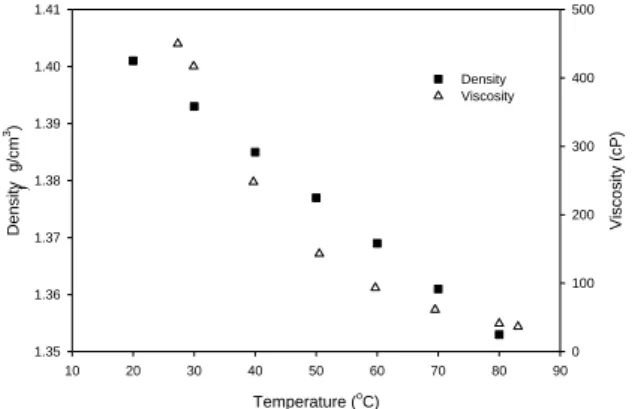
Similar to other DESs reported in the literature, the basic physical properties of the synthesized DES is affected by temperature as shown in Fig. 1 and Fig. 2.
Expectedly, while the viscosity, density and refractive index decrease with temperature, the conductivity increased
TABLE III: THERMOMIXER SPECIFICATIONS
Parameter Specifications
Temperature work range Amb-16°𝐶– 373.15°𝐶
Temperature adjustable range -10°𝐶– +105°𝐶
Accuracy / Resolution +/- 0.1°𝐶/ 0.1°𝐶
Maximum heating rate 6.0°𝐶/ min
Maximum cooling rate 12°𝐶/ min
Shaking frequency 200 – 1,500 rpm
Orbit 3 mm orbital
Dimensions (W ×D ×H) 220 ×330 ×144 mm
Capacity 1 thermoblock
Weight (without block / blocks) 9 kg
Electrical heating- /
cooling-power 130 W
Electrical supply 115 V / 230 V, 50-60 Hz
TABLE IV: HPLC SPECIFICATIONS AND EXPERIMENTAL CONDITIONS
Specifications Equipment model Agilent (1260 Infinity Series)
Column Reversed-phase ZORBAX extended C18, 4.6 ×
150mm, 5𝜇m
Detector Variable Wavelength Detector (VWD)
Pump Quaternary pump
Auto sampler Equipped
Experimental conditions
Mobile phase combination: Acetonitrile and Water (80/20) @ 1ml/min
Injection volume: 1𝜇𝑙
Column temperature: 25℃
with temperature. However, the temperature effect on these properties is more pronounced on the viscosity and conductivity than it is on both the density and refractive index.
Fig. 1. Effect of temperature on the density and viscosity of the DES.
Fig. 2. Effect of temperature on the conductivity and refractive index of the DES.
B. Effect of Extraction Variables onthe Extraction Efficiency of the DES
Extraction experiments were carried out as described in the methodology section and the effect of extraction variables of time, DES mass fraction (solvent mass fraction), temperature, and starting concentration on the desulfurization efficiency of the DES was studied.
Fig. 3. Effect of extraction time on desulfurization efficiency
The effect of time on the desulfurization efficiency of the DES, as shown in Fig. 3, shows that the efficiency for both DBT and thiophene increased rapidly between 0 to 40 minutes of extraction time and become relatively constant beyond 60 minutes. Consequently, 100 minutes was selected
as the extraction time for subsequent extraction experiments. Similarly, the results of the investigation of effect of DES mass fraction, as shown in Fig. 4, show that the desulfurization efficiency of the DES increases significantly with increase in the DES mass fraction. Quantitatively, the efficiency increased from 27.30% and 18.15% at 0.2 mass fraction to 87.80% and 70.72% at 0.8 mass fraction for DBT and thiophene respectively. In order to minimize DES consumption, 0.5 was selected as the solvent mass fraction for subsequent experimental runs
The efficiency however showed a somewhat decreasing trend with temperature as shown in Fig. 5. Although this is contrary to our expectation that extraction efficiency would increase with temperature, particularly from the findings of our previous work [16], a probable explanation to it is due to the observed increase in vaporization of the fuel from the raffinate phase at higher temperatures when taking sample for quantitative analysis thereby increasing the concentration of sulfur compounds in the same phase. This would eventually decrease the calculated extraction efficiency of the DES from Equation 1, thus making the temperature effect on the extraction efficiency exhibit a decreasing trend.
Fig. 4. Effect of solvent mass fraction on desulfurization efficiency.
However, this does not mean that the absolute removal of sulfur compound from the fuel by the DES is reduced, it only means that change in concentration may not be the suitable criterion for establishing a trend between DES extraction efficiency and extraction temperature. Absolute amount of sulfur compounds in the fuel before and after extraction would have given a better and accurate picture of the exact trend.
Therefore, 30℃ was the selected extraction temperature for other extraction experiments.
Fig. 5. Effect of temperature on desulfurization efficiency. Temperature (oC)
10 20 30 40 50 60 70 80 90
D
ens
ity
g
/c
m
3)
1.35 1.36 1.37 1.38 1.39 1.40 1.41
Vis
c
os
ity
(
c
P)
0 100 200 300 400 500
Density Viscosity
Temperature (oC)
10 20 30 40 50 60 70 80 90
Cond
uct
iv
it
y
(
S
/cm
)
500 1000 1500 2000 2500 3000
Ref
ractiv
e
Ind
ex
1.530 1.535 1.540 1.545 1.550 1.555
Conductivity Refractive Index
Time (min)
0 20 40 60 80 100 120 140 160 180 200
E
x
tra
c
tion ef
fic
ienc
y
(%
)
0 10 20 30 40 50 60 70
DBT Thiophene
Solvent mass fraction
0.2 0.25 0.3333 0.5 0.6666 0.75 0.8
E
x
trac
tion
ef
fic
ienc
y
(%
)
0 20 40 60 80 100
DBT Thiophene
Temperature (oC)
30 40 50 60 70 80
Ex
tr
ac
tion ef
fic
ienc
y
(
%
)
20 40 60 80
Interestingly, starting concentration showed a relatively constant effect on the extraction efficiency of the DES as shown in Fig. 6. This suggests that concentration gradient, which is the major driving force involved in mass transfer, is not the driving force in extraction. Rather, the characteristic nature of the solvents involved vis-à-vis their relative affinity towards the solute (in this case sulfur compounds) determine the driving force and its direction. Asumana et al. [21] and many other research groups [5], [15], [22]-[24] made similar findings in their works related to desulfurization of liquid fuels with ionic liquids.
Fig. 6. Effect of starting concentration on desulfurization efficiency.
C. Deep Desulfurization Ability of DES
Taking into consideration the trend exhibited by the effect of solvent mass fraction on the desulfurization efficiency of the DES, carrying out deep desulfurization of the fuel in a single extraction experiment would require very high solvent mass fraction (close to unity) that could be impractical to perform. Consequently, the deep desulfurization of the fuel was achieved in multiple and successive extraction stages by changing fresh solvent and maintaining the same fuel across the experiments.
However, extraction conditions of time, temperature and solvent mass fraction across the successive stages were maintained as those in the first stage.
Fig. 7a. Effect of multistage extraction on desulfurization efficiency.
The trend shown in Fig. 7a means that extraction efficiency of the DES could be greatly improved by multiple extraction stages because efficiency as high as 97% and 80% could be achieved for DBT and thiophene respectively. This
also means that concentrations of sulfur compounds in the fuel have been remarkably lowered as shown in Fig. 7b. However, similar to preceding analyses, the DES showed higher extraction efficiency for DBT than thiophene.
Fig. 7b. Effect of multistage extraction on the concentration of sulfur compounds in fuel.
D. Extraction Capacity of DES
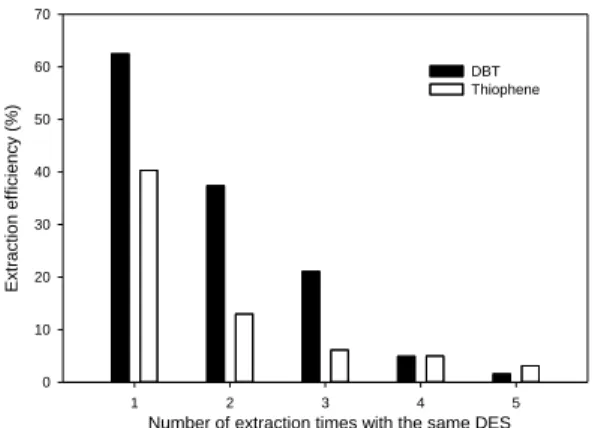
A characteristic ability of the DES that cannot be left unexplored is its extraction capacity, which simply means the performance of the same DES in multiple extractions without regeneration. Fig. 8 shows the trend exhibited by the DES in this regard. It is obvious in the second cycle that the DES loses its extraction ability by about 40% of what it was in the first cycle. Even though this is discouraging, the option of solvent regeneration, which is in prospect for this work, could be a suitable remedy.
Fig. 8. Extraction capacity of DES.
IV. CONCLUSION
Extractive desulfurization of multicomponent fuel containing dibenzothiophene and thiophene as sulfur compounds was successfully carried out using SnCl2.2H2O –
based DES. The DES was found to be effective in the desulfurization of simulated fuel when compared with the performance of its ionic liquids counterparts in the same field.
The study showed that extraction time, solvent mass fraction and extraction temperature affect the desulfurization efficiency of the DES. The deep desulfurization of fuel by the DESs was also carried out and achieved in the fifth extraction
Starting concentration (ppm)
500 1000 1500 2000 2500 3000
E
x
tr
ac
tion
ef
fic
ienc
y
(
%
)
20 30 40 50 60 70
DBT Thiophene
Exctraction Stage
1st 2nd 3rd 4th 5th
E
x
trac
tion
ef
fic
ien
c
y
(%
)
20 40 60 80 100
DBT Thiophene
Extraction stage
0 1st 2nd 3rd 4th 5th
Co
nce
nt
rat
io
n
of
sul
fur
com
pou
nd
in
f
uel
(ppm
)
0 100 200 300 400 500 600
DBT Thiophene
Number of extraction times with the same DES
1 2 3 4 5
E
x
tra
c
tion ef
fic
ienc
y
(%
)
0 10 20 30 40 50 60 70
stage. Similarly, it was found that while multiple reuse of the
solvent decreased its desulfurization ability, starting sulfur concentration in fuel has negligible effect on the same ability.
REFERENCES
[1] H. Zhang, J. Gao, H. Meng, and C.-X. Li, “Removal of thiophenic
sulfurs using an extractive oxidative desulfurization process with three
new phosphotungstate catalysts,”Industrial & Engineering Chemistry
Research, vol. 51, pp. 6658-6665, 2012.
[2] V. C. Srivastava, “An evaluation of desulfurization technologies for
sulfur removal from liquid fuels,”RSC Advances, vol. 2, pp. 759-783,
2012.
[3] J. M. C. Martin, M. C. C. Sanchez, P. P. Presas, and J. L. G. Fierro,
“Oxidative processes of desulfurization of liquid fuels: Review,” Journal of Chemical Technology and Biotechnology, vol. 85, pp. 879-890, 2010.
[4] H. Gao et al., “Desulfurization of fuel by extraction with
pyridinium-based ionic liquids,”Industrial & Engineering Chemistry
Research, vol. 23, pp. 8384-8388, 2008.
[5] Y. Nie, C.-X. Li, and Z.-H. Wang, “Extractive desulfurization of fuel
oil using alkylimidazole and its mixture with dialkylphosphate ionic
liquids,” Industrial Engineering Chemistry Research, vol. 46, pp.
5108-5112, 2007.
[6] H. Zhao, S. Xia, and P. Ma, “Use of ionic liquids as „green‟ solvents for
extraction: Review,” Journal of Chemical Technology and
Biotechnology, vol. 80, pp. 1089-1096, 2005.
[7] C. F. Poole and S. K. Poole, “Review: Extraction of organic
compounds with room temperature ionic liquids,” Journal of
Chromatography A, vol. 1217, pp. 2268-2286, 2010.
[8] S. Keskin, D. K. Talay, U. Akman, and O. Hortacsu, “A review of ionic
liquids towards supercritical fluid applications,” Journal of
Supercritical Fluids, vol. 43, pp. 150-180, 2007.
[9] P. S. Kulkarni and C. A. M. Afonso, “Deep desulfurization of diesel
fuel using ionic liquids: current status and future challenges: Critical
review,”Green Chemistry, vol. 12, pp. 1139-1149, 2010.
[10] H. Gao et al., “Desulfurization of diesel fuel by extraction with
lewis-acidic ionic liquid,”Separation Science and Technology, vol. 44,
pp. 971-982, 2009.
[11] A. O. Diallo, C. Len, A. B. Morgan, and G. Marlair, “Revisiting
physico-chemical hazards of ionic liquids,”Separation & Purification
Technology, vol. 97, pp. 228-234, 2012.
[12] Q. Zhang, K. D. O. Vigier, S. Royer, and F. Jerome, “Deep eutectic
solvent: syntheses, properties and applications,” Chemical Society
Reviews, vol. 41, pp. 7108-7146, 2012.
[13] Z. S. Gano, F. S. Mjalli, T. A. Wahaibi, Y. A. Wahaibi, and I. M. AlNashef, “Solubility of thiophene and dibenzothiophene in anhydrous
FeCl3- and ZnCl2- based deep eutectic solvents,” Industrial &
Engineering Chemistry Research, vol. 53, pp. 6815-6823, 2014.
[14] M. Hayyanet al., “Short communication: Are deep eutectic solvents
benign or toxic?”Chemosphere, vol. 90, pp. 2193-2195, 2013.
[15] C. Li et al., “Extraction desulfurization process of fuels with
ammonium-based deep eutectic solvents,”Green Chemistry, vol. 15,
pp. 2793-2799, 2013.
[16] U. A. Z. S. G. I. M. A. F. S. Mjalli, T. A. Wahaibi, and Y. A. Wahaibi, and Omar, “Ionic solvents for the deep desulfurization of liquid fuels,” in Proc. International Symposium on Materials Characterization and Testing, Kuala Lumpur, Malaysia, 2014, pp. 78-90.
[17] A. Hayyanet al., “Fruit sugar-based deep eutectic solvents and their
physical properties,”Thermochemica Acta, vol. 541, pp. 70-75, 2012.
[18] F. S. Mjalli, J. Naser, B. Jibril, V. Alizadeh, and Z. Gano, “Tetrabutylammonium chloride based ionic liquid analogues and their
physical properties,”Journal of Chemical & Engineering Data, vol. 59,
pp. 2242-2251, 2014.
[19] F. S. Mjalli, J. Naser, B. Jibril, S. S. A. Hatmi, and Z. S. Gano, “Ionic
liquids analogues based on potassium carbonate,”Thermochimica acta,
vol. 575, pp. 135-143, 2014.
[20] L. Alonso, A. Arce, M. Francisco, O. Rodriguez, and A. Soto, “Gasoline desulfurization using extraction with [C8mim][BF4] ionic
liquid,”AIChE Journal, vol. 53, pp. 3108-3115, 2007.
[21] C. Asumana et al., “Extractive desulfurization of fuel oils with
low-viscosity dicyanamide-based ionic liquids,”Green Chemistry, vol.
12, pp. 2030-2037, 2010.
[22] H. Gao et al., “Extractive desulfurization of fuel using
3-methylpyridinium-based ionic liquids,”Energy & Fuels, vol. 23, pp.
2690-2694, 2009.
[23] D. Liu, J. Gui, L. Song, X. Zhang, and Z. Sun, “Deep desulfurization of
diesel fuel by extraction with task-specific ionic liquids,”Petroleum
Science and Technology, vol. 26, pp. 973-982, 2008.
[24] Y. Nie, C. Li, A. Sun, H. Meng, and Z. Wang, “Extractive desulfurization of gasoline using imidazolium-based phosphoric ionic
liquids,”Energy and Fuels, vol. 20, pp. 2083-2087, 2006.
Zaharaddeen Sani Gano was born in Nigeria in 1982. He obtained his B.Eng. in chemical engineering from Ahmadu Bello University, Zaria, Nigeria in 2008, and MSc in process design from the University of Manchester, UK in 2011 and currently he is pursuing his PhD in chemical and process engineering at Sultan Qaboos University, Muscat, Oman.
He is a senior research officer at National Research Institute for Chemical Technology (NARICT), Zaria in Nigeria. His research experience includes design of pilot gasification plant for the conversion of coal-to-methanol. His current research area focuses on the development of green solvents for desulfurization of liquid fuels.
Mr Gano is a member of the Nigerian Society of Chemical Engineers, Nigerian Society of Engineers, all Zaria chapters, Nigeria.
![TABLE II: S YNTHESIZED DES AND I TS M ELTING P OINT DES Combination Molar ratio Melting point (℃) SnCl 2 .2H 2 O : [CH 3 (CH 2 ) 3 ] 4 PBr 1 : 1 30.23](https://thumb-us.123doks.com/thumbv2/123dok_us/8071036.2137975/2.893.457.820.762.1007/table-ynthesized-elting-oint-combination-molar-ratio-melting.webp)