EFFECT OF HYPNOBIRTHING ON THE PROGRESS OF THE
LATENT PHASE OF LABOR
IN PRIMIGRAVIDA
Wiwik Muhidayati1*, Syarif Thaufik Hidayat2, Nur Khafidhoh3,Ari Suwondo4
1Postgraduate Midwifery Program, Semarang Health Polytechnic, Semarang, Indonesia 2Medical Staff Group of Obstetric Gynecology Department, Dr. Kariadi Hospital, Semarang, Indonesia
3Lecturer, Semarang Health Polytechnic, Semarang, Indonesia
4Health and Work Safety Department, Faculty of Public Health, Diponegoro University, Semarang, Indonesia
*Corresponding author: Wiwik Muhidayati, MTr.Keb
Postgraduate Midwifery Program, Semarang Health Polytechnic, Jl. Tirto Agung, Pedalangan, Banyumanik, Kota Semarang, Jawa Tengah, Indonesia (50268)
Email: [email protected]
Abstract
Background: The first stage of labor is a tiring moment for mothers, which may cause exhaustion, dehydration, risk of infection, uterine atony, and postpartum hemorrhage. Hypnobirthing is considered effective to speed up early labor process.
Objective: This study aimed to examine the effect of hypnobirthing on the progress of the latent phase of labor.
Methods: This study was a quasi-experiment with posttest only control group design. Thirty-two primigravida mothers in the latent phase of labor were selected using purposive sampling, with 16 assigned in the experiment group and the control group. The progress of labor was measured by four indicators recorded in partograph, namely frequency and duration of uterine contraction, cervical dilatation, and descent of the fetal head.Independent t-test was used for data analysis.
Results: There was a significant difference in the frequency of uterine contraction (p=0.001), duration of contraction (p=0.001), cervical dilatation (p=0.007), and descent of the fetal head (p=0.001) between the experiment group and the control group.
Conclusion: Hypnobirthing technique is significant in accelerating the progress of the latent phase of labor in primigravida mothers.
Keywords: hypnobirthing; latent phase; labor; primigravida
INTRODUCTION
The duration of labor is influenced by several factors, such as uterine strength, abdominal muscle contraction, diaphragm contraction and ligament action. The other factors are the fetal factor (passanger) and the factor of the
birth passage (Karo, Pramono, Wahyuni,
Mashoedi, & Latifah, 2017). Labor is divided into 4 stages, namely (i) the opening stage, (ii) the expenditure stage, (iii) the stage that the placenta is released from the uterine wall and is born, and (iv) the stage from the birth of the
placenta up to the next 2 hours (Wahyuni,
Pramono, Suherni, & Widyawati, 2017). The progression of labor in the first stage is a tiring moment, which a mother begins to feel pain because the activity of the uterus begins to be more active. The first stage of labor may cause exhaustion, dehydration, risk of infection, uterine atony, and postpartum hemorrhage. If this stage is not well-managed, the safety of mothers and fetus may be affected (Khomsah, Suwandono, & Ariyanti, 2017).
© 2018 The Author(s)
This is an Open Access article distributed under the terms of the Creative Commons Attribution 4.0 International License which permits unrestricted non-commercial use, distribution, and reproduction in any medium, provided the original work is properly cited.
In Indonesia, Maternal Mortality Rate (MMR) during childbirth remains high as the third highest rank in South Asia and Southeast Asia. There were 228 maternal deaths per 100,000 live births in 2007, increased to 359 maternal deaths per 100,000 live births in 2012, and decreased slightly to 305 maternal
deaths per 100,000 live births in 2015 (World
Health & Unicef, 2014). On the other hand, the complications during labor are common in Indonesia, such as postpartum hemorrhage, trapped placenta, prolonged pregnancy and infection. The prolonged labor accounted for
11% of maternal deaths in Indonesia (MOH,
2014).
Based on preliminary study in 4 midwives on November 2016 in Midwifery Center in Lamongan regency, it is found that primigravida mothers often experienced problems in the first stage of labor, with the average of > 13 hours. The first stage of labor refers to the time required to deal with labor begins with regular uterine contractions until the cervix opens completely. Normally, the length of first stage of primigravida is 13 hours, and multipara is 7 hours. Thus, the efforts to maintain uterine contraction in the first stage of labor is needed.
One of the efforts is by using hypnobirthing technique. This technique is a combination of a natural birth process with hypnosis to build positive perceptions and self-esteem and decrease fear, anxiety, tension and panic
before, during and after childbirth (Kuswandi,
2014). The hypnobirthing method is either
autohypnosis (self-hypnosis) in facing and
undergoing pregnancy and childbirth
preparation in order to be able to go through their pregnancy and childbirth in a natural, fluent, and comfortable (painless) way (Kuswandi, 2014).
Hypnobirthing combines breathing technique, relaxation, affirmation and visualization, as well as deepening. In breathing techniques, the mother can save energy during the depletion phase during cervical dilatation. In addition, the slow breathing that is taught can dilute and open the cervix that can shorten the
duration of labor. While relaxation,
visualization, and affirmations help mothers cope with tension, stress, and discomfort
during childbirth (Mongan, 2016).
Previous studies have been studied have been conducted about the effect of hypnobirthing in labor process (Astuti & Noviyanti, 2016;
Madden, Middleton, Cyna, Matthewson, & Jones, 2012), but lack of study related to the its effect on the progress of the latent phase of labor. Thus, the aim of this study was to examine the effect of hypnobirthing on the progress of the latent phase of labor.
METHODS
Study design
This study employed a quasi-experimental study with posttest only control group design.
Setting
The research was conducted in four Independent Midwifery Practice Centers in Lamongan Regency on January 8, 2016 until February 2, 2017.
Sample
Thirty-two primigravida mothers in the latent phase of labor were selected using purposive sampling, which 16 assigned in the experiment and control group.
Intervention
Hypnobirthing was implemented by the researchers who have been trained and certified. Hypnobirthing was done 30-45 minutes with lemon test and suggestibility test assisted by midwives in the location of the study.
Instrument
Demographic instrument was used to collect the demographic data of the respondent, such as age, education, occupation/activity, and
parity). To measure the effect of
hypnobirthing on the progress of the latent phase of labor, partograph was used with four
contraction, cervical dilatation, and descent of the fetal head.
Ethical consideration
The research has met the ethical requirements of the Ethics Research Commission of Politeknik Kesehatan Kemenkes Semarang with approval number: 049 / KEPK / Poltekkes-Smg / EC / 2017. The study permission was also obtained from four Independent Midwifery Practice Centers. Informed consent was signed by each respondent. All of the respondents were given explanation about the research objectives, procedures, risks and benefits, confidentiality and willingness.
Data analysis
Descriptive statistics was used to describe
mean and frequency distribution of
characteristics of the respondents.
Independent t-test was used to see the
difference in both experiment and control group.
RESULTS
Table 1 shows that majority of the respondents aged 21-30 years, with 10 respondents in the experiment group and 13 respondents in the control group. There was no difference of the age between the two groups with p=0.433. While the respondent’s education in the control group was mostly senior high school (10 respondents) and the experiment group was senior high school (6 respondents) and university level (6 respondents). However, there was no difference of educational level between both groups with p= 0.343. And majority of the respondents in both groups worked as a housewife (p=0.559)
Table 1 Characteristics of the respondents
Category Experiment (n = 16) Control (n=16) Homogeneity test P-value (Chi Square) Mother’s age (year)
≤ 20 6 3 0.165 0.433
21 - 30 10 13
Mother’s Education
Junior high school 4 3
0.100 0.343
Senior high school 6 10
University level 6 3
Mother’s occupation
Housewife 9 11
0.142 0.559
Entrepreneur 2 3
Teacher 4 2
Farmer 1 0
Table 2 Frequency and duration of contraction, cervical dilatation, and descent of the fetal head
Variables Mean SD
Frequency of contraction (per 10 min)
Experiment group 3.929 0.534
Control group 3.000 0.549
Contraction duration (second/contraction)
Experiment group 39.335 2.863
Control group 35.539 2.708
The progress of cervix dilatation (cm)
Experiment group 3.563 1.750
Control group 2.125 0.957
Descent of fetal head
Experiment group 1.125 0.500
Table 2 shows that the mean of frequency of contraction evaluated in 10 minutes in the experimental group was 3.929 times with standard of deviation of 0.534. While the mean of frequency of contraction in the control group was 3.000 times, and a standard deviation of 0.549. It is also known that the mean of duration of contraction in each time of contraction in the experimental group was 39.335 seconds with standard of deviation of 2.863. While the mean of duration of contraction in each time of contraction in the control group was 35.539 seconds with
standard of deviation of 2.708. The mean of the progress of cervical dilatation in the experimental group was 3.563 cm with standard deviation of 1.750. While the mean of the progress of cervical dilatation in the control group was 2.125 cm with standard deviation of 0.957. Table 2 also shows that the mean of descent of fetal head in the experimental group was 1.125 with standard deviation of 0.500; while the mean of descent of fetal head in the control group was 0.125 with standard deviation of 0.342.
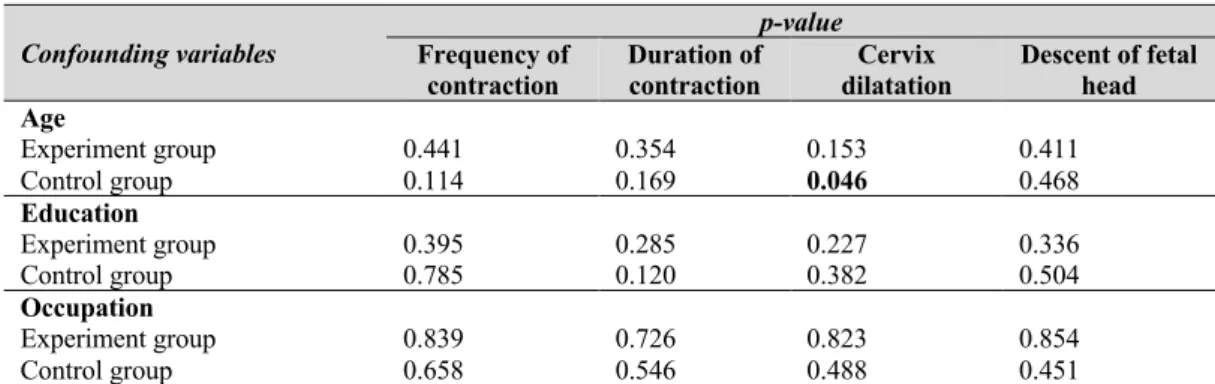
Table 3 Contingency coefficient test on confounding variables
Confounding variables
p-value Frequency of
contraction
Duration of contraction
Cervix dilatation
Descent of fetal head Age
Experiment group
Control group 0.441 0.114 0.354 0.169 0.153 0.046 0.411 0.468
Education
Experiment group Control group
0.395 0.785
0.285 0.120
0.227 0.382
0.336 0.504
Occupation
Experiment group Control group
0.839 0.658
0.726 0.546
0.823 0.488
0.854 0.451
Table 3 shows that there were no significant effects of confounding variables on frequency and duration of contraction, cervical
dilatation, and descent of the fetal head, only age variable had a significant effect on cervix dilatation.
Table 4 Difference of frequency and duration of contraction, cervical dilatation, and descent of the fetal head between the experiment and control group using Independent t-test
Variable Experiment Control t p-value
Mean SD Mean SD
Frequency of contraction 3.929 0.534 3.000 0.549 4.851 0.001
Duration of contraction 39.335 2.863 35.539 2.708 2.853 0.001
Cervix dilatation 3.563 1.750 2.125 0.957 2.883 0.007
Descent of fetal head 1.125 0.500 0.125 0.342 6.606 0.001
Table 4 shows that there was a significant difference in the frequency of contraction (p=0.001), duration of contraction (p=0.001), cervical dilatation (p=0.007), and descent of the fetal head (p=0.001) between the experiment and control group.
The result of effect size calculation in this study was 1.69 for frequency of contraction, 1.401 for duration of contraction, 1.502 for cervical dilatation, and 2.92 for descent of
fetal head, which indicated that there was a very strong influence of hypnobirthing on the progress of labor.
DISCUSSION
cervical dilatation, and descent of the fetal head. In this study, the average of frequency of contraction in 10 minutes in the experimental group was 3.929 times and its duration in each time of contraction was 39.335 seconds. This shows that the frequency and duration of contraction in the experimental group were good enough, as stated by previous study that contraction in the latent phase of labor is adequate if its contraction is > 2 times and duration is
closely to 40 seconds (Sumapraja, 2002).
The results of this study also showed that the average of cervical dilatation in the experimental group in the first 4 hours of the first stage was 3.563 cm and some of them had the progress of descent of fetal head. It suggests that the cervical dilatation in the experimental group was quite effective, as previous study says that the normal cervical dilatation size in the latent phase of labor is about 3 cm (Varney, Kriebs, & Gegor, 2007).
While the fetal head descent in the latent phase rarely shows a progress. In the experimental group, the progress of fetal head descent was very good, as most have progressed from Hodge 1 to Hodge 2 and Hodge 3. According to literature, in normal labor, the advancement of cervical dilatation is always followed by a decrease in the lower part of the fetus or fetal head descent. Usually the fetal head descent occurs after the cervical dilatation reaches 7 cm or after the first 4 hours of the first stage, but if the descent of head can be achieved before that, then the process of delivery is faster than normal (Farrer, 1990).
The progress of labor achieved by the experimental group cannot be separated from the influence of hypnobirthing technique given for 60 minutes. The hypnobirthing used relaxation techniques, including breathing exercises, relaxation and visualization with positive suggestion. According to literature, hypnobirthing aims for the mother to be able to give birth comfortably, quickly and smoothly and eliminate the pain of childbirth without any anesthetic aid. This method also
emphasizes more on giving birth in a positive, gentle, secure way and how to achieve it
easily (Aprillia, 2010). In this study,
respondents were very cooperative following the guidance of hypnobirthing technique to obtain useful results.
Hypnobirthing is a natural method used to eliminate fear, panic, tension and other stresses of mothers in labor. Therefore, it is said that hypnobirthing refers more to hypnotherapy, namely the exercise of subconscious suggestion to support the conscious mind that controls the mother's
action in undergoing labor process (Mongan,
2016). Hypnobirthing is intended to prepare
and train the muscles that play an optimal role in the process of delivery through breathing exercises, relaxation, visualization, and affirmations and deepening. These exercises can affect mother’s power, passage,
passanger, psychology, and helpers (Mongan,
2016).
The breathing technique helps the mother save energy during labor phases. Breathing slowly maximizes waves of vertical muscles to work more efficiently in pulling up the lower circular muscles, as well as diluting and opening the cervix. Hypnobirthing teaches a deeper level of relaxation to eliminate stress as well as fear and anxiety ahead of birth (Mongan, 2016).
On the fetus factors, hypnobirthing teaches the mother to communicate with the fetus.
Relaxation methods were used for
The results of this study were in line with previous study showed there was a significant influence of deep breathing exercises on the progress of labor (Astuti & Noviyanti, 2016;
Yulidaningsih, 2006). The practice of relaxation is an important part of the hypnobirthing technique, but the difference is that relaxation technique performed by previous study was a progressive muscle
relaxation technique (Yulidaningsih, 2006),
while the relaxation technique in
hypnobirthing in this study was deep breath relaxation.
However, the method of hypnobirthing can provide mental support that positively impacts the mother's psychological state, which affects the smoothness of the labor process. At the time of delivery, stress hormones, such as adrenaline, interact with beta-receptors in the uterine muscle and inhibit contraction and delay labor, therefore mothers require relaxed
and comfortable conditions (Mongan, 2016).
When the condition is calm and relaxed, the subconscious mother will adjust the body's harmony and produce anesthesia or natural anesthesia in the mother, the endorphin hormone. Hypnobirthing is proven effective in providing comfort at the time of delivery.
Limitation of the study
The obstacles and limitations encountered during the implementation of this intervention are the presence of the family of the respondents that await the delivery process, which affected the concentration of the respondents. On the other hand, theoretically, the implementation of hypnobirthing should start from the first trimester of pregnancy, but in this study the implementation of hypnobirthing was only given at the latent phase, so the result might be less than the maximum.
CONCLUSION
Based on the results of this study, it can be concluded that hypnobirthing has a significant
effect on frequency and duration of
contraction, cervical dilatation, and descent of
the fetal head. Thus, primipara mothers are suggested to develop hypnobirthing technique independently from the beginning of pregnancy until the labor process to speed up the progress of normal labor. Midwives are also recommended to apply hypnobirthing technique in antenatal care services. The technique is expected to assist midwives in reducing the risk of obstacles and complications in normal labor.
Declaration of Conflicting Interest
None declared.
Funding
This study was supported by Postgraduate Midwifery Program, Semarang Health Polytechnic, Semarang, Indonesia.
Author Contribution
All authors contributed equally in this study.
References
Aprillia, Y. (2010). Hipnostetri. Jakarta, Indonesia: GagasMedia.
Astuti, I., & Noviyanti, N. (2016). Pengaruh hypnobirthing terhadap tingkat nyeri dan kemajuan persalinan pada ibu bersalin di BPM Kota Cimahi [Effect of hypnobirthing on pain and pregnancy status in pregnant mothers at BPM Kota Cimahi]. The Southeast Asian Journal of Midwifery, 1(1), 43-47.
Farrer, H. (1990). Maternity care (2nd ed.). New York: Churchill Livingstone.
Karo, H. Y. K., Pramono, N., Wahyuni, S., Mashoedi, I. D., & Latifah, L. (2017). Lavender (lavandula angustifolia) aromatherapy as an alternative treatment in reducing pain in primiparous mothers in the active first stage of labor.
Belitung Nursing Journal, 3(4), 420-425. Khomsah, Y. S. b., Suwandono, A., & Ariyanti, I.
(2017). The effect of acupressure and effleurage on pain relief in the active phase of the first stage of labor in the Community Health Center Of Kawunganten, Cilacap, Indonesia. Belitung Nursing Journal, 3(5), 508-514.
Kuswandi, L. (2014). Gentle hypnobirthing a gentle way to give birth. West Java, Indonesia: Puspa Swara.
Madden, K., Middleton, P., Cyna, A. M., Matthewson, M., & Jones, L. (2012). Hypnosis for pain management during labour and childbirth.
Cochrane Database of Systematic Reviews, 11.
MOH. (2014). Health profile of Indonesia 2014. Jakarta: Ministry of Health of Indonesia.
Sumapraja, S. (2002). Normal delivery. Jakarta: FK-UI. Varney, H., Kriebs, J. M., & Gegor, C. L. (2007). Buku
ajar asuhan kebidanan [Teaching book of midwifery care]. Jakarta: EGC.
Wahyuni, I., Pramono, N., Suherni, T., & Widyawati, M. N. (2017). Effect of pregnancy exercise on duration of the first and second stage of labor in primigravida mothers during the third trimester of pregnancy. Belitung Nursing Journal, 3(6), 765-770.
World Health Organization. (2014). Trends in maternal mortality: 1990-2010. Geneva, Switzerland: WHO.
Yulidaningsih, E. (2006). Pengaruh teknik relaksasi progresif terhadap kemajuan persalinan pada ibu inpartu primigravida kala 1 fase aktif di RB/BKIA Aisyiyah Bandung Tulungagung [Effect of progressive relaxation technique on pregnancy status in primigravida mothers at active phase I at RB/BKIA Aisyiyah Bandung
Tulungagung]. Surabaya: Universitas
Airlangga.