Abstract—The establishment of the technological mode of the freeze drying process of Penaeus monodon was based on the solution to a multi-objective optimization problem. Experiments were carried out to set up the objective functions describing the influence of technological factors (temperature and pressure of freeze drying chamber, and time of freeze drying) to the freeze drying process. The restricted area method was applied to solve the multi-objective optimization problem, determining the optimal technological mode of freeze drying process (correspondingly 31.000C, 0.008mmHg, and 13.82h) in order that the objective functions reached the minimum value in terms of the final product, including the energy consumption of 5.84 kWh/kg, the residual water content of 4.67%, the anti-rehydration capacity of 6.98%, the volume contraction of 8.49% and the loss of total protein of Penaeus monodon after freeze drying of 2.95%.
Index Terms—Multi-objective optimization, freeze drying, technological freeze drying mode, penaeus monodon.
I. INTRODUCTION
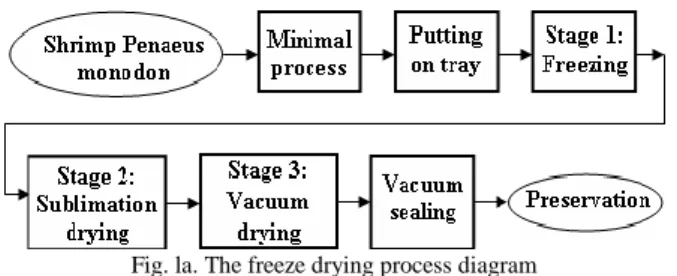
The freeze drying is a process including three consecutive main stages, (Fig 1a), [1]-[6].
Fig. la. The freeze drying process diagram
Firstly, the freezing material stage: this stage requires quickly freezing product in order that the temperature of product reaches the optimal freezing temperature. At that time, water in food is completely frozen.
Secondly, the sublimation drying stage: crystallized water inside product will be sublimated from solid state to moisture state. This stage finished when the temperature of product is higher than crystallization temperature of water inside product. At this time, water inside product is liquid state.
Finally, the vacuum drying stage: water inside product will be evaporated from liquid state to moisture state. This stage finished when the residual water content of the final product
Manuscript received April 16, 2012; revised June 15, 2012. This work was supported in part by the Faculty of Chemical and Food Technology, Ho Chi Minh City University of Technical Education.
The authors are with University of Technical Education; 01-VO Van Ngan Street, Thu Duc District, HCM City, Viet Nam (e-mail: [email protected]).
reaches (2 6)%.
It can be showed that the freeze drying is a quite complicated technology. Howere, there have been a number of researches on establishing and solving the mathematical models of heat and mass transfer for the freeze drying applied to many different types of drying materials, which results in the determination of the kinetics of the freeze drying process. One of the most typical model was the one of Luikov A.V. (1972) [1], from which Liapis A.I. et al. (1996) [2], Pikal M.J. et al. (1984 and 1989) [3], [4] and Khalloufi S. et al. (2004) [5], they achieved the mathematical models of heat and mass transfer for the freeze drying of specific drying materials. Mainly in these researches the kinetics of the freeze drying process was focused to establish the technological parameters, but the assessment of the qualified products via the freeze drying mode reaching the objectives such as minimum energy consumption or residual water content of final products still remained unsolved [6]-[8]. The combination of these targets with the determination of the freeze drying mode is the problem of multi-objective optimization. However, it is complicated to give an answer to the multi-objective optimization problem. As always tests of the multi-objective optimization problem is a set of optimal Pareto test, each application of different methods will give different optimal Pareto tests. There are currently numerous methods applied to this problem, namely linear combination [9], fuzzy data classification [10] and Harrington method [9],[10], which reveals the subjective concept of the expert group on deciding the importance of each objective function. Therefore, the utopian point method or the restricted area method based on Pareto optimization theory is necessarily replaced to obtain the results more objective.
According to [11], [12], the freeze drying mode of Penaeus vannamei was determined with two objectives: the energy consumption, the residual water content of the final product, but the volume contraction and the capability of rehydration and the loss of total protein of the freeze dried product (or the final product), which were indispensable in mass production, were not mentioned. As a result, in order to manufacture, the freeze drying mode should be established on five objectives: the energy consumption, the residual water content, the capability of rehydration, the volume contraction and the loss of total protein of product.
It is obvious that three main stages of the freeze drying is a complicated technique [1]-[6]. These final stages determine the quality of the final product [6], [7]
The determination of the freeze drying mode required the outputs to reach the minimal level (Fig 1b), including the energy consumption per weight (y1, kWh/kg), the residual water content (y2, %), the anti-rehydration capacity (y3, %),
Nguyen Tan Dzung
the volume contraction (y4, %) and the loss of total protein (y5, %) of the freeze-dried product (final product). It should be emphasized that these 5 outputs were affected by the 3 technological factors: temperature of freeze drying chamber (Z1,
0
C), pressure of freeze drying chamber (Z2, mmHg) and time of freeze drying (Z3, h).
Fig. 1b. diagram of freeze drying.
However, the simultaneous consideration of all these outputs above to reach the minimal level resulted in the standard solution to the multi-objective optimization problem [13], [14]. This problem regularly appears in reality and in different fields. The answer to the multi-objective optimization problem was found in the case of the application of the R*(Z) optimal combination criterion (also known as the restricted area method, [13]) for the freeze drying process of Penaeus monodon. The results obtained were applied to determine the technological mode of the freeze drying process of Penaeus monodon in order that the optimal Pareto effect was the closest to the utopian point but the furthest from the restricted area C, [13], [14].
II. MATERIALS AND METHODS A. Materials
The material used for the freeze drying experiments was Penaeus monodon which had the approximate weight of (4150) prawns/kg, with the size coefficient K = 11, [1]. Blanched at 700C during (15 30) seconds, the material was processed minimally by peeling off the shells and cutting off the heads.
B. Apparatus
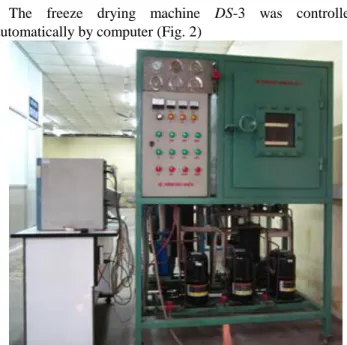
The freeze drying machine DS-3 was controlled automatically by computer (Fig. 2)
Fig. 2. The freeze drying system DS-3 with the auto-freezing (-50-45)C
The tools determining these factors such as energy consumption, residual water content, rehydration capacity, volume contraction, and loss of total protein could be referred to by [1], [5].
C. Methods
Determining the energy consumption (y1, kWh/kg product) for 1 kg final product by Watt meter, [8], [14].
1
U .I . .cos
y
G
(1) where: G (kg) – weight of the final product;
U (V) – number of Voltmeter; I (A) – number of Amperemeter; (s) – second; cos - power factor
Determining the residual water content of the final product (y2, %) by the mass sensor controlled by computer, [8], [14].
2 i
i
e
G
y
100
100 W
G
(2) Determining the anti-rehydration capacity of the final product (y3, %) indirectly by IR [%], which is the rehydration capacity of the finished product: y3 = 100 – IR, [8], [14].
1 e
i e
G
G
IR
.100%
G
G
(3)i 1
i e
3
G
G
y
100
IR
100%
G
G
(4)where: Gi (kg) – weight of the initial material used for freeze drying; Ge (kg) - weight of the final product; G1 (kg) – weight of the final product which was soaked into the water at 250C until the constant mass (the saturation of the water content); Wi (%) – initial water content of the material.
The ideal rehyration capacity of the product means that the in-water content is equal to the out-water content of the product, i.e. G1 = Gi and IRmax = 1 = 100%, y3min = 0. In fact, y3 > 0.
Determining the volume contraction (y4, %) by the volume of the initial material (V1, ml) and of the final product after freeze drying (V2, ml), [8], [14].
2 4
1 1
1
V
V
V
y
100%
100%
V
V
(5)The fact that the surface of the product is not rough and not contracted means y4min = 0. In fact, y4 > 0.
Determining the loss of total protein of the final product (y5, %) by the method Kjeldahl (TCVN 4328:200), [8], [14].
2 5
1 1
1
m
m
m
y
100%
100%
m
m
(6)where the total protein of the material initial and after freeze drying respectively m1 and m2 (%) were calculated according to weight of dry matter. The fact that the product achieves the best quality means y5min = 0. In fact, y5 > 0.
Establishing the objective functions by the quadratic orthogonal experimental planning method, [10], [13].
Building and solving five-objective optimization problem by the restricted area method, [13], [14].
III. RESULTS AND DISCUSSION
A. Establishing the Constituent Objective Functions of the Multi-Objective Problem
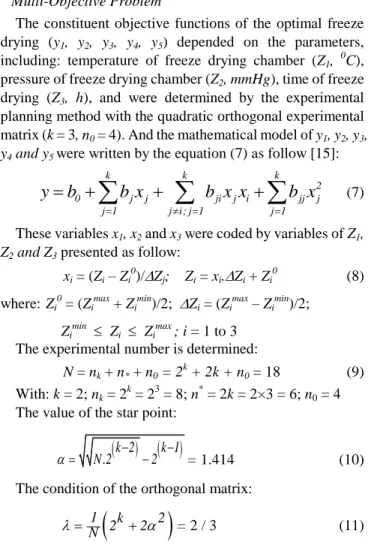
The constituent objective functions of the optimal freeze drying (y1, y2, y3, y4, y5) depended on the parameters, including: temperature of freeze drying chamber (Z1, 0C), pressure of freeze drying chamber (Z2, mmHg), time of freeze drying (Z3, h), and were determined by the experimental planning method with the quadratic orthogonal experimental matrix (k = 3, n0 = 4). And the mathematical model of y1, y2, y3, y4 and y5were written by the equation (7) as follow [15]:
k k k
2
0 j j ji j i jj j
j 1 j i; j 1 j 1
y
b
b x
b x x
b x
(7)These variables x1, x2 and x3 were coded by variables of Z1, Z2 and Z3 presented as follow:
xi = (Zi – Zi 0
)/Zj; Zi = xi.Zi + Zi 0
(8) where: Zi0 = (Zimax + Zimin)/2; Zi = (Zimax – Zimin)/2;
Zi min
Zi Zi max
; i = 1 to 3 The experimental number is determined:
N = nk + n* + n0 = 2k + 2k + n0 = 18 (9) With: k = 2; nk = 2k = 23 = 8; n* = 2k = 2×3 = 6; n0 = 4 The value of the star point:
k 2 k 1 N .2 2 = 1.414 (10) The condition of the orthogonal matrix:
1 k 2
2 2
N
= 2 / 3 (11)
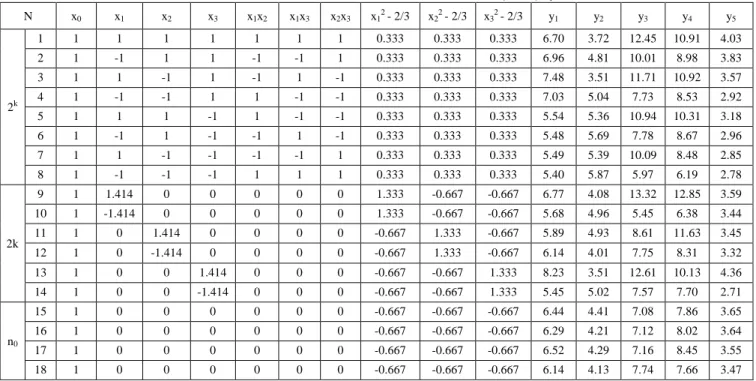
The experimental parameters were established by coditions of the technological freeze drying [13]-[15], they were summarized in Table I.
1) Establishing the mathematical model of objective functions y1, y2, y3, y4 and y5
The experiments were carried out with all of the parameter levels in Table 1 to determine the value of the objective functions y1, y2, y3, y4 and y5. The results were summarized in Table II [11], [12].
TABLE I: PARAMETER LEVEL DESIGN
Parameters
Levels
Deviation
i
Z
- (-1.414) Low
-1
Centra l 0
High +1
+ (1.414)
Z1,(0C) 20.102 23 30 37 39.898 7
Z2,
(mmHg) 0.008 0.094 0.3 0.50
7 0.592 0.2065
Z3, (h) 11.172 12 14 16 16.828 2
The mathematical model of regression equations below were obtained after processing the experimental data, calculating the coefficients, testing the significance of the coefficients by the Student test, and testing the regression equations for the fitness of the experimental results by Fisher test [10], [11], [12].
Methematical model of the energy consumption for 1 kg final product:
y1 = f1(x1, x2, x3) = 6.314 + 0.157x1 + 0.847x3 – 0.208x22 + 0.207x32
(12)
Methematical model of the residual water content of the final product:
y2 = f2(x1, x2, x3) = 4.17 – 0.39x1 – 0.614x3
– 0.226x1x3 + 0.27x12 + 0.245x22 + 0.142x32 (13)
Methematical model of the anti-rehydration capacity of the final product:
y3 = f3(x1, x2, x3) = 7.578 + 2.069x1 + 0.575x2
+ 1.187x3 + 0.851x12 + 1.205x32 (14)
Methematical model of the volume contraction of the final product:
y4 = f4(x1, x2, x3) = 8.307 + 1.45x1 + 0.789x2
+ 0.76x3 - 0.484x2x3 + 0.429x12 + 0.607x22 (15)
Methematical model of the loss of total protein of the final product:
y5 = f5(x1, x2, x3) = 3.508 + 0.112x1 + 0.173x2 + 0.409x3 + 0.106x2x3 - 0.154x22 (16) 2) Building the mathematical model of the one-objective optimization problems
If the individually survey of every objective function (yj, j = 1 to 5) of the freeze drying process depended on the technological parameters (xi, i = 1 to 3), it was obvious that these objective functions along with the technological parameters would constitute the one-objective optimization problems. Because all targets of the one-objective functions were to find the minimal value, the one-objective optimization problems were restated as [13], [18]: Finding in common the test x = (x1opt, x2opt, x3opt) x = {-1.414 x1, x2, x3 1.414} in order that:
opt opt opt
j jmin 1 2 3 j 1 2 3 x 1 2 3
y f x , x , x min f x , x , x
x 1.414 x , x , x 1.414 ; j 1,5
(17a)
3) Building the mathematical model of the multi-objective optimization problem
The establishment of the technological mode of freeze drying process of Penaeus monodon was based on factors including: economic, technicality and quality of the product obtained, [16], [17]. The final product after freeze drying has been good quality, the energy consumption for the production of 1 kg product reached the minimum value and the residual water content of the final product reached the minimum value but in (2 6)%. In addition, the final product after freeze drying must satisfy technological conditions with requirements in (18). Experimental results were obvious that:
If the anti-rehydration capacity of the final product was greater than 10% (y3 > C3 = 10), [6], [7], the final product would be denatured, not be able to recover the original its quality. As a results, quality of final product reduced.
If the volume contraction of the final product was greater than 10% (y4 > C4 = 10), [8], the surface of final product would be chappied and sensory value of the final product reduced.
If the loss of total protein of the final product was greater than 5% (y5 > C5 = 5), [6], [8], vitamines, natural color and flavor of final product would be destroyed and nutritional value of product reduced.
In addition, if the residual water content of the final product was greater than 6% (y2 > b = 6), the microorganisms would be capable to grow and develope and damage products. On the other hand, if residual water content of the final
product was less than 2% (y2 < a = 2), the final product would be completely denatured, [8].
It was obvious that the multi-objective optimization problem appeared on research into establishing the technological mode of the freeze drying process. According to putting forward of [13], [14], [18], the multi-objective optimization problem has to be solved by the restricted area method. The technological parameters (x1, x2 and x3) of the freeze drying process of Penaeus monodon had the simultaneous impact on five objective functions (y1, y2, y3, y4 and y5) with the identified domain x = {-1.414 x1, x2, x3 1.414}. Thus, the mathematical model of five-objective optimization problem determining the technological mode of the freeze drying process of Penaeus monodon was restated as:
TABLE II: THE DEGREE-2ORTHOGONAL EXPERIMENTAL MATRIX,K=3,N0=4
N x0 x1 x2 x3 x1x2 x1x3 x2x3 x12 - 2/3 x22 - 2/3 x32 - 2/3 y1 y2 y3 y4 y5
2k
1 1 1 1 1 1 1 1 0.333 0.333 0.333 6.70 3.72 12.45 10.91 4.03
2 1 -1 1 1 -1 -1 1 0.333 0.333 0.333 6.96 4.81 10.01 8.98 3.83
3 1 1 -1 1 -1 1 -1 0.333 0.333 0.333 7.48 3.51 11.71 10.92 3.57
4 1 -1 -1 1 1 -1 -1 0.333 0.333 0.333 7.03 5.04 7.73 8.53 2.92
5 1 1 1 -1 1 -1 -1 0.333 0.333 0.333 5.54 5.36 10.94 10.31 3.18
6 1 -1 1 -1 -1 1 -1 0.333 0.333 0.333 5.48 5.69 7.78 8.67 2.96
7 1 1 -1 -1 -1 -1 1 0.333 0.333 0.333 5.49 5.39 10.09 8.48 2.85
8 1 -1 -1 -1 1 1 1 0.333 0.333 0.333 5.40 5.87 5.97 6.19 2.78
2k
9 1 1.414 0 0 0 0 0 1.333 -0.667 -0.667 6.77 4.08 13.32 12.85 3.59
10 1 -1.414 0 0 0 0 0 1.333 -0.667 -0.667 5.68 4.96 5.45 6.38 3.44
11 1 0 1.414 0 0 0 0 -0.667 1.333 -0.667 5.89 4.93 8.61 11.63 3.45
12 1 0 -1.414 0 0 0 0 -0.667 1.333 -0.667 6.14 4.01 7.75 8.31 3.32
13 1 0 0 1.414 0 0 0 -0.667 -0.667 1.333 8.23 3.51 12.61 10.13 4.36
14 1 0 0 -1.414 0 0 0 -0.667 -0.667 1.333 5.45 5.02 7.57 7.70 2.71
n0
15 1 0 0 0 0 0 0 -0.667 -0.667 -0.667 6.44 4.41 7.08 7.86 3.65
16 1 0 0 0 0 0 0 -0.667 -0.667 -0.667 6.29 4.21 7.12 8.02 3.64
17 1 0 0 0 0 0 0 -0.667 -0.667 -0.667 6.52 4.29 7.16 8.45 3.55
18 1 0 0 0 0 0 0 -0.667 -0.667 -0.667 6.14 4.13 7.74 7.66 3.47
Finding in common the test x = (x1opt, x2opt, x3opt) x = {-1.414 x1, x2, x3 1.414} in order that:
opt opt opt
1 1min 1 2 3 1 1 2 3 opt opt opt
2 2min 1 2 3 2 1 2 3 opt opt opt
3 3min 1 2 3 3 1 2 3 opt opt opt
4 4min 1 2 3 4 1 2 3 opt opt opt
5 5min 1 2 3 5 1 2 3 x
y f x , x , x min f x , x , x
y f x , x , x min f x , x , x
y f x , x , x min f x , x , x
y f x , x , x min f x , x , x
y f x , x , x min f x , x , x
x
1.414 x , x , x1 2 3 1.414
(17b)
where y1 < C1 = 6; 2 = a < y2 < b = 6;
y3 < C3 = 10; y4 < C4 = 10; y5 < C5 = 5 (18) A. Solving the one-Objective Optimization Problems
These one-objective optimization problems (17a) were found to achieve: y1min = minf1(x1, x2, x3); y2min = minf2(x1, x2, x3); y3min = minf3(x1, x2, x3); y4min = minf4(x1, x2, x3); y5min = minf5(x1, x2, x3), with the identified domain x = {-1.414 x1,
x2, x3 1.414}. By using the meshing method programmed in Matlab 7.0 software, the results of the optimal parameters of every objective function (12), (13), (14), (15) and (16) limited in the experimental domain were summarized in table 3, [11]-[18]:
TABLE III:MINIMUM TESTS OF EACH ONE-OBJECTIVE OPTIMIZATION
PROBLEMS
j yjmin x1j opt x2j opt x3j opt
1 4.89 -1.414 1.414 -1.414
2 3.12 1.314 0.000 1.414
3 5.22 -1.216 -1.414 -0.493
4 5.16 -1.394 -1.214 -1.405
5 2.43 -1.411 -1.414 -1.414
In the table 3, it is obvious that the utopian points were indentified: fUT = (f1min, f2min, f3min, f4min, f5min) = (4.89, 3.12, 5.22, 5.16 , 2.43). However, the utopian test and the utopian plan did not exist, because of xjopt = (x1jopt, x2jopt, x3jopt) xkopt = (x1
kopt , x2
kopt , x3
kopt
B. Solving the Multi-Objective Optimization Problem The purpose of the experiment was to reach the targets of the freeze drying process which were expressed by 5 regression equations (12), (13), (14), (15) and (16), but the tests satisfying all function values (y1min, y2min, y3min, y4min, y5min) could not be found. Hence, the idea of the multi-objective optimization problem was to find the optimal Pareto test for yPR = (y1PR, y2PR, y3PR, y4PR, y5PR) closest to the utopian point and the furthest from the restricted area, but yj = yj(x) = fj(x1, x2, x3) must satisfy technological conditions with requirements in (18), [11]-[15]:
By the restricted area method, solving the multi-objective optimization problem of the freeze drying (17b) were presented as the followings [13]-[18]:
Setting the new objective functions [13], 14]:
I1(x) = y1(x) with I1(x) < C1 = 6 (19)
I2(x) = [y2(x) – (a + b)/2]2 = (y2(x) – 4)2 with I2(x) < C2 = [(b – a)/2]2 = 4 (20) I3(x) = y3(x) with I3(x) < C3 = 10 (21)
I4(x) = y4(x) with I4(x) < C4 = 10 (22)
I5(x) = y5(x) with I5(x) < C5 = 5 (23)
x = (x ,x ,x )1 2 3
x (24)From the system of equations from (19) to (23) and table 3, it can be easily found: I1min = y1min = 4.89; I2min = 0.00; I3min = y3min = 5.22; I4min = y4min = 5.16; I5min = y5min = 2.43; From (19) to (23), the restricted area would be made: y1 C1 = 6; y2 C2 = 4; y3 C3 = 10; y4 C4 = 10; y5 C5 = 5; (25)
Establishing the R*-objective combination function R*(I1, I2, I3, I4, I5) = R*(y1, y2, y3, y4, y5) = R*(x1, x2, x3) = R*(x) as the followings [13], [14]:
1 1 5 5 5 5 * * 1 2 3 j 1 2 3 j j 1 j 1 x 1 2 3 1 2 3 ( ) r ( ) r (x) , x , x ; x = (x , x , x )R (x) R x , x , x
x , x , x
1.414 x
1.414
(26) With: j j j j j min C I ( x ) r ( x ) C I when I ( x )j Cj (27)r ( x )j 0 when I ( x )j Cj (28)
where: r1(x) = (6 – I1(x))/(6 – 4,89) when I1(x) < 6 and r1(x) = 0 when I1(x) 6 r2(x) = (4 – I2(x))/(4 – 3,12) when I2(x) < 4 and r2(x) = 0 when I2(x) 4 r3(x) = (10 – I3(x))/(10 – 5,22) when I3(x) < 10 and r3(x) = 0 when I3(x) 10 r4(x) = (10 – I4(x))/(10 – 5,16) when I4(x) < 10 and r4(x) = 0 when I4(x) 10 r5(x) = (5 – I5(x))/(5 – 2,43) when I5(x) < 5 and r5(x) = 0 when I5(x) 5 From (27), it can be seen: if Ij(x) Ij min and Ij(x) < Cj, rj(x) rjmax = 1, [13]-[14]. By choosing R*(x) as the objective function, the m-objective optimization problem (17) is restated as: Find ZR = (x1R, x2R, x3R) x in order that R*(x) reaches the maximum value [13]-[14]. 1 5 5 * * max j j 1 R R (xR) max r (x)
(29)x = (x1, x2, x2) = {-1.414 x1, x2, x2 1.414} x From (27), it can be seen: 0 R*(xR) 1. If R*(xR) = 1, xR = xUT – the utopian test. If R*(xR) = 0, one of the values of Ij(x) violates (18), which means that Ij(x) belongs to the restricted area C (25).
The five-objective optimization problem needed to indentify xR = (x1R, x2R, x3R) x in order that R*(x1R, x2R, x3R) = Max{R*(x1, x2, x3)}. The maximum value and test of (29) was determined by using the meshing method programmed in Matlab 7.0 software [11]-[15]:
R*(x)max = Max{R*(x1, x2, x3)}
= R*(x1R, x2R, x3R) = 0.456 With: x1R = 0.142; x2R = -1.414; x3R = -0.092; Then, transforming into real variables:
Z1opt = 31.000C; Z2opt = 0.008mmHg; Z3opt = 13.82h Substituting x1R, x2R, x3R into these equations from (19) to (23), the results were obtained as:
I1PR = 5.84; I2PR = 0.45; I3PR = 6.98; I4PR = 8.49; I5PR = 2.95
Substituting x1R, x2R, x3R into these equations from (19) to (23), the results were obtained as:
y1PR = 5.84; y2PR = 4.67; y3PR = 6.98; y4PR = 8.49; y5PR = 2.95
The rehydration capacity of the product was determined as: IR = 100 - y3PR = 93.02
where xR = (x1R, x2R, x3R) called optimal Pareto test and IPR = (I1PR, I2PR, I3PR, I4PR, I5PR) or fPR = yPR = (y1PR, y2PR, y3PR, y4PR, y5PR)called the optimal Pareto effect.
C. Experiment to test the Results of Multi-Objective Optimization Problem
The freeze drying process of Penaeus monodon was Carried out at the optimal Pareto test:temperature of freeze drying chamber of Z1opt = 31.000C, pressure of freeze drying chamber of Z2opt = 0.008mmHg, and time of freeze drying Z3opt = 13.82 hours. The experimental results were determined value of objectives of final product as: the energy consumption per final product weight of y1 = 5.86 kWh/kg, the residual water content of of y2 = 4.71%, the rehydration capacity of IR = 100 - y3 = 92.99% (the anti-rehydration capacity of y3 = 7.01%), the volume contraction of y4 = 8.38% and the loss of total protein of y5 = 2.91%.
Consequently, it was very noticeable that the results from the optimization problems of the freeze drying process had the approximation to the experimental results
The Penaeus monodon after the freeze drying at the optimal Pareto test: Z1opt = 31.000C; Z2opt = 0.008 mmHg; Z3opt = 13.82h. The final product obtained could be seen in Fig 3 (Freeze-dried Penaeus monodon).
It was certain that the optimal Pareto test and the optimal Pareto effect of the multi-objective optimization problem of the freeze drying process were be possibly applied to determine the technological mode of the freeze drying process of Penaeus monodon in the industrial production.
Fig. 3. Freeze-dried Penaeus mondon
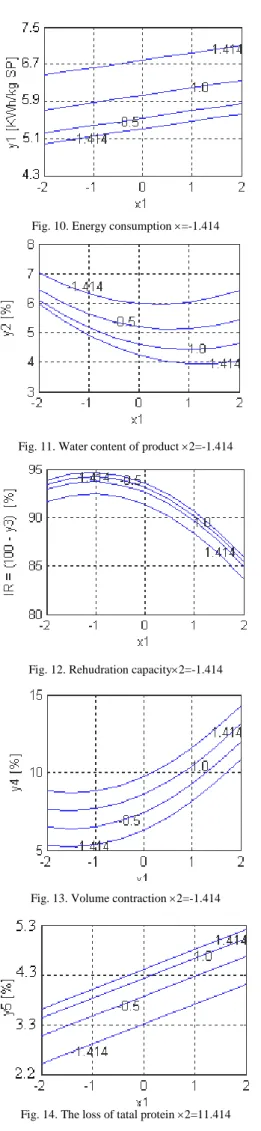
When the pressure of freeze drying chamber was fixed: x2 = -1.414, respectively Z2 = 0.008 mmHg, the relationship between y1, y2, y3, y4, y5 and R* combination function with 2 variables x1, x3 was performed geometrically in 3D (Figures 4, 5, 6, 7, 8, 9). When x3 was fixed with constant values, the variation of x1 was shown in Fig, 10, 11, 12, 13, 14, 15.
Fig. 4. Energy consumption 2=-1.414.
Fig. 5. Water content product2=-1.414.
Fig. 6. Rehydr capacity 2=-1.414
Fig. 7. Volume contraction 2=-1.414
Fig. 8. The loss of tatal pretein 2=-1.414
Fig. 10. Energy consumption =-1.414
Fig. 11. Water content of product 2=-1.414
Fig. 12. Rehudration capacity2=-1.414
Fig. 13. Volume contraction 2=-1.414
Fig. 14. The loss of tatal protein 2=11.414
Fig. 15. Conbination function R2=-1.414
IV. CONCLUSION
The mathematical models (12), (13), (14), (15) and (16) obtained from the experiments described quite well the impact of the freeze drying chamber temperature, the freeze drying chamber pressure and the freeze drying time on the energy consumption, the residual water content, the rehydration capacity, the volume contraction and the loss of total protein of the final product.
The mathematical model of multi-objective function (17b) described quite well about the freeze drying process of Penaeus monodon. The results showed that optimization the freeze drying process determined three optimal technological parameters: Z1
opt
- temperature of freeze drying chamber, Z2 opt - pressure of freeze drying chamber, Z3opt - time of freeze drying in order that five objective functions (y1, y2, y3, y4, y5) reached the the minimal level, which were entirely consistent with the experimental datas and conditions of the industrial production, [11], [12].
The results also demonstrated that optimal Pareto test ZR = (Z1opt = 31.000C; Z2opt = 0.008mmHg; Z3opt = 13.82h) for optimal Paréto effect yPR = (y1PR = 5.84; y2PR = 4.67; y3PR = 6.89; y4PR = 8.49; y5PR = 2.95) was the closest to the utopian point but the furthest from the restricted area.
The results obtained was established the technological freeze drying mode of Penaeus monodon in order that the total energy consumption per weight of the final product reached the minimal level, the quality of the final product reached the maximal level, and the residual water content of the final product reached the requisite value of (2 6)%.
ACKNOWLEDGMENT
The author thank Faculty of Chemical and Food Technology, and Department of Food Technology, HCMC University of Technical Education, for help with expriments carrying out.
REFERENCES
[1] A.V. Luikov, “Equations applicable to Sublimation drying,” Journal of Food Engineering, vol. 29, pp. 501-505, 1972.
[2] A. I. Liapis, R. Bruttini, and M. J. Pikal, “Research and development needs and opportunities in freeze drying,” Journal of Food Engineering, pp. 1265-1300, 1996.
[3] M. J. Pikal, M. L. S. Shah, “Mass and Heat transfer in vial freeze drying of pharmaceuticals: role of the vial. J. Pharm. Sci,” Journal of Food Engineering, pp. 1224-1237, 1984.
chamber pressure,” Journal of Food Engineering, USA: pp. 203-217, 1989.
[5] S. Khalloufi, J. L. Robert, and Ratti, “Solid foods Freeze drying simulation and experimental data, Journal of Food Engineering,” 2004.
[6] W. J. Mascarenhas, H. U. Akay, and M. J. Pikal, “A Computational model for finite element analysis of the Freeze drying,” USA: 221-235, 1997.
[7] T. V. Phu, “Heat and mass transfer process (Book),” Published by VNU HCMC, 2th ed, Viet Nam, pp. 385, 2004.
[8] L. O. Figura, “Food Physics: Physical properties Measurement and Application,” Germany, pp. 554, [Online]. Available: mechmath http://mechmath .org/ books /82246
[9] N. T. Dzung and N. Q. Dzung, Application of Multi-Objective Optimization to Determining the Technological Mode of Avocado Oil Extraction. Canadian Journal on Chemical Engineering & Technology, vol. 2, no. 6, July 2011, ISSN: 1923-1652, pp. 106-113, 2011. [10] N. Canh, “Planning experiments, Published by VNU HCMC,” 3th ed,
Viet Nam, 2007.
[11] N. T. Dzung, L. X. Hai, T. V. Dzung, and T. D. Ba, “Multi-objective optimization applied to determine regime technological freeze drying of penaeus vannamei,” Journal of Fisheries Science and Technology, no. 1, pp. 82-93, 2010.
[12] N. T. Dzung, L. X. Hai, and T. V. Dzung, “Multi-objective optimization with optimal standard combination of R applied to determine regime technological freeze drying of penaeus merguiensis,” Journal the Development of Science and Technology, 2010.
[13] L. X. Hai and N. T. Lan, “Multi-objective optimization with combination criteria applied to extraction of the high colour degree anthocyanin,” Science and Technology development, VNU-Ho Chi Minh City 11: 69-76, Tailieu. [Online]. Available:
http://tailieu.vn/xem-tai-lieu /toi-uu-da -muc-tieu-voi-cac-chuan-toi-uu-to-hop-s-va-r.205116.html
[14] N. T. Dzung, “Application of Multi-Objective Optimization by The Restricted Area Method to Determining the Cold Drying Mode of Gac. Canadian,” Journal on Chemical Engineering and Technology, vol. 2, no. 7, pp. 136-143, 2011.
[15] N. T. Dzung, (2012), “Application of Multi-Objective Optimization by The Utopian Point Method to Determining the Technological Mode of Gac Oil Extraction,” International Journal of Chemical Engineering and Application, vol. 3, no. 1, February 2012, [Online]. Available: http://www.ijcea.org/papers/150-A640.pdf
[16] G. H. Haugvalstad, D. Skipnes, M. Sivertsvik, “Food free from preservative,” Journal of Food Engineering, vol. 30, pp. 124-142, 2005.
[17] D. R. Heldman and D. B. Lund, “Handbook of Food Engineering,” Marcel Dekker New York – Basel – Hong Kong, pp. 3550, 1992. [18] L. X. Hai and N. V. Nguyen, “Multi-objective optimization for
grouper (e.coioides) compounded feed formulation,” Journal of Science and Technology, Tạp chí Khoa học và Công Nghệ [Online]. Available: http://www.vjol.info/index.php /jst/ search/results.
Nguyen Tan Dzung Faculty of Chemical and Food