International Journal of Advanced Research in Computer Science and Electronics Engineering Volume 2, Issue 2, February 2013
Abstract— In the world of web technology the safety of connections between the client users and the server cannot be ensured to a great extent in a shared LAN environment. The users can get access to any webpage or website if it is not controlled by the server or any type of intermediate system. This paper introduces a new system called A Proxy Agent for Client Systems (APACS) which helps in resolving the issue. The client systems will be installed with APACS and further the users will have to be authorized to get access to Internet. Users are confined to a few options through built-in browser available in APACS. The administrator has the privilege to restrict any website to a particular user or a group of users. Hence the data usage will be controlled and the performance of the system is improved.
Index Terms— Client, Server, APACS, Proxy Agent.
I. INTRODUCTION
The increase in the amount of users accessing Internet daily requires protection of the data and the better sharing of network. In a LAN environment, the users are given the privilege to access Internet to a great extent. This affects the performance of network and the data usage. A Proxy Agent for Client Systems (APACS) is an application that helps in adding network features and the internet capabilities to the client-server communication with safety concerns in the networking environment. It is a system that works between a client system and a server where the client system includes a built-in web browser. A client is an application or system who works on one end of the connection and makes use of the services provided by the server which is placed at the other end. A client program requests for a page or information from the server who holds the key to the information. This procedure occurs in a client/server relationship.
The server program serves the requests from the client program appearing at its end. The server manipulates and performs some requests or major computational task which cannot be done at the client side. The client program has the option to either perform some operations on the same computer or try to connect through the network for performing any tasks. When the safety features are concerned proxy agent comes forward and it acts as an intermediate between two ends of a client/server network connection. APACS is an intermediate server that works between a client application, such as a web browser or a program, and an actual server who provides the information or performs major
tasks. It intercepts all requests to the actual server to see if it can fulfill the requests by its own. If APACS cannot fulfill the request, it forwards the request to the actual server.
With the use of APACS, one can configure one machine in the network as the proxy agent and every other node as clients, communicating to the Internet via the proxy agent. Hence, by using APACS, the implementation cost of the network will be reduced where we would have to use a separate modem for each node. The APACS runs on the machine that has a net connection and is seeking requests from the clients. It accepts the requests and opens a Transmission Control Protocol (TCP) socket and reads the data and sends it to a particular client. APACS is created with an objective to create an access point to the internet that can be shared by all users on the Local Area Network (LAN). The APACS can monitor all the clients who are connected to it.
The administrator of APACS system has the entire control of the proxy server. The features of APACS are especially important on larger networks like corporate intranets and in large institutions. The more users on a LAN, the more critical will be the need for data privacy. The key features of APACS are;
Access Authority Restriction Shared bandwidth Security
Contribution: In this paper, a highly secured and reliable internet connectivity user interface is proposed. APACS is designed and built on VC++ with some networking essentials.
Organization: The introduction is given in section I, the existing research works are discussed in section II, the proposed model is explained in section III, the algorithm is described in section IV, the performance analysis is discussed in section V and conclusion is given in section VI.
II. LITERATUREREVIEW
Joo Yong Kim et al., [1] has described about the structure of proxy server to reduce the traffic in network. The structure has been implemented to reduce the response time even during a communication at the bottleneck. The mechanism or the secret behind this performance is the help of cache system which is activated by periodic polling. The periodic polling is carried out at the polling server located beyond the bottleneck. This mechanism will help in increasing the network bandwidth so that the traffic will be reduced during the bottleneck. Then the web servers which are the actual origins will be given preference and loaded.
Alphin John, Kevin C. Fernandez, Dr. Jossy P. George
Department of Computer Science Christ University, Bangalore, Karnataka, India
International Journal of Advanced Research in Computer Science and Electronics Engineering Volume 2, Issue 2, February 2013 Olatunde O Abiona et al., [2] has explained about how to
improve the performance and speed of the client system when the requested pages are to be served from the cache of a proxy server. The response to requested page is improved after the first document is been fetched. The response time becomes smaller. This is achieved by the development of cyclic multicast proxy server through the use of a cyclic multicast engine.
Richard Howard et al., [3] has described about the reason of bringing proxy server into the network technologies. Troubles in servicing the users with adequate access and long response time became the reason for introducing proxy server into the network world. A 14-day experiment was carried out to test the performance of network and data access with the help of proxy server. The result showed that the proxy server did not succeed in decreasing the access time for the client systems and drew conclusions on changing nature of web and its impact on proxy servers.
Hsieh Chang Tu et al., [4] has explained about the problems faced in web browsing and navigation when traversing within the same website and trying to collect the information. The problems would be with the web browsing but differs in magnitude and solvability. Hence the encountered problems are investigated and corresponding solutions are introduced based on the agents deployed in browsers.
B Thai et al., [5] has presented the architecture of proxy agents which helps the server to provide the data in a flexible manner to different clients. Since the information in the network is diversified, it is not possible for the server to categorize the information for different clients. These proxy agents are made to be transportable and active on the network. Hence the data content can be altered from the server’s end and the client’s individual requirements can be satisfied.
III. MODEL
In this section, the definitions of performance analysis of APACS model are discussed.
A. Definitions:
i) Server: A server is a system or a program that controls the whole network connections and who holds the key to the information.
ii) Client: A client is a system or a program that works on one end of the connection and makes use of the services provided by the server which is placed at the other end.
iii) Proxy Agent: A proxy server is a computer system or an application that acts as an intermediary for serving the requests from clients seeking resources from other servers.
iv) Error rate: It is the number of times a particular query of a client is failed to access which can be obtained by Equation 1.
Error rate =
Absolute Value [((estimate-actual)/actual)*100] ….. (1)
B. Proposed APACS model
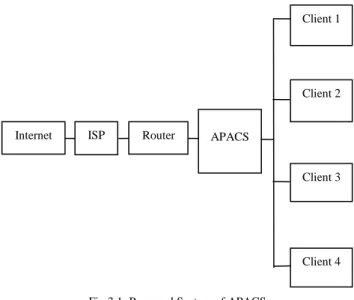
The proposed model is a network, in which a single machine is configured as the server machine, by running the APACS program as shown in Fig. 3.1 and every client
is connected to it. The server is connected to the internet via a cable modem. The Internet Service Provider (ISP) provides the internet connection to the server through the modem. The clients access the net through the APACS.
Fig 3.1: Proposed System of APACS
The APACS designed here is divided into three modules namely;
Proxy Mechanism: The proposed system acts as an intermediary between the web browser and the server that hosts the webpage. APACS intercepts all messages send through it and sees if it can fulfill the requests itself. If not, the request is forwarded. The most advantageous feature of a proxy server is its ability to share the bandwidth. This feature proves to be a largest cost saving function to users.
Site Restriction: By this system, we can restrict the clients individually from accessing the internet and communicating via ports. Along with that, caching of homepage and frequently accessed homepages can be done.
User Authentication: User authentication is implemented with the help of dialog boxes and controls at the entry point of the program. Only after the user is authenticated, the software starts itself. The user is forced to input the valid username and password to the program, which is in turn checked with a database file for authentication.
These three modules are embedded into a single interface, where each of these modules can be accessed by the corresponding buttons. This interface has an extended list box, where the currently connected users and their computer details are entered.
C. Data Flow Diagram of APACS model
The model is designed in such a way that there is absolute flow of data through the network. APACS ensures that the data is available at the client side when the user requests. When a particular website is restricted for a user, APACS checks with the database. The system should have a proper flow of data so that the requested page is served at
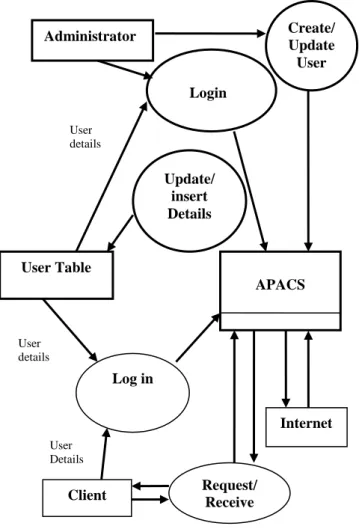
the client side if it is not restricted. The users can be added, deleted or modified with details. The different data flow diagram of proposed APACS model is given below;
ISP Router APACS
Client 1
Client 2
Client 3
International Journal of Advanced Research in Computer Science and Electronics Engineering Volume 2, Issue 2, February 2013
Fig. 3.2: Flow Diagram for APACS
APACS works as similar to a proxy server but with more functionalities as shown in Fig. 3.2. The client system has to login to the server to access the internet. The server will verify the user name and password from the database and give the permissions accordingly. The sending and receiving request is done through the APACS.
Fig. 3.3: Website Restriction of APACS
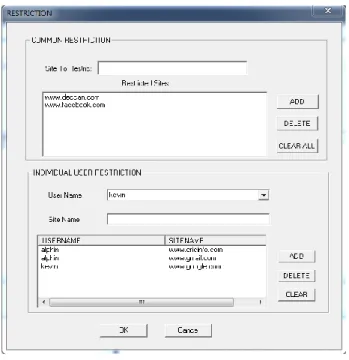
The websites are restricted individually or for a particular group of users as shown in Fig. 3.3. Then the clients request for a particular page, the information is send to the APACS and it will be checked in the database. If the particular website is restricted it will send a message to the client saying that no permission to access the website. Otherwise client will receive the page.
Fig. 3.4: User Settings of APACS
The user settings of APACS depend on the privileges and operations performed to the database as shown in Fig. 3.4. Only administrator has the permission to create/delete and update the user settings. The administrator will give the information about the clients to the APACS and it will be stored in the database.
Fig. 3.5: Client Login of APACS
Send Login Details
APACS
Validate
Details User Table
Proxy Client
Administrator
Create Client
Update Client
APACS
Insert/ update
User Table
Request/ Receive
Page
Client
Check Restriction
APACS
INTERNET
Page request
Page request
Page request
Requested page Requested
page
Create/ Update User Login
Update/ insert Details
User Table
Log in
APACS
Request/ Receive
Internet Administrator
User details
User details
User Details
International Journal of Advanced Research in Computer Science and Electronics Engineering Volume 2, Issue 2, February 2013 The client can login to APACS by providing username
and password which will be validated at the server side as shown in Fig. 3.5. When a client try to access the internet by entering the user name and password it will send to the APACS which will check in the database. If the username and password is valid then the client can serve the internet or it will get a warning message from the APACS.
Fig. 3.6: Website Restriction
The information about the common and individual website restriction are displayed from the database as shown in Fig. 3.6. The administrator can add and delete both the common restricted and individual restricted websites. The restriction can be given for a particular user or a group of users.
IV. ALGORITHM
The proposed algorithm is used to create a safe and secure communication between the client system and server system.
The procedure of the algorithm starts from the authentication
process till the messaging feature as explained in Table 4.1. The user has to be authorized in order to use APACS. The
procedure of logging into the system is done by providing the username and password. The design of APACS model is
implemented to ease the use of system. The administrator can
check the online users at his screen and the administrator has the privilege to restrict them from accessing one or more
websites. The complete details of the online users will be available at the administrator screen which is a component of
APACS. Every system has to be installed with APACS for the users to access Internet. APACS provides a browser
through which the user can access Internet. The administrator has to ensure that no other browsers are installed in the client
systems and the users are accessing Internet through APACS.
Table 4.1 Algorithm of APACS
Step 1: The client system will have the application running and login window will open. Step 2: The client logs-in by providing the assigned username and password.
Step 3: The server receives the information about the client at the server system.
Step 4: The client now receives the browser if the
username and password is valid which is
authorized by APACS.
Step 5: If the requested website is restricted then the client will be obstructed from receiving that website and a notification to the system arrives. Step 6: Otherwise the client receives the website at the in-built browser of APACS.
Step 7: APACS has option to restrict the website for a particular user or a group of users which can be done by the administrator.
Step 8: APACS provides the permission for the administrator to edit the user details such as to add or delete users, add or delete the restriction to a particular user or every user.
Step 9: APACS provides a window at the server system which shows the users connected tothe Internet through APACS.
Step 10: The details such as the IP address of the client system, time, date and time limit.
Step 11: When the client logs out the notification will be appearing at the server system.
V. PERFORMANCEANALYSIS
For analyzing the performance of APACS with existing systems, a specific system and network speed is mandatory. This specification is similar for both client system and server system. The specifications include basic hardware requirements and the network speed. The processor used for analyzing is Intel Core i-3 processor, RAM for system is 2GB and the network connection speed for shared LAN should be 100.0 Mbps.
Table 5.1: Performance Analysis of Proposed system
Existing System Proposed
System
Browsers Mozilla Explorer Chrome APACS
Speed
(seconds) 5.7 4.5 4.4 5.2 Error rate
(percent) 0.17% 0.27% 0.18% 1% Success rate
(percent) 99.83% 99.73% 99.82% 99% Security
Sandbox security model
Zero zone based security, Phishing Filter
Malware blocking, security vulnerability
APACS Security model
Ease of use Medium Medium Medium High
International Journal of Advanced Research in Computer Science and Electronics Engineering Volume 2, Issue 2, February 2013
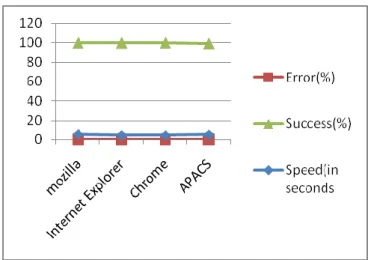
The comparison of the browsers shows that APACS performs better than a few browsers when the features like speed and success rate is considered. The speed is calculated in terms of seconds and the error rate is valued in terms of percentage as shown in Table 5.1.
Fig 5.2 Graphical Representation of Performance Analysis
The Fig 5.2 shows that Google Chrome performs better in navigating to another web page whereas Mozilla Firefox does not have better speed. APACS shows a better performance when the speed is considered. The error rate of Google Chrome and Mozilla Firefox is almost similar. Internet Explorer is considered as the worst browser when the error rate is taken into consideration. APACS also has an error rate higher than the existing browsers but almost similar to the errors produced by Internet explorer.
Actual value: Maximum possible number of successful navigation to another webpage when certain number of different URLs is tried.
Estimate value: Number of successful navigation to another webpage when certain number of different URLs is tried.
So the proposed APACS model performs better than any other browser when considering the most important features. It ensures a secure connection between the client and the server.
VI. CONCLUSION
APACS is an internet administration tool for Windows OS. This system can be used to share the internet over a network, to restrict sites for users, and to authenticate users for accessing the internet. APACS model is effective and easy to use with good helpful documentation. All the modules satisfy the user needs perfectly. APACS could solve the problems faced by the existing system by including a number of features. It also helps in reducing the complexity and difficulties. It is found to be a powerful system for both the client and administrator.
REFERENCES
[1] Joo Yong Kim, Kyoung Woon Cho and Kern Koh, “A Proxy Server Structure and its Cache Consistency Mechanism at the Network Bottleneck,” Proceedings of IEEE International Conference on Communication, Networking and Broadcasting, Computing and Processing, pp. 278-283, 1999.
[2] Olatunde Abiona, Tricha Anjali and Lawrence Kehinde, “Simulation of a Cyclic Multicast Proxy Server,” IEEE International Conference on Electro/Information Technology, pp. 105-106, 2008.
[3] Richard Howard and J. Bernard Jansen, “A Proxy Server Experiment: an Indication of the Changing Nature of the Web,” Proceedings of IEEE International Conference on Communication, Networking, Broadcasting, Computing and Processing, pp. 646-649, 1998. [4] Hsieh Chang Tu, L. Michael Lyu and Jieh Hsiang, “Agent Technology
for Website Browsing and Navigation,” Proceedings of the 32nd Hawaii International Conference on System Sciences, pp. 1-10, 1999. [5] B. Thai and A. Seneviratne, “The Use of Software Agents as Proxies,”
IEEE Symposium on Communication, Networking, Broadcasting, Computing and Processing, pp. 546-551, 2000.
AUTHORS PROFILE
Alphin John obtained his BCA in Department of Computer Science from
Christ University, Bangalore and Postgraduate (MCA) in Department of Computer Science from Christ University, Bangalore. His research interests includes computer networks and cloud computing.
Kevin C. Fernandez obtained his BCA in Department of Computer
Science from Kristu Jayanti College, Bangalore and Postgraduate (MCA) in Department of Computer Science from Christ University, Bangalore. His research interests includes network security, cloud computing and data mining.
Jossy P. George currently serves as Assistant Professor of the