International Telecommunication Union Telecommunication Development Bureau Place des Nations CH-1211 Geneva 20 Switzerland www.itu.int
R
the
tR
ansition f
R
om anal
ogue to digit
al te
RR
est
R
ial television in Cambodia
de
C
embe
R 2011
Printed in Switzerland
R o a d m a p f o r t h e
tRansition fRom analogue to
digital teRRestRial television in
C a m b o d i a
D
E
C
E
M
B
E
R
2
0
1
1
T e l e c o m m u n i c a t i o n D e v e l o p m e n t S e c t o r
Transition from analogue to digital
terrestrial television in Cambodia
Roadmap
December 2011
framework of the ITU digital broadcasting project. This project’s objective is to assist countries in setting
out their own roadmap and to shift smoothlyfrom analogue to Digital Terrestrial Television Broadcasting
(DTTB) and to introduce Mobile Television (MTV).
This report was prepared by the National Roadmap Team (NRT) of the Cambodia Government assisted by ITU experts: Peter Walop, Gu-Yeon Hwang, and Jan Doeven.
ITU 2011
All rights reserved. No part of this publication may be reproduced, by any means whatsoever, without the prior written permission of ITU.
Foreword
The process of transition from analogue to digital broadcasting offers advantages in terms of spectrum efficiency, higher video and audio quality and new business opportunities. It also offers the opportunity to allocate part of the broadcasting band to International Mobile Telecommunication (IMT) services and other applications.
In all ITU regions the transition from analogue to digital broadcasting has started. In a number of countries (e.g. the USA and many countries in the European Union) analogue switch-off has been completed. Most developing countries are also considering digital switch-over or have started the process. To support developing Member States to overcome the challenges and migrate smoothly from analogue to digital broadcasting ITU developed a programme to help countries to reap the full benefits of spectrum efficiency, and covers terrestrial TV, mobile TV and sound broadcasting.
In May 2010, the ITU published a comprehensive set of guidelines for the transition from analogue to digital broadcasting under this programme. These guidelines were developed for the Africa region. A version for the Asia-Pacific region will be published soon.
In a further effort to help countries to switch over to digital broadcasting, ITU has been helping countries to draft a roadmap, and Cambodia is one of the countries receiving further assistance.
From March to May 2011, the roadmap for transition from analogue to digital terrestrial television in Cambodia was jointly developed by a team of ITU experts and the National Roadmap Team (NRT) of the Cambodia Government.
I would like to commend the ITU experts, Mr Jan Doeven, Mr Peter Walop and Mr Gu-Yeon Hwang who have developed the roadmap through their excellent expertise and experience, as well as to give special thanks to the Cambodia National Roadmap Team.
Also, I very much appreciate the active support of the Ministry of Information (MOI), Cambodia, Ministry of Posts and Telecommunications of Cambodia (MPTC) and the support of the Korea Communications Commission (KCC) in facilitating the work of the ITU experts.
I am confident that this report will help the Cambodia Government in reaching their digital switch-over objectives.
Brahima Sanou Director Telecommunication Development Bureau International Telecommunication Union
Executive summary
The roadmap for transition from analogue to digital television in Cambodia has been prepared by the National Roadmap Team (NRT) and ITU experts in the period from March to May 2011.
The main observations and conclusions of the Roadmap are summarized below.
Scope of the roadmap
a. The roadmap for transition from analogue to digital television in Cambodia covers the short-term
digital switch-over (DSO) objectives (until about one year after analogue TV switch-off, see also
item c) and the activities managed by NRT. The roadmap does not include:
• The introduction of Mobile TV (MTV), because in Cambodia four MTV networks using
the T-DMB standard have already been planned and a licence for T-DMB operation in TV channel 10 has been granted to the Cambodia public service broadcaster, TV Cambodia (TVK), as multiplex and network operator.
• The introduction of digital radio.
b. The Cambodia television market is characterized by a great number of national TV services and a
wide choice of TV platforms (analogue and digital terrestrial, analogue and digital cable, Internet Protocol Television (IPTV) and satellite TV). Thirteen analogue TV services provided by 11 broadcasters can or will be soon received in Phnom Penh and a lower number in other parts of the country. In addition, a package of 60 digital terrestrial TV services provided by cable operator Phnom Penh Cable Television company (PPCTV) is offered in Phnom Penh.
c. The aim of the roadmap is to help Cambodia to reach the DSO objectives. These objectives are
divided into short-term (about 1 year after analogue switch-off) and long-term (5 to 10 years after analogue switch-off) objectives. The objectives are shown in table 1.
d. The duration of the transition process from analogue to digital television cannot yet be
determined. The NRT has the ambition to switch-off all analogue terrestrial television services by the end of 2015 at the earliest (or 2018 as possibly the latest). As long as the final switch-off date has not been decided (and politically endorsed), the roadmap duration varies from five to eight years.
e. The scope of the activities involved in the roadmap depends on the licensing model that will be
adopted. In the digital television value chain a new entity needs to be established: the multiplex operator. The multiplex operator combines the program streams of the broadcasters into so-called Transport Streams to be distributed to the transmitters. The tasks of the multiplex operator together with the tasks of the transmitter network operator can be assigned to each individual broadcaster (licensing model A) or to a common multiplex and network operator (licensing model B). In the latter case the roadmap includes more activities. The two licensing models have distinct advantages and disadvantages.
f. The input and output documents of the phases of the roadmap related to licensing model B
(common multiplex and network operator) are summarized in table 2. In case licensing model A is adopted, the preparation of the output documents indicated in Phase 4 (planning and implementation DTTB networks) is not managed by the NRT, but by the individual broadcasters.
g. The decisions taken, partly taken and not yet taken on the key topic and choices regarding
phases 1 to 4 of the roadmap and the activities required to prepare the decisions that are still pending, are indicated in annexes 1 to 4.
TABLE 1 DSO objectives
No Objective Short term (1 year after analogue
switch-off)
Long term (5-10 years after analogue switch-off)
1 Smooth transition from analogue to digital
• All analogue services converted to digital with same coverage areas • Simulcasting:
– Phasing – Test area 2 End of transition in < 2018
(aligned with neighbouring countries)
• Exact year, date and hour still to be determined
3 New entrants/services (after digital frequency plan has been completed)
• Additional digital service per location (not same bouquet on all locations) • May be new digital broadcasters
• New digital broadcasters
4 Extended population coverage • Additional locations • All locations same services 5 Better picture quality • Noise free and stable picture
• Widescreen (16 x 9) • SDTV
• (HDTV up to the market, although reserve spectrum)
6 Lower costs • Minimize viewer migration costs: – STB/Antenna
– Installation
• Network operations
7 Digital dividend • Reallocation of channels above 48/60 (as decided in APT)
TABLE 2
Input and output documents of the phases of the roadmap for licensing model B.
Roadmap Phase Input documents Output documents
1. DTTB policy development
• International Agreements • National telecommunication,
broadcasting and media acts • Existing policy documents and
objectives
• Digital terrestrial television broadcasting policy
2. Analogue-Switch-Off planning
• Digital terrestrial television broadcasting policy
• Initial frequency plan • Analogue-Switch-Off plan 3. Licensing policy and
regulation
• Digital terrestrial television broadcasting policy • Analogue-Switch-Off plan
• National coordinated frequency plan • International coordinated frequency plan • Licence terms and conditions
• Licensing procedure and planning 4. Planning and
implementation DTTB networks
• International coordinated frequency plan
• Licensing procedure and planning
• DTTB implementation plan • Detailed coverage presentations • Notification at MPTC and MOI • Order to put DTTB site into operation 5. Licence
administration
• Notification at MPTC and MOI • DTTB station approval by MPTC • DTTB station recorded in ITU- Master
Recommendations
a. The NRT is recommended to carry out the following next steps for a smooth transition to digital
television broadcasting and switching off the analogue services:
1. Get the roadmap report approved at either ministerial level and/or political level;
2. After approval, acquire a mandate to plan and manage the analogue switch-off (ASO)
process in accordance to the phases of the roadmap. As indicated in the roadmap report, this mandate may come in stages;
3. Once mandated, prepare and take the following decisions as the first of the roadmap as
these decisions are needed to determine the scope and duration of the roadmap planning:
– Determine ASO date and the date of the first Digital Terrestrial Television Broadcasting
(DTTB) transmissions. The latter is also relevant for the selection of the transmissions standard. An adoption of the DVB-T2 standard will open up more solutions and will significantly impact the frequency planning activities.
– Determine ASO model (phased simulcasting or not) .
– Licensing model (model A or B). In the case of model B this decision should also include
whether a public-private partnership is envisioned.
– Determine the date to stop licensing analogue television services. The later decision is
taken the more possibilities are excluded and the more complex the ASO will become.
4. Form a project management office (PMO) and start drafting an initial detailed ASO planning
and determine the progress reporting procedures and structures.
b. Apart from these next steps for the NRT to take, some additional recommendations can be
provided which seem to be evident for Cambodia:
1. Have market research carried out covering the key elements as indicated in this roadmap
report (see Phase 1). As indicated some key research data is lacking and starting an ASO process without this data could incorporate a major project risk.
2. Carry out detailed frequency and service planning (see phases 2 and 3), regardless which
licensing (model A/B) and transition model (simulcast or not) is selected. In Cambodia, spectrum is significantly limited by the large number of existing analogue services. Extensive and profound frequency planning will be required to see what is possible.
3. Reserve capacity for the future services of DVB-T2 and DAB. Without such a capacity
reservation it will be extremely difficult (or even impossible) to introduce these services at a later date or only against very high costs.
4. As for the digital dividend, awaiting the success of the DTTB and mobile (Long Term
Evolution (LTE) or IMT) services, the NRT could start the ASO planning process with 40 channels in Band IV/V. Depending on the proven success of the DTTB and mobile services, the number of channels available for broadcasting can be reduced to 29 channels at a later date.
5. Investigate the possibilities of auctioning mobile (LTE or IMT) spectrum as an important
means for financing the ASO process. This also includes the investigation of the possibilities of advancing the ASO costs as the proceeds of the auction will become available after ASO.
Table of contents
Page
Foreword ... i
Executive summary ... iii
Glossary of abbreviations ... ix
1 Introduction ... 1
2 Current TV market and DSO objectives ... 2
2.1 Market structure ... 2
2.2 Regulatory framework ... 5
2.3 Digital switch-over objectives ... 6
2.3.1 Short- and long-term objectives ... 6
2.3.2 MTV objectives ... 7
2.3.3 Digital radio objectives ... 8
3 National Roadmap ... 8
3.1 Roadmap concept ... 9
3.2 Roadmap construction ... 9
3.3 Functional building blocks relevant to Cambodia ... 11
3.4 Description of the Cambodia roadmap ... 13
3.4.1 Roadmap overview ... 14
3.4.2 Phase 1 DTTB policy development ... 18
3.4.3 Phase 2 ASO planning ... 22
3.4.4 Phase 3 Licensing policy and regulation ... 26
3.4.5 Phase 4 Planning and implementation DTTB network ... 30
3.4.6 Phase 5 Licence administration ... 33
4 Considerations on the top-10 most critical key topics and choices ... 34
4.1 Single and low cost STB ... 35
4.1.1 Transmission standard ... 35
4.1.2 Conditional access ... 37
4.2 Customer proposition ... 38
4.2.1 Non-cabled areas ... 40
4.2.2 Cabled areas ... 41
4.3 Licensing framework model A or B ... 42
4.4 Required and available budget ... 44
4.4.1 Cost considerations ... 44
4.4.2 Budget considerations ... 46
4.5 ASO model ... 48
Page
4.7 ASO communication plan ... 54
4.8 Business model and conditional access ... 55
4.9 Digital TV frequency plan ... 57
4.9.1 Need for a digital TV frequency plan ... 57
4.9.2 Conditions for developing a digital TV frequency plan ... 59
4.9.3 Coverage considerations ... 60
4.9.4 Construction of a frequency plan ... 62
4.10 Allocation of mobile services (LTE) ... 63
4.10.1 Frequency bands ... 64
4.10.2 Spectrum requirements ... 65
4.10.3 Trade-off between requirements ... 68
5 Recommendations ... 69
Annex 1 – Functional building blocks related to Phase 1 of the roadmap ... 71
Annex 2 – Functional building blocks related to Phase 2 of the roadmap ... 83
Annex 3 – Functional building blocks related to Phase 3 of the roadmap ... 97
Annex 4 – Functional building blocks related to Phase 4 of the roadmap ... 105
Annex 5 – Information on DTTB standards ... 109
Annex 6 – Coverage considerations ... 113
Glossary of abbreviations
16-QAM 16-state Quadrature Amplitude Modulation
64-QAM 64-state Quadrature Amplitude Modulation
API Application Programming Interface
APT Asia-Pacific Telecommunity
ASEAN Association of Southeast Asian Nations
ASO Analogue switch-off
ATSC Advanced Television Systems Committee
C/N Carrier to Noise ratio
CA Conditional Access
CAS Conditional Access System
CTN Cambodia Television Network, commercial broadcaster in Cambodia
dB decibel
DRM Digital Rights Management
DSO Digital switch over
DTMB Digital Terrestrial Multimedia Broadcast
DTTB Digital Terrestrial Television Broadcasting
DTV Satellite TV provider in Cambodia
DVB Digital Video Broadcasting
DVB-T Digital Video Broadcasting-Terrestrial
DVB-T2 Digital Video Broadcasting – Terrestrial 2nd generation
Emed Median minimum field strength
Emin Minimum field strength
EPG Electronic Program Guide
ERP Effective Radiated Power
FCFS First come, first served
FFT Fast Fourier Transform
FTA Free-To-Air
GDP Gross Domestic Product
GE06 Geneva Agreement 2006
HDTV High Definition Television
ID Identification
IDTV Integrated Digital Television set
IMT International Mobile Telecommunications
IPTV Internet Protocol Television
ISDB-T Integrated Services Digital Broadcasting – Terrestrial
ITU-D International Telecommunication Union – Development Sector
ITU-R International Telecommunication Union – Radiocommunication Sector
LTE Long Term Evolution, often marketed as 4G
MFN Multi Frequency Network
MHP Multimedia Home Platform
MOI Ministry of Information in Cambodia
MPEG Moving Picture Expert Group
MPTC Ministry of Posts and Telecommunications of Cambodia
MTV Mobile Television
NA Not applicable
NRT National Roadmap Team
NSP National Spectrum Plan
OPN Open Network Provisioning
PAL Phase Alternating Line; analogue colour TV system
PMO Project Management Office
PP Phnom Penh
PPCTV Phnom Penh Cable Television company
PPP Public Private Partnership
PSB Public Service Broadcasting
QPSK Quadrature Phase Shift Keying
RR Radio Regulations
SDTV Standard Definition Television
SFN Single Frequency Network
SMS Short Message Service
SMS Subscriber Management System
SSU System Software Updates
STB Set-Top-Box
T-DAB Terrestrial – Digital Audio Broadcasting
T-DMB Terrestrial – Digital Multimedia Broadcasting
TRC Telecommunications Regulator Cambodia
TVHH Television households
TVK TV Cambodia (Cambodia public service broadcaster)
UHF Ultra High Frequencies (frequency range between 300 and 3000 MHz)
VHF Very High Frequencies (frequency range between 30 and 300 MHz)
WRC-07 World Radiocommunications Conference 2007
1 Introduction
ITU has published guidelines for the transition from analogue to digital broadcasting1 (referred to as the
Guidelines). The Guidelines provide assistance to Member States to smoothly migrate from analogue to digital broadcasting. In a further effort to help countries to switch over to digital broadcasting ITU helps Members to draft their national roadmaps for this digital switch-over (DSO) process. Cambodia is one of the Member States receiving further assistance.
The roadmap for transition from analogue to digital terrestrial television in Cambodia has been jointly developed by a team of ITU experts consisting of Peter Walop, Jan Doeven Gu-Yeon Hwang and the Cambodia National Roadmap Team (NRT). The NRT is chaired by H.E. Ouk Pratrana, Secretary of State of the Ministry of Information, with Mr Nuth Bophann, Deputy Director General of Information and Broadcasting of the Ministry of Information as permanent Vice Chair. The NRT consists of representatives from the following organisations:
• Ministry of Information (MOI);
• Ministry of Posts and Telecommunications of Cambodia (MPTC);
• TVK (public TV service broadcaster);
• NRK (public radio service broadcaster);
• Bayon TV (commercial broadcaster);
• PPCTV (cable TV operator and DVB-T service provider);
• DMB World Co. (Mobile TV provider);
• CFOCN (Optical Fibre Network and DTMB operator).
Representatives of CTN (commercial broadcaster) attended the meetings with the ITU experts, at the invitation of the MOI.
The Cambodia TV market, with an estimated 2.4 million TV households, is mainly a terrestrial TV market with a very high number of analogue terrestrial TV services (13). There is a wide choice of TV delivery platforms; in addition to analogue terrestrial TV, there is also digital TV satellite, analogue and digital cable TV, IPTV and in Phnom Penh digital terrestrial TV (with an offer of 60 services).
In 2010, the Cambodia Gross Domestic Product (GDP) per capita was USD 8142 and continues to grow
rapidly. This relatively low GDP figure and the very competitive TV market mark one of the great challenges for the DSO process. Digital switch-over can only succeed if the costs for the government, the broadcasters and the viewers are kept low. On the other hand transition to digital television will offer great advantages. The viewer will have more services and better picture quality, the broadcasters can offer new services and network costs can be reduced. The government can achieve more efficient use of the frequency spectrum and may allocate part of the broadcasting band to mobile communication services.
The ITU assistance to Cambodia consisted of four key activities:
1. Preparation and first country visit to collect information.
2. Drafting roadmap report.
3. 2nd country visit to present and discuss the draft roadmap report.
4. Drafting final roadmap report.
1
The guidelines for transition from analogue to digital broadcasting can be found at
www.itu.int/publ/D-HDB-GUIDELINES.01-2010/en
2
The experts who prepared the Guidelines for the transition to digital broadcasting visited Cambodia from 15 to 24 March 2011 and from 3 to 6 May 2011. During the first visit, the experts together with the NRT prepared:
• an analysis of the TV market and regulatory situation;
• an overview of short-term and long-term DSO objectives; and
• an inventory of decisions (partly) taken regarding key objectives and choices with respect to the
functional building blocks in scope.
After the first visit the experts prepared a draft roadmap report. During the second visit, the draft report and the contributions made by the NRT were discussed and evaluated, resulting in an agreed list of
changes to the draft report. Finally, the experts prepared the Roadmap for the transition from analogue
to digital terrestrial television in Cambodia.
In the following sections, the current situation and DSO objectives will be addressed in section 2. Section 3 shows the draft national roadmap for achieving the DSO objectives. Section 4 gives considerations regarding the top-10 key topics and choices.
Annexes 1 to 4 show in detail the decisions taken, partly taken and not yet taken on the key topic and choices regarding the DSO process in Cambodia. Also the activities required to prepare the decisions that are still pending, are indicated.
Additional information regarding DTTB transmission standards, coverage considerations and spectrum requirements is given in the annexes 5, 6 and 7.
2
Current TV market and DSO objectives
The starting point for developing the roadmap for transition to digital terrestrial television is an analysis of the current TV market and regulatory framework, described in section 2.1 and section 2.2 respectively. The aim of the roadmap is indicated by the DSO objectives, as described in section 2.3.
2.1 Market
structure
The Cambodia television market structure is shown in the Figure 2.1.
It is estimated that the total population in Cambodia is 15 million, the average household consists of five people and that 80 per cent of households has a TV set. Consequently, the total number of TV households (TVHH) is about 2.4 million.
The TV market is mainly a terrestrial TV market with a very high number of terrestrial TV services. Bayon TV, CTN and TVK are the main players. New services are foreseen; Hang Meas TV will come into operation soon and more TV services are envisaged.
A cable TV company (PPCTV) has been licensed for digital terrestrial TV and has nine DVB-T transmitters
(and hence nine multiplexes) in operation in Phnom Penh using the DVB-T standard3. The offer consists of
60 services, 48 in a pay-tv package and 12 national TV services free-to-air. The STBs are PPCTV owned and on loan to subscribers. The installation fee is USD 50 and the subscription fee is USD 10 per month, or USD 50 for a six month service fee.
3
The output signal of the transmitters (each 1.4 kW) is combined in a single antenna of eight tiers at a height of about 120 m. It is understood that, although the compression system applied in the head-end is MPEG2, the STBs are equipped for MPEG4.
Figure 2.1: Cambodia TV market structure
An indication of the frequency use of the current and planned analogue and digital TV and MTV services is given in Table 2.1. In addition to the services and channels indicated in Table 2.1, a number of TV assignments have been reserved for future use.
TABLE 2.1
Overview of TV frequency usage
Service Standard Number
of sites
Channel in PP
Channels in provinces
TVK B-PAL 6 7 Battambang 7, Kratie 7, Pursat 7, Ratanakiri 7, Sihanouk Ville 7, CTN G-PAL 9 21 Banteay Mean Chey 25, Battambang 21, Kampong Cham 24,
Kampong Thom 29, Pursat 30, Sihanouk Ville 21, Siem Reap 23 Svay Rieng 26
My TV G-PAL 9 29 Banteay Mean Chey 23, Battambang 23, Kampong Cham 28, Kampong Thom 22, Pursat 23, Sihanouk Ville 23, Siem Reap 26, Svay Rieng 24
Bayon TV B/G-PAL 15 27 Banteay Mean Chey 27, Battambang 31, Kampong Cham 12, Kampong Thom 32, Kampot 25, Kratie 23, Preah Vihear 25, Pursat 27, Ratanakiri 23, , Sihanouk Ville 27, Siem Reap 8, Stung Treng 27, Svay Rieng 32
Bayon News G-PAL 1 50
C T S C T S P ubl ic Se rv ic e B roa dc as ti ng C om m e rc ia l br oa dc as ti ng se rv ic e s
National Television of Cambodia (TVK) Content
Creators AggregatorsContent MultiplexOperator ProvidersService DistributorsContent
= Public entity = Commercial entity
National Television of Cambodia
CTN CTN
My TV MY TV
Channel 9, 10, 11..(60 services) PP Cable TV ( A & D pay tv )
Bayon TV Bayon TV
Army TV5 Army TV5
PPMTV TV 3 (VHF)
PP Cable TV ( A & D)
All comm. broadcasters ( except 1)
(70% pop , 9.8 m/week)
(80% pop, 11.2 m/week) (90% pop, 12.6 m/week)
(50% pop, 7.0 m/week) (70% pop, 9.8 m/week)
Apsara TV SEA TV (?)
(60% pop, 8.4 m/week) (50% pop, 7.0 m/week)
National Television of Cambodia (TVK) PP Cable TV (A & D)
Nat. TV of Cambodia (TVK) Regional (4 inserts)
Satellite service provider DTV (120 k subs)
Satellite service provider DTV (120 k subs) Apsara TV
SEA TV
All comm. broadcasters
Other cable companies ( A only) Other cable companies (A only)
TV 9 (Khnmer TV) TV 9 (Khnmer TV)
Bayon TV 1 Bayon TV 1
PPMTV TV 3 (VHF)
PPMTV TV 3 (UHF) PPMTV TV 3 (UHF)
Hang MEAS TV Hang MEAS TV
All comm. broadcasters National Television of Cambodia (TVK)
% pop coverage/ million viewers per week
Vietnam TV Vietnam TV
TV5 Monde France TV5 Monde France
Service Standard Number of sites
Channel in PP
Channels in provinces
ArmyTV ch5 B-PAL 5 5 Battambang 5, Kratie 5, Sihanouk Ville 5, Siem Reap 5 PPMTV3 B/G-PAL 5 3; 33 Battambang 12, Kampong Cham 10, Sihanouk Ville 12,
Siem Reap 12
Apsara B-PAL 1 11
Sea TV G-PAL 3 31
TV9 (Khmer TV)
B/G-PAL 3 9 Battambang 29, Siem Reap 10 TV5 Monde
France
G-PAL 1 23
Vietnam TV G-PAL 1 25
Hang Meas TV
G-PAL 1 46
PPCTV DVB-T 1 36-44
TVK-DMB T-DMB 1 10
In principle all terrestrial broadcasters are allowed to provide nationwide coverage, with the exception of PPTCV.
Cross border interference has been experienced in the following situations:
TABLE 2.2
Overview of experienced cross border interference
Channel Area Interference from
7 East part of Cambodia Vietnam
21, 23, 27 Northwest part of Cambodia Thailand
29 South part of Cambodia Vietnam
As an example the sites of Bayon TV, the broadcaster with the most extended network, is shown in Figure 2.2.
The satellite platform of DTV offers a pay-TV package for USD 10 per month. The number of subscribers is currently estimated at 120 000.
Cable TV is offered by two companies in Phnom Penh (serving similar areas) and by 102 cable companies in the provinces. The offer is about 60 channels and the subscription fee is USD 10 per month or USD 50 for a six month service fee. The number of cable TV subscribers is estimated to be 30 per cent to 50 per cent of the TVHH.
Figure 2.2: TV transmitter sites of Bayon TV
Source: Bayon TV
2.2 Regulatory
framework
The regulatory framework with regard to television broadcasting is shown in Table 2.3.
The main regulatory bodies are the Ministry of Information (MOI) and the Ministry of Posts and Telecommunications of Cambodia (MPTC).
With regard to the transition to digital television the following observations can be made:
1. Two DTTB standards are permitted by the government, DVB-T and DTMB; it is up to the
broadcaster to select one of the two. Currently only DVB-T services are operational. For MTV one standard is allowed: T-DMB. T-DMB test transmissions take place in Phnom Penh. Operational T-DMB services are expected soon (see also section 2.3.2).
2. A great number of analogue TV channels are in use (see section 2.1) and a number of channels
are assigned for future use. The high number of operational and planned channels will make the digital switch-over process complex (see also section 4.10).
3. All broadcasters have a broadcasting licence, with a frequency assignment, from the Ministry of
Information. However, not all broadcasters have applied for the actual spectrum licence from the Ministry of Posts and Telecommunications of Cambodia.
4. A new telecommunication law is in preparation; in this law the establishment of a regulatory
executive tasks of spectrum management, while the Ministry of Posts and Telecommunications of Cambodia will deal with policy issues.
5. Private Public Partnerships are sources of financing the transition to digital TV in a number of
countries (see section 2.9 of the Guidelines). This possibility is not excluded in Cambodia as foreign ownership in broadcasting and/or multiplex companies is allowed provided that it is restricted to a minority share.
TABLE 2.3 Regulatory framework
Relevant legislation Arranges/Covers Regulatory body Assigned rights
Press Law No impact on television market Ministry of Information (MOI)
Telecommunications Act in preparation
Covers all telecom markets, including broadcasting frequency aspects. It also includes competition rules.
Telecom act will assign policy tasks to MPTC and executing tasks to Telecom Regulator Cambodia (TRC)
Ministry of Posts and Telecommunication of Cambodia (MPTC)
Telecommunications Act
National Spectrum Allocation and managing NSP
MPTC/
Telecommunications Regulator Cambodia (TRC)
Telecommunications Act
Licensing of transmitters TRC Spectrum rights
Law on copyrights and related rights
No impact on television market Ministry of Culture and Fine Arts
Sub ‘decree’ Licensing of broadcasters MOI Content /
broadcast rights Proclamation on TV and
Radio Standard
Setting transmission standards for digital television (DVB-T , DTMB, T-DMB)
MOI
No law or regulations for PSB (nor on tasks or funding)
2.3
Digital switch-over objectives
The short and long term DSO objectives in Cambodia are indicated in section 2.3.1. The emphasis of these objectives is on DTTB services. As mobile television (MTV) provides a different broadcasting service, the MTV objectives are described separately in section 2.3.2. Digital radio may have an impact on TV spectrum use. For that reason, digital radio objectives are indicated in section 2.3.3.
2.3.1 Short- and long-term objectives
As mentioned in section 2.1, digital terrestrial television has started in Phnom Penh with the nine multiplexes PPCTV is providing. In addition, as a result of the DSO process all current analogue TV services will be digital and new digital services are envisaged. The objectives for DSO are shown in Table 2.4.
TABLE 2.4 DSO objectives
No Objective Short-term
(1 year after ASO)
Long-term (5-10 years after ASO)
1 Smooth transition from analogue to digital
• All analogue services converted to digital with same coverage areas • Simulcasting :
– Phasing – Test area 2 End of transition in < 2018
(aligned with neighbouring countries)
• Exact year, date and hour still to be determined
3 New entrants/services (after digital frequency plan has been completed)
• Additional digital service per location (not same bouquet on all locations)
• May be new digital broadcasters
• New digital broadcasters
4 Extended population coverage • Additional locations • All locations same services 5 Better picture quality • Noise free and stable picture
• Widescreen (16 x 9) • SDTV
• (HDTV up to the market, although reserve spectrum)
6 Lower costs • Minimize viewer migration costs: • STB/Antenna
• Installation
• Network operations
7 Digital dividend • Reallocation of channels above 49/60 (as decided in APT)
With regard to the DSO objectives the following observations can be made:
1. A number of objectives (such as the number of services, the coverage of the services, lower costs
and digital dividend) may be contradictory. After having analyzed the consequences in spectrum requirements and costs (for the viewer and the broadcaster) a number of objectives may need to be reviewed.
2. Realization of the DSO objective regarding the conversion of all analogue TV services to digital
and the continuation of the DVB-T free-to-air services of PPCTV will result in dual coverage of ten national services in Phnom Penh and its surroundings. This situation should be avoided as it is not economic and spectrum efficient (see also section 4.10).
2.3.2 MTV objectives
MTV networks provide services for handheld and mobile receiving devices, using a dedicated MTV transmission standard. The international market prospective of MTV is variable. MTV services using the T-DMB standard are successfully implemented in Korea and Japan. However, in Europe a number of countries started MTV services using the DVB-H standard, and due to limited market take up, these DVB-H services have been stopped or will stop soon. On the other hand, multimedia services via mobile communication networks (3G and 4G) seem more promising.
In Cambodia, four MTV networks using the T-DMB standard have been planned4 and a licence for T-DMB operation in frequency block 10A, 10B, 10C and 10D has been granted to TVK as multiplex and network operator. MTV introduction has been planned in a phased approach, as summarized in Table 2.5.
TABLE 2.5 MTV introduction
Phase Introduction Frequency block Location
1 2011 10A, 10B, 10C*) Phnom Penh
2 2012 10A, 10B, 10C*) Battambang, Siem Riep
3 2013 10A, 10B, 10C*) Kampong Cham, Sihanouk Ville
4 2014 10D*) Phnom Penh, Battambang, Siem Riep, Kampong Cham,
Sihanouk Ville 5 2015 10A, 10B, 10C*), 10D*) Other regions
Source: Consulting report on Support for T-DMB Commercialization in Cambodia. * Content to be decided.
With the licence issued and the project plan already drafted (see footnote 3), the purpose of a roadmap for MTV has been met. For that reason MTV networks are not part of the roadmap described in this report.
In the longer term, there may be requests for more T-DMB services or from other operators. For that purpose, it may be necessary to be set aside one or more channels in Band III. These channels will be available after analogue switch-off.
It should be noted that the content of frequency blocks 10C and 10D has not yet been decided. Future T-DMB requirements could therefore (partly) be accommodated in these frequency blocks.
2.3.3 Digital radio objectives
Digital radio is not in the scope of the roadmap for transition from analogue to digital television. However, frequency assignments for digital radio in Band III should be taken into account in the network planning. It is understood that the Ministry of Information is considering digital radio and may reserve one of more channels for T-DAB (or T-DAB+) in Band III.
In this light, it should be noted that the T-DMB multiplex includes a number of digital radio services.
3 National
Roadmap
After having determined the aim of the roadmap as described in section 2, this section will describe the roadmap itself. Section 3 starts with an introduction on the concept of a roadmap, followed by the description of the construction of the roadmap in section 3.2. In section 3.3, the selected functional building blocks of the Cambodia roadmap are shown. Section 3.4 describes each of the phases of the Cambodia roadmap.
The national roadmap will deal with digital terrestrial broadcasting only. Mobile TV is not included because a licence is granted and a project plan is available (see section 2.3.2).
4
See Consulting Report on Support for T-DMB Commercialization in Cambodia, December 2010 by KCC and KBS, directed by Mr Gu-Yeon Hwang.
3.1 Roadmap
concept
A roadmap is a management forecasting tool and is directed to the implementation of strategy and related to project planning.
A roadmap matches short-term and long-term goals and indicates the main activities needed to meet these goals. Developing a roadmap has three major uses:
1. It helps to reach consensus about the requirements and solutions for transition to DTTB.
2. It provides a mechanism to help forecast the key miles stones for the transition to DTTB.
3. It provides a framework to help plan and coordinate the steps needed for transition to DTTB.
A roadmap consists of various phases, normally related to preparation, development and implementation of the strategy. A roadmap is often presented in the form of layers and bars, together with milestones on a time scale.
3.2 Roadmap
construction
Part 6 of the Guidelines for transition to digital television describes a method for developing a roadmap. Also a set of generic roadmaps regarding the whole process of transition to DTTB and introduction of MTV is given. The methodology described in Part 6 of the Guidelines will be followed in the development of the national Cambodia roadmap.
The basis is a functional framework consisting of five layers (see Figure 3.1).
Figure 3.1: Functional framework
• Each functional building block is described in the
corresponding chapters of Part 2 to 6, including
– Key topics and choices
– Implementation guidelines
Functional layer
Guidelines
A. Policy and regulation Part 2
B. Analogue switch-off (ASO) Part 2
C. Market and business development Part 3
D. DTTB & MTV networks Part 4 & Part 5
E. Roadmap development Part 6
• In each layer 3 to 13 functional building blocks
have been identified
Functional layers
Functional
building blocks
Key topic &
choices
Information &
implementation
Each layer consists of a number of functional building blocks. In each functional building block key topics and choices have been identified.
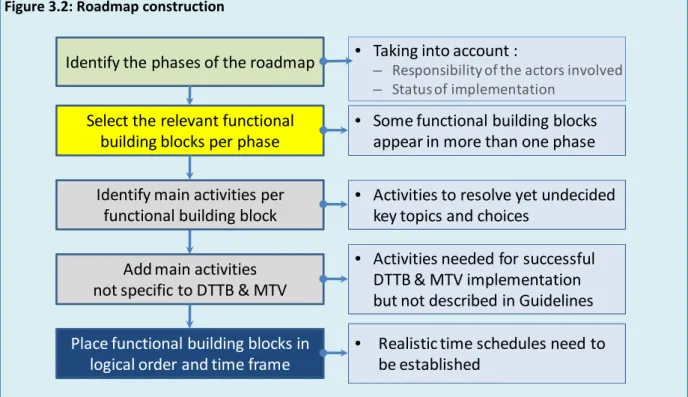
The roadmap is constructed by defining the phases and by placing the relevant functional blocks in each phase in a logical order and in a time frame. For each of the functional building blocks the decisions already taken and the main activities to resolve not yet decided key topics and choices are identified. Figure 3.2 illustrates the construction process.
Figure 3.2: Roadmap construction
The result is a roadmap that consists of three levels:
1. Phases of the roadmap with the selected functional building blocks per phase.
2. For each phase, the functional building blocks places in a logical order and time frame.
3. For each functional building block in a phase, the status on key topics and choices and the main
activities to be carried out.
The roadmap structure is illustrated in Figure 3.3.
The selected relevant functional building blocks are shown in Figure 3.4 in section 3.3. Key topics and choices related to the selected functional building blocks of functional layers A (Policy and regulation), B (Analogue switch-off), C (Market and business development), and D (Networks (DTTB and MTV)) have been considered and decisions which have (partly) been taken, and which still need to be taken, have been identified.
An overview of the status of the selected functional building blocks is given in Annexes 1 to 4.
•
Activities needed for successful
DTTB & MTV implementation
but not described in Guidelines
•
Some functional building blocks
appear in more than one phase
Identify the phases of the roadmap
Select the relevant functional
building blocks per phase
Add main activities
not specific to DTTB & MTV
•
Taking into account :
– Responsibility of the actors involved
– Status of implementation
Identify main activities per
functional building block
Place functional building blocks in
logical order and time frame
•
Activities to resolve yet undecided
key topics and choices
•
Realistic time schedules need to
be established
Figure 3.3: Roadmap structure
3.3
Functional building blocks relevant to Cambodia
Of the five functional layers shown in Figure 3.1, layer E is “Roadmap development” and hence covered by this report. The other functional layers A (Policy and Regulation, B (Analogue switch-off), C (Market and Business Development) and D (Networks (DTTB and MTV)) contain in total 38 functional building blocks (see Figure 3.4). Out of the 38 functional building blocks, 26 blocks were selected to construct the Cambodia roadmap.
The roadmap covers:
• The short DSO objectives (until one year after ASO) as defined in Table 2.4.
• Activities managed by the NRT.
Figure 3.4 shows three types of functional building block:
1. White coloured blocks with dashed frame
These blocks are not be included in the Cambodia roadmap (see Table 3.1).
2. Yellow coloured blocks without frame
These blocks are included in the Cambodia roadmap and will be managed by the NRT.
3. Yellow coloured blocks with a blue frame
These blocks are included in the Cambodia roadmap and will be managed by the NRT in case licensing model B will be chosen. If model A is chosen these functional building blocks will be carried out by each individual DTTB licensed broadcaster (for more details see section 3.4).
Phase
Functional blocks
In each phase, the relevant functional blocks are placed in a logical order and in a time frame.
For each of the functional blocks, the status of the key topics and choices and the main activities for carrying out the function are identified Internationally coordinated frequency plan ASO plan DTTB Policy International frequency coordination 2.2 Licensing framework License assignment procedure License conditions 2.8 Media permits & authorizations 2.5 Assignment procedures Consultation with market parties/ Parliament License procedure and planning Nationally coordinated frequency plan Detailed DTTB
service planning 4.2 Design principles & network architecture 4.3 Network planning 4.4 System parameters 4.5 Radiation characteristics License terms &conditions
Framework decided conditions definedLicense terms & DTTB service planning coordinated procedure approvedAssignment (first) license assigned
2.6 License terms & conditions
Key topics & choices Status Decision
2.5.1 Basic assigned instruments and procedures: What is the preferred assignment instrument (FCFS, auction or public tender) for broadcasting?
C No legislation present arranging assignment instruments for spectrum and/or broadcast rights.
The current situation is that all licenses to the Cambodian broadcasters and service providers were assigned on the basis of FCFS.
2.5.2 Assignment procedures for DTTB services: What is the selected assignment instrument (FCFS, auction or public tender) for DTTB services?
C The NRT should make a difference between assigning licenses to broadcasters (model A) and multiplex/network operator (model B).
In case of model B the NRT could apply a different instrument (for example public tender).
In case of model A, the NRT should be aware of the risk that introducing another assignment instrument (other than FCFS) may lead to claims of unfair competition. Mitigation may be needed.
Main activities Observation/Advice
1. Consult market (current broadcasters and potential bidders/applicants) on assignment methods and license Terms & Conditions.
All to be carried out as part of this Phase.
Drafting of the Licensing procedure and passing Parliament should be aligned with the ASO planning.
Licensing procedure should be ‘future proof’ in the sense that after ASO additional licenses might be assigned. 2. Evaluate results and select assignment method & procedures.
3. Draft detailed plans & planning for DTTB assignment procedure (for detailed steps see Appendix 2.5B).
4. Prepare approval of assignment Procedures by Parliament. 5. Publish assignment planning and procedures and update National
Figure 3.4: Selected functional building blocks (coloured yellow) in the Cambodia roadmap
The reasons for not including the white coloured functional building blocks in Figure 3.4 are given in the Table 3.1.
A. Policy &
Regulation Regulations2.3. ITU-R
2.4. National Spectrum Plan 2.1. Technology & Standards Regulation 2.2. Licensing Framework 2.5. Assignment Procedures 2.6. License Terms & Conditions 2.7. Local Permits (building & planning) 2.8. Media Permits & Authorizations 2.9. Business Models & Public
Financing
2.10. Digital Dividend
C. Market & Business Development 3.4. Business Planning 3.1. Customer Insight & Research 3.2. Customer Proposition 3.3. Receiver Availability Considerations 3.5. End Consumer Support B. ASO 2.14. Transition Models 2.16. ASO Planning & Milestones
2.17. Infra & Spectrum Compatibility 2.18. ASO Communication Plan 2.15. Organizational Structure & Entities 2.11. National Telecom, Broadcast & Media Acts 2.12. Law enforcement & execution 2.13. Communication to consumers &
industry D. Networks 4.2. Design Principles & Network Architecture 4.3/5.3. Network Planning 4.1. Technology & Standards Application 4.4. System Parameters 4.5/5.5 Radiation Characteristics 4.7/5.7 Shared & Common Design Principles 4.9 Network Rollout Planning 4.6. Network Interfacing 5.2. Design Principles & Network Architecture 5.1. Technology & Standards Application 5.6. Network Interfacing & studio facilities DTTB MTV 4.8 Transmitting equipment Availability 5.4.System parameters 5.9 Network Rollout Planning 5.8 Transmitting equipment Availability
TABLE 3.1
Functional building blocks not included in the national roadmap
Not included functional building block Reason
Number Title
2.7 Local permits (building and planning) Limited or no regulatory framework in place in Cambodia 2.12 Law enforcement and execution Restructuring of the regulatory framework may be
considered but is not seen as a condition for the successful transition to digital television
2.13 Communication to consumers and industry
As the policy and regulation activities will all be carried out as part of the transition process, the activities related to 2.13 will be included in 2.18 (ASO communication plan) 2.17 Infra and spectrum compatibility Infrastructure compatibility is not considered as a major
issue in Cambodia. Spectrum compatibility during transition (between analogue and digital TV) will be covered in the national frequency plan
3.5 End consumer support As the activities related to Market and business
development will all be carried out as part of the transition process, the activities related to 3.5 will be included in 2.18 (ASO communication plan)
4.7 Shared and common design principles The MTV network has been designed already 5.1 to 5.9 MTV networks (all functional building
blocks)
Roadmap for MTV is not needed because MTV services have been planned and a licence has been granted (see section 2.3.2)
3.4
Description of the Cambodia roadmap
In this section, the overall roadmap for Cambodia is outlined. The roadmap is segmented in several phases. After presenting the roadmap outline (section 3.4.1), each phase is discussed in the following sections (3.4.2 onwards).
The detailed activities and considerations for each phase and its associated functional building blocks are included in annexes of this report.
The following sections contain a number of figures. The symbols used in these figures have the following meaning:
Figure 3.5: Symbols used in roadmap figures
Functional building blocks described in the Guidelines; the number in the blocks refer to the functional block numbers in Figure 3.3 and to the corresponding section numbers in the Guidelines
Input or output document
Non specific DTTB main activity; not described in the Guidelines
Important milestone in relation to time scales
Sequence Time line
Interrelation between groups of activities
3.4.1 Roadmap overview
As discussed previously, the NRT has the ambition to switch off all analogue terrestrial television services by the end of 2015 at the earliest (or 2018 as possibly the latest). As long as the final switch-off date has not been decided (and politically endorsed), the roadmap duration varies considerably; from five to eight years. Therefore the duration of the phases in which the DTTB network is rolled out and the analogue transmitters are switched off can span a number of years.
Model A or B
A key decision for the NRT to make is the selection of the licensing model (either model A or B)5. Selecting
model B will result in additional functional building blocks to be included in the roadmap as the NRT will also resume responsibilities for rolling out a common DTTB network. In this way, after selecting the licensing framework an alternative branch in the roadmap will occur.
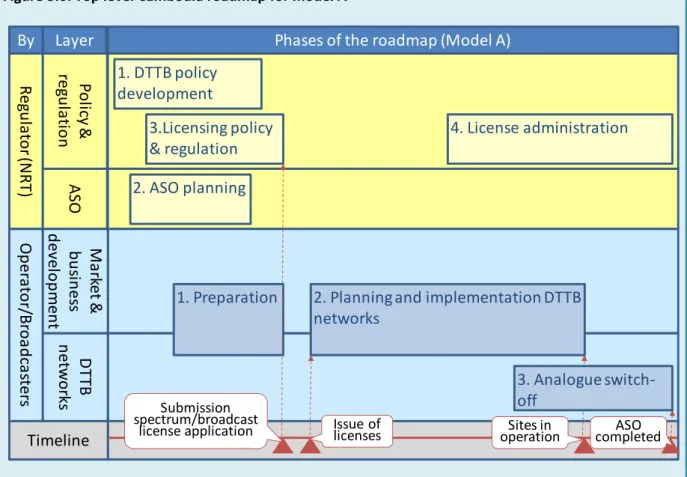
The figure below illustrates the various phases of the NRT roadmap for model A (i.e. the yellow shaded blocks). As shown in Figure 3.6, Phases 1, 2 and 3 are likely to be carried out partly in parallel because of the interrelationships between the issues to be decided. The figure also illustrates that the broadcasters assume the responsibility of the actual DTTB network roll-out (i.e. the blue shaded blocks). They prepare for acquisition of the necessary spectrum and broadcast licences (Phase 1 of the network operator), plan the network roll-out and implement the network (Phase 2).
Figure 3.6: Top level Cambodia roadmap for model A
5
See the ITU Guidelines for the transition from analogue to digital broadcasting, p. 26.
Po
lic
y &
re
gu
la
tio
n
ASO
Re
gu
la
to
r (N
R
T
)
Mar
ke
t &
bus
ine
ss
de
ve
lopm
e
nt
DTTB
ne
tw
o
rk
s
Op
er
at
o
r/
B
ro
a
d
ca
st
er
s
Timeline
Layer
By
1. DTTB policy
development
2. ASO planning
3.Licensing policy
& regulation
4. License administration
1. Preparation
2. Planning and implementation DTTB
networks
Issue of licenses Submission
spectrum/broadcast
license application operationSites in completedASO
3. Analogue
switch-off
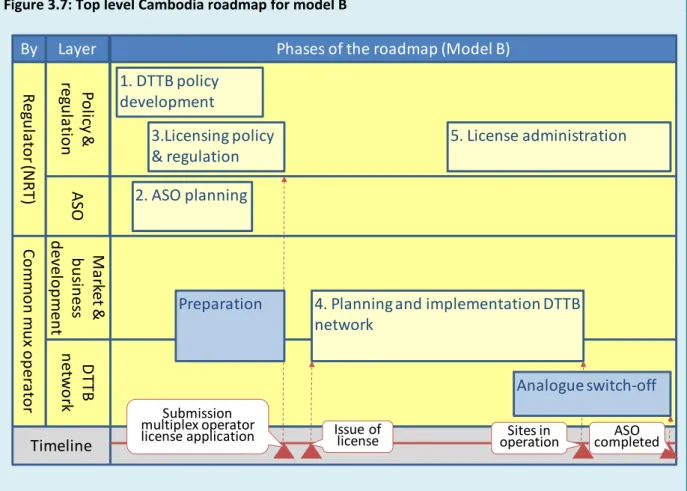
Figure 3.7 shows the various phases for the NRT roadmap in case model B is selected. As the figure shows the first three NRT phases are the same as in the roadmap for model A. However, after selecting the licensing model (i.e. in Phase 3), the NRT will issue a tender procedure for selecting the common multiplex/network operator. After selecting this multiplex/network operator, the NRT will develop the network roll-out planning together with this newly selected network operator (Phase 4). Also the NRT, in close cooperation with the common multiplex/network operator, will assume the responsibility of rolling out the DTTB network.
Figure 3.7: Top level Cambodia roadmap for model B
Functional building blocks for model A and B
The decision for the licensing model will impact the number of functional building blocks to be included in the roadmap. In model B, the NRT will resume responsibility for the establishment of a common multiplex/network operator and will have to endorse which services will be offered on the market. In addition, the NRT will directly manage the network roll-out and the associated planning. In such a situation the Cambodia roadmap will include activities and decisions typical for a multiplex/network operator:
1. Market and business development layer:
a. Customer insight and research (functional building block 3.1): the NRT will have to
investigate what distribution services the multiplex/network operator is going to offer and how they are going to research this market demand.
b. Customer proposition (functional building block 3.2): the NRT will have to establish the exact
attributes of the distribution services, such as coverage areas, number of services, conditional access (in case of pay-tv services) and price tables for the various services (including multiplex capacity reservations).
P
o
lic
y &
re
gu
la
tio
n
AS
O
Reg
u
la
to
r (
N
RT
)
Mar
ke
t &
bus
ine
ss
de
ve
lopm
en
t
DTTB
ne
tw
or
k
C
o
mmo
n
mu
x
o
p
e
ra
to
r
Timeline
Layer
By
1. DTTB policy
development
2. ASO planning
3.Licensing policy
& regulation
5. License administration
Issue of license Submission
multiplex operator
license application operationSites in completedASO
Analogue switch-off
Phases of the roadmap (Model B)
Preparation
4. Planning and implementation DTTB
network
c. Receiver available considerations (functional building block 3.3): in line with the DSO objective to have a single cheap STB for the Cambodia market, the NRT will have to determine what functionality this STB will have. This will include aspects such as the transmission and compression standard as well as the conditional access system (which is likely to be embedded to keep costs down).
d. Business planning (functional building block 3.4): the NRT will also have to resume
responsibility for a economically viable service offering. Hence the NRT will have to assess the future cash flows of the common multiplex/network operator and what type of financing is required. Also the ownership construction will have to be determined, i.e. only public or private partnership or a combination of both in a so called public private partnership.
2. DTTB Network layer:
a. Technology and standards application (functional building block 4.1) to radiation
characteristics (functional building block 4.5): all these five technical functional building blocks have to be included as to determine what the required DTTB network will look like. This includes aspects as the design of the key network elements (i.e. the head-end/multiplex centre, the distribution links and the transmitter sites), the various system parameters (i.e. transmission mode, guard interval, etc.) and the applied frequencies per site (i.e. ERP, antenna height and diagram).
b. Network interfacing (functional building block 4.6), transmission equipment availability
(functional building block 4.8) and network roll-out planning (functional building block 4.9): all these three functional building blocks have to be include as the NRT will have to directly manage the planning of the network roll-out.
In case model A is selected, the NRT will leave a number of responsibilities to the individual broadcaster to take care of:
1. The actual service offering. The broadcasters can determine the number of services and the
coverage areas (if not stipulated) themselves. Consequently, a number of functional building blocks doesn’t have to be included in the roadmap:
a. Customer insight and research (functional building block 3.1): the broadcasters will carry out
their own research as to determined which services to offer on the DTTB platform.
b. Customer proposition (functional building block 3.2): the broadcasters will determine the
various attributes, including pricing. It should be noted however, that the NRT can still stipulate some minimum service requirements the broadcasters have to comply to. For example the coverage areas and/or the launch windows (when the additional services have to be on air).
c. Business planning (functional building block 3.4): the broadcasters will be directly
responsible for making the DTTB services economically viable and hence they will carry out their own business planning.
2. The actual network out. The broadcasters will resume the responsibility of their network
roll-out and hence some blocks don’t have to be included in the roadmap:
a. Network interfacing (functional building block 4.6): for example the broadcasters will
determine how the transport streams are distributed to the transmission sites (e.g. satellite or optical fibre).
b. Transmitter equipment availability (functional building block 4.8): the broadcasters will order
their own equipment and will consider the available equipment themselves.
c. Network roll-out planning (functional building block 4.9): the broadcasters will roll-out their
own network and the transmitters will probably been deployed on their existing towers. Although the broadcasters will carry out their own network roll-out the NRT will have to set
milestones for them to comply to. The broadcasters will have to follow the ASO planning (especially in the case of a phased simulcast model).
It should be noted that in model A, the following building blocks will remain in the Cambodia roadmap:
1. Receiver availability considerations (functional building block 3.3): Although the broadcasters are
free to determine their DTTB services, the NRT will have to assure that Cambodia viewers are not confronted with a wide range of STBs. Especially in the case the broadcasters will decide to offer pay-tv services many CA embedded STBs may become available in the market and will cause confusion under the viewers. Consequently, in model A the NRT will have to stipulate a minimum set of STB requirements.
2. Technology and standards application (functional building block 4.1) to radiation characteristics
(functional building block 4.5): These five blocks will remain necessary in a model A situation, because these blocks are directly related to the required spectrum. When carrying out the activities in these blocks the NRT can accurately define the spectrum rights for each individual broadcaster and can assure spectrum efficiency (and consequently the digital dividend).
Functional blocks in each phase
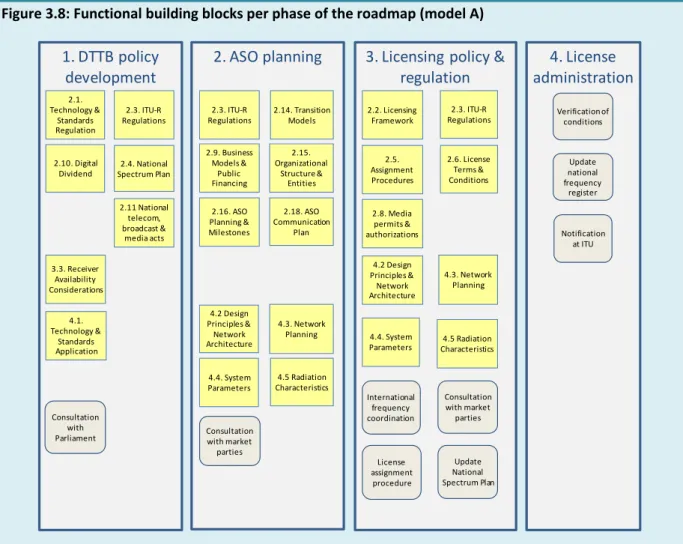
As a result from the different building blocks to be included in either model A or B, two sets of functional building blocks can arise in Cambodia. The figure below shows the functional building blocks to be included in case model A is selected. Please note that the yellow shaded blocks are described in the sections of the Guidelines with corresponding numbering. The grey shaded blocks are not described in the Guidelines. These blocks represent activities that are not specific to the introduction of digital terrestrial television services.
Figure 3.8: Functional building blocks per phase of the roadmap (model A)
4. License administration 2. ASO planning
1. DTTB policy development 2.1. Technology & Standards Regulation 2.10. Digital Dividend 2.11 National telecom, broadcast & media acts 3.3. Receiver Availability Considerations 2.14. Transition Models 2.16. ASO Planning & Milestones 2.18. ASO Communication Plan 2.15. Organizational Structure & Entities 2.3. ITU-R Regulations 4.2 Design Principles & Network Architecture 4.3. Network Planning 4.4. System Parameters 4.5 Radiation Characteristics 2.9. Business Models & Public Financing
3. Licensing policy & regulation 2.2. Licensing Framework 2.3. ITU-R Regulations 2.5. Assignment Procedures 2.6. License Terms & Conditions 2.8. Media permits & authorizations Verification of conditions Notification at ITU Update national frequency register 4.2 Design Principles & Network Architecture 4.3. Network Planning 4.4. System
Parameters Characteristics4.5 Radiation 4.1. Technology & Standards Application 2.3. ITU-R Regulations Consultation with
Parliament Consultation with market parties International frequency coordination License assignment procedure Consultation with market parties Update National Spectrum Plan 2.4. National Spectrum Plan
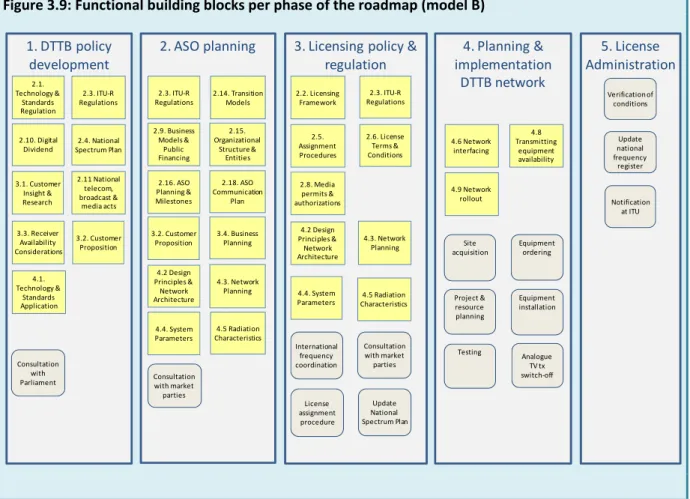
The Figure 3.9 shows the functional building blocks to be included in case model B is selected. Comparing this figure with the previous figures shows that both figures are for a large part similar and that model B includes more functional building blocks.
Figure 3.9: Functional building blocks per phase of the roadmap (model B)
To avoid duplication, the remainder of this report will describe the roadmap for model B and will indicate how and when the roadmap will differ for model A. For example, when a functional building block and its associated activities will not have to be included or when the output documents are used for different purposes.
3.4.2 Phase 1 DTTB policy development
The DTTB policy development phase of the roadmap is aimed at getting the DTTB policy objectives agreed at a political level. Political consensus and commitment lies at the heart of any successful ASO project. Politicians will have to commit to the ASO objectives, deadlines, necessary budget and endorse the establishment of a NRT with a clear mandate to plan and execute the ASO process.
Inputs
The inputs for this phase are international agreements, such as agreements made in the Association of Southeast Asian Nations (ASEAN), existing regulatory framework (see Table 2.3) and policy objectives (see Table 2.4) and documents (e.g. the Proclamation on Radio and Television standards). The policy objectives as included in Table 2.4 still have to be completed. For example, the exact ASO dates and the minimum number of television services and their coverage have to be determined and endorsed in Parliament.
5. License Administration 2. ASO planning
1. DTTB policy development 2.1. Technology & Standards Regulation 2.10. Digital Dividend 2.11 National telecom, broadcast & media acts 3.2. Customer Proposition 3.3. Receiver Availability Considerations 3.4. Business Planning 3.1. Customer Insight & Research 2.14. Transition Models 2.16. ASO Planning & Milestones 2.18. ASO Communication Plan 2.15. Organizational Structure & Entities 2.3. ITU-R Regulations 4.2 Design Principles & Network Architecture 4.3. Network Planning 4.4. System Parameters 4.5 Radiation Characteristics 2.9. Business Models & Public Financing 3.2. Customer Proposition
3. Licensing policy & regulation 2.2. Licensing Framework 2.3. ITU-R Regulations 2.5. Assignment Procedures 2.6. License Terms & Conditions 2.8. Media permits & authorizations
4. Planning & implementation DTTB network Verification of conditions Notification at ITU Update national frequency register 4.2 Design Principles & Network Architecture 4.3. Network Planning 4.4. System
Parameters Characteristics4.5 Radiation 4.1. Technology & Standards Application 2.3. ITU-R Regulations 4.8 Transmitting equipment availability 4.9 Network rollout 4.6 Network interfacing Consultation with
Parliament Consultation with market parties International frequency coordination License assignment procedure Consultation with market parties Project & resource planning Site acquisition Equipment ordering Equipment installation Testing Analogue TV tx switch-off Update National Spectrum Plan 2.4. National Spectrum Plan
Outputs
The key output of the DTTB policy development phase is a politically endorsed DTTB policy document to be published to the general public (in the ‘Official Gazette’). Such a DTTB policy document typically includes the following items:
• Policy justification. This includes the benefits and necessities of introducing DTTB services in Cambodia (including the allocation of the digital dividend).
• The legal framework. This entails the legal basis (and any necessary changes) for the DTTB service introduction and the ASO.
• Technical framework. Detailing the available spectrum for the DTTB services and the current spectrum in use by existing broadcasters.
• Starting and ending date of ASO process. These dates have to be exact as to inform the general public and the industry accurately.
• The principle ASO model. This could be either simulcasting or no simulcasting (including the justification for any of the two).
• DTTB services. Describing at a high level which existing television services and additional content/services will be distributed on the DTTB platform and at which districts/provinces these service will be made available.
• DTTB standards. What standards (for example the transmission and compression standard) will be mandatory and its justification.
• Funding principles. The intention to include selected ASO costs in the Government budgets and the way it is going to be funded.
• Communication and plan of action. Outline of how viewers (and other stakeholders) will be informed about the ASO process and plan of action with major regulatory and operational milestones (e.g. the establishment date of the NRT, the date of when the Broadcast Act will be changed/updated, the decision on the allocation of the digital dividend, etc.).
For an example DTTB policy document, please refer to “Strategy for Switchover from Analogue to Digital Broadcasting of Radio and Television Programs in the Republic of Serbia” as published in the Official Gazette of the Republic of Serbia, No. 55/05, 71/05 – correction 101/07, the Government of the Republic of Serbia, 2 July 2009.
Roadmap
The roadmap of the DTTB policy development phase and the associated functional building blocks is shown in the figure below. The decisions taken, partly taken and not yet taken on the key topic and choices regarding Phase 1 of the roadmap and the activities required to prepare the decisions that are still pending, are indicated in Annex 1.
As can be derived from figure 3.10, the following steps (i.e. functional building blocks and non-DTTB specific activities) are included in the first phase of the roadmap:
1. Mandating the NRT. Although the NRT has been formally established, its mandate should be
checked. In order to deliver the aforementioned DTTB policy document it should have at least a clear mandate to do so. After this policy document has passed Parliament, the NRT mandate can be extended to prepare, plan and execute the roadmap. In this phase of the roadmap this NRT can have a limited membership. At the second phase of the roadmap (i.e. ASO planning) the NRT membership can be extended to include all stakeholders in the DTTB value chain (and structured in line with the implementation guidelines of functional building block 2.15).