INSTITUTIONAL PLAN
FOR THE ASSESSMENT OF
STUDENT LEARNING
OUTCOMES
Approved July 2015
1
About UMUC
Founded in 1947, University of Maryland University College (UMUC) is the largest public university in the United States. As one of the 12 degree-granting institutions of the University System of Maryland, it specializes in high-quality academic programs tailored to working adults and has earned a global reputation for excellence as a comprehensive virtual university. UMUC provides educational opportunities to approximately 90,000 students throughout Maryland, across the United States, and in 27 countries around the world. The university offers
undergraduate and graduate degrees, certificate programs, and noncredit leadership development. For more information regarding UMUC and its programs, visit www.umuc.edu.
Accreditation/Governance Statement
University of Maryland University College is accredited by the Commission on Higher Education of the Middle States Association of Colleges and Schools, 3624 Market Street,
Philadelphia, PA 19104 (267-284-5000), one of the six regional accrediting agencies recognized by the U.S. Department of Education. UMUC is governed by the University System of
Maryland Board of Regents and certified by the State Council of Higher Education for Virginia. UMUC is a constituent institution of the University System of Maryland.
Nondiscrimination
UMUC is committed to ensuring that all individuals have equal access to programs, facilities, admission, and employment without regard to personal characteristics not related to ability, performance, or qualifications as determined by UMUC and/or University System of Maryland policy or by federal, state, or local authorities, in accordance with UMUC Policy 40.30 Policy and Procedures on Affirmative Action and Equal Opportunity
(https://www.umuc.edu/policies/adminpolicies/admin04030.cfm). UMUC does not discriminate against or harass any person because of race, religion, color, creed, gender, marital status, age, national origin, ancestry, political affiliation, mental or physical disability, sexual orientation, or veteran status (including Vietnam-Era veterans). All inquiries regarding UMUC’s
Nondiscrimination Statement or compliance with applicable statutes and regulations should be directed to the director of Diversity Initiatives, Office of the President, UMUC, 3501 University Boulevard East, Adelphi, MD 20783-8000 (phone 800-888-UMUC, ext. 7940).
i
TABLE OF CONTENTS
1. Introduction ... 1
2. History and Acknowledgments ... 2
3. Assessment’s Guiding Philosophy and Framework ... 4
3.1 Culture and Philosophy of Assessment ... 4
3.2 A Guiding Systematic Process of Assessment ... 4
4. Develop Assessment Plans ... 6
4.1 UMUC’s Mission... 6
4.1.1 Institution-Level Learning Outcomes (Expectations) ... 7
4.2 School-Level Missions ... 7
4.2.1 School-Level Learning Outcomes (Expectations) ... 8
4.3 Program-Level Missions ... 9
4.3.1 Program-Level Learning Outcomes (Expectations) ... 9
4.4 Course Outcomes ... 10
4.5 Assessment Plans and Activities... 10
4.5.1 Institutional-Level Outcomes Assessment Plans and Activities ... 10
4.5.2 School- and Program-Level Plans ... 11
4.6 Assessment Plan Implementation Timelines ... 16
5. Gathering and Analyzing Evidence ... 19
5.1 Data Collection ... 19
5.2 Data Analysis ... 19
5.3 Discussion of Results ... 20
6. Reporting and Dissemination ... 22
6.1 On-Demand Reporting ... 22
6.2 Five-Year Reporting Cycle ... 23
6.3 Academic Program Reviews ... 24
7. Closing the Loop: Applying the Results of Assessment ... 26
8. Roles and Responsibilities ... 27
8.1 Assessment Steering Committee ... 27
8.2 Schools, Offices and Individuals ... 27
9. Envisioning Learning Assessment Beyond Spring 2016 ... 31
9.1 Curriculum Philosophy ... 31
9.2 Curriculum Model ... 32
9.3 Degree and Certificate Options... 35
9.4 Evaluating Student Learning ... 36
9.5 Learning Evaluation Plans ... 37
9.6 Curriculum Rollout ... 39
ii
LIST OF TABLES AND FIGURES
Tables1. Foundation for Culture and Philosophy of Assessment at UMUC ... 4
2. Guiding Principles of Learning Outcomes Assessment at UMUC ... 5
3. Institution-Level Learning Outcomes: Student Learning Expectations (SLEs) ... 7
4. TUS Additional School-Level Learning Expectations (SLEs)/Hallmarks ... 8
5A. TUS Hallmark Alignment ... 13
5B. General Education Crosswalk ... 14
6. TUS Examples of Methods Used for Assessing Student Learning at Program Level ... 15
7. TGS SLE Alignment ... 15
8. Examples of Methods Used for Assessing Student Learning at Program Level ... 16
9 . TUS Sample Program Timeline: Management Studies ... 17
10. TGS Assessment Plan Timeline ... 17
11. Summary of Available Taskstream Reports ... 22
12. Summary of Available TK20 Reports ... 23
13. Examples of Closing-the-Loop Actions Plans ... 26
14. Overview of Roles and Responsibilities for Learning Outcomes Assessment ... 30
Figures 1. Assessment Cycle... 5
2. Summary Illustration of Program Findings from Taskstream System ... 19
3. Learning Goal, Competency, Descriptor Hierarchy ... 33
4. Problem Solving Process ... 34
5. Example of Graduate Degree Program Structure ... 35
6. TGS CBL Degree-Certificate Design ... 36
7. Example of Program Learning Evaluation Plan ... 38
iii
APPENDICES
A. UMUC Glossary of Assessment Terminology ... 42
B. ETS Proficiency Profile (EPP) ... 47
C. The Undergraduate School Program-Level Assessment Plan Documentation (POG, COGs and DeCOGs) ... 51
D. The Graduate School Program-Level Assessment Plan Summary ... 55
E. TGS Education Department Assessment System ... 63
F. Sample Taskstream Reports ... 65
G. The Undergraduate School 2016 SLOAR Assessment Plan ... 71
1
1 Introduction
This Institutional Plan for the Assessment of Student Learning Outcomes establishes a roadmap for all activities related to student learning outcomes assessment at University of Maryland University College (UMUC). The plan clarifies the University’s rationale for undertaking outcomes assessment and provides coordination for the broad range of learning assessment activities carried out by the university’s two major academic units (Schools): The
Undergraduate School (TUS) and The Graduate School (TGS). This plan updates the 2010 Institutional Plan for the Assessment of Student Learning Outcomes and extends through Spring 2016.
Based on a conceptual framework that defines institution-wide student learning outcomes, the plan describes how these outcomes are assessed across the University, within the Schools and within degree programs. Each step of the assessment process is covered:
1. defining learning outcomes and their alignment to the curriculum, 2. designing assessment plans and methods,
3. collecting and analyzing data,
4. disseminating and discussing results, and
5. taking actions for “closing-the-loop” to improve students’ learning and educational experiences.
This plan builds upon the flourishing institutional culture of learning outcomes assessment at UMUC centered on a shared commitment by faculty, administrators, and other key stakeholders to student learning and its ongoing systematic assessment and improvement. The goals of assessment are directly informed by the university’s mission, core values, and strategic plan; the missions of the Schools; and by UMUC’s responsibility to meet the external requirements of the Maryland Higher Education Commission and the Middle States Commission on Higher
Education.
UMUC’s Institutional Plan for the Assessment of Student Learning Outcomes is reviewed and revised, as appropriate. The most up-to-date approved version of the plan is available to the UMUC community on ENGAGE, the university’s social networking software, through the Institutional Research – Outcomes Assessment space, and publicly available online at http://www.umuc.edu/visitors/about/ipra/learning-outcomes.cfm.
2
2 History and Acknowledgments
The first Institutional Plan for the Assessment of Student Learning Outcomes consolidated years of dedicated work by UMUC faculty, administrators, and staff to establish ongoing and
systematic learning outcomes assessment across the institution. At the heart of the 2003 plan were the same seven competency areas that have informed institutional assessment efforts ever since: written communication, critical thinking, quantitative reasoning, scientific literacy, information literacy, and technological fluency, as well as specialized disciplinary knowledge and skills. In 2006, the University’s assessment activities, including its Institutional Plan, were recognized by the Middle States evaluation team, which noted in its report that UMUC “has clearly articulated academic performance expectations…the resulting evidence from these assessments is systematically used to improve teaching and learning throughout the institution” (Report to the Faculty, Administration, Regents, Students of University of Maryland University College, p. 32). In Middle States’ periodic review of UMUC, the University was commended for the outcomes assessment practices based on the 2010 Institutional Plan. While serving as a roadmap for institution-wide assessment activities, the Institutional Plan is itself an evolving document, subject to continuous improvement based on the results of learning outcomes
assessment. Since 2003, the plan has undergone a number of revisions, including revisions to the current plan.
The current plan is firmly grounded in all aspects of good assessment practice and consistently operates through meaningful cycles of data gathering, analysis, and improvement of curriculum and student learning. Individuals involved in the process are committed to improving assessment practices and to making information gathered in the process more useful to the broader UMUC learning community. Supporting this point, early in 2013 UMUC entered a pilot study with the educational consulting organization, Eduventures, to complete a Diagnostic Review of
Assessment Practices. In this review, UMUC was described as having a “solid foundation on which to continue to build and improve its processes for continuous improvement.” This Institutional Plan builds upon UMUC’s key strengths in the area of student learning outcomes assessment and describes actions to promote continued improvement.
UMUC’s key strengths are:
Assessment and continuous improvement are institutional priorities.
Leadership has developed and implemented effective structures, training, and processes for assessment within each School.
Accountability for the practice of assessment is clear and evident. Assessment results are regularly communicated to key stakeholders.
Assessment data are used for curriculum change and program improvement.
Technologies designed for managing and communicating assessment information are employed across the institution.
Social media are used within each School and the University to disseminate information about assessment to faculty.
3
For UMUC to improve and “take assessment to the next level,” the Eduventures 2013 report recommended:
seeking the root cause when assessment data indicates a problem, then implementing a change, subsequently following up to determine the effects of the change over time; engaging the faculty more deeply in assessment by increasing their understanding of the
value of assessment and improving their participation in planning and decision-making; and
connecting learning outcomes assessment to other divisions of the University (e.g., Academic Affairs, Finance & Budgeting, and Strategic Planning).
This current plan, extending through Spring 2016, looks to these recommendations, and
acknowledges the collaboration among Deans, Program Chairs, assessment liaisons, faculty, and representatives from the Provost’s Office and Institutional Research in the development,
4
3 Assessment’s Guiding Philosophy and Framework
3.1 Culture and Philosophy of Assessment
Four elements form the foundation for a culture and philosophy of assessment at UMUC as shown in Table 1 below. They include UMUC’s mission, core values and strategic plan; its established institution-wide learning outcomes; the missions of the Schools and their select learning outcomes; and the missions of the degree programs, and their select learning outcomes.
Table 1: Foundation for Culture and Philosophy of Assessment at UMUC
Foundation for Student Learning Outcomes Assessment
UMUC Mission, Core Values, and
Strategic Plan
Institution-level Student Learning Outcomes –
stated as Student Learning Expectations
Undergraduate and Graduate Missions and
School-level Student Learning Expectations
Program Missions and Program-level
Hallmarks or Student Learning
Expectations Together these elements build upon each other and serve to inspire the vision for assessment, its framework, and the commitment of the UMUC learning community to continuous improvement of assessment activities. Brief discussion of each element follows. A full Glossary of
Terminology related to UMUC’s assessment framework appears in Appendix A.
3.2 A Guiding Systematic Process of Assessment
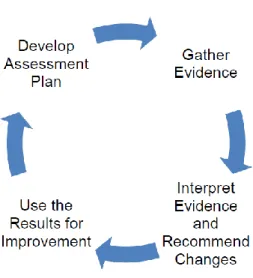
Learning outcomes assessment is the systematic process of evaluating stated and expected outcomes against demonstrated student performance outcomes as collected by assessment instruments. UMUC has developed assessment plans and activities at the institutional, school and program levels. All assessment plans are based on a continuous cycle, as illustrated in Figure 1, consisting of curricular mapping of learning activities to student learning outcomes (developing an assessment plan); data collection (gathering evidence); analysis, interpretation and reporting; and application of assessment results to the improvement of the students’ educational experiences and learning.
5
Figure 1: Assessment Cycle
UMUC has identified guiding principles to ensure that learning outcomes assessment is
systematic, sustained, and meaningful. Summarized in Table 2 below, these principles articulate the values and expectations for maintaining an institution-wide commitment to a culture of assessment and inform discussions pertaining to learning outcomes assessment across the institution.
Table 2: Guiding Principles of Learning Outcomes Assessment at UMUC
All administrators, faculty, and staff have a role in ensuring the academic success of students. Assessment is a collective effort.
Every degree program is responsible for the development and assessment of student skills in specific and identified areas of learning.
Learning assessment is an integral and unconditional component of effective instruction.
Assessment of student learning outcomes uses reliable and effective methodologies.
Results are used in a documented way to inform curriculum review and design. Stakeholders, including internal and external constituents, are routinely informed of learning outcomes results.
6
4 Develop Assessment Plans
In developing its institution-, school- and program-level assessment plans, those responsible for the assessment of student learning outcomes in the various UMUC units and departments (see Section 7) take the following steps:
1) Review institutional, School and program missions and goals and establish the desired levels of assessment.
2) Identify student learning goals in relation to the planned level of assessment.
3) Determine methods and tools for assessing student performance at the planned level. 4) Decide how results will be gathered, analyzed, and disseminated.
5) Establish timelines for assessment plan implementations. 6) Implement assessment plans and revisions as needed.
The next sections expand on steps followed at UMUC when developing assessment plans. Sections 4.1 through 4.4 describe the first and second steps in detail. Section 4.5 summarizes details related to steps three and four, while Section 4.6 addresses steps five and six.
4.1 UMUC’s Mission
UMUC’s institutional mission is “improving the lives of adult learners,” to be accomplished by “1) operating as Maryland’s open university, serving working adults, military servicemen and servicewomen and their families, and veterans who reside in Maryland, across the United States, and around the world; 2) providing our students with affordable, open access to valued, quality higher education; and 3) serving as a recognized leader in career-relevant education, embracing innovation and change aligned with our purpose and sharing our perspectives and expertise.” 1
Its core values encompass the principles of putting students first, at the center of their learning experiences, with UMUC being accountable for their success. We value excellence and
integrity, strive to lead and innovate in educational offerings. UMUC’s Strategic Plan prioritizes efforts to constantly improve our quality and to maximize student success by serving as a leader in higher education. A commitment to a quality learning outcomes assessment program is a means for identifying teaching and learning strategies that address these institutional goals. The University further commits itself to applying the results of its outcomes assessment activities to innovate and change curriculum and academic support. Accordingly, all processes and activities within the outcomes assessment cycle are designed with full attention to “closing the loop” and applying assessment results to improving students’ educational experiences and learning (see Section 5.4). As a means of ensuring quality instruction across degree programs, UMUC has instituted systematic instruction across the curriculum in a set of institution, School, program and course-wide competency areas. These competency areas are explained further in the following sections.
1
7
4.1.1 Institution-Level Learning Outcomes (Expectations)
UMUC learning outcomes are stated in terms of Student Learning Expectations (SLEs), expressed in the form of specific competencies, which the UMUC learning community has defined as “essential knowledge, skills and abilities (attitudes, dispositions, values and habits of mind) for success in a profession or area of study.” UMUC has developed four levels of student learning expectations: institution-level, school-level, program-level, and course-level.
Institution-level outcomes are based on UMUC’s mission. They also correspond to competency areas identified in Standard 12 of the Middle States Commission’s Characteristics of Excellence in Higher Education (2006 edition; revised online 2009) and those adopted by the Maryland Higher Education Commission as mandatory reporting categories required in the five-year assessment reports of all institutions under its coordination. The definitions for UMUC’s seven institution-level SLEs are listed in Table 3.
Table 3: Institution-Level Learning Outcomes: Student Learning Expectations (SLEs)
Definitions of Student Learning Expectations (SLEs)
Written Communication (COMM) Produce writing that meets expectations for format, organization, content, purpose, and audience.
Technology Fluency (TECH) Demonstrate an understanding of information technology broad enough to apply technology productively to academic studies, work, and everyday life.
Information Literacy (INFO) Demonstrate the ability to use libraries and other information resources to effectively locate, select, and evaluate needed information. Critical Thinking (THIN) Demonstrate the use of analytical skills and
reflective processing of information. Content/Discipline-Specific Knowledge
(SPEC/KNOW)
Demonstrate knowledge and competencies specific to program or major area of study. All UMUC students, regardless of their degree programs, are instructed and assessed in four common learning areas: written communication, critical thinking, information literacy, and technology fluency (abbreviated COMM, THIN, INFO, and TECH, respectively). In addition, the University expects that all students demonstrate competence in their chosen field of study (abbreviated as SPEC or KNOW).
4.2 School-Level Missions
Each School within UMUC has a mission specific to the needs and concerns of its students. The Undergraduate School (TUS) is “committed to meeting undergraduate students’ needs for
8
lifelong learning by providing innovative delivery of high-quality educational programs,
ensuring substantive and relevant curricula, and recognizing the value of experiential learning.” The Undergraduate School has an identified general education core, as mandated by the State of Maryland, and also prepares its students as global citizens. The mission of The Graduate School (TGS) is to equip graduates not only with discipline knowledge but also with the ability “to apply what they study to their professions and their daily lives.”
The missions of both Schools emphasize providing workforce-relevant programs that prepare students in arts and humanities, behavioral and social sciences, business and management, health-related fields, computing, education and technology, including degrees in fields facing critical shortages, such as cybersecurity, information assurance and teacher training in STEM areas.
4.2.1 School-Level Learning Outcomes (Expectations)
Just as UMUC’s institutional mission drives its institution-level outcomes, the specific missions of each School further focus and often expand the learning expectations. School-level student learning expectations are those competency areas that The Undergraduate School or The
Graduate School have identified as relevant to their Schools based on their respective missions. The Undergraduate School, based on mission-specific requirements, includes the full
complement of the institution-level SLEs in its assessment activities and also includes four other SLEs as shown in Table 4. TUS uses the term “hallmarks” to refer collectively to the institution-level SLEs plus the four additional school-institution-level outcomes. In its communications, it refers to the “the hallmarks of the educated person,” to convey to students and others the importance of these competencies and their integration throughout the curriculum.
Table 4: TUS Additional School-Level Learning Expectations (SLEs)/Hallmarks
Definitions of Student Learning Expectations
Quantitative Reasoning (QUAN) Demonstrate the application of mathematical and numerical reasoning skills.
Scientific Literacy (SCIE) Demonstrate the ability to understand key concepts and principles of the natural, social, and behavioral sciences and to apply these principles appropriately within personal lives. Historical and Cultural Perspectives
(HIST)
Knowledge of diverse cultures and historical periods
Ethics (ETH) Understanding of and ability to apply frameworks for ethical decision making
9
The Graduate School, with a mission that focuses on more specialized and applied professional programs, does not require a set of general education outcomes. Therefore it focuses on the institution-level SLEs of COMM, THIN, INFO, and TECH and KNOW for its school- and program-level assessments.
4.3 Program-Level Missions
Each UMUC degree program also has a specific mission that guides its design. Degree programs may be shaped by employer needs and external standards either mandated or recommended by accrediting bodies or scholarly societies, and are frequently informed by alumni and experts (i.e., practitioners) within each field. A program’s mission and other requirements are recorded in each program’s assessment plan. Based on its mission or other concerns, a program identifies SLEs that are specific to the program and that require routine evaluation.
4.3.1 Program-Level Learning Outcomes (Expectations)
Within The Undergraduate School, program-level learning expectations are defined as rich, robust, complex statements of what students can demonstrate when they graduate from the program. Assessments of program outcomes are implemented at the course level, in
collaboration with faculty, and are designed to evaluate student performance in the context of the discipline and provide information on curricular strengths and weaknesses. For example, the Psychology program evaluates critical thinking (THIN) through assessment activities that require students to demonstrate the scientific approach, while the Accounting program evaluates THIN by requiring students to analyze and validate financial system data. The learning outcomes for each course map to program outcomes and the results of assessment activities are aggregated to provide a view of student learning in the area of critical thinking for each program.
Currently, The Graduate School evaluates five institution-level SLEs (COMM, THIN, INFO, TECH and KNOW) for its school- and program-level SLEs, employing assessment activities capable of informing curricular improvements at both levels. TGS employs the “C2 Model” of assessment, which is described in greater detail in Section 4.4. Under this model, one school-wide, common assessment activity is performed to evaluate student learning in COMM, THIN, INFO and TECH at the school and program levels. The activity was designed and vetted by a special TGS assessment team. Independent raters score the student essays using a rubric the team developed. To assess the fifth SLE, KNOW, Program Chairs identify an assessment activity at the course-level to be used to assess discipline-specific knowledge in their programs. All sections of the course employ the same assessment activity and evaluation tool (rubric). For example, the Healthcare Program may employ an essay as an assessment activity, while the Accounting and Finance Program may employ a standardized exam that has been mapped to the TGS KNOW rubric. Both activities are aligned and mapped to the TGS KNOW Rubric, which was also developed and vetted by a special TGS assessment team. The results of course-level evaluations are aggregated to reflect program views, and results of all programs are further summarized to create a school-level view of student learning.
10 4.4 Course Outcomes
Course-level assessments focus on the degree to which students are achieving the learning
outcomes that are unique to the course and that are stated in the course syllabi. Generally, course learning outcomes are common to all sections of a course, but learning activities may vary from section to section. In such cases, assessments of student learning are not generally meant to measure the SLEs or broader degree program outcomes.
Courses may serve as the primary assessment points for evaluating program-level student learning outcomes. In such cases, the student learning outcomes and learning activities used in evaluation are common across all course sections. Under the coordination of a Program Chair, the course outcomes and mapped SLEs are monitored collectively to inform program-level curriculum changes and improvements, as is described above in the TUS and TGS examples related to critical thinking and discipline knowledge, respectively.
4.5 Assessment Plans and Activities
The following section provides information on UMUC assessment plans and activities pertaining to the institution, school and program levels.
4.5.1 Institution-Level Outcomes Assessment Plans and Activities
Institution-level learning outcomes assessment activities at UMUC are driven by the faculty, programs, and Schools. The Institutional Research (IR) office provides support for assessment activities to the Schools to assure consistency across the Schools, as well as institutional reporting for UMUC. Key tasks for IR include, but are not limited to:
• Support activities that create and sustain a culture of learning assessment for UMUC • Provide guidance and support to The Undergraduate School and The Graduate School on
the development of rubrics and school-level student learning assessment plans and the validation of statistical reporting, assuring that institutional assessment data are reliable and accurate
• Review and evaluate institutional progress and adherence to the Institutional Plan for the Assessment of Student Learning Outcomes
• Coordinate institutional learning assessment activities
• Conduct and report on national assessments such as the ETS Proficiency Profile (EPP) • Prepare annual reports that summarize learning assessment data and findings from the
institution-level, program-level, and course-level reports, monitoring and documenting the effective use of results in course design, curriculum review, and program development IR will work with both schools to develop and implement the Institutional Plan for the
Assessment of Student Learning Outcomes. In doing so, IR will coordinate with the Assessment Steering Committee (ASC) which will monitor, evaluate, and report on institutional assessment activities. Such activities will include implementing closing-the-loop action plans; reporting on process, progress, and outcomes; maintaining communication across the institution; sharing best
11
practices; coordinating assessment work shares; examining the alignment of SLEs across the schools; updating and evaluating the Institutional Plan; and gathering and sharing information from the external environment.
The IR office will develop an annual institutional assessment report that summarizes student learning outcomes and assessment activities for UMUC. This report will include:
1. Aggregated SLEs from the schools
2. Significant assessment activities that have occurred within each of the schools 3. Institution-level analyses and recommendations for assessment activities
4. Results of the ETS Proficiency Profile for UMUC over time and in comparison with other institutions as available
In addition, the IR office will gather institution-level information to report externally. For example, the Maryland Higher Education Commission (MHEC) requires the Student Learning Outcomes Assessment Report (SLOAR) every five years. This report is scheduled to be
submitted next in 2016. IR will be responsible for developing, vetting, and submitting this report to MHEC. The College Portrait (formerly VSA, for Voluntary System of Accountability)
requires that UMUC provide standard test results for student learning outcomes. For this measure, UMUC will report the results of the Educational Testing Service Proficiency Profile (EPP) to College Portrait. For more information regarding the EPP, see Appendix B.
4.5.2 School- and Program-Level Plans
With the support and consultation of the Institutional Research office, the schools develop plans to assess student learning at the school and program levels. The development of assessment plans begins with the association or mapping of learning activities to SLEs. Program Chairs develop or select learning activities within courses that provide students with opportunities to demonstrate their performance of specific SLEs. For example, an essay may require a student to demonstrate communication, critical thinking and discipline knowledge (COMM, THIN and KNOW). The assessment mapping and methodologies encompass a variety of approaches that include course-embedded methods involving both direct and indirect assessment tools and independent assessment measures.
The Program Chair creates or adopts an evaluation tool (instrument) to assess student
performance in relation to the learning activity. Evaluation tools generally include rubrics, but may also include standardized exams. Faculty evaluate student performance using the tool, summarize results and send them to the Institutional Research office where they are analyzed. IR returns the analyzed data back to the schools for review, further analyses, and use as the basis for curriculum recommendations. The findings and actions related to assessment activities are then reported according to the reporting processes described in Section 6.
Both schools conduct outcomes assessment on a semi-annual, annual, or multi-year basis, dependent upon programmatic, school, and University needs. Each has identified key points in academic programs at which to focus on gathering assessment data to determine student mastery
12
-- generally at the beginning, middle and end of a program. The plans developed by the Schools follow the cycle illustrated in Figure 1 of aligning activities to learning outcomes, evaluating student performance, gathering data, analyzing results, and using findings to improve teaching, programs and services. The plans for each school are presented in greater detail in the following sections.
TUS School- and Program-Level Assessment Plans
TUS School-Level Plan
The Undergraduate School annually sets forth an overall assessment plan for the School. Assessment plans for the school, division (academic department) and program are systematically reviewed and revised throughout the academic year as appropriate, with regard to the following considerations:
Alignment of learning outcomes to UMUC and TUS Program Missions
Other relevant standards including external requirements and professional standards for programs.
Recommendations from the five-year Academic Program Review Modifications to the curriculum
Institutional assessment initiatives
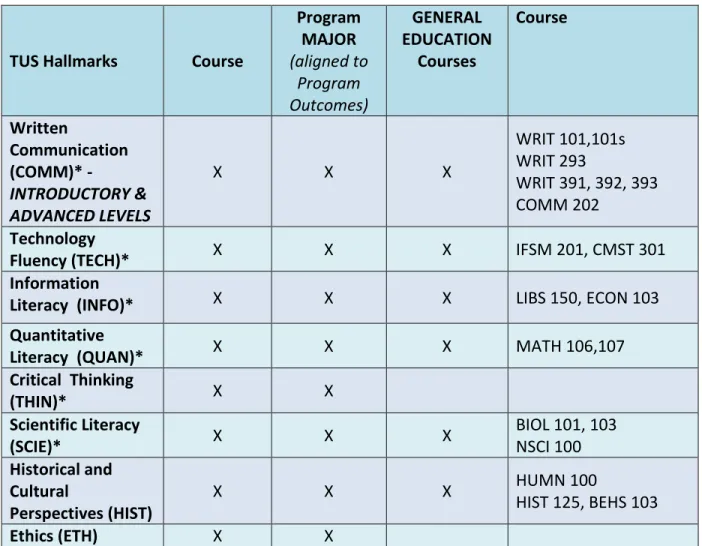
The Undergraduate School (TUS) assessment of hallmarks uses a multi-level approach. The TUS Hallmark Alignment (Table 5a) identifies where hallmarks are most appropriately assessed, using a standardized test or rubrics aligned to outcomes. In general, the hallmarks are
represented within all programs and assessment for specific hallmarks may occur within programs to provide summative program evaluation information. However, at the School level courses are selected to represent TUS General Education; thus Table 5a shows assessment within both the program and General Education courses, and Table 5b shows the designated courses. Because definitions of critical thinking (CRIT) and ethical perspectives (ETH) are highly contextual, they are assessed solely within programs and have no separate General Education assessment.
13
Table 5a: TUS Hallmark Alignment
TUS Hallmarks Course
Program MAJOR (aligned to
Program Outcomes)
GENERAL EDUCATION
Courses Institutional
ETS Proficiency
Profile (EPP)* Content/Discipline
(SPEC)* X X
Written
Communication (COMM)* -
Introductory & Advanced Levels
X X X X X
Technology Fluency
(TECH)* X X X X
Information Literacy
(INFO)* X X X X
Quantitative Literacy
(QUAN)* X X X X X
Critical Thinking
(THIN)* X X X
Scientific Literacy
(SCIE)* X X X
Historical and
Cultural Perspectives (HIST)
X X X
Ethics (ETH) X X
*Correspond to institution-level SLEs (i.e., not TUS alone)
For the General Education Program, the following crosswalk in Table 5b maps the selected General Education courses to the appropriate Hallmark:
14
Table 5b: General Education Crosswalk
TUS Hallmarks Course
Program MAJOR (aligned to
Program Outcomes)
GENERAL EDUCATION
Courses
Course
Written
Communication (COMM)* -
INTRODUCTORY & ADVANCED LEVELS
X X X
WRIT 101,101s WRIT 293
WRIT 391, 392, 393 COMM 202
Technology
Fluency (TECH)* X X X IFSM 201, CMST 301 Information
Literacy (INFO)* X X X LIBS 150, ECON 103 Quantitative
Literacy (QUAN)* X X X MATH 106,107
Critical Thinking
(THIN)* X X
Scientific Literacy
(SCIE)* X X X
BIOL 101, 103 NSCI 100
Historical and Cultural
Perspectives (HIST)
X X X HUMN 100
HIST 125, BEHS 103
Ethics (ETH) X X
TUS Program-level Plan
By academic program in The Undergraduate School, Program Chairs maintain a Program
Outcome Guide (POG), which is an assessment planning tool used to map course assessments to program outcomes and School hallmarks. Program Chairs determine what courses and program outcomes will be scheduled by term each academic year. After the assessment plan is created, updated or reviewed, pre-determined instructional action plans and assessments are implemented in the course. After each term, assessment results are compiled and analysis is conducted. Assessment findings are aligned to the program goals and hallmarks and reviewed by Program Chairs and faculty. Based on feedback received, action plans are reviewed and are created or modified, as appropriate. Program Chairs and faculty work together to implement instructional action plans and assessments in the course. Using the POG as a source of origination to ensure alignment and appropriate course sequencing, the Course Outcomes Guide (COG) outlines the course outcomes, assessments and key concepts, skills and issues. The COG identifies the alignments with the Hallmarks. A Deconstructed Course Outcomes Guide (DeCOG)
summarizes the course outcomes, related competencies and assessments, and the degree of rigor. After implementation, Program Chairs then review results to determine whether the instructional
15
action plan made a positive difference. Samples of a POG, COG and DeCOG appear in Appendix C.
Examples from the plan illustrate the methods used for assessing student learning, as summarized in the following table:
Table 6:
TUS Examples of Methods Used for Assessing Student Learning at Program Level
SLE Course/Activity/Evaluation Tool
COMM WRTG 101 Common Essay, rubric-scored TECH IFSM 201 Authentic Assessment, rubric-scored INFO LIBS 150 Common Final Exam *
KNOW Program Capstone Courses, Authentic Assessment, rubric-scored QUAN MATH 106 and 107 Common Final Exam
ETH Program Capstone Courses, Authentic Assessment, rubric-scored HIST HIST 157 Authentic Assessment, rubric-scored
*Common final exams are developed in collaboration with Institutional Research to ensure reliability and uniform administration procedures.
TGS School-Level Plan
The Graduate School similarly establishes an annual assessment plan. The school-level
assessment is based on the aggregate of program-level assessment activities, as described in the following paragraph. Program-level activities select specific courses in a program’s lifecycle in which to conduct assessment activities and capture indications of student performance on the TGS SLEs.
Table 7: TGS SLE Alignment
TGS SLEs
(the same for school and program levels)
Course Program Institutional*
Written Communication (COMM) X X
Technology Fluency (TECH) X X
Information Literacy (INFO) X X Quantitative Literacy (QUAN)* X X
Critical Thinking (THIN) X X
Discipline Knowledge (KNOW) X X
16 TGS Program-level Plans
The Graduate School plans for program-level outcomes assessment on an annual basis and conducts its assessment activities each spring semester. Course-level activities map to program-level SLEs, creating the assessment plan for the program. The aggregate findings of the
program-level assessment activities form the school-level assessment plan since program- and school-level SLEs are the same. The result is that every spring, TGS runs assessment activities that serve to inform school-and program-level assessment planning. An overview of The Graduate School Plan, which is referred to as the C2 model, is available in Appendix D.
Table 8: Examples of Methods Used for Assessing Student Learning at Program Level
SLE Course/Activity/Evaluation Tool School
COMM C2 Model – Common Assignment, rubric scored
The Graduate School THIN C2 Model – Common Assignment, rubric
scored
The Graduate School TECH C2 Model – Common Assignment, rubric
scored
The Graduate School INFO C2 Model – Common Assignment, rubric
scored
The Graduate School KNOW Embedded Assignments, rubric scored The Graduate School In addition, in The Graduate School, in compliance as a candidate for CAEP/NCATE
accreditation, the TGS Department of Education maintains a system of assessment for its Master of Arts in Teaching for Initial Secondary Certification (MAT) and the Master’s of Education in Instructional Technology (MEd) degrees. The programs employ TK20 to gather assessment data on candidate applicant and admissions quality and candidate performance of knowledge, skills and dispositions, for education and TGS-wide competencies.
An overview of the Department of Education’s assessment activities appear in Appendix E. 4.6 Assessment Plan Implementation Timelines
Both the Undergraduate and Graduate Schools have developed plans and implementation timelines for assessment activities through Spring 2016.
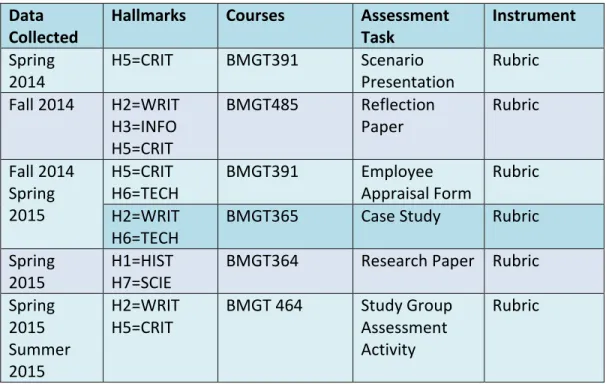
The TUS Sample Program Timeline in Table 9 illustrates the type of planning that takes place for each program in The Undergraduate School. See also the sample POG and COG in Appendix C for how all program-level outcomes (both hallmarks and KNOW outcomes) are identified and aligned with courses.
17
Table 9: TUS Sample Program Timeline: Management Studies
Data Collected
Hallmarks Courses Assessment Task
Instrument
Spring 2014
H5=CRIT BMGT391 Scenario Presentation
Rubric Fall 2014 H2=WRIT
H3=INFO H5=CRIT
BMGT485 Reflection Paper Rubric Fall 2014 Spring 2015 H5=CRIT H6=TECH
BMGT391 Employee Appraisal Form
Rubric H2=WRIT
H6=TECH
BMGT365 Case Study Rubric Spring
2015
H1=HIST H7=SCIE
BMGT364 Research Paper Rubric Spring 2015 Summer 2015 H2=WRIT H5=CRIT
BMGT 464 Study Group Assessment Activity
Rubric
The TGS Assessment Plan Timeline in Table10 summarizes all activities in TGS from Spring 2010 through Spring 2016.
Table 10: TGS Assessment Plan Timeline
Spring SLEs Program Courses Assignment Instrument 2010 All 5 All, excluding
specializations (subsets of the programs with narrower requirements)
Round 1 – Course within 3-9 credits Selected by Program Chair TGS Developed Rubrics
2011 All 5 All, excluding specializations
Round 2 – Course within 12- Selected by Program Chair TGS Developed Rubrics 2012 All 5 All, excluding
specializations
Round 3 – Course within 33-36 credits Selected by Program Chair TGS Developed Rubrics 2013 All 5 All, excluding
specializations
C2 Model Common Assignment & Select Course Activity for KNOW
Combined Rubric & TGS KNOW Rubric
18 2014 All 5 All, excluding
specializations
C2 Model Common Assignment & Select Course Activity for KNOW
Combined Rubric & TGS KNOW Rubric
2015 COMM, KNOW
All, including specializations
C2 Model Common Assignment & Select Course Activity for KNOW
Combined Rubric & TGS KNOW Rubric
2016 COMM, KNOW
All, including specializations
C2 Model Common Assignment & Select Course Activity for KNOW
Combined Rubric & TGS KNOW Rubric
19
5 Gathering and Analyzing Evidence
5.1 Data CollectionBoth schools employ Taskstream Accountability Management Software. The software is used for the following assessment planning tasks:
storing and maintaining UMUC’s SLE database, creating curriculum and activity maps,
compiling and archiving annual assessment plans, and documenting findings and action (close-the-loop) plans.
Similarly, the Department of Education in The Graduate School employs Tk20 Assessment Software to track assessment of student learning at course level.
Data collection varies according to each school’s plan. The Institutional Research office works with each school’s head of assessment to determine sampling plans and how to aggregate data. The IR office performs final analyses. Examples of the reports created and maintained in Taskstream and Tk20 are presented in Appendix F.
5.2 Data Analysis
The Institutional Research office analyzes the data and assists by entering the findings into Taskstream or other reporting systems or formats. Typical analyses show how well students performed on evaluation criteria. The following illustrates the findings related to employing a rubric to evaluate student performance on an assignment related to the SLE discipline-specific knowledge (KNOW):
Figure 2: Summary Illustration of Program Findings from Taskstream System
Program Findings for KNOW Rubric - TGS MS in Instructional Technology - Spring 2013
Description/Details of Measure: Course assignment measured with associated TGS KNOW rubric overlapping with certain criteria in Phase III of the "Data-Driven Decision Making Project."
Acceptable Target/Benchmark: Completing the assignment at least at the "Proficient" level according to the rubric is acceptable. Therefore our acceptable target is having at least 80% of the students receiving at least a "B" on the assignment.
Summary of Findings: Student learning was at a competent or exemplary level on all three dimensions of content knowledge.
Detailed Analysis: There were 3 sections in the analysis. There were 36 students in the data set. Five were not in the major. They were removed from the data set. There were 31 students in the analysis.
20 Conceptual
Understanding 1 = 0.0% Unsatisfactory 2 = 19.4% Marginal 3 = 32.3% Competent 4 = 48.4% Exemplary
Theory Application 1 = 3.2%
Unsatisfactory 2 = 3.2% Marginal 3 = 35.5% Competent 4 = 58.1% Exemplary
Knowledge Integration 1 = 6.5% Unsatisfactory 2 = 0.0% Marginal 3 = 32.3% Competent 4 = 61.3% Exemplary
Overall
Target of 80% of all students earning a B or better in all three criteria, achieved.
Findings can be aggregated at the student, section, program and school levels. Data analyses and findings are shared and used by the schools and the larger UMUC learning community to inform improvements to curriculum and student support.
When appropriate (e.g., for the SLOAR report), data from the institution-level EPP exam is gathered and analyzed in the Fall and Spring semesters, and a report is completed in the Summer by the Institutional Research office.
5.3 Discussion of Results
Open and ongoing dialogue among faculty across the University is crucial for the meaningful application of outcomes assessment results. UMUC is working to increase faculty engagement in the assessment process. To do so, the University leadership is increasing the number of organized assessment events, including meetings, forums, and discussions designed to support faculty engagement and buy-in by providing opportunities for education about the continuous improvement process, including how it benefits faculty, programs, the schools, and the broader institution. To further increase faculty buy-in and engagement, expanded opportunities for all faculty members to engage in the continuous improvement process, from planning through analysis and decision-making, are being created. Enabling all faculty, including adjuncts, to participate in the process supports improvement efforts because they may provide broader perspectives on the effects of decisions on programs and students that may not otherwise be contributed. Increased faculty involvement is expected to support their feelings of commitment to the institution or connection to a given program. Based on the recommendations of the Eduventures audit, among the methods being implemented to increase faculty engagement are:
Providing increased access to documentation on assessment practices, including this updated version of the Institutional Assessment Plan
Maintaining an up-to-date Outcomes Assessment space on UMUC’s social networking site “ENGAGE”; sharing resources and timelines, and updating the institutional plan for assessment to incorporate modifications more frequently as the assessment initiative moves forward
Keeping information on the outcomes assessment web site up-to-date
Introducing faculty during their orientation to the culture of assessment and expectations for their participation.
21
Increasing faculty involvement in the design of “closing the loop” actions and program improvements.
Connecting assessment efforts and findings across all divisions of the University by holding two special Assessment Steering Committee meetings annually to discuss the outcomes assessment activities in the two schools and its programs over the previous six months; invite the entire faculty to attend online.
Engaging adjunct faculty with special outcomes assessment projects (e.g., the Graduate School Rubric Norming and Scoring Project) and providing collaborative opportunities to adjunct faculty related to assessment process, implementation and results.
22
6 Reporting and Dissemination
6.1 On-Demand Reporting
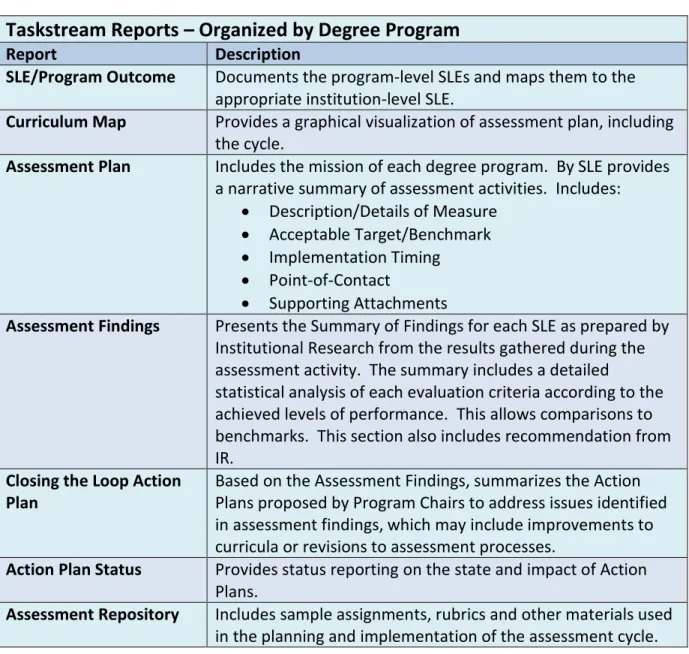
Each school summarizes school- and program-level assessment activities in the Taskstream Accountability Management Software system. The Graduate School also employs Tk20 Assessment Software to track and summarize course-level assessment activities. The systems produce on-demand reports that are disseminated to stakeholders as required. Currently, the Reports available in each system include:
Table 11: Summary of Available Taskstream Reports
Taskstream Reports – Organized by Degree Program
Report Description
SLE/Program Outcome Documents the program-level SLEs and maps them to the appropriate institution-level SLE.
Curriculum Map Provides a graphical visualization of assessment plan, including the cycle.
Assessment Plan Includes the mission of each degree program. By SLE provides a narrative summary of assessment activities. Includes:
Description/Details of Measure Acceptable Target/Benchmark Implementation Timing
Point-of-Contact
Supporting Attachments
Assessment Findings Presents the Summary of Findings for each SLE as prepared by Institutional Research from the results gathered during the assessment activity. The summary includes a detailed
statistical analysis of each evaluation criteria according to the achieved levels of performance. This allows comparisons to benchmarks. This section also includes recommendation from IR.
Closing the Loop Action Plan
Based on the Assessment Findings, summarizes the Action Plans proposed by Program Chairs to address issues identified in assessment findings, which may include improvements to curricula or revisions to assessment processes.
Action Plan Status Provides status reporting on the state and impact of Action Plans.
Assessment Repository Includes sample assignments, rubrics and other materials used in the planning and implementation of the assessment cycle.
23
Table 12: Summary of Available TK20 Reports
Tk20 Reports – Organized by Course & Program
Report Description
Rubric Evaluation Summaries
Reports responses on rubric by student and in course aggregate by evaluation criteria.
Program Evaluation Summary
Reports aggregate responses on rubric by criteria for program view of all student performance.
Those involved in ongoing assessment activities employ the systems in real time throughout the assessment cycle to document plans and review and analyze findings. This method replaces prior reporting processes that required periodic manual preparation of reports in Microsoft Word documents. The on-demand nature of reporting enables easy compilation of assessment findings for Academic Program Review reporting, for reporting to accrediting and certification bodies, and for internal assessment planning. These reports are readily available to Deans, Vice Deans and Program Chairs through authorized direct access or upon request to each school’s
assessment administrator. Examples of semester undergraduate and annual graduate Taskstream reports are provided in Appendix F.
UMUC continues to build its reporting capabilities with the goal of providing additional reporting that will include:
1. Aggregate reporting of assessment results by SLE by school. Currently this information must be assembled manually from Taskstream system reports.
2. Compilation of school-level data into an institutional report, to offer a high-level
summary of all students’ learning on all Student Learning Expectations (SLEs) across the University.
3. Shared reporting on ENGAGE and the UMUC website.
6.2 Five-Year Reporting Cycle
Beginning August 2, 2004, the Maryland Higher Education Commission required Maryland institutions of higher education to submit triennial reports on assessment activities at the
undergraduate level. To promote efficiency among institutions within the University System of Maryland, the commission adopted for the Student Learning Outcomes Assessment Report (SLOAR) the same competency areas identified in Standard 12 of the Middle States
Commission’s Characteristics of Excellence in Higher Education (2006 edition; revised online 2009). These include written and oral communication skills, quantitative reasoning, critical thinking, scientific literacy, information literacy, and technological fluency.
The Student Learning Outcomes Assessment Report has specific requirements in terms of form and content. For each competency area, the report provides an institution-level definition, a discussion of methodology and measures, and documentation of the ways in which outcomes assessment has been applied to the improvement of teaching and learning.
24
To allow more time for the changes from assessment to become evident, in 2011 the Maryland Higher Education Commission changed the timing of the required Student Learning Outcomes Assessment Report from every three years to every five years. Therefore, every five years a report is created based on a compilation of The Undergraduate School’s reports from the preceding five years. The Student Learning Outcomes Assessment Report is compiled in the Institutional Research office, and the next report will need to be completed in 2016. The assessment plan for SLOAR appears in Appendix F.
Also in 2011 (five years subsequent to its successful decennial evaluation by the Middle States accreditation team), UMUC was required to submit the interim Periodic Review Report. According to the commission, the report is a “retrospective, current, and prospective analysis of an institution since its last evaluation … [including] a description of how the institution
responded to any recommendations made by the institution in its own self-study report, by the visiting team that evaluated the institution, and by the Commission.” UMUC was commended by MSCHE for its 2011 Periodic Review Report, which among other notable accomplishments described the comprehensive redesign of The Undergraduate School’s curriculum to make it outcomes-based and appropriate for working professionals. The curriculum was built on outcomes that were defined by professional is the field, professional associations, and people who teach in the field. The redesign was a year-long project that engaged about 600 full and part-time faculty members. Middle States described UMUC as being committed to using assessment to enhance student learning. The University received an affirmative report from the 2011 Periodic Review and now, while continually improving its assessment practices, is
preparing for its 2015-2016 self-study and looking forward to the next review by MSCHE in 2016.
6.3 Academic Program Reviews
Also on five-year cycles (although not necessarily coinciding with the MHEC or MSCHE reporting) are the Academic Program Reviews completed by each undergraduate and graduate academic program. The full Academic Program Review (APR), mandated by the University System of Maryland (USM) is a comprehensive assessment, covering enrollment and graduation rates, faculty demographics, grade distributions, course evaluations, and other measures relevant to the overall health and quality of an academic program. Included as well is a report from an external reviewer not affiliated with UMUC.
Learning outcomes assessment has become an increasingly prominent part of the academic program review process. The Program Assessment Reports discussed previously in Section 6.1 provide the basis not only for school- and institution-level reporting on SLEs but also for the five-year summary and analysis provided in the Academic Program Reviews. The focus of the APRs, however, is on those assessment activities most directly related to students’ mastery of the specialized content of their degree program and their ability to demonstrate the associated
knowledge, skills, and attitudes during and upon completion of the program—those areas of competency collectively designated by this plan as the SLE in content/discipline-specific knowledge. In practice, some disciplinary academic program reviews include outcome assessment results for program outcomes aligned with other SLEs. This is because many programs have articulated outcomes that represent higher levels of competency for certain SLE
25
skills than are generally expected of all UMUC students. For example, a computer and information science (CMIS) major demands a level of competency in technological fluency (TECH) that is more advanced than the level expected by a history major. In its academic program review, CMIS accordingly included different assessment activities related to the TECH SLE to reflect the specialized content of the degree program.
Therefore, assessment results and activities discussed in the Program Assessment Reports are used as the basis for school- and institution-level reports and serve as a primary source for reporting to external stakeholders including the Maryland Higher Education Commission, the Middle States Commission on Higher Education and specialized accreditors.
26
7 Closing the Loop: Applying the Results of Assessment
Following the analysis and dissemination of results, faculty and program administrators ensure that these results are applied for improvements in the students’ learning experience. For
example, results of program-level assessments of information literacy have over the past several years been used to inform changes in both curricula and pedagogy. Revisions to the content of the online library and research skills course (LIBS 150) were implemented to address deficits in student performance revealed by a program-level assessment. To help support faculty teaching this course, the interface to a quiz-results database was improved so that instructors get a
snapshot of student performance on assessments across a section and can adjust their instruction and provide feedback to individual students accordingly. Other examples of using assessment findings to improve curriculum are presented in Appendix H. Documenting such instances of program-level closing-the-loop activities is included in the reporting procedures described in Section 6.
Sharing examples of successful use of outcomes assessment results helps to encourage similar strategies within and across programs. The Office of the Provost, Deans, Vice Deans and Program Chairs strive to work collaboratively with the faculty to use learning outcomes
assessment data to direct research toward fully identifying the problems leading to weak learning outcomes assessment scores. From that research, those stakeholders make closing-the-loop decisions with respect to allocations or re-allocations of resources, program and curricular changes, policy revisions, and all other feasible actions that can improve student learning. Some particular examples under the broad category of closing-the-loop actions stated above are
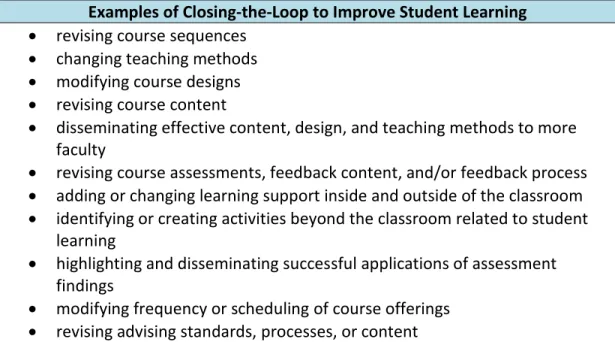
provided in Table 13 below. The chart is not intended to be exhaustive, merely illustrative of possible ways in which to apply the results of outcomes assessment to improve student learning. Detailed samples of closing-the-loop plans appear in Appendix H.
Table 13: Examples of Closing-the-Loop Action Plans
Examples of Closing-the-Loop to Improve Student Learning
revising course sequences changing teaching methods modifying course designs revising course content
disseminating effective content, design, and teaching methods to more faculty
revising course assessments, feedback content, and/or feedback process adding or changing learning support inside and outside of the classroom identifying or creating activities beyond the classroom related to student
learning
highlighting and disseminating successful applications of assessment findings
modifying frequency or scheduling of course offerings revising advising standards, processes, or content
27
8 Roles and Responsibilities
Various organizational entities and personnel have distinct roles and responsibilities in maintaining ongoing, systematic learning outcomes assessment. Details are provided in the discussion below.
8.1 Assessment Steering Committee
The Assessment Steering Committee (ASC) serves in an advisory and coordinating capacity between the Provost and the Schools to assist in setting the direction for student learning outcomes assessment at UMUC and ensure its ongoing, systematic practice. The committee meets routinely to discuss the state of assessment activities in each school and identify specific tasks and activities required to support ongoing UMUC assessment efforts. The goals of the ASC are to:
1. Ensure that each school has established a process for collecting, analyzing, and reporting outcomes assessment data.
2. Align learning expectations across the schools and programs.
3. Document and evaluate “close-the-loop” activities that demonstrate how data are used to make decisions to improve learning outcomes.
4. Manage, in coordination with Institutional Research and the Schools, external reporting timelines related to assessment practices.
5. Advocate for institution-level support for ASC agreed-upon assessment initiatives. 6. Develop a forum for Program Chairs and faculty to share assessment activities and best
practices.
7. Provide information about UMUC assessment activities on ENGAGE and information on our public website for internal and external stakeholders.
8. Conduct environmental scanning activities to identify assessment activities and best practices at other institutions or at a national level.
The membership of the ASC consists of the Associate Vice President of Institutional Research, Associate Dean in The Graduate School, Associate Dean in The Undergraduate School, Student Learning Evaluation (Assessment) Committee Representative, Director of Assessment in The Undergraduate School, and faculty representatives from the Graduate and Undergraduate Schools
8.2 Schools, Offices and Individuals
Deans, Associate Deans, Vice Deans and Program Chairs have responsibility for ensuring robust assessment processes in both schools, and that results and actions are reported to key
stakeholders. They work with faculty and other UMUC offices to design and implement their assessment activities and are held accountable each year for assessment work as a requirement of their position and successful performance review.
28
Undergraduate and Graduate Deans and Associate Deans
The deans of The Undergraduate School and The Graduate School are responsible for the overall development and implementation of school-level assessment plans, which in turn inform the Institutional Plan. Deans have primary responsibility for the following:
Ensure the submission of annual school-level and program-level reports that describe data and/or use of findings resulting from learning outcomes assessment activities
Establish a communication process that demonstrates support of the learning outcomes assessment initiative to faculty and students
Develop and implement a curricular mapping process that ensures all relevant institution-level student learning outcomes are embedded across all degree programs
Ensure program-level and school-level reporting on instances of closing-the-loop activities Provide school-level faculty development opportunities that act on the results of assessment
and further support continuing effective learning outcomes
The deans are further responsible for ensuring that learning outcomes assessment findings are incorporated into Academic Program Reviews and other curriculum development processes. For each school, the respective dean appoints a senior administrator responsible for the general coordination of learning outcomes assessment activities. Currently, in The Undergraduate School this role is assigned to the Director of Assessment who reports to the Associate Dean, while in The Graduate School the activities are managed by the Associate Dean through the Student Learning Evaluation (Assessment) Committee. The roles are explained below. Assessment Administrators
Undergraduate Director of Assessment
The TUS Director of Assessment works with the Deans to develop the school-level learning outcomes assessment plans and assists Vice Deans and Program Chairs in the design and implementation of program-level assessment plans. He/she works directly with school personnel, including faculty, in the design and implementation of assessment instruments and collaborates with academic departments to manage, support, and document learning outcomes assessment activities within the schools. The Director provides support, guidance, and training in assessment practice. He/she assists with the recording, tracking and analysis of assessment findings in Taskstream and serves on the Assessment Steering Committee. As the key
administrator, the Director serves as the key point of contact for assessment questions within the school.
TGS Student Learning Evaluation (Assessment) Team
The Committee works with the TGS Associate Dean to develop plans and coordinate processes for the evaluation of student learning at the school, program and course levels. Its work includes developing and maintaining The Graduate School Student Learning Evaluation Plan. Specific activities include assisting in the validation of rubrics for courses, approving program and school level evaluation plans, training TGS personnel on evaluation practices, conducting the annual review of student learning outcomes, documenting and analyzing results, and monitoring the
29
implementation and results of “close-the-loop” plans. These activities require use of a system that tracks student, program and school performance (Taskstream andTK20). Select members also serve as representatives to UMUC’s Assessment Steering Committee and carry out work as assigned from this committee. This committee coordinates with and reports on its activities to the TGS Associate Dean, who is the principal point of contact for assessment within the School. Vice Deans and Program Chairs
As the heads of departments and degree programs, respectively, these individuals share
responsibility in working with the senior assessment administrators in each school to design and implement program- and course-level assessment plans. Though they may not be directly involved in all assessment activities, they are knowledgeable about assessment plans and ongoing activities. They meet periodically as a group and individually with Deans, senior assessment administrators and others involved in assessment activities to receive updates, provide feedback, analyze results, make changes to curriculum based on the results, and lead the continuous process of improvement. Vice Deans and Program Chairs stay abreast of trends in assessment and participate in training and events that showcase UMUC assessment activities. They play key roles in leading and supporting the culture of assessment at UMUC through their leadership and advocacy.
Provost
The infrastructure for learning outcomes assessment at UMUC is directed by the collaborative vision of many senior administrators. Working with other members of the Assessment Steering Committee, the Provost articulates the institutional vision for the assessment of student learning and is committed to institutional ownership of the learning assessment process. Among the primary responsibilities of the Provost with regard to outcomes assessment are the following: • Ensures external mandated requirements are met
• Ensures institutional assessment processes embody best practices
• Maintains the Institutional Plan for the Assessment of Student Learning Outcomes
• Ensures all plans and procedures for assessment are clear, well developed, consistent, and meaningful
• Ensures that the Institutional Plan is executed
• Produces triennial Student Learning Outcomes Assessment Report for the Maryland Higher Education Commission
The Provost’s Office also serves as the principal link between the faculty and administration with regard to learning outcomes assessment (see discussion of the Faculty Advisory Council below). Faculty Participation
Consisting of 18 elected members, the Faculty Advisory Council represents all faculty, including librarians, in UMUC Adelphi, UMUC–Asia, and UMUC–Europe. The council advises the provost on a variety of matters of concern to faculty, including curricular and assessment activities.