UTS:Engineering
Engineering Practice Program Student Guide
Table of Contents
1 Introduction ... 2
2 What is practice-based engineering education? ... 2
3 Overview of the UTS:Engineering Practice Program ... 2
3.1 Practice Program Requirements by Course ... 2
3.2 48-week Structured Practice Program (DipEngPrac) ... 2
3.3 12-week practice program (BE course) ... 4
4 What will I gain from doing the practice program? ... 4
5 Practice Program Subjects ... 6
5.1 48121 Engineering Practice Preview 1 (EPP1) ... 6
5.2 48110 Engineering Experience 1 (EE1) ... 6
5.3 48122 Engineering Practice Review 1 (EPR1)... 7
5.4 48141 Engineering Practice Preview 2 (EPP2) ... 7
5.5 48130 Engineering Experience 2 (EE2) ... 8
5.6 48142 Engineering Practice Review 2 (EPR2)... 9
5.7 Exemption from first internship ... 9
5.8 48100 Professional Practice (BE) ... 10
5.9 Capstone Project ... 10
6 Timelines / Deadlines ... 10
6.1 Completion of Engineering Experience 1 (<87cp) ... 10
6.2 Commencement of Engineering Experience 2 (>129cp) ... 11
6.3 Submission of start forms ... 11
6.4 Submission of finish forms ... 11
6.5 Definition of “engineering subjects” for application of engineering practice rules .. 11
7 Internship Support ... 11
7.1 Industry Partnering Unit ... 11
7.1.1 I2MS ... 12
7.2 What is a suitable Internship Position? ... 12
7.3 Getting paid ... 13
7.4 Insurance ... 14
7.5 What to do if something goes wrong ... 14
7.5.1 I have lost my job ... 14
7.5.2 My job is not as described ... 14
7.5.3 I am mistreated at work ... 15
7.5.4 I am injured at work during my internship ... 15
7.6 Important Student Contacts ... 15
8 Frequently Asked Questions ... 15
9 Further reading ... 18
Appendix A: Abbreviations ... 19
Appendix B: Company Letter Template ... 20
Appendix C: Internship Approval Process ... 21
Appendix D: Suitable Internship Work ... 22
Appendix E: WHS checklist ... 23
This guide is available electronically at:
https://my.feit.uts.edu.au/pages/course/undergraduate/engineering_practice_program/processes_administration
1 Introduction
This guide is intended to assist students in UTS:Engineering undergraduate degree courses to meet the work experience components of their course and to maximise the learning outcomes from that part of the course. The guide explains the rationale of the program and its components as well as the important rules and procedures that are in place to support the rationale.
2 What is practice-based engineering education?
The UTS:Engineering perspective on practice-based engineering education requires students to experience the reality of engineering from an early stage in their professional formation — through internship. It actively relates this experience to their developing understanding of engineering theory, analysis and laboratory work, and to studies in other disciplines, and it promotes critical and creative thinking based on knowledge gained outside as well as within the University.
Practice-based education is more than practice and more than education. A university education should impart a thorough grasp of fundamental principles, a respect for knowledge, a capacity for critical inquiry and lateral thinking, a fluency in communication, a pride in excellence and an eagerness to contribute to shaping the future. Practice-based engineering education claims that these attributes can be more effective when they have been developed in contact with the human and technical challenge of real engineering situations.
3 Overview of the UTS:Engineering Practice Program
3.1 Practice Program Requirements by Course
The amount and type of engineering practice that you are required to complete as part of your UTS:Engineering course is given in the following table:
Course Name & Code Practice Requirements
Bachelor of Engineering Diploma in Engineering Practice (C10061) 48 weeks structured DOUBLE BE DEGREES with DipEngPrac
BEBAIntStudDipEngPrac (C10062), BEBBusDipEngPrac (C10068), BEBScDipEngPrac (C10074), BEBMedScDipEngPrac (C10076), BEBBioTechDipEngPrac (C10079)
48 weeks structured
Bachelor of Engineering (international students only) (C10067) 12 weeks DOUBLE DEGREES without DipEngPrac
BEBAIntStud (C10063), BEBBus (C10065), BEBSc (C10073), BEBMedSc (C10075), BEBBioTech (C10078)
12 weeks
Bachelor of Engineering Science (C10066) None Bachelor of Engineering Science in Aerospace Operations
(Singapore) (C10069)
None
Bachelor of Engineering Science Bachelor of Laws (C10136) None
Table 1 - Practice requirements for UTS:Engineering undergraduate courses
3.2 48-week Structured Practice Program (DipEngPrac)
The 48-week structured engineering practice program, known as the Diploma in Engineering Practice (DipEngPrac) is a compulsory component for all professional
engineering courses at UTS1. It consists of 2 phases: one that occurs about one third
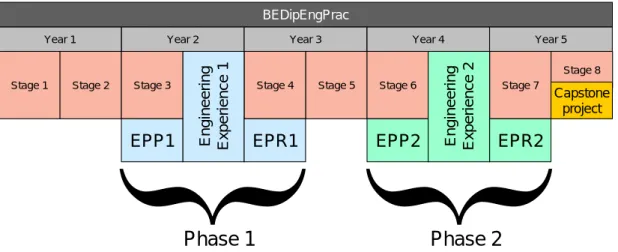
of the way through the course and the second about two thirds of the way through the course (although this is flexible to some extent). Each phase includes a 24 week (roughly 6 months) paid2 internship in industry. It also includes a preparatory subject
called engineering practice preview and a reflective assessment subject called engineering practice review for each phase. This is shown in figure 1 below:
Stage 1 Stage 2
En
gi
neering
Exp
e
ri
ence 1
Stage 4 Stage 5 Stage 6
Stage 3 Stage 7
Stage 8
EPP1 EPR1 EPP2 EPR2
Year 1
Eng
ineering
Exp
e
ri
ence 2
Year 2 Year 3 Year 4 Year 5
Capstone project
BEDipEngPrac
Phase 1
Phase 2
Figure 1 - Overview of the 48-week structured practice program
The pattern of completion of stages of the BEDipEngPrac shown in Figure 1 is indicative only; there is substantial flexibility in the way students complete the course based on the notion of pre-requisite requirements for each subject. Pre-requisite requirements for engineering practice program subjects are detailed within this guide. Students may also complete the course part-time if they are working full-time. In this case, students nominate a particular semester of their on-going employment as being their official internship after they have completed the required ‘preview’ subject.
Despite this flexibility, there are also some rules about when the internships can and should be taken. These are explained in detail in Section 6 Timelines / Deadlines. In a nutshell, there are 2 main requirements:
1. The first internship, consisting of 24 weeks of full-time work, must be completed early in the course, preferably in year 2. Students are not permitted to continue studying beyond 87 credit points if they have not completed their first internship. UTS:Engineering believes that early exposure to the practice of engineering significantly motivates students about their study and changes the way they approach their learning. 2. The second internship must be completed towards the final third of the
course. Students must not commence their second internship before completing a minimum of 129 credit points.
The sequential nature of the practice program is also critical to quality learning outcomes. The subjects must be completed in the order specified and each subject must be completed before moving onto the next subject. This is because each phase has been designed for learning goals to be set in the ‘preview’ subject, then experience to be gained in light of those goals, and finally for an assessment and reflection on that learning in the ‘review’ subject. It is also important to complete the first phase entirely before moving onto the next phase.
1 Except for international students where visa restrictions prevent appropriate employment in Australia and for some double degree courses.
For students who have had significant and relevant prior work experience to being admitted into UTS:Engineering, there is an exemption process that covers 48121 and 48110. (see section Error! Reference source not found. Exemption from first internship). Under no circumstances are any students ever granted an exemption from the second phase of the practice program. That is, all students, regardless of age or experience, must complete EPP2, EE2 and EPR2. This is because if you want a degree from UTS, we need to be sure that you have completed all learning aspects of the structured work experience program involving setting learning goals, gaining experience and then assessing and reflecting on that experience.
Also shown in Figure 1 is another component of the engineering practice program which comes at the very end of the degree which is the capstone project.
3.3 12-week practice program (BE course)
Students enrolled in professional engineering courses without the Diploma in Engineering Practice must complete a 12 week internship program as specified by Engineers Australia, the professional body that is responsible for accrediting engineering courses in Australia. Students requiring to complete the 12-week program must enroll in the subject 48100 Professional Practice (BE). Details about this subject are available in section 5.8.
4 What will I gain from doing the practice program?
Learning outcomes from the engineering practice program are based largely on guidelines published by Engineers Australia. This organisation represents the engineering profession in Australia and is responsible for accrediting engineering courses as well as maintaining the national register of chartered professional engineers. Through the “Washington accord” agreement, Australian engineering qualifications are also recognised in 13 countries across the globe. More information about Engineers Australia can be found on their website. There is also a separate website for International Engineering Agreements (including the Washington accord) which can be found in the references section at the end of this document.Engineers Australia define a two-stage competency recognition arrangement for engineering professionals. These are:
Stage 1 competence: Covers the technical knowledge and skills required of engineers in a range of disciplines. Graduates of accredited engineering courses are automatically recognised as being stage 1 competent. All professional engineering courses from UTS:Engineering are accredited by Engineers Australia. Some stage 1 competencies are assessed in the subject Capstone Project in your UTS:Engineering course.
Stage 2 competence: This covers the attributes required of professionals to practice engineering in the real world. Stage 2 competence is normally achieved around 2 to 4 years after graduation. However, UTS:Engineering students get a head-start on other engineering graduates from Australia because a significant subset of stage 2 competencies are assessed as part of the UTS:Engineering practice program. This is largely what you do in the ‘review’ subjects in the program. There is also strong alignment between the Engineers Australia competencies and the UTS:FEIT Graduate Attributes. The following figure shows the learning threads that are embedded into the various practice program subjects and their relation to the graduate attributes:
48230 Engineering Communication 48121 Engineering Practice Preview 1 48110 Engineering Experience 1 48122 Engineering Practice Review 1 48141 Engineering Practice Preview 2 48130 Engineering Experience 2 48142 Engineering Practice Review 2
Understand social contexts of
engineering practice Practice in a manner that is
socially responsible Develop creative solutions
to complex problems Develop & use effective
job seeking skills Become a reflective practitioner
and lifelong learner Understand and practice
workplace health & safety Understand workplace cultures
& organisational behaviours Undertake career planning &
development
Practice Ethically Work effectively as a member
and/or leader of teams
Communicate effectively in a
variety of contexts and forms
Basic introduction Basic introduction Basic awareness Practice & develop Introduce Understand
Practice &
develop
UTS:FEIT Graduate
Attributes A1 A4 B3 D1 D2 F3 F1 F2 E2 E1 Basic awareness Beginner Application Basic awareness Basic awareness Basic awareness Practice & develop
Practice &
develop
Practice &
develop
Practice &
develop
Develop & apply Analyse & report
Reflect on &
document Refine & apply
Observe & document Practice & document Practice & document
Practice & document Observe & document Document experience Practice & document Analyse & report Analyse & report Analyse & report
Analyse & report Analyse & report Analyse & report Analyse & report
Analyse & report
Observe & document
Understand Analyse &
report Understand Practice &
document
Analyse & report Practice &
document
Analyse & report
Understand Practice & document
Analyse & report
Reinforce Practice & document
Analyse & report
Observe & document
Understand Analyse &
report
Assessment & Goal setting
Document experience
Understand Practice & document
Analyse & report Practice &
develop
Practice &
develop
Analyse & report
Analyse & report
Demonstrate and document at least 3 elements
from across 3 units to a “developing” level from
the EA stage 2 competency standard
Analyse & report
Demonstrate and document at least 3 elements across 3 units to a “functional” level from the
EA stage 2 competency standard
Analyse & report
5 Practice Program Subjects
The following descriptions of the practice program subjects are intended to be of an introductory nature only and do not provide sufficient detail for you to complete all of the requirements for each subject. You should refer to the individual subject outlines for each subject in any given semester for more complete information.
5.1 48121 Engineering Practice Preview 1 (EPP1)
This subject prepares students for their first internship in the engineering industry. In this subject you will learn about how to apply for a job (writing a letter, writing a resume, etc.) as well as learning about workplace cultures and practices, including ethics, equal opportunity, workplace health & safety, industrial relations & professional development.
The assessment tasks for this subject include: Job application letter
Resume
Discover workplace practice report Oral presentation on workplace interview
In this subject, you will also learn about the faculty’s Industry Internship Management System, commonly called I2MS. More information about I2MS can be found in section 7.1.1 of this document.
More information can be found in the online handbook entry for this subject:
http://handbook.uts.edu.au/subjects/48121.html
5.2 48110 Engineering Experience 1 (EE1)
When you want the University to recognise your work experience as an official internship as part of the DipEngPrac, you need to do ALL of the following:
1. Have passed EPP1 (i.e., result officially released by the University)
2. Lodge a “start form” on I2MS within 2 weeks of starting employment or at a time that you want to be considered as having started your internship3. Internships advertised on I2MS have been approved by the
IPU as being suitable positions. Independently found internships must be approved by the course co-ordinator, engineering practice program. The approval process is contained in Appendix E. Examples of suitable engineering work can be found in Appendix D: Suitable Internship Work. For independently found positions, the University also requires you to lodge a complete workplace health and safety checklist with your start form. This can be found in
Appendix E: WHS checklist
.3. Confirm your enrolment in 48110 in MyStudentAdmin (approx 2 weeks after submitting start form)
4. Work at the company undertaking duties as specified on the start form. 5. Maintain a reflective learning journal on UTSOnline with an entry made at
least every 2 weeks and comments made on your critical friends’ journals.
6. Lodge a “finish form” on I2MS and submit a company letter to the APO within 2 weeks of completing your internship. (refer to Appendix B)4.
3
Note that your internship cannot start until you have officially passed the preview subject. If you submit your form after 2 weeks from the starting date on your start form, a late fee of $100 must be paid before it will be processed. 4
Failure to complete ANY of the above steps will result in your work experience not being recognised by the faculty and it will not count as part of your DipEngPrac, possibly delaying your graduation.
The normal period of employment for an internship is 24 weeks of full-time work (35 hours per week). The faculty will accept a minimum of 22 weeks, however, the total period of both internships must be a minimum of 48 weeks. Hence, if your first internship is only 22 weeks, then your second internship must be at least 26 weeks in duration. The maximum duration for any one internship is 26 weeks.
If you work part-time, then you must accumulate the required number of work-hours that is equivalent to 24 weeks at 35 work-hours per week. This works out to 840 hours. If considering a part time internship, you must also work a minimum of 21 hours per week to claim your work as an internship, and it must total 840hrs. It is also possible to work more than 35 hours per week, however, the maximum acceptable limit is 42 hours per week. Also note that absences such as leave and public holidays are deducted from the number of hours worked in order to calculate your total hours worked for the internship.
UTS:Engineering believes that it is important for students to be exposed to engineering practice early in their engineering degree course. For this reason, you must commence your first internship before you have passed 87 credit points. (see section 6.1 Completion of Engineering Experience 1 (<87cp)).
During your internship, you are advised not to enroll in more than the maximum number of credit points of concurrent academic study as determined in the table below:
Number of hours of work Maximum number of credit points allowed
21 – 28 18
29 – 36 12
37 – 42 6
More information can be found in the online handbook entry for this subject:
http://handbook.uts.edu.au/subjects/48110.html
5.3 48122 Engineering Practice Review 1 (EPR1)
This subject provides students an opportunity to report on and reflect on their learning during their internship, as well as having an opportunity to learn from the experiences of other students.
You must have passed EE1 in order to enroll in EPR1. If you have not passed 48110 EE1 by the census date of the semester in which you are enrolled in 48122, you will receive an automatic failure in 48122.
The assessment tasks for the subject are: Internship report
Group review presentation
More information can be found in the online handbook entry for this subject:
http://handbook.uts.edu.au/subjects/48122.html
5.4 48141 Engineering Practice Preview 2 (EPP2)
This subject is similar to EPP1 in that it prepares students for their internship; in this case, the second internship. Seminar/workshop sessions introduce more advanced interview techniques, workplace behaviour and psychology, professional societies and recognition as a chartered professional engineer (CPEng).
You must have passed EPR1 before you can enroll in EPP2. The reasons for this is that it is important for you to have met all of your learning outcomes from your first internship before planning your second internship.
Assessment tasks for this subject are:
Preparation of an updated resume A learning proposal
A company research report
Active participation in all seminar/workshop activities Attendance at one group review session of EPR2 students More information can be found in the online handbook entry for this subject:
http://handbook.uts.edu.au/subjects/48141.html
5.5 48130 Engineering Experience 2 (EE2)
The process for EE2 is very similar to EE1. For your work experience to be recognised by the faculty as an official internship towards your DipEngPrac, you must comply with ALL of the following requirements:
1. Have passed EPP2 (i.e., result officially released by the University)
2. Have passed at least 129 credit points of engineering subjects (refer to sections 6.2 & 6.5). Please note that there are NO EXCEPTIONS to this rule, so don’t bother asking.
3. Submit a “start form” on I2MS within 2 weeks of your starting date5
Internships advertised on I2MS have been approved by the IPU as being suitable positions. Independently found internships must be approved by the course co-ordinator, engineering practice program. The approval process is contained in Appendix E. Examples of suitable engineering work can be found in Appendix D: Suitable Internship Work. For independently found positions, the University also requires you to lodge a complete workplace health and safety checklist with your start form. This can be found in
Appendix E: WHS checklist
.4. Confirm your enrolment in EE2 in MyStudentAdmin (approx 2 weeks after submitting start form)
5. Work at the company performing duties as specified in your start form. 6. Maintain a reflective learning journal on UTSOnline with an entry made at
least every 2 weeks and comments made on your critical friends’ journals
7. Lodge a “finish form” on I2MS and submit a company letter within 2 weeks of finishing your internship period to the APO6. (refer Appendix B)
Failure to complete ANY of the above steps will result in your work experience not being recognised by the faculty and it will not count as part of your DipEngPrac, possibly delaying your graduation.
The normal period of employment for an internship is 24 weeks of full-time work (35 hours per week). The faculty will accept a minimum of 22 weeks, however, the total period of both internships must be a minimum of 48 weeks. Hence, if your first internship was only 22 weeks, then your second internship must be at least 26 weeks in duration. The maximum period for any one internship is 26 weeks.
If you work part-time, then you must accumulate the required number of work-hours that is equivalent to 24 weeks at 35 work-hours per week. This works out to 840
5
Note that your internship cannot start until you have officially passed the preview subject. If you submit your start form after 2 weeks from the starting date, a late fee of $100 must be paid before it is processed.
6Failure to lodge your finish form within 2 weeks of completing your internship will result in a $100 late lodgement fee
hours. If considering a part time internship, you must also work a minimum of 21 hours per week to claim your work as an internship, and it must total 840hrs. You are not permitted to work any more than 42 hours per week. Leave absences and public holidays are deducted from your work hours in order to calculate the total number of hours worked for your internship.
During your internship, you are advised not to enroll in more than the maximum number of credit points of concurrent academic study as determined in the table below:
Number of hours of work Maximum number of credit points allowed
21 – 28 18
29 – 36 12
37 – 42 6
More information can be found in the online handbook entry for this subject:
http://handbook.uts.edu.au/subjects/48130.html
5.6 48142 Engineering Practice Review 2 (EPR2)
This subject reviews both of your internship placements and allows you to assess your competencies against those defined by Engineers Australia. You will need to write engineering competency claims (ECCs) as evidence of competence as defined by Engineers Australia in their documentation for Chartered professional Engineer (CPEng). You must have passed EE2 before enrolling in EPR2. Unless you have received specific permission from the course co-ordinator, engineering practice program, if you have not passed 48130 EE2 by the census date in the semester in which you are enrolled in 48122, you will receive an automatic failure in EPR2
Assessment tasks in EPR2 are:
An internship report which includes at least 3 ECCs assessed at the level of “functional”, one of which must include an element from “technical proficiency”
A group review presentation
More information can be found in the online handbook entry for this subject:
http://handbook.uts.edu.au/subjects/48142.html
5.7 Exemption from first internship
An exemption process is available for students who have had significant engineering experience prior to enrolling in their UTS:Engineering course, and covers 48121 Engineering Practice Preview 1 and 48110 Engineering Experience 1. You still, however, need to enroll in and complete 48122 Engineering Practice Review 1. The requirements for applying for this exemption are as follows:
You need to have at least 44 weeks of full-time (35 hours/week) work experience (in a field appropriate to your engineering major) which was completed prior to you being admitted to UTS:Engineering. If you worked part-time, then you can calculate an equivalent full-time period based on the number of hours worked.
You need to have verifiable proof of your prior work experience which is usually a letter from your employer on company letterhead stating your duties, dates of employment and hours worked. Contact details for your supervisor must also be provided in the letter.
Details of the exemption process can be found here:
http://my.feit.uts.edu.au/pages/course/undergraduate/engineering_practice_progra m/processes_administration
Note that if you have already passed EPP1, then you are no longer eligible for this exemption process.
5.8 48100 Professional Practice (BE)
This zero credit point subject must be completed by all students enrolled in BE professional engineering courses without the DipEngPrac. It is designed to ensure that students admitted in these courses fulfill the minimum requirements for professional practice as specified by Engineers Australia. You must have completed at least 128 credit points of engineering subjects before enrolling in this subject. The assessment tasks in this subject are:
A professional practice report – this details your professional engineering practice activities required by Engineers Australia for your degree course. Acceptable activities are detailed in the subject outline (and include relevant work experience, guest lectures, relevant electives or other coursework, industry visits, relevant short courses, an industry-based capstone project, readings, etc.).
A group review presentation
For more information, contact EugeniaFigueroa by email.
More information can be found in the online handbook entry for this subject:
http://handbook.uts.edu.au/subjects/48100.html.
5.9 Capstone Project
The capstone project is also part of the Engineering Practice Program. Detailed information about the capstone project can be found at http://www.eng.uts.edu.au/capstone. The official UTS handbook entry for this subject can be found at: http://handbook.uts.edu.au/subjects/48016.html.
6 Timelines / Deadlines
There are a number of important deadlines that you should be aware of with regards to the engineering practice program.
6.1 Completion of Engineering Experience 1 (<87cp)
You must complete your first internship before you have accumulated more than 87 credit points. If you have not passed Engineering Experience 1 and have passed more than 87cp of engineering subjects, you will receive an official warning from the faculty that you must undertake your first internship as soon as possible and you are only permitted to enroll in a maximum of 12cp of academic study.
If you have accumulated more than 120cp of engineering subjects and you have still not completed your first internship, you will receive notification from the faculty that your enrolment in all subjects will be terminated until such time as you have completed your first internship. Note that this is strictly enforced and there are no exceptions to this permitted. Also note that if you delay your first internship, you run the risk of possibly delaying your graduation due to the pre-requisite chain in the engineering practice program. No subsequent special consideration will be given to students who delay their first internship.
For students who have transferred to UTS:Engineering from another institution and have been awarded more than 120cp in advanced standing, you must complete 48121 Engineering Practice Preview 1 and 48110 Engineering Experience 1 in your first year at UTS, otherwise your enrolment will be restricted.
6.2 Commencement of Engineering Experience 2 (>129cp)
You are not permitted to commence your second work experience until you have accumulated 129cp of engineering subjects. Once again, this is strictly enforced without exception. The UTS:Engineering DipEngPrac has been designed on the basis that your first internship should occur early in your course and your second internship much later in the course. This is the basis on which the award has been accredited by Engineers Australia.
6.3 Submission of start forms
You must submit your start form within 2 weeks of commencing your internship and preferably by the census date of each semester. If you have independently found your internship, please note it must be approved as suitable for your engineering discipline. For independently found positions, the University also requires you to lodge a complete workplace health and safety checklist with your start form. This can be found in
Appendix E: WHS checklist
.Failure to submit the start form within 2 weeks of your internship period will result in $100 late fee, or else your start date will be adjusted to 2 weeks before you submitted the form.
6.4 Submission of finish forms
You must submit your finish form and certified copy of company letter within 2 weeks of completion of your internship to the APO. If you are finishing close to start of semester and you want to enroll in an EPR subject you must advise EPP staff and where possible you will be allowed to commence the subject. Failure to submit your finish form and company letter within 2 weeks will results in a $100 late fee. In this case, you will not be able to pass your “experience” subject unless you pay the fee.
6.5 Definition of “engineering subjects” for application of
engineering practice rules
For students in the BEDipEngPrac, the definition of “engineering subjects” are those that are contained in your normal course program as specified in the UTS Handbook, including any elective subjects that are available in your program. For example, if your course has 4 electives available and you have chosen these subjects from another faculty, they are still considered as “engineering subjects”.
For students doing combined degrees, elective subjects from your engineering course are replaced by subjects from your other degree. In this case, the normal number of subjects that you would have in your single degree can also be counted as “engineering subjects” towards your calculation for application of rules for the practice program. For example, if your normal single degree engineering course has 3 electives, then you can count up to 18cp of subjects from your second degree as “engineering subjects” in your calculation of credit points for the practice program rules.
7 Internship
Support
7.1 Industry Partnering Unit
The industry partnering unit’s (IPU) role is to liaise with industry in promoting UTS engineering courses and students. A key focus is to negotiate internship opportunities. The IPU also provides the administrative support to advertise and record information on student internships.
Over 2000 contacts are managed within the faculty’s Industry Internship Management System (I2MS) with around 350 internships advertised each autumn and spring semester. Students can browse these job advertisements and attach their resume at the click of a button. After the closing date for a position, the IPU forwards resumes to the employer for review, the companies will consider applications and may then make contact to organise an interview. Details of this process are provided when you are studying in the ‘preview’ subjects of the practice program. Also check EPP subjects on UTS online.
The IPU as well as the UTS Careers Service can assist individual students who are having difficulty in finding an internship position. The IPU also organise workshops to discuss different ways of finding internships. About 50% of students find internships on their own (without I2MS) through internet job sites (seek.com, byron.com etc.) and/or through contacts in the industry. It is also acceptable to undertake voluntary work in an engineering context and have this counted as your official internship.
The IPU also secure a number of scholarships for continuing students who are looking to combine an internship and scholarship arrangement. These normally become available in spring semester and cover the following calendar year. For more information, please refer to:
http://my.feit.uts.edu.au/pages/support_and_services/ipu/internships_scholarships. You can contact the IPU (http://my.feit.uts.edu.au/pages/support_and_services/ipu) by telephone on 9514 2381 or 9514 2026 or email [email protected]. The IPU is located on level 7, building 2, near the UTS:Engineering academic programs office.
7.1.1 I2MS
I2MS is the faculty’s Industry Internship Management System. You will learn about this system in the subject 48121 Engineering Practice Preview 1. In a nutshell, students register with I2MS for each semester that they are enrolled in any of the practice program subjects that belong to the DipEngPrac. In the ‘preview’ subjects, students submit a resume on the system which is assessed as part of the academic requirements of the subject. If it is marked ‘fit for use,’ you are then able to attach your resume to an advertised internship position within your major. After the closing date for a position, the attached resumes are sent to the company for consideration. The company may then contact students who are shortlisted for interview. I2MS also keeps records of all student internships, whether they are advertised initially on the system or whether they have been found independently by students. In Spring 2013, I2MS is progressively being replaced by a new system called CareerHub. Initially, only students enrolled in the electrical major will be using CareerHub as a trial.
7.2 What is a suitable Internship Position?
Internships advertised on I2MS have already been approved as “suitable”. Independently found positions need to be approved by the course co-ordinator of the engineering practice program. The following points are considered in this process:
The duties of the position must be engineering work or engineering related work that is relevant to your major of study. The company itself does not need to be an engineering company. Senior internship positions must involve engineering work of some depth. Please refer to
Appendix D: Suitable Internship Work for general principles and examples of suitable duties.
Your immediate supervisor should be a qualified engineer. Where this is not possible, you must have access to an engineer to ask questions, resolve issues and obtain advice.
The hours of work must be at least 21 hours per week and nominally 35 hours per week. You must accumulate at least 840 hours of work in total, excluding holiday periods and other approved absences. A maximum of 42 hours per week is permitted.
Your internship must be one continuous period of employment with one employer. It is not normally possible to “string together” two or more periods of employment to make up the required number of hours.
Internships in overseas companies is permitted, as long as other requirements are met in full. At least one of your 2 internships should be in an Australian engineering context. UTS is a member of the International Association for the Exchange of Students for Technical Experience (IEASTE). The IAESTE arranges overseas work experience opportunities for university students studying degrees in engineering, science, and technology related disciplines. For information on international internship opportunities, please contact UTS International at [email protected].
Industry experience should be obtained outside of the University environment, unless the position and work environment are very similar to an external industry experience. For example, working with an academic member of staff on a research project is not acceptable. However, students in ICT majors are permitted to work for the faculty’s IT support group. Other acceptable University internships include technical support in the Faculty of Nursing, Midwifery and Health for simulators, and in the Centre for Autonomous Systems on industry-based projects.
The company that you will be working at must comply with the NSW Workplace Health and Safety Act of 2011. In requiring you to complete your internship as a compulsory component of your degree, UTS has legal responsibilities for your safety and wellbeing during your internship. For independently found internships, this means that you must ask your employer to complete and sign the WHS checklist which is in Appendix G and return this to us with your start form. An incomplete or missing WHS checklist will result in your start form being rejected.
7.3 Getting paid
Although appropriate voluntary work is acceptable for engineering internships, the vast majority of UTS:Engineering students are paid market rates for their work experience. The table below gives typical salary figures for UTS:Engineering students in 2011:
Typical Salaries ($) gross per week
Stage of course Lower Average Upper
1st Internship 550 650 800
2nd Internship 600 750 900
Table 2 - Typical Internship Salaries
These figures are based on a particular semester only and there is some variation between different majors in the course, depending on current market conditions.
7.4 Insurance
While you are working in paid internship, you are covered by your employer’s worker’s compensation and public liability insurance.
If you are doing voluntary work, you are covered by the UTS public liability and personal accident insurance policy. However, in order for this to be valid, you must comply with the following:
1. Be officially enrolled in one of the ‘engineering experience’ subjects.
2.
Contact the IPU and arrange to sign an indemnity form which can be found athttp://www.fsu.uts.edu.au/insurance/forms/indemnity_form_voluntary_work_experie nce.pdf
Please also note that there is an excess payable on any claims made.
If you are going to do an internship overseas, contact the IPU to organise travel insurance and any other supporting documentation required for obtaining your visa.
7.5 What to do if something goes wrong
Not all things go to plan, despite the best of intentions and careful planning! If something does go wrong when you are working as part of your internship, please don’t suffer in silence! Tell us, because we may be able to help you. We also want to make sure, where possible, that your progression in your course is not compromised by events that are beyond your control. Contact the IPU (see section 7.1). For many students, working in a professional engineering environment for the first time in your life can be exciting, daunting, challenging, rewarding, unexpected, unfamiliar, and even stressful at different times. You may not enjoy all aspects of your internship for various reasons. Take the time and effort to prepare for your work experience by setting learning goals, researching the company that you will work for, discussing your learning goals with your supervisor and reviewing these goals regularly.
7.5.1 I have lost my job
If you don’t complete your internship, it’s not the end of the world! Here’s what you need to do:
1. Lodge a finish form on I2MS and a company letter so that you can get recognition for the actual number of weeks that you have worked. Also send an email to [email protected] with the details. Note that you need to have worked at least 8 weeks in one workplace for this to count towards an internship. Any period less than 8 weeks is not considered sufficiently significant to count towards an internship.
2. Find another job as soon as possible.
3. Lodge a new start form on I2MS to make up for the remaining number of weeks required for your internship, completing with another finish form. Regarding your official enrolment in the engineering experience subjects, we can extend your enrolment in those subjects for up to halfway through the following semester if you lose your job due to circumstances beyond your control. This should give you enough time to prevent you from having to receive a fail grade in your engineering experience subject. If your internship extends for longer than halfway through the next semester or you lose your job due to circumstances that are within your control, then a fail grade will be recorded for your engineering experience subject and you will have to re-enroll in the next semester.
7.5.2 My job is not as described
What happens if you are promised all of this high quality engineering experience when you apply for a job, and then once you start, you find out that it is mostly
manual labour or fetching the lunches for the other staff? If something like this happens to you, please contact the IPU as soon as possible to discuss your situation. Often, the IPU can talk to your employer and resolve the situation. Most jobs do have some degree of unexciting work, but your engineering internship is supposed to be about gaining relevant engineering experience for the course you are enrolled in. You can minimize the chances of this situation occurring by thoroughly researching the company, setting learning goals for your internship, communicating these with your work supervisor and review & reflect upon these goals during your internship.
7.5.3 I am mistreated at work
This is very rare, but it can happen. You may be bullied at work, or subject to demeaning work conditions. Perhaps you are being sexually harassed, racially vilified, or subject to other unacceptable behaviour. If this is the case, you do not have to put up with this - please contact the IPU as soon as possible for advice about what to do. You have rights under common law that can be exercised to prevent this situation from continuing. It is also important that you act professionally and responsibly at all times, regardless of the behaviour of others around you. As a UTS intern, you are an ambassador of UTS, the Faculty of Engineering & IT and for all future UTS students that may want to work at that company. It is also important that you let us know so that we can prevent other students from ending up in the same situation in future.
7.5.4 I am injured at work during my internship
You must comply in a timely fashion with all employer requirements relating to their workplace health and safety system. In addition, you must also inform UTS by completing an online incident report. This can be done by navigating to
http://www.safetyandwellbeing.uts.edu.au and then clicking on the “REPORT All Hazards and Incidents HERE” icon link. This is important so that UTS can track incidents over time and make changes where appropriate.
7.6 Important Student Contacts
Course Co-ordinator, Engineering Practice Program: Anthony Kadi ([email protected]). Anthony deals with academic issues within the practice program.
Rob Jarman, first internship exemption co-ordinator ([email protected]). Contact Rob with enquiries regarding the exemption process for 48121 and 48110.
Eugenia Figueroa, Professional Practice (BE) co-ordinator
([email protected]). Eugenia can answer queries for BE (non
DipEngPrac) students.
Industry Partnering Unit: [email protected]. (Start forms, assistance with finding an internship, employer problems, insurance, etc.)
Academic Programs Office. [email protected]. (Finish forms, learning journals, subject results, etc.)
8 Frequently
Asked
Questions
Q. I have had significant work experience prior to commencing my BE at UTS. Can I get an exemption from the engineering practice component of the course?
A. You can gain an exemption from EPP1 and EE1 (refer to
gram/processes_administration), however, under no circumstances are any students ever granted an exemption from the second phase of the practice program.
Q. I work full-time and study part-time. Do I need to complete the engineering practice component of the BE?
A. Yes, even though you are working full-time, you still need to go through the process of setting learning goals, gaining structured experience, assessing competencies and learning from other students’ experiences. You must nominate a period of your normal work as your internship period, ie submit start form, be officially enrolled in Engineering Experience subject, lodge finish form and company letter. You don’t get the award of DipEngPrac just for ‘turning up to work’!
Q. I don’t want the Diploma in Engineering Practice. Can I opt out of it?
A. All Australian citizens and permanent residents must complete the DipEngPrac along with their BE. Only international students and double degree students can elect to opt out of the engineering practice program. All UTS:Engineering graduates benefit from this strong branding in the employment marketplace. Starting salaries and graduate success are well above the national average for DipEngPrac graduates.
Q. Can I enroll in any of the practice program subjects concurrently?
A. No, you must complete the subjects in the right sequence to maximise your learning outcomes from the practice program. That is, you must complete EPP1 before you start EE1; you must complete EE1 before you start EPR1; you must complete EPR1 before you start EPP2; you must complete EPP2 before you start EE2; you must complete EE2 before you start EPR2. This is the basis on which the program has been accredited by Engineers Australia. You need to plan your progression in the practice program so that it doesn’t delay your graduation. In some cases, we may allow you to complete EE2 and EPR2 concurrently (see question regarding this below).
Q. I have just found a job, but have not completed the required ‘preview’ subject. Can this work count towards my industry internship?
A. No. All work experience is valuable to some degree, so if you want to keep working, do so by all means. However, the accreditation of the DipEngPrac is on the basis of a structured sequential program. This means that it is important to complete the requirements for the preview subject before you formally do your engineering experience subject.
Q. I have found an internship but am not sure if it is related to my engineering degree or major. What should I do?
A. You can lodge a start form on I2MS. All internships advertised on I2MS are “approved” positions. All independently found internships need to be approved by the course co-ordinator, engineering practice program. Alternatively, you can contact the course co-ordinator of the engineering practice program to discuss your situation. The approval process for independently found internships can be found in the appendix of this document.
Q. Is it possible to work during a vacation period and claim this work experience as part of an internship?
A. Your internship must be a minimum of 22 weeks (nominally 24 weeks). If the vacation work is less than this period, then the answer is “no” unless you keep working and meet this requirement.
Q. I have just completed EPP1 and have found an internship for 12 months, would it be possible to credit half of this employment for my Engineering Experience 2? A. No, that is not possible. If you registered your internship, this industrial placement
would be only valid for your first internship (full time – 24 weeks). There is nothing to stop you from working for 12 months, but you will only be able to claim 26 weeks of this work towards your internship. Your second block of experience should be taken later on in your degree when you are better able to understand some of your senior engineering subjects, and can perform tasks more like those expected of a graduate engineer. You also need to pass EPR1 and then EPP2 before you can start your second internship.
Q. I can’t seem to enroll in the engineering experience subjects in MyStudentAdmin. What should I do?
A. The only way that you can be enrolled in either of the engineering experience subjects is to lodge a start form in I2MS and submit a completed workplace health and safety checklist. You cannot enroll yourself in MyStudentAdmin. Once your start form has been approved, checks are done to make sure that you are eligible to enroll and then student centre staff do the enrollment for you. (You should check to make sure that you are officially enrolled about 2 weeks after you lodge your start form). You need to have passed the required “preview” subject before you lodge a start form, and for EE2, you need to have passed at least 129cp of engineering subjects.
Q. I am 6cp short of the required 129cp before I can commence my second internship. Can I get an exemption from this rule?
A. NO! No student is ever permitted to commence their second internship before completion of at least 129cp under ANY circumstances. The reason for this is that your second internship is designed to be near the end of your course – at least in the last one third of your course. The course has been accredited with Engineers Australia on this basis. Do not bother asking for an exception to this rule!
Q. I am nearing graduation and still have my second internship and EPR2 left to complete. Can I do these concurrently so that I don’t have to delay my graduation by one semester?
A. It depends. If you will have completed a minimum of two thirds of your second internship hours by the time the internship report is due in EPR2, then you can enroll in EPR2 concurrently by lodging an e-request. This only applies if you are in your final semester prior to graduation. Refer to the following examples:
Due date for internship report is normally Monday of week 8 for Aut/Spr semesters. i.e., 16/4/2012 for Autumn 2012 semester
Student 1: start date: 9/1/2012. No. hours per week: 35 Required number of weeks of work = 24 Leave absences: 2 days
Date for completion of 2/3 of 840 hours = 1/5/2012 This date is AFTER the report due date
NO CONCURRENT ENROLMENT ALLOWED Student 1: start date: 9/1/2012. No. hours per week: 42
Required number of weeks of work = 20 Leave absences: 4 days
Date for completion of 2/3 of 840 hours = 12/4/2012 This date is BEFORE OR ON the report due date CONCURRENT ENROLMENT ALLOWED
9 Further
reading
Dowling, D., Carew, A., Hadgraft, R., Engineering Your Future: An Australasian Guide, 2nd Ed., 2012. Wiley.
Engineers Australia, website, http://www.engineersaustralia.org.au Engineers Australia, eChartered resources, viewed 22/2/13,
https://www.engineersaustralia.org.au/echartered/resources
Engineers Australia, Stage 2 Australian Engineering Competency Standards, 2012, viewed 22/2/13,
http://www.engineersaustralia.org.au/sites/default/files/shado/Education/echartere d/competency_standards_june.pdf
International Engineering Agreements, website, http://www.washingtonaccord.org. Johnson S. F., Gostelow J. P., Jones E., Engineering and Society: An Australian Perspective, 2nd edition, 1999, Addison-Wesley, 1999
Appendix A: Abbreviations
APO Academic Programs Office (Building 2, level 7)
BE Bachelor of Engineering
cp credit point
CPEng Chartered Professional Engineer DipEngPrac Diploma in Engineering Practice
ECC Engineering Competency Claim (required by Engineers Australia for consideration of elevation to CPEng status)
EE1 Engineering Experience 1
EE2 Engineering Experience 2
EE(BE) Engineering Experience (Bachelor of Engineering) EPP Engineering Practice Program
EPP1 Engineering Practice Preview 1 EPP2 Engineering Practice Preview 2 EPR1 Engineering Practice Review 1 EPR2 Engineering Practice Review 2 FT Full-time
I2MS Industry Internship Management System IPU Industry Partnering Unit
Appendix B: Company Letter Template
Company Letter
LOGO
and Company Name
Company letterhead
(including A.B.N., postal address of company and telephone contact details)
Date of production of letter
Your Name
Internship Start Date
Internship Finish Date
Number of Weeks
Hours per week
Nº of leave days
List of engineering activities that you performed
1. . 2. . 3. .
Your supervisor signature
Name
Appendix C: Internship Approval Process
Student findsinternship
Student enters
details into I2MS
21 hours
per week?
840
hours in
total?
Student negotiates
with employer to
meet requirements?
Duties OK
for major?
WHS checklist returned?
Wait up to 7
days for WHS
checklist Start form
rejected
EE1 or
EE2?
Passed
EPP1 ?
Passed
EPP2 ?
Passed
129cp ?
Duties OK
for senior
intern?
Start form
on‐time?
Start form
approved in
I2MS
Student centre
enrols you in
48110 or 48130
Pay $100 late fee
within 7 days
Start form is
rejected
Start form is
rejected
An internship must be at least 21 hours per week (averaged over the duration of the internship)
An internship is nominally 24 weeks x 35 hours per week = 840 hours. The minimum total hours per internship is 22 x 35 = 770. The maximum total hours per internship is 26 x 35 = 910. The sum total of both internships must be a minimum of 1680 hours. Any leave days are deducted from the total. 35 hours is deducted for the Christmas / New Year period.
Your duties must be engineering work related to your major of study. Refer to Appendix F. Labouring is unacceptable.
The University has a legal obligation under the WHS act 2011 to ensure that your compulsory work placement is safe. You must submit the completed WHS checklist with your start form.
EE1 EE2
You must have passed the relevant ‘preview’ subject (results officially released by the university) before submitting your start form
You must have
passed a minimum
of 129cp for your
senior internship
(NO EXCEPTIONS!)
A senior internship
must involve
engineering work of
greater depth than a
junior internship
Start (and finish) forms in I2MS must be lodged within 2 weeks of starting (or finishing) your internship. Otherwise, a $100 late lodgement fee is payable to the Industry Partnering Unit You need to register for I2MS access for EACH SEMESTER
that you want to use it
APPROVAL PROCESS for INDEPENDENTLY FOUND INTERNSHIPS
Once your start form is approved in I2MS, it can take up to 14 days for the student centre to enrol you into the appropriate Engineering experience subject in the NEXT AVAILABLE SEMESTER
NB: If your internship is rejected, you may
continue working, but it will NOT count
towards your DipEngPrac. Many students
get more experience than the minimum 48
weeks. More experience is better on your
Appendix D: Suitable Internship Work
General Principles
Work undertaken during your engineering internship must be:
1. Engineering work or engineering related work (not necessarily for an engineering company – Eg. A bank or insurance company)
2. Supervised by a qualified engineer (or with access to one) 3. Outside of the University Environment7
4. Of sufficient engineering depth to satisfy:
a. First Internship: need to be able to claim at least 3 elements of competence at a “developing” level from the Engineers Australia stage 2 competencies.
b. Second Internship: need to be able to claim at least 3 elements of competence spread across 3 different units from the Engineers Australia stage 2 competencies, one of which must be “technical proficiency” to a level of “functional”.
For all majors in Engineering
Engineering design or design related work
Computer Programming or CAD work
Project Estimation (cost, quantities) Project planning Site visits (inspection,
sampling, testing, monitoring)
Risk assessment
Technical sales / support Interpretation of specifications
Productivity analysis
Engineering report writing Engineering document management and control
Supervision of trades people on site or in factory
Quality control Quote generation Tender submissions
For specific majors in Engineering
Civil / Enviro / Construc. ICT / Elec
Mechanical
Surveying and site set-out Software / Web development Performance testing & analysis
Drafting and document control
Network design Component design
Asset rating and maintenance activities
Problem investigation / troubleshooting
prototyping
Environmental Analysis System engineering inspection Environmental Impact
Analysis
Circuit board
troubleshooting, alteration, repair
Manufacturing analysis
Hydrologic Modeling Prototype development & construction
Manufacturing solution design / implementation Hydraulic Calculations PLC work
Model building Requirements analysis
The above lists are not exhaustive, but provide guidance.
Basic laboring (eg. Building site, general vehicle servicing, repetitive soldering work, production line worker, etc.) or non-engineering work is unacceptable
7
Unless it is work for an industry project, or ICT students employed in ICT support roles or engineering support for the faculty of Nursing patient simulator labs.
Appendix E: WHS checklist
To be used for INDEPENDENTLY FOUND INTERNSHIPS only. Section 1 must be completed by the student.
Section 2 must be completed and signed by the employer.
The completed form must be emailed (as a single 2-page PDF) to the course co-ordinator, Engineering Practice Program by the time the start form is lodged in I2MS.
Refer to following 2 pages as a sample. The latest form is available from:
STUDENT
PLACEMENT
HEALTH
AND
SAFETY
CHECKLIST
FOR
INDIVIDUAL
STUDENT
PLACEMENT
This checklist is to be completed for student course related work experience placements. It is intended to help UTS ensure
the health and safety of students as per Work Health and Safety Act 2011. It is to be returned from the host organisation at
least two (2) weeks prior to intended commencement of the student placement.
SECTION 1.
THIS SECTION IS TO BE COMPLETED BY THE UTS STUDENT PRIOR TO SENDING THIS FORM TO THE
HOST ORGANISATION
Student undertaking placement
Student
name
Student
ID
number
Telephone
numbers
Home:
Work:
Mobile:
address
Details of University placement supervisor
Name
Anthony
Kadi
(course
co
‐
ordinator,
Engineering
Practice
Program)
Faculty/Unit
Faculty
of
Engineering
&
IT
Telephone
9514
2459
Fax
N/A
[email protected]
SECTION 2.
THIS SECTION IS TO BE COMPLETED BY THE HOST ORGANISATION ACCEPTING THE UTS STUDENT
Name
of
host
organisation
Address
Telephone
Fax
Summary
of
host
organisations
business
Environments
applicable
Office
Laboratory
Workshop
Hospital/clinic
Educational
institution
Factory
Other
(please
specify):
Summary
of
student
placement
duties/activities
QUESTION
YES
NO N/A
HEALTH AND SAFETY MANAGEMENT SYSTEM
1.
Does
host
organisation
have
a
work
health
and
safety
management
system
in
place?
INDUCTION AND TRAINING
2.
Are
new
workers
and
students
provided
with
safety
inductions
and
training
in
safe
work
practices?
EMERGENCY MANAGEMENT
3.
Is
an
emergency
plan
in
place?
FIRST AID
4.
Is
there
a
first
aid
procedure
for
the
workplace?
ACCIDENTS/INCIDENTS AND HAZARDS
5.
Does
your
organisation
keep
a
record
of
accidents/incidents
and
hazards?
WORK ENVIRONMENTS AND ACTIVITIES
6.
Are
health
and
safety
risks
arising
from
work
practices
identified
and
controlled?
7.
Are
regular
inspections
of
work
environments
conducted
to
identify
and
control
health
and
safety
hazards?
INSURANCE
8.
Are
your
workers
covered
by
workers
compensation
insurance?
Refer to Guidance Notes on Student Placement Health and Safety Checklist for help with these
questions.
DECLARATION (to be completed by an authorised officer of the organization)
The
above
statements
are
true
to
the
best
of
my
knowledge
and
belief.
Signed
___________________________
Dated
___
/
___
/______
Name
Phone
Position
title