VULNERABILITIES AND
SECURITY LIMITATIONS OF
CURRENT IP TELEPHONY SYSTEMS
Ralf Ackermann
Darmstadt University of Technology
Industrial Process and System Communications (KOM)
[email protected] Markus Schumacher
Darmstadt University of Technology IT Transfer Office (ITO)
[email protected] Utz Roedig
Darmstadt University of Technology
Industrial Process and System Communications (KOM)
[email protected] Ralf Steinmetz
Darmstadt University of Technology
Industrial Process and System Communications (KOM)
German National Research Center for Information Technology (GMD IPSI)
Abstract Within the traditional telephone system a certain level of quality and se-curity has been established over the years. If we try to use IP Telephony systems as a core part of our future communication infrastructure (e.g. as classical PBX enhancement or replacement) continuous high availabili-ty, stable and error-free operation and the protection of the privacy of the spoken word are challenges, that definitely have to be met.
Since manufacturers start deploying new end systems and infrastruc-ture components rather fast now - a critical inspection of their securi-ty features and vulnerabilities is mandatory. The critical presentation of the theoretical background of certain vulnerabilities, testing and attacking tools and the evaluation results reveals, that well-known security flaws be-come part of implementations in the new application area again and the security level of a number of examined solutions is rather insufficient.
Keywords: Internet Telephony, Security, Protocols, Vulnerabilities, System Evalua-tion
1.
INTRODUCTION
IP telephony applications are considered to have a huge economic po-tential in the near future. The role of IP telephony can be described as a specific part of a continuously emerging scene of more general multime-dia applications. Concerning signaling protocols, interfaces and imple-mentation details, we currently face a lot of work in progress with high dynamics and multiple concurrent approaches.
Security and privacy are mandatory requirements for this application area. Unfortunately developers do not pay too much attention to these features, they are often seen as a “add-on task”, following the implemen-tation of the basic (communication) functionality.
Our paper tries to create security awareness in the field of IP telephony and addresses mainly two target groups: First, potential consumers of IP telephony solutions, who should be able to “ask the right questions” and perform checks with the supplied tools. Second, developers (protocol de-signers, implementors and vendors) of IP telephony equipment, that can either fix problems in their current products and (even more important) may reason about pro-active security approaches in their future designs.
From our point of view, presenting the information does not increase the risk for current IP Telephony system installations. Both customers and vendors will benefit, if security limitations are discussed before po-tential attackers start exploiting them and the installed base (with severe vulnerabilities) gets really large.
The shown vulnerabilities have not been published immediately after discovery. On the contrary, we have informed the vendors in order to en-able them to work on effective solutions for final products. As stressed in [9] a skilled attacker has probably already discovered the described flaws. Then concealing of the security problems would just cause the contrary of the (perhaps initially good) intention not to spread the knowledge.
2.
TERMINOLOGY AND EVALUATED
SCENARIO
A system component shows a (security) vulnerability if protected in an insufficient way against abuse. Once advantage is taken of this vulnera-bility, the security provided for the system in question is jeopardized [9]. In order to understand the potential reasons and nature of the vulnerabili-ties to be shown, we will first describe the characteristics of the evaluated IP Telephony scenario.
2.1.
GENERIC IP TELEPHONY SCENARIO
Figure 1 shows the parts that are typically used to build an IP Tele-phony scenario. It normally compromises - independent from the used protocol (H.323, SIP or others) - a signaling plane, a media transport plane and various telephony components.
Internet
PSTN
Firewall Gateway
Registration Soft IP-Phone
IP-Phone
Intranet
Data
Phone Phone
Soft IP-Phone
Service Base
Router Registration
IP-Phone Service
Signalling Flow Media Flow
Intranet
Figure 1 Generic IP Telephony Scenario
The signaling plane is used for transporting the necessary signaling information between the components. After a call setup, the media trans-port plane is used to carry the voice data between the components, e.g. ter-minals or gateways. Normally the components have to be operated re-motely, so there is also a need to transport management data. This could be seen as a third plane, but this function is often considered as an addi-tion to the signaling plane.
For a security assessment, a number of (related) facts have to be con-sidered. First, both planes that are used, depend on the same infrastruc-ture, the IP network. Compared to the conventional telephony in the Pub-lic Switched Telephone Network (with SS#7), where there is a certain level of isolation, this increases the risk of system misuse. In our scenari-o there is nscenari-o physical separatiscenari-on between the planes.
Second, the network infrastructure is not maintained or controlled by a single authority or just a small (trusty-worth) set of providers. Signaling and media plane might be based on untrusted network parts, components and operators.
Finally the IP network, which is used by the signaling and media plane, is also used by other services and both end system and infrastructure com-ponents are often full featured computers able to fulfill many other tasks. Based on these facts we can conclude that not only telephony relat-ed security problems (e.g. possible missing privacy of the spoken word) may occur. IP telephony systems are based on normal network and com-puter systems and interfere with them. The resulting security problem domain is considerably larger compared to a standard PSTN based tele-phony system. We will furtheron concentrate on IP Teletele-phony specific
problems
though, and will e.g. not mention the fact, that routers or other general infrastructure components are vulnerable as well.
2.2.
VULNERABILITY TARGETS IN H.323
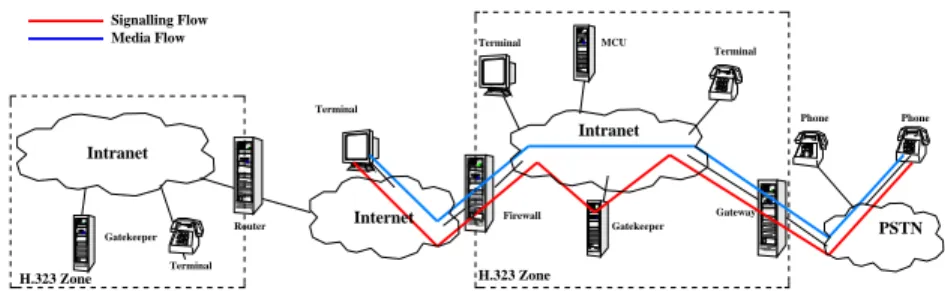
Figure 2 describes a scenario in which H.323 based components are used. It is considered to be representative for common operational areas and may slightly be adapted to individual other configurations.
Internet
PSTN
Firewall Gateway
Gatekeeper Terminal
Terminal
Intranet
MCU
Phone Phone
Terminal
Router
Intranet
Gatekeeper
Terminal Signalling Flow Media Flow
H.323 Zone H.323 Zone
Figure 2 H.323 IP Telephony Scenario
We identify the following potential risks and derived points of attack: Both the signaling or media transport plane can be target of an at-tack. This involves integrity, confidentiality, authentication or non-repudiation of the transported data.
Both the audio payload data but especially the signaling informa-tion exchanged between the components is sensitive to eavesdrop-ping, jamming and even active modification. The challenges be-come even more evident if we consider an open environment where finding, choosing and using services and transfer points from and towards the PSTN (we can compare this to conventional ”Call Rout-ing”) are subject to economic competition between various service providers.
Compromising the identity of an end system or infra structure com-ponent leads to additional risks even when using standard and non-compromised signaling mechanisms. If a malicious user can reg-ister with a H.323 Gatekeeper (or SIP server/registrar), he can po-tentially gain the personality of the user whom he attacks. That in-volves a potential invasion of privacy (since at least incoming calls are routed to the attacker and may give him the knowledge who calls) as well as the chance of miss-using services that are charged for.
The specific functions of the IP telephony infrastructure compo-nents might be target of an attack. For example we consider the registration service as provided by a gatekeeper.
The components environment, hosting a specific IP telephony func-tion can be target of an attack. This includes the management inter-faces, used to configure the IP telephony function, which are also hosted by the operating system.
Even systems and functions that are not directly involved can be attacked. For example a IP telephony enabled firewall might be weakened due to the fact that it supports IP telephony communi-cation (and temporarily opens certain communicommuni-cation paths that might be used for attacks instead of regular voice conversation). The next section gives a selection of the examined vulnerability exam-ples which can be arranged according to our classification.
3.
CASE STUDIES
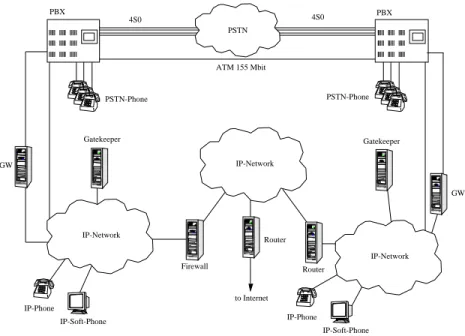
In the following we present selected vulnerabilities of a H.323 based IP telephony scenario (Figure 3) that incorporates gatekeepers and gateways that form the point of (cost-rising) interaction with the PSTN world.
IP-Phone
IP-Soft-Phone Gatekeeper
IP-Phone
IP-Soft-Phone Gatekeeper
PSTN-Phone PSTN-Phone
PBX PBX
Firewall Router
Router PSTN
IP-Network
IP-Network
IP-Network
to Internet GW
GW
4S0 4S0
ATM 155 Mbit
The conventional PBX components and their administrative IP access points (that form further potential points of attack as well) are just shown for completeness.
3.1.
ATTACKING END SYSTEMS
Getting control of an end system.
IP telephony end systems will often be placed in publically accessible places (e.g. offices or even on public floors). Once an attacker gets physi-cal access to the examined IP telephone in our scenario, he is able to reset it to its factory configuration. (In the later we show typical characteristics of the vulnerabilities or code fragments in a framed example box.)
Instructions taken from the IP telephone manual Restoring the factory settings
Enter the 6-digit password: 124816 Access to the Administration menu
In the as-supplied condition, the Administrators password is 123456.
Getting physical access to the telephones management
The example of providing backdoors or weak initial passwords is not a unique flaw but has been examined for multiple components from dif-ferent vendors. The remote management interface (via HTTP) that the IP telephone uses is vulnerable to attacks as well. The administrator pass-word is sent in plaintext which makes the communication vulnerable to sniffing. Additionally (due to its limited length and restricted alphabet, because it has normally to be typed in via the telephones keypad) the administration password can also be attacked with a series of automated brute-force trials.
Once initial access to the device is gained, its administrative password for both local (manual) as well as remote WWW access can be set to a value known and becomes usable for further malicious operations. The device configuration is visible to an attacker and can be used for gain-ing additional information about the attacked network, user identities and E.164 numbers as well as for restoring values after an attack. In our ex-ample details such as the IP phones IP address, its E.164 number and the IP address of the H.323 gatekeeper(s) that it tries to register with, can be obtained and changed. Doing so even allows an attacker to change a phones capabilities in a way, that it registers with a different gatekeeper which is under the attackers control. This gives this attacker reading and even changing access to the IP telephony signaling and may be used for getting information about communication relations (who calls whom),
enables
calculated degradation or even denial of communication services (the user is unable to receive calls from or originate calls to specific other phones) or access to voice content for outgoing calls to PSTN participants if those are routed via a H.323 to PSTN gateway of the attackers choice.
Obtaining administrative access to the device can even be used for completely changing its firmware, that can be loaded from outside vi-a the network. Though this (still, vi-as long vi-as no development APIs for telephone firmware are available - which might change with upcoming configurable ”Java-Phones”) means a very high effort for the attacker, consequences are rather severe, because a new firmware placed on the device could offer all the functionality that the original device had, while providing permanent backdoors for later attacks.
DoS-Attack using IP telephony signaling.
The end systems we evaluated (both a commercial ”hard” phone and the Open Source ohphone) were unable to withstand an attack that sends un-expected or incorrect H.323 signaling PDUs. Those resulted in either a temporary unavailability or even a total system failure with the device locked up, crashing or rebooting.
In the case of a ”registration attack” that we will describe later -a m-alicious -att-acker c-an use -a Deni-al of Service first, to (m-aybe even just temporarily) suppress the packets from the original system in order to start the de-registration / registration of another malicious end system then.
Denial-of-Service Attack using general means.
The examined IP phone uses an integrated WWW server that allows to manage the device and to query some of its settings. This WWW serv-er and its implementation faults (though not a basic part responsible for IP telephony functions of the device) makes it vulnerable for malicious attacks. Using a URL with a sufficiently long length, the device can (de-pending on the length of the URL string) either be made inoperable which results in its total failure or rebooted.
uses standard TCP socket communication on port 80 (HTTP)
...
memset(query string, 0x1, 256); query string256 0x0;
write(sock, query string, sizeof(query string)); ...
For the attack just minimal skills of the attacker, simple tools (we have performed the attack using either a standard browser, a telnet tool or a tiny test program) and low effort are required, but they result in a total loss of systems functionality and can be performed at all end systems of an installation from a remote place at the same time.
3.2.
ATTACKING THE USERS PRIVACY
IP telephony applications use RTP [7] packets transmitted via the UDP protocol for carrying audio data streams. Though basic mechanisms for using symmetrically encrypted [1] audio payloads in RTP packets are de-scribed in an appropriate RTP profile [6], those are not widely used yet, due to the lack of deployed key exchange or negotiation features within the IP telephony signaling protocols. For a potential eavesdropper it is necessary to identify the data streams that form the audio connection(s). Since the ports used for that, are typically negotiated in a dynamic man-ner this is not a totally straight-forward task. With the public availability of IP telephony protocol stacks and an in-detail description of protocol mechanisms it becomes more easy even for non-expert attackers though. For investigation we developed and tested a tool that - after specifying the characteristics of the users we observe (depending on the kind of sig-naling and scenario e.g. H.323 with or without registration of symbolic names at a Gatekeeper we can e.g. specify an E.164 number we want to observe) - allows to monitor and / or record calls on the fly.
uses libpcap for packet capturing
...
#define RTP PAYLOAD OFFSET
...
while (!finished)
packet (u char ) pcap next(pcap, &pkthdr);
...
write(audio fd, (unsigned char )packet RTP PAYLOAD OFFSET,
rtp payload size); ...
Playing audio data by sniffing the (unprotected) RTP payload Since a structured cabling with dedicated lines towards each partici-pant instead of a shared ethernet is usually considered a basic precon-dition for a sufficient data throughput, low audio packet delay and loss bounds, people often argument, that the use of switches instead of hubs limits the problem of unauthorized access to the data connections. Recent
publicationshave shown though, how vulnerable also such configurations are to attacks. After sending faked ARP replies to a switch it starts send-ing data not only to the dedicated user link but also to the one of the attacker.
3.3.
ATTACKING INFRASTRUCTURE
COMPONENTS
Gatekeeper registration attack.
When registering an H.323 device, it establishes a mapping compromis-ing its E.164 number and a voluntary number of additional symbolic names (so called aliases) with its IP address at the gatekeeper. This mechanism is part of the H.225 RAS (Registration, Admission and S-tatus) signaling and allows for a comparable easy auto-configuration and portability of devices within a given local environment as well as a certain mobility.
The gatekeeper typically implements a certain policy which describes, whether just pre-configured sets of E.164 numbers/symbolic names and IP addresses are allowed to register or every potential end-system can. This is a purely administrative decision and out of the scope of the H.323 standard specification itself. In the best case, gatekeepers allow to choose which policy to use in a granular way and are pre-configured with a rather strict policy that forbids arbitrary access. For the systems we evaluated that is not the case though.
In traditional PBX systems, rights (as for instance whether a certain person is allowed to originate long distance or international calls) are usu-ally bound to user identities. This mechanism without additional (e.g. cryp-tographic) protective means can be exploited by ”stealing” or faking user identities. If the registration is not restricted by any means the registration mechanism can be exploited for either (miss-)using the communication services which often includes calling to external parties via IP telephony to PSTN gateways without paying for that service, for just causing costs by calling expensive external service numbers or even calling dedicated numbers that their operator has a benefit from.
uses OpenH323 for PDU generation
!"
we show the unregistration part
"!
!"
an attacker can register then
"!
...
UnRegReq.m callSignalAddress.SetSize(1); (UnRegReq.m callSignalAddress[0]).SetTag( H225 TransportAddress::e ipAddress);
H225 TransportAddress ipAddress &
h225 transportaddress ipaddress#
(UnRegReq.m callSignalAddress[0]);
h225 transportaddress ipaddress.m ip[0]# ip[0];
h225 transportaddress ipaddress.m ip[1]# ip[1];
h225 transportaddress ipaddress.m ip[2]# ip[2];
h225 transportaddress ipaddress.m ip[3]# ip[3];
h225 transportaddress ipaddress.m port.SetValue(port); ...
sendto(sock, data d, data s, 0, (struct sockaddr$ )&name,
size-of(name)); ...
Attacking Gatekeeper Registrations
As a minimal means of protection only de-registration requests carry-ing the IP address of the previously registered participant could be ob-served while others should be disregarded or may even trigger warnings or alarms for the systems administrator. Since the (de)registration IP ad-dress is carried in the (usually unprotected) payload of an H.323 PDU, they can easily be faked. Additional checks (e.g. the test whether the P-DUs source IP address corresponds to the correct entity) have either to be evaluated for their general applicability (e.g. in the case of proxying instances or additional gateway originating messages) or can be broken by using spoofing at the IP layer. (This poses some more burden at an attacker, but can and has been done.)
Only cryptographic methods such as the H.323 protocol extensions de-scribed in H.235 [2] and Annex F form a better basis for protective mech-anisms. They are not implemented in the devices we evaluated though. Denial of Service targeting the Gatekeeper.
We were able to prevent all (both commercial and Open Source) observed gatekeepers from fulfilling their regular tasks by sending them a large number of either regular (cyclic registration and de-registration of ter-minals) or irregular H.323 PDUs. This makes the IP Telephony service
una
%
vailable either for a certain period or in general (if the gatekeeper is forced to crash).
It must be mentioned that for those DoS-attacks only a comparable small bandwidth is necessary (since we are attacking the signaling) and it is difficult to protect a gatekeeper (e.g. by means of a firewall) if it needs regular communication relationships with ”outside” parties for its regular tasks (e.g. if outside clients are allowed to regularly call).
4.
CONCLUSIONS
4.1.
ASSESSMENT RESULTS
The scenarios that we described have been evaluated within our uni-versity environment and we believe them to be rather realistic, once IP phones (at the current security level) would be deployed regularly within publically accessible network segments of our campus. This deployment within just one single network (then used for both data as well as voice traffic) has been determined as on of the potential reasons for starting to use IP telephony - so scenarios planning to use two separate (then both IP networks) are considered to be not realistic.
Even if a certain level of ”isolation” could potentially be obtained by using VLAN techniques this would also limit the promising chances for close computer and telephony interaction which forms the basis for new innovative services.
It should be mentioned that - differing from the situation with a con-ventional PBX, which compromised highly specialized equipment and is usually not available for attackers with an ”average background” - IP infrastructure components such as H.323 gatekeepers or H.323 to PSTN gateways are available even as Open Source [3][4] implementations and can easily be obtained, adapted and deployed.
4.2.
POTENTIAL COUNTERMEASURES
The paper intentionally concentrates on the search (based on theoret-ical analysis of the protocols and scenarios), description and practtheoret-ical exploit of vulnerabilities. We just give a short reference to potential coun-termeasures which can be be classified as either
short-term and more or less just ”bug-fixing” (which is definitely necessary but will not change the problem situation in general) or
longer-term and comprehensive (which we see as a general must for the practical feasibility and success of IP Telephony solutions).
IPTelephony Specific Approach.
Both the IETF and ITU recently show more efforts to provide standards, that also cover the security aspect. For example the ITU provides some extensions to the H.323 framework, which specify how security can be added [2]. For SIP, cryptographic authentication and privacy features are defined within the base RFC already. An overview about these security related extensions to the IP telephony standards is given in [5]. As shown in this contribution, these protocol extensions are necessary to be able to solve some security problems, but do not provide a general and automatic security solution to broken system designs.
Establishing a Security Improvement Feedback-Loop.
In [8] we introduced the concept of a Security Improvement Feedback-Loop (SIF) which is a systematic way of understanding security weak-nesses and elaborating efficient solutions. The SIF concept consists of four stages:
Observation: security weaknesses of existing systems are observed and reflected in various forms such as mailing-lists, newsgroups, and articles.
Information Retrieval: information is gathered from different sources. In case of electronic documents this can be done automatically. Form-based interfaces can be used to guide human users by enter-ing information that comes from non-digital sources.
Screening: the data is transformed according to a uniform, highly structured data scheme, as this is more suitable for further machine-based processing. It is possible to apply screening filters in order to determine the relevance of information that will be stored in vul-nerability databases.
Analysis and Utilization: as we have described in [9], appropriate data mining procedures help to identify and improve patterns that are in turn used to engineer new or to improve existing systems. For example this knowledge can be used for the elaboration of security design patterns, security guidelines or as input for security tools. Thus the security of new and existing systems will be improved as known errors should not occur again. Now the feedback-loop is closed.
The data-mining approach reveals valuable insights for security im-provement. Our long term goal is to identify a set of comprehensive
security
' patterns for secure distributed application domains, with IP
tele-phony just one of those.
4.3.
FINAL REMARKS
The observed design flaws and potential misbehavior of IP telepho-ny solutions are in their majority not due to limitations or shortcomings within the technology or its architectures and signaling protocols itself, but result from severe design, implementation and policy faults.
With just ”basic attacking components” and without special precon-ditions (most attacks were performed from user space and without even physical access to the attacked network) we could show vulnerabilities that reach from the invasion of the users privacy over service misuse and fraud to the total degradation of services. Both commercial equipment as well as popular Open Source implementations (such as the OpenH323 stack, that a lot of people now start basing their future solutions on) have been shown to be vulnerable in the same way. Basically all the attacks that we theoretically planned in the first evaluation step succeeded.
The shown problems can and must be fixed by the manufacturers of the equipment and should definitely be avoided in future designs. We strongly believe that a critical view on the current situation is helpful in order to avoid potential threats to user as well as operator and vendor interests once the equipment is deployed in larger quantities.
The authors are working on improving the situation in close contact and cooperation with the component manufacturers and system integra-tors. Interested parties are explicitly encouraged to contact the authors for the source code and (Linux) executables for all the described checks and attacks. A number of details on the potential exploits are - due to their sensitivity - available on request only and will be publically available just after they have been fixed.
References
[1] D. Balenson. Privacy enhancement for Internet electronic mail: Part III: Algorithms, modes and identifiers. RFC 1423, January 1993. [2] ITU-T. Security and Encryption for H. Series (H.323 and
oth-er H.245 based) Multimedia Toth-erminals. ITU-T Recommendation H.235, February 1998.
[3] OpenH323 Project. OpenH323. http://www.openh323.org/.
[4] OpenH323 Project. OpenH323 Gatekeeper.
[5]
( Christoph Rensing, Utz Roedig, Ralf Ackermann, and Ralf
Stein-metz. A Survey of Requirements and Standardization Efforts for IP-Telephony-Security. In M. Schumacher and R. Steinmetz, editors, Sicherheit in Netzen und Medienstr¨omen, Informatik aktuell, pages 50–60. Springer Verlag, September 2000.
[6] H. Schulzrinne. RTP profile for audio and video conferences with minimal control. RFC 1890, January 1996.
[7] H. Schulzrinne, S. Casner, R. Frederick, and V. Jacobson. RTP: A Transport Protocol for Real-Time Applications. RFC 1889, January 1996.
[8] Markus Schumacher, Ralf Ackermann, and Ralf Steinmetz. Towards Security at all Stages of a System’s Life Cycle. In 2000 Interna-tional Conference on Software, Telecommunications and Computer Networks (SoftCOM), 2000.
[9] Markus Schumacher, Christian Haul, Michael Hurler, and Alejandro Buchmann. Data-Mining in Vulnerability Databases. (90), 2000.