2014-2015 Academic Catalog
See aiprograms.info for program duration, tuition, fees, and other costs, median debt, federal salary data, alumni success, and other important info.
Catalog Preparation
This catalog was prepared by The New England Institute of Art, 10 Brookline Place West, Brookline, Massachusetts 02445. The information contained herein applies to the academic year 2014-2015.
Curriculum, fees, expenses, and other matters described herein are subject to change without notice and at the discretion of The New England Institute of Art. For more information, write to the above address or call 1-800-903-4425.
LETTER FROM THE PRESIDENT
It is my pleasure to welcome you to The New England Institute of Art (NEIA). This is an exciting time to be involved in art and design, and we look forward to helping you reach your full, amazing potential.
Our college has been helping students like you for many decades, and we have gotten very good at it. We offer a wide selection of general education courses, but the true heart of all of our programs occurs in studios and labs, where students and faculty do work on hands-on projects together. Here you will find others who think like you, students and faculty alike. You will be working with them side-by-side.
We know that you are here because you have a creative drive that you are passionate about and you wish to pursue it fully. Our professional faculty will teach you both the theory and the practice of creative work. Most of them come from industry careers, and that experience enriches the instruction immeasurably.
One caveat: NEIA will challenge you. This is college, it is supposed to be challenging. The workload is significant. Faculty will critique your work, and you might not always agree with their assessments. However, learning to incorporate such comments into the final work is part of the process of becoming a professional, and after you graduate you will come to recognize how important those critiques were.
My office is in the administrative section of the college. I hope you will come to see me. I am always pleased to talk to students. Also, it turns out I am pretty good at solving problems. If my office door is open, and I’m not meeting with anyone else, you can come right in to talk to me, no appointment necessary. I think that is one of the things that makes our college special -- there is nobody too important to take the time to help a student, and I include myself in that equation. I can’t wait to see the work you will do here. Welcome!
Yours truly,
Tad Graham-Handley, President The New England Institute of Art
MISSION, VISION, AND VALUES
Mission
The New England Institute of Art educates students from diverse backgrounds and experiences to become working professionals who are thoughtful, engaged citizens. A skills-based
curriculum blended with a strong liberal arts core allows students to focus on futures in the creative economy through the fields of media arts, creative business, and design.
Vision
The New England Institute of Art aspires to become the northeast’s leader in its chosen field. Spurred by planned growth in programs and locations, the College will be recognized as a preeminent center of excellence for professional advancement and personal development. Strategic partnerships with industry, alumni, and the greater community will lead to new educational and career opportunities for students.
Values
The New England Institute of Art values:
exemplary education that promotes professional and personal growth accomplished faculty who engage students in the learning process
dynamic and creative students committed to academics, student life, and the community technology and facilities driven by an industry-focused curriculum
student-centered staff who approach problem-solving and service collaboratively an environment that fosters self-expression, embraces diversity and inspires mutual
respect
strong connections with local industry enhanced by alumni that lead to broad career opportunities for graduates
ABOUT THE NEW ENGLAND INSTITUTE OF ART
City and School
Students who study at The New England Institute of Art (“NEIA” or the “College”) have it all at their doorstep. Situated in the Town of Brookline, the College is surrounded by a blend of busy streets, independent businesses, restaurants, shops, pubs, apartment buildings and stately homes. Just a few steps away is the City of Boston with all it has to offer. There is always something to do, with places to go and new things to learn. Students can hop on public transportation and quickly be at The Institute of Contemporary Art (admission is complimentary to The New England Institute of Art students with a school ID), The Museum of Fine Arts, Fenway Park, on Newbury Street with its fine art galleries and shopping, or socializing with other students from the more than 80 other schools, colleges, and universities in the area. Boston also has a lively film community and students often form teams to compete in the annual Boston 48 Hour Film Festival.
When students are ready to seek their internships and first jobs, Boston is home to many media outlets, advertising agencies, design shops, production companies and a thriving retail
community.
History
The New England Institute of Art was founded in 1952 as the Norm Prescott School of Radio and Television by Norm Prescott and Robert M. Cabitt. Prescott later sold the school to Cabitt who then renamed it The Northeast Broadcasting School. In 1962, the school was sold to television producer Victor Best, who relocated the school to facilities in the Back Bay. Mr. Best operated the school until 1988, when it was purchased by The Northeast Company, Inc. At that time, the curriculum consisted of a single Radio and Television Broadcasting diploma program, with all students enrolled in a prescribed set of courses. The school added a second diploma program in the Recording Arts in July 1991.
In September 1995, the College was granted authority to award two Associate of Science
degrees: one in Broadcasting and another in Recording Arts. The school changed its name to The Northeast College of Communications, Inc., and was renamed again in 1997 as Massachusetts Communications College. In 1998, it was granted authority to award three more Associate of Science degrees in Communications Studies, Multimedia Communications and Internet Communications.
In 1999, the College became part of The Art Institutes system when it was acquired by The Art Institutes’ parent company, Education Management Corporation (EDMC). The Art Institutes system currently operates over 50 schools in North America, offering degree programs in media arts, design, fashion and culinary arts.
In June 2000, Massachusetts Communications College was authorized to award the Associate of Science degree in Graphic Design. In September 2000, it was granted approval to retitle the Associate of Science in Recording Arts degree program to the Associate of Science in Audio Production and the Associate of Science in Multimedia Technology degree program to Associate
of Science in Multimedia & Web Design. Programs in Web Design, Digital Film, Interior Design, Photography, and Animation have since been added and approved.
The Massachusetts Board of Higher Education approved the request for a name change from Massachusetts Communications College to The New England Institute of Art &
Communications in July 2001.
In December 2001, The New England Institute of Art & Communications gained approval to offer Bachelor of Science degrees. In 2002, the College opened The Center for Professional Development, offering certificate programs.
In May 2003, the Board of Trustees approved the College’s request to change its name to The New England Institute of Art. This final name change better reflects the College’s commitment to all types of art, from communication arts to design.
The New England Institute of Art is owned by The New England Institute of Art LLC, a wholly-owned subsidiary of The Art Institutes International LLC, which through two intermediary limited liability companies is a subsidiary of Education Management Corporation, 210 Sixth Avenue, Pittsburgh, PA 15222.
The New England Institute of Art is a for-profit institution accredited by the New England Association of Schools and Colleges (NEASC) through its Commission on Institutions of Higher Education (CIHE), 3 Burlington Woods Drive, Suite 100, Burlington, MA 01803- 4514,
A CREATIVE MINDED STUDENT
Students come to The New England Institute of Art from across the state, across the nation and across the globe. Many have just graduated from high school; others seek new or expanded careers after considerable employment experience. What they all have in common is a keen desire to develop the creative skills they will need to apply their talents in their careers.
The College faculty, many of whom enjoy successful careers of their own in the fields to which the students aspire, bring years of experience to the classroom, meshing creative talents with practical skills.
The New England Institute of Art celebrates diversity with students for over ten different states including the New England area. The student body also includes students from outside of the United States from countries in North America, South America, Europe, Africa, and Asia including China, France, and the Dominican Republic.
Focusing on the Student
The New England Institute of Art is student-centered, with an academic culture built on educational quality and hands-on work in audio production, digital filmmaking & video production, graphic & web design, interior design, media arts & animation, photography, and fashion & retail management. The challenging environment allows students to benefit from personalized attention from faculty and close working relationships with fellow students. Student-centered also means that The New England Institute of Art, beginning at the moment of application and through every step of the academic experience, works with the student and family to provide a supportive, user-friendly environment. Individualized academic and career counseling, in addition to internships, are available to guide the student’s personal, academic and professional growth.
At The New England Institute of Art, differences and cultural diversity are celebrated. The College is committed to providing educational and professional opportunities to people of all ages, races, colors, religious beliefs, national and ethnic origins, sexual orientations and marital or parental status.
The Bachelor of Science and Associate of Science degree programs are designed to build academic, professional, technical and creative capacities. Students have the opportunity to develop their abilities to analyze and understand the factors that influence culture and technology and apply them to the student’s chosen field. The certificate programs are designed to focus on hands-on skills for students who already have work experience and some academic preparation. Hands-on learning is an important part of the educational experience at The New England Institute of Art. The student may put his or her skills to work in independent projects and internships with industry leaders. By graduation, the student may have the hands-on technical skills as well as the academic skills needed to be prepared to seek an entry-level job.
ACADEMIC AFFAIRS
Academic Affairs Mission
The mission of the Academic Affairs Department is to prepare students to seek entry-level positions in applied arts and to provide a learning environment in which they acquire the foundational skills and broad contextual understanding that could help them have meaningful, rewarding careers.
Desired Outcomes
Graduates of The New England Institute of Art should:
Possess written and oral skills that enable them to communicate effectively with prospective employers, colleagues, clients, and the general public. They will be able to formulate messages in more than one medium.
Possess creative design and problem-solving skills that result in imaginative, innovative, and professional-level solutions that meet deadlines, audience or customer expectations, and budget.
Have a thorough understanding of the field they plan to enter, including foundational elements and principles, technical skills, and terminology.
Have an understanding of connections between their lives and the broader world in which they will perform their professions, applying observation, research, reasoning, creativity, and analysis to global issues through the lens of the humanities, arts, natural sciences and social sciences.
Have developed themselves professionally, attaining a professional demeanor that
matches industry standards, an understanding of business practices, and an understanding of continuous career development.
GENERAL EDUCATION Mission
The General Education Department, in accord with the overall mission of The New England Institute of Art, is committed to providing students the knowledge and the skills needed to seek personal and professional success. Featuring a learner-centered, competency based curriculum that fosters academic and intellectual excellence, General Education requirements give students the opportunity to learn and practice critical and creative thinking, effective communication, methods of scientific and intellectual inquiry, respect for diversity within a global community, and the value of artistic/creative endeavors as vital components of a dynamic society. All areas of specialization require these general abilities. The General Education curriculum integrates knowledge across disciplines and is an essential component of every academic program at The New England Institute of Art.
Classes
The academic categories of General Education include Communications, English, Mathematics, Natural Science, Humanities, and Social Science, offering students a broad knowledge base, competencies and perspectives.
Faculty
The General Education courses at The New England Institute of Art are taught by creative professionals who have made the arts a central part of their lives. They are writers, poets,
musicians, visual artists, painters, film makers, and photographers. They bring the passion of the arts to all their classes and they connect the course materials to the programs of The New
England Institute of Art and to the students’ lives.
Desired Outcomes
Critical thinking and analytical skills Research and information literacy
Effective written and oral communication skills Group collaboration skills
Quantitative reasoning skills Scientific literacy
Ability to analyze the nature, diversity, and impact of social political, psychological, and/or economic thought on the individual, institutions, and cultures
Ability to interpret and analyze artistic work, historical events, or philosophical thought, and describe the relevance of the work to themselves, society, and cultures
TRANSITIONAL STUDIES
Transitional Studies is designed to prepare students for coursework at The New England Institute of Art. Transitional Studies faculty and staff are committed to increasing students’ knowledge of basic skills in math and writing with the goal of preparing them for the challenge of academic life as they become independent learners.
The New England Institute of Art assesses the reading, writing, and math skills of entering students to determine if they could benefit from additional assistance. Placement is determined based on transfer credit, ACT or SAT test scores, and ACCUPLACER (an online placement exam produced by the College Board).
Transitional courses are coordinated closely with each student’s academic advisor to provide tutoring in math, English and other subjects, and with Student Affairs staff to provide
counseling. The Transitional Studies course at the College is ENG0110 which does not grant college-level credit (institutional credit only). This course does not fulfill the required credits of English course work but will affect the maximum allowable time frame calculation.
Desired Outcomes
Written Communication: an ability to develop essays and paragraphs that are logically structured and that employ the generally accepted conventions of English usage. Reading Comprehension: an ability to read and understand college level essays Critical Thinking Skills: an ability to demonstrate critical thinking skills through
DEGREE REQUIREMENTS
Requirements for Bachelor of Science: To receive a Bachelor of Science, students must complete a minimum of 180 quarter-credits, including 60 quarter-credits of general education with a cumulative GPA of 2.0 or higher. Students must receive a passing grade or credit for all required course work, meet portfolio or other requirements, complete a 120 –hour internship or capstone project, and satisfy all financial obligations to The New England Institute of Art. Each General Education course is 4 credits. Specified courses may be required for specific programs as noted in departmental requirements.
General Education Requirements for Bachelor of Science – may vary slightly depending on program requirements:
COMMUNICATIONS: two courses
COM1500: Effective Communication COM1600: Media Literacy
ENGLISH: three courses
ENG1010: English I: Written Composition ENG2000: English II: Introduction to Literature ENG Selection 3 – 3000-level or higher
MATH: two courses
MAT1010: College Algebra MAT Selection 2
SCIENCE: two courses
SCI Selection 1 – Natural Science SCI Selection 2 – Lab Science SOCIAL SCIENCE: two courses
Selection 1 – 1000-level
Selection 2 – 2000-level or higher HUMANITIES: two courses
Selection 1 – 1000-level
Selection 2 – 2000-level or higher Two additional General Education electives
Requirements for Associate of Science: To receive an Associate of Science degree, students must complete a minimum of 90 credit hours with 32 hours in General Education courses with a cumulative GPA of 2.0 or higher. Students must receive a passing grade or credit for all required course work, meet portfolio or other requirements, complete a 120 –hour internship or capstone project, and satisfy all financial obligations to The New England Institute of Art. Each General Education course is 4 credits. Specified courses may be required for specific programs as noted in departmental requirements.
General Education Requirements for Associate of Science: COMMUNICATIONS: two courses
COM1500: Effective Communication COM1600: Media Literacy
ENGLISH: two courses
ENG1010: English I: Written Composition ENG2000: English II: Introduction to Literature MATH: one course
MAT1010 College Algebra NATURAL SCIENCE: one course
SCI Selection 1
One additional General Education elective
Requirements for a Certificate: Students must complete a minimum of 48 quarter credit hours with a cumulative GPA of 2.0 or higher. Students must also receive a passing grade or credit for all required course work, meet portfolio or other requirements, and satisfy all financial
ACADEMIC PROGRAMS
The New England Institute of Art offers both Associate of Science and Bachelor of Science degree programs. Students in the Associate of Science programs must successfully complete 92 credits, including 32 credits in General Education. Students must successfully complete at least 180 credits for the Bachelor of Science programs, including a minimum of 60 credits in General Education.
The Associate of Science degree programs prepare graduates with the foundational skills they need in their chosen fields, while the Bachelor of Science degree offers greater depth and breadth in knowledge and skills, with advanced work in both the field of study and General Education. Graduates at both levels are also prepared to pursue further education if they so choose.
The New England Institute of Art also offers certificate programs in certain fields of study. These programs provide college-level work designed to enhance the student’s professional skills. Students must successfully complete 48 credits. The certificate programs do not include General Education courses, though students must be prepared to demonstrate competencies in English, mathematics, and computer science.
Associate of Science Programs Audio Production Photography
Bachelor of Science Programs Audio & Media Technology
Digital Filmmaking & Video Production Fashion & Retail Management
Graphic & Web Design with Graphic Design Concentration Graphic & Web Design with Web Design Concentration Interior Design
Media Arts & Animation
Media Arts & Animation with Game Art Concentration Photography
Sound & Motion Picture Technical Arts
Certificate Programs Audio Production Photography
Multimedia & Web Design I Multimedia & Web Design II
Course Codes and Departments
AMT: Audio & Media Technology/Audio Production BUS: Business (Shared: Audio and Fashion)
COM: General Education
DFV: Digital Filmmaking & Video Production ENG: General Education
FLM: Digital Filmmaking & Video Production FRM: Fashion & Retail Management
GAD: Media Arts & Animation (Game Art Concentration) GRD: Graphic & Web Design (Graphic Design Concentration) GEN: General Education
GWD: Graphic & Web Design HUM: General Education INT: Interior Design
MAA: Media Arts & Animation MAT: General Education
MUS: Audio & Media Technology/Audio Production PHT: Photography
SCI: General Education
SMP: Digital Filmmaking & Video Production SSC: General Education
WEB: Graphic & Web Design (Web Design Concentration)
Audio & Media Technology (Bachelor of Science)
Visit ge.artinstitutes.edu/programoffering/258 for program duration, tuition, fees, other costs, median debt, federal salary data, alumni success, and other important info on the Bachelor of Science in Audio & Media Technology.
The Audio & Media Technology program at The New England Institute of Art strives to prepare graduates to seek careers in the field of audio. Through rigorous study of theoretical concepts, industry practices and hands-on production techniques, students have the opportunity to develop the technical skills and aesthetic sensibilities needed to become professional audio engineers, technicians, producers and business people.
Students in the Audio & Media Technology program focus their studies in audio recording, editing and mixing audio content to be used in conjunction with visual media. Students can take advanced production courses in sound for picture and fundamental courses in video technology and multimedia.
Graduates from the Audio & Media Technology degree program may seek entry-level positions in music recording, television, radio, studio management, industrial and corporate audio visual, technical support, live sound reinforcement and other audio-related fields.
The Bachelor of Science in Audio & Media Technology degree program is a full-time program of study. Bachelor’s degree candidates must complete the entire core curriculum found in the Associate of Science in Audio Production degree program, plus additional courses in electronics, business, ear training, sound for picture, web technologies and, a variety of in-depth studio production courses.
Bachelor of Science degree candidates may choose a concentration of study in Audio Production or Audio & Video Technology, or may choose to have no concentration and fulfill the
concentration courses through program electives. Students in the Audio Production
concentration focus their studies in audio recording, editing, and mixing audio or content that is used in presentations where audio is the primary medium. The Audio Production concentration allows students to take advanced production courses in music recording, live sound, and
maintenance. Students in this concentration may also opt to focus on the business and management aspects of the audio industry. Students in the Audio & Video Technology
concentration focus their studies in audio recording, editing, and maxing audio content to be used in conjunction with visual media. Students take advanced production courses in sound for
picture as well as fundamental courses in video technology and multimedia.
Methods of Instruction
Instructional methods at The New England Institute of Art include lecture, demonstrations, labs, one-on-one tutorials and periodic examinations. With the exception of Internet-based classes offered through Plus Learning, internships and field trips, all instruction is conducted in a classroom setting.
Degree Requirements
Students must complete a minimum of 180 quarter credit hours with 60 quarter credit hours in general education courses with a cumulative GPA of 2.0 or higher. Also, students must receive a passing grade or credit for all required course work, meet portfolio or other requirements,
complete a 180-hour internship or capstone project and satisfy all financial obligations to The New England Institute of Art.
BS in Audio & Media Technology: Courses with recommended sequence. Quarter
1
AMT1010 Audio Technology I (pre: appropriate math placement score)
AMT1100 Survey of the Audio Industry (pre: ENG0110 or appropriate English placement score)
MUS1010 Listening & Analysis (pre: appropriate math placement score)
ENG1010 English I: Written Composition (pre: ENG0110 or appropriate English placement score)
Quarter 2
AMT1500 Audio Technology II (pre: AMT1010; co-req: AMT1700)
AMT1700 Audio Recording I (pre: AMT1010; co-req: AMT1500)
AMT1600 Digital Audio & Media (pre: AMT1010)
MAT1010 College Algebra (pre: NONE)
Quarter 3
AMT2100 Hard Disk Recording (pre: AMT1600)
AMT2010 Audio Recording II (pre: AMT1700)
ENG2000 English II: Introduction to Literature (pre: ENG1010)
MAT2010 Advanced College Algebra & Trigonometry (pre: MAT1010)
Quarter 4
MUS1100 Principles of Computer Music (pre: AMT1600 & MUS1010)
AMT2800 Advanced Recording Techniques (pre: AMT2010)
COM1500 Effective Communication (pre: ENG1010)
MAT3010 Calculus (pre: MAT2010)
Quarter 5
AMT3050 Advanced Mixing Techniques (pre: AMT2800)
AMT2600 Advanced Hard Disk Recording (pre: AMT2100)
XXXxxxx General Education Elective (pre: See course description)
SCI2010 Physics (pre: MAT1010)
Quarter 6
MUS2500 Music Theory (pre: MUS1010)
AMT2750 Live Sound Reinforcement I (pre: AMT1700)
BUS3010 Business Fundamentals (pre: MAT1010)
SCI2350 Acoustics (pre: SCI2010)
Quarter 7
AMT3970 Industry Seminar & Portfolio (w/ 60-hour Internship) (pre: AMT2010)
AMT2751 Live Sound Reinforcement II (pre: AMT2750)
COM1600 Media Literacy (pre: NONE)
SSCxxxx Social Science Elective (pre: See course description)
Quarter 8
AMT2300 Electronics I (pre: MAT1010)
GWD1600 Fundamentals of Web Design for Non-GWD Majors (pre: NONE)
Program Elective 1 (pre: See course description)
ENG3xxx English Elective (3000-level or higher) (pre: ENG2000)
Quarter 9
AMT2900 Electronics II (pre: AMT2300)
AMT3400 Sound for Picture (pre: AMT2100 & AMT2800)
Program Elective 2 (pre: See
course description) HUMxxxx
Quarter 10
AMT3200 Electronics III (pre: AMT2900)
Program Elective 3 (pre: See course description)
SSC2xxx Social Science Elective (2000-level or higher)
Quarter 11
AMT3981 Audio Production Portfolio & Internship I (pre: AMT3970)
Program Elective 4 (pre: See course description)
HUM2300 Ethics & Intellectual Property (pre: COM1600)
Quarter 12
AMT3982 Audio Production Portfolio & Internship II (pre: AMT3981)
Program Elective 5 (pre: See course description)
XXXxxxx General Elective (pre: See course description)
Program Electives for the Bachelor of Science degree in Audio & Media Technology:
AMT2501 Record Label Operations (Pre: AMT1100) AMT2502 Music Retail & Distribution (Pre: AMT1100) AMT2503 Club & Venue Management (Pre: AMT1100) AMT2930 Pro Tools Level I Certification (Pre: AMT1600)
AMT3001 Music Publishing (Pre: AMT1100)
AMT3002 Entertainment Marketing & Public Relations (Pre: AMT1100) AMT3030 Location Recording (Pre: AMT2010)
AMT3100 A/V Installation (Pre: AMT2750 & AMT2300) AMT3150 Logic Pro Audio (Pre: MUS1100 & AMT2100) AMT3500 Advanced Digital Audio Skills (Pre: AMT2100)
AMT3550 Field Recording for Film (Pre: AMT2100) AMT3600 Repair & Maintenance (Pre: AMT2900)
AMT3700 Advanced Studio Production (Pre: AMT2100 & AMT2800) AMT3750 Special Topics in Live Sound (Pre: AMT2751)
AMT3930 Pro Tools Level II Certification (Pre: AMT2930)
AMT4100 Mastering (Pre: AMT2800)
AMT4150 Advanced Digital Mix (Pre: AMT2600)
AMT4800 Foley (Pre: AMT3400)
DFV1000 Principles of Cinematography (Pre: None) DFV1010 Fundamentals of Video Production (Pre: DFV1000)
MUS2200 Designing Music & Sound for Visual Media (Pre: AMT1600)
MUS2600 Music Production (Pre: AMT1700) (Recommended: take concurrently with another studio class)
MUS3050 Music Synthesis (Pre: MUS1100)
SCI3350 Acoustics II (Pre: SCI2350)
SSC2060 History & Sociology of Hip Hop (Pre: ENG1010) SSC2070 Rock & Roll: An Historical Perspective (Pre: ENG1010) XXXxxxx General Elective: Choose one from any course offered.
Required General Education Courses for BS in Audio & Media Technology:
COM1500 Effective Communication COM1600 Media Literacy
ENG1010 English I: Written Composition ENG2000 English II: Introduction to Literature
ENG3xxx English Elective: Choose one from the list of General Education English courses (3000-level or higher).
HUM2300 Ethics & Intellectual Property
HUMxxxx Humanities Elective: Choose one from the list of General Education humanities courses.
MAT1010 College Algebra
MAT2010 Advanced College Algebra & Trigonometry MAT3010 Calculus I
SCI2010 Physics SCI2350 Acoustics
SSCxxxx Social Science Elective: Choose one from the list of General Education social science courses.
SSC2xxx Social Science Elective: Choose one from the list of General Education social science courses (2000-level or higher).
XXXxxxx General Education Elective: Choose one from the list of General Education courses.
Audio Production (Associate of Science)
Visit ge.artinstitutes.edu/programoffering/259 for program duration, tuition, fees, other costs, median debt, federal salary data, alumni success, and other important info on the Associate of Science in Audio Production.
The Audio Production program at The New England Institute of Art strives to prepare graduates to seek careers in the field of audio production. Through rigorous study of theoretical concepts, industry practices and hands-on production techniques, students have the opportunity to develop the technical skills and aesthetic sensibilities needed to become professional audio engineers, technicians, producers and business people.
Students in the Audio Production concentration focus their studies in audio recording, editing, and mixing audio or content where the audio is the primary medium. The Audio Production program allows students to take production courses in music recording, live sound, location recording, electronics, and other related fields. Students in this program can also focus on the business and management aspects of the audio industry.
Graduates from the Associate of Science in Audio Production degree program may seek entry-level positions in music recording, television, radio, studio management, industrial and corporate audio visual, technical support, live sound reinforcement and other audio-related fields. Students who graduate with an Associate of Science in Audio Production may also apply to continue their studies in the Bachelor of Science in Audio & Media Technology degree program.
Methods of Instruction
Instructional methods at The New England Institute of Art include lecture, demonstrations, labs, one-on-one tutorials and periodic examinations. With the exception of Internet-based classes offered through Plus Learning, internships and field trips, all instruction is conducted in a classroom setting.
Degree Requirements
Students must complete a minimum of 92 credit hours with 32 hours in general education courses with a cumulative GPA of 2.0 or higher. Students must also receive a passing grade or credit for all required course work, meet portfolio or other requirements, complete a 60-hour internship ) and satisfy all financial obligations to The New England Institute of Art.
AS in Audio Production: Courses with recommended sequence. Quarter
1
AMT1010 Audio Technology I (pre:
appropriate math placement score)
AMT1100 Survey of the Audio Industry (pre: ENG0110 or appropriate English placement score)
MUS1010 Listening & Analysis (pre: appropriate math placement score)
ENG1010 English I: Written Composition (pre: ENG0110 or appropriate English placement score) Quarter
2
AMT1500 Audio Technology II (pre: AMT1010; co-req: AMT1700)
AMT1700 Audio Recording I (pre: AMT1010; co-req: AMT1500)
AMT1600 Digital Audio & Media (pre: AMT1010)
MAT1010 College Algebra (pre: NONE)
Quarter 3
AMT2100 Hard Disk Recording (pre: AMT1600)
AMT2010 Audio Recording II (pre: AMT1700)
ENG2000 English II: Introduction to Literature (pre: ENG1010)
SCI2010 Physics (pre: MAT1010)
Quarter 4
MUS1100 Principles of Computer Music (pre: AMT1600 & MUS1010)
AMT2800 Advanced Recording Techniques (pre: AMT2010)
AMT2750 Live Sound Reinforcement I (pre: AMT1700) COM1500 Effective Communication (pre: ENG1010) Quarter 5
Program Elective (pre: See course description)
AMT2751 Live Sound Reinforcement II (pre: AMT2750)
XXXxxxx General Education Elective (pre: See course description)
COM1600 Media Literacy (pre: NONE)
Quarter 6
AMT3970 Industry Seminar & Portfolio (w/ 60-hour Internship) (pre: AMT2010)
XXXxxxx General Elective (pre: See course description)
SSCxxxx Social Science or HUMxxxx Humanities Elective (pre: See course description)
Program Electives for the Associate of Science degree in Audio Production:
AMT2300 Electronics I (Pre: MAT1010)
AMT2501 Record Label Operations (Pre: AMT1100) AMT2502 Music Retail & Distribution (Pre: AMT1100) AMT2503 Club & Venue Management (Pre: AMT1100) AMT2600 Advanced Hard Disk Recording (Pre: AMT2100)
AMT2900 Electronics II (Pre: AMT2300)
AMT2930 Pro Tools Level I Certification (Pre: AMT1600)
AMT3001 Music Publishing (Pre: AMT1100)
AMT3002 Entertainment Marketing & Public Relations (Pre: AMT1100) AMT3030 Location Recording (Pre: AMT2010)
AMT3050 Advanced Mixing Techniques (Pre: AMT2800)
AMT3100 A/V Installation (Pre: AMT2750 & AMT2300) AMT3150 Logic Pro Audio (Pre: MUS100 & AMT2100) AMT3400 Sound for Picture (Pre: AMT2100 & AMT2800) AMT3500 Advanced Digital Audio Skills (Pre: AMT2100)
AMT3550 Field Recording for Film (Pre: AMT2100) AMT3600 Repair & Maintenance (Pre: AMT2900) AMT3930 Pro Tools Level II Certification (Pre: AMT2930) BUS3010 Business Fundamentals (Pre: MAT1010) DFV1000 Principles of Cinematography (Pre: None) DFV1010 Fundamentals of Video Production (Pre: DFV1000)
MUS2500 Music Theory (Pre: MUS1010)
MUS2200 Designing Music and Sound for Visual Media (Pre: AMT1600)
MUS2600 Music Production (Pre: AMT1700 (Recommended: take concurrently with another studio class)
SCI3350 Acoustics II (Pre: SCI2350) SSC2060 History & Sociology of Hip Hop (Pre: ENG1010) SSC2070 Rock & Roll: An Historical Perspective (Pre: ENG1010) XXXxxxx General Elective: Choose one from any course offered.
Required General Education Courses for AS in Audio Production:
COM1500 Effective Communication COM1600 Media Literacy
ENG1010 English I: Written Composition ENG2000 English II: Introduction to Literature
HUMxxx Humanities Elective: Choose one from the list of General Education humanities courses
or
SSCxxxx Social Science Elective: Choose one from the list of General Education social science courses.
MAT1010 College Algebra SCI2010 Physics
XXXxxxx General Education Elective: Choose one from the list of General Education courses.
Audio Production (Certificate)
Visit ge.artinstitutes.edu/programoffering/3483 for program duration, tuition, fees, other costs, median debt, federal salary data, alumni success, and other important info on the Certificate in Audio Production.
The Audio Production certificate program at The New England Institute of Art is designed to furnish students with the knowledge and skill set to pursue success in the audio and recording industry.
Through rigorous study of theoretical concepts, industry practices and hands-on production techniques, students focus their studies in audio recording, editing, mixing, live sound, and understanding of the audio industry. Proficiency in common industry software, such as ProTools, is emphasized. The program culminates in the development of a portfolio that demonstrates the student’s mastery of the program learning outcomes.
Upon completion of the program, students should be able to:
Explain how digital information is transmitted, stored, processed, and delivered. Demonstrate clear organization of digital audio projects including audio file
management, archival, restore, and delivery of audio content.
Design, run, maintain, and troubleshoot a sound system for a wide variety of venues including corporate audio and conventions.
Methods of Instruction
Instructional methods at The New England Institute of Art include lecture, demonstrations, labs, one-on-one tutorials and periodic examinations. With the exception of Internet-based classes offered through Plus Learning, internships and field trips, all instruction is conducted in a classroom setting.
Certificate Requirements
Students must complete a minimum of 48 quarter credit hours with a cumulative GPA of 2.0 or higher. Students must also receive a passing grade or credit for all required course work, meet portfolio or other requirements, and satisfy all financial obligations to The New England Institute of Art.
Criteria
This course sequence assumes the accepted student meets the criteria below. A candidate who does not meet these criteria would require additional coursework to be successful, including General Education courses or introductory courses in the program. The admissions criteria include the following:
Bachelor’s degree (minimum GPA of 2.3) OR
Associate’s degree (minimum GPA of 2.3) and two years of work experience in a related industry OR
High school diploma (minimum GPA of 2.3) and two years of work experience in a related industry AND Accuplacer scores of 90 or above in both math and English.
Certificate in Audio Production: Courses with recommended sequence.
Quarter 1 AMT1010 Audio Technology I AMT1100 Survey of the Audio Industry Quarter 2 AMT1500 Audio Technology II AMT1700 Audio Recording I
Quarter 3 AMT1600 Digital Audio & Media AMT2010 Audio Recording II
Quarter 4 AMT2100 Hard Disk Recording AMT2800 Advanced Recording Techniques Quarter 5 MUS1010 Listening & Analysis AMT2600 Advanced Hard Disk Recording Quarter 6 AMT3950 Portfolio & Capstone AMT2750 Live Sound Reinforcement I
Digital Filmmaking & Video Production (Bachelor of Science)
Visit ge.artinstitutes.edu/programoffering/261 for program duration, tuition, fees, other costs, median debt, federal salary data, alumni success, and other important info on the Bachelor of Science in Digital Filmmaking & Video Production.
The Bachelor of Science in Digital Filmmaking & Video Production degree program is designed to provide a foundation in storytelling through digital video and television production in both the single-camera and multi-camera formats.
This degree program offers students the opportunity to develop critical thinking skills through such courses as Media Literacy, History of the Moving Image I and II, Humanities through the Arts, and Topics in Film. It also immerses students in the industry-related technology in shooting, editing, and graphics.
This degree program is best suited for students who are highly motivated self-starters and want to learn about digital video technology and how professionals tell stories of all kinds with it. Entering students should be prepared to master critical general education requirements that provide an important basis for success in the program courses. They should have a strong command of English and be able to express themselves in writing as well as visually.
Students who successfully complete this program are trained in production, directing, editing and writing. They are creative thinkers able to generate ambitious ideas for a fast-paced world
community, hungry for intelligent media. They should be able to solve problems, entertain, enlighten, educate, inform and inspire.
Upon graduation, students are prepared to seek entry-level positions in a variety of disciplines including production houses, film and documentary companies, television stations, news departments, advertising agencies and corporate video production facilities.
Methods of Instruction
Instructional methods at The New England Institute of Art include lectures, demonstrations, labs, one-on-one tutorials and periodic examinations. With the exception of Internet-based classes offered through Plus Learning, internships and field trips, all instruction is conducted in a classroom setting.
Degree Requirements
Students must complete a minimum of 180 credit hours with 60 credit hours in general education courses with a cumulative GPA of 2.0 or higher. Also, students must receive a passing grade or credit for all required course work, meet portfolio or other requirements, complete a 160-hour internship and satisfy all financial obligations to The New England Institute of Art.
BS in Digital Filmmaking & Video Production: Courses with recommended sequence. Quarter
1
DFV1000 Principles of Cinematography (pre: NONE)
DFV1100 Survey of the Motion Picture Industry (pre: ENG0110 or appropriate English placement score)
DFV1400, 1410 or 1420 Digital Video Editing I (pre: NONE)
ENG1010 English I: Written Composition (pre: ENG0110 or appropriate English placement score) Quarter
2
DFV1010 Fundamentals of Video Production (pre: DFV1000)
DFV1300 Audio Recording for Video & Television (pre: DFV1000)
MAT1010 College Algebra (pre: NONE) COM1500 Effective Communication (pre: ENG1010) Quarter 3 DFV2000 Single-Camera Production (pre: DFV1010)
FLM1000 History of the Moving Image I (pre: ENG1010)
DFV2200 Conceptual & Visual Storytelling (pre: DFV1010 & ENG1010)
MAT2xxx Math Elective (2000-level or higher) (pre: See course description)
Quarter 4
DFV2010 Multi-Camera Production I (pre: DFV2000)
FLM1010 History of the Moving Image II (pre: FLM1000)
ENG2000 English II: Introduction to Literature (pre: ENG1010)
COM1600 Media Literacy (pre: NONE)
Quarter 5
DFV2020 Lighting for Video & Television (pre:
DFV2010)
DFV2300 Sound Design (Pre: DFV1400/1410/1420 & DFV1300)
DFV3200 Fundamentals of Scripting & Storyboarding I (pre: DFV2200 & ENG2000)
HUM1010 Humanities through the Arts (pre: ENG1010)
Quarter 6
DFV3000 Digital Cinematography I (pre: DFV2020)
DFV2400 Digital Video Editing II (pre: DFV2300)
DFV3210 Fundamentals of Scripting & Storyboarding II (pre: DFV3200)
ENG3xxx English Elective (3000-level or higher) (pre: See course description)
Quarter 7
DFV3010 Multi-Camera Production II (pre: DFV2020)
DFV3400 Digital Post Effects (pre: DFV2400)
DFV3220 Production Management (pre: MAT1010 & COM1500 & DFV2000)
SSCxxxx Social Science Elective (pre: See course description)
Quarter 8
DFV3500 Acting & Directing (pre: DFV2000)
DFV3020 Non-Fiction Production (Pre: DFV1400/1410/1420 & DFV3000 & DFV3220)
FLM2000 Topics in Film (pre: ENG2000)
SCIxxxx Natural Science Elective (pre: See course description)
Quarter 9
DFV4000 Senior Thesis I: Pre-Production (pre: DFV3020 & DFV3220; to be taken in 9th quarter)
DFV4400 Digital Media Management (pre: DFV2400)
SCIxxxx Natural Science Elective (pre: See course description)
HUM2300 Ethics & Intellectual Property (pre: COM1600)
Quarter 10
DFV4010 Senior Thesis II: Production & Post-Production (pre: DFV4000;
to be taken in 10th quarter)
DFV4100 Professional Development (pre: DFV1100 & DFV4000)
COM3500 Professional Communication (pre: COM1500 & ENG2000)
Quarter 11
DFV4020 Portfolio & Internship I (pre: DFV4010)
Program Elective 1 (pre: See course description)
SSC2xxx Social Science Elective (2000-level or higher) (pre: See course description)
Quarter 12
DFV4030 Portfolio & Internship II (pre: DFV4020)
Program Elective 2 (pre: See course description)
SCI2000 Physical Science of Visual Technology (pre: MAT1010 & ENG1010) or
SCI2010 Physics (pre: MAT1010)
Program Electives for the Bachelor of Science degree in Digital Filmmaking & Video Production:
DFV2500 Fundamentals of Acting (Pre: COM1500) DFV2510 Performing for Television (Pre: COM1500)
DFV4090 Capstone (Pre: DFV3020 & DFV3220 & DFV3500) DFV4200 Introduction to the Feature Screenplay (Pre: DFV3210)
DFV4210 Writing the Feature Screenplay (Pre: DFV4200) DFV4220 Writing the Short Script (Pre: DFV3210) DFV4230 Pre-Producing the Short (Pre: DFV4220) DFV4240 Producing the Short (Pre: DFV4230)
DFV4250 Script Analysis (Pre: DFV3210)
FLM3000 Motion Picture Theory & Criticism (Pre: FLM1010)
Required General Education Courses for BS in Digital Filmmaking & Video Production:
COM1500 Effective Communication COM1600 Media Literacy
COM3500 Professional Communication ENG1010 English I: Written Composition ENG2000 English II: Introduction to Literature
ENG3xxx English Elective: Choose one from the list of General Education English courses (3000-level or higher).
HUM1010 Humanities through the Arts HUM2300 Ethics & Intellectual Property MAT1010 College Algebra
MAT2xxx Math Elective: Choose one from the list of General Education math courses (2000-level or higher).
SCI2000 Physical Science of Visual Technology
or
SCI2010 Physics
SCIxxxx Natural Science Elective: Choose one from the list of General Education natural science courses.
SSCxxxx Social Science Elective: Choose one from the list of General Education social science courses.
SSC2xxx Social Science Elective: Choose one from the list of General Education social science courses (2000-level or higher).
XXXxxxx General Education Elective: Choose one from the list of General Education courses.
Fashion & Retail Management (Bachelor of Science)
Visit ge.artinstitutes.edu/programoffering/1808 for program duration, tuition, fees, other costs, median debt, federal salary data, alumni success, and other important info on the Bachelor of Science in Fashion & Retail Management.
The Bachelor of Science in Fashion & Retail Management degree program at The New England Institute of Art is for students who have a sense of style and the drive to work in the fashion and retail industry. This fast-paced industry requires talented, creative professionals who have a strong business sense, an eye for style, and knowledge and training in both retail and
management.
The Bachelor of Science in Fashion & Retail Management degree program offers experience across disciplines in business, fashion, and retail management. Courses are designed to develop the student’s passion for the fashion and retail industry through in-depth training in business, and sales and marketing with a specialized focus on fashion. Students can study various aspects of fashion, such as fashion trending and forecasting, textile and apparel evaluation, visual
merchandising, business and merchandising management, marketing, and buying. Students are exposed to effective sales strategies based on consumer demographics and
behaviors through such courses as Marketing, International Marketing, Consumer Behavior, and Visual Merchandising. The Textile and Apparel Evaluation course assists students in developing skill sets in fabric weaves, construction, and determining the quality of a product. These skills can then be further developed and applied in Merchandising Management and Retail Buying. Industry-experienced faculty guide students and help them hone their skills. Students have the opportunity to network with professionals in the field through participation in fashion events. A required internship gives students the opportunity to practice their skills and knowledge in a retail environment. In addition, all Fashion & Retail Management students take a portfolio course where they develop career-oriented portfolios demonstrating their abilities as they seek entry-level professional employment in this highly demanding industry.
Graduates of the Bachelor of Science in Fashion & Retail Management program are prepared to seek entry-level positions such as show room account assistant, assistant buyer, associate store planner, visual merchandiser, product development associate, product sourcing and import coordinator, sales associate, marketing specialist, retail store assistant manager, or promotions and special events coordinator.
Methods of Instruction
Instructional methods at The New England Institute of Art include lectures, demonstrations, labs, one-on-one tutorials, and periodic exams. With the exception of Internet-based classes offered through Plus Learning, internships and field trips, all instruction is conducted in a classroom setting.
Degree Requirements
Students must complete a minimum of 180 credit hours with 60 credit hours in general education courses with a cumulative GPA of 2.0 or higher. Also, students must receive a passing grade or credit for all required course work, meet portfolio or other requirements, complete a 120-hour internship or capstone project, and satisfy all financial obligations to The New England Institute of Art.
BS in Fashion & Retail Management: Courses with recommended sequence. Quarter
1
FRM1000 Introduction to the Fashion Industry (pre: NONE)
GWD1020 Design Fundamentals (pre: NONE)
FRM1010 History of Fashion (pre: NONE)
ENG1010 English I: Written Composition (pre: ENG0110
or appropriate English placement score)
Quarter 2
FRM1011 Retail Principles (pre: FRM1000)
FRM1110 Textiles (pre: FRM1000)
FRM1205 Fashion Digital Imagery (pre: FRM1000)
COM1500 Effective Communication (pre: ENG1010) Quarter 3 FRM2020 Visual Merchandising (pre: GWD1020 & FRM1011)
FRM2010 Apparel Evaluation (pre: FRM1110)
FRM1206 Fashion Digital Illustration (pre: FRM1205)
MAT1010 College Algebra (pre: NONE)
Quarter 4
BUS2000 Marketing Principles (pre: ENG1010)
GWD1090 Color Fundamentals (pre: GWD1040 or Department Chair Approval)
XXXxxxx General Education Elective (pre: See course description)
ENG2000 English II: Introduction to Literature (pre: ENG1010)
Quarter 5
FRM2510 Trends & Forecasting (pre: FRM1110 & FRM1010)
BUS2015 Leadership & Organizational Behavior (pre: ENG1010)
FRM2011 Consumer Behavior (pre: BUS2000)
MAT2070 Business Math (pre: MAT1010)
Quarter 6
FRM3020 Product
Development (pre: FRM2510 & FRM1110)
FRM2110 Brand Strategy & Marketing (pre: BUS2000)
HUM1010 Humanities through the Arts (pre: ENG1010)
SSCxxxx Social Science Elective (pre: See course description)
Quarter 7
FRM3310 Retail Buying (pre: MAT2070 & FRM2510)
BUS3210 International Marketing (pre: BUS2000 & ENG2000)
SCI2000 Physical Science of Visual Technology (pre: MAT1010 & ENG1010)
Quarter 8
FRM3320 Merchandise Management (pre: FRM3310)
FRM3010 Promotional Events (pre: BUS2015 & ENG2000)
BUS3005 Business Law (pre: ENG2000)
ENG3xxx English Elective (3000-level or higher) (pre: See course description)
Quarter 9
FRM4010 Retail eCommerce (pre: FRM3320)
FRM4000 Retail Operations (pre: FRM3310)
XXXxxxx General Elective (pre: See course description)
SCIxxxx Natural Science Elective (pre: See course description) Quarter 10 FRM4150 Retail Entrepreneurship (pre: FRM4000)
FRM4005 Business of Retail Manufacturing (pre: FRM3020)
COM3500 Professional Communication (pre: COM1500 & ENG2000)
SSC2xxx Social Science Elective (2000-level or higher) (pre: See course description)
Quarter 11
FRM4980 Portfolio Development (pre:
FRM1206; co-req: FRM4990 & Senior Standing)
FRM4990 Retail/
Management Internship I (co-req: FRM4980 & Senior Standing)
HUM2xxx Humanities Elective (2000-level or higher) (pre: See course description)
Quarter 12
FRM4981 Portfolio (pre: FRM4980; co-req: FRM4991)
FRM4991 Retail/ Management Internship II (pre: FRM4990; co-req: FRM4981)
XXXxxxx General Education Elective (pre: See course description)
Program Electives for the Bachelor of Science degree in Fashion & Retail Management:
FRM3990 Special Topics in Fashion (Pre: 2nd Year Standing)
GEN3990 Industry Field Experience (Pre: Department Chair & Career Services Approval)
XXXxxxx General Elective: Choose one from any course offered.
Required General Education Courses for BS in Fashion & Retail Management:
COM1500 Effective Communication COM3500 Professional Communication ENG1010 English I: Written Composition ENG2000 English II: Introduction to Literature
ENG3xxx Choose one from the list of General Education English courses (3000-level or higher).
HUM1010 Humanities through the Arts
HUM2xxx Choose one from the list of General Education humanities courses (2000-level or higher).
MAT1010 College Algebra MAT2070 Business Math
SCI2000 Physical Science of Visual Technology
SCIxxxx Natural Science Elective: Choose one from the list of General Education natural science courses.
SSCxxxx Social Science Elective: Choose one from the list of General Education social sciences courses.
SSC2xxx Social Science Elective: Choose one from the list of General Education social sciences courses (2000-level or higher).
XXXxxxx General Education Elective: Choose two from the list of General Education courses.
Graphic & Web Design (Bachelor of Science)
Visit ge.artinstitutes.edu/programoffering/4248 for program duration, tuition, fees, other costs, median debt, federal salary data, alumni success, and other important info on the Bachelor of Science in Graphic & Web Design.
In the first year, students begin their design education by studying the fundamentals of design, drawing, color, and industry-standard software. Typography and layout design are then
introduced as students continue to expand their knowledge and skills in digital illustration, image manipulation, branding & corporate identity, and the fundamental web design.
There are two concentrations of study: Graphic Design and Web Design. Toward the end of the first year, students’ individual progress in the program is assessed and choice of concentration can be affirmed or changed. A student’s demonstrated aptitude in certain areas of study and feedback from faculty help inform the student’s decision.
Graphic Design Concentration
Graphic Design students have the opportunity to explore photography, publication design, package design, and art direction. Life as a graphic designer is explored through the business of graphic design as well as an internship at a design studio, advertising agency, or in-house corporate design department. Through elective tracks, students can develop deeper skills in illustration or visual design.
Web Design Concentration
Web Design students have the opportunity to explore current programming languages, content management systems, experience design, audio & video, and social networking components of web design. Web Design students prepare for the real world through a two-part senior project as well as an internship at a design studio or in-house corporate design department. Through elective tracks, students can develop deeper skills in web development or visual design.
Process
While training to solve visual problems, students can expect to develop ideas through research, thumbnail drawings and rough drafts. Strict project deadlines are adhered to, and group critiques teach students to analyze the work of their peers and utilize the language of graphic and web design. This program offers daily immersion in design through intensive homework projects, lectures, field trips, seminars and workshops.
General Education Courses
Becoming a designer means being aware of the world at large. Challenging classes in the humanities, social sciences, physical science, math and English are designed to provide students with the knowledge needed to understand and motivate an audience, write proposals and copy, develop insightful concepts and successfully function in a business environment.
Desired Outcomes
By graduation, graphic design students have been exposed to the knowledge and skills needed to begin to seek an entry-level position in graphic design, production and pre-press, visual design,
interactive design and front-end development. Meanwhile, web design students have been exposed to the knowledge and skills needed to seek an entry-level position in web design, web development, interactive design, user interface, and experience design.
Student Clubs
All graphic and web design students are encouraged to expand their education by joining the Graphic Design Club or the Web Design Club - student organizations that promote team-work and serve to integrate students into the design industry in the New England area. Students also have the opportunity to enter design contests, participate in workshops, attend field trips, or to display their work in the college’s many display spaces.
Methods of Instruction
Instructional methods at The New England Institute of Art include lectures, demonstrations, labs, one-on-one tutorials and periodic examinations. With the exception of Internet-based classes offered through Plus Learning, internships and field trips, all instruction is conducted in a classroom setting.
Degree Requirements
Students must complete a minimum of 180 credit hours with 60 credit hours in general education courses with a cumulative GPA of 2.0 or higher. Also, students must receive a passing grade or credit for all required course work, meet portfolio or other requirements, complete a 120-hour internship or capstone project, and satisfy all financial obligations to The New England Institute of Art.
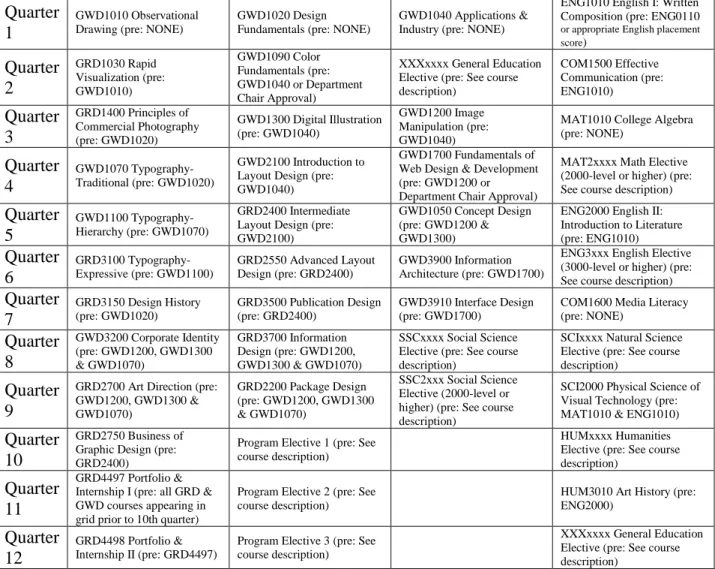
BS in Graphic & Web Design (Graphic Design Concentration): Courses with recommended sequence.
Quarter 1
GWD1010 Observational Drawing (pre: NONE)
GWD1020 Design Fundamentals (pre: NONE)
GWD1040 Applications & Industry (pre: NONE)
ENG1010 English I: Written Composition (pre: ENG0110
or appropriate English placement score) Quarter 2 GRD1030 Rapid Visualization (pre: GWD1010) GWD1090 Color Fundamentals (pre: GWD1040 or Department Chair Approval)
XXXxxxx General Education Elective (pre: See course description) COM1500 Effective Communication (pre: ENG1010) Quarter 3
GRD1400 Principles of Commercial Photography (pre: GWD1020)
GWD1300 Digital Illustration (pre: GWD1040)
GWD1200 Image Manipulation (pre: GWD1040)
MAT1010 College Algebra (pre: NONE)
Quarter 4
GWD1070 Typography-Traditional (pre: GWD1020)
GWD2100 Introduction to Layout Design (pre: GWD1040)
GWD1700 Fundamentals of Web Design & Development (pre: GWD1200 or Department Chair Approval)
MAT2xxxx Math Elective (2000-level or higher) (pre: See course description)
Quarter 5
GWD1100 Typography-Hierarchy (pre: GWD1070)
GRD2400 Intermediate Layout Design (pre: GWD2100)
GWD1050 Concept Design (pre: GWD1200 &
GWD1300)
ENG2000 English II: Introduction to Literature (pre: ENG1010)
Quarter 6
GRD3100 Typography-Expressive (pre: GWD1100)
GRD2550 Advanced Layout Design (pre: GRD2400)
GWD3900 Information Architecture (pre: GWD1700)
ENG3xxx English Elective (3000-level or higher) (pre: See course description)
Quarter 7
GRD3150 Design History (pre: GWD1020)
GRD3500 Publication Design (pre: GRD2400)
GWD3910 Interface Design (pre: GWD1700)
COM1600 Media Literacy (pre: NONE)
Quarter 8
GWD3200 Corporate Identity (pre: GWD1200, GWD1300 & GWD1070)
GRD3700 Information Design (pre: GWD1200, GWD1300 & GWD1070)
SSCxxxx Social Science Elective (pre: See course description)
SCIxxxx Natural Science Elective (pre: See course description)
Quarter 9
GRD2700 Art Direction (pre: GWD1200, GWD1300 & GWD1070)
GRD2200 Package Design (pre: GWD1200, GWD1300 & GWD1070)
SSC2xxx Social Science Elective (2000-level or higher) (pre: See course description)
SCI2000 Physical Science of Visual Technology (pre: MAT1010 & ENG1010)
Quarter 10
GRD2750 Business of Graphic Design (pre: GRD2400)
Program Elective 1 (pre: See course description)
HUMxxxx Humanities Elective (pre: See course description)
Quarter 11
GRD4497 Portfolio & Internship I (pre: all GRD & GWD courses appearing in grid prior to 10th quarter)
Program Elective 2 (pre: See course description)
HUM3010 Art History (pre: ENG2000)
Quarter 12
GRD4498 Portfolio & Internship II (pre: GRD4497)
Program Elective 3 (pre: See course description)
XXXxxxx General Education Elective (pre: See course description)
Program Electives for the Bachelor of Science degree in Graphic & Web Design (Graphic Design Concentration):
Illustration Focused Electives:
GRD4010 Mixed Media Illustration (Pre: GWD1050) GRD4020 Editorial Illustration (Pre: GWD1050)
GRD4030 Book Illustration (Pre: GWD1050)
Expanded Graphic Design Electives:
GRD4040 Special Topics in Graphic Design (Pre: GWD3200) GRD4050 Life Drawing for Graphic Design (Pre: GWD1300) GRD4060 Environmental Graphic Design (Pre: GWD3200)
Required General Education Courses for BS in Graphic & Web Design (Graphic Design Concentration):
COM1500 Effective Communication COM1600 Media Literacy
ENG1010 English I: Written Composition ENG2000 English II: Introduction to Literature
ENG3xxx English Elective: Choose one from the list of General Education English courses (3000-level or higher).
HUM3010 Art History
HUMxxxx Humanities Elective: Choose one from the list of General Education humanities courses.
MAT1010 College Algebra
MAT2xxx Math Elective: Choose one from the list of General Education math courses (2000-level or higher).
SCI2000 Physical Science of Visual Technology
SCIxxxx Natural Science Elective: Choose one from the list of General Education sciences courses.
SSCxxxx Social Science Elective: Choose one from the list of General Education social sciences courses.
SSC2xxx Social Science Elective: Choose one from the list of General Education social sciences courses (2000-level or higher).
XXXxxxx General Education Elective: Choose two from the list of General Education courses.
BS in Graphic & Web Design (Web Design Concentration): Courses with recommended sequence.
Quarter 1
GWD1010 Observational Drawing (pre: NONE)
GWD1020 Design Fundamentals (pre: NONE)
GWD1040 Applications & Industry (pre: NONE)
ENG1010 English I: Written Composition (pre: ENG0110
or appropriate English placement score)
Quarter 2
GWD1070 Typography-Traditional (pre: GWD1020)
GWD1090 Color Fundamentals (pre: GWD1040 or Department Chair Approval)
XXXxxxx General Education Elective (pre: See course description) COM1500 Effective Communication (pre: ENG1010) Quarter 3 GWD1100 Typography-Hierarchy (pre: GWD1070)
GWD1300 Digital Illustration (pre: GWD1040)
GWD1200 Image Manipulation (pre: GWD1040)
MAT1010 College Algebra (pre: NONE)
Quarter 4
WEB1200 Programming Logic (pre: MAT1010)
GWD2100 Introduction to Layout Design (pre: GWD1040)
GWD1700 Fundamentals of Web Design & Development (pre: GWD1200 or Department Chair Approval)
MAT2xxxx Math Elective (2000-level or higher) (pre: See course description)
Quarter 5
WEB2100 Computer Programming (pre: WEB1200)
WEB2700 Intermediate Web Design & Development (pre: GWD1700 & WEB1200)
GWD1050 Concept Design (pre: GWD1200 &
GWD1300)
ENG2000 English II: Introduction to Literature (pre: ENG1010)
Quarter 6
GWD3200 Corporate Identity (pre: GWD1200, GWD1300 & GWD1070)
WEB3700 Advanced Web Design & Development (pre: WEB2100 & WEB2700)
GWD3900 Information Architecture (pre: GWD1700)
ENG3xxx English Elective (3000-level or higher) (pre: See course description)
Quarter 7
WEB2350 Content Management Systems (pre: WEB2700)
WEB2600 Timeline Animation & Interaction (pre: GWD1700)
GWD3910 Interface Design (pre: GWD1700)
COM1600 Media Literacy (per: NONE)
Quarter 8
WEB3920 Experience Design (Pre: WEB3700)
WEB2200 Social Networking (pre: GWD1700)
SSCxxxx Social Science Elective (pre: See course description)
SCIxxxx Natural Science Elective (pre: See course description)
Quarter 9
WEB4800 Senior Project Pre-Production (pre: WEB3700 & WEB3920)
WEB3400 Audio & Video (Pre: WEB2700)
SSC2xxx Social Science Elective (2000-level or higher) (pre: See course description)
SCI2000 Physical Science of Visual Technology (pre: MAT1010 & ENG1010)
Quarter 10
WEB4900 Senior Project Production (pre: WEB4800)
Program Elective 1 (pre: See course description)
HUMxxxx Humanities Elective (pre: See course description)
Quarter 11
WEB4497 Portfolio & Internship I (pre: WEB4900)
Program Elective 2 (pre: See course description)
HUM3010 Art History (pre: ENG2000)
Quarter 12
WEB4498 Portfolio & Internship II (pre: WEB4497)
Program Elective 3 (pre: See course description)
XXXxxxx General Education Elective (pre: See course description)
Program Electives for the Bachelor of Science degree in Graphic & Web Design (Web Design Concentration):
Design Focused Electives:
WEB4850 SEO, Accessibility & Analytics (Pre: WEB3920) Development Focused Electives:
WEB3350 Advanced Content Management Systems (Pre: WEB2350)
WEB4580 Developing for Mobile Applications (Pre: WEB2600 & WEB3700) WEB4700 Emerging Technologies in Development (Pre: WEB3700)
Required General Education Courses for BS in Graphic & Web Design (Web Design Concentration):
COM1500 Effective Communication COM1600 Media Literacy
ENG1010 English I: Written Composition ENG2000 English II: Introduction to Literature
ENG3xxx English Elective: Choose one from the list of General Education English courses (3000-level or higher).
HUM3010 Art History
HUMxxxx Humanities Elective: Choose one from the list of General Education humanities courses.
MAT1010 College Algebra
MAT2xxx Math Elective: Choose one from the list of General Education math courses (2000-level or higher).
SCI2000 Physical Science of Visual Technology
SCIxxxx Natural Science Elective: Choose one from the list of General Education science courses.
SSCxxxx Social Science Elective: Choose one from the list of General Education social science courses.
SSC2xxx Social Science Elective: Choose one from the list of General Education social science courses (2000-level or higher).
XXXxxxx General Education Elective: Choose two from the list of General Education courses.