Published online 2016 November 21. Review Article
Issues of Theoretical Sampling: A Narrative Review
Nayyereh Davoudi,
1,2Nahid Dehghan Nayeri,
3,*Afsaneh Raiesifar,
1Sarieh Poortaghi,
4and Shamsi
Ahmadian
51Department of Medical Surgical Nursing, School of Nursing and Midwifery, Tehran University of Medical Sciences, Tehran, IR Iran 2Department of Medical Surgical Nursing, School of Nursing and Midwifery, Mashhad University of Medical Sciences, Mashhad, IR Iran 3Nursing and Midwifery Care Research Center, School of Nursing and Midwifery, Tehran University of Medical Sciences, Tehran, IR Iran 4Department of Community Health Nursing, School of Nursing and Midwifery, Tehran University of Medical Sciences, Tehran, IR Iran 5Faculty of Nursing, Baqiyatallah University of Medical Sciences, Tehran, IR Iran
*Corresponding author: Nahid Dehghan Nayeri, Nursing and Midwifery Care Research Center, School of Nursing and Midwifery, Tehran University of Medical Sciences, Tehran,
IR Iran. Tel: +98-2166914368, Fax: +98-2161054170, E-mail: [email protected]
Received2016 April 06;Revised2016 November 01;Accepted2016 November 12. Abstract
Context:Theoretical sampling is the hallmark of grounded theory methodology, but there seems to be little information accessible to researchers regarding process and guidance concerning theoretical sampling. The current study aimed to have a comprehensive and thorough review of the related studies on theoretical sampling and examine definitions, challenges, differences and applicable tips about this type of sampling to provide a comprehensive and clear picture of the sampling process and its probable challenges as well as explaining its practical aspects.
Objectives:The ultimate goal of all the explorations is to provide practical sources for researchers to answer their questions about theoretical sampling.
Data Sources:Databases such as ProQuest, Scopus, Pubmed, Science Direct, Wiley, Ovid, Google Scholar, and also Magiran, SID and Iran Medex (Persian databases) were searched from 1967 to 2015 using keywords of theoretical sampling and qualitative sampling.
Study Selection:A total of 562 Persian and English studies were found. According to the inclusion and exclusion criteria thirty articles and nine books were examined thoroughly.
Data Extraction:The narrative literature review was used as the most appropriate method to manage the data.
Results:Definitions and characteristics of theoretical sampling; theoretical sampling of data archive; the difference between theo-retical, purposeful and selective sampling; saturation and credibility in theoretical sampling were discussed in results.
Conclusions:The current study indicated disagreements about some theoretical definitions and operational applications of theo-retical sampling; however, the general consensus was that researchers explicated the decision making process in detail. Researchers should justify the selection and the sequence of sampling process to explain the complicated process of analytical abstraction and theory development by empirical data. Hence, the credibility of their theory and research is enhanced.
Keywords:Theoretical Sampling, Qualitative Sampling, Qualitative Research, Qualitative Method, Grounded Theory
1. Context
Human beings are complicated and partly unpre-dictable. Their individual differences and special needs make it impossible to form a universal law of human behavior. Qualitative researchers emphasize the impor-tance of detailed and exact description of social actions. They attempt to understand how participants experience their world. To explicate the individuals’ experiences, re-searchers try to present a thorough understanding of hu-man behaviors (1), and create a word picture of today’s multi-faceted and complex life. To this end, qualitative data collection should be thorough to answer the research questions in depth (2).
There are some similarities in qualitative paradigms, although sampling and qualitative data analysis involve a wide range of research traditions and techniques.
Qualita-tive sampling is naturalistic since it is done in normal and natural and not artificial situations (3). Qualitative sam-pling is based upon context which means it considers indi-vidual’s characteristics, the effect of time, location and sit-uation (4). Sampling is therefore the key element of quali-tative research (1,5) and determines the quality of a quali-tative research (6). As Patton noted, selecting participants should be congruent with the research conceptual frame-work. In other words, which and how many participants relate to what researcher strives to know, what the research purpose is, what proves useful and what has credibility (7), all should be taken into account.
The sampling method in qualitative research is also determined by methodological procedures. The qualita-tive research in health sciences is typically focused on grounded theory, phenomenology and ethnography (8). Among them, grounded theory is one of the most
lar and common qualitative research methods (9). This general methodology attempts to develop a theory that is ‘grounded’ in the data from which it is derived. Therefore, sampling in grounded theory is directed toward produc-ing and developproduc-ing an emergproduc-ing conceptual theory (10).
Reviewing recent qualitative studies indicates that de-spite most writers’ agreement on definition of theoretical sampling, its process remains largely vague and contradic-tory. Therefore, employing theoretical sampling can lead to specific challenges for novice researchers who are con-ducting their first grounded theory study (10). Draucker et al. reported that despite the fact that theoretical sam-pling is the hallmark of grounded theory, there is little practical guidance accessible to researchers regarding the process of theoretical sampling. The reason is that the re-searchers who used this method provided little descrip-tions on how they applied the sampling in response to the emergent findings (11). For example, in the studies con-ducted by Vandecasteele et al. and Ward et al. the processes of theoretical sampling were not explained, and if yet so, researchers used different interpretations of theoretical sampling and its application method (12,13). Also, in two recent grounded theory studies, Moudi et al. and Mirzaee Rabor et al. used purposive sampling to select the study participants; however, they did not mention the employ-ment of theoretical sampling in their studies (14,15). In the study by Masoudi Alavi et al. through grounded theory, some sentences showed that selecting participants dur-ing the study was merely purposive and was not theoret-ical. For example they said that: “the participant selection process deliberately selected patients at different ages and with various physical conditions” or “after collecting data from the patient group, fifteen health professionals with at least five years of experience working with persons with diabetes were selected” (16). In another grounded theory study, although researchers did not mention the employ-ment of theoretical sampling, it seems that this approach was used to select participants along with the progress of the study (17).
Hence, the current study aimed to have a comprehen-sive review of related studies on theoretical sampling and examine definitions, challenges, differences and applica-ble tips about this type of sampling to provide a compre-hensive and clear picture of the sampling process and its probable challenges as well as explaining its practical as-pects.
2. Objectives
The ultimate goal was to provide a practical source to answer the questions during their qualitative researches.
Accordingly, the current study major questions were as follows:
- How is theoretical sampling defined? And what are its specific characteristics?
- What are the practical phases of theoretical sampling? - What are the issues of its applications? And what are the strategies to confront these issues in practice?
3. Data Sources
In the current study, relevant databases were searched to find appropriate resources and studies. Databases such as Science Direct, Pubmed, Scopus, ProQuest, Google Scholar, Ovid, and Wiley were searched to examine pub-lished studies. Keyword of theoretical sampling and qual-itative sampling were searched. To achieve a wide range of studies and not missing related studies, AND/OR operators were not used while searching and the keywords of the-oretical sampling and qualitative sampling were not put into the brackets. Furthermore, the search in the databases was not confined to only review articles, since by doing so there was the possibility of missing some of the studies.
4. Study Selection
The criteria for inclusion in the study were as follows: - Keywords in the title of articles: considering the aim of study, keywords were searched in the title of articles (not in the abstracts); therefore, the researcher can access theo-retical articles rather than methodological ones about the concept under study.
- To be published from 1967 to 2015 (history of theo-retical sampling refers to the simultaneous discovery of grounded theory by Glaser and Strauss in 1967. The reason for the selection of this time period was the ability of re-searchers to have a comprehensive review for definitions, challenges of theoretical sampling from its emergence up to now as well as to clarify and monitor them in case of any changes in the traits).
The exclusion criteria were also as follows: Being E-books; not being in English or Persian; not being relevant to the aims of the study, being duplicated; and full text not accessible. Hence, the process for the selection of articles was based on this protocol: A) Assessing the relationship of title to the goals of the study; B) Examining the relation-ship of abstract to the aims of the study and C) Exploring full text (in case of availability) according to its consistency with the aims of the study.
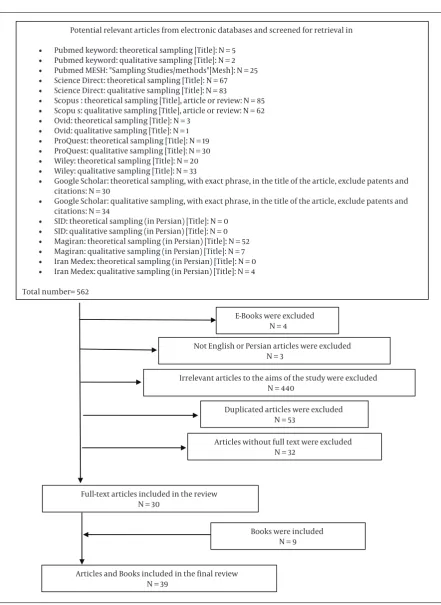
Sciences were also included in the study. Flowchart of the review process is presented inFigure 1.
5. Data Extraction
The narrative literature review was used as the most appropriate method for the study. This type of review ar-ticle tries to summarize a huge volume of information in a specific field and provide findings in a clear and explicit manner (18). Review of studies using narrative method can cover a wide range of topics in various levels in a hensive way. The method can either undergo a compre-hensive searching or not, and quality assessment of arti-cles can either be done or not. Synthesis in such studies is generally narrative and analysis may be chronological, conceptual or thematic (19).
6. Results
It seems vital to note differences between quantitative and qualitative sampling as they provide a better under-standing of theoretical sampling. Therefore, after explain-ing the differences, other findexplain-ings were discussed under the following titles:
1- Definitions and characteristics of theoretical sam-pling, including definitions and some of its characteristics. 2- Issues of theoretical sampling, including theoreti-cal sampling of data archive; the differences between theo-retical, purposeful and selective sampling; saturation and credibility in theoretical sampling.
6.1. Differences Between Qualitative and Quantitative Sam-pling
The methodology of qualitative and quantitative re-search differs in their underlying assumption which leads to differences in sampling objectives and strategies, reli-ability and validity related issues, generalizreli-ability and re-peatability (3,20,21). Quantitative research assumptions are concerned with distribution and statistical power. These assumptions are the cornerstones of sampling decision-making and support designing stronger causal inferences. The underlying assumptions are based upon statistical theories and central limit theorem in particular, which describes the distribution of variables among the population (20). It is assumed that the population param-eters are normally distributed. But qualitative researchers are not looking for representativeness; they usually make no assumption regarding normal distribution of individu-als’ experiences or interactions and settings (4).
Sampling in quantitative research is a random selec-tion of a part of the populaselec-tion. Researchers generalize re-sults respecting the target population which is representa-tive of the larger population. Therefore, how to choose the target population from the larger population is of prime importance as it should represent the main characteristics of a larger population. Researchers employing qualitative sampling place more emphasis on concepts and seek in-cidents related to them (22). Consequently, it can be as-serted that qualitative research emphasizes the saturation and quantitative research emphasizes the generalization (23-25).
Sampling techniques in quantitative research are used to reduce bias and enhance generalization, whereas quali-tative researchers contend that their primary goal is creat-ing a mirror or window-like prospect of a particular situa-tion or phenomenon being investigated (26).
Moreover, the nature of a proper sample differs in qual-itative and quantqual-itative research (27). Cases and not vari-ables are examined in qualitative research. Qualitative re-searchers seek people, events or experiences with rich and specific information. Participants in qualitative research are selected not to represent the population distribution, but to provide a unique vision for the phenomenon (20,
28). Qualitative researchers, considering concepts, seek differences and not the similarities. They assert that varia-tions would expand the broadness of concepts and scope of the theory (22). Qualitative researchers take negative and extreme cases into consideration for their unique in-sights, but quantitative researchers tend to exclude out-liers by random sampling (3).
In addition, in quantitative sampling, researcher mea-sures sample size before the study. The sample size is con-sidered as a constant goal throughout the study. Quanti-tative researchers can use others’ studies and find clues regarding the sample size and by analyzing them provide appropriate power to track down effects. Qualitative sam-pling is an iterative series of decisions in the research pro-cess. Therefore, samples in qualitative research are not necessarily constant, their nature is emergent. A thought-ful and reflexive researcher makes some revisions concern-ing his/her interpretation and explains the samplconcern-ing con-sequences (8,29). The information richness of each case in qualitative research explicates the reason for a smaller sample size in contrast with quantitative research (20).
Potential relevant articles from electronic databases and screened for retrieval in
• Pubmed keyword: theoretical sampling [Title]: N = 5 • Pubmed keyword: qualitative sampling [Title]: N = 2 • Pubmed MESH: "Sampling Studies/methods"[Mesh]: N = 25 • Science Direct: theoretical sampling [Title]: N = 67 • Science Direct: qualitative sampling [Title]: N = 83
• Scopus : theoretical sampling [Title], article or review: N = 85 • Scopu s: qualitative sampling [Title], article or review: N = 62 • Ovid: theoretical sampling [Title]: N = 3
• Ovid: qualitative sampling [Title]: N = 1 • ProQuest: theoretical sampling [Title]: N = 19 • ProQuest: qualitative sampling [Title]: N = 30 • Wiley: theoretical sampling [Title]: N = 20 • Wiley: qualitative sampling [Title]: N = 33
• Google Scholar: theoretical sampling, with exact phrase, in the title of the article, exclude patents and citations: N = 30
• Google Scholar: qualitative sampling, with exact phrase, in the title of the article, exclude patents and citations: N = 34
• SID: theoretical sampling (in Persian) [Title]: N = 0 • SID: qualitative sampling (in Persian) [Title]: N = 0 • Magiran: theoretical sampling (in Persian) [Title]: N = 52 • Magiran: qualitative sampling (in Persian) [Title]: N = 7 • Iran Medex: theoretical sampling (in Persian) [Title]: N = 0 • Iran Medex: qualitative sampling (in Persian) [Title]: N = 4
Total number= 562
E-Books were excluded N = 4
Not English or Persian articles were excluded N = 3
Irrelevant articles to the aims of the study were excluded N = 440
Duplicated articles were excluded N = 53
Articles without full text were excluded N = 32
Full-text articles included in the review N = 30
Books were included N = 9
Articles and Books included in the final review N = 39
6.1.1. Definitions and Characteristics of Theoretical Sampling 6.1.1.1. Definition of Theoretical Sampling
Despite improvements in grounded theory, the basic definition of theoretical sampling is almost unchanged. Glaser defined theoretical sampling as “the process of gen-erating theory whereby the analyst jointly collects, codes and analyses his data and decides which data to collect next and where to find them to develop his theory as it emerges” (30). Despite different epistemological assump-tions, Charmaz presented a similar description for theo-retical sampling, highlighting data collection, increasing analytical abstraction of theory by clarifying variation and identifying gaps which need interpretation (31). Strauss and Corbin believed that theoretical sampling is meant to maximize opportunities of discovering variations in con-cepts and it is used to densify categories in terms of their properties and dimensions (32). According to Polit and Beck, a theory based sampling is the process of selecting in-cidents, slices of life, time periods, or people on the basis of their potential manifestation or representation of impor-tant theoretical constructs (33).
6.1.1.2. Some Characteristics of Theoretical Sampling
Researchers mentioned some characteristics of theo-retical sampling each of which is explained in full detail:
- At the beginning of a study, theoretical sampling is open-ended and as the study progresses, it emerges (26).
- Theoretical sampling is grounded in the concepts in which their theoretical relationship with the emerging theory is confirmed (34). In fact, it can be said that theo-retical sampling is directed by concept. Concepts are sam-pled in the data and participants provide data which in-form us of the concepts. Therefore, in theoretical sam-pling, researchers refer to locations, persons and situa-tions which provide information respecting their selected concepts (22,35,36).
- It is essential to employ theoretical sampling as a ma-jor feature of grounded theory in the inductive-deductive process. Inductive process includes the emergence of the-ory from data and deductive process includes purposeful selection of samples to test the emerging theory (37).
- Given that guided interviews or selecting the best strategy for data collection is determined by the emer-gence of theoretical concepts, researcher relies on the abil-ity of the initial participants to demonstrate the elements of the research topic (38).
- Theoretical sampling is indeed a kind of triangula-tion and is used to confirm research findings. This method helps researchers to correct or add interview questions, change the observation method, select new informants and change the selection criteria to elucidate data ob-tained through analysis (39).
- Theoretical sampling uses the constant comparative method (39). As the process of data analysis is applied, each event is compared with other events in terms of similari-ties or differences. This comparison allows researchers to distinguish between categories and themes and identify their dimensions plus properties (22). According to Patton as cited by Suri, researchers who apply constant compara-tive method can utilize theoretical sampling. Hence, theo-retical sampling is used to systematically elucidate and re-fine the variations found in manifestations and meanings of the emergent concept (40).
- Studying new and unexplored area reveals the impor-tance of theoretical sampling. It allows researchers to ex-plore, discover and benefit from accidental events (22).
- As the time passes, theoretical sampling is planned and researchers check back their assumptions. Given that participants are selected in different situations and their presence is needed to clarify researcher’s understanding, then the research process should be explained in depth for budget agencies (41).
6.1.2. Issues of Theoretical Sampling
6.1.2.1. The Possibility of Theoretical Sampling From Data Archive
Researchers can sample available collected data con-cerning the concept. Reviewing analyzed data, and regard-ing them with a new perspective is not exceptional. Since events related to a concept may have already been over-looked and their significance not valued. Documents such as newspapers and books may be used as data sources. Sampling is exactly the same as when data are collected through interviews, observations or field notes by coding and sampling. Documentary data may be found in sev-eral libraries, organizations, populations or regions. Con-sequently, the researchers should reason where the rele-vant events can be found and sampled. Some documents may consist of interviews or field notes that were collected by another researcher (22).
6.1.2.2. The Difference Between Theoretical and Purposeful Sam-pling
pur-pose, under the guidance of a theory, with the purpose of refining and elucidating the emerging theory (10,46). Based on this feature, when a researcher applying a theo-retical sampling notices an emerging process, he/she will purposefully seek new data. Hence a more appropriate term for theoretical sampling can be “analysis-driven pur-poseful sampling” or “analysis-governed purpur-poseful sam-pling” (37).
Moreover, other researchers pointed out the applica-tion of purposeful or selective sampling at the beginning of theoretical sampling and argued that it is inevitable to apply some degrees of judgment in the early stages of sam-ple selection (47). For example, Thompson believes that data collected via selective sampling as “tentative theoret-ical jumping off points from which to begin theory de-velopment” (48). Therefore, phenomenal or demographic characteristics can be the starting points (49). According to Glaser, “initial sampling decisions are based on a gen-eral sociological perspective and a gengen-eral problem, but once data are collected and coding begins, the researcher is led in all directions which seem relevant and work” (30). Therefore, in the process of employing theoretical sam-pling, the researcher can start with selective sampling and when the concepts emerge, he inclines toward theoretical sampling (11).
However, some researchers state that theoretical sam-pling differs from other samsam-pling strategies of purposeful or selective sampling, which are applied in qualitative re-search (50). Purposeful sampling involves identification and selection of individuals or groups who possess a partic-ular knowledge or experience regarding a phenomenon. In addition to the knowledge and experience, Spradley as cited by Palinkas et al. believes that purposeful sample in a qualitative research should have the following features: noticing the importance of availability, willingness to par-ticipate in research, and the ability to share experiences and ideas in a detailed, expressive and reflexive way (23). Strauss and Corbin mentioned that purposeful sampling points to a strategy that researcher evaluates his judgment related to participants who provide the best perspective for the phenomenon and then purposefully invites those particular perspectives into the research (32).
Moreover, to ensure selecting the richest information provided by participants, the researcher determines a set of inclusion and exclusion criteria. These criteria are grounded in research questions designed comparatively regarding prior knowledge of subject matter or initial study of related articles (10), but theoretical sampling is understood in context (37), since sampling criteria and its size in this method emerge as the study progresses (37,
51) and researchers applying theoretical sampling do not know exactly where and what sample they are directed to
(10). Glaser suggests that in theoretical sampling, the re-searcher should always be ready to change the interview approach, data collection sources, and participants as data patterns emerge (30). Hence, researcher waits for the sam-ple selection to be formed by concurrent data collection and analysis (5), while a purposeful sample is selected by a predetermined aim at the beginning of the study (10).
In this field, the exploration of various studies showed that grounded theorists, in some cases, applied purpose-ful sampling instead of theoretical sampling in their stud-ies (52-54). In addition, in some studies, they started the study using purposeful sampling (and a mention of inclu-sion and excluinclu-sion criteria), but as the study headed forth and developed, theoretical sampling was employed (12,13,
55).
6.1.2.3. Saturation in Theoretical Sampling
Since qualitative studies do not aim at statistical gener-alizations, many of qualitative researchers state that sam-ple size and sampling designs are not issues and chal-lenges in qualitative research (27); though a novice re-searcher is concerned with where to start a research and where to stop data collection (10).
The term “saturation” in qualitative research is an am-biguous concept and is frequently misinterpreted (10). Re-searchers have a few disagreements over its definitions and applications, which are as follows:
dimen-sions of categories, including variation and possible rela-tionships with other concepts (22). Consequently, theo-rists saturate categories with more explanatory power and integrate them around a core variable. Therefore, the the-orists are capable of acting beyond the typical descriptive level of a qualitative research and present the theoretical essence of a substantive area. In grounded theory, satura-tion is not related to confirming hypothesis and describ-ing a specific situation at a specific time. In theoretical sat-uration, researcher is interested in creating a theory that can overcome changing situations. In grounded theory, theoretical sampling and the sampling end point are con-trolled by the emerging theory (10). When there is no valu-able and/or new idea concerning the theory development, sampling can be stopped. Regarding the quality of the developed theory, researchers can recognize when satura-tion has taken place (42,51). Despite these descriptions, some researchers believe that data saturation and redun-dancy are closely related to theoretical saturation; hence, the richness of data clarifies the theoretical development (5).
In general, concerning sampling end point, re-searchers should be aware not to conclude soon. Some-times when the researchers use the term saturated categories, they truly mean “they” are saturated with the process of data collection. In such circumstances, their time, money, and energy are finished and research is called off very soon and some gaps remain. It is unlikely that five or six interviews lead to saturation (22). Ryan and Bernard showed that saturation is connected with researcher’s experience and fatigue and the number of analysts who review the data. In other words, theoretical saturation relates to the researcher or research team’s skills (56). Therefore, for those who apply grounded theory for the first time, understanding the concept of theoretical sat-uration is probably difficult. Then, they never experience reaching the saturation point (10).
A review of studies indicated that grounded theorists’ researchers have different conceptions and understand-ings of ‘saturation’; for example, Ashghali Farahani et al. considered their data as saturated when the new data could not provide any new theoretical insight or new char-acteristics for categories (57). Similarly, Heidari et al. also reported that they considered their data saturated when by increasing the number of samples, new data were not achieved (58). Other researchers believe that data satura-tion means that no new concept which needs creasatura-tion of a new code is gained (53, 54). Seidi et al. wrote on satura-tion as the time when there are no new data emerging and clarification of interrelationships between concepts and sub categories with no emergence of new category, evolu-tion of axial categories and gradual emergence of theory
(55). Furthermore, Silva et al. pointed out that theoreti-cal saturation happens when collecting new data makes no changes in the consistency and theoretical density of the emergent concepts (59). Vandecasteele et al. believed that saturation means when you cannot glean any new in-formation and the interrelations between concepts are ob-served clearly (12). As it can be observed in the review of such studies, the researchers frequently use the concept of “data saturation” interchangeably with “theoretical satu-ration”.
6.1.2.4. Evaluating the Credibility of Theoretical Sampling In the past decades, despite the growing popularity of qualitative research, it is criticized for its ambiguous process and procedures. Many published qualitative re-searches provide little information regarding features of studied sample, sample or process type and sampling tech-niques (8). One of the major problems of applying theoret-ical sampling is using this method without adequate un-derstanding of grounded theory which leads to inability to clarify sampling strategy. Inappropriate application of grounded theory is harshly criticized, since it seems that with a sleight of hand, researchers create a set of themes. Thus, with no step by step explanation of how to achieve this theoretical insight, people are invited to believe their theory (10). Sampling is essentially needed to determine research quality. Providing an exact description of partic-ipants is one of the credibility elements in qualitative re-search (6,10). It is recommended that novice grounded theorists avoid a separate, on-off, and static description and instead concentrate on the theoretical sampling devel-opment, justification and decision making. Their explica-tion should reflect the complex process of theory develop-ment (10). Researchers should explicate, in detail, the de-cision making process for sampling and systematic proce-dures to achieve research samples. If research findings can-not explicitly connect to the research process, it is difficult to determine research credibility (8,24,25).
Corbin and Strauss pointed out that the evaluation and judgment criteria respecting the quality of grounded the-ory involve the evaluation criteria of theoretical sampling. They suggested that in research evaluation, the following factors should be taken into account:
- How were the original sample and its following sam-ple selected?
- Which categories was theoretical sampling based on? - How did theoretical formulation direct data collec-tion?
- How did descriptions related to theoretical sampling determine that categories were obtained from the data? (22).
A review of literatures using grounded theory indi-cated that in some of the studies, researchers sufficed only to defining theoretical sampling and did not mention any practical realities of theoretical sampling process in their studies. For example, in the studies by Ward et al. and Shi-razi et al. the process of researchers’ access to theoretical insights was unclear for the readers (13,60).
7. Conclusions
Theoretical sampling is the process of data collec-tion for theory generacollec-tion. The review of literature indi-cated that despite disagreements and challenges regard-ing some operational application of theoretical samplregard-ing, there were agreements and general consensus respecting the significance of theoretical sampling and its influence over quality of theory. Therefore, it is recommended that researchers explicate the decision making process in de-tail, since they apply theoretical sampling in their stud-ies. Researchers should also justify the selection and the sequence of sampling process to explain the complicated process of analytical abstraction and theory development by empirical data. Consequently, the credibility of their theory and research is enhanced.
Footnotes
Authors’ Contribution: Study concept and design (Nayyereh Davoudi, Nahid Dehghan Nayeri); searching databases and selecting the articles: (Nayyereh Davoudi, Afsaneh Raiesifar, Sarieh Poortaghi, Shamsi Ahmadian); in-terpretation of data: (Nayyereh Davoudi, Nahid Dehghan Nayeri); drafting the manuscript: (Nayyereh Davoudi); critical revision of the manuscript: (Nahid Dehghan Nayeri, Afsaneh Raiesifar, Sarieh Poortaghi, Shamsi Ah-madian); all authors read, revised and approved the final copy of the manuscript.
Financial Disclosure:The authors declared no conflict of interest regarding the materials and results of the current study.
Funding/Support:There was no financial support for the current study.
References
1. Omona J. Sampling in qualitative research: Improving the qual-ity of research outcomes in higher education.Makerere J High Educ.
2013;4(2) doi:10.4314/majohe.v4i2.4.
2. Kearney MH. Going deeper versus wider in qualitative sampling.
J Obstet Gynecol Neonatal Nurs. 2007;36(4):299. doi:
10.1111/j.1552-6909.2007.00167.x. [PubMed:17594402].
3. Abrams LS. Sampling ’hard to reach’ populations in qualitative re-search: The case of incarcerated youth.Qual Soc Work.2010;9(4):536– 50. doi:10.1177/1473325010367821.
4. Marshall MN. Sampling for qualitative research. Fam Pract.
1996;13(6):522–5. [PubMed:9023528].
5. Roy K, Zvonkovic A, Goldberg A, Sharp E, LaRossa R. Sampling richness and qualitative integrity: Challenges for research with families.J Mar-riage Family.2015;77(1):243–60. doi:10.1111/jomf.12147.
6. Gibbs L, Kealy M, Willis K, Green J, Welch N, Daly J. What have sampling and data collection got to do with good qualitative research?.Aust N Z J Public Health.2007;31(6):540–4. doi:10.1111/j.1753-6405.2007.00140.x. [PubMed:18081574].
7. Patton MQ. Qualitative evaluation and research methods. Newbury Park: SAGE Publications, Inc; 1990.
8. Higginbottom GM. Sampling issues in qualitative research.Nurse Res. 2004;12(1):7–19. doi: 10.7748/nr2004.07.12.1.7.c5927. [PubMed:
15493211].
9. Harris T. Grounded theory. Nurs Stand. 2015;29(35):32–9. doi:
10.7748/ns.29.35.32.e9568. [PubMed:25922026].
10. Breckenridge J, Jones D. Demystifying theoretical sampling in grounded theory research.Ground Theor Rev.2009;8(2):113–26. 11. Draucker CB, Martsolf DS, Ross R, Rusk TB. Theoretical sampling
and category development in grounded theory. Qual Health Res. 2007;17(8):1137–48. doi: 10.1177/1049732307308450. [PubMed:
17928484].
12. Vandecasteele T, Debyser B, Van Hecke A, De Backer T, Beeckman D, Verhaeghe S. Nurses’ perceptions of transgressive behaviour in care relationships: a qualitative study.J Adv Nurs.2015;71(12):2786–98. doi:
10.1111/jan.12749. [PubMed:26250148].
13. Ward K, Gott M, Hoare K. Participants’ views of telephone interviews within a grounded theory study.J Adv Nurs. 2015;71(12):2775–85. doi:
10.1111/jan.12748. [PubMed:26256835].
14. Moudi Z, Abed Saeedi Z, Ghazi Tabatabaie M. How baloch women make decisions about the risks associated with different childbirth settings in southeast iran.Nurs Midwifery Stud. 2015;4(1):e24453. [PubMed:25830159].
15. Mirzaee Rabor F, Taghipour A, Mirzaee M, Mirzaii Najmabadi K, Fazi-lat Pour M, Fattahi Masoum SH. Developing a Questionnaire for Ira-nian Women’s Attitude on Medical Ethics in Vaginal Childbirth.Nurs Midwifery Stud. 2015;4(4):e29004. doi: 10.17795/nmsjournal29004. [PubMed:26835464].
16. Masoudi Alavi N, Ghofranipour F, Ahmadi F, Babaee G, Rajab A, Emami A. Explanatory model of diabetes management; an experience from Iran.Nurs Midwifery Study.2012;1(2):100–6.
17. Seylani K, Karlsson S, Hallberg IR, Mohammadi E, Negarandeh R. Spiri-tuality among iranian nursing students during undergraduate study.
18. Yarmohammadian MH, Mohammadi E, Movahedi F. Standards for writing review articles [in Persian].Health Inf Manag. 2012;8(8):1226– 34.
19. Grant MJ, Booth A. A typology of reviews: an analysis of 14 review types and associated methodologies.Health Info Libr J. 2009;26(2):91–108. doi:10.1111/j.1471-1842.2009.00848.x. [PubMed:19490148].
20. Ayres L. Qualitative research proposals–part III: sampling and data collection.J Wound Ostomy Continence Nurs. 2007;34(3):242–4. doi:
10.1097/01.WON.0000270816.99318.3b. [PubMed:17505241].
21. Trotter RT. Qualitative research sample design and sample size: resolving and unresolved issues and inferential imperatives.Prev Med. 2012;55(5):398–400. doi:10.1016/j.ypmed.2012.07.003. [PubMed:
22800684].
22. Corbin J, Strauss A. Basics of qualitative research: Techniques and pro-cedures for developing grounded theory. 3 ed. Thousand Oaks: SAGE Publications, Inc; 2008.
23. Palinkas LA, Horwitz SM, Green CA, Wisdom JP, Duan N, Hoagwood K. Purposeful Sampling for Qualitative Data Collection and Anal-ysis in Mixed Method Implementation Research.Adm Policy Ment Health. 2015;42(5):533–44. doi: 10.1007/s10488-013-0528-y. [PubMed:
24193818].
24. Byrne M. Sampling for qualitative research.AORN J.2001;73(2):494–8. [PubMed:11218935].
25. Luborsky MR, Rubinstein RL. Sampling in Qualitative Research: Rationale, Issues, and Methods. Res Aging. 1995;17(1):89–113. doi:
10.1177/0164027595171005. [PubMed:22058580].
26. Koerber A, McMichael L. Qualitative sampling methods a primer for technical communicators.J Bus Tech Comm.2008;22(4):454–73. 27. Onwuegbuzie AJ, Leech NL. Sampling designs in qualitative research:
Making the sampling process more public.Qual Rep.2007;12(2):238– 54.
28. Jalali R. qualitative research sampling. J Qual Res Health Sci.
2013;1(4):310–20.
29. Guetterman TC. Descriptions of sampling practices within five ap-proaches to qualitative research in education and the health sciences.
Forum Qual Soc Res.2015;16(2):Art. 25.
30. Glaser BG. Advances in the methodology of grounded theory: Theo-retical sensitivity. Mill Valley, CA: Sociology Press; 1978.
31. Charmaz K. Constructing grounded theory: A practical guide through qualitative analysis. London: SAGE Publications; 2006. 32. Strauss A, Corbin J. Basics of qualitative research: Techniques and
procedures for developing grounded theory. SAGE Publications, Inc; 1998.
33. Polit DF, Beck CT. Nursing research: Generating and assessing evi-dence for nursing practice. 9 ed. Philadelphia: Lippincott Williams & Wilkins; 2012.
34. Seale C, Gobo G, Gubrium J, Silverman D. Qualitative research prac-tice. London: SAGE Publications; 2004.
35. Boswell C, Cannon S. Introduction to nursing research, incorporating evidence based practice. Boston: Jones & Bartlett Publishers; 2007. 36. Ranjbar H, Haghdoost AA, Salsali M, Khoshdel A, Soleimani M,
Bahrami N. Sampling in qualitative research: A Guide for beginning [in Persian].Ann Mil Health Sci Res.2012;10(3):238–50.
37. Coyne IT. Sampling in qualitative research. Purposeful and the-oretical sampling; merging or clear boundaries?. J Adv Nurs.
1997;26(3):623–30. [PubMed:9378886].
38. Currie K. Using survey data to assist theoretical sampling in grounded theory research. Nurse Res. 2009;17(1):24–33. doi:
10.7748/nr2009.10.17.1.24.c7336. [PubMed:19911651].
39. Houser J. Nursing research: Reading, using and creating evidence. Jones & Bartlett Publishers; 2008.
40. Suri H. Purposeful sampling in qualitative research synthesis.Qual
Res J.2011;11(2):63–75. doi:http://dx.doi.org/10.3316/QRJ1102063. 41. Bagnasco A, Ghirotto L, Sasso L. Theoretical sampling.J Adv Nurs.
2014;70(11):e6–7. doi:10.1111/jan.12450. [PubMed:24889554]. 42. Holloway I, Wheeler S. Qualitative research in nursing and
health-care. John Wiley & Sons; 2010.
43. Sandelowski M. Sample size in qualitative research.Res Nurs Health.
1995;18(2):179–83. [PubMed:7899572].
44. Wilmot A. Designing sampling strategies for qualitative social re-search: With particular reference to the office for national statis-tics’ qualitative respondent register. Surv Meth Bull Off Natl Stat.
2005;56:53.
45. Bowers D, House A, Owens D. Getting started in health research. John Wiley & Sons; 2011.
46. Tuckett AG. Qualitative research sampling: the very real complexi-ties.Nurse Res.2004;12(1):47–61. doi:10.7748/nr2004.07.12.1.47.c5930. [PubMed:15493214].
47. Curtis S, Gesler W, Smith G, Washburn S. Approaches to sampling and case selection in qualitative research: examples in the geography of health.Soc Sci Med.2000;50(7-8):1001–14. [PubMed:10714922]. 48. Thompson C. Qualitative research into nurse decision making:
fac-tors for consideration in theoretical sampling.Qual Health Res.
1999;9(6):815–28. [PubMed:10662261].
49. Waltz CF, Strickland OL, Lenz ER. Measurement in nursing and health research. Springer Publishing Company; 2010.
50. Robinson OC. Sampling in interview-based qualitative research: A theoretical and practical guide.Qual Res Psychol.2014;11(1):25–41. doi:
http://dx.doi.org/10.1080/14780887.2013.801543.
51. Streubert HJ, Carpenter DR. Qualitative research in nursing: Ad-vancing the humanistic imperative. 5 ed. Philadelphia: Lippincott Williams & Wilkins; 2011.
52. Angerud KH, Brulin C, Eliasson M, Naslund U, Hornsten A. The Process of Care-seeking for Myocardial Infarction Among Pa-tients With Diabetes. J Cardiovasc Nurs. 2015;30(5):E1–8. doi:
10.1097/JCN.0000000000000195. [PubMed:25325370].
53. Rosenthal MM, Molzahn AE, Chan CT, Cockfield SL, Kim SJ, Pauly RP. Why take the chance? A qualitative grounded theory study of nocturnal haemodialysis recipients who decline kidney transplan-tation.BMJ Open.2016;6(5):e011951. doi:10.1136/bmjopen-2016-011951. [PubMed:27194322].
54. van Gilst MM, Cramer IC, Bloem BR, Overeem S, Faber MJ. A grounded theory study on the influence of sleep on Parkinson’s symptoms.
BMC Res Notes. 2016;9:299. doi: 10.1186/s13104-016-2114-3. [PubMed:
27283443].
55. Seidi J, Alhani F, Salsali M. Exploration of structure of clinical judg-ment of nurses: A grounded theory study [in Persian].J Qual Res Health Sci.2014;2(4):297–309.
56. Ryan GW, Bernard HR. Techniques to identify themes.Field Method.
2003;15(1):85–109.
57. Ashghali-Farahani M, Mohammadi E, Ahmadi F, Maleki M, Hajizadeh E. Obstacles of patient education in CCU and post CCU: A grounded theory study [in Persian].Iran J Nurs.2009;22(58):55–73.
58. Heidari MR, Anooshe M, Azadarmaki T, Mohammadi E. The process of patient’s privacy: A grounded theory.J Shahid Sadoughi Univ Med Sci.
2012;19(5):644–54.
59. da Silva TP, da Silva MM, Valadares GV, Silva IR, Leite JL. Nursing care management for children hospitalized with chronic conditions.Rev Bras Enferm. 2015;68(4):556–63. doi:10.1590/0034-7167.2015680410i. [PubMed:26422035] 641-8.