Research Journal
Volume 12, No. 3, September 2018, pages 75–95
DOI: 10.12913/22998624/90223 Review Article
EFFECTS OF FORMING TOOLS AND PROCESS PARAMETERS ON SURFACE
ROUGHNESS IN INCREMENTAL SHEET FORMING
Umair Khalil1, Muhammad Haris Aziz1, Mirza Jahanzaib1, Wasim Ahmad1, Salman Hussain1, Faisal Hafeez1
1 Department of Industrial Engineering, University of Engineering & Technology Taxila, Pakistan
e-mail: [email protected], [email protected], [email protected], [email protected], [email protected], [email protected]
ABSTRACT
Literature has vastly advocated for incremental sheet forming as a significant process for formation of sheet metal components, because of its higher formability in compar-ison with the rest of metal forming processes such as deep drawing and stamping. Due to high formability of incremental sheet forming it becomes important to investigate the main factors, influencing the quality of forming products. However, less attention has been given to investigate the inconsistencies reflected often in determining the ef-fect of multiple forming parameters and parametric interactions comprising of spindle rotational speed and feed rate, tool size and sheet thickness, sheet thickness and step depth. This study investigates the effect of various principal factors including tool type, tool size, sheet thickness, spindle speed, feed rate, step increment including and their respective interaction on surface roughness. Research data was collected by un-dertaking extensive literature review of previous studies on incremental sheet forming regarding surface quality. A quantitative one way analysis of variance (ANOVA) was employed to analyze the significance and contribution of factors influencing surface quality of sheet forming. The findings highlight the contribution of forming param-eters and their combined interactions on surface roughness. Based on the empirical findings, this study derives implications for the optimization of tool type, parametric interactions among principal factors and their respective optimized operational range for incremental sheet forming.
Keywords: ISF, quantitative survey, forming tools, forming parameters, surface roughness.
INTRODUCTION
Sheet metal forming is as old as human
learned the use of metals. With advance in sci
-ence and technology, forming methods have been evolved to form the desired complex shape products and improving the strength of metals. For forming, mostly sheet metals are ductile in nature which could be formed up to a specific limit. Beyond this limit, frac
-ture occurs which is consider as part failure. Surface roughness is considered a weak point
for incremental sheet forming (ISF) products. Surface finish is represented by the large scale waviness created by the tool path and the small scale roughness induced by large surface strains. The surface quality is influenced by several process parameters.
Incremental sheet forming (ISF) removes the use of punch and die. It is a die less process so, friction between forming tool and sheet metal is less. In incremental sheet forming (ISF), de
-formation process is local in nature and gradual which highly influence the surface roughness. Received: 2018.03.18
Research has been led into changes of basic in
-cremental sheet forming process. As an example, others forming methods like hot incremental sheet forming have been investigated in order to reduce forming force. Duflou et al. [1] utilized laser mechanism in order to improve surface fin
-ish and increase maximum wall angle of titanium aluminum alloy (TiAL6V4) blank. Similar tita
-nium composite was heated with band radiators installed in sheet holder by Palumbo et al. [2] ob
-served the improvement in surface finish of that alloy. In recent years, use of electric incremental forming method have been investigated and ap
-plied to different materials such as aluminum al
-loy (AA 6061) by Adams et al. [3] and titanium aluminum alloy (TiAL6V4) used by Fan [4] with decrease in roughness. Due to its high formabil
-ity, incremental sheet forming (ISF) is used in different industrial applications. For automotive industry various asymmetric complex parts were made as rapid prototyping like reflective surface of head lights, service panels, and hood and fend
-ers. , incremental sheet forming (ISF) can also be used for non-automotive industrial applications like aerospace industries, biomedical applications (ankle support, cranial plate) and appliances (so
-lar cooker) etc.
Due to its importance and significance lot of research has been done and is going on. In order to highlight its research trend, data base used for
search literature was google scholar and science
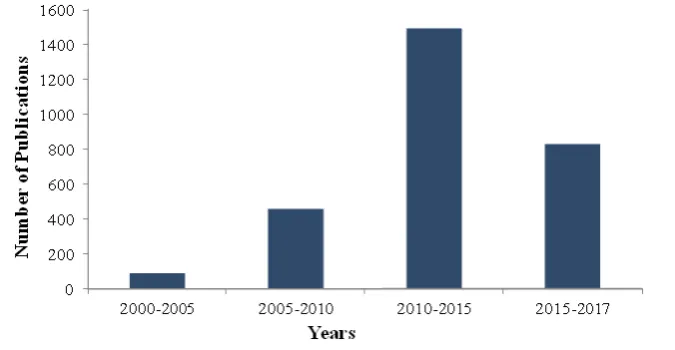
direct. Key words employed were “incremental sheet forming (ISF)”. We observed that 89 pub
-lications were carried out from 2000-2005, 457 researches have been examined from 2005-2010, 1490 publications have been observed from
2010-2015, 829 researches were seen from 2015-2017. The rising trend about incremental sheet forming (ISF) has been observed in recent years. It is expected that the number will keep growing in coming years.
Continuing too much publications pose a challenge to researchers to sort the required pa
-rameters for desired formability especially when there are contradicting findings. For instance, Durante et al. [5] found that surface roughness decreases as tool tip diameter increases on the
same site other tests demonstrated that tool
di-ameter has no significant effect on roughness as Bagudanch et al. [6] and Deepak et al. [7] sug -gested that roughness decreased with increase in
sheet thickness. From these, Gulati et al. [8] and Shanmuganatan et al. [9] discovered that rough
-ness decreased with decrease in sheet thick-ness. However, ambiguity in experiment requires high attention to look at the results from the others pa
-pers related to these parameters.
Most important inconsistencies that ob -served while investigating the conclusions
were about the effect of forming tools and other forming parameters. Li et al. [10] inves
-tigated that ball tool has better surface finish than hemispherical tool on the other hand Du
-rante M. [5] demonstrated that hemispherical tools provide better surface finish as compared to ball tool. Similarly, Cawley et al. [11] ex
-amined that parabolic tools reduced roughness while inverse results of angular tools about sur
-face finish as Adams [12]. Therefore, there was a need to conduct a comprehensive literature review on tool and other forming parameters to investigate their effects on Roughness.
HYPOTHESIS
What does this survey say in regards to the impacts of forming tools and others process parameters for enhancing surface roughness? Is there any difference or consistency between various conclusions? Different hypotheses have been drawn regarding the effect on roughness, particularly how the variation of these process parameters minimizing roughness? Following
conclusions that are considered in this review
are given below as:
• Null hypothesis (Ho): Forming parameters have no effect on roughness.
• Alternate hypothesis (H1): At least one pa
-rameter has significant effect on roughness. • H1 (a): Tool types have significant effect on
roughness.
• H1 (b): Tool size has significant effect on roughness.
• H1 (c): Sheet thickness has significant effect on roughness.
• H1 (d): Step increment has significant effect on roughness.
• H1 (e): Feed rate has significant effect on roughness.
• H1 (f): Spindle speed has significant effect on roughness.
• H1 (g): Interaction (tool diameter and sheet thickness) has significant effect on roughness.
METHODOLOGY
This survey was conducted as ‘organized quantitative review’ about incremental sheet forming parameters. This sort of survey has been defined by Pickering and Byrne [13]. This survey practice has been tried by various students and researchers and gets repeated and best outcomes. This procedure is very beneficial to the incremen
-tal sheet forming process parameters because of quantitative idea about input data and will be seen in tabular form, permits successful comparison of process parameters values between various pa
-pers. In this survey paper, some of selected pro
-cess parameters have been considered, because these parameters are basic in every incremental sheet forming process, other particular incremen
-tal process like electric and hot incremen-tal form
-ing also included is this survey and output param
-eters that considered is roughness.
A large number of papers were searched for incremental sheet forming. For this study, papers were selected according to some specified crite
-ria i.e. recent papers, original research, published journal papers which included various incremen
-tal sheet forming (ISF) process parameters ex
-cluding review papers. Summary of papers that were used in this survey database were process parameter values, tool and sheet material, biblio
-graphic information and results and discussion. Data is presented in tabular form and papers are referenced. For simplicity and better understand
-ing, authors name and numerical reference which will separate papers with same author and refer
-ence. For example, Ham et al. [14] and Ham and jesweit [15]. In the data tables, if some informa
-tion about any process parameter was not given, then it is expressed as N/A in tables.
Following conclusions that are considered in
this review are given below as:
• Increasing process parameters value will de
-crease roughness.
• Decreasing process parameters value will decrease roughness.
• Optimized process parameters value will de
-crease roughness.
• No effect of process parameters values on roughness.
Analysis of variance (ANOVA) is used in order to analyze the input data. Analysis of vari
-ance (ANOVA) is a statistical method used to in
-vestigate experimental data and make decisions about process parameters under study. It is used to classify significant process parameters and to measure their effects on response like roughness. It is also very helpful in determining the percent
-age contribution of each parameter against an ex
-pressed level of certainty.
Experimental incremental sheet forming (ISF) parameters have been studied in order to investigate their effects on roughness. Results and discussion is performed for each parameter and also examined interaction effect, after the re
-sults of tables about each process parameter. Next section describes the parameters comparison on roughness. End discussion was conducted which concluded the whole findings of this survey pa
-per. Finally, future scope of work and overall con
-clusions were presented.
EXPERIMENTAL FORMING PARAMETERS
This survey paper investigates fundamen
However, statistical methods should be used to analyze the data so that results and conclusions are objective. Analysis of variance (ANOVA) is widely used to test the statistical significance of the effects through fisher method (F-test). In this study qualitative data classified the item into dif
-ferent categories like increase or decrease and good or bad. If response (roughness) obtained from experiments is in the form of qualitative data, then the problem is that how to analyze data. In order to analyze data through analysis of vari
-ance (ANOVA), first convert input data into dif
-ferent classes hemispherical, spherical or flat as 0, 1 or 2 etc respectively.
For example in case of tool types we classify tool shapes into different numbers as shown in Table 1.
Similarly, roughness achieved from these tool types were also classified into different classes as no effect, Increasing or decreasing roughness as 0, 1 or 2 respectively in Table 2.
For others forming process parameters De
-sign of experiment was developed at 3- levels in Table 3 and analyze the results with the help of analysis of variance (ANOVA) to see the signifi
-cance of these process parameters on roughness. Forming parameters and their ranges were classi
-fied and low, medium and high indicated as 0, 1, 2 respectively in order to design experiment, as shown in Table 3.
RESULTS AND DISCUSSIONS
Forming tool characteristics
Initially, two types of forming tools have been used in incremental sheet forming process. First one is rigid hemispherical tool and the other is ro
-tating ball end tool, enabling it to roll freely over forming parts [16]. With the growth in incremen
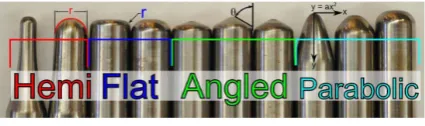
-tal sheet forming field, flat end, angular and other forming tool profiles were developed [11].
Cawley et al. [11] and Kim et al. [17] and Petek et al. [18] showed that one kind of forming tool has more advantageous over the other kind of forming tool in terms of surface quality and formed parts accuracy. Two parameters forming tool shapes and tool size were considered in this survey paper. Forming mechanism was significantly influenced by forming tool profiles and tool size. Tool shape and tool size mainly influence the contact area be -tween forming sheet and tool interface that creates
friction [5] and forming forces [5].
Table 1. Tool type’s levels
Hemi spherical Spherical Flat Parabolic Water jet tool Ball tool Angular tool
0 1 2 3 4 5 6
Table 2. Response (Roughness) Levels
Increase Decrease No effect
1 2 0
Table 3. Input Factors and their levels
Sr.no Factors Units Levels Low Range [0](mm) Medium Range [1](mm) High Range [3](mm)
1 Tool size 1-10 11-15 16
2 Sheet thickness .1-.8 .9-1.5 1.6 3 step increment .1-.4 .5-.8 .9-1 4 Feed rate 100-1200 1250-2400 2450 5 Spindle speed 100-2000 2100-4000 4050
6 (tool size and sheet thickness)Interaction 1-1.5 1.6 -2 2.1- 2.5
Forming tools are made from different materials like tool steel, carbide and high speed steel (HSS). Lubrication between forming sheet and tool affects the friction condition during forming process [19].
Presently no papers have been found that inves
-tigate specifically the influence of tool materials on roughness. So, we have not considered the effect of tool materials on formability in this survey.
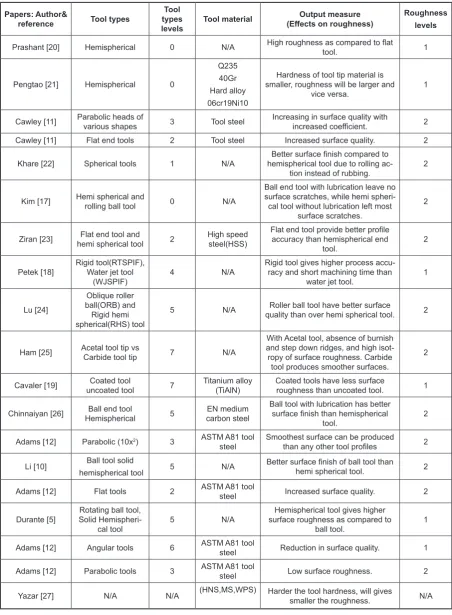
Table 4. Tools types paper summary
Papers: Author&
reference Tool types
Tool types
levels Tool material
Output measure
(Effects on roughness) Roughnesslevels
Prashant [20] Hemispherical 0 N/A High roughness as compared to flat tool. 1
Pengtao [21] Hemispherical 0
Q235 40Gr Hard alloy 06cr19Ni10
Hardness of tool tip material is smaller, roughness will be larger and
vice versa. 1
Cawley [11] Parabolic heads of various shapes 3 Tool steel Increasing in surface quality with increased coefficient. 2
Cawley [11] Flat end tools 2 Tool steel Increased surface quality. 2
Khare [22] Spherical tools 1 N/A hemispherical tool due to rolling ac-Better surface finish compared to
tion instead of rubbing. 2
Kim [17] Hemi spherical and rolling ball tool 0 N/A
Ball end tool with lubrication leave no surface scratches, while hemi
spheri-cal tool without lubrication left most surface scratches.
2
Ziran [23] hemi spherical toolFlat end tool and 2 High speed steel(HSS) Flat end tool provide better profile accuracy than hemispherical end
tool. 2
Petek [18] Rigid tool(RTSPIF), Water jet tool
(WJSPIF) 4 N/A
Rigid tool gives higher process accu-racy and short machining time than
water jet tool. 1
Lu [24]
Oblique roller ball(ORB) and Rigid hemi spherical(RHS) tool
5 N/A quality than over hemi spherical tool.Roller ball tool have better surface 2
Ham [25] Acetal tool tip vs Carbide tool tip 7 N/A
With Acetal tool, absence of burnish and step down ridges, and high isot-ropy of surface roughness. Carbide tool produces smoother surfaces.
2
Cavaler [19] uncoated toolCoated tool 7 Titanium alloy (TiAlN) Coated tools have less surface roughness than uncoated tool. 1
Chinnaiyan [26] HemisphericalBall end tool 5 carbon steelEN medium Ball tool with lubrication has better surface finish than hemispherical
tool. 2
Adams [12] Parabolic (10x2) 3 ASTM A81 tool
steel Smoothest surface can be produced than any other tool profiles 2
Li [10] Ball tool solid
hemispherical tool 5 N/A
Better surface finish of ball tool than hemi spherical tool. 2
Adams [12] Flat tools 2 ASTM A81 tool steel Increased surface quality. 2
Durante [5] Solid Hemispheri-Rotating ball tool,
cal tool 5 N/A
Hemispherical tool gives higher surface roughness as compared to
ball tool. 1
Adams [12] Angular tools 6 ASTM A81 tool steel Reduction in surface quality. 1
Adams [12] Parabolic tools 3 ASTM A81 tool steel Low surface roughness. 2
Forming tool shapes
Few papers compared various shapes of form
-ing tools that determines their effect on surface roughness. The target of this survey is addition
-ally to buildup comprehension of how incremen
-tal sheet forming tools shapes influence the form
-ing attribute like surface roughness. Main focus is given to the effects of various tool shapes which have not yet been illustrated.
The summery of effects of these tools on sur
-face roughness is given in Table 4.
Analyze the results with the help of ANOVA in Table 5.
Factor significance Criteria:
• Factor will be significant if P value < α
⇒ .02 < .05 (Condition satisfied)
• Hence, Null hypothesis (Ho) should be rejected • Contribution = (.61 / 1.71) ˟ 100 = 36 %
It means that Alternate hypothesis (H1) should
be accepted. Therefore, tool shapes has significant effect in terms of surface quality. Li et al. [10] and Kim et al. [17] compared roller ball tool and hemi
-spherical tools by using straight groove test (SGT) in order to quantify their effects on surface rough
-ness. Other researcher Durante et al. [5] expressed that such kind of test is not the real indicator of ac
-tual deformation of incremental forming process. Durante suggested that hemispherical tool gives higher surface roughness as compared to ball tool.
The others issue that were examined by com
-paring the solid hemi spherical tool without ro
-tation, with rolling ball tool, it will be seen that rolling ball tool is more advantageous than hemi
-spherical tools in terms of roughness. A careful understanding about the various shapes of form
-ing tools on surface quality and will permits the clients of sheet forming process to choose the best tool for every specific forming requirement.
Forming tool size
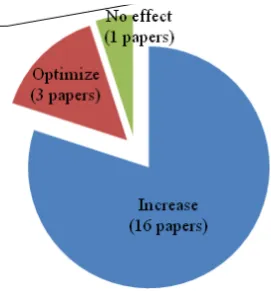
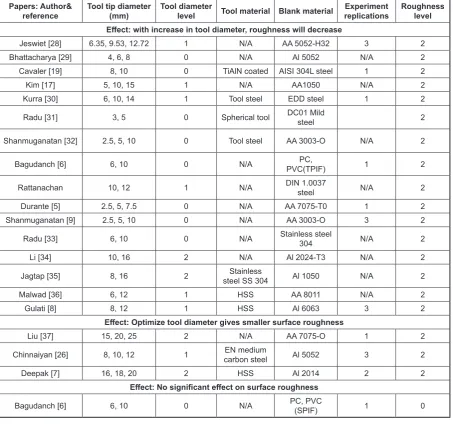
There were 20 journal papers were found in this survey paper that describe the effects of forming tool size on surface roughness. Most of the papers claimed that with increase in tool tip
diameter surface roughness decreased. 3 papers suggested that an optimized value of tool diam
-eter decreased surface roughness. Only one paper was seen that presented that forming tool size has insignificant effect on surface roughness. No pa
-per was seen that claimed that with decrease in tool size surface roughness decreased.
Table demonstrates the summery of each pa
-per, with extra information about sheet material, tool material and experiment replications.
Summery of papers is given in the Table 6. Shanmuganatan et al. tetsted various tool di
-ameter combined with step increment on AA 3003-O sheet and analyzed that with increasing the tool diameter surface roughness decreased [32].
Table 5. ANOVA for forming tool shapes
Model Sum of Squares dof Mean square F Sig.
Between groups .61 1 .61 6.73 .02 Within groups (error) 1.09 12 .09
Total 1.71 13
Significance level = α = .05
Fig. 3. Forming tool diameter journal papers
Analyze the results with the help of ANOVA in Table 7.
Factor significance Criteria:
• Factor will be Significant if P value < α
⇒ .03 < .05 (Condition satisfied)
• Hence, Null Hypothesis (Ho) should be re
-jected.
• Contribution = (2.616 / 4.526) ˟ 100 = 57.7 % It means that Alternate hypothesis (H1) should be accepted. Therefore, tool size has
significant effects in terms of surface quality. It was observed that for specific step increment, in
-crease in tool diameter, and ends between neigh
-bors cover overlaps. Forming tool with small tip
diameter focuses the strain at the area of
defor-mation on blank sheet while tools with larger tip
diameter tend to allocate strain rate over larger
area of deformation. Thus larger diameter tools have considerable effect in formation process and can enhance the surface quality and reduce
Table 6. Tool diameter papers summery
Papers: Author&
reference Tool tip diameter (mm) Tool diameter level Tool material Blank material replicationsExperiment Roughness level Effect: with increase in tool diameter, roughness will decrease
Jeswiet [28] 6.35, 9.53, 12.72 1 N/A AA 5052-H32 3 2 Bhattacharya [29] 4, 6, 8 0 N/A Al 5052 N/A 2 Cavaler [19] 8, 10 0 TiAlN coated AISI 304L steel 1 2 Kim [17] 5, 10, 15 1 N/A AA1050 N/A 2 Kurra [30] 6, 10, 14 1 Tool steel EDD steel 1 2
Radu [31] 3, 5 0 Spherical tool DC01 Mild steel 2
Shanmuganatan [32] 2.5, 5, 10 0 Tool steel AA 3003-O N/A 2
Bagudanch [6] 6, 10 0 N/A PVC(TPIF)PC, 1 2
Rattanachan 10, 12 1 N/A DIN 1.0037 steel N/A 2
Durante [5] 2.5, 5, 7.5 0 N/A AA 7075-T0 1 2 Shanmuganatan [9] 2.5, 5, 10 0 N/A AA 3003-O 3 2
Radu [33] 6, 10 0 N/A Stainless steel 304 N/A 2
Li [34] 10, 16 2 N/A Al 2024-T3 N/A 2
Jagtap [35] 8, 16 2 steel SS 304Stainless Al 1050 N/A 2
Malwad [36] 6, 12 1 HSS AA 8011 N/A 2 Gulati [8] 8, 12 1 HSS Al 6063 3 2
Effect: Optimize tool diameter gives smaller surface roughness
Liu [37] 15, 20, 25 2 N/A AA 7075-O 1 2
Chinnaiyan [26] 8, 10, 12 1 carbon steelEN medium Al 5052 3 2
Deepak [7] 16, 18, 20 2 HSS Al 2014 2 2
Effect: No significant effect on surface roughness
Bagudanch [6] 6, 10 0 N/A PC, PVC (SPIF) 1 0
Table 7. ANOVA for tool diameter
Model Sum of squares Dof Mean square F Sig.
Between groups 2.61 2 1.30 1.24 .03 Within groups (error) 1.91 16 .11
the forming time with increase in step incre
-ment without disturbing surface quality. It was observed that formability increases with smaller tool diameter. Strano et al. [38] suggested that material type and material thickness must be tak
-ing into account when choos-ing form-ing tool. Results about tool diameter and sheet thickness interaction were shown in interaction table of “tool size vs sheet thickness”.
Sheet material characteristics
Various materials have been utilized in in
-cremental sheet forming process that includes metals [39] polymer blanks [40] and others blank materials like sandwich panels [41] with high variety of surface finish. This survey does not investigate the surface finish of particular material; despite enlist them in tables for para
-metric analysis in order to show the compari
-son between different tests with same mate
-rial as an example aluminum alloy (AA 3003) or poly vinyl chloride (PVC). On the base of blank material type all others forming param
-eters are selected.
Sheet thickness is an essential process param
-eter and efficiently affects the incremental sheet forming process, particularly when the forming force is required to deform the blank sheet be
-cause with increase in sheet thickness, forming forced increased [42]. For shear forming, sheet thickness is also an important factor in sine law equation in which final sheet thickness can be find with the help of initial sheet thickness and have seen accurate formed parts in single pas [43]. Equation 1. given below as
tf = ti ˟ sin (90-φ) (1) Where: tf = final sheet thickness, ti = Initial sheet
thickness, φ = Wall angle.
The values of blank thickness are not essen
-tial in this survey paper because every material have different mechanical and chemical proper
-ties for example 1.5 mm sheet thickness of one material performs inversely to 1.5 mm thickness of an alternate material [39]. General influence of increasing or decreasing the sheet thickness on surface roughness has been examined.
Sheet thickness
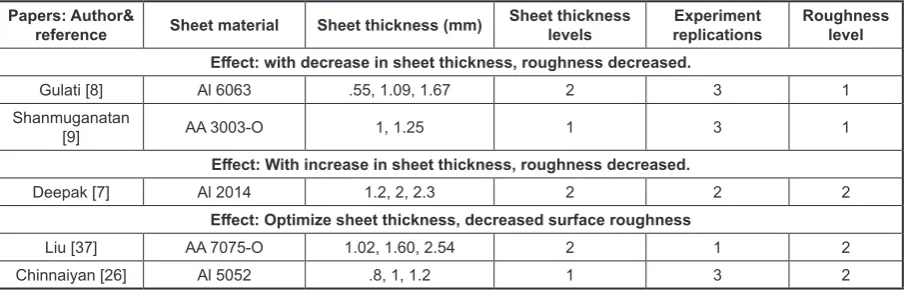
In this survey paper, few papers were seen that showed the effect of sheet thickness on surface roughness. Total 5 journal papers var
-ied sheet thickness to decide their impact on surface roughness. Only one papers showed that with increase in sheet thickness, surface roughness increased. 2 papers showed that with decease in sheet thickness, surface rough
-ness decreased. 2 papers suggested that an op
-timized sheet thickness improved surface fin
-ish. Summery of papers is given in the Table 8. Analyze the results with the help of ANOVA in Table 9.
Fig. 5. Sheet thickness papers
Table 8. Sheet thickness papers summery
Papers: Author&
reference Sheet material Sheet thickness (mm) Sheet thickness levels replicationsExperiment Roughness level Effect: with decrease in sheet thickness, roughness decreased.
Gulati [8] Al 6063 .55, 1.09, 1.67 2 3 1 Shanmuganatan
[9] AA 3003-O 1, 1.25 1 3 1
Effect: With increase in sheet thickness, roughness decreased.
Deepak [7] Al 2014 1.2, 2, 2.3 2 2 2
Effect: Optimize sheet thickness, decreased surface roughness
Factor significance Criteria:
• Factor will be Significant if P value < α
⇒ .68 > .05 (Condition not satisfied). • Hence, Null Hypothesis (Ho) should be ac
-cepted.
• Contribution = (.050 / .800) ˟ 100 = 6.25 %. It means that Alternate hypothesis (H1)
should be rejected. Therefore, sheet thickness has insignificant effect on surface roughness. From this survey it was observed that surface quality decreases as sheet thickness increases.
Deepak examined different sheet thickness of AL 2014 with two replications of each ex
-periment in order to get better results on surface quality. They analyzed that with increase in sheet thickness roughnss increased [7].
On the other side, Shanmuganatan et al. tested aluminim alloy (AA 3003-O) with different sheet thickness and investigated that with decrease in sheet thickness surface roughness decreased [9]. It might be due to that more forming force is required for thick sheets as compared to thin sheets in order to metal flow thus rough surface seen for thick sheets.
Step increment
In this survey paper, 27 differerent papres were seen that varied step increment in order to decide their effect on surface qulaity. Out of these, 19 of the papers presents that surface qual
-ity of material improved by decreasing the step down. 3 papers suggested that with increasing the step increment surface roughness decreased. 2 papers showed that an optimization of step incre
-ment decreased surface roughness. 3 papers pre
-sented that step down has insignificant effect on surface roughness. Summery of papers about step down is explained in Table 10.
Summery of papers is given in the Table 10. Analyze the results with the help of ANOVA shown Table 11.
Factor significance Criteria:
• Factor will be Significant if P value < α
⇒ .045 < .05 (Condition satisfied)
• Hence, Null Hypothesis (H0) should be re
-jected.
Table 9. ANOVA for sheet thickness
Model Sum of squares dof Mean square F Sig.
Between Groups .05 1 .05 .20 .68 Within Groups (error) .75 3 .25
Total .80 4
Fig. 6. Step increment papers
• Contribution = (4.935 / 13.181) ˟ 100 = 19.9 % = 37.4 %
It means that Alternate hypothesis (H1) should
be accepted. Therefore, step increment has sig
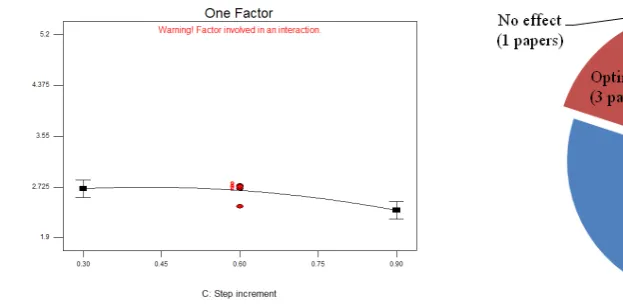
-nificant effect on roughness. Figure 7 shows the
effect of step increment on surface roughness. As, with increase in step increment surface roughness decreased. It might be important in some cases, to optimize surface roughness and forming process speed in which surface quality shoud be improved per milimeter, it would require to be evaluated. An optimized value of step increment in neces
-sary when tradeoff between surface quality and forming time is required.
Hagan tested different step increment for alu
-minum alloy (AA 3003) with one replication of each experiment. They found that with decrease in step increment surface roughness decreased [44]. Bhattacharya et al. [29] tested different step increment on aluminum (Al 5052). They exam
-ined that with increasing the step increment sur
-face roughness increased first up to certain value,
after this surface roughness decreased with
in-crease in step depth.
Assumptions related to the effect of step in
-crement on surface roughness were proposed by various papers in this survey. With decresing step down has been appeared to increase surface fin
-face quality and forming process speed in which surface quality should be improved per millime
-ter. For example, would require to be evaluated.
Feed Rate
In this survey paper, 18 journal papers have been found that showed the effect of feed rate on surface quality. Out of these, 6 journal papers
claimed that surface roughness would be decrased with decrease in feed rate. 4 papers found that with increase in feed rate, roughness decreased. 3 papers suggested that an optimized value of feed rate minimized the surface roughness. 5 papers claimd that feed rate has no impact on surface roughness. Summery of papers about feed rate is explained in Table 12.
Table 10. Step increment papers summery
Papers: Author&
reference Sheet material Step increment (mm) Step increment levels replicationsExperiment Roughness levels Effect: With decrease in step increment, roughness decreased
Hagan [44] Al 3003 .5, 1, 1.5 2 1 1 Bhattacharya [29] Al 5052 .2, .6, 1 2 N/A 1 Attanasio [45] Fe P04 steel .2, .5, 1 2 N/A 1 Desai [46] Al1200-H14 .2, .3, .4, .5, .6, .7, .8 1 3 1 Radu [31] DC01 Mild steel .05, .5 1 N/A 1 Patel [47] IS 19000 (Al alloy) .1, .2, .3 0 1
Bagudanch [6] PC,PVC(SPIF) .2, .5 1 2 1 Kurra [30] EDD steel .7, 1.1, 1.5 2 1 1
Gulati [8] Al 6063 .5, 1, 1.5 2 3
Radu [33] Stainless steel .05, .5 1 N/A 1 Khazaali [48] SS 304 1, 1.5, 2 2 N/A 1 Shanmuganatan
[32] AA 3003-O .2, .4, .6, .8 1 N/A 1 Uttarwar [49] Al 1100 .2, .5, 1 2 1 1 Mulay [50] AA 8011 .2, .5, .1 1 N/A 1 Durante [5] AA 7075-TO .2, .4, .6 1 N/A 1 Lu [51] Al 7075-O .1, .6, 1.1 2 N/A 1 Lasunon [52] AA 5052 .38, .76 1 N/A 1 Malwad [36] AA 8011 .2, .5 1 N/A 1 Jagtap [35] Al 1050 .5, 1 2 N/A 1
Effect: With increase in step increment, roughness decreased
Cavaler [19] AISI 304L steel .4, .6, .8 1 1 2 Rattanachan [53] DIN 1.0037 steel 1, 2 2 N/A 2 Bagudanch [6] PC, PVC(TPIF) .2, .5 1 2 2
Effect: No significant effect of step increment on roughness
Bermudez l [54] Al 1100-H0 .5, 1 2 3 0 Yazar [27] QD steel .2, .5, .8 1 3 0 Deepak [7] Al 2014 .3, .5, .75 1 2 0
Effect: Optimize step increment, will minimum surface roughness
Liu [37] AA 7075-O .2, .5, .8 1 1 2 Mugendiran [55] AA 5052 .25, .5, .75 1 1 2
Table 11. ANOVA for step increment
Model Sum of Squares Df Mean Square F Sig. Between Groups 4.93 2 2.46 3.401 .045 Within Groups(error) 8.24 16 .63
Summery of papers is given in the Table 12. Analyze the results with the help of ANOVA shown in Table 13.
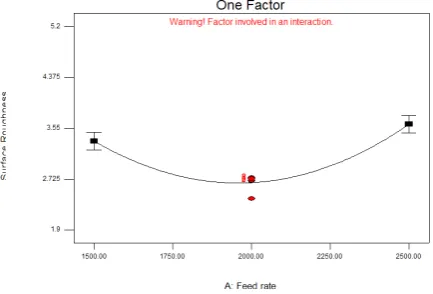
Fig. 7. Effect of step increment on surface roughness Fig. 8. Feed rate papers
Table 12. Feed rate papers summery
Papers: Author& reference Sheet material Feed rate (mm/min) Feed rate levels replicationsExperiment Surface roughness levels Effect: with decrease in feed rate, Surface roughness will decrease
Patel [47] IS 19000
(Al alloy) 1000, 1500, 2000 1 1 1 Mulay [50] AA 8011 500, 800, 1200 0 N/A 1
Rattanachan [53] DIN 1.0037 steel 3142, 3770 2 N/A 1
Chinnaiyan [26] AA 5052 300, 600, 900 0 3 1 Gulati [8] Al 6063 1000, 2000, 2500 2 3 1
Effect: with increase in feed rate, surface roughness will decrease
Silva [56] SAE 1008 steel 2160, 4800, 8400720, 1440, 1800, 1 1 2
Bermudez [54] Al 1100-H0 2000, 3500 2 3 2 Yazar [27] QD steel 900, 1200, 1500 1 3 2 Radu [33] Stainless 304 1500, 3000 2 N/A 2
Effect: Optimize feed rate for minimum surface roughness
Deepak [7] Al 2014 1500, 2000, 3000 2 2 2 Mugendiran [55] AA 5052 500, 650, 800 0 1 2 Kurra [30] EDD Steel 750, 1500, 2250 1 1 2
Effect: Feed rate has no significant effect on surface roughness
Liu [37] AA 7075-O 4000, 5000, 6000 2 1 0 Bagudanch [6] PC, PVC 1500, 3000 2 1 0 Uttarwar [49] Al 1100 500, 800, 1200 0 1 0 Shah [57] Al 1100 500, 800, 1200 0 1 0 Lasunon [52] AA 5052 317, 635, 1270 1 N/A 0
Table 13. ANOVA for feed rate
Model Sum of squares dof Mean square F Sig.
Between Groups .19 2 .09 .687 .52 Within Groups (error) 1.52 11 .13
Factor significance Criteria:
• Factor will be Significant if P value < α
⇒ .52 > .05 (Condition not satisfied)
• Hence, Null Hypothesis (H0) should be ac
-cepted.
• Contribution= (.190 / 1.714) ˟ 100 = 11 % It means that Alternate hypothesis (H1) should
be rejected. Therefore, feed rate has insignificant effect on surface roughness. Figure 8 shows the effect of feed rate on surface roughness. As, with
increase in feed rate surface roughness decreased
at some extent the surface roughness increased. Chinnaiyan investigated aluminum alloy (AA 5052) sheet metal under different feed rate 300, 600 and 900 mm/rev with 3 replications of each experimnet. They suggested that with decrease in feed rate surface roughnedd decreased. Moreover smaller feed rate inceased forming time [26].
Gulati tested alminum (Al 6063) blank mate
-rial at three different level of feed rate with three rpelictaion of each experiment using Design of experiment (DOE). They found that with decrease in feed rate surface roughness decreased [8].
Yazar performed experiments on quartz (QD) steel at different level of feed rate 900, 1200 and 1500 mm/rev with three replications of each experiment using orthogonal array. They suggested that with in
-crease in feed rate surface roughness de-creased [27]. It can be seen that impact of feed rate relies upon sheet material that formed in incremental sheet forming. Feed rates combined with step increment effects the forming time. However, for the trade off between surface roughness and forming time. Optimization would be required between these forming process parameters. Infor
-mation about the imapct of feed rates on various materials would be necessary for the improve
-ment of surface quality as feed rate deceased.
Spindle rotational speed
In this survay, 15 journals papers presented the impact of spindle speed on surface rough
-ness. Out of these, 5 papers claimed that sur
-face rughness decreased with increase in spindle speed. 3 papers suggested that with decrease in spindle speed surface roughness decreased. 4 pa
-pers represents that an optimized spindle speed would cause to decrease surface roughness. 3 pa
-pers suggested that rotational speed has no effect on surface roughness. Summery of papers about spindle rotational speed is explained in Table 14.
Summery of papers is given in the Table 14. Analyze the results with the help of ANOVA shown in Table 15.
Factor significance Criteria:
• Factor will be Significant if P value < α
⇒ .10 > .05 (Condition not satisfied)
• Hence, Null Hypothesis (Ho) should be ac
-cepted.
• Contribution = (1.571 / 6.0) ˟ 100 = 26 % It means that Alternate hypothesis (H1)
should be rejected. Therefore, spindle speed has insignificant effect on surface roughness. Figure 10 shows the effect of spindle speed on surface roughness. As, with increase in spindle speed surface roughness decreased. Desai tested alumi
-num (Al 1200-H14) sheet blank at constant feed and step increment and varying spindle rotation
-al speed and investigated their effect on surface roughness [46].
Bermudez et al. [54] developed design of experiments in order to investigate the effect of spindle rotation speed on surface roughness. They tested aluminum (Al 1100-H0) at 0 and 500 rev/ min with three replication of each of each experi
-ment. They found that spindle rotational sped in
fluence the surface roughness n both perpendicu
-lar and parallel direction. They suggested that with decrease in spindle speed surface roughness decreased.
In view of these results from 15 papers, it ap
-pears to be evident that with increasing the rota
-tional speed over 0 rpm will probably bring the improvement in surface quality. Two optimized paper [60] [61] upper limit will be discovered when contact between metal sheet and tool is too high and surface fracture began. These papers shows that there would be no example where sta
-tionary forming tool should be utilized. With the help ball end tool, minimum friction was seen. Rigid stationary forming tools are inconvenient to both surface finish and formability, shown in T. Hakutani et al. [61] and Xu et al. [62] and Du
-rante et al. [5].
Direction of Spindle rotation
Just two papers in this survey attempted re
-search utilizing conventional and vertical milling direction. Obikawa et al. [61] combined this view
Table 14. Spindle rotational speed papers summery
Papers: Author&
reference Sheet material Spindle speed (rpm)
Spindle speed levels
Experiment replications
Surface roughness
levels Effect: with decrease in Spindle speed, Surface roughness decreased
Hagan [44] Al 3003 500, 1000, 1500, 2000, 2500 1 1 1 Bermudez [54] Al 1100-H0 0, 1500 0 3 1 Rattanachan [58] DIN 1.0037 steel 100, 1000 0 N/A 1
Effect: with increase in spindle speed, Surface roughness decreased
Desai [46] Al1200-H14 500, 750, 1000, 1250 0 1 2
Radu [33] Stainless steel 304 500, 1000 0 N/A 2
Mulay [50] AA 8011 600, 800, 1000 0 N/A 2 Radu [31] DC01 Mild steel 500, 1000 0 N/A 2 Patel [47] IS 19000(Al alloy) 500, 1000, 1500 0 1 2
Effect: Significant effect of spindle speed on surface roughness
Petek [59] DC05 steel 0, 4000 1 3 2 Uttarwar [49] Al 1100 600, 800, 1000 0 1 2 Shah [57] Al 1100 600, 800, 1000 0 1 2
Effect: Optimize spindle speed to minimize roughness
Gulati [8] Al 6063 0, 250, 500 0 3 0 Chinnaiyan [26] Al 5052 300, 450, 600 0 3 0 Deepak [7] Al 2014 0, 100, 200 0 2 0 Mugendiran [55] AA 5052 1500, 2000, 2500 1 1 0
Table 15. ANOVA for spindle speed
Model Sum of squares dof Mean square F Sig.
Between Groups 1.57 1 1.57 3.19 .10 Within Groups (error) 4.42 9 .49
Total 6.00 10
point into their tests on alumimium foils. Spindle speed range of 0 to 25000 rpm was examined in both vertical and conventional milling directions, indicated by -25000 rpm to +25000 rpm. At high rotational speeds, there was small change change observed between these two rotational directions. Durante et al. [5] step by step formed the parts with rigid hemispherical tool rotationing in both directions clockwise and anti clock wise, and matched the reults of those rolling ball tool and stationary rigid tool. Spindle rotation direction have not significant impact on formability but have significant effect on forming forces and on surface quality. The rigid hemispherical tool cre
-ated an poorer surface quality as compred to the rolling ball tool. Solid hemispherical tool rotating at 600 rpm in rolling direction in order to produce miminal forming force.
The conclusion that was extract from the re
-sults of this portion and in the last section of spin
-dle speed is that for most of the materials forming tools should be revolved at high speeds in order to maximize the formability of forming parts and minimize surface roughness. All discussion con
-siderd that rotational direction of spindle will not effect the results of any importance. However climb will at present remain most widely recog
-nized milling mode as forming tools rolling on the forming sheet in order to minimize the rela
-tive friction. Furthermore, it could be claimed there would be no condition where tradational milling would be useful.
FACTORS INTERACTION EFFECT ON
SURFACE ROUGHNESS
The following portion in this survey demon
-strated the important factors interactions and dis
-cuss about their importance on response.
Spindle rotational speed and feed rate interaction
Spindle speed and feed rate play a significant role in friction between formed tool and sheet ac
-companying heat generated during incremental
sheet forming process. Two papers were seen that showed that the interaction between these two form
-ing process parameters, both papers utilized Poly
-mers in their experiments. Bermudez et al. [54] and Chinnaiyan et al. [26] demonstrated that idecreased roughness for specific interaction of spindle speed and feed rate, result the high interaction between these two parameters using Aluminium alloy.
Summery of papers is given in the Table 16. Bagudanch et al. [6] found no effect of speed and feed interaction on formability, however showed a critical results on surface quality. They utilized comparative feed rates such as 1500 mm/ min and 3000 mm/min and diverse values of spin
-dle speed free rotation mean 0 rpm and 2000 rpm. Free rotation of forming tool would have
Table 16. Spindle rotational speed and feed rate inter-action
Papers: Author& reference
Feed rate
(mm/min) speed (rpm)Spindle materialSheet Effect: Feed rate is regular, when spindle speed
in-creases, Roughness will be lower and vice versa
Pengtao [21] Constant 50, 150, 250, 350,…..,950 2A112
Mugendiran
[55] Constant 1500, 2000, 2500 AA 5052
Effect: spindle speed is regular, when feed rate de-creases, Roughness will be lower and vice versa
Pengtao [21] 300,…..,1000100, 200, Constant 2A112
Mugendiran
[55] 500, 650, 800 Constant AA 5052
Effect: Reducing feed rate and spindle speed will decrease surface roughness
Rattanachan
[53] 3142, 3770 100,200 1.0037 DIN
Optimize: Spindle speed and feed gives lower surface roughness
Bermudez
[54] 2000, 3500 0, 1500 Al 1100-H0 Chinnaiyan
[26] 300, 600, 900 300, 450, 600 Al 5052
Effect: No significant effect of feed and speed on surface roughness
Uttarwar [49] 500, 800, 1200 600, 800, 1000 Al 1100
Table 17. ANOVA for Spindle rotational speed and feed rate interaction
Model Sum of squares dof Mean square F Sig.
Between Groups .75 1 .75 2.40 .02 Within Groups (error) 1.25 4 .31
caused low spindle speed of 50 rpm to 160 rpm. Thus, it would be motivating to chek a central point spindle speed to look at with results comes from Le et al. [40].
Analyze the results with the help of ANOVA in Table 17.
Factor significance Criteria:
• Factor will be Significant if P value < α
⇒ .045 < .05 (Condition satisfied)
• Hence, Null Hypothesis (H0) should be re
-jected.
• Contribution= (.750 / .20) ˟ 100 = 37.5 % It means that Alternate hypothesis (H1) should
be accepted. Therefore, spindle speed and feed rate interactions have significant effect on rough
-ness. Figure 12 shows that spindle speed and feed rate interaction effects on surface roughness. As, spindle speed and feed rate increase surface
roughness decreased at some extent after this sur
-face roughness increased. There is an opportunity for understanding the impact of this interaction on materials others than polymers, in order to over
-come frictional condition. Furthermore, build up an upper and lower operating border of the rela
-tion of feed rate and spindle speed.
Tool diameter and sheet thickness interaction
In this section an interaction between form
-ing tool diameter and blank thickness discussed. There is an indication to demonstrate that inter
-action of tool tip diameter and sheet thickness plays an important role in surface roughness of any type of material, regardless whether part will form or not. A smaller tool tip diameter with a thick sheet can damage the surface, unless the part will become useless [63]. Table 18 illustrates extra data for the papers mention above in the table of tool size. In the table ratio min R/t * and max R/t * has no unit because tool radius and sheet thickness has same unit (mm). The differ
-ence between max R/t and min R/t is persented as range in the Table 18.
Summery of papers is given in the Table 18. Analyze the results with the help of ANOVA in Table 19.
Factor significance Criteria:
• Factor will be Significant if P value < α
⇒ .08 > .05 (Condition not satisfied)
• Hence, Null Hypothesis (H0) should be re
-jected.
• Contribution = (.097 / .897) ˟ 100 = 11 %
Fig. 12. Effect of spindle rotational speed and feed rate interaction on surface roughness
Table 18. Paper summery
Papers: Author&
reference min R/t * max R/t * Range Sheet material Sheet thickness (mm)
Effect: with increase in tool diameter, surface roughness will decrease
Cavaler et al. [19] 8 10 2 AISI 304L .5 Bagudanch et al.[6] 2 3.34 1.34 PC, PVC 1.5
Li [34] 5 8 3 Al 2024-T3 1 Shanmuganatan [32] 1 5 4 AA 3003-O 1, 1.25
Durante et al. [5] 2.5 7.5 5 AA 7075-T0 1 Shanmuganatan [9] 1 5 4 AA 3003-O 1, 1.25
Effect: with decrease in tool diameter, surface roughness will decrease
Gulati et al. [8] 2.39 10.90 8.51 Al 6063 .55, 1.09, 1.67
Effect: Optimize tool diameter will decrease surface roughness
Liu et al. [37] 2.95 12.25 9.30 AA 7075-O 1.02, 1.60, 2.54 Chinnaiyan et al. [26] 3.33 7.5 4.16 Al 5052 .8, 1, 1.2
It means that Alternate hypothesis (H1)
should be accepted. Therefore, Tool size and sheet thickness interaction has insignificant ef
-fect on surface roughness.Bagudanch et al. [64] conducted analysis of variance (ANOVA) with
full factorial and discovered that tha interaction
between tool diameter and sheet thickness was uneffected on formability however, have sig
-nificant effect on surface quality. Manco et al. [65] carried analysis of variance (ANOVA) and discovered that interaction being reffered to did not significantly affect the mimimum sheet metal thickness shown in tests.
It means that In order to understand this
in-teraction would permit the forming tool to be selected based on specific material and sheet metal thickness, in the situation where the last is product requirment. As Silva et al. [66] fo
-cus on that it is substantially more reasonable to change sheet thickness over a large range of forming tool size.
Sheet thickness and step down interaction
Bagudanch et al. [64] and Ham et al. [14] both surveyed sheet thickness and step down interaction with the help of analysis of variance (ANOVA) observed that this interaction has in
-significant effect on response.
A medium impact of sheet thickness and step increment was seen by Manco et al. [65] and Hus
-sain et al. [63] observed that this interaction has insgnificant effect on fracture modes examined in their paper.
Step down and sheet material thickness inter
-action effect is consequently not vast. So, more research would required to find in view of if there is an optimal choice of sheet thickness and step increment.
PARAMETERS COMPARISON ON
SURFACE ROUGHNESS
Bar graph shown below in Figure 8analyzes the total amount of papers that were found for ev
-ery process parameter in this survey paper. Step increment had highest number of papers, followed by tool tip diameter and feed rate. Few papers were found about spindle rotation speed, sheet thickness and forming tool types. There are some possible causes for limited research in this direc
-tion. The factors could have smaller to insignifi
-cant effect that was seen in case of spindle rotation direction, or it could be new research. As an ex
-ample, using different forming tools geometries. It could be due to deficiency of knowledge about the process parameters about in depth for example, forming tool types(using only rigid hemispherical
Table 19. ANOVA for Tool size and sheet thickness interaction
Model Sum of squares dof Mean square F Sig.
Between Groups .09 2 .04 .14 .08 Within Groups (error) .80 4 .20
Total .89 6
forming tool) or due to rotational speed of spindle( using non rotated forming tools only).
ISF PROCESS PARAMETERS IN SURVEY
This quantitative evaluation in this survey paper permitted an understanding about the ex
-perimental data written into these journal articles. Some papers from this survey did not specify, for example, many papers carried out that uses exper
-imental test replications that carried out material properties or value of spindle rotational speed. It is important to specify the whole exprimental as
-pects for forming process parameters like lubrica
-tion, missing from 25% of journal papers in this survey. Feed rate of 100 mm/min and 3000 mm/ min could have significantly various effects on re
-sponses due to heat produced during incremental sheet forming process.
The number of missed forming process pa
-rameters like lubrication, implied that full com
-parison between these paprameters is not possi
-ble. This requirment more attention of full broad
-ness of forming process parameters that have an impact on incremental sheet forming process, or on important results mention in the papers.
A framework for important experimental data is suggested in Table 20. For any fundamental in -cremental sheet forming research also consider-ing hot or electrically assisted incremental sheet
forming processes. All these parameters provide an important information about incremental sheet forming for researchers.
CONTRADICTORY RESULTS
In this survey it observed that forming pro
-cess parameters have inconsistent results. This delivers confirmation about the hypothesis of this survey work, especially that forming process fac
-tors are related, thus do not have stable effects during ISF process in all conditions.
Most important inconsistencies that observed while investigating the conclusions about the ef
-fect of forming tool diameter, instead of having large number of various journals articles that ex
-amined these forming parameters. The investiga
-tions demonstrate that various papers used differ
-ent forming tool sizes and furthermore focus on forming tool types and important interaction be
-tween tool tip diameter and blank material thick
-ness, also the interaction of tool diameter with step increment. Due to these reasons, number of papers was differing in their conclusions for form -ing tool diameter and form-ing tool geometries is
not common. It provides direction for future re
-searchers to consider the effect of interactions in forming process so that we can see more reliable conclusions about their collective impacts, and in this way set optimal choices in incremental sheet forming process.
DISCUSSION AND CONCLUSIONS
Based on extensive literature review, the aim of this paper is to foster deeper understanding re
-garding influence of incremental sheet forming tool geometries on surface roughness. Forming tool profiles and parametric interaction of various factors have received little academic attention. This study represents extensive understanding regarding the influence of forming tool profiles on surface finish ,assisting in selection of best forming tool for specific forming operation and forming requirements.
Forming tool geometries and shapes are con
-sidered as pivotal attritubets of incremental sheet forming process. Results obtained after employ
-ing analysis of variance (ANOVA) represent the significant effect of tool shapes on surface rough
-ness as hihglighted by its contribution of 36%. Parabolic shape forming tools seemed to emabrk an outstanding effects on minimizaing the surface roughness for sheet metal forming. The reason for this finding is justified due to large angle side supporting the blank sheet or smothering scallop from forming tool step down.
Table 20. Incremental sheet forming process param-eters framework
Sr. No ISF Parameters
In order to obtain desired forming charateris
-tics, it is recommended to form the part with flat end tool and then changing it to parabolic forming tool, leading to better surface finishing once sur
-face angle has been set up. Further reseach is es
-sentially required to analyze the effects which roll
-ing ball end tools might impart on suface finish.
Studies have investigated various factors
con-tributing to control the incremental sheet forming process in multiple experimentations form earlier stage of development [17]. An organized survey [13] was conducted to investigate the diversity among forming parameters and examined their effect on surface quality.
In this paper, information and results from various related papers were quantitatively rep
-resented including findings of sheet thickness, forming tool types, tool diameter, spindle rotation speed, feed rate and interactions between impor
-tant process parameters. The finding imply that there are some important forming process param -eters that are necessary to control each
incremen-tal sheet forming process including simple, hot or electric assisted forming process. Based on to this
we considered only these fundamentals forming
parameters and did not undertake parameters like temperature and current in this paper.
In incremental sheet forming (ISF) process most of the researchers used sheet thickness from .5 mm to 2 mm.The results from these investiga -tions demonstrated that with increasing or
decreas-ing of sheet thickness, surface quality improved. Optimization of sheet is important because with very large sheet thicknesses, outside form the range of values examined in majority of papers would start high challenge to form the parts with
very high forming force and due to this surface roughness increase as shown with aluminum alloy
(AA 3003-O) by Shanmuganatan et al. [32] and with aluminum alloy (AA 1100) having thickness 4 mm by Fang et al. [67]. This survey analyzed that influence of sheet thickness is reliable despite the effects of every sheet material may vary.
In incremental sheet forming (ISF) process most of the researchers used spindle speed in range of 100 rpm to 1000 rpm. Based on sheet material type, spindle speed and feed should be optimized, also with the requirement of forming process time trade off. As spindle speed and feed would increase, surface finish during forming process would decrease. Analysis of variance (ANOVA) results showed that both spindle speed and feed rate have insignificant effect on roughness. In in
-cremental sheet forming (ISF) feed rate can be selected above 1000 mm/min to 6000 mm/min. Spindle rotation speed commonly considered the main consideration of producing heat from friction between forming tool and sheet. If heating advan
-tages are required, then optimum setting of spindle speed is essential in order to stop forming surface damage as a result of friction between sheet and forming tool interface. It was found that forming time is independent of tool rotation speed. It was observed that at higher spindle speed, surface qual
-ity of formed parts increased. However it was ob
-served up to specific level, after this surface rough
-ness decreases and remained almost constant. In incremnetal sheet forming (ISF) most of the researchers used step increment from .2 mm to 1 mm.The conclusions from this survey expressed that surface finish improved with decreasing in step increment. . Analysis of variance (ANOVA) results analyzed that step increment has also sig
-nificant effect onsurface quality and has contribu
-tion up to 37%. If less forming process time is required in in sheet forming process then value of step increment should be optimized. This illus
-trates that material requirments should be consid
-ered in order to select this process parameter and it also demonstrates the significnace of catering to utilize the interactions of step increment with tool diameter and sheet thickness.
Few papers were found in this survey that discussed about process parameters interactions. There is a strong interaction between spindle speed and feed rate due to friction between form
-ing tool tip and blank sheet interface. Addition
-ally, this interaction also affects frictional heating that might be valueable or unfavourable to this process, depending upon others forming param
-eters like sheet material type. An important inter
-action between forming tool diameter and sheet thickness which can significantly effect the sur
-face roughness if the ratio between them is very large, investigated by Hussain et al. [63].
In conclusion of this survey paper, it has been observed that incremental sheet forming process parameters are not independent but are extreme
-ly interdependent.The results from this survey demonsterted that how important the selection of forming tool profile and others forming param
-eters that can bring optimal forming character
REFERENCES
1. Duflou, J., et al., Laser assisted incremental form-ing: formability and accuracy improvement. CIRP Annals-Manufacturing Technology, 2007. 56(1): p. 273-276.
2. Palumbo, G. and M. Brandizzi, Experimental in-vestigations on the single point incremental form-ing of a titanium alloy component combinform-ing static heating with high tool rotation speed. Materials & Design, 2012. 40: p. 43-51.
3. Adams, D. and J. Jeswiet, Single-point incremen-tal forming of 6061-T6 using electrically assisted forming methods. Proceedings of the Institution of Mechanical Engineers, Part B: Journal of En-gineering Manufacture, 2014. 228(7): p. 757-764. 4. Fan, G., et al., Electric hot incremental forming of
Ti-6Al-4V titanium sheet. The International Jour-nal of Advanced Manufacturing Technology, 2010. 49(9): p. 941-947.
5. Durante, M., A. Formisano, and A. Langella, Ob-servations on the influence of tool-sheet contact conditions on an incremental forming process. Journal of materials engineering and performance, 2011. 20(6): p. 941-946.
6. Bagudanch, I., M. Sabater, and M.L. Garcia-Romeu, Single Point versus Two Point Incremen-tal Forming of thermoplastic materials. Advances in Materials and Processing Technologies, 2017. 3(1): p. 135-144.
7. Deepak, S.S., COMPUTER AIDED MANUFAC-TURING FACTORS AFFECTING REDUCTION OF SURFACE ROUGHNESS AND THICKNESS IN INCREMENTAL SHEET FORMING PRO-CESS. COMPUTER, 2017. 4(07).
8. Gulati, V., et al., Process parameters optimization in single point incremental forming. Journal of The Institution of Engineers (India): Series C, 2016. 97(2): p. 185-193.
9. Shanmuganatan, S. and V. Senthil Kumar. An ex-perimental investigation on profile forming of an end cap using Al 3003 (O). in Advanced Materials Research. 2011. Trans Tech Publ.
10. Li, Y., et al., Simulation and experimental observa-tions of effect of different contact interfaces on the incremental sheet forming process. Materials and Manufacturing Processes, 2014. 29(2): p. 121-128. 11. Cawley, B., D. Adams, and J. Jeswiet, Examining
tool shapes in single point incremental forming. Proc NAMRI/SME, 2012. 26: p. 201-206.
12. Adams, D.W., Improvements on single point incre-mental forming through electrically assisted form-ing, contact area prediction and tool development. 2014: Queen’s University (Canada).
13. Pickering, C. and J. Byrne, The benefits of
publish-ing systematic quantitative literature reviews for PhD candidates and other early-career researchers. Higher Education Research & Development, 2014. 33(3): p. 534-548.
14. Ham, M. and J. Jeswiet, Single point incremen-tal forming and the forming criteria for AA3003. CIRP Annals-Manufacturing Technology, 2006. 55(1): p. 241-244.
15. Ham, M. and J. Jeswiet, Forming limit curves in sin-gle point incremental forming. CIRP Annals-Manu-facturing Technology, 2007. 56(1): p. 277-280. 16. Shim, M.-S. and J.-J. Park, The formability of
aluminum sheet in incremental forming. Jour-nal of Materials Processing Technology, 2001. 113(1): p. 654-658.
17. Kim, Y. and J. Park, Effect of process parameters on formability in incremental forming of sheet metal. Journal of materials processing technology, 2002. 130: p. 42-46.
18. Petek, A., et al., Comparison of alternative ap-proaches of single point incremental forming pro-cesses. Journal of materials processing technology, 2009. 209(4): p. 1810-1815.
19. Cavaler, L., et al., Surface roughness in the incre-mental forming of AISI 304L stainless steel sheets. J. Mechan. Eng. Phys, 2010. 1(2): p. 87-98. 20. Prashant, M., et al., Single Point Incremental Sheet
Forming By CNC Vertical Milling Machine. Imperi-al JournImperi-al of Interdisciplinary Research, 2016. 2(11). 21. Pengtao, S., et al., Research on the Influencing
Factors of” Scale Veins” of Single Point Incremen-tal Forming Workpieces Surface. Open Mechanical Engineering Journal, 2015. 9: p. 1025-1032. 22. Khare, U. and M. Pandagale, A review of
funda-mentals and advancement in incremental sheet metal forming. IOSR Journal of Mechanical and Civil Engineering, 2014: p. 42-46.
23. Ziran, X., et al., The performance of flat end and hemi-spherical end tools in single-point incremental form-ing. The International Journal of Advanced Manufac-turing Technology, 2010. 46(9): p. 1113-1118. 24. Lu, B., et al., Mechanism investigation of
friction-related effects in single point incremental forming using a developed oblique roller-ball tool. Interna-tional Journal of Machine Tools and Manufacture, 2014. 85: p. 14-29.
25. Ham, M., B. Powers, and J. Loiselle. Surface to-pography from single point incremental forming using an acetal tool. in Key Engineering Materials. 2013. Trans Tech Publ.
engineer-ing and manufacturengineer-ing, 2014. 15(11): p. 2309-2316. 27. Yazar, K., P. Date, and K. Narasimhan, Experimen-tal studies on single point incremenExperimen-tal forming of metallic sheets.
28. Jeswiet, J., et al., Single point and asymmetric in-cremental forming. Advances in Manufacturing, 2015. 3(4): p. 253-262.
29. Bhattacharya, A., et al., Formability and surface finish studies in single point incremental forming. Journal of manufacturing science and engineering, 2011. 133(6): p. 061020.
30. Kurra, S. and S. Regalla, Multi-objective optimi-sation of single point incremental sheet forming using Taguchi-based grey relational analysis. In-ternational Journal of Materials Engineering Inno-vation, 2015. 6(1): p. 74-90.
31. Radu, C., Effects of Process Parameters on the Quality of Parts Processed by Single Point In-cremental Forming. Int. J. Mod. Manuf. Technol, 2011. 3(2): p. 91-96.
32. Shanmuganatan, S. and V.S. Kumar, Metallurgical analysis and finite element modelling for thinning characteristics of profile forming on circular cup. Materials & Design, 2013. 44: p. 208-215.
33. Radu, C., et al., The effect of residual stresses on the accuracy of parts processed by SPIF. Materials and Manufacturing Processes, 2013. 28(5): p. 572-576. 34. Li, X., et al. Single-point incremental forming of
2024-T3 aluminum alloy sheets. in AIP Confer-ence Proceedings. 2013. AIP.
35. Jagtap, R., et al., An experimental study on the influence of tool path, tool diameter and pitch in single point incremental forming (SPIF). Advances in Materials and Processing Technologies, 2015. 1(3-4): p. 465-473.
36. Malwad, D. and V. Nandedkar, Deformation mech-anism analysis of single point incremental sheet metal forming. Procedia Materials Science, 2014. 6: p. 1505-1510.
37. Liu, Z., et al., Modeling and optimization of sur-face roughness in incremental sheet forming using a multi-objective function. Materials and Manufac-turing Processes, 2014. 29(7): p. 808-818.
38. Strano, M., Technological representation of form-ing limits for negative incremental formform-ing of thin aluminum sheets. Journal of manufacturing pro-cesses, 2005. 7(2): p. 122-129.
39. Jeswiet, J., et al., Asymmetric single point incre-mental forming of sheet metal. CIRP Annals-Man-ufacturing Technology, 2005. 54(2): p. 88-114. 40. Le, V., A. Ghiotti, and G. Lucchetta, Preliminary
studies on single point incremental forming for thermoplastic materials. International Journal of Material Forming, 2008. 1: p. 1179-1182.
41. Jackson, K., J. Allwood, and M. Landert, Incre-mental forming of sandwich panels. Journal of Materials Processing Technology, 2008. 204(1): p. 290-303.
42. Arfa, H., R. Bahloul, and H. BelHadjSalah, Finite element modelling and experimental investigation of single point incremental forming process of alu-minum sheets: influence of process parameters on punch force monitoring and on mechanical and geometrical quality of parts. International journal of material forming, 2013. 6(4): p. 483-510. 43. Jeswiet, J., E. Hagan, and A. Szekeres, Forming
parameters for incremental forming of aluminium alloy sheet metal. Proceedings of the Institution of Mechanical Engineers, Part B: Journal of Engineer-ing Manufacture, 2002. 216(10): p. 1367-1371. 44. Hagan, E. and J. Jeswiet, Analysis of surface roughness
for parts formed by computer numerical controlled in-cremental forming. Proceedings of the Institution of Mechanical Engineers, Part B: Journal of Engineering Manufacture, 2004. 218(10): p. 1307-1312.
45. Attanasio, A., E. Ceretti, and C. Giardini, Optimi-zation of tool path in two points incremental form-ing. Journal of Materials Processing Technology, 2006. 177(1): p. 409-412.
46. Desai, B.V., K.P. Desai, and H.K. Raval, Die-Less rapid prototyping process: Parametric investigations. Procedia Materials Science, 2014. 6: p. 666-673. 47. Patel, J.R., et al., Analysis of Variance for Surface
Roughness Produced During Single Point Incre-mental Forming Process. Analysis, 2015. 2(3). 48. Khazaali, H., Determining frustum depth of 304
stainless steel plates with various diameters and thicknesses by incremental forming. Journal of Mechanical Science and Technology, 2014. 28(8): p. 3273-3278.
49. Uttarwar, P., S. Raini, and D. Malwad, Optimiza-tion of process parameter on Surface Roughness (Ra) and Wall Thickness on SPIF using Taguchi method. International Research Journal of Engi-neering and Technology, 2015.
50. Mulay, A.S. and R. Navthar, Experimental and nu-merical studies on single point incremental form-ing of commercial aluminum alloy.
51. Lu, H., et al., Study on step depth for part accu-racy improvement in incremental sheet forming process. Advanced Materials Research, 2014(939). 52. Lasunon, O.U. Surface roughness in incremental
sheet metal forming of AA5052. in Advanced Ma-terials Research. 2013. Trans Tech Publ.