Doctor of Psychology (PsyD) Theses and Dissertations
2-1-2016
From Patient to Student Activation: Development
of the Student Activation Measure
Clinton J. Smith
This research is a product of the Doctor of Psychology (PsyD) program at George Fox University.Find out moreabout the program.
This Dissertation is brought to you for free and open access by the Theses and Dissertations at Digital Commons @ George Fox University. It has been accepted for inclusion in Doctor of Psychology (PsyD) by an authorized administrator of Digital Commons @ George Fox University. For more information, please [email protected].
Recommended Citation
Smith, Clinton J., "From Patient to Student Activation: Development of the Student Activation Measure" (2016).Doctor of Psychology (PsyD). 219.
From Patient to Student Activation: Development of the Student Activation Measure
by
Clinton J. Smith
Presented to the Faculty of the
Graduate Department of Clinical Psychology
George Fox University
in partial fulfillment
of the requirements for the degree of
Doctor of Psychology
in Clinical Psychology
Newberg, Oregon
From Patient to Student Activation: Development of the Student Activation Measure
Clinton J. Smith
Graduate Department of Clinical Psychology
George Fox University
Newberg, Oregon
Abstract
The Patient Activation Measure (PAM) was constructed to measure a person’s
knowledge, skill, and confidence for self-managing one’s healthcare, or “activation” (Hibbard,
Stockard, Mahoney, & Tusler, 2004). The Student Activation Measure (SAM) extends this
definition to secondary education. The SAM is a short, positively worded measure that is
intended to guide intervention planning. Six hundred three students from two disparate high
schools located in the Pacific Northwest completed the measure and an accompanying
demographic questionnaire. The respective schools provided the students’ GPAs and attendance
records. Using Rasch modeling, the SAM evidenced excellent reliability and construct validity.
One-way ANOVAs with post hoc Scheffe’s tests showed that higher SAM scores had
significantly higher GPAs, fewer absences, increased time spent on homework, and less time
spent on social media or playing video games. Overall, the SAM showed promise as both a
research and intervention tool. In addition, the concept of activation has the added benefits of
secondary education. Further research is needed to understand the properties of the SAM when
Table of Contents
Approval Page ... ii
Abstract ... iii
List of Tables ... vii
Chapter 1: Introduction ...1
Self-Efficacy and Education ...2
Student Engagement in Education ...3
Self-Regulated Learning ...5
Self-Regulated Learning and Patient Activation ...7
Chapter 2 Methods ...11
Participants ...11
Procedure ...11
Instruments ...12
Student activation measure ...12
Demographic questionnaire ...12
Analyses ...12
Chapter 3 Results ...14
Rasch Item Analysis ...14
Reliability ...16
Validity ...16
Chapter 4 Discussion ...21
Limitations ...24
Conclusion ...24
References ...26
List of Tables
Table 1 SAM Response Categories ...14
Table 2 SAM items ordered by difficulty ...15
Table 3 Resulting SAM items values following item deletion ...17
Table 4 SAM score groupings ...17
Table 5 Academic measures in relation to SAM group scores for all students ...18
Table 6 Academic measures in relation to SAM group scores for low SES school ...19
Chapter 1
Introduction
There is an ongoing call to improve the status of education in America. With over
700,000 high school dropouts per year, the U.S. lags behind other industrialized countries in
every major objective measurement of educational quality (Levin, Belfield, Muennig, & Rouse,
2007; Organisation for Economic Cooperation and Development [OECD], 2013). In addition, the
U.S. has not made any significant progress in closing the education gap between itself and other
industrialized countries since making it a priority (OECD, 2013). These results were startling
enough for the Secretary of the U.S. Department of Education to declare that the U.S. education
system was in a “state of crisis” (Chuck, 2013).
There are clear economic consequences to students dropping out of high school. High
school dropouts tend to require more government spending and will earn approximately
$206,000 less than their counterparts who graduate (Levin et al., 2007). If high school dropouts
were reduced by 50%, America would gain approximately $45 billion in tax revenues and
reduced public spending. Because of this, the benefits to society of funding interventions aimed
at reducing high school dropouts are 212 times greater than the cost of the interventions
themselves (Levin et al., 2007).
Psychologists have been involved with the education system for over 100 years and have
contributed thousands of articles aimed at improving the academic outcomes of students
testing, implemented group learning, and rethought the learning process. In the last 20 years, the
focus has shifted to an emphasis on the individual characteristics of the learner (Fredricks,
Blumenfeld, & Paris, 2004; Zimmerman, 2000).
Self-Efficacy and Education
Self-efficacy has been a particularly promising construct for educational research.
Bandura’s definition of self-efficacy continues to be the most commonly accepted and utilized
among researchers; he defined self-efficacy as “the belief in one’s capabilities to organize and
execute courses of action required to produce given attainments” (Bandura, 1997, p. 3; Chemers,
Hu, & Garcia, 2001). Self-efficacy has proven to be an effective way of predicting academic
outcomes and has the added value of being a construct that is conceptually and psychometrically
different from other self-oriented constructs such as self-beliefs and perceived outcomes
(Multon, Brown, & Lent, 1991; Zimmerman, Bandura, & Martinez-Pons, 1992). Self-efficacy
models are more effective and consistent in predicting student’s academic performance than
other variables such as personality traits and demographic variables (Multon et al., 1991;
Richardson et al., 2012; Schunk, 1988; Zimmerman et al., 1992).
Self-efficacy is particularly useful in an educational setting in that it tends to operate in a
feedback loop with performance evaluations provided by educators (Multon et al., 1991; Schunk,
1988). Because of this, students with high self-efficacy tend to persist longer on challenging
tasks, approach hard tasks with more optimism, overcome stress associated with academic rigor,
and are more committed to staying in school (Chemers et al., 2001; Zajacova, Lynch, &
Espenshade, 2005). Impressively, self-efficacy can explain between 14-25% of the variance in
A learning strategy that has received particular attention has been students’ utilization
and acquisition of study skills. Study skills are an important part of a successful academic
learning strategy and have also shown to be an effective way to improve the academic
performance of students (Credé & Kuncel, 2008; Hassanbeigi et al., 2011; Robbins et al., 2004).
However, the relationship between study skills and academic success is not as strong as
academic self-efficacy and academic success (Robbins et al., 2004). This discrepancy could be
due to difficulties in measuring study skills, but it seems that study skills and academic
self-efficacy are related constructs (Credé & Kuncel, 2008; Robbins et al., 2004; Zimmerman, 2000).
Student Engagement in Education
Another line of research has focused on student engagement as a predictor of academic
outcomes. In the early stages of its conceptualization, student engagement was meant to help
educators understand and combat student boredom and reduce dropouts (Christenson, Reschly,
& Wylie, 2012). An early definition was “the student’s psychological investment in and effort
directed toward learning, understanding, or mastering the knowledge, skills, or craft that
academic work is intended to promote” (Newmann, 1992, p. 12). While student engagement
lacks the sheer number of studies that self-efficacy has gained, it does offer other advantages.
One such advantage is that engagement can be separated into three components: behavioral,
cognitive, and emotional (Fredricks et al., 2004).
Behavioral engagement draws on the idea of participation; it includes involvement in
academic and social or extracurricular activities and is considered crucial for achieving
positive academic outcomes and preventing dropping out. Emotional engagement
school and is presumed to create ties to an institution and influence willingness to do the
work. Finally, cognitive engagement draws on the idea of investment; it incorporates
thoughtfulness and willingness to exert the effort necessary to comprehend complex ideas
and master difficult skills. (Fredricks et al., 2004, p. 60)
By separating these components, it is possible to develop a multifaceted conceptualization of a
student’s learning process. As is true of many constructs in psychology and education, scholars
are not in full agreement about the components of student engagement. Another model of
engagement includes four components of engagement: academic, social, cognitive, and affective.
Other definitions include an academic domain in addition to the cognitive, affective, and
behavioral domains previously listed (Shui-fong Lam et al., 2014). As of yet, there is no agreed
upon definition of engagement, and the term is often used by researchers to describe varying
constructs (Reschly & Christenson, 2012). Even amidst problems defining the concept, several
studies have found engagement to be related to positive outcomes for students, including better
grades, higher test scores, better attendance, lower chance of dropping out, higher chance of
graduating, more academic resilience, and less chance of engaging in risky behaviors (as found
in Skinner, Furrer, Marchand, & Kindermann, 2008).
Using Frederick and colleague’s definition, Skinner and colleagues attempted to gain
understanding of the internal dynamics of behavioral and emotional engagement. Their findings
indicated that emotional components of engagement significantly influenced behavioral
components but the relationship was not reciprocal (Skinner et al., 2008). Skinner, Kindermann,
and Furrer (2009) hypothesized that engagement exists along a continuum ranging from
This emphasis on disaffection is rare among other studies of engagement but is closer to the
original work done by Newmann (1992). A student that is behaviorally, affectively, and
cognitively engaged with their studies attends class regularly, feels comfortable in the classroom,
and has developed a plan to meet the goals necessary for academic success. A disaffected student
is often tardy or misses class, feels like there is little to gain from school, and has little interest in
creating strategies to meet academic requirements.
Cognitive engagement has received less attention than other facets of student engagement
(Fredricks et al., 2004). Studies have shown it to be positively correlated to teacher support and
to play an important role in the learning process (Fredricks, Blumenfeld, Friedel, & Paris, 2002).
Deep Cognitive Processing is a term commonly associated with cognitive engagement
(Shui-fong Lam et al., 2014; Wolters, Yu, & Pintrich, 1996). This depth of processing approach allows
for the concept of cognitive engagement to be differentiated from other constructs and means
that students should have better understanding and retention of important material (Shui-fong
Lam et al., 2014).
Self-Regulated Learning
Self-regulated learning is a construct that has repeatedly been connected with both
self-efficacy and engagement. Similar to both of those constructs, self-regulated learning has been
linked to positive academic outcomes (Boekaerts, Pintrich, & Zeidner, 2005; Lavasani,
Mirhosseini, Hejazi, & Davoodi, 2011; Mega, Ronconi, & De Beni, 2014). Self-regulated
students are “metacognitively, motivationally, or behaviorally active promoters of their academic
achievement” (Zimmerman & Martinez-Pons, 1990). Self-regulated learners take ownership of
Self-regulated learning has been shown to have a mediating effect on a student’s experience of
emotions related to challenges in the academic environment. This helps to explain why a student
can have positive feelings toward school but not be academically successful (Mega et al., 2014).
Self-efficacy has been shown to increase after students completed an intervention focused
on self-regulation learning skills (Lavasani et al., 2011). Zimmerman (2000) hypothesized that
the underlying force behind a student utilizing a particular learning strategy may best be
accounted for by self-efficacy. Some scholars have attempted to conceptualize self-regulated
learning using terminology from the student engagement literature. For instance, one writer
hypothesized that self-regulated learning falls under the umbrella of cognitive engagement while
student attitudes and on-task behavior likely are associated with emotional and behavioral
engagement, respectively (Fredricks et al., 2004). However, another group of scholars disputed
the inclusion of self-regulated learning into the cognitive domain of engagement and pointed out
that self-regulated learning has components of the behavioral domain as well (Shui-fong Lam et
al., 2014). Regardless, regulated learning appears to be closely related to a student’s
self-efficacy and engagement.
Research on self-regulated learning faces similar challenges to student engagement. The
last two decades has brought increased fragmentation of research and has resulted in a large
number of new models, theoretical orientations, and vocabulary being used to describe the
phenomenon of self-regulated learning (for a full review, see Boekaerts et al., 2005). Pintrich
(2004) argues that all models share four phases: (a) forethought, planning and activation; (b)
monitoring; (c) control; (d) and reaction and reflection. However, these phases are not always
argued that each of these phases is ongoing and have to be modified based on the task at hand.
As research has grown, interventions and measures have emerged that allow researchers to refine
their approach to and target the domains of self-regulated learning (Lavasani et al., 2011;
Pintrich, 2004).
Self-Regulated Learning and Patient Activation
Self-regulated learners share many similarities to “activated” patients in the healthcare
literature. A primary goal of healthcare is to provide efficacious, cost-effective care for
individuals who suffer from a chronic illness. In the last decade, this focus has turned to a
patient-centered approach called “patient activation.” An “activated” patient believes that they
have an important role to play in managing their care, collaborating with providers, and
maintaining their health. They have the knowledge necessary to manage their condition, maintain
functioning, and prevent health declines. Activated patients are able to convert their knowledge
and beliefs into skills and a behavioral repertoire that can be used to manage their condition,
collaborate with health providers, maintain their functioning, and access appropriate and
high-quality care (Hibbard, Stockard, Mahoney, & Tusler, 2004). This is similar to the cognitive and
behavioral patterns of self-regulated learners. Activated patients engage in their treatment and
believe that they have the ability to complete the tasks required to improve their health, while a
self-regulated learner engages with the challenges of academia and believes in their ability to
meet those challenges. By bringing the concept of activation into the educational literature, it
will help to bridge the gap between two research bases that have traditionally had little overlap
The Patient Activation Measure (PAM) was constructed to measure a person’s
knowledge, skill, and confidence for self-managing one’s healthcare, or “activation” (Hibbard et
al., 2004). The PAM has repeatedly been shown to be a highly reliable and valid instrument
(Fowles et al., 2009; Hibbard et al., 2004; Skolasky, Mackenzie, Riley, & Wegener, 2009).
Additional studies have shown that high scores on the PAM are related to better health outcomes
for a variety of illnesses: HIV, diabetes, and heart failure (Marshall et al., 2013; Remmers et al.,
2009; Shively et al., 2013). Conversely, low scores on the PAM were related to higher individual
health care costs (Hibbard, Greene, & Overton, 2013). Hibbard et al. (2013) were able to
condense the original 22-item PAM into a shorter, 13-item version while maintaining its
psychometric integrity (Hibbard, Mahoney, Stockard, & Tusler, 2005). In recent years, the PAM
has been adapted for use in the fields of mental health and higher education; both versions have
respectable psychometric properties and were predictive of successful outcomes in their
respective fields (Green et al., 2010; Kinder, 2008).
Hibbard and colleagues were able to construct a multilevel, developmental approach to
measuring activation by using Rasch analysis to create the PAM. Using a PAM score, an
individualized treatment plan can be developed that focuses on improving the patient’s activation
(Hibbard et al., 2004).
Kinder (2008) adapted the PAM for use with nursing students in a higher education
setting. Her version of the PAM was titled the Student Activation Measure (SAM) but was not
designed to have application outside of nursing students. One of her primary goals in creating the
SAM was to help nursing programs improve the academic success of their students and facilitate
(NCLEX-RN). As part of her study, she defined student activation as “a level of engagement in
learning and self-management that a student has in reaching his or her academic goal” and
created a model of student activation to conceptualize the factors underlying activation (Kinder,
2008, p. 50). As hypothesized, her measure was significantly, positively correlated with
participants’ feelings of mastery, cognitive adaptation, resilience, hardiness, self-esteem, and
patient activation. She also hypothesized that student activation would be significantly,
negatively correlated with psychological vulnerability, which was supported by the results. Each
of these constructs has been shown by previous research to be related to a student’s academic
success (Kinder, 2008). Her research produced a reliable, valid instrument for identifying
nursing students who were at risk for failure; however, it lacked applicability to students in other
settings. An additional limitation of the study was that it relied on classical testing theory rather
than Rasch modeling, a method similar to item response theory. To date, no other researcher has
attempted to modify the PAM for use in an academic setting.
In 2011, Michael Fulop and Antonia Forster obtained a research license from Insignia
Health to modify the PAM for use in secondary education settings. Their goal was to create a
short, positively worded measure that would be useful in the guiding and monitoring the
intervention efforts of professionals whom worked with struggling students. An activated student
was defined as a student who has the knowledge, skills, and confidence to self-manage their
education. This definition is the organizing principle of the SAM items. The measure has been
given on an informal basis to a clinical sample of high school and junior high students in order to
begin to determine its feasibility. In early usage, the SAM has yielded information that appears
new items that were created in collaboration with Judith Hibbard in order to insure fidelity with
the construction of activation.
In order for the instrument to be useful when working with students of different ages, I
will be using Rasch analysis to explore if items operate differently for students in various
settings and levels of academia. This insures that items will be sample independent and allows us
to confidently convert the scores obtained from ordinal items into interval-level data.
Additionally, I will examine the SAM’s reliability, criterion validity, and construct validity.
Examining the items fit with the Rasch model will establish the reliability and construct validity
of the instrument. Rasch is a useful tool in establishing construct validity because “items that fit
are likely to be measuring the single dimension intended by the construct theory (Baghaei, 2008,
p. 1146).” Criterion validity, specifically predictive validity, will be assessed through examining
Chapter 2
Methods
Participants
A total of 603 students (330 males, 262 females, and 11 other gender) from two high
schools located in the Pacific Northwest completed the measure. The high schools offered
contrasting levels of academic success and socioeconomic status. Three hundred and ten
participants (51.4%) were freshmen in a mostly upper class, private high school with a history of
academic success. The remaining 293 participants (48.5%) were high school students at various
grade levels from a school that had not met state academic expectations in the two previous
years. Participants’ ages ranged from 14 to 19 years of age (M = 15.52, SD = 1.17) and were
predominantly freshmen (66.8%) followed by juniors (12.6%), seniors (9.4%), sophomores
(9.9%), and unspecified (1.1%). Students identified as, in descending order, European heritage
(66.1%), Asian American (8.9%), Unspecified (8.1%), Bicultural (5.9%), Hispanic/ Latino
(5.4%), African American (2.4%), Native American (1.6%), Pacific Islander (.8%), and Arabic
American (.3%),
Procedure
Both schools notified parents of their student’s participation through an advance mailing.
The packet included a fact sheet regarding the measure and gave them the opportunity to request
student assent, students completed the SAM and demographic questionnaire using either an iPad
or paper and pencil. Schools provided student’s concurrent grade point average and attendance.
We evaluated the items using Rasch analysis to determine which items scaled, and
whether it was possible to create a unidimensional measure. Afterwards, we provided the high
school administrations with the data pertaining to their students and debriefed the results. All
data was stored in an encrypted database or in a double locked location.
Instruments
Student activation measure. The SAM is a modified version of the PAM that is
intended for use with students in a secondary education setting. Its items are positively worded
and designed to lead directly into academic interventions. The underlying principles of activation
were used to guide item construction. An activated student was defined as a student who has the
knowledge, skills, and confidence to self-manage their education. The initial version of the
measure included 20 items.
Demographic questionnaire. The demographic questionnaires included age, ethnicity
grade level, birthdate, student identification number, father’s occupation, father’s highest level of
education, mother’s occupation, mother’s highest level of education, and gender. We used the
occupational and educational data as a rough estimate of socioeconomic status. Students also
self-reported total homework time and productive homework time.
Analyses
Rasch analysis provides a mathematical basis for the creation of interval-level,
unidimensional, probabilistic Guttman-like scales from ordinal data (Hibbard et al., 2004;
ordered based on the amount of the trait necessary to increase the probability of agreeing with
the item. This is termed item “difficulty.” Item difficulties reflect how “hard or easy” it is for an
individual to endorse an item (Boone et al., 2014). Once item difficulties have been calibrated, a
developmental model of activation can be created (Bond, 2007; Hibbard et al., 2004). The
concept of item difficulty is central to the creation of Guttman-like scales where agreement with
an item signals an increased probability that an individual will endorse the preceding items in a
similar manner.
Unidimensionality can be evaluated by measuring the fit characteristics of each item.
Infit and outfit are chi-square statistics that are used to describe how well the data fit the Rasch
model (Boone et al., 2014). Outfit is sensitive to item responses on items that are at extremes in
terms of the difficulty of the item. An example of this could be a set of items on a math test that
are susceptible to guessing. Infit is sensitive to responses on items that are similar to an item’s
difficulty level. Fit values of 1.0 indicate a perfect fit with the model’s expectations. A value of >
1.0 is indicative of more stochastic variability than was predicted by the model. Fit values of <
1.0 indicate that persons do not vary as much as the model predicted. Previous studies have
utilized cutoffs of .5 and 1.5 to evaluate the acceptability of item fit (Hibbard et al., 2004; Smith,
Chapter 3
Results
Rasch Item Analysis
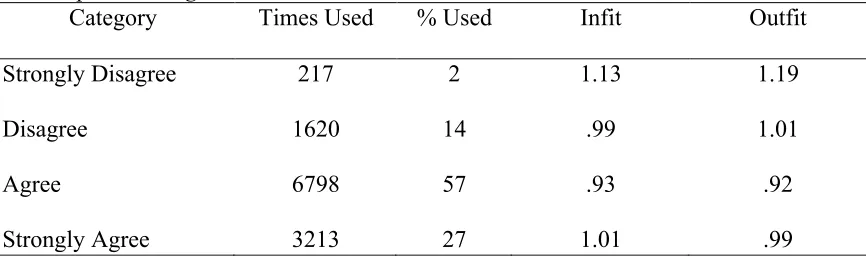
Initial analysis supported the 4 choice response category structure of each item (Table 1).
Table 1
SAM Response Categories
Notes. Infit and outfit values of 1.0 indicate a perfect fit with model expectations. Values ranging from .7 to 1.5 signify an acceptable amount of variability in responses.
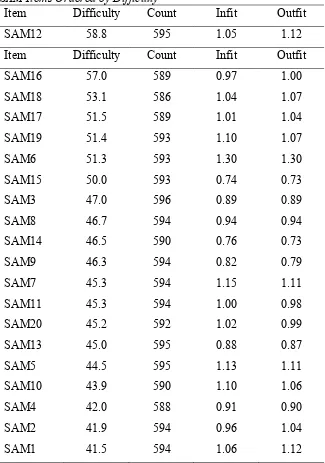
Item difficulty refers to the amount of activation required for a person to endorse a particular
item. Rasch analysis utilizes the logit as a measure of item difficulty. The logit scale is presented
in an easily interpretable 0-100 scale where zero is the lowest possible scale location and 100 is
the highest possible location. Table 2 shows the items ordered by difficulty.
Category Times Used % Used Infit Outfit
Strongly Disagree 217 2 1.13 1.19
Disagree 1620 14 .99 1.01
Agree 6798 57 .93 .92
Table 2
SAM Items Ordered by Difficulty
Item Difficulty Count Infit Outfit SAM12 58.8 595 1.05 1.12 Item Difficulty Count Infit Outfit SAM16 57.0 589 0.97 1.00 SAM18 53.1 586 1.04 1.07 SAM17 51.5 589 1.01 1.04 SAM19 51.4 593 1.10 1.07 SAM6 51.3 593 1.30 1.30 SAM15 50.0 593 0.74 0.73 SAM3 47.0 596 0.89 0.89 SAM8 46.7 594 0.94 0.94 SAM14 46.5 590 0.76 0.73 SAM9 46.3 594 0.82 0.79 SAM7 45.3 594 1.15 1.11 SAM11 45.3 594 1.00 0.98 SAM20 45.2 592 1.02 0.99 SAM13 45.0 595 0.88 0.87 SAM5 44.5 595 1.13 1.11 SAM10 43.9 590 1.10 1.06 SAM4 42.0 588 0.91 0.90 SAM2 41.9 594 0.96 1.04 SAM1 41.5 594 1.06 1.12
Most items showed excellent fit, except items 6, 9, 14 and 15. With few exceptions, items
Reliability
Rasch measurement utilizes two reliability coefficients in order to determine the
reproducibility of the results: model and real. Reliability coefficients can range from 0 to 1, with
a minimum acceptable value of .7. The SAM showed exceptional model reliability (.91) and real
reliability (.90). These values remained the same after deleting item 6, which was the poorest
fitting item. Further item deletion caused significant drops in reliability, so the remaining
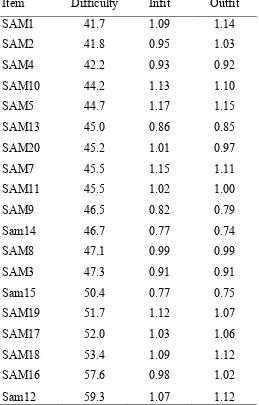
analysis utilized a 19-item version of the scale. Table 3 shows the resulting item difficulties and
fit, ordered by difficulty.
Validity
SAM scores ranged from 8.3 to 100 with a mean of 64.94 (sd = 13.91). We broke the data
up into three groups to compare student performance on the SAM to homework time, social
media usage, gaming time, school importance, desire to change homework behaviors, confidence
in ability to change, grade point average and attendance data. Table 4 shows the descriptive
statistics of each group: low, moderate, and high. Each group included a relatively similar
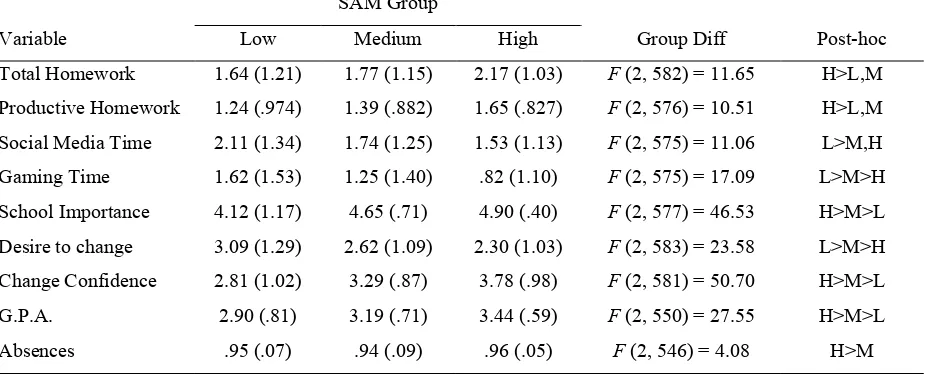
number of students who had comparable SAM scores. We utilized one-way analyses of variance
(ANOVAs) with post-hoc Scheffe tests to further understand the differences between the SAM
score groups. Table 5 shows the results of the analysis. Because of the extreme differences
Table 3
Resulting SAM Items Values Following Item Deletion
Item Difficulty Infit Outfit SAM1 41.7 1.09 1.14 SAM2 41.8 0.95 1.03 SAM4 42.2 0.93 0.92 SAM10 44.2 1.13 1.10 SAM5 44.7 1.17 1.15 SAM13 45.0 0.86 0.85 SAM20 45.2 1.01 0.97 SAM7 45.5 1.15 1.11 SAM11 45.5 1.02 1.00 SAM9 46.5 0.82 0.79 Sam14 46.7 0.77 0.74 SAM8 47.1 0.99 0.99 SAM3 47.3 0.91 0.91 Sam15 50.4 0.77 0.75 SAM19 51.7 1.12 1.07 SAM17 52.0 1.03 1.06 SAM18 53.4 1.09 1.12 SAM16 57.6 0.98 1.02 Sam12 59.3 1.07 1.12
Table 4
SAM Score Groupings
Group Level N Mean SD Minimum Maximum
Low 188 51.6 6.54 8.3 57.5
Table 5
Academic Measures in Relation to SAM Group Scores for All Students SAM Group
Variable Low Medium High Group Diff Post-hoc
Total Homework 1.64 (1.21) 1.77 (1.15) 2.17 (1.03) F (2, 582) = 11.65 H>L,M Productive Homework 1.24 (.974) 1.39 (.882) 1.65 (.827) F (2, 576) = 10.51 H>L,M Social Media Time 2.11 (1.34) 1.74 (1.25) 1.53 (1.13) F (2, 575) = 11.06 L>M,H Gaming Time 1.62 (1.53) 1.25 (1.40) .82 (1.10) F (2, 575) = 17.09 L>M>H School Importance 4.12 (1.17) 4.65 (.71) 4.90 (.40) F (2, 577) = 46.53 H>M>L Desire to change 3.09 (1.29) 2.62 (1.09) 2.30 (1.03) F (2, 583) = 23.58 L>M>H Change Confidence 2.81 (1.02) 3.29 (.87) 3.78 (.98) F (2, 581) = 50.70 H>M>L G.P.A. 2.90 (.81) 3.19 (.71) 3.44 (.59) F (2, 550) = 27.55 H>M>L Absences .95 (.07) .94 (.09) .96 (.05) F (2, 546) = 4.08 H>M
Note. Total homework, productive homework, social media, and gaming time are reported in hours. School
importance is a self-report, Likert item that ranged from “not important” to “very important” (1-5). Desire to change the way you do homework is a self-report, Likert item that ranged from “not at all” to “a whole lot” (1-5). The student’s confidence in their ability to change is a self-report, Likert item that ranged from “no confidence” to “very high confidence” (1-5). Total absences is a ratio of days present to total possible attended days with a value of 1 being equal to no absences. The three groups are designated high (H), medium (M), and low (L) SAM scores.
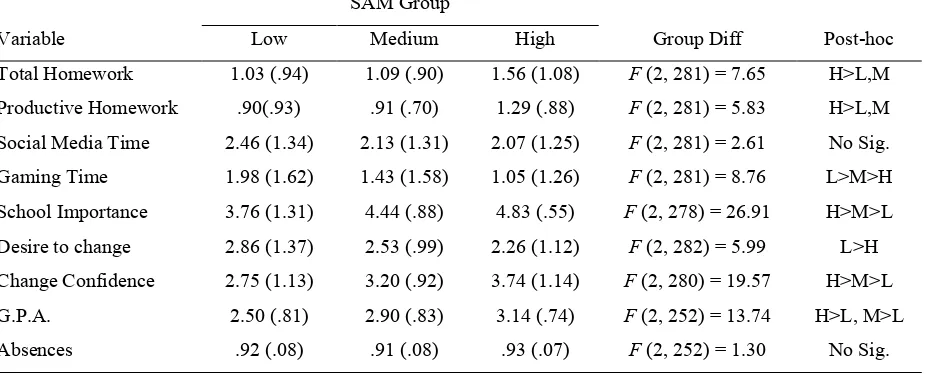
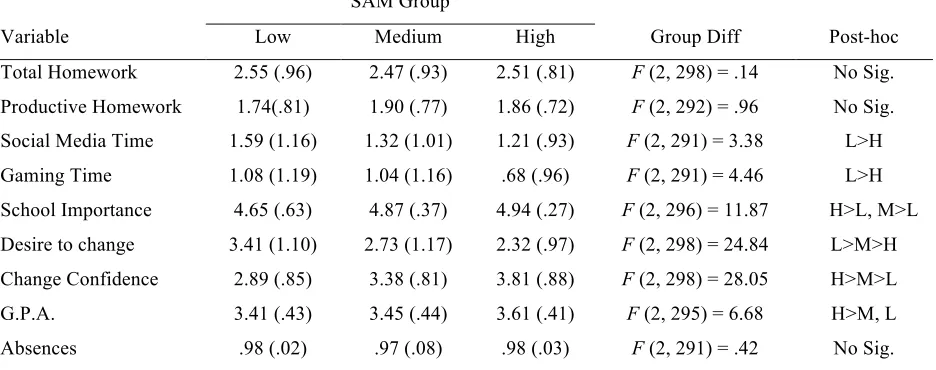
Tables 6 and 7 show the results of those analyses. Analyses resulting in p-values less than .05
were deemed statistically significant. Though repeated use of an alpha of .05 is likely to result in
Type 1 error, the pattern of results seen in the following tables suggests systematic differences
Table 6
Academic Measures in Relation to SAM Group Scores for Low SES School SAM Group
Variable Low Medium High Group Diff Post-hoc
Total Homework 1.03 (.94) 1.09 (.90) 1.56 (1.08) F (2, 281) = 7.65 H>L,M Productive Homework .90(.93) .91 (.70) 1.29 (.88) F (2, 281) = 5.83 H>L,M Social Media Time 2.46 (1.34) 2.13 (1.31) 2.07 (1.25) F (2, 281) = 2.61 No Sig. Gaming Time 1.98 (1.62) 1.43 (1.58) 1.05 (1.26) F (2, 281) = 8.76 L>M>H School Importance 3.76 (1.31) 4.44 (.88) 4.83 (.55) F (2, 278) = 26.91 H>M>L Desire to change 2.86 (1.37) 2.53 (.99) 2.26 (1.12) F (2, 282) = 5.99 L>H Change Confidence 2.75 (1.13) 3.20 (.92) 3.74 (1.14) F (2, 280) = 19.57 H>M>L G.P.A. 2.50 (.81) 2.90 (.83) 3.14 (.74) F (2, 252) = 13.74 H>L, M>L Absences .92 (.08) .91 (.08) .93 (.07) F (2, 252) = 1.30 No Sig.
Note. Total homework, productive homework, social media, and gaming time are reported in hours. School
Table 7
Academic Measures in Relation to SAM Group Scores for Private School Freshmen SAM Group
Variable Low Medium High Group Diff Post-hoc
Total Homework 2.55 (.96) 2.47 (.93) 2.51 (.81) F (2, 298) = .14 No Sig. Productive Homework 1.74(.81) 1.90 (.77) 1.86 (.72) F (2, 292) = .96 No Sig. Social Media Time 1.59 (1.16) 1.32 (1.01) 1.21 (.93) F (2, 291) = 3.38 L>H Gaming Time 1.08 (1.19) 1.04 (1.16) .68 (.96) F (2, 291) = 4.46 L>H School Importance 4.65 (.63) 4.87 (.37) 4.94 (.27) F (2, 296) = 11.87 H>L, M>L Desire to change 3.41 (1.10) 2.73 (1.17) 2.32 (.97) F (2, 298) = 24.84 L>M>H Change Confidence 2.89 (.85) 3.38 (.81) 3.81 (.88) F (2, 298) = 28.05 H>M>L G.P.A. 3.41 (.43) 3.45 (.44) 3.61 (.41) F (2, 295) = 6.68 H>M, L Absences .98 (.02) .97 (.08) .98 (.03) F (2, 291) = .42 No Sig.
Note. Total homework, productive homework, social media, and gaming time are reported in hours. School
Chapter 4
Discussion
The purpose of this study was to explore the feasibility of student activation as a
construct for further understanding non-cognitive factors contributing to a student’s academic
success. The SAM was developed in collaboration with the team that validated the construct of
patient activation in medical settings, and it appears to be a reliable and valid measure of student
activation. Initial Rasch item analysis resulted in the deletion of item 6 and led to a 19-item
version of the SAM. This version of the SAM fit well with the expectation of the Rasch model,
which indicates high construct validity, and was exceptionally reliable. In both schools,
inferential analysis showed that higher SAM scores are associated with significantly higher
GPAs, less absences, increased time spent on homework, and less time spent on social media or
playing video games. It is important to note that these outcomes (e.g., less social media time)
were characteristics of highly activated students and should not be considered causal factors.
Within the individual schools, SAM scores are associated with similarly positive student
characteristics, although these differences are not as pronounced when the scores are combined
from both schools. These findings, joined with the fit statistics, indicate that the measure has a
high level of construct and criterion validity.
The constructs of self-regulated learning and student engagement have impressive
research bases that have consistently grown over time. However, both face the challenge of
studies have attempted to bridge the gap between medical and secondary education settings, even
though both settings regularly attempt to modify behavior. Professionals in both settings often
face the challenging task of meeting the needs of a large, diverse group. Because of this,
efficiency and precision are paramount in insuring the success of any intervention. Previous
research has already established the strong link between lower activation scores and higher
healthcare costs, while higher scores are associated with better health outcomes (Hibbard, et al.,
2013; Hibbard & Greene, 2013). Therefore, a measure of student activation could conceivably be
a useful tool for lowering academic costs and improving outcomes.
Hibbard et al. (2005) pointed out that the first step to improving patient care is the
development of reliable and valid instruments, and this is also true for improving the
performance of struggling students. The Student Activation Measure (SAM) appears to be a
valid and highly reliable instrument to measure a student’s knowledge, skill, and confidence for
self-managing one’s academic responsibilities. Compared to other academic measures, the SAM
is distinct that it is intended to be used in intervention planning, rather than strictly research. Its
19-item structure allows for rapid administration and scoring. In addition, the positive wording
of the items is intended to decrease the reactivity of struggling students who complete the
measure and facilitate a motivational interviewing intervention. The items are intended to be
non-judgmental and respectful of the student’s experience. The goal of this approach is to
decrease the social desirability associated with the items. Further research is needed to determine
if the item wording had the intended effect.
Similar to the PAM, the SAM has strong psychometric properties and evidences a
a useful tool for working with individual students and comparing the effectiveness of
interventions across academic settings. A strength of this study is the highly disparate schools
that compose the sample. Even with these differences, the items performed well across settings.
The creators of the PAM have utilized the developmental nature of activation to design
individualized interventions, and it is likely that the SAM can be employed in a similar manner.
For instance, students with low SAM scores evidenced a strong desire to change but had little
confidence in their ability to change. An intervention approach that utilizes a collaborative
problem-solving framework might be useful for these students. As a student begins to have
success overcoming challenges, their SAM scores should increase in a corresponding manner.
Research aimed at further testing the psychometric properties of the SAM and detecting the
SAM’s sensitivity to intervention is currently underway. The findings of this study indicated a
high degree of similarity between the construct of activation regardless of the setting it is
measured in.
Future Research
This study is the first study to explore the construct of student activation. There are
numerous possible directions for future research. It would be beneficial to replicate this study
with the same student population to examine the stability of SAM scores over time and
reexamine the relationship between SAM scores and markers of academic success. The students
in this sample were socioeconomically diverse but other identity markers may not have been
adequately represented, such as ethnicity or gender. Future studies would benefit by intentionally
seeking to include students whose identity markers address these gaps. Another possibility is to
aimed at improving academic performance. The SAM is explicitly designed to be used in
academic interventions and could benefit from the development of a companion measure
designed to individualize intervention efforts.
Further research is needed to fully understand the construct of activation as it relates to
disorders that impede students from accessing their education, such as ADHD or oppositional
defiant disorder. These nuances are unique and more pronounced in an educational setting. The
current sample was composed of high school students, and it is unknown if activation is a useful
construct for understanding the learning behaviors of students who are not in high school.
Because of this, it is possible that additional forms, or refinement, of the SAM may be necessary.
Limitations
This study lacked cultural diversity and future studies would benefit from the intentional
inclusion of culturally and ethnically diverse students. In addition, there was a large disparity in
the socioeconomic status of the students of the two schools. The inclusion of a third school with
more diverse or moderate SES status would have helped to address this disparity. The current
version of the SAM is exclusively self-report, and this is a potential limitation of the study.
Teacher and parent ratings of students would increase our understanding of the construct of
activation.
Conclusion
The SAM appears to be a useful and psychometrically sound measure to further
understand the learning process of high school students. Because this is the initial study with this
construct, there are numerous research possibilities to be explored. A popular approach to
and intervene on struggling students. Fortunately, predictive modeling and psychological
measures are advancing so that a well-designed screeners can be used in classrooms to identify
students with a high probability of failing before they begin to fail, thereby increasing the
intervention time allotted to the student and lessening the risk of academic failure. The SAM
presents one such opportunity to identify students at risk so that intervention efforts can be
developed for struggling students. The SAM, or any such measure, is a step towards an
educational system that seeks to meet the needs of it students while valuing the efficient
allocation of resources. Further research and collaboration with education professionals will
References
Baghaei, P. (2008). The Rasch model as a construct validation tool. Transactions of the Rasch
Measurement SIG American Educational Research Association, 21, 1145-1146.
Retrieved from http://www.rasch.org/rmt/rmt221a.htm
Bandura, A. (1997). Self-efficacy: The exercise of control. New York, NY: Freeman.
Boekaerts, M., Pintrich, P. R., & Zeidner, M. (Eds.). (2005). Handbook of self-regulation.
Burlington, MA: Academic Press.
Bond, T. G. (2007). Applying the Rasch model: Fundamental measurement in the human
sciences (2nd ed.). Mahwah, NJ: Routledge.
Boone, W. J., Staver, J. R., & Yale, M. S. (2014). Rasch analysis in the human sciences. New
York, NY: Springer.
Chemers, M. M., Hu, L., & Garcia, B. F. (2001). Academic self-efficacy and first-year college
student performance and adjustment. Journal of Educational Psychology, 93, 55-64.
Christenson, S. L., Reschly, A. L., & Wylie, C. (Eds.). (2012). Handbook of research on student
engagement. New York, NY: Springer Science & Business Media.
Chuck, E. (2013, October 8). US in a “real state of crisis,” education secretary says. Retrieved
from
http://www.nbcnews.com/news/other/us-real-state-crisis-education-secretary-says-f8C11354527
Credé, M., & Kuncel, N. R. (2008). Study habits, skills, and attitudes: The third pillar supporting
collegiate academic performance. Perspectives on Psychological Science, 3, 425–453.
Fowles, J. B., Terry, P., Xi, M., Hibbard, J., Bloom, C. T., & Harvey, L. (2009). Measuring
self-management of patients’ and employees’ health: Further validation of the Patient
Activation Measure (PAM) based on its relation to employee characteristics. Patient
Education and Counseling, 77, 116-122. doi:10.1016/j.pec.2009.02.018
Fredricks, J. A., Blumenfeld, P. B., Friedel, J., & Paris, A. (2002, April). Increasing engagement
in urban settings: An analysis of the influence of the social and academic context on
student engagement. Paper presented at the annual meeting of the American Educational
Research Association, New Orleans, LA.
Fredricks, J. A., Blumenfeld, P. C., & Paris, A. H. (2004). School engagement: Potential of the
concept, state of the evidence. Review of Educational Research, 74, 59-109.
doi:10.3102/00346543074001059
Green, C. A., Perrin, N. A., Polen, M. R., Leo, M. C., Hibbard, J. H., & Tusler, M. (2010).
Development of the Patient Activation Measure for Mental Health (PAM-MH).
Administration and Policy in Mental Health, 37, 327-333.
doi:10.1007/s10488-009-0239-6
Hassanbeigi, A., Askari, J., Nakhjavani, M., Shirkhoda, S., Barzegar, K., Mozayyan, M. R., &
Fallahzadeh, H. (2011). The relationship between study skills and academic performance
of university students. Procedia - Social and Behavioral Sciences, 30, 1416-1424.
doi:10.1016/j.sbspro.2011.10.276
Hibbard, J. H., & Greene, J. (2013). What the evidence shows about patient activation: Better
health outcomes and care experiences; fewer data on costs. Health Affairs (Project
Hibbard, J. H., Greene, J., & Overton, V. (2013). Patients with lower activation associated with
higher costs; delivery systems should know their patients’ “scores.” Health Affairs
(Project Hope), 32, 216-222. doi:10.1377/hlthaff.2012.1064
Hibbard, J. H., Mahoney, E. R., Stockard, J., & Tusler, M. (2005). Development and testing of a
short form of the Patient Activation Measure. Health Services Research, 40, 1918-1930.
doi:10.1111/j.1475-6773.2005.00438.x
Hibbard, J. H., Stockard, J., Mahoney, E. R., & Tusler, M. (2004). Development of the Patient
Activation Measure (PAM): Conceptualizing and measuring activation in patients and
consumers. Health Services Research, 39, 1005-1026.
doi:10.1111/j.1475-6773.2004.00269.x
Kinder, R. A. (2008). Development and validation of the Student Activation Measure (Doctoral
dissertation). Retrieved from
http://etd.library.vanderbilt.edu/ETD-db/available/etd-11202008-122821/
Lavasani, M. G., Mirhosseini, F. S., Hejazi, E., & Davoodi, M. (2011). The effect of
self-regulation learning strategies training on the academic motivation and self-efficacy.
Procedia - Social and Behavioral Sciences, 29, 627-632.
doi:10.1016/j.sbspro.2011.11.285
Levin, H., Belfield, C., Muennig, P., & Rouse, C. (2007). The costs and benefits of an excellent
education for all of America’s children. Retrieved from
https://ebssp.eboardsolutions.com/sites/sbgtask/Documents/B.%20PUBLIC%20EDUCA
TION%20-%20REPORTS/B.1%20Costs%20and%20Benefits%20of%20Education%20-%20Highly%20technical%20report%20on%20the%20actual%20costs%20and%20benefi
ts-Columbia%20Univ.pdf
Maes, S. & Gebhardt, W. (2005). Self-regulation and health behavior: The health behavior goal
model. In M. Boekaerts, P. R. Pintrich, & M. Zeidner, (Eds.), Handbook of
self-regulation (pp. 343-368). Burlington, MA: Academic Press.
Marshall, R., Beach, M. C., Saha, S., Mori, T., Loveless, M. O., Hibbard, J. H., … Todd, P.
(2013). Patient activation and improved outcomes in HIV-infected patients. Journal of
General Internal Medicine, 28, 668-674. doi:10.1007/s11606-012-2307-y
Massof, R. W. (2002). The measurement of vision disability. Optometry and Vision Science:
Official Publication of the American Academy of Optometry, 79, 516-552.
Mega, C., Ronconi, L., & De Beni, R. (2014). What makes a good student? How emotions,
self-regulated learning, and motivation contribute to academic achievement. Journal of
Educational Psychology, 106, 121-131. doi:10.1037/a0033546
Multon, K. D., Brown, S. D., & Lent, R. W. (1991). Relation of self-efficacy beliefs to academic
outcomes: a meta-analytic investigations. Journal of Counseling Psychology, 38, 31-38.
Newmann, F. M. (1992). Student engagement and achievement in American secondary schools.
New York, NY: Teachers College Press.
Organisation for Economic Cooperation and Development. (2013). Time for the U.S. to reskill?
Paris, France: Author. Retrieved from
Pajares, F.(2006). Self-efficacy during childhood and adolescence: Implications for teachers and
parents. In F. Pajares & T. C. Urdan (Eds.), Self-efficacy beliefs of adolescents (pp.
339-367). Charlotte, NC: Information Age Publishing.
Pintrich, P. R. (2004). A conceptual framework for assessing motivation and self-regulated
learning in college students. Educational Psychology Review, 16, 385-407.
doi:10.1007/s10648-004-0006-x
Rasch, G. (1993). Probabilistic models for some intelligence and attainment tests. Chicago, IL:
MESA Press.
Remmers, C., Hibbard, J., Mosen, D. M., Wagenfield, M., Hoye, R. E., & Jones, C. (2009). Is
patient activation associated with future health outcomes and healthcare utilization
among patients with diabetes? The Journal of Ambulatory Care Management, 32,
320-327. doi:10.1097/JAC.0b013e3181ba6e77
Reschly, A. L., & Christenson, S. L. (2012). Jingle, jangle, and conceptual haziness: Evolution
and future directions of the engagement construct. In S. L. Christenson, A. L. Reschly,, &
C. Wylie, (Eds.), Handbook of research on student engagement (pp. 3-145). New York,
NY: Springer Science & Business Media.
Richardson, M., Abraham, C., & Bond, R. (2012). Psychological correlates of university
students’ academic performance: A systematic review and meta-analysis. Psychological
Bulletin, 138, 353-387. doi:10.1037/a0026838
Robbins, S. B., Lauver, K., Le, H., Davis, D., Langley, R., & Carlstrom, A. (2004). Do
psychosocial and study skill factors predict college outcomes? A meta-analysis.
Schunk, D. H. (1988, April). Perceived self-efficacy and related social cognitive processes as
predictors of student academic performance. Paper presented at the meeting of the
American Educational Research Association, New Orleans, LA. Available from
http://www.eric.ed.gov/contentdelivery/servlet/ERICServlet?accno=ED293866
Shively, M. J., Gardetto, N. J., Kodiath, M. F., Kelly, A., Smith, T. L., Stepnowsky, C., …
Larson, C. B. (2013). Effect of patient activation on self-management in patients with
heart failure. The Journal of Cardiovascular Nursing, 28, 20-34.
doi:10.1097/JCN.0b013e318239f9f9
Shui-fong Lam, Jimerson, S., Wong, B. P. H., Kikas, E., Hyeonsook Shin, Veiga, F. H., …
Zollneritsch, J. (2014). Understanding and measuring student engagement in school: The
results of an international study from 12 countries. School Psychology Quarterly, 29,
213-232. doi:10.1037/spq0000057
Skinner, E. A., Kindermann, T. A., & Furrer, C. J. (2009). A motivational perspective on
engagement and disaffection conceptualization and assessment of children’s behavioral
and emotional participation in academic activities in the classroom. Educational and
Psychological Measurement, 69, 493-525. doi:10.1177/0013164408323233
Skinner, E., Furrer, C., Marchand, G., & Kindermann, T. (2008). Engagement and disaffection in
the classroom: Part of a larger motivational dynamic? Journal of Educational
Psychology, 100, 765-781. doi:10.1037/a0012840
Skolasky, R. L., Mackenzie, E. J., Riley, L. H., & Wegener, S. T. (2009). Psychometric
properties of the Patient Activation Measure among individuals presenting for elective
Life Aspects of Treatment, Care and Rehabilitation, 18, 1357-1366.
doi:10.1007/s11136-009-9549-0
Smith, R. M. (1996). Polytomous mean-square fit statistics. Rasch Measurement Transactions,
10, 516-517.
Wolters, C. A., Yu, S. L., & Pintrich, P. R. (1996). The relation between goal orientation and
students’ motivational beliefs and self-regulated learning. Learning and Individual
Differences, 8, 211-238.
Zajacova, A., Lynch, S. M., & Espenshade, T. J. (2005). Self-efficacy, stress, and academic
success in college. Research in Higher Education, 46, 677-706.
doi:10.1007/s11162-004-4139-z
Zimmerman, B. J. (1990). Self-regulated learning and academic achievement: An overview.
Educational Psychologist, 25, 3-17. doi:10.1207/s15326985ep2501_2
Zimmerman, B. J. (2000). Self-efficacy: An essential motive to learn. Contemporary
Educational Psychology, 25, 82-91. doi:10.1006/ceps.1999.1016
Zimmerman, B. J. (2005). Attaining self-regulation: A social cognitive perspective. In M.
Boekaerts, P. R. Pintrich,, & M. Zeidner, (Eds.), Handbook of self-regulation (pp. 13-39).
Burlington, MA: Academic Press.
Zimmerman, B. J., Bandura, A., & Martinez-Pons, M. (1992). Self-motivation for academic
attainment: The role of self-efficacy beliefs and personal goal setting. American
Zimmerman, B. J., & Martinez-Pons, M. (1990). Student differences in self-regulated learning:
Relating grade, sex, and giftedness to self-efficacy and strategy use. Journal of
Appendix A
Curriculum Vitae
EDUCATION
Doctoral Degree
Institution: George Fox University (APA accredited) Name of Degrees:
Master of Arts, Clinical Psychology Date Awarded: May 2014
Doctorate of Psychology, Clinical Psychology (expected May 2017)
Dissertation Title: From Patient to Student Activation: Development of the Student Activation Measure
Dissertation Defended: April 1st, 2016 Emphasis: Child and Adolescent Cumulative GPA: 4.0 (Current)
Master’s Degree
Awarding Institution: McNeese State University Name of Degree: Master of Arts, Psychology Concentration: Experimental Psychology Date Awarded: May 2011
Thesis Title: An Examination of the Effects of Stigma on Medication Prescription Practices Cumulative GPA: 4.0
Bachelor’s Degree
Awarding Institution: McNeese State University Name of Degree: Bachelor of Science, Psychology Minor: Biology
Date Awarded: May 2008 Cumulative GPA: 3.95
CLINICAL AND RELATED EXPERIENCE
Momentous Institute (APA accredited), Dallas, TX, (7/2016-current)
Position: Doctoral Intern
Duties:
o Provide therapeutic services to families in outpatient and school settings
o Sessions structured based on individual family need and can take the form of individual, family or couples work.
o Families typically come from European Heritage, Latino, and African American
heritages with high rates of trauma
utilizing behavioral, personality, cognitive, and academic measures.
o Act as early childhood assessment team member during 12-week rotation
o Administer and interpret assessment
o Write relevant portions of report
o Participate in weekly family therapy treatment team
o Treatment modality utilizes traditional family therapy technique of reflecting team and focuses on service delivery to one family
o Team member responsibilities include acting as co-therapists inside the room with family or observing from behind two-way mirror and offering feedback to family in reflecting session.
o Treatment team also includes weekly, hour long supervision dedicated to enlarging participant’s knowledge of family therapy techniques and conceptualizations
o Attend weekly didactics focused on a variety of topics including working in diverse settings, assessing and treating trauma, and introductions to evidence based practices
o Attend bimonthly assessment seminars on a variety of topics including, but not limited to, utilizing therapeutic assessment techniques, understanding the effects of diversity on the assessment process, and incorporating assessment into treatment
o Provide group therapy services to multi-family and child groups
o Act as consultant/liaison in a K-5th grade setting
o Conduct bi-weekly intakes
Morrison Child and Family Services, Gresham, OR (8/2015-6/2016)
Position: Practicum Therapist
Duties:
o Provide therapeutic services to children, adolescents, and families, clients ages 3-17, European Heritage, Latino, African American, and Pacific Islander heritages with high rates of trauma
o Interfacing with DHS and community support organizations
o Medicaid and insurance billing
o Attendance at bimonthly consultation teams for complex cases including monthly case presentations
o Coordinating care with onsite medical professionals o Conducting bimonthly new client intakes
o Use of ACORN system to monitor client progress and treatment outcomes
George Fox University Graduate Department of Clinical Psychology, Newberg, OR (9/2013- Present)
Title: Fourth Year Oversight
Duties:
o Oversight of Practicum 1 Psy.D. students
o Fostering development of clinical and assessment skills
School Based Behavioral Health, Newberg, OR (9/2014-5/2015)
Position: Behavioral Intern
Duties:
o Develop competency working within systems with multidisciplinary staff, including education staff, autism specialists, and allied professionals.
o Provide therapeutic services to youth, ages 10-13, Low SES, European, Latino, and Asian heritages. Incorporating CBT and ACT based interventions.
o Conduct intake interviews and develop treatment plans to implement empirically supported intervention strategies.
o Implemented crisis intervention including risk assessments and safety planning.
o Provided comprehensive psychoeducational assessments in conjunction with IDEA and IDEIA standards. Integrating cognitive, achievement, neuropsychological, personality, and behavioral measures; ages 5-17, European heritage, Latino, Asian.
o Provide feedback of assessment results to students, families, and professional colleagues.
o Psychoeducation with interdisciplinary staff and families.
Willamette Family Medical Center, Salem, OR (8/2013-7/2014)
Position: Behavioral Health Intern
Duties:
o Individual therapy with children, adolescents and adults (ages 3-89)
o Diverse patient group including LGBTQ individuals, predominantly Caucasian and Latino heritages
o Administered cognitive and personality assessments, primarily to children to guide in
diagnosis of ADHD
o Promoting health-related behavior change with clients, such as weight loss and smoking cessation
o Presenting psychoeducational trainings to providers, topics included ADHD and motivational interviewing techniques
o Consultation with medical providers around client’s presenting problems and physical
health
o Weekly 4 hour “warm handoff”shifts where I administered brief interventions and conducted risk assessments at the request of the provider
o Oversight of implementation of problem alcohol use measure (SBIRT).
Behavioral Health Consultation Team, Newberg, OR (2/2013- 5/2015) Duties:
o Conduct risk evaluations and crisis management in hospital Emergency Department, ICU, and Medical/ Surgery for individuals at risk of harm to self or others, inability to care for self or psychoses
o Consultation and liaison with medical providers and county mental health workers
George Fox University Graduate Department of Clinical Psychology, Newberg, OR (1/2013-5/2013)
Position: Pre-practicum II Therapist
Duties:
o Scheduling and providing weekly individual psychotherapy sessions for two undergraduate clients
o Conducting intake session
o Writing formal intake report and SOAP notes o Using SRS and ORS to monitor treatment outcomes o Attend weekly group and individual supervision
o Practicing person-centered techniques
George Fox University Graduate Department of Clinical Psychology, Newberg, OR (9/2012-11/2012)
Position: Depression Management Group Facilitator
Duties:
o Facilitating group conversation regarding positive life choices and recovering from mental illness
o Applying person-centered techniques
o Attend weekly group supervision by advanced student
o Developing group therapy skills
o Collaborating with other graduate students regarding group process and structure
Volunteers of America, Lake Charles, LA (8/2011-6/2012)
Position: Trainer
Duties:
o Providing residential services to individuals with severe mental illness (schizophrenia), predominantly European and African American heritage adults
o Social skills training, medication monitoring, and budget training for residents o Answering crisis hotline
o Consulting with treatment team in order to aid in achieving positive therapeutic outcomes and encouraging healthier lifestyles.
Medical Resources and Guidance, Lake Charles, LA (12/2008 –6/2010)
Position: Case Manager
Duties:
o Constructing personalized plans of care for developmentally disabled individuals
o Working with clinicians to develop formal behavior plans to address problem behaviors o Collaborating with care team to establish goals and allocating state funds to assist client
in meeting goals
o Conducting yearly meetings to assess client’s needs and appropriateness of goals
TEACHING EXPERIENCE
George Fox University Department of Psychology, Newberg, OR (9/2015-12/2015)
Position: Graduate Teaching Assistant
Course: Statistics
Duties: individual tutoring, course planning, grading, and guest lecturing
George Fox University Department of Psychology, Newberg, OR (6/2015-7/2015)
Position: Graduate Teaching Assistant
Course: Child and Adolescent Therapy and Assessment
Duties: individual tutoring, course planning, grading, and guest lecturing
George Fox University Graduate School of Counseling, Tigard, OR (6/2014-7/2014, 6/2015-7/2015)
Position: Adjunct Faculty
Course: Research Design and Statistics
Duties: semester planning, syllabus creation, assessment creation, lecture, assisting struggling students, office hours, and grading.
George Fox University Department of Psychology, Newberg, OR (9/2013-12/2013, 9/2015-12/2015)
Position: Graduate Teaching Assistant
Course: Advanced Counseling
Duties: group facilitation, grading of assignments, feedback for counseling videos
George Fox University Department of Psychology, Newberg, OR (4/2013)
Position: Visiting Lecturer
Course: Research Methods
Lecture given: Inferential Statistics
McNeese State University Department of Psychology, Lake Charles, LA (9/2010- 7/2012)
Position: Graduate Teaching Assistant transitioned to Visiting Lecturer
Courses taught: Introduction to Psychology, Child Psychology
Duties: semester planning, syllabus creation, assessment creation, lecture, assisting struggling students, office hours, and grading.
CLINICAL TRAININGS
Clinical Team (2013-Present)
George Fox University, Newberg, OR
Primary Care/ Health Psychology Training
Intro to Motivational Interviewing Workshop: Michael Fulop, Psy.D. (2/2014) World Forestry Center, Portland, Oregon
Integrated Primary Care: Brian Sandoval, Psy.D., and Juliette Cutts, Psy.D. (9/2013) George Fox University, Newberg, Oregon
Screening, Brief Intervention, Referral to Treatment (SBIRT) training (9/2013) George Fox University, Newberg, Oregon
Child & Adolescent Training
“Face Time”in an Age of Technological Advancement: Doreen Dodgen-McGee, Psy.D. (11/2014)
George Fox University, Newberg, Oregon
ADHD: Evidence-based Practice for Children and Adolescents: Erika Doty, Psy.D. (10/2014) George Fox University, Newberg, Oregon
Diversity Training
Afrocentric Approaches to Clinical Practices: Danette Haynes, Ph.D. and Marcus Sharp, Ph.D. (1/2013)
George Fox University, Newberg, Oregon
Sexual Identity: Erica Tan, Psy.D. (11/2012) George Fox University, Newberg, Oregon
Treating Gender Variant Clients: Christian Integration: Erica Tan, Psy.D. (10/2012) George Fox University, Newberg, Oregon
Assessment Training
Learning Disabilities: A Neuropsychological Perspective (10/2014) George Fox University, Newberg, Oregon
Tabitha Becker, Psy.D
Northwest Psychological Assessment Conference (5/2013)
• Using Tests of Effort in Psychological Assessment: Paul Green, Ph.D. • Assessing Mild Cognitive Impairment: Mark Bondi, Ph.D., ABPP
Other Related Clinical Trainings
Spiritual Formation and Psychotherapy: Barrett McRay, Ph.D. (3/2015) George Fox University, Newberg, Oregon
Credentialing, Banking, the Internship Crisis, and other Challenges for Graduate Students in Psychology: Morgan Sammons, Ph.D. (2/2015)
George Fox University, Newberg, Oregon
Evidence Based Treatment for PTSD in Veteran Populations: Clinical and Integrative Perspectives: David Beil-Adaskin, Psy.D. (3/2014)
George Fox University, Newberg, Oregon ACT workshop: Steven Hayes, Ph.D. (1/2014) Oregon Conference Center, Portland, Oregon
DSM-V Training, Essential Changes in Form and Function: Jeri Turgeson, Psy.D. and Mary Peterson, Ph.D., ABPP (1/2014)
George Fox University, Newberg, Oregon
The Person of the Therapist: Brooke Kuhnhausen, Ph.D. (3/2013) George Fox University, Newberg, Oregon
PROFESSIONAL AFFILIATIONS
American Board of Professional Psychology (2015-Present)
Early Entry Candidate
A.P.A. Division 53: Society of Clinical Child and Adolescent Psychology (2015-Present)
Graduate Student Affiliate
Association for Contextual Behavioral Science (2014-Present)
Member
American Psychological Association (2013- Present)
Graduate Student Affiliate
Journal of Health Psychology (2011- Present)
Reviewer
COMMUNITY INVOLVEMENT
Providence Health and Fitness Day (06/2015) Bullying Awareness and Prevention Booth
George Fox University Graduate Department of Clinical Psychology (8/2014- 5/2015)
Peer Mentor to incoming Psy.D. student
Willamette Family Medical Center (5/2013) Presentation to Medical Providers and Staff
“An Introduction to Motivational Interviewing”
Juliette’s House Child Abuse Intervention Center (9/2012, 2013, 2014)
Serve Day Team Member
Duties: Once per year with the GFU PsyD program, serve the Child Abuse Intervention Center by completing labor tasks, such as managing mail duties, washing windows, gardening, grounds work, and painting the facility.
George Fox University Graduate Department of Clinical Psychology (9/2012- 5/2014)
Graduate Student Council Representative
George Fox University Graduate Department of Clinical Psychology (9/2012- 5/2013)
Department Admissions Committee Member
AWARDS AND RECOGNITION
Research Award for Competency in Science and Application Oregon Psychological Association Conference 2015
Presentation title: Activating race: Impacts of race priming in a predominantly white institution
Finalist Graduate Research Competition
Southwestern Psychological Association Convention 2011
Presentation title: Overmedication: What role does mental capacity play?
Temple Inland scholarship Date Awarded: 9/2003 Amount Awarded: 1500$
Tops scholarship Date Awarded: 9/2003 Amount Awarded: 40,000$
McNeese State University
President's Honor List 4 years (2005-2008)
McNeese State University