Research Journal
Volume 11, Issue 2, June 2017, pages 8–16
DOI: 10.12913/22998624/67377 Research Article
THE IMPACT OF SELECTED TECHNOLOGICAL AND MATERIAL
PARAMETERS ON THE STRENGTH OF ADHESIVE STEEL SHEETS JOINTS
Anna Rudawska1, Katarzyna Głogowska1, Tatiana Vitenko2,
Dana Stančeková3, Nadežda Čuboňová3, Dariusz Kasperek4
1 Lublin University of Technology, Faculty of Mechanical Engineering, Nadbystrzycka 36 Str, 20-618 Lublin, PL,
e-mail:[email protected], [email protected]
2 Ternopil Ivan Pul’uj National Technical University, Faculty of Mechanical Engineering and Food Technologies,
Ruska Street 56, 46001, Ternopil, UK, [email protected]
3 University of Žilina, Faculty of Mechanical Engineering, Univerzitna 1, 010 26, Žilina, SK, dana.stancekova@
fstroj.uniza.sk, [email protected]
4 URSUS BUS S.A., ul. Frezerów 7, 20-209 Lublin
ABSTRACT
The following paper analyses selected problems regarding the impact of technologi-cal parameters and the type of adherend material on the strength of adhesive-bonded steel sheet joints. The subject of the test was a single-lap adhesive joint of S235JR steel sheet. Joints were formed on two types of substrates: with or without corro-sion products on the surface. The surface of steel sheet adherends was pre-treated with three cleaning solutions: acetone, Wiko industrial degreasing agent and Cortanin F anti-corrosion agent, depending on the state of the surface. Adhesive joints were formed with Epidian 53/ET/100:15 epoxy adhesive. The formed joints were subjected to one of three ageing variants: 14 days, two months and 3 months, which were fol-lowed by destructive testing to determine the shear strength of joints. The analysis of results obtained in the tests indicates that the strength performance of adhesive joints of corrosion-free adherends was characterised by higher values than in corroded steel sheets, regardless of ageing time.
Keywords: adhesive joints, steel sheets, corrosion, ageing, strength, surface treatment.
INTRODUCTION
Adhesive joining technology covers a
broad spectrum of fields, which mainly revolve
around the problems of cohesion and adhesion, selection of proper adhesive to given applica-tions, preparation of adherends, preparation and application of adhesive as well as its properties for a given application [1÷5].
Obtaining the highest strength of adhesive joints is not be possible without a suitable prepa-ration of the surface of adherends [3, 5÷7]. There is a number of operations that serve as surface preparation methods, such as: degreasing, chemi-cal bath, mechanichemi-cal and chemichemi-cal machining, rinsing, drying, applying primers and other
spe-cial operations [1, 2, 8÷13]. It is paramount for the strength of joints that surface preparation is carried out with great care. The obtained substrate surface must be contaminant-free of proper struc-ture and the contact between substrates must be close and consistent to ensure the strongest adhe-sion forces between the adhesive and adherends [2, 7, 11]. Preparation of surface for adhesive joining facilitates producing joint of desired prop-erties. Among factors contributing to decreasing adhesion between adhesive and adherends is cor-rosion on the surface of substrates [7, 14]. The term “corrosion” is mainly applied in the context of metal substrates, however, it also concerns non-metallic substrates, such as: concrete, wood, glass or polymers [15]. Corrosion is a
enon which, in its dominant form, consists in de-grading metals through chemical or electrochem-ical reactions with the surrounding environment, which occurs on their interface [14, 15].
The present paper analyses selected problems of adhesive joint strength of corroded and corro-sion-free steel sheet substrates, which were
sub-jected to different cleaning operations and three
time variants of ageing.
TEST METHODOLOGY
Adherends and adhesive
The specimens were obtained from non-alloy structural steel sheets S235JR (according to
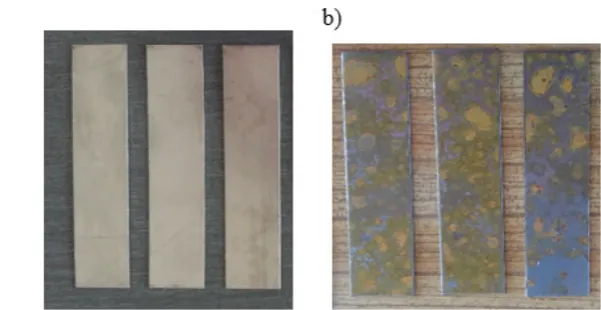
Pol-ish Norm PN-EN 10027-1 [16]). Table 1 shows a selection of steel material mechanical properties. The tests were carried out on S235JR steel speci-mens with (Fig. 1b) or without corrosion products on the surface (Fig. 1a).
S235JR steel sheet specimens shown in Fig. 1a were characterised by smooth, homogeneous metallic surface with no signs of corrosion. The surface of corroded steel sheet specimens (Fig. 1b) was covered with a considerable amount of corro-sion debris, distributed unevenly on the specimen: in certain places, the surface of specimens showed no signs of corrosion. Corrosion on the surface of specimens usually took form of irregular spots of various sizes that were yellow-brown in colour. Corrosion products were strongly bonded with the substrate, however, a certain portion of loosely bonded corroded material could be observed.
Cleaning agents
Surface treatment consisted in cleaning the sur-face of adherends with three types of products: ace-tone, Wiko industrial degreasing agent and Cortanin
Fig. 1. S235JR steel specimens: a) non-corroded specimen, b) corroded specimen
Table 1. Mechanical properties of S235JR steel [16]
Property
Minimum yield strength
Re
MPa
Tensile strength
Rm MPa
Minimum elongation
Amin %
Notch impact,
J
Value 235 360-510 18 27
Table 2. Physicochemical properties of acetone [17]
Property Density at 20°C,g/cm3 Viscosity at 20°C,mPas Melting point,°C Boiling point,°C Flash point,°C Auto-ignition temp,°C
Value 0.79 0.33 -94.8 56.2 -19 540
Table 3. Wiko industrial degreasing agent content [18]
Property Petroleum,% Acetone,% Isobutane,% Propane,% Carbon dioxide, %
F anti-corrosion agent. Tables 2-4 show selected properties features of the products in question.
Acetone (C3H6O) is a chemical compound belonging to ketone family. Its physicochemical properties, such as low viscosity, water miscibil-ity and the fact that it is also miscible with cer-tain organic solvents makes it a widely applied general purpose solvent. Industrial degreasing agent, Wiko, comes in a form of a highly-concen-trated aerosol and is applied in various assembly processes. Cortanin F anti-corrosion agent is an aqueous alcoholic solution of tannin with an ad-dition of phosphate corrosion inhibitors and sur-face-active agents. It chemically bonds corrosion products in a stable complex with tannin, which prepares the surface for further operations con-nected with adhesive bonding.
Degreasing and anti-corrosion agents remove various contamination, oils or metal powder from the surface of substrates. A fundamental property of an anti-corrosion agent is bonding corrosion prod-ucts that cover the substrate surface. Specimens treated with degreasers and anti-corrosion agents are properly prepared for adhesive bonding, and the joint formed on such surfaces exhibits higher quality.
Adhesive joint design and assembly
The tests analysed single lap adhesive joints of S235JR steel sheet formed on corroded and corro-sion-free substrates, whose shape is shown in Fig-ure 2.The dimensions of joints assembled in the study were: overlap length lz = 16.5 mm, speci-men thickness g = 1 mm, joint width b = 25 mm, adhesive thickness 0.12 mm.
The surface of substrates was cleaned with three types of cleaning agents: acetone, degreas-ing agent Wiko, and anti-corrosion agent Cortanin F. Corroded specimens were divided into three groups, each subjected to surface pre-treatment
with a different cleaning agent. Specimens free of
corrosion products were degreased with acetone. In acetone treatment, acetone was applied on the surface of substrates and then dried. The proce-dure was repeated three times for each specimen, however, the last coat of acetone was left to dry for 2 minutes. A similar application procedure was followed in cleaning with Wiko degreasing agent,
where after the third application the degreaser was left to dry for approximately 5 minutes.
The anti-corrosion agent was applied on the surface of adherends with a brush. Afterwards the samples were left to rest for 24 hours, during which time the anti-corrosion agent could fully bond the products of corrosion covering the surface of steel sheets. After the time required for full activation of the anti-corrosion agent, subsequent operations leading to joint assembly were performed.
Adhesive joints were produced with Epidian 53 epoxy-based adhesive with ET amine curing agent. The desired adhesive composition was ob-tained by mixing resin and curing agent at a ratio of 100:15 for 2 minutes at ambient temperature of 24-26°C and air humidity of approx. 31-32%, until the consistency of the mixture was properly uniform. The adhesive was applied on the pre-treated surface of substrates by means of a
spatu-la, so that the thin film of the adhesive was spread
evenly and was free of undesired air bubbles. The adhesive was applied on one of the substrates. The application procedure was carried out im-mediately after blending the adhesive, bearing in mind the pot life of the mixture, whose properties
are guaranteed within the specified time. Joints
was assembled as soon as the adhesive was
ap-plied, bearing in mind the specified lap length.
Adhesive joints were assembled at ambient tem-perature of approx. 24-26°C and air humidity of approx. 31-32%. The load of 0.06 MPa was ap-plied to the curing joint for 48 h. The cure time was 7 days. The assembled joints were divided
into three groups, each subjected to different age
-ing time. The three tested age-ing variants were: 14 days, 2 months and 3 months (Table 5).
Table 4. Physicochemical properties of Cortanin F anti-corrosion agent [19]
Property Density at 20°C, g/cm3
Solidification
point,°C Boiling point, °C Flash point,°C pH
Value 1.05 – 1.11 -20 85 32 1 - 2
The 12 series of joints, consisting of 8-10 spec-imens each, were produced according to the con-siderations shown in Table 5. Upon reaching the subsequent ageing time marks, the joints were sub-jected to further strength tests. The shear strength of joints was tested on Zwick/Roell Z150 testing machine according to DIN EN 1465 standard [20], at temperature of 21±1°C and humidity 31%. The
specified test speed was equal to 5 mm/min.
TEST RESULTS AND COMPARATIVE
ANALYSIS
Adhesive joints strength - non-corroded substrates
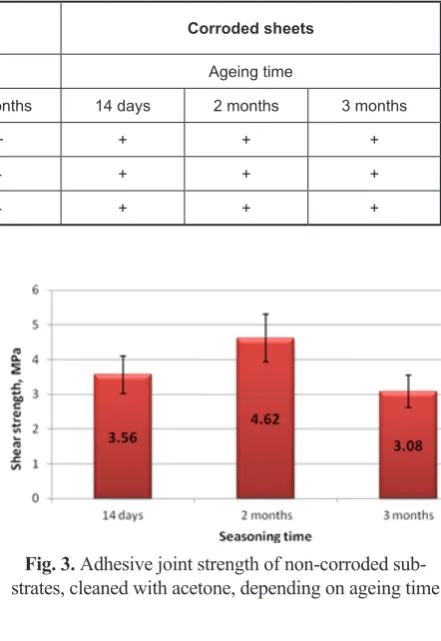
The comparison of shear strength of non-corroded steel sheet joints cleaned with acetone depending on ageing time is shown in Figure 3.
As shown in Figure 3, the highest joint strength was observed in joints subjected to 2 months of ageing. The average strength amounted to 4.62 MPa, which was higher than in the remain-ing variants by 1.06 MPa and 1.54 MPa. The av-erage strength of non-corroded substrates cleaned
with acetone after 14 days of ageing amounts to 77% of maximum obtained strength. The mini-mum strength of joints subjected to ageing for 3 months was equal to 3.08 MPa, corresponding to 67% of the strength of joints after 2 months.
Adhesive joint strength – corroded substrates – ageing time
The effect of time of exposure to ageing on
the strength of analysed joints of corroded steel sheet substrates depending on the applied cleaning
Table 5. Research variants Type of
substrate Non-corroded sheet Corroded sheets
Cleaning agent Ageing time Ageing time
14 days 2 months 3 months 14 days 2 months 3 months
Acetone + + + + + +
Wiko - - - + + +
Cortanin F - - - + + +
Fig. 3. Adhesive joint strength of non-corroded sub-strates, cleaned with acetone, depending on ageing time
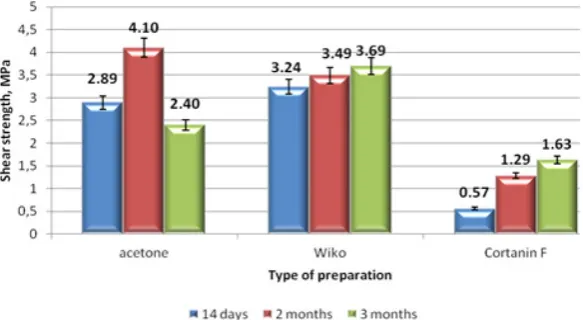
solution is shown in Figure 4. The analysis of ex-posure time of 14 days concludes that the highest joint strength in the ageing variant in question was exhibited in specimens where the substrates’ sur-face was pre-treated with Wiko industrial degreas-ing agent, in which case the strength was equal to 3.24 MPa. Joints of acetone-cleaned substrates ex-hibited the strength of 2.89 MPa, which amounts to 89% of maximum strength obtained in tests. It was, furthermore, noted that the application of the
anti-corrosion agent significantly decreased joint
strength, which did not amount to more than 0.57 MPa. Such a low value of shear strength amounts to mere 18% of the strength observed in speci-mens pre-treated with Wiko degreaser.
The results obtained for specimens after 2 months of exposure to ageing revealed that the highest strength was obtained in joints subjected to acetone pre-treatment. The average strength value noted for the joint variant in question was equal to 4.10 MPa, which was higher than in the case of remaining variants. A further comparison revealed that in joints whose substrates were pre-treated with Wiko industrial degreasing agent, the strength obtained after 2-month exposure was still considerable, corresponding to 85% of the maximum strength. The highest discrepancy in lap shear strength was observed in specimens treated with acetone and anti-corrosion agent, and is equal to 2.81 MPa. The strength of 1.29 MPa amounts to mere 30% of maximum strength. In joints exposed to ageing for 3 months it was
ob-served that lap shear strength values for differ
-ent surface treatm-ent ag-ents showed significant differences. Joints cleaned with Wiko degreasing
agent produced strength on a high level of 3.69 MPa, which exceeds the joint strength measured
for the remaining two surface treatment variants. Acetone-treated substrates formed joints whose strength amounted to 65% of maximum strength, whereas the lowest lap shear strength was ob-served in specimens subjected to treatment by means of the anti-corrosion agent, in which case it was equal to 1.63 MPa, i.e. 44% of maximum strength of joints cleaned with Wiko degreaser.
Adhesive joint strength – corroded substrates – surface pre-treatment
The effect of surface treatment on joint
strength of corroded steel sheet substrates depend-ing on time of exposure to agedepend-ing is shown in Fig. 5. As shown in Fig. 5, the highest strength was obtained in adhesive-bonded joints of corroded substrates that were prepared for bonding through cleaning with acetone and subjected to ageing for two months. The strength in those joints amount-ed to 4.10 MPa, and constitutamount-ed the highest notamount-ed among the tested ageing variants. The exposure times of 14 days and 3 months produced joints whose strength corresponded to respectively 70% and 58% of the lap shear strength exhibited by joints after 2-month exposure time. Furthermore, it was observed that the strength of joints of corroded substrates that were subjected to pre-treatment with Wiko industrial degreasing agent was rather consistent in all ageing variants. The highest joint strength was obtained after 3-month exposure time, 3.69 MPa. In the remaining cases, i.e. the exposure of 14 days and 2 months, the ob-tained joint strength amounted to 3.24 MPa and 3.49 MPa respectively, which is equal to 88% and 95% of the maximum obtained strength. The scatter of results is considerably low, which
cates high repeatability of strength values exhib-ited by adhesive-bonded specimens which were pre-treated with Wiko degreaser. The strength of joints increases with exposure time. In addition, it was noted that the strength of corroded specimens cleaned with anti-corrosion agent was consistently low. The minimal strength obtained in the tests was exhibited by joints exposed to ageing for 4 days, and was equal to 0.57 MPa. This value correspond-ed to only 35% of the maximum strength of the joint in question, which amounted to 1.63 MPa and was observed in the exposure time of 3 months.
As shown, that particular strength values measured in tests are characterised by high vari-ance with regards to time of exposure to ageing of the produced joints. The highest strength was exhibited by joints of substrates pre-treated with Wiko degreaser and subjected to ageing after assembly for 2 months. On the opposite end of the scale were joints pre-treated with Cortanin F anti-corrosion agent and exposure time of 14 days. In joints whose substrates were subjected to treatment with Wiko degreaser and anti-corro-sion agent, the strength demonstrates steady im-provement over exposure. For acetone, the high-est strength was developed after the joints have been aged for 2 months, beyond which point it begins to decrease, to reach its lowest value after 3 months. The comparative analysis of test re-sults proved that the lowest-strength joint were produced with corroded substrates whose sur-face had been cleaned by means of anti-corrosion agent, Cortanin F. Furthermore, the lowest scatter of strength values was observed in joints subject-ed to cleaning with Wiko industrial degreasing agent. The study, therefore, concludes that apart from surface pre-treatment, it is also exposure
time that is of high impact on lap shear strength of joints in tensile tests.
Comparative analysis – the bonding surface condition and joint strength
In order to determine the effect of the state
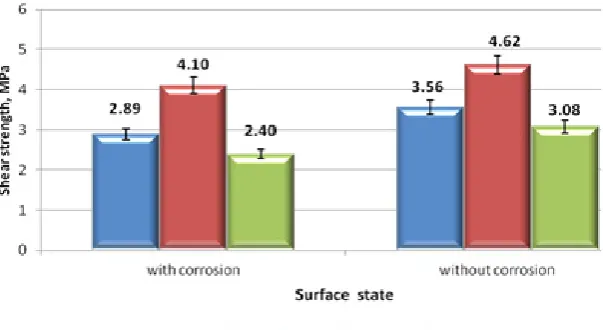
of surface on the strength of joint, the values obtained for corroded and non-corroded speci-mens depending on exposure time of particular joints were compared. The results of compari-son were collated and are shown in Figure 6.
The surface condition of substrates has a
considerable influence on the strength of ad
-hesive-bonded joint. The strength observed in joints of non-corroded substrates was char-acterised by higher values than in the case of corroded steel sheets, regardless of exposure time. This could result from better adhesion of the epoxy to the surface with no corrosion debris loosely bound to the substrate. In sheets covered with rust, the load necessary to detach them from the surface they covered was lower. Therefore, the highest joint strength was ob-tained when the surface was cleaned with ac-etone and the joint was exposed to ageing for 2 months. Corroded sheets produced joints whose strength amounted to 4.10 MPa, i.e. 89% of the strength of non-corroded substrates, which was equal to 4.62 MPa. Among the analysed values, the average strength was produced by joints af-ter 14 days of exposure. In corroded specimens this amounted to 2.89 MPa, which, compared with 3.56 MPa of non-corroded specimens, amounted to 81% of the latter. The lowest strength values were noted in joints subjected to ageing for 3 months; the strength of 2.4 MPa
exhibited by corroded specimens amounted to 78% of 3.08 MPa, which was recorded for specimens with no corrosion products. The de-termined percentage values indicate that the re-lationship between the strength of corroded and non-corroded specimens is relatively constant for all ageing exposure time variants. This indi-cates that it is possible to increase the designed joint strength, even by 0.5 MPa as it was shown in the presented tests, when joined substrates are free from corrosion products.
Statistical analysis of strength test results
Statistical analysis of results obtained in strength tests consisted in comparing values of adhesive joint strength of S235JR steel sheets, whose surface was
subjected to pre-treatment by means of different
degreasing agents and exposed to ageing for a
speci-fied length of time. The labels for particular series of
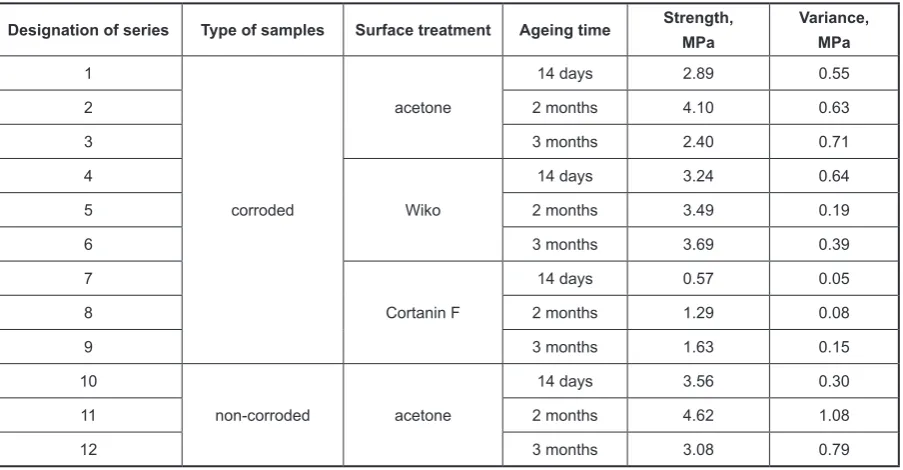
test specimens are shown in Table 6. The statistical analysis procedure was presented in [21].
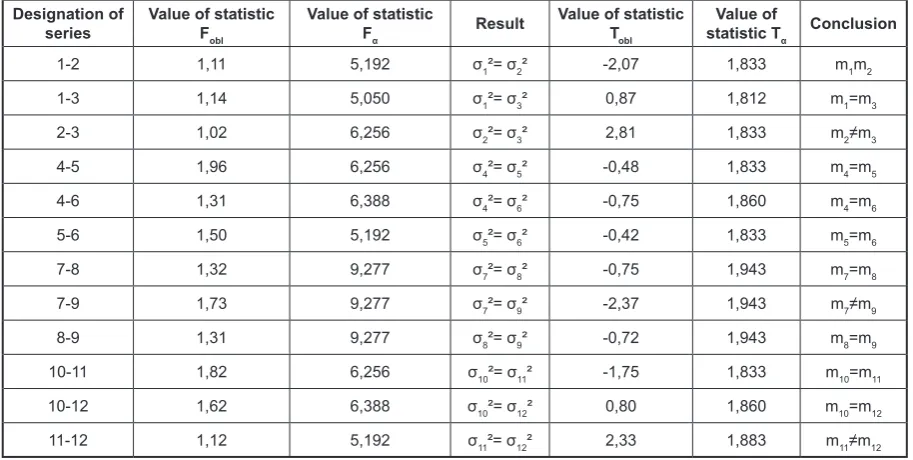
Data collected in Table 6 constituted the ma-terial for statistical analysis (Table 7) carried out
by means of different mathematical models and statistical tests for different variants, which ac -counted for adhesive-bonded joints produced with specimens subjected to surface –
pre-treat-ment with different cleaning agents. The con
-ducted Snedecor’s F-Distribution test showed whether the variances of two populations are equal, whereas the Student’s t-test determined the equality of means.
Statistical analysis of the results obtained in lap shear tests shows that in each case the vari-ances are statistically equal. Therefore, for all the analysed adhesive joints of S235JR steel sheet
substrates subjected to treatment with different
cleaning agents and aged for a particular time there exists no basis for rejecting the hypothesis of equality of variances. This proves that strength test results of such pairs are not statistically
sig-nificant for two variances at the level of signifi
-cance equal to α = 0.05.
The conducted statistical reasoning for equal-ity of means indicates that for all analysed models in variants 1-2, 2-3, 7-9 and 11-12 the hypothesis of equality of means was rejected. In the remain-ing comparison variants the hypothesis of
equal-ity of means was confirmed.
CONCLUSIONS
The analysis of test results concludes that both the surface condition of substrates and the applied pre-treatment method for the prepara-tion of bonded surfaces as well as exposure time to ageing have a paramount impact on the qual-ity and strength of produced adhesive joints. Lap shear strength of joints in tensile tests showed that the highest strength was exhibited by joints cleaned with acetone and subjected to age-ing after bondage-ing for the period of 2 months, in which conditions the strength amounted to 4.10 MPa and surpassed the strength produced
Table 6. Strength values and test variance for particular joint variants
Designation of series Type of samples Surface treatment Ageing time Strength, MPa
Variance, MPa 1
corroded
acetone
14 days 2.89 0.55
2 2 months 4.10 0.63
3 3 months 2.40 0.71
4
Wiko
14 days 3.24 0.64
5 2 months 3.49 0.19
6 3 months 3.69 0.39
7
Cortanin F
14 days 0.57 0.05
8 2 months 1.29 0.08
9 3 months 1.63 0.15
10
non-corroded acetone
14 days 3.56 0.30
11 2 months 4.62 1.08
by any other joint variant. In addition, a further analysis of test results proved that the lowest strength of joints was produced when bonding corroded steel sheet substrates that were cleaned by means of an anti-corrosion agent, Cortanin F, and ranged from 0.57 to 1.63 MPa, regardless of the exposure time.
The comparative analysis showed that the strength of joints increases gradually over time when the adhered surfaces are cleaned with Wiko industrial degreasing agent and anticorrosion agent. Joints pre-treated with acetone, however, obtain the maximum strength after exposure time of 2 months, after which time the strength of the joints in question decreases to exhibit the low-est strength recorded for acetone after 3 months. Furthermore, the lowest scatter of results was observed in joints treated with Wiko industrial degreaser, and ranged between 3.24-3.69 MPa. A further conclusion drawn after analysis of test results is that strength values exhibited by joints with no corrosion debris on the surface of adher-ends is characteristically higher than joints of cor-roded substrates, regardless of ageing exposure time. Better adhesion of the epoxy to the surface with no corrosion debris, which is loosely bound to the substrate, could account for the higher joint strength of non-corroded substrates. On the basis of our data we could produce more rigid or more
flexible joints, depending on the requirements of
a particular application. To recapitulate, there are
several factors that contribute to the final strength
and quality of adhesive joints, including the con-dition of surface, surface preparation and ageing exposure time. To produce joints of the best pos-sible quality and strength, an engineer must select the most proper substrate that would be free from corrosion debris, apply suitable surface treatment before bonding and leave the joint for a particular ageing time after the joint is formed. The utmost consideration in selecting the substrate material, preparing the surface for adhesive joining and ageing joints for a proper time period is condu-cive to obtaining joints of desired properties.
REFERENCES
1. Brockmann, W., Geiß, P.L., Klingen, J., Schröder, B.: Adhesive Bonding. Materials, Applications and Tech-nology. Germany: Wiley-VCH, Weinheim; 2009. 2. Ebnesajjad, S.: Adhesives Technology Handbook.
2nd edition: William Andrew Publishing; 2008. 3. Adams, R.D., Comyn, J., Wake, W.C.: Structural
Adhesive Joints in Engineering Book, 2nd edition. UK: Springer; 1997.
4. da Silva, L.F.M., Carbas, R.J.C., Critchlow, G.W.,
Figueiredo, M.A.V., Brown, K.: Effect of mate -rial, geometry, surface treatment and environment on the shear strength of single lap joints. Inter-national Journal of Adhesion and Adhesives, 29, 2009, 621-632.
5. Rudawska, A.: Surface Free Energy and 7075 Alu-minium Bonded Joint Strength Following Degreas-ing Only and Without Any Prior Treatment. Jour-Table 7. Statistical analysis of lap shear strength of adhesive-bonded S235JR steel sheets
Designation of
series Value of statistic Fobl Value of statistic Fα Result Value of statistic Tobl statistic TValue of α Conclusion
1-2 1,11 5,192 σ1²= σ2² -2,07 1,833 m1m2
1-3 1,14 5,050 σ1²= σ3² 0,87 1,812 m1=m3
2-3 1,02 6,256 σ2²= σ3² 2,81 1,833 m2≠m3
4-5 1,96 6,256 σ4²= σ5² -0,48 1,833 m4=m5
4-6 1,31 6,388 σ4²= σ6² -0,75 1,860 m4=m6
5-6 1,50 5,192 σ5²= σ6² -0,42 1,833 m5=m6
7-8 1,32 9,277 σ7²= σ8² -0,75 1,943 m7=m8
7-9 1,73 9,277 σ7²= σ9² -2,37 1,943 m7≠m9
8-9 1,31 9,277 σ8²= σ9² -0,72 1,943 m8=m9
10-11 1,82 6,256 σ10²= σ11² -1,75 1,833 m10=m11
10-12 1,62 6,388 σ10²= σ12² 0,80 1,860 m10=m12
11-12 1,12 5,192 σ11²= σ12² 2,33 1,883 m11≠m12
nal Adhesion Science and Technology, 26, 2012, 1233-1247.
6. Bouquet, F., Cuntz, J.M., Coddet, C.: Influence of
surface treatment on the durability of stainless steel sheets bonded with epoxy. Journal of Adhesion Science and Technology, 6, 1992, 233-242.
7. Rudawska, A.: Selected aspects of the effect of
mechanical treatment on surface roughness and adhesive joint strength of steel sheets. Interna-tional Journal of Adhesion and Adhesives, 50, 2014, 235-243.
8. Rudawska, A., Reszka, M., Warda, T., Miturska, I.,
Szabelski, J., Stančekova, D., Skoczylas, A.: Mill -ing as a methoof surface pre-treatment of steel for adhesive bonding, Journal of Adhesion Science and Technology, 2016, http://dx.doi.org/10.1080/0 1694243.2016.1191585.
9. Le Bozec, N., C. Compere, C., L’Her, M., Laouenan, A., Costa, D., Marcus, P.: Infuence of stainless steel surface treatment on the oxygen re-duction reaction in seawater. Corrosion Science, 43, 2001, 765–786.
10. Maeda, S.: Surface chemistry of galvanized steel sheets relevant to adhesion performance. Progress in Organic Coatings, 28, 1996, 227-238.
11. Elsner, C.I., Cavalcanti, E., Ferraz O., Di Sarli, A.R.:
Evaluation of the surface treatment effect on the an -ticorrosive performance of paint systems on steel. Progress in Organic Coatings, 48, 2003, 50-62.
12. Santágata, D.M., Seré, P.R., Elsner, C.I., Di Sarli,
A.R.: Evaluation of the surface treatment effect on the
corrosion performance of paint coated carbon steel. Progress in Organic Coatings, 33, 1998, 44-54. 13. Laouar, L., Hamadache, H., Saad, S.,
Bouchela-ghem, A., Mekhilef, S.: Mechanical surface treat-ment of steel - Optimization parameters of regime. Physics Procedia, 2, 2008, 1213-1221.
14. Seré, P.R., Armas, A.R., Elsners, C.I., Di Sarli,
A.R.: The surface condition effect on adhesion and
corrosion resistance of carbon steel/chlorinated
rubber/artificial sea water systems. Corrosion Sci -ence, Vol. 38, No. 6, 1996, 853-866.
15. Surowska B.: Wybrane zagadnienia z korozji i
ochrony przed korozją. Politechnika Lubelska, Lublin 2002 r.
16. PN-EN 10027-1: 2007: Systemy oznaczania stali -
Część 1: Znaki stali.
17. http://www.poch.com.pl (accessed on 26.04.2016) 18. http://pl.gluetec-industrieklebstoffe.de (accessed
on 26.04.2016)
19. https://strona.organika.com.pl (accessed on 26.04.2016)
20. DIN EN 1465. Adhesives. Determination of tensile lap-shear strength of bonded joints.
21. Krysicki, W., i inni: Rachunek
prawdo-podobieństwa i statystyka matematyczna
w zadaniach. Część II. Statystyka matematyczna.