The Journal of Threatened Taxa (JoTT) is dedicated to building evidence for conservation globally by publishing peer-reviewed articles online every month at a reasonably rapid rate at www.threatenedtaxa.org. All articles published in JoTT are registered under Creative Commons Attribution 4.0 International License unless otherwise mentioned. JoTT allows unrestricted use, reproduction, and distribution of articles in any medium by providing adequate credit to the author(s) and the source of publication.
www.threatenedtaxa.org
ISSN 0974-7907 (Online) | ISSN 0974-7893 (Print) Building evidence for conservation globally
Journal of Threatened Taxa
For Focus, Scope, Aims, Policies, and Guidelines visit https://threatenedtaxa.org/index.php/JoTT/about/editorialPolicies#custom-0 For Article Submission Guidelines, visit https://threatenedtaxa.org/index.php/JoTT/about/submissions#onlineSubmissions For Policies against Scientific Misconduct, visit https://threatenedtaxa.org/index.php/JoTT/about/editorialPolicies#custom-2
For reprints, contact <[email protected]>
Communication
The pattern of waterbird diversity of the trans-Himalayan
wetlands in Changthang Wildlife Sanctuary, Ladakh, India
Pushpinder Singh Jamwal, Shivam Shrotriya & Jigmet Takpa
26 January 2020 | Vol. 12 | No. 1 | Pages: 15129–15139 DOI: 10.11609/jott.5122.12.1.15129-15139
Partner
Member
Threatened Taxa
Publisher & Host
PLATINUMOPEN ACCESS
15129 Editor: Carol Inskipp, Bishop Auckland Co., Durham, UK. Date of publication: 26 January 2020 (online & print) Citation: Jamwal, P.S., S. Shrotriya & J. Takpa (2020). The pattern of waterbird diversity of the trans-Himalayan wetlands in Changthang Wildlife Sanctuary, Ladakh,
India. Journal of Threatened Taxa 12(1): 15129–15139. https://doi.org/10.11609/jott.5122.12.1.15129-15139
Copyright: © Jamwal et al. 2020. Creative Commons Attribution 4.0 International License. JoTT allows unrestricted use, reproduction, and distribution of this article in any medium by providing adequate credit to the author(s) and the source of publication.
Funding: Department of Wildlife Protection, Leh-Ladakh.
Competing interests: The authors declare no competing interests.
Author details: Pushpinder Singh Jamwal is working on the ecology of otters along Indus River and its tributaries in Ladakh region of India. Shivam Shrotriya’s
research focuses on Himalayan Wolf along with other large mammals in the Trans-Himalayan landscape of Ladakh. Jigmet Takpa undertook several initiatives on biodiversity conservation, rural development and renewable energy in Ladakh.
Author contribution: PSJ and JT conceptualised and designed the study. PSJ and SS collected the data, analysed and wrote the manuscript. All the authors
reviewed the final manuscript.
Acknowledgements: We express our gratitude to Mr. A.K. Singh, PCCF, Department of Wildlife Protection, Government of Jammu & Kashmir, India for permission
to conduct this study. Mr. Intesar Suhail and Mr. Tsering Angchok, wildlife warden of Leh during the survey, are acknowledged for their support in fieldwork. We thank Mr. Neeraj Mahar, WII for reading and reviewing an early draft of this article.
The pattern of waterbird diversity
of the trans-Himalayan wetlands
in Changthang Wildlife Sanctuary, Ladakh, India
Pushpinder Singh Jamwal 1 , Shivam Shrotriya 2 & Jigmet Takpa 3
1 University of Molise, Department of Biosciences and Territory, Pesche 86090, Italy. 2 Wildlife Institute of India, P.O. Box 18, Chandrabani, Dehradun, Uttarakhand 248001, India. 3 Ministry of Environment, Forest and Climate Change, Government of India, New Delhi 110003, India.
1 [email protected] (corresponding author), 2 [email protected], 3 [email protected] Journal of Threatened Taxa | www.threatenedtaxa.org | 26 January 2020 | 12(1): 15129–15139
Abstract: Ladakh lies on an important bird migratory route between the Palearctic and the Indian sub-continent, and the high altitude
migratory species utilise Ladakh frequently as a stopover site. The trans-Himalayan landscape in Ladakh also serves as a breeding site for many water birds species including the globally threatened Black-necked Crane Grus nigricollis. Yet, only sporadic information is available on the status and diversity of waterbirds here. In a landscape-level assessment study spanning over 27,000km2 area, we surveyed 11 major high-altitude wetlands of Changthang Wildlife Sanctuary, Ladakh during the pre-winter season of the year 2013. We recorded a total of 38 waterbird species belonging to 10 families, including one species in Vulnerable and two species in Near Threatened categories of IUCN Red List. We calculated species diversity and richness indices to compare the wetlands. Statapuk Tso and Tsokar were the most diverse wetlands of the sanctuary (Shannon diversity 2.38 and 2.08, respectively). We used principal component analysis to find out the wetlands with unique species assemblage and identify the sites with high conservation value. We also observed a directional pattern of diversity among the wetlands of Ladakh. We provide a reminder that wildlife even in protected areas should be surveyed regularly with the sources of threats to their conservation documented carefully.
Keywords: Black-necked Crane, conservation management, migratory birds, point count survey, species assemblage, tourism. ISSN 0974-7907 (Online) | ISSN 0974-7893 (Print)
C o m m u n i c a t i o n #5122 | Received 28 May 2019 | Final received 20 November 2019 | Finally accepted 17 January 2020
DOI: https://doi.org/10.11609/jott.5122.12.1.15129-15139
INTRODUCTION
Waterbirds are an essential component of wetland ecosystems and serve as bio-indicators and models to monitor the health of wetlands (Urfi et al.2005). Aquatic birds function at multiple trophic levels in the wetland food webs, thus reflecting the changes in different ecosystem components (Custer & Osborne 1977; Grimmett et al. 2011). The Convention on wetlands or the Ramsar Convention stresses the importance of waterfowl habitats. Conserving and managing wetlands over vast landscapes, however, requires extensive resources, is cumbersome and often difficult to achieve. For practical reasons, it is important that wetlands supporting important species assemblages are identified and protected (Young et al. 2014). Avifauna diversity parameters such as species richness, diversity and density of the birds frequently provide information on habitat quality and are crucial to wetland management (Nilsson & Nilsson 1978; Sampath & Krishnamurthy 1990; Colwell & Taft 2000).
India harbours more than 4,000 high altitude lakes, and most of those are situated in the trans-Himalayan Ladakh region (Space Applications Centre 2011). Ladakh is the westward extension of the Tibetan Plateau. The Indus Valley in Ladakh is a crucial bird migratory route between the Palearctic and the Indian sub-continent (Williams & Delany 1986; Ali & Ripley 1988). As many as 319 bird species, making about 26% of Indian avifauna, are reported from Ladakh; and out of these 44 species are waterbirds (Pfister 2004; Chandan et al. 2008; Hussain et al. 2008). Ladakh is the only known breeding ground of Black-necked Crane Grus nigricollis in India
(Chandan et al. 2006). Other waterbird species that breed in Ladakh are Bar-headed Goose Anser indicus,
Brown-headed Gull Chroicocephalus brunnicephalus,
Common Merganser Mergus merganser, Common
Redshank Tringa totanus, Common Tern Sterna hirundo,
Great Crested Grebe Podiceps cristatus, Ruddy Shelduck
Tadorna ferruginea, and Lesser Sand Plover Charadrius mongolus (Prins & Wieren 2004; Chandan et al. 2008; Hussain et al. 2008; Humbert-Droz 2011).
Only a few sporadic scientific studies on waterbirds in the Indian trans-Himalaya have been conducted so far, leaving a significant information gap. Except for a few studies on waterbirds at specific high altitude wetlands (Mishra & Humbert-Droz 1998; Hussain & Pandav 2008; Namgail et al. 2009; Chandan 2015), there has been no attempt made to study waterbirds of Ladakh at the landscape level. We surveyed 11 major high-altitude wetlands of Ladakh during the pre-winter
season from 15 September to 15 November 2013, when bird migration towards India takes place. Here, we provide an inventory of migratory waterbirds of Ladakh and report on the species richness and diversity of the wetlands. We also highlight the critical wetlands that support a high diversity and threatened bird species.
MATERIAL AND METHODS
Study area
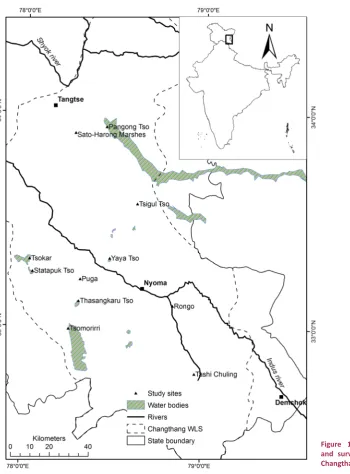
Ladakh constitutes the trans-Himalayan landscape bordering Tibet (China). A high number of wetlands including 22 lakes and Indus river catchment are located in Changthang Wildlife Sanctuary (CWS) in eastern Ladakh (Chandan et al. 2006). CWS spans about 27,000km2 between 32.317–34.583 0N and 77.750– 79.300 0E at an average altitude of 4,000m. CWS is an important highland grazing system in the cold desert biotope with a short summer and Arctic-like winter. Powerful and unpredictable winds make the area highly inhospitable; temperature ranges from 0°C to 30°C during summer and from -10°C to -40°C during winter (Mishra & Humbert-Droz 1998; Chandan 2015). Most of the wetlands in Ladakh are of glacial origin and remain frozen from December to March. Several brackish and freshwater wetlands here are home to a wide variety of flora and fauna. We surveyed 11 major wetlands (>0.4
km2) in CWS: Pangong Tso, Puga, Rongo, Sato-Harong Marshes, Statapuk Tso, Tashi Chuling, Thasangkaru Tso, Tsigul Tso, Tsokar, Tsomorirri, and YayaTso (Figure 1, Table 1).
Data collection
Waterbird diversity pattern of Changthang Wildlife Sanctuary Jamwal et al.
Journal of Threatened Taxa | www.threatenedtaxa.org | 26 January 2020 | 12(1): 15129–15139 15131
J
TT
the Red List classification of IUCN (IUCN 2019).
Data analysis
We calculated Shannon-Weiner diversity index SDI (Hutchison 1970), Margalef’s richness index MRI (Margalef 1958), Pielou’s evenness index PEI (Pielou 1966), and McNaughton’s community dominance index CDI (McNaughton 1968) to compare the species richness and diversity across the sites. We performed principal component analysis with Bray-Curtis distances on the species assemblage to develop a minimum spanning tree of the surveyed wetlands (Bray & Curtis 1957; Gower 1966). Minimum spanning tree is closely
related to single linkage clustering. All the analyses were performed in statistical program R, version 3.4.4 (R Core Team 2018) using the package “vegan”, version 2.4-6 (Oksanen et al. 2018).
RESULTS
Recurvirostridae (5% each), and Ardeidae, Gruidae and Motacillidae (2.6% each). Bar-headed Goose, Common Merganser, Common Sandpiper Actitis hypoleucos,
Northern Pintail Anas acuta, and Ruddy Shelduck
Tadorna ferruginea were the most abundant species, while less than five individuals were recorded for Black-winged Stilt Himantopus himantopus, Kentish Plover
Charadrius alexandrinus, Pacific Golden Plover Pluvialis fulva, Pallas’s Gull Ichthyaetus ichthyaetus, Red-crested
Pochard Netta rufina, and Water Rail Rallus aquaticus.
Bar-headed Goose, Black-necked Crane Grus nigricollis,
Brown-headed Gull Chroicocephalus brunicephalus, Common Sandpiper Actitis hypoleucos, Great Crested Grebe, Northern Pintail Anas acuta and Ruddy Shelduck were the most well distributed species, recorded at more than five wetlands (Table 2).
Table 1. Location, size and survey effort of the high altitude wetlands of Ladakh in Changthang Wildlife Sanctuary.
Wetland Location (KmSize 2) Survey Points
Pangong Tso N 33.936°, E 78.447° 26.99 4 Puga N 33.223°, E 78.318° 0.84 4 Rongo N 33.105°, E 78.835° 1.66 3
Sato-Harong Marshes N 33.905°, E 78.274° 6.34 4
Statapuk Tso N 33.256°, E 78.052° 6.09 8 TashiChuling N 32.789°, E 78.962° 0.44 4 Thasangkaru Tso N 33.121°, E 78.311° 5.48 4 Tsigul Tso N 33.579°, E 78.627° 0.89 3
Tsokar N 33.314°, E 78.035° 21.53 11
Tsomorirri N 32.991°, E 78.258° 22.19 9
Yaya Tso N 33.323°, E 78.479° 1.55 5
Waterbird diversity pattern of Changthang Wildlife Sanctuary Jamwal et al.
Journal of Threatened Taxa | www.threatenedtaxa.org | 26 January 2020 | 12(1): 15129–15139 15133
J
TT
Table 2. List of waterbird species recorded at the high altitude wetlands of Changthang Wildlife Sanctuary, Ladakh.
Family Common name Scientific name statusIUCN * Recorded at wetlands# Abundance†
Anatidae Bar-headed Goose Anser indicus LC 2,3,4,5,6,8,9,10,11 1298 –1717 Anatidae Common Merganser Mergus merganser LC 5,10,11 1573–1806 Anatidae Common Pochard Aythya ferina LC 4 44–61 Anatidae Eurasian Wigeon Anas penelope LC 5,10 20–48 Anatidae Ferruginous Duck Aythya nyroca NT 1,5,10,11 40–56
Anatidae Gadwall Anas strepera LC 5 29–56
Anatidae Garganey Anas querquedula LC 5,11 58–105 Anatidae Mallard Anas platyrhynchos LC 5,8 55–76 Anatidae Northern Pintail Anas acuta LC 1,2,3,4,5,6,7,8,9,10,11 1341–1571 Anatidae Northern Shoveler Anas clypeata LC 5,10,11 48–68 Anatidae Red-crested Pochard Netta rufina LC 5 4 Anatidae Ruddy Shelduck Tadorna ferruginea LC 2,3,4,5,6,7,8,9,10,11 943–1526 Anatidae Tufted Duck Aythya fuligula LC 5,11 31–48
Ardeidae Grey Heron Ardea cinerea LC 4,5,11 7–8
Charadriidae Kentish Plover Charadrius alexandrinus LC 5,9 2–4
Charadriidae Lesser Sand Plover Charadrius mongolus LC 5,9 146–210
Charadriidae Pacific Golden Plover Pluvialis fulva LC 5 2
Gruidae Black-necked Crane Grus nigricollis VU 2,3,4,5,6,8,9,11 29–35
Laridae Brown-headed Gull Chroicocephalus brunnicephalus LC 1,3,4,5,7,9,10 563–699
Laridae Common Tern Sterna hirundo LC 2,5 8–11 Laridae Little Gull Hydrocoloeus minutus LC 5 12–56
Laridae Pallas's Gull Ichthyaetus ichthyaetus LC 3 2–4 Motacillidae Citrine Wagtail Motacilla citreola LC 5 15–18
Podicipedidae Black-necked Grebe Podiceps nigricollis LC 5,9 10–25
Podicipedidae Great Crested Grebe Podiceps cristatus LC 1,5,7,9,10,11 520–860
Rallidae Eurasian Coot Fulica atra LC 5 7
Rallidae Water Rail Rallus aquaticus LC 5 2
Recurvirostridae Black-winged Stilt Himantopus himantopus LC 5 4 Recurvirostridae Pied Avocet Recurvirostra avosetta LC 9 21–23
Scolopacidae Common Redshank Tringa totanus LC 5,10 71–101
Scolopacidae Common Sandpiper Actitis hypoleucos LC 2,3,4,5,6,7,8,9,10,11 1469–1854
Scolopacidae Common Snipe Gallinago gallinago LC 5 73–90
Scolopacidae Eurasian Curlew Numenius arquata NT 5,9 3–9
Scolopacidae Green Sandpiper Tringa ochropus LC 5,9 104–131
Scolopacidae Little Stint Calidris minuta LC 5,9 17–26
Scolopacidae Little Ringed Plover Charadrius dubius LC 2,5,9 282–486
Scolopacidae Ruff Philomachus pugnax LC 5 6
Scolopacidae Temminck's Stint Calidris temminckii LC 5,9 453–566
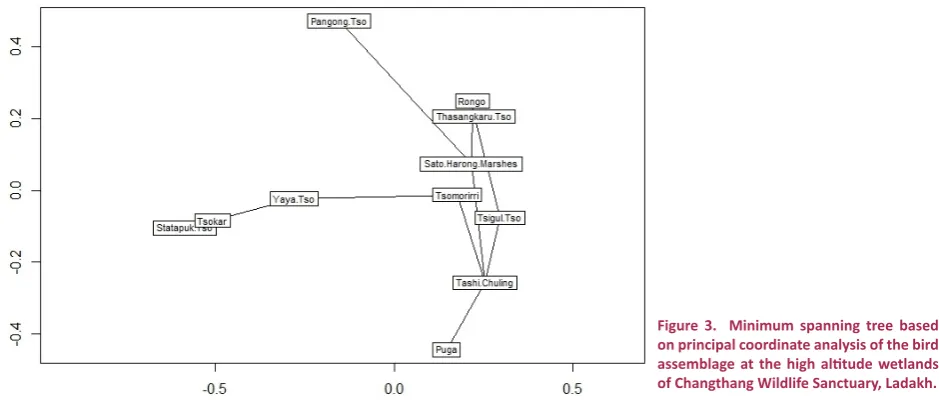
Statapuk Tso was the most diverse and species-rich wetland (SDI 2.38, MRI 3.91) with 35 species recorded there. Diversity and richness were higher at Tsokar (n=16, SDI 2.08, MRI 1.93), Yaya Tso (n=12, SDI 1.7, MRI 1.58) and Tsomoriri (n=11, SDI 2.24, MRI 1.79) as well. Pangong Tso had the lowest number of species (n=4, SDI 1.07, MRI 0.54). PEI was the highest at Thasangkaru Tso (0.98) and the lowest at Rongo (0.58), while CDI was the highest at Pangong Tso, Rongo and Tashi Chuling (0.8) and the lowest at Statapuk Tso and Tsomoriri (0.4) (Table 3). We also observed that the western wetlands held comparatively higher waterbird diversity than the eastern wetlands, revealing a directional pattern (Figure 2). We tested the hypothesis if the species diversity was affected by the size of the wetlands using paired Mann-Whitney-Wilcoxon test; and we found that wetland size does not relate with Shannon diversity (V= 53, p=0.083). Following the species assemblage, studied sites aligned into two main groups. Statapuk Tso, Tsokar, and Yaya Tso formed one group and Rongo, Thasangkaru Tso, Sato-Harong Marshes, Tsomoriri, Tsigul Tso, and Tashi Chuling formed another group. Species assemblage at Pangong Tso and Puga were distinct from each other and all other wetlands as well (Figure 3).
DISCUSSION
Measures of diversity are frequently seen as indicators of the wellbeing of ecological systems (Magurran 1988). The presence of an endangered species, however, can add to the conservation importance of a site. For effective conservation, wetlands supporting important
species, diversity and unique assemblages should be identified and protected (Young et al. 2014). Black-necked Crane was the most threatened waterbird species in our checklist, categorised as Vulnerable in the IUCN Red List (Rahmani 2012; Rahmani et al. 2015; IUCN 2019). Ladakh is the only known breeding ground of Black-necked Crane in India (Chandan et al. 2006). The species was present at all wetlands but Thasangkaru Tso, Tsomoriri and Pangong Tso. Although widespread among the surveyed wetlands, its abundance was very low (Table 2). Seasonality might have affected its sighting as the species is reported to begin migrating at the beginning of the winter season (Chandan 2015). Eurasian Curlew Numenius arquata and Ferruginous
Duck Aythya nyroca, categorised as Near Threatened in the IUCN Red List (IUCN 2019), were also sighted infrequently (Table 2). Eurasian Curlew was present at Statapuk Tso and Tsokar, whereas Ferruginous Duck was present at Statapuk Tso, Tsomoriri, Yaya Tso and Pangong Tso. We did not sample a large number of the smaller wetlands (<0.4 km2) during the present study, where a few species and individuals of threatened species might find refuge. Principal coordinates analysis of the wetlands based on their species composition indicated that Statapuk Tso, Puga and Pangong Tso are unique, falling on the farthest edges of the minimum spanning tree (Figure 3). Statapuk Tso and Tsokar hold most of the waterbird diversity and are situated together forming a complex (Chandan et al. 2014). Tsomoriri and Tsigul Tso are located at the centre of the minimum spanning tree (Figure 3), suggesting that the water-bird communities of these wetlands share common species with other wetlands as well. Tsomoriri is a high altitude Ramsar
Waterbird diversity pattern of Changthang Wildlife Sanctuary Jamwal et al.
Journal of Threatened Taxa | www.threatenedtaxa.org | 26 January 2020 | 12(1): 15129–15139 15135
J
TT
Table 3. Measurements of waterbird diversity and richness at the high altitude wetlands of Changthang Wildlife Sanctuary, Ladakh.
Wetland SpeciesTotal
Shannon-Weiner diversity index
(SDI)
Margalef’s richness index
(MRI) Pielou’s evenness index (PEI)
Community dominance index
(CDI)
Pangong Tso 4 1.07 0.54 0.77 0.8
Puga 7 1.52 1.06 0.78 0.6
Rongo 7 1.13 1.25 0.58 0.8
Sato-Harong Marshes 8 1.77 1.26 0.85 0.5
Statapuk Tso 35 2.38 3.91 0.67 0.4
Tashi Chuling 5 1.34 0.76 0.83 0.8
Thasangkaru Tso 5 1.58 1.07 0.98 0.5
Tsigul Tso 6 1.49 1.03 0.83 0.6
Tsokar 16 2.08 1.93 0.75 0.5
Tsomorirri 11 2.24 1.79 0.93 0.4
YayaTso 12 1.7 1.58 0.68 0.7
site, while Tsokar and Tsomoriri are also identified as ‘Important bird areas’ in India (Rahmani et al. 2013).
The wetlands with the highest Shannon diversity and Margalef’s richness, namely, Statapuk Tso, Tsokar,
and Tsomoriri, were all situated in the southwestern
region of CWS (Figure 2, Table 3). Other wetlands in this region, such as Yaya Tso, Puga, and Thasangkaru Tso, also hold comparatively higher diversity than that of the wetlands situated in the eastern part of the sanctuary, e.g., Tashi Chuling and Rongo (Figure 2, Table 3). Our results show that wetland size did not affect waterbird diversity. We, however, observed a directional pattern in the species diversity of wetlands of the eastern Ladakh landscape (Figure 2). In general, wetlands on the western part were comparatively more diverse than the eastern wetlands. Wetlands in the south-west seem to offer suitable habitat for the majority of waterbird species. The landscape in Ladakh opens towards Tibetan Plateau in the east, which is comparatively much drier and colder habitat. Moreover, the wetlands in the north such as Pangong Tso have steep shores, providing less area for waterbirds to establish. Therefore, geo-climatic factors might be the reason for a directional pattern of species diversity.
Worldwide more than 50% of natural wetland areas have been lost due to human activities. This has adversely affected the hydro system, plant growth and avian communities that depend on wetland habitats directly and indirectly for various activities (Fraser & Keddy 2005; Coleman et al. 2008; Zakaria & Rajpar 2014). Ladakh is facing similar threats owing to growing tourism close to many of the wetlands (Chandan et al. 2006). Pangong Tso, Tsokar and Tsomoriri, three
crucial wetlands for waterbirds, are also among the prime tourist places during the summer season. Global population trend of the waterbird species recorded in Ladakh shows that 20 species (53%) are declining in number, three species (8%) have a stable population, three species (8%) are increasing, and the status of 13 species (34%) is unknown (Wetlands International 2012; Gopi et al. 2014). As much as nine waterbird species are known to breed in the area (Prins & Wieren 2004; Hussain et al. 2008; Humbert-Droz 2011). Therefore, wetlands of Ladakh hold a high conservation value. We recommend that critical areas around the wetlands need to be mapped where tourist routes and waterfowl habitats overlap, and protective measures such as restriction of access to key waterfowl habitats especially during their breeding time could be applied.
Image 1. Bar-headed Goose Anser indicus
Image 3. Black-necked Crane Grus nigricollis
Image 5. Brown-headed Gull Chroicocephalus brunnicephalus
Image 4. Black-winged Stilt Himantopus himantopus
Image 6. Common Pochard Aythya ferina Image 2. Ruddy shelduck Tadorna ferruginea
© Pushpinder Singh Jamwal
© Pushpinder Singh Jamwal
© Pushpinder Singh Jamwal
© Pushpinder Singh Jamwal
Waterbird diversity pattern of Changthang Wildlife Sanctuary Jamwal et al.
Journal of Threatened Taxa | www.threatenedtaxa.org | 26 January 2020 | 12(1): 15129–15139 15137
J
TT
Image 7. Common Redshank Tringa totanus
Image 9. Common Tern Sterna hirundo
Image 11. Eurasian Curlew Numenius arquata
Image 8. Common Snipe Gallinago gallinago
Image 10. Eurasian Coot Fulica atra
Image 12. Great-crested Grebe Podiceps cristatus
© Pushpinder Singh Jamwal © Pushpinder Singh Jamwal
© Pushpinder Singh Jamwal © Pushpinder Singh Jamwal
Image 13. Little Ringed Plover Charadrius dubius Image 14. Northern Shoveler Anas clypeata
Image 15. Bar-headed Goose Anser indicus and Ruddy Shelduck Tadorna ferruginea
© Pushpinder Singh Jamwal © Pushpinder Singh Jamwal
Waterbird diversity pattern of Changthang Wildlife Sanctuary Jamwal et al.
Journal of Threatened Taxa | www.threatenedtaxa.org | 26 January 2020 | 12(1): 15129–15139 15139
J
TT
REFERENCES
Ali, S. & S.D. Ripley (1988).Compact handbook of the birds of India and Pakistan together with those of Bangladesh, Nepal, Bhutan and Sri Lanka. 2nd edition. Oxford University Press, New Delhi, 890pp.
Bibby, C. J., N.D. Burgess & D.A. Hill (1992).Bird census techniques. Academic Press, London, 302pp.
Bray, J.R. & J.T. Curtis (1957). An ordination of the upland forest communities of southern Wisconsin. Ecological Monographs 27(4): 325–349.
Chandan, P. (2015). Breeding biology and ecology of Black-necked Cranes in selected High Altitude Wetlands of Ladakh, India. PhD Thesis. Aligarh Muslim University, Aligarh, India.
Chandan, P., M. Abbas & P. Gautam (2008). Field Guide –Birds of Ladakh. WWF-India and Department of Wildlife Protection, Government of Jammu and Kashmir, India.
Chandan, P., P. Gautam & A. Chatterjee (2006). Nesting sites and breeding success of black necked crane Grus nigricollis in Ladakh, India, pp. 311–314. In: Boere, G.C., C.A. Galbraith & D.A. Stroud (eds.). Waterbirds Around the World. The Stationery Office, Edinburgh, UK.
Chandan, P., A. Khan, J. Takpa, S.A. Hussain, K. Mehdi, P.S. Jamwal, R. Rattan, N. Khatoon, T. Rigzin, A. Anand, P.K. Dutta, T. Ahmad, P.S. Ghose, P. Shrestha & L.T. Theengh (2014). Status and distribution of Black-necked Crane (Grus nigricollis) in India. Zoological Research
35(S1): 39–50.
Coleman, J.M., O.K. Huh & D. Braud Jr. (2008). Wetland loss in world deltas. Journal of Coastal Research 24(1A): 1–14.
Colwell, M.A. & O.W. Taft (2000). Waterbird communities in managed wetlands of varying water depth. Waterbirds 23(1): 45–55. Custer, T.W. & R.G. Osborn (1977). Wading birds as biological
indicators: 1975 colony survey. Special Scientific Report - Wildlife
206.US Fish and Wildlife Service, 28pp.
de Carvalho, D.L., T. Sousa-Neves, P.V. Cerqueira, G. Gonsioroski, S.M. Silva, D.P. Silva & M.P.D. Santos (2017). Delimiting priority areas for the conservation of endemic and threatened Neotropical birds using a niche-based gap analysis. PloS ONE 12(2): e0171838. Fraser, L.H. & P.A. Keddy (2005). The World’s Largest Wetlands:
Ecology and Conservation. Cambridge University Press, New York,
488pp.
Gopi, G.V., S. Arya & S.A. Hussain (2014). Waterbirds of India: An Introduction, pp. 10-23. In: Gopi, G.V. & S.A. Hussain (eds.).
Waterbirds of India, ENVIS Bulletin: Wildlife and Protected Areas. Vol. 16. Wildlife Institute of India, Dehradun, 367pp.
Gower, J.C. (1966). Some distance properties of latent root and vector methods used in multivariate analysis. Biometrika 53(3-4): 325–338. Grimmett, R., C. Inskipp & T. Inskipp (2011). Birds of Indian
Subcontinent. 2nd Edition. Christopher Helm, London, 480pp.
Humbert-Droz, B. (2011). Trends in waterfowl populations and development of tourism in high-altitude wetlands of Ladakh, North-western India. КАЗАРКА 14: 184–202.
Hussain, S.A. & B. Pandav (2008). Status of breeding water birds in Changthang Cold Desert Sanctuary, Ladakh. Indian Forester 134(4): 469–480.
Hussain, S.A., R.K. Singh & R. Badola (2008). An ecological survey of the Trans-Himalayan Wetlands of the proposed Changthang Biosphere Reserve, India, for conservation planning. Biosphere Conservation
9(1): 53–63. https://doi.org/10.20798/biospherecons.9.1_53 Hutchison, K. (1970). A test for comparing diversity based on the
Shannon formula. Journal of Theoretical Biology 29(1): 151–154. IUCN (2019). The IUCN Red List of Threatened Species. Version 2019-1.
http://www.iucnredlist.org. Downloaded on 21 March 2019. Magurran, A.E. (1988). Why diversity? Pp. 1–5. In: Ecological diversity
and its measurement. Springer, Dordrecht, 178pp.
Margalef, R. (1958). Temporal succession and spatial heterogeneity in phytoplankton, pp. 323–347. In: Buzzati-Traverso, A.A. (ed.).
Perspectives in Marine Biology. University of California Press,
Berkeley, 621pp.
McNaughton, S.T. (1968). Structure and function in California grasslands. Ecology 49(5): 962–972.
Mishra, C. & B. Humbert-Droz (1998). Avifaunal survey of Tsomoriri Lake and adjoining Nuro Sumdo Wetland in Ladakh, Indian trans-Himalaya. Forktail 14: 65–68.
Namgail, T., D. Mudappa & T.R.S. Raman (2009). Waterbird numbers at high altitude lakes in eastern Ladakh, India. Wildfowl 59: 135–142 Nilsson, S.G. & I.N. Nilsson (1978). Breeding bird community densities
and species richness in lakes. Oikos 31: 214–221.
Oksanen, J., F.G. Blanchet, M. Friendly, R. Kindt, P. Legendre, D. McGlinn, P.R. Minchin, R.B. O’Hara, G.L. Simpson, P. Solymos, M. Henry, H. Stevens, E. Szoecs & H. Wagner (2018). vegan: Community Ecology Package. R package version 2.4-6. https://CRAN.R-project. org/package=vegan
Pfister, O. (2004).Birds and mammals of Ladakh. Oxford University Press, 392pp.
Pielou, E.C. (1966). The measurement of diversity in different types of biological collections. Journal of theoretical biology 13: 131–144.
https://doi.org/10.1016/0022-5193(66)90013-0
Prins, H.H. & S.E. van Wieren (2004). Number, population structure and habitat use of bar-headed geese Anser indicus in Ladakh (India) during the brood-rearing period. Acta Zoologica Sinica 50(5): 738– 744.
R Core Team (2018). R: A language and environment for statistical computing (v 3.4.4). R Foundation for Statistical Computing, Vienna, Austria. https://www.R-project.org/
Rahmani, A.R. (2012). Threatened birds of India: Their conservation
requirements. Indian Bird Conservation Network, Bombay Natural History Society, Royal Society for the Protection of Birds and BirdLife International. Oxford: Oxford University Press. 870pp.
Rahmani, A.R., I. Suhail, P. Chandan, K. Ahmad, & A.A. Zarri (2015).
Threatened birds of Jammu & Kashmir. Bombay Natural History Society. Oxford University Press, Oxford, 145pp.
Rahmani, A.R., Z. Islam, K. Ahmad, I. Suhail, P. Chandan & A.A. Zarri (2013).Important Bird areas of Jammu & Kashmir: Priority sites for
conservation. Indian Bird Conservation Network, Bombay Natural
History Society, Royal Society for the Protection of Birds, BirdLife International, and World Wide Fund for Nature-India. Oxford University Press, Bombay, 142pp.
Sampath, K. & K. Krishnamurthy (1990). Shorebirds (Charadriiformes) of the Pichavaram mangroves, Tamil Nadu, India. Wader Study
Group Bull 58: 24–27.
Space Applications Centre (2011). National Wetland Inventory
Assessment: High Altitude Himalayan Lakes. ISRO, Ahmedabad,
India, 24pp. http://www.moef.nic.in/sites/default/files/NWIA_ brochure_High_Altitude_Wetlands.pdf Electronic version accessed 21 March 2019.
Urfi, A.J., M. Sen, A. Kalam & T. Meganathan (2005). Counting birds in India: methodologies and trends. Current Science 89: 1997–2003. Wetlands International (2012).Waterbird Population Estimates.Fifth
edition-Summary Report. Wetlands International, Wageningen, The Netherlands, 28pp.
Williams, C. & S. Delany (1986). Migration through the northwest Himalaya–some results of the Southampton University Ladakh Expeditions, Part 2. Bulletin of the Oriental Bird Club 3: 11–16. Young, H.G., R.P. Young, R.E. Lewis, F. Razafindrajao, I. A. Bin
Aboudou & J.E. Fa (2014). Patterns of waterbird diversity in central western Madagascar: where are the priority sites for conservation?.
Wildfowl 64(64): 35–53.
Zakaria, M. & M.N. Rajpar (2014). Assessing the habitat suitability of two different artificial wetland habitats using avian community structures. American Journal of Applied Sciences 11: 1321–1331.
ISSN 0974-7907 (Online) | ISSN 0974-7893 (Print)
January 2020 | Vol. 12 | No. 1 | Pages: 15091–15218 Date of Publication: 26 January 2020 (Online & Print)
DOI: 10.11609/jott.2020.12.1.15091-15218
www.threatenedtaxa.org
in any medium by providing adequate credit to the author(s) and the source of publication.
Article
A citizen science approach to monitoring of the Lion
Panthera leo (Carnivora: Felidae) population in Niokolo-Koba National Park, Senegal
– Dimitri Dagorne, Abdoulaye Kanté & John B. Rose, Pp. 15091– 15105
Communications
Status, distribution, threats, and conservation of the
Ganges River Dolphin Platanista gangetica (Mammalia:
Artiodactyla: Cetacea) in Nepal
– Deep Narayan Shah, Amit Poudyal, Gopal Sharma, Sarah Levine, Naresh Subedi & Maheshwar Dhakal, Pp. 15106–15113
Bat (Mammalia: Chiroptera) diversity, dominance, and richness in the southwestern region of Bhutan with three new records for the
country
– Sangay Tshering, Dhan Bahadur Gurung, Karma Sherub, Sumit Dookia, Kuenzang Dorji & Pema Choephyel, Pp. 15114–15128
The pattern of waterbird diversityof the trans-Himalayan
wetlands in Changthang Wildlife Sanctuary, Ladakh, India
– Pushpinder Singh Jamwal, Shivam Shrotriya & Jigmet Takpa, Pp. 15129–15139
Composition, diversity and foraging guilds of avifauna in agricultural landscapes In Panipat, Haryana, India
– Parmesh Kumar & Sharmila Sahu, Pp. 15140–15153
An overview of fishes of the Sundarbans, Bangladesh and their present conservation status
– Kazi Ahsan Habib, Amit Kumer Neogi, Najmun Nahar, Jina Oh, Youn-Ho Lee & Choong-Gon Kim, Pp. 15154–15172
Digital image post processing techniques for taxonomic publications with reference to insects
– Nikhil Joshi, Hemant Ghate & Sameer Padhye, Pp. 15173–15180
Short Communications
Description of a new species of the genus Lampropsephus Fleutiaux, 1928 (Coleoptera: Elateridae: Elaterinae: Dicrepidiini) from Konkan, Maharashtra, India
– Amol Patwardhan & Rahul Khot, Pp. 15181–15185
Spiders (Arachnida: Araneae) from the vicinity of Araabath Lake, Chennai, India
– John T.D. Caleb, Pp. 15186–15193
Two new records of gilled mushrooms of the genus Amanita (Agaricales: Amanitaceae) from India
– R.K. Verma, V. Pandro & G.R. Rao, Pp. 15194–15200
Notes
A first record of oviposition of Common Onyx Horaga onyx Moore, 1857 (Insecta: Lepidoptera: Lycaenidae) in Sri Lanka and its importance in conserving a highly threatened butterfly
– Chathura Udayanga Herath, Pavan Bopitiya Gamage, Iroshan Rupasinghe & Moditha Hiranya Kodikara Arachchi, Pp. 15201– 15204
Additions to known larval host plants of butterflies of the Western Ghats, India
– Deepak Naik & Mohammed S. Mustak, Pp. 15205–15207
Rhynchotechum parviflorum Blume (Gesneriaceae): a new
record to mainland India
– Momang Taram, Puranjoy Mipun & Dipankar Borah, Pp. 15208–15211
Re-collection of the Luminous Lantern Flower Ceropegia lucida
Wall. (Apocynaceae) from Assam, India
– Debolina Dey, Manash Baruah, Nilakshee Devi & Jitendra Nath Borah, Pp. 15212–15215
Tetrasporidium javanicum Möbius (Chlorophyta), a rare species recorded from Arpa River in Bilaspur, Chhattisgarh, India
– Rakesh Kumar Dwivedi, Pp. 15216–15218