K
ATARZYNAR
ATAJCZAK1, K
ATARZYNAA
UGOFF2, J
ERZYG
OSK1, R
ENATAT
ABOŁA2,
R
OMANR
UTOWSKI1Lactate Dehydrogenase Isoenzymes
in Dupuytren’s Contracture
Izoenzymy dehydrogenazy mleczanowej
w patogenezie przykurczu Dupuytrena
1Department of Traumatology and Hand Surgery, Silesian Piasts University of Medicine in Wrocław, Poland 2Department of Gastrointestinal and General Surgery, Silesian Piasts University of Medicine in Wrocław, Poland
Adv Clin Exp Med 2007, 16, 2, 205–211 ISSN 1230−025X
ORIGINAL PAPERS
© Copyright by Silesian Piasts University of Medicine in Wrocław
Abstract
Background.Dupuytren’s contracture is a fibroproliferative disorder of the hand characterized by an abnormal myo/fibroblast proliferation and extracellular matrix deposition, leading to retraction and deformation of the palm. Lactate dehydrogenase (LDH, EC 1.1.1.27) is a well−known glycolytic enzyme that reversibly catalyses the con− version of pyruvate to lactate. It has been recently suggested that lactate promotes cell growth and induces an increase in collagen production.
Objectives. The aim of the present study was to examine the participation of LDH in the pathogenesis of Dupuytren’s contracture.
Material and Methods.The relative values of LDH isoenzyme activity, expressed by the LDH−A to LDH−B sub− unit ratio, were investigated in 39 pathological tissues representing four clinical stages of disease progression and 20 fragments of normal palmar fascia obtained from patients surgically treated for carpal tunnel syndrome, using an original method of native electrophoresis separation. Total LDH activity was evaluated using the COBAS INTE− GRA lactate dehydrogenase (P–L) (Roche) cassette.
Results. The study demonstrated a significantly elevated (p < 0.05) A/B ratio in the palmar fasciae with Dupuytren’s contracture (median: 2.38, range: 1.0–3.25) compared with the normal tissues (median: 1.5, range: 0.68–2.08), which is strictly associated with a shifted LDH isoenzyme pattern towards more the anaerobic isoen− zymes LDH−4 and LDH−5. Increased A/B ratio characterized pathological tissues with degree I–III of disease pro− gression. In the group with degree IV, the A/B ratio resembled that of the control values and was significantly decreased compared with the other groups of patients with contracture (p< 0.05). Also observed was a statistical− ly significant increase (p< 0.05) in total LDH activity in aponeurosis affected by Dupuytren’s contracture (medi− an: 0.96, range: 0.11–2.4) compared with normal fasciae (median: 0.62, range: 0.13–1.0).
Conclusions.Since significant differences were found in the A/B ratio and total LDH activity in fibrotic palmar aponeurosis, adaptation of the isoenzyme profile to the altered conditions (hypoxia) and participation of LDH in the pathogenesis of Dupuytren’s contracture can be suggested (Adv Clin Exp Med 2007, 16, 2, 205–211).
Key words: lactate dehydrogenase, LDH, Dupuytren’s contracture, hypoxia.
Streszczenie
Wprowadzenie. Choroba Dupuytrena (contractura/morbus Dupuytren) jest przykładem włókniakowatości guzko− watej, pojawiającej się w obrębie rozcięgna dłoni. Charakteryzuje się wzmożoną aktywnością proliferacyjną mio− /fibroblastów oraz nadmierną ekspresją i akumulacją białek macierzy zewnątrzkomórkowej, co prowadzi do trwa− łego przykurczu palców, a nawet do deformacji stawów śródręczno−paliczkowych i międzypaliczkowych. Dehy− drogenaza mleczanowa (LDH, EC 1.1.1.27) jest enzymem szlaku glikolitycznego, katalizującym odwracalnie redukcję pirogronianu do mleczanu.
Cel pracy.Ocena udziału dehydrogenazy mleczanowej w patogenezie przykurczu Dupuytrena w zależności od kli− nicznego stopnia zaawansowania choroby.
Lactate dehydrogenase (LDH, EC 1.1.1.27) is a well−known glycolytic enzyme that reversibly catalyses the conversion of pyruvate to lactate. LDH is a tetramer that exists in five isoenzyme forms, LD1 to LD5, as a result of random associa− tion of the two subunits A and B encoded by two distinct genes, ldhA and ldhB. The differences in the activities of the isoenzymes are dependent on their subunit composition. The LD1 (B4) isomer functions primarily in aerobic conditions and favors converting lactate to pyruvate. The LD5 (A4) isoform has the highest efficiency among all other isoenzymes to catalyze pyruvate to lactate and thereby plays an important role in compro− mised oxygen delivery [1]. The expression of LDH genes is generally regulated developmentally in a tissue−specific manner and undergoes changes in pathological conditions [2]. Upregulation of ldhA gen expression is tightly coupled with a strong gly− colytic metabolism and reduces the dependence of cells on the presence of oxygen [3, 4]. It was reported that microcirculation disruption, inflam− mation, or rapid cell growth and subsequent increased oxygen consumption lead to changes in LDH−A activity, resulting in over−production and accumulation of lactate [5]. Recent studies have provided evidence that the functional role of LDH−A might be more complicated [6]. Several observa− tions indicate that the A subunit also displays non− glycolytic functions, such as participation in tran− scription or DNA replication [6].
Dupuytren’s contracture (palmar fibromato− sis) is a connective tissue disorder viewed as a pro− gressive pathological process involving significant changes in cell phenotype and function and the deposition of excess matrix proteins, mainly colla− gens, in the extracellular space of the palmar aponeurosis, resulting in irreversible flexion deformity and contracture of fingers and loss of hand function. The critical feature of the early stage of the Dupuytren’s contracture is enhanced
proliferation of fibroblasts [7–9]. It is well known that lactate promotes cell growth in cultured fibroblasts in a dose−dependent manner [10]. Moreover, it has been recently suggested that lac− tate, by down−regulating ADP−ribosylation, stimu− lates collagen transcription and procollagen syn− thesis [5, 11, 12]. Therefore, the present authors postulated that LDH may be an important partici− pant in the progression of Dupuytren’s contrac− ture. Because the etiopathogenesis of Dupuy− tren’s contracture remains unknown, although there have been numerous theories suggesting that it may be the consequence of abnormal growth factor/cytokine expression, diabetes, epilepsy, traumatic phenomena, or genetic alterations [13, 14], it was decided to investigate LDH activity and isoenzyme composition in palmar fascia with Dupuytren’s contracture in relation to different clinical stages of its progression.
Material and Methods
Fragments of pathological palmar aponeurosis taken intraoperatively from 39 patients aged 33–87 years, surgically treated for Dupuytren's contracture at the Department of Traumatic Surgery and Hand Surgery, Silesian Piasts University of Medicine in Wrocław, comprised the study material. Iselin’s classification was used to identify four clinical stages of the disease progres− sion (I–IV) [15]. According to this scale, 9 speci− mens of palmar fascia were classified as first degree contracture, 9 as second degree, 12 as third degree, and 9 as fourth degree. For comparison, 20 fragments of normal palmar fascia obtained from patients surgically treated for carpal tunnel syndrome were analyzed. Highly vascularized tis− sues were not analyzed because any erythrocyte contamination elevates results, especially the isoenzymes LDH−1 and LDH−2.
leczenia zespołu kanału nadgarstka. Do rozdziału izoform LDH zastosowano natywną elektroforezę w 6% żelu po− liakrylamidowym. Udział izoenzymów w aktywności całkowitej LDH wyrażono stosunkiem podjednostki A do podjednostki B. Aktywność całkowitą LDH oznaczono za pomocą biochemicznego analizatora z wykorzystaniem kasetki odczynnikowej COBAS INTEGRA dehydrogenaza mleczanowa (P–L) (Roche).
Wyniki. W tkankach objętych przykurczem Dupuytrena (mediana = 2,38; zakres 1,0–3,25) wykazano istotnie większą wartość A/B (p< 0,05) w porównaniu do grupy kontrolnej (mediana = 1,5; zakres 0,68–2,08), co wska− zuje na duży udział w aktywności całkowitej LDH podjednostki A, a więc izoenzymów wolno wędrujących w po− lu elektrycznym (LD5 i LD4). Istotnie wyższy poziom izoenzymów LD5 i LD4 obserwowano w grupie patologicz− nych tkanek z I, II oraz III stopniem klinicznym przykurczu. Wykazano również istotny (p< 0,05) wzrost aktyw− ności całkowitej LDH w patologicznych tkankach (mediana = 0,96; zakres 0,11–2,4) w porównaniu z tkankami prawidłowymi (mediana = 0,62; zakres 0,13–1,0).
Wnioski.Reorganizacja aktywności izoenzymatycznej w kierunku dominacji izoform wolno wędrujących w polu elektrycznym, a więc LDH5 i LDH4 oraz podwyższona aktywność całkowita LDH może sugerować dostosowa− nie profilu izoenzymatycznego LDH do zmienionych warunków (niedotlenienie) oraz udział dehydrogenazy mle− czanowej w patogenezie przykurczu Dupuytrena (Adv Clin Exp Med 2007, 16, 2, 205–211).
The tissue fragments (50 mg) were rinsed with 0.9% NaCl, dried on blotting paper, and homoge− nized in five volumes of 50 mM Tris−HCl lysis buffer, pH 7.5, containing 250 mM sacharose, in a glass Potter′s homogenizer. After 30 minutes of incubation at 4C, the homogenates were
cen-trifuged for 15 minutes at 13,500 × g. These
extracts were collected and stored at –20°C and used for isoezymatic studies by non-denaturing gel electrophoresis and to determine total activity of LDH. Native electrophoresis was carried out in 6% polyacrylamide gel in which the wells were covered with an upper gel of the same composition as the separating gel [16]. The isoenzymes were stained by a method modified by Langvad [17] and densitometrically analyzed using Image J soft-ware. The ratio of polypeptide A to B was obtained in each specimen from the integral percentage value of each isoenzyme according to the method described by Stagg et al. [18] using the formula:
A = [(LDH5) + 0.75 (LDH4) + 0.50 (LDH3) + + 0.25 (LDH2)/ Σ(LDH1–5)] × 100
B = 100 – A
Total LDH activity was determined using the cassette COBAS INTEGRA. Lactate dehydroge− nase (P–L) contains an in vitrodiagnostic reagent system intended for use on COBAS INTEGRA 400 (Roche).
The results were analyzed statistically using the non−parametric Mann−Whitney U−test (http://eatworms.swmed.edu/~leon/stats/utest.html). pvalues of less than 0.05 were considered statisti− cally significant.
Results
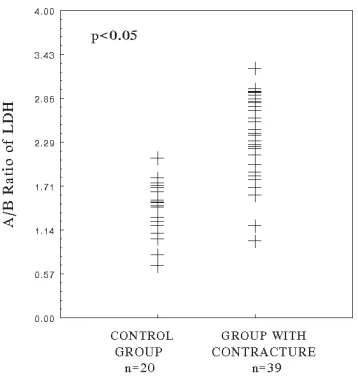
Figure 1 shows the pattern of the isoenzymes of lactate dehydrogenase in normal and pathologi− cal palmar fasciae, randomly selected from the collection of all the investigated samples. In the group of 39 tested palmar aponeurosis with Dupuytren’s contracture, the median A/B ratio was 2.38 (range: 1.0–3.25) and 1.5 (range: 0.68–2.08) in the group of 20 normal tissues. The difference between the two groups was statisti− cally significant (p < 0.05) (Fig. 2). Total LDH activity in normal and pathological specimens are presented in Fig. 3. It was found that the activity of LDH in the Dupuytren’s tissues (median: 0.96, range: 0.11–2.4) was significantly elevated (p < 0.05) in comparison with the normal palmar fasci− ae (median: 0.62, range: 0.13–1.0).
Table 1 shows changes in the A/B ratio and total activity of LDH in the tissues with Dupuytren’s con−
tracture depending on the clinical stage of disease progression. It was found that the A/B ratios of tis− sues in the groups I–III were significantly higher than in the control group. The lowest A/B ratios were noted in the most advanced stage of disease, i.e. in the group of patients with clinical degree IV of contracture (median: 1.7). This group appeared sta− tistically significantly different (p< 0.05) in com− parison with all the other groups of patients with contracture except for the control group.
High levels of total LDH activity character− ized tissues with first and second degree palmar contracture (groups I and II). Significant differ−
Fig. 1. Lactate isoenzyme pattern in tissue extracts of palmar fascia from a healthy donor (lane K) and from four patients with Dupuytren’s contracture (lanes A–H). Lanes A–B, C–D, E–F, and G–H show, succes− sively, clinical degrees I–IV of disease
Ryc. 1. Profil izoenzymatyczanej aktywności LDH w tkankach prawidłowych (K) i tkankach objętych przykurczem Dupuytrena (A–H). Linie A–B; C–D; E–F i G–H odpowiednio obrazują I–IV stopień kli− niczny choroby
Fig. 2. A/B ratio of the LDH subunits in normal fasci− ae (control group) and in tissues of palmar aponeurosis with Dupuytren’s contracture; p– probability value in relation to the control group (p = 2.364 × 10⁻⁵)
Table 1.A/B ratio of LDH subunits and total activity of LDH in the group of normal tissues of palmar fascia (control group) and in the four patient groups with degrees I, II, and III, IV of disease progression
Tabela 1.Stosunek podjednostki A do B i aktywność całkowita LDH w tkankach prawidłowych oraz w grupie patologicz− nych tkanek z I, II, III i IV stopniem klinicznym przykurczu Dupuytrena
Tested groups A/B ratio of Total activity
(Badane grupy) LDH subunits of LDH [U/l/mg]
(Stosunek podjednostki (Aktywność
A/B LDH) całkowita LDH)
Control group median 1.5 0.625
(Grupa kontrolna) range 0.68–2.08 0.13–1.0
n = 20
Group I median 2.3 1.1
(Grupa I) range 1.9–3.25 0.82–2.4
First−degree contracture p k 5.033 × 10–5* 9.128 × 10–5*
(Pierwszy stopień przykurczu) n = 9
Group II median 2.55 1.34
(Grupa II) range 2.12–2.85 0.2–2.25
Second−degree contracture p k 0.0004* 0.03*
(Drugi stopień przykurczu) p I 0.452 0.691
n = 9
Group III median 2.57 0.65
(Grupa III) range 2.2–2.95 0.3–2.2
Third−degree contracture p k 0.0006* 0.242
(Trzeci stopień przykurczu) p I 0.669 0.022*
n = 12 p II 0.886 0.319
Group IV median 1.7 0.34
(Grupa IV) range 1.0–2.3 0.11–1.6
Fourth−degree contracture p k 0.2203 0.238
(Czwarty stopień przykurczu) p I 0.003* 0.011*
n = 9 p II 0.0009* 0.057
p III 0.0004* 0.117
p k – probability value in relation to the control group. p I – probability value in relation to degree I of disease. p II – probability value in relation to degree II of disease. p III – probability value in relation to degree III of disease. * statistically significant difference.
p k – wartość prawdopodobieństwa w stosunku do grupy kontrolnej.
p I° – wartość prawdopodobieństwa w stosunku do grupy z I stopniem klinicznym przykurczu. p II° – wartość prawdopodobieństwa w stosunku do grupy z II stopniem klinicznym przykurczu. p III° – wartość prawdopodobieństwa w stosunku do grupy z III stopniem klinicznym przykurczu. * różnica istotna statystycznie.
Fig. 3. Total activity of LDH in normal fasciae (control group) and in tissues of palmar aponeurosis with Dupuytren’s contracture; p– proba− bility value in relation to the control group (p = 0.02602)
ences were found between these groups and all others. Groups with advanced stages of disease (III and IV) did not differ statistically significant from the control group.
Discussion
Dupuytren’s contracture is a palmar fibro− matosis that leads to a heavy flexion deformity of the fingers. The deformity occurs as a conse− quence of progressive scarring and shortening of the palmar and digital fascia [19]. From the clini− cal point of view there are four degrees in the course of Dupuytren’s contracture according to Iselin’s classification [15]. Each of them charac− terizes a different stage of palm contracture and tissue architecture [7]. The first degree is related with the appearance of nodules composed of pro− liferative cells, mostly of myofibroblastic pheno− type, and small cords without signs of contracture in the interphalangeal joints. Degree II shows a lit− tle contracture in the metacarpophalangeal (MCP) and the proximal interphalangeal joints (PIP). Degree III has contracture in the MCP, PIP, and the distal interphalangeal (DIP) joints, and degree IV severe contracture in the MCP and PIP joints with hyperextension of the DIP joints together with advanced lesions in the osseous system [15].
The appearance of highly specialized myofi− broblasts rich in smooth muscle α−actin in the ini− tial stage of disease suggests that these cells are probably responsible for generating contractile forces and deposition of abnormally large amounts of extracellular matrix components [8]. Sub− stantial experimental evidence supports the idea that myofibroblasts are the key players in the process of response to tissue injury, especially under hypoxic conditions as a result of microvas− cular compromise. Hypoxia can directly upregu− late α−smooth muscle actin expression in fibrob− last subpopulations, suggesting that lack of oxygen may result in mediating the “transdifferen− tiation” of fibroblasts into myofibroblasts. In addi− tion, chronic hypoxia causes stable phenotypic changes in the cells that appear to be associated with the signaling pathways used to elicit a prolif− eration [20]. Some authors have suggested a sig− nificant role of local hypoxia in the progression of aponeurosis contracture. The increased cellularity in Dupuytren‘s tissue causes strangulation of the vascular architecture, producing further localized ischemia and hypoxic conditions. Such conditions trigger an increased level of xanthine oxidase, which allows the synthesis of free radicals. The free radicals subsequently cause a proliferation of fibroblasts and deposition of collagen, leading to
tissue fibrosis and even lower local oxygen con− centrations [21, 22]. Additionally, hypoxia may significantly decrease the rate of beta−oxidation and enhance triglyceride accumulation. Increased levels of free fatty acids and short−chain fatty acids in fibrotic fascia in patients with Dupuytren’s con− tracture are suggestive of the local hypoxia that exists [23, 24].
In this study, total LDH activity in tissues of palmar aponeurosis with Dupuytren’s contracture was measured. It was found that the level of LDH activity in pathologic tissues was significantly ele− vated, especially in tissues at early stages of the contracture. It was reported that the biosynthesis of both non−collagen and collagen proteins, which are elevated in the initial phases of Dupuytren’s contracture and decrease during the final stages of fibrosis, tightly correlates with the presence of myofibroblasts. During disease progression, myo− fibroblasts gradually disappear and are not observed in the most advanced phase [7].
The present study showed that elevated levels of total LDH activity were coupled with alter− ations in the A/B subunits ratio. In the group of palmar aponeurosis with symptoms of Dupuy− tren’s contracture, an increased A/B ratio in com− parison with normal palmar fasciae was found. This was strictly associated with teh shifted LDH isoenzyme pattern towards the more anaerobic isoenzymes, i.e. LDH−4 and LDH−5, with a simul− taneous reduction in the LDH−1 and LDH−2 pro− portion. These findings are not surprising. It is known that hypoxia, a reduction in the normal level of tissue oxygen tension, may disturb cellu− lar activity by changes in metabolism [25]. Under hypoxic conditions, cells switch glucose metabo− lism from the oxygen−dependent tricarboxylic acid (TCA) cycle to glycolysis, the oxygen−indepen− dent metabolic pathway [25].
Changes in the ratio of A/B in relation to dif− ferent clinical phases of the progression of Dupuytren’s contracture were also observed in the present study. The significantly higher ratio of A/B than that seen in the control group characterized tissues with first, second, and third degree palmar contracture progression. In the specimens taken from the patients with fourth degree contracture, regression to the control level of the A/B ratio was observed. This might prove that the metabolism of glucose ultimately returns to the state observed in normal palmar aponeurosis, where mature fibrob− lasts constitute a small proportion of cells. Additionally it seems that only myofibroblasts appear to be uniquely equipped to proliferate and migrate under hypoxic conditions [20].
enhances lactate production. LDH−A gene tran− scription is directly regulated by hypoxia− inducible factor I (HIF I), whose expression is induced under conditions of reduced oxygen ten− sion [26, 27]. It is well known that increased lac− tate level is connected with enhanced collagen synthesis, whose excessive expression is a major contributor to Dupuytren′s contracture [11, 12]. Gladden et al. [12] and Trabold et al. [11] pro− posed two separate mechanisms to explain the stimulation of collagen synthesis by lactate. First, lactate induces an increase in collagen promoter activity that leads to elevated pro−collagen mRNA production and collagen synthesis. Lactate may also increase the activity of prolyl hydroxylase, a crucial enzyme of collagen biosynthesis. Both mechanisms are based on down−regulation of ADP−ribosylation, a widespread form of the post−translational modifi− cation of proteins. These authors presumed that col− lagen gene transcription in fibroblasts is normally down−regulated by polyadenosinediphosphoribose (pADPR) and that lactate accumulation decreases pADPR levels by depleting intracellular NAD+, the substrate for pADPR [5, 11, 12].
It is known that reorientation of the LDH isoenzyme pattern, with characteristically elevated levels of the cathodic isoenzyme LDH−5, has been observed in cancer tissues [3,4]. The analogy between Dupuytren’s contracture (palmar fibro− matosis) and benign fibroproliferative tumors may be presumably associated with marked cell (fibro/myofibroblast) proliferative activity and high metabolic demands involving significant alterations in microenvironmental conditions of hypoxia and acidity. Hence the results of this investigation are consistent with the concept that the course of Dupuytren’s contracture resembles benign tumor formation.
The authors conclude that the data of this study showed that the fasciae of Dupuytern’s con− tracture are characterized by an elevated level of the A/B ratio of the LDH subunits and increased total activity of LDH which directly correlate with an imbalance in energy metabolism and enhanced anaerobic glycolysis. The participation of LDH in the progress of Dupuytren’s contracture can be suggested.
References
[1] Shim H, Dolde Ch, Lewis BC, Wu ChS, Dang G, Jungmann RA, Dalla−Favera R, Dang ChV:c−Myc trasac− tivation of LDH−A: Implications for tumour metabolism and growth. Proc Natl Acad Sci USA 1997, 94, 6658–6663.
[2] Maekawa M, Inomata M, Sasaki MS, Kaneko A, Ushiama M, Sugano K, Takayama J, Kanno T: Electrophoretic variant of lactate dehydrogenase isoenzyme and selective promoter methylation of the LDHA gene in a human retinoblastoma cell line. Clin Chem 2002, 48, 1938–1945.
[3] Koukourakis M, Giatromanolaki A, Sivridis E: Lactate dehydrogenase 1 and 5: Differential Expression by Neoplastic and Stromal Cells in Non−Small Cell Lung Cancer and Other Epithelial Malignant Tumours. Tumour Biol 2003, 24, 199–202.
[4] Koukourakis M, Giatromanolaki A, Sivridis E, Bougioukas G, Didilis V, Gatter KC, Harris AL:Lactate dehydrogenase−5 (LDH−5) overexpression in non−small−cell lung cancer tissues is linked to tumour hypoxia, angiogenic factor production and poor prognosis. Br J Cancer 2003, 89, 877–885.
[5] Ghani P, Wagner S, Hussain MZ: Role of ADP−ribosylation in wound repair. Wound Rep Reg 2003, 11, 439–444.
[6] Kim J, Dang ChV:Multifaceted roles of glycolytic enzymes. Trends Biochem Sci 2005, 30, 142–150.
[7] Melling M, Karimian−Teherani D, Mostler S, Behnan M, Sobal G, Menzel EJ: Changes of Biochemical and Biomechanical Properties in Dupuytren Disease. Arch Pathol Lab Med 2000, 24, 1275–1281.
[8] Tomasek JJ, Vaughan MB, Haaksma CJ:Cellular structure and biology of Dupuytren’s disease. Hand Clinics 1999, 15, 21–34.
[9] Gabbiani G, Majno G:Dupuytren’s contracture: fibroblast contraction? An ultrastructural study. Am J Pathol 1972, 66, 131–146.
[10] Wagner S, Hussain MZ, Hunt TK, Bacic B, Becker HD: Stimulation of fibroblast proliferation by lactate−medi− ated oxidants. Wound Rep Reg 2004, 12, 368–373.
[11] Trabold O, Wagner S, Wicke C, Scheuenstuhl H, Haussain MZ, Rosen N, Seremetiev A, Becker HD, Hunt TK: Lactate and oxygen constitute a fundamental regulatory mechanism in wound healing. Wound Rep Reg 2003, 11, 504–509.
[12] Gladden LB: Lactate metabolism; a new paradigm for the third millennium. J Physiol 2004, 558, 5–30. [13] Burge P, Hoy G, Regan G, Milne R:Smoking, alcohol and the risk of Dupuytren’s contracture. J Bone Surg
1997, 79B, 206–210.
[14] Chansky HA, Thomas E, Trumble TE, Conrad EU, Wolff JF, Murray LW, Raskind WH: Evidence for a Polyclonal Etiology of Palmar Fibromatosis. J Hand Surg 1999, 24A, 339–344.
[16] Dietz A, Lubrano T, Rubinstein HM: Disc electrophoresis of lactate dehydrogenase isoenzymes. Clin Chim Acta 1970, 27, 225–232.
[17] Langvad E: Lactate dehydrogenase isoenzyme patterns in bronchogenic carcinoma. Eur J Cancer 1968, 4, 107–115.
[18] Stagg BH, Whyley GA: Some characteristics of lactate dehydrogenase isoenzymes in tumours of the female gen− ital tract. Clin Chim Acta 1968, 22, 521–533.
[19] Dave SA, Banducci DR, Graham WP, Allison GM, Ehrlich HP: Differences in αsmooth muscle actin expres− sion between fibroblasts derived from Dupuytren’s nodules or cords. Exp Mol Pathol 2001, 71, 147–155. [20] Stenmark KR, Gerasimovskaya E, Nemenoff RA, Das M: Hypoxic Activation of Adventitial Fibroblasts: Role
in Vascular Remodelling. Chest 2002, 122, 326–334.
[21] Murrell GAC, Hueston JT: Aetiology of Dupuytren’s contracture. Aust N Z J Surg 1990, 60, 247–252. [22] Kloen P: New insights in the development of Dupuytren’s contractue: a review. Br J Plast Surg 1999, 52,
629–635.
[23] Rabinowitz JL, Ostermann LJ, Bora FW, Steffen J: Lipid composition and de novo lipid biosynthesis of human palmar fat in Dupuytrens disease. Lipids 1983, 18, 371–374.
[24] Hughes TB, Mechrefe A, Littler JW, Akelman E:Dupuytren’s Disease. J Hand Surg (Am) 2003, 3, 27–40. [25] Harris AL: Hypoxia – a key regulatory factor in tumour growth. Nat Rev Cancer 2002, 2, 38–46.
[26] Dang ChV, Lewis Brian C, Dolde Ch, Dang G, Shim H:Oncogenes in Tumour Metabolism, Tumorigenesis, and Apoptosis. J Bioenerg Biomembr 1997, 29, 345–354.
[27] Dang ChV, Semenza GL:Oncogenic alterations of metabolism. Trends Biochem Sci 1999, 24, 68–72.
Address for correspondence:
Katarzyna Ratajczak
Department of Traumatology and Hand Surgery Silesian Piasts University of Medicine
ul. Traugutta 57/59 50−417 Wrocław Poland
Tel.: +48 71 7332625
E−mail: [email protected]
Conflict of interest: None declared