A New Le Gall Wavelet-Based Approach to Progressive Encoding and
Transmission of Image Blocks
Deividas Kan
č
elkis, Jonas Valantinas
Department of Applied Mathematics, Kaunas University of Technology Studentų St 50-325c, LT-51368 Kaunas, Lithuania
e-mail: [email protected], [email protected]
http://dx.doi.org/10.5755/j01.itc.41.3.860
Abstract. In this paper, a modified version of the discrete reversible (integer-to-integer) Le Gall wavelet transform (DLGT), distinguishing itself by apparently improved space localization properties and visibly extended potential capabilities, is proposed. The key point of the proposal – ensuring full decorrelation of Le Gall wavelet coefficients across the lower scales. Based on the latter circumstance, a novel exceptionally fast procedure for computing the integer DLGT spectra of the selected image blocks (regions of interest - ROI) is presented. It is shown that the new developments can be efficiently applied to progressive encoding and transmission of image blocks. Progressive encoding and transmission of image blocks is achieved by first transmitting a “rough” estimate of the original image, then sending further details related to one or another image block (ROI). To translate the idea into action, the zero-tree-based encoder SPIHT (Set Partitioning in Hierarchical Trees) with an improved quad-tree analysis scheme is employed.
Keywords: digital images; discrete wavelet transforms; Le Gall wavelets; Lifting schemes; image processing; progressive image encoding; ROI.
1. Introduction
Progressive encoding and subsequent transmission of digital images refers to image compression techniques that allow both the original image reconstruction without loss of any detail and the construction of image approximations (estimates) with the accuracy level depending on the amount of data available. Lossless compression is highly important for images obtained at a great cost, such as space or medical images. In this case, even negligible loss of data may destroy some details needed during further processing, or add artefacts that lead to misinterpretation. In various problem-oriented applications fast extraction of image estimates with a priori prescribed levels of accuracy may also be necessary. Surely, the speed of this operation depends on the amount of data that should be retrieved from the storage for image reconstruction. On the other hand, in the case of non-progressive compression, neither an image estimate nor the original image is available until the whole image data are retrieved.
Nowadays, most modern image compression techniques employ a discrete wavelet transform, usually followed by quantization and entropy coding [1-6]. Especially practicable are image coders that allow progressive encoding with an embedded bit stream, such as the embedded zero-tree wavelet
(EZW) image coder, suggested by Shapiro [7]. With embedded bit streams, the wavelet coefficients are encoded in bit planes, with the most significant bit planes being transmitted first. In that way, the decoder can stop decoding at any point in the bit stream, and it will reconstruct an image with required level of accuracy. There have been many variants of zero-tree-based progressive image coders since Shapiro introduced his algorithm in 1993. The SPIHT (Set Partitioning in Hierarchical Trees) algorithm, proposed by Said and Pearlman, deserves special attention in this class of coders because it provides the highest image quality, lossless compression, progressive image transmission and so forth [8]. The SPIHT algorithm appears to be very useful for applications where the user can quickly inspect the image and decide if it is good enough to be saved, or need a refinement.
Some other interesting ideas and developments in the wavelet-based image compression field are presented in [9-14].
coefficients s of interest a regions of in image that is In this encoding an transmitting to the user, t or another se (proposed localization discrete reve transform ( exceptionally spectra of th blocks (ROI assumption t image under in ensuring r approach.
The rest Section 2 describes pro of a digital comment o localization presents a no the integer D (ROI). Exper the energy co DLGT are pr
2. Impleme Le Gall wa
Any disc an iterative x x x x x x x x x x x x x x x x
so that the bit are placed in nterest are dec s not of interes paper, the nd transmiss a “rough” est then sending f elected block ( approach) e properties o ersible (integer
(DLGT) and y fast proced he selected (a I). The latter that the modi processing is easonably hig
of the pape introduces t ocedures for f
l image (sig on factors
properties of ovel fast proce DLGT spectra rimental resul ompaction pro resented in Se
enting the di avelet transfo
rete wavelet t procedure. E
x0 x1 x2 x3 x4 x5 x6 x7 x8 x9 x10 x11 x12 x13 x14 x15
1st ite
s associated w higher bit p coded before st.
locally prog sion is achi timate of the further details (ROI) of the im explores imp
f the new v r-to-integer) L d the new dure for findi at the user’s r procedure l ified DLGT s s known and p gh overall perf
er is organiz the DLGT t
finding the D gnal). Section
ensuring im f the modifie edure (algorith of the selecte lts and some c operty of the ection 4.
iscrete rever form
transform (DW Each iteration
Figure 1. Fin
…
…
er. 2nd
with the region planes. So, th the part of th
gressive imag eved by fir
original imag s related to on mage. The ide proved spac version of th Le Gall wavel wly develope
ing the DLG request) imag leans upon th pectrum of th plays a key ro formance of th
ed as follow transform an DLGT spectrum
n 3 passes mproved spac ed DLGT an hm) for findin ed image block commentary o new version o
rsible
WT) represen n (step) of th
nding the DLGT Wavelet coefficients
…
iter. 3d
ns he he ge rst ge ne ea ce he let ed GT ge he he ole he ws. nd um a ce nd ng ks on of nts he DWT (digi
(N
appli 2
N
wave the u wave trans origi will (refle trans in th the (scal orde prec (n s
X smoo the o
1 n T wave wave coeff 3 h coeff 2 g calcu coeff (Figu
T spectrum of a Wavelet coefficients
…
diter. 4
Scaling
Wavele
T applies the ital signal).
2 ,n n N
) v
ied in the wav 2 averaged (
elet transform upper half of elet function sform) is also inal signal ha be applied ecting change sform, the wa he lower half
subsequent it ling and wav
red set of sm eding iteration steps) the DW is found. Th othed value ( ordered set of
1 preceding it
The discrete re elet transform elet function fficients are
1 4 and h4
fficient value 1 2
. The
ulated by takin fficients and
ure 1).
a digital signal ( s
Wavelet 4thiter.
g function:
et function:
e scaling func If the origin values, the sc
velet transform (smoothed) v m the smoothe
f the N elem
n (in each o applied to
as N values,
d to calcul e in the data). avelet (differen
of the N ele
teration, both velet) are app moothed value
n. After a fini WT spectrum
he vector Y
(obtained in t f differenced v
erations). eversible (inte m (DLGT) has coefficients. - h0 1 8
1 8
, while
s are - g0
scaling and ng the (intege five or thr
(N 16) Wavelet c t coefficients
Scaling c
ction to the d
nal signal X
caling functio rm iteration to values. In the
ed values are ment input ve
step of the the input da , the wavelet
late N 2 d
In the ordere nced) values ement input v h mentioned plied repeated es calculated d ite number of
Y of the dig
Y comprises
the n-th itera
values (obtain
eger-to-intege s five scaling
The scaling , h11 4 , e the wavelet
1 2
, g1
wavelet func er) scalar prod ree input da
coefficient coefficient
data input
X has N
on will be o calculate e ordered e stored in
ector. The e wavelet ata. If the
t function differences ed wavelet are stored vector. On functions dly to the
during the f iterations ital signal the only ation) and ned in the
r) Le Gall and three g function
2 3 4
h ,
t function 1
, and
In practice, to compute the integer DLGT spectrum
Y of the digital input signal X of size N2n
( nN ), an efficient iterative procedure (Lifting
Scheme [15, 16]) can be applied.
Let us assume that ( )
(
0( ) 1( ) 2( )n i 1)
i i i i T
S
s s
s
and ( )
(
0( ) 1( ) 2( )n i 1)
i i i i T
D
d d
d
stand for the resultof application of the Le Gall scaling and wavelet
functions to the data vector S(i1)
, respectively
( i{1, 2,, }n ; S(0) X
, i.e.
s
k(0)
x
k , for all0,1, , 1
k N ). Then:
( ) ( 1) ( 1) ( 1)
2 1 2 2 2
1 2
i i i i
k k k k
d s s s
,
( ) ( 1) ( ) ( )
2 1
1 1
4 2
i i i i
k k k k
s s d d
,
for all k0,1,, 2n i 1; here 1 1
( 1) ( 1)
2n i
:
2n i 2i i
s
s
,( ) ( )
1 : 0
i i
d d and i{1, 2,, }n . Thus, the integer DLGT
spectrum Y of the digital signal X is obtained in n
iterations and takes the form:
( ) ( ) ( 1) ( 1) ( 2) ( 2) ( 2) ( 2)
0 0 0 1 0 1 2 3
(1) (1) (1)
0 1 2 1
(
) .
n n n n n n n n
T N
Y s d d d d d d d
d d d
The inverse integer-to-integer DLGT is specified this way:
( 1) ( ) ( ) ( )
2 1
1 1
4 2
i i i i
k k k k
s s d d
,
( 1) ( ) ( 1) ( 1)
2 1 2 2 2
1 2
i i i i
k k k k
s d s s
,
for all k0,1, , 2n i 1
and i{1, 2,, }n .
The “edge” problem, which takes place at both
ends of the data vector S(i1)
(i{1, 2,, }n ) and determines the partially localized nature of the discrete Le Gall wavelet transform, here (Lifting Scheme) is solved by treating the data vector as if it is mirrored at the ends (Figure 1).
In order to compute the integer DLGT spectrum of
a two-dimensional digital image X of size N1N2
( 2 ,ni
i
N niN, i1, 2) , the one-dimensional
discrete reversible Le Gall wavelet transform should
be applied N1N2 times, i.e. N2 times along the first
spatial axis and then N1 times along the second spatial
axis.
3. A novel approach to progressive encoding and transmission of image blocks
In the subsections below, we present a new approach to progressive encoding and transmission of grey-level image blocks. The essence of the approach
– additional bit streams are used to improve quality not of the whole image under reconstruction but that of selected smaller image blocks (ROI). Implementation of the approach is based on the improved space localization properties of the modified integer DLGT and the newly developed fast procedure for finding (modified) integer DLGT spectra of the selected ROI.
3.1. Full decorrelation of Le Gall wavelet coefficients at lower scales
The characteristic feature of DWT is that individual basis functions are localized in space (compact support). Full localization in space (or, what is the same, full decorrelation of wavelet coefficients) means that numerical values of wavelet coefficients, computed on the same iteration (at the same scale!), are specified exclusively by image (signal) blocks that cover the whole image (signal) and do not overlap. Unfortunately, only the simplest Haar (Daubechies D2) wavelet transform, most frequently used in educational environment, is fully localized in space [17]. Higher order wavelet transforms (DLGT, Daubechies D4, CDF 9/7, etc. [11, 16]) are partially localized in space since image (signal) blocks which specify numerical values of any adjacent wavelet coefficients overlap (Figure 1; the overlapping part is coloured in grey). This gives some limitations to practical application of higher order DWT, especially in such areas where block-processing of digital data is preferable (e.g. image feature extraction, locally progressive image encoding, localization of defects in textural images.
In the paper, full decorrelation of Le Gall integer wavelet coefficients across the lower scales is achieved by partitioning the original data vector
(signal) X of size N (N2 ,n nN) into a finite set
of non-overlapping blocks (ROI) of a priori prescribed
size 2p (1 p n) and by transferring the
before-mentioned “edge” problem (Section 2) to those blocks. That is to say, when solving the “edge”
problem, not only the (intermediate) data vector S( )i
( i{0,1,,p1}) but also its component blocks of
size 2p i are mirrored at the ends. This way, improved
(full) localization in space is ensured for all Le Gall
integer wavelet coefficients across the i -th
(i{ ,p p1,, }n ) scale.
Following this perception, we have developed a new iterative procedure (Lifting Scheme) for
computing the modified integer DLGT spectrum Y of
X , namely (for all k0,1,, 2n i 1 and
{1, 2, , }
i n ) :
( 1) ( 1) 2 1 2 ( )
( 1) ( 1) ( 1)
2 1 2 2 2
, { 1, 2 1, , 1},
1
, otherwise , 2
i i
k k i i i i
i
k i i i
k k k
s s k l l q l
d
s s s
( 1) ( )
2
( )
( 1) ( ) ( )
2 1
1 1
,
2 2
for all {0, , 2 , , ( 1) };
1 1 , otherwise; 4 2 i i k k i
k i i i i
i i i
k k k
s d
s k l l q l
s d d
here: li 2p i , qi 2n p ,for i1, 2,,p, and li 1, 2n i
i
q
, for i p 1,p2,,n.
The new Lifting Scheme for the inverse modified DLGT has also been developed, and is presented
below, i.e. (for all k 0,1,, 2n i 1 and
{ , 1, , 2,1}
i n n ):
( ) ( ) ( 1) 2 ( ) ( ) ( ) 1 1 1 , 2 2for all {0, , 2 , , ( 1) },
1 1
, otherwise ,
4 2
i i
k k
i
k i i i i
i i i
k k k
s d
s k l l q l
s d d
( ) ( 1)
2 ( 1)
2 1 ( ) ( 1) ( 1)
2 2 2
, { 1, 2 1, , 1}, 1
, otherwise. 2
i i
k k i i i i
i
k i i i
k k k
d s k l l q l
s
d s s
Thus, in n iterations, the original data vector
(signal) X S(0)
is restored.
The modified integer DLGT spectrum of a
two-dimensional digital image X of size N1N2
( 2 ,ni
i
N niN, i1, 2) is obtained by repeated use
of the one-dimensional modified integer DLGT, i.e.
2
N times along the first spatial axis and then N1
times along the second spatial axis.
3.2. Fast evaluation of the modified DLGT spectra for image blocks
To show extended potential capabilities of the modified integer-to-integer DLGT (Section 3.1) and to proclaim viability of the locally progressive image coding idea, we here propose a novel fast procedure (algorithm) for evaluating the (modified) integer DLGT spectra of the selected blocks (ROI) of the digital image. The proposed algorithm refers to the assumption that the modified integer DLGT spectrum of the original image is known.
To begin with, we briefly survey the situation concerning the one-dimensional case. Let
( ) ( ) ( 1) ( 1) ( 2) ( 2) ( 2) ( 2)
0 0 0 1 0 1 2 3
(1) (1) (1)
0 1 2 1
(
)
n n n n n n n n
T N
Y s d d d d d d d
d d d
be the modified integer DLGT spectrum of the data
vector (signal) ( 0 1 2 2 1)
T
N N
X x x x x x . Each
wavelet coefficient ( )i
j
d ( i{ ,p p1,, }n ,
{0,1, , 2n i 1}
j ), evidently, can be put into
one-to-one correspondence with the signal block
( )
2 2 1 2 ( 1) 1
( i i i )
i T
j j j j
X x x x , i.e. numerical value
of ( )i j
d is specified uniquely by ( )i
j
X (full localization
manifests itself on the i-th scale).
To find the (modified) integer DLGT spectrum ( )i
j
Y of ( )i j
X , the following two steps should be carried
out:
1. The very first spectral coefficient (smoothed value
( )i j
s ) in ( )i j
Y is determined by:
1
( ) ( ) ( ) ( )
0 1
1 ( 1) 1 1
2 2 2
r
r r
j n i
i n i r i r
j j j
r
s s d d
;here: j0j, jr jr1 2, for all r1, 2,,n i ;
2. The rest spectral coefficients (differenced values)
in ( )i j
Y are extracted from the modified integer
DLGT spectrum Y of X, i.e. they are identified
with the ordered set of wavelet coefficients
1 1 1
( ) ( 1) ( 1) ( 2) ( 2) ( 2) ( 2) ( 3)
2 2 1 4 4 1 4 2 4 3 8
( 3) (1) (1) (1)
8 7 2 2 1 2 ( 1) 1
{ , , , , , , , ,
, , , i , i , , i }.
i i i i i i i i
j j j j j j j j
i
j j j j
d d d d d d d d
d d d d
Thus, the discrete (modified) integer DLGT
spectrum ( )i
j
Y of the signal block (ROI) ( )i
j
X of size
not less than 2p (p{1, 2,,n1}) is computed and
takes the form:
1 1 1
( ) ( ) ( ) ( 1) ( 1) ( 2)
2 2 1 4
(1) (1) (1)
2 2 1 2 ( 1) 1
(
i i i ) .
i i i i i i
j j j j j j
T
j j j
Y s d d d d
d d d
Now, let X[ (X m m1, 2)] be a two-dimensional
grey-level image of size N N (N 2n, nN) and
let Y[ ( ,Y k k1 2)] be its two-dimensional modified (full decorrelation of wavelet coefficients across the
scales not higher than p, 1 p n) integer DLGT
spectrum.
Consider a wavelet coefficient Y k k( ,1 2) ,
1
1, 2 {1, 2, , 2 1}
n p
k k
. It is evident that indices
1
k and k2 can be presented in the form:
1
1 2 1
n i
k j ,
2
2 2 2
n i
k j , i i1,2{1, 2,, }n 1
1 {0,1, , 2 1} n i
j
,
2
2 {0,1, , 2 1}
n i
j
.
One can easily ascertain that Y k k( ,1 2) is associated
with the image block (ROI) [ (~1,~2)]
) ,
(1 2 X m m
X kk , where
2 1 ) ~ , ~
(m1 m2 Vk Vk and r { 2r, 2r1, ,( 1)2r1}
i r i r i r
k j j j
V ,
r = 1,2. Let us denote the (modified) integer DLGT
spectrum of the image block X(k k1,2) by
1 2 1 2
( , ) ( , )
1 2
[ ( , )]
k k k k
Y Y u u , where {0,1, , 2ir 1}
r
u ,
1, 2
r .
A newly developed fast procedure (algorithm) for computing the two-dimensional (modified) integer
DLGT spectrum
Y
(k k1,2) of the image block (ROI)1 2 (k k, )
Algorithm.
1. The following sets are formed:
1
0 1
{ , , , }
V n i
S , where: 0 k1;
1 2
s s
, s1, 2,,n i1;
2
0 1
{ , , , }
H n i
S , where: 0 k2;
1 2
t t
, t1, 2,,n i 2;
1 { (0),1 1(1), , 1(n i1 1)}
, where:
1(0) j1
; 1( )s 1(s1) 2,
1
1, 2, , 1
s n i ;
2 { (0),2 2(1), , 2(n i2 1)}
, where:
2(0) j2
, 2( )t 2(t1) 2,
2
1, 2, , 1
t n i ;
1
1 ( )
r
r r
i
k kr q k q
, where:( ) {2 , 2 1, , 2 ( 1) 1}
r
q q q
k q kr kr kr
,
1, 2
r .
2. An array of intermediate data (1 2, )
1 2
ˆ
[Ak k ( , )]l l
(
1
1 {0} V k
l S ,
2
2 {0} k
l ) is found,
namely:
1 2
2 2
( , )
1 1
( 1)
1 1
1
ˆ ( , 0) ( , 0)
1 ( 1) 1 1
( , ) ( , ) ,
2 2 2
k k
n i t
t t
t
A l Y l
Y l Y l
for all
1
1 {0} V k
l S ;
1 2
( , )
1 2 1 2
ˆ k k ( , ) ( , )
A l l Y l l ,
for all
1
1 {0} V k
l S and
2
2 k
l .
3. The inverse (modified) integer DLGT is applied to
the l1-th ( l1{0}SV ) row of the data array
(1 2, ) 1 2
ˆ
[Ak k ( , )]l l . The resulting vector is designated as
(1 2, ) (1 2, )
1 1 2
( , 0) ( , )
k k k k
A l A l l .
4. A vector (1 2, )
(1 2, ) (1 2, )
2
(0, 0) (0, )
k k k k k k
B B B l ,
2
2 {0} k
l , is formed, namely:
1 2 1 2
1 1
1 2
1 2
( , ) ( , )
2 2
( 1) ( , )
2 1
( , ) 2
(0, ) (0, )
1 ( 1)
( , )
2
1 1
( , ) .
2 2
k k k k
n i s
k k s s
k k s
B l A l
A l
A l
5. The (modified) integer DLGT is applied to B(k k1,2).
The resulting DLGT spectrum is
(1 2, ) (1 2, )
2
ˆk k (0, 0) ˆk k (0, )
B B l .
6. Finally, the integer Le Gall wavelet coefficients of
the image block X(k k1,2) are found in accordance
with:
1 2 1 2
(k k, )(0, 0) ˆ(k k, )(0, 0)
Y B ;
1 2 1 2
( , ) ( , )
1
ˆ
( , 0) ( , 0)
k k k k
Y u A l , 1
1, 2, , 2i 1
u ;
here l1 is the u-th element of the ordered set k1
(numbering of elements starts with 1);
1 2 1 2
( , ) ( , )
2
ˆ
(0, ) (0, )
k k k k
Y v B l , 2
1, 2, , 2i 1
v ;
here l2 is the v-th element of the ordered set k2
(numbering of elements starts with 1);
1 2 1 2
( , ) ( , )
1 2
ˆ
( , ) ( , )
k k k k
Y u v A l l , 1
1, 2, , 2i 1
u ,
2
1, 2, , 2i 1
v ; l1 and l2 are the u-th and the
v-th elements of the ordered sets
1 k
and
2 k
,
respectively (numbering of elements in 1 k
and
2 k
starts with 1).
7. The end. The two-dimensional (modified) integer
DLGT spectrum Y(k k1,2) of the image block (ROI)
1 2
(k k, )
X is computed.
Some comments on the efficiency of the newly developed algorithm for computing the (modified) integer DLGT spectra of the selected image blocks are presented in Section 4.
4. Experimental analysis and discussion
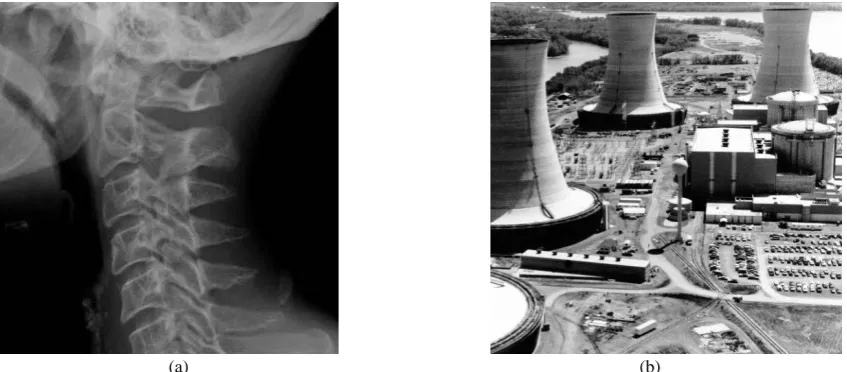
To motivate the proposed progressive image block encoding and transmitting idea, a couple of test images have been processed (Figure 2).
Computer simulation was performed on a PC with CPU Intel® Core i7 [email protected], 8 GB RAM, Windows7 x64, Programming language Java.
First and foremost, the efficiency of the newly developed algorithm for computing the (modified) integer DLGT spectra of the selected image blocks (Subsection 3.2), in comparison with direct evaluation of DLGT spectra for the same blocks (Lifting Scheme; Section 2), was analysed.
The achievable impressive speed gains, expressed
in terms of d pr (d specifies the time needed
for direct evaluation of DLGT spectra for image
blocks and pr - that needed by the proposed
Table 1. Comparison of two approaches to finding DLGT spectra for ROI of size 2p2p
p
N N 6 7 8 9 10
512x512 165.6 334.5 526.1 - - 1024x1024 154.9 313.3 505.9 678.5 - 2048x2048 148.9 302.8 489.6 648.2 629.0
Undoubtedly, fast passage from the modified integer DLGT spectrum of the image under processing to DLGT spectra of the selected image blocks (ROI) opens the door to many new real-time applications of the modified version of integer DLGT, say, image feature extraction in the Le Gall wavelet domain, locally progressive image encoding, localization of defects in textural images, etc. One interesting application of the modified DLGT to locally
progressive encoding of regions of interest in a digital signal is described in [6].
In the context of progressive encoding and transmission of image blocks (ROI), the above results (achievable speed gains in computing the integer DLGT spectra for the ROI selected at the user’s request) are highly valuable.
To simplify description of the obtained results, we here introduce the following notations: the CPU time required to perform the (modified) integer Le Gall wavelet transform (DLGT) of the digital image (or
that of ROI) is denoted by 1, to perform
wavelet-based (SPIHT) encoding of the image (or that of ROI)
– by 2, to transmit data across a low communications
channel – by 3, to perform both the inverse SPIHT
and the inverse integer DLGT, i.e. to reconstruct the image, – by 4.
(a) (b) Figure 2. Test grey-level images: (a) Neck.bmp 1024 1024 ; (b) Power.bmp 512 512
Three cases were analysed and compared: first of all, a non-compressed image was sent across the low communications channel to the user (Figure 3, a); secondly, lossless encoding (SPIHT algorithm with an improved quad-tree analysis scheme [9]) in the Le Gall wavelet domain was applied to the image, and compressed image was sent to the user (Figure 3, b); thirdly, the image was processed (lossy encoding by SPIHT), a “rough” estimate of the original image was sent to the user, the selected image blocks (ROI) were processed by applying both the (modified) integer DLGT and the SPIHT encoder, and then a high quality estimate of the selected ROI were sent again to the user’s PC (Figure 3, c).
We have assumed that the capacity (data rate) of the low communications channel equals 100 KBps.
Obviously, transmitting of non-processed image
Neck.bmp of size 1024 1024 (Figure 2, a) across the
channel (Figure 3, a) requires 310.49s.
Computing the modified ( p7) integer DLGT
spectrum of the same image, lossless encoding
(SPIHT algorithm; T 1), sending across the channel
and reconstruction (Figure 3, b) requires
1 2 3 4 0.038 405.46 2.85 11.97
420.318
s. Evidently, application of the SPIHT
algorithm, with threshold value T 1, is unacceptable
(for the given capacity of the channel).
The developed approach (Figure 3, c) requires: as
before, 1 0.038 s for computing the modified
integer DLGT spectrum of the image Neck.bmp;
2 0.041
s for SPIHT encoding (T 32; 0.5 KB of
compressed data Z ; 2097 ); 3 0.005 s for
transmitting of Z to the user’s PC across the channel,
and 4 0.036 s for reconstructing the “rough”
(a)
(b)
(c)
Figure 3. The digital image processing and transmission: (a) the image is sent across the low communications channel to the user; (b) lossless encoding (SPIHT) is applied to the image,
whereupon compressed image is sent to the user; (c) the proposed locally progressive digital image encoding and transmitting approach
(a) (b) (c)
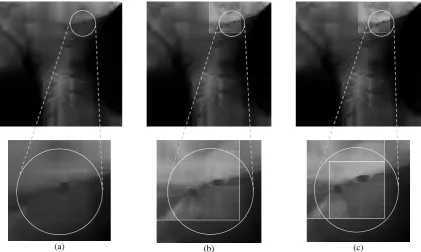
Figure 4. Progressive encoding of image blocks (ROI) in the image Neck.bmp: (a) “rough” estimate of the original image; (b) additional bits are added to the ROI X(4,6) (T 8, 1.38 KB, 0.02); (c) third quarter
of the ROI X(4,6), i.e. image block X(9,13), in greater detail (T 2, 3 KB, 0.08)
Consequently, the total image processing time equals 1 2 3 4 0.12 s.
In Figure 4 (b, c), some additional blocks (ROI) of
the image Neck.bmp, namely, X( 4,6) and X(9,13), are
processed and analysed. Compression details of the selected ROI are also indicated.
Thus, block-processing of the image Neck.bmp, in
accordance with the third approach (Figure 3, c), takes (in total) 0.12 0.02 0.08 0.22 s, and appears to be nearly 50 times faster than in the first approach (Figure 3, a).
Transmission
X Y
Server/Database User PC
Transmission SPIHT
DLGT
Y Commpressed data, Z X
Server/Database User PC Inverse
DLGT Inverse
SPIHT
Z
(k1,k2) Transmission
Transmission Inverse SPIHT Inverse DLGT SPIHT
SPIHT DLGT
Y Commpressed data, Z X
Server/Database
Inverse DLGT Inverse
SPIHT
Z
The prop idea (Figure inspection of
Power.bmp
image proce generate a “r
KB; 5
1 2
0.333
s; to
quality imag
(T 2; 42.1
very first hi made availab
F
5. Conclusi
In the p computation wavelet (DL (regions of presented. T localization p (modification modified DL known.
It is show efficiently a progressive idea (approa additional bi to the whol selected (at t the image. approach is with an enha
posed locally e 3, c) has a
f several imag
512 512 (Fi essing speed g
rough” estima
59.44 ) o
3 4 0.00
o prepare (for
ge blocks X(6
4 KB), requir igh quality im ble to the use
Figure 5. Fast v estim
ions
paper, a nov of the (modif LGT) spectra
interest - RO The procedure properties of n) of DLGT a LGT spectrum
wn that the d applied to im
digital image ach). The es it streams are le image un the request of
The ultima supported by anced quad-tre
progressive im also been app ge blocks (RO
igure 2, b). gains are rea ate (Figure 5, a of the im
07 0.27 0.0
r coherent ana 6,5), X(6,6), X
res (in total) 1 mage block ( er in 0.697 s,
(a)
visual inspection mate of the imag
(6, X
vel fast proc fied) discrete a for the se OI) in the di
e employs im a newly dev and refers to t m of the orig
developed pro mplementing e encoding an
ssence of th used to add n nder processin f the user!) b ate implemen y the use of S ee analysis sch
mage encodin plied to visu OI) in the imag
The obtaine ally hopeful: t
a; T 64, 4.4
mage require
044 0.012
alysis) the hig (6,7)
X and X(7,
1.488 s. So, th (ROI) X(6,5)
i.e. 3.76 time
n of image bloc ge; (b) “rough”
5), X(6,6), X(
cedure for th integer Le Ga elected block igital image mproved spac veloped versio the fact that th ginal image
ocedure can b of a locall nd transmittin he approach new details no ng but to th blocks (ROI) i ntation of th SPIHT encod heme. ng ual ge ed to 41 es gh 7) he is es faste of th requ cohe runs S user conc prog (Figu medi amou
cks (ROI) in the estimate of the
(6,7 ) and X(7,7 )
he all ks is ce on he is be ly ng – ot he in he der E enco be pu comp Zero Codi algor faste perfo C digit comp prov is sc diffe (ROI imag step) bits plan JPEG the i limit
er than in the he original im uires 2.62 s).
erent image bl on the real-tim Since in each
has the neces clusion that th gressive imag
ure 3, c) may ical or spac unts of data) t
e image Power.b image with im
) in greater deta
Evidently, the oding and tran ut into practic pression algo o-tree Wavel ing with Op rithm perform er image enc
ormance of th Comparison o tal image cod pression stan vides the possi carcely pointf erences). In J I) are coded w ge, and this is ) by scaling up associated wi es, i.e. at the G 2000, the v image (an int ted.
first approach
mage Power.b
Processing an
ocks (ROI) X
me scale. case (Figure 4 ssary ROI av he proposed ge encoding y lead (espec ce images ch to auspicious a
(b)
bmp 512 512 age blocks (RO ail
e developed nsmission of i ce using other orithms, such let), EBCOT ptimized Tru ms better? It g
oding algorit e proposed ap of the develop ding techniqu ndard JPEG ibility for defi ful (both app JPEG 2000, with better qua
s done (just a p the wavelet ith the ROI a e front of bit visual inspecti teractive dialo
h (Figure 3, a
bmp to the u
nd visual insp (6,6)
X , X(6,7) a
4, b, c; Figure vailable, we co Le Gall wav
and transmit cially, when a characterized
and fast-track
: (a) “rough” OI)
approach (pr image blocks r zero-tree-ba h as EZW (E
T (Embedde uncation), etc goes without s
thm the bette pproach.
ped locally pr ue with the n
2000 [2], w fining ROI in proaches have selected ima ality than the after the pre-p t coefficients s are placed in
streams. Mo ion of cohere ogue with th
a; sending user’s PC pection of and X(7,7 )
We unreservedly believe that the proposed idea will find various applications in implementing efficient and up-to-date digital data processing technologies. In particular, the proposed locally progressive digital image coding idea can be employed when large amounts of requested graphical data are sent across a low communications channel (say, the Internet).
References
[1] I. Daubechies. Ten Lectures on Wavelets, SIAM, Philadelphia, 1992. http://dx.doi.org/10.1137/1.978161 1970104.
[2] C. Christopoulos, A. Skodras, T. Ebrahimi. The JPEG2000 Still Image Coding System, An Overview,
IEEE Trans. on Consumer Electronics, Vol. 46, No. 4, 2000, 1103-1127. http://dx.doi.org/10.1109/30.920468. [3] M. Vetterli. Wavelets, approximation and
compression, IEEE Signal Processing Mag., Vol. 18,
No. 5, 2001, 59-73. http://dx.doi.org/10.1109/79.9528 05.
[4] R. Sudhakar, R. Karthiga, S. Jayaraman. Image Compression Using Coding of Wavelet Coefficients: A Survey, International Journal on Graphics, Vision and
Image Processing, Vol. 5, No. 6, 2005, 25-38.
[5] L. Kaur, R. C. Chauhan, C. Saxena. Wavelet based compression of medical ultrasound images using vector quantization. Journal of Medical
Engineering&Technology, Vol. 30, No. 3,2006, 128-133. http://dx.doi.org/10.1080/03091900500235705. [6] J. Valantinas, D. Kančelkis. A new wavelet-based
approach to progressive encoding of regions of interest in a digital signal. Information Technology and Control, Vol. 38, No. 3, 2009, 195–202.
[7] J. M. Shapiro. Embedded image coding using zero-trees of wavelet coefficients, IEEE Trans. Signal
Processing, Vol. 41, 1993, 3445-3462.
http://dx.doi.org/10.1109/78.258085.
[8] A. Said, W. A. Pearlman. A new, fast, and efficient image codec based on set partitioning in hierarchical trees, IEEE Trans. Circuits Syst. Video Technology,
Vol. 6, 1996, 243-250. http://dx.doi.org/10.1109/76.49 9834.
[9] J. Valantinas, D. Kančelkis. Speeding-up image encoding times in the SPIHT algorithm. Information
Technology and Control, Vol. 40, No. 1, 2011, 7–11. http://dx.doi.org/10.5755/j01.itc.40.1.187.
[10] R. S. H. Istepanian, A. A. Petrosian. Optimal Zonal Wavelet-Based ECG Data Compression for Mobile Telecardiology System, IEEE Trans. Inform. Technol.
Biomed., Vol. 4, 2000, 200-211. http://dx.doi.org/10 .1109/4233.870030.
[11] R. M. Rao, A. S. Bopadikar.Wavelet Transforms:
Introduction to Theory and Applications, Pearson
Education, Asia, 2002.
[12] H. F. Ates, M. T. Orchard. An Adaptive Edge Model in the Wavelet Domain for Wavelet Image Coding,
Signal Processing: Image Comm., Elsevier, Vol. 20,
No. 2, 2005, 169-185.
[13] B. D. Vijendra, N. R. Alamelu. Wavelet Based Medical Image Compression Using ROI EZW,
International Journal of Recent Trends in Engineering,
Vol. 1, No. 3, 2009, 97-100.
[14] J. Valantinas, D. Kančelkis. Improving compression time in zero-tree based image coding procedures,
Proceedings of the 2nd International Conference on
Image Processing Theory Tools and Applications
(IPTA 2010), July 7-10, 2010, Paris, France, 118-121. [15] W. Sweldens. The lifting scheme: A construction of
second generation wavelets, SIAM J Math Anal, Vol. 29, No.2, 1997, 511-546. http://dx.doi.org/10.1137/S0 036141095289051.
[16] A. Jense, A. la Cour-Harbo. Ripples in Mathematics: the Discrete Wavelet Transform, Springer, 2001. [17] C. Phang, P. Phang. Modified Fast and Exact
Algorithm for Fast Haar Transform, International
Journal of Computer Science and Engineering, Vol. 2,
No. 2, 2008, 55-58.