74
Acute and sub-chronic toxicity study of
Cocos nucifera
leaf extracts in
mice
Nirankush Paul1, Rajarshi Roy1, Sanjib Bhattacharya2*, Moulisha Biswas1
1. Bengal Institute of Pharmaceutical Sciences, Kalyani, Nadia, West Bengal, India
2. Bengal School of Technology, Delhi Road, Sugandha, Hooghly, West Bengal, India.
*Corresponding author: [email protected]
ABSTRACT
In the present study, the safety profile of Cocos nucifera L. (Arecaceae) leaf was
evaluated by acute and sub-chronic toxicity study of the petroleum ether, chloroform
and methanol extracts of C. nucifera leaf in Swiss albino mice. In acute toxicity study,
each extract up to 2000 mg/kg body weight orally did not produce any toxic effect or
death. In sub-chronic toxicity study, the three extracts were administered at the single
daily dose of 200 mg/kg body weight orally for 28 consecutive days and at the 29th day,
the hematological, histological, serum and hepatic biochemical parameters were
evaluated by sacrificing the animals. No mortality was observed during the course of
whole study period. No detectable alterations were found in hematological, biochemical
and histological parameters in treated groups when compared to vehicle control group
after 28 days. The results of the present study therefore indicated that C. nucifera leaf
is safe in adult male albino mice demonstrating no noticeable toxicity.
Keyword: Acute toxicity, biochemical, Cocos nucifera, leaf, sub-chronic toxicity.
INTRODUCTION
Cocos nucifera Linn. belonging to the family Arecaceae, is commonly known as Narkel in
Bengali, Nariyel in Hindi and Coconut in English. It is a large palm of about 60 to 90
feet height found across the sea levels of the tropical and subtropical world. It is found
throughout India mainly at the costal regions. The coconut is known for its great
versatility as observed in the many edible, domestic, commercial and industrial uses of
its different parts. [1] It has certain traditional medicinal uses also. Coconut water
(coconut liquid endosperm) is a refreshing beverage consumed worldwide as it is
nutritious and beneficial for health. It is used in local application in small pox to avoid
75
avoid dehydration. The fixed oil from fruit is used in nourishing hair and the fruit is
regarded as an aphrodisiac agent. [2] The present study aimed to establish the acute
and sub-chronic toxicity profile of petroleum ether, chloroform and methanol extracts of
C. nucifera leaf in adult Swiss albino mice.
MATERIALS AND METHODS
Plant material:
The mature leaf of the plant Cocos nucifera L. (Arecaceae) was collected in the month of
August 2011 from North 24 Parganas, West Bengal, India. The plant material was
taxonomically identified at the Central National Herbarium, Botanical Survey of India,
Howrah, West Bengal, India. The voucher specimen (CNH/95/2011/Tech II/591) was
maintained in our research laboratory for future reference. The leaves were collected
and the midrib of each leaf was separated. Then plant material was shade-dried with
occasional shifting and then powdered with mechanical grinder, passing through sieve
no. 40, and stored in an air-tight container.
Preparation of extract:
The powdered plant material was extracted with petroleum ether, chloroform and
methanol successively using simple percolation technique. The solvent were almost
removed from the extracts in a hot water bath leaving the semisolid masses (yields:
PECN – 1.79%, CECN – 2.17%, MECN – 2.17%) and stored in conical flasks wrapped
with aluminum foil. Preliminary phytochemical screening of these extracts exhibited the
presence of triterpenoids and steroids in PECN; triterpenoids in CECN; steroids,
saponins, tannins and glycosides in MECN. [3]
Drugs and chemicals:
Bovine serum albumin from Sigma Chemical Co., St. Louis, Mo, USA; Trichloroacetic
acid (TCA) from Merck Ltd., Mumbai, India; Thiobarbituric acid (TBA), 5,5´-dithio bis
-2-nitro benzoic acid (DTNB), phenazonium methosulphate (PMS), reduced nicotinamide
adenine dinucleotide (NADH) and reduced glutathione (GSH) from SISCO Research
Laboratory, Mumbai, India; potassium dichromate and glacial acetic acid from
Ranbaxy, Mumbai, India. All the other reagents used were of analytical reagent grade
76
Animals:Adult Swiss albino mice of either sex weighing 18-25 g were used for the present
investigation. They were housed in clean polypropylene cages and maintained under
standard laboratory conditions (temperature 25 ± 2°C with dark/light cycle 14/10 h).
They were fed with standard pellet diet (Hindustan Lever, Kolkata, India) and water ad
libitum. The animals were acclimatized to laboratory conditions for one week prior to
experiment. All experimental procedures were reviewed and approved by the
Institutional Animal Ethics Committee.
Acute toxicity:
The acute toxicity of PECN, CECN and MECN in Swiss albino mice was studied as
reported method. [4] Each extract were given to four groups (n = 6) of mice at 50, 500,
1500 and 2000 mg/kg body weight, p.o. The treated animals were kept under
observation for 3 days, for mortality and general behaviour. No death was observed till
the end of the study.
Sub-chronic toxicity:
The adult Swiss albino mice were divided into four groups containing 6 animals per
group. The first group received normal saline (5 ml/kg body weight, p.o.) and the other
three groups received the three extracts each at 200 mg/kg body weight p.o.,
respectively daily for 28 consecutive days. Food and water intake of animals were
observed during this period. Twenty four hours after the last dose (i.e., at the 29th day),
blood was collected from overnight fasted mice of each group by cardiac puncture for
estimation of hematological and serum biochemical parameters. Then the mice were
sacrificed by cervical dislocation for the study of liver biochemical parameters and
organ weights. [5]
Body weight and organ weights:
The body weight of mice of each group were measured just before and 28 days after the
extract treatment, respectively. Heart, lung, liver and kidney weights of all mice were
77
Hematological studies:Collected blood was used for the estimation of hemoglobin (Hb) content; red blood cell
count (RBC) and white blood cell counts (WBC) by standard recommended procedures
[6, 7].
Estimation of serum biochemical parameters:
Collected blood was used for the estimation of serum biochemical parameters viz.
serum glutamate oxaloacetate transaminase (SGOT), serum glutamate pyruvate
transaminase (SGPT), serum alkaline phosphatase (SALP), serum cholesterol and total
protein contents by using commercially available reagent kits (Span Diagnostics, Surat,
India).
Estimation of liver biochemical parameters:
Lipid peroxidation i.e., thiobarbituric acid reactive substances (TBARS) was estimated
by the previously reported method and expressed as mM/100 g of liver tissue. [8]
Reduced glutathione (GSH) was determined by the reported method and was expressed
as mg/100 g of liver tissue. [9] Catalase (CAT) activity was assayed according the
method described by standard method and expressed as µmoles of H2O2
consumed/min/mg of liver tissue. [10]
Statistical analysis:
The all experimental data were expressed as mean ± standard error of mean (SEM).
RESULTS:
In acute toxicity study, PECN, CECN, MECN up to 2000 mg/kg body weight orally
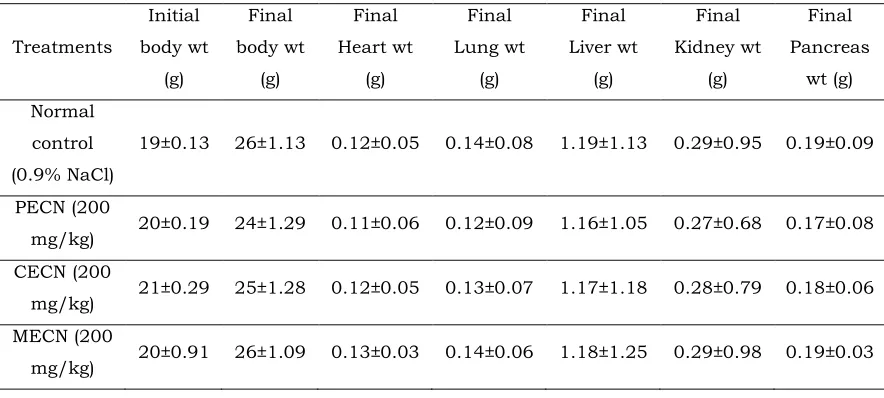
exhibited no toxic effect or death in mice. There were no significant changes in body
weights and organ weights of mice of extract treated groups (after 28 days) from saline
control group (Table 1). No mortality was evident from the experimental results in mice.
The food and water intake of treated group was found comparable to the control group
without showing significant alteration in body weight and growth rate. From the present
study it was seen that there was no significant changes in the counts of WBC, RBC and
78
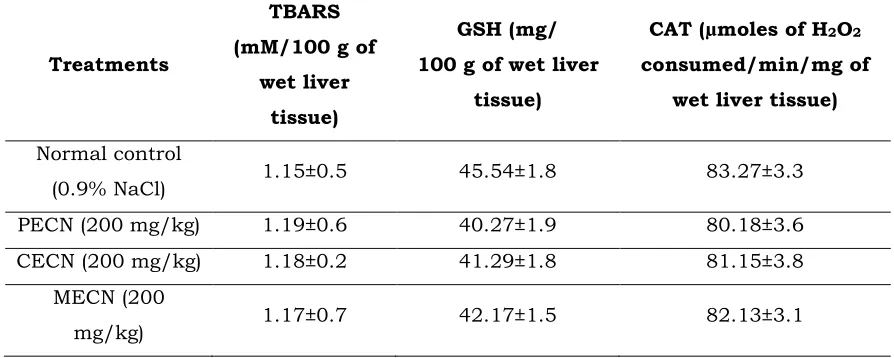
After 28 days of treatment no significant alterations were observed in all serum and
hepatic biochemical parameters in animals of extract treated group when compared to
those of normal control group (Tables 3, 4).
Table 1: Effect of C. nucifera leaf extracts on body weight and weight of organs in mice.
Treatments
Initial
body wt
(g)
Final
body wt
(g)
Final
Heart wt
(g)
Final
Lung wt
(g)
Final
Liver wt
(g)
Final
Kidney wt
(g)
Final
Pancreas
wt (g)
Normal
control
(0.9% NaCl)
19±0.13 26±1.13 0.12±0.05 0.14±0.08 1.19±1.13 0.29±0.95 0.19±0.09
PECN (200
mg/kg) 20±0.19 24±1.29 0.11±0.06 0.12±0.09 1.16±1.05 0.27±0.68 0.17±0.08
CECN (200
mg/kg) 21±0.29 25±1.28 0.12±0.05 0.13±0.07 1.17±1.18 0.28±0.79 0.18±0.06
MECN (200
mg/kg) 20±0.91 26±1.09 0.13±0.03 0.14±0.06 1.18±1.25 0.29±0.98 0.19±0.03
Values are expressed as mean ± SEM (n = 6).
DISCUSSION:
The present study was aimed to investigate the possible toxic effects of the pet. ether,
chloroform and methanol extract of C. nucifera leaf (PECN, CECN, MECN) in adult Swiss
albino mice. The results of acute toxicity study revealed that the extracts may be safe in
Swiss albino mice. Various parameters were thoroughly studied in the sub-chronic
toxicity study. The body weights, food and water intakes were found to be unaltered
during the 28 days treatment period when compared to control group. Similarly there
were no significant changes in different vital organ weights also. No mortality was
observed during this period. Also in the study of hematological parameters there was no
alteration of the normal levels of RBC, WBC and hemoglobin compared with the extract
treated groups. Therefore, the test extracts had no toxic effect to the blood and
79
Table 2: Effect of C. nucifera leaf extracts on hematological parameters in mice.
Treatments
Hemoglobin
(g/dl)
RBC (106 cells/ml) WBC (103 cells/ml)
Normal control (0.9% NaCl) 13.96 ± 0.85 6.63 ± 0.54 3.15 ± 0.42
PECN (200 mg/kg) 11.28 ± 0.36 5.83 ± 0.34 4.36 ± 0.83
CECN (200 mg/kg) 12.73 ± 0.65 6.03 ± 0.56 3.96 ± 0.33
MECN (200 mg/kg) 13.18 ± 0.16 6.23 ± 0.76 3.36 ± 0.69
Values are expressed as mean ± SEM (n = 6).
Table 3: Effect of C. nucifera leaf extracts on serum biochemical parameters in mice
Treatments SGOT
(IU/dl) SGPT (IU/dl) SALP (IU/dl) Bilirubin (mg/dl) Cholesterol (mg/dl) Total protein (mg/dl) Urea (mg/dl) Uric acid (mg/dl) Creatinine (mg/ml) Normal control (0.9% NaCl) 42.51 ±1.29 35.99 ±1.27 83.29 ±1.89 0.91 ±0.15 151.33 ±9.6 7.22 ±1.7 42.15 ±1.13 6.92 ±1.89 0.95 ±0.13 PECN (200 mg/kg) 48.86 ±1.19 38.63 ±1.63 89.18 ±1.91 1.06 ±0.29 155.69 ±10.6 5.98 ±1.8 45.63 ±1.29 8.05 ±1.63 2.04 ±0.29 CECN (200 mg/kg) 45.92 ±1.78 37.98 ±1.33 88.72 ±1.29 0.99 ±0.18 154.15 ±10.7 6.52 ±1.9 44.23 ±1.27 7.95 ±1.65 1.78 ±0.27 MECN (200 mg/kg) 43.16 ±1.68 36.25 ±1.83 86.28 ±1.19 0.93 ±0.45 153.33 ±10.6 6.92 ±1.5 43.68 ±1.19 7.15 ±1.33 1.18 ±0.19
Values are expressed as mean ± SEM (n = 6).
Table 4: Effect of C. nucifera leaf extracts on liver biochemical parameters in mice.
Treatments
TBARS (mM/100 g of
wet liver tissue)
GSH (mg/ 100 g of wet liver
tissue)
CAT (µmoles of H2O2 consumed/min/mg of
wet liver tissue)
Normal control
(0.9% NaCl) 1.15±0.5 45.54±1.8 83.27±3.3
PECN (200 mg/kg) 1.19±0.6 40.27±1.9 80.18±3.6
CECN (200 mg/kg) 1.18±0.2 41.29±1.8 81.15±3.8
MECN (200
mg/kg) 1.17±0.7 42.17±1.5 82.13±3.1
80
The serum biochemical parameters were studied to evaluate the possible alterations in
hepatic and renal functions influenced by the extracts. Serum biochemical parameters
related to hepatic function namely SGPT, SGOT, SALP, bilirubin and cholesterol
contents exhibited no significant alterations as compared to the control mice. It is well
known that almost all drugs, chemicals and xenobiotics are eliminated through renal
excretion hence it was found necessary to estimate the effects of the extracts on kidney
functions. [11] Serum biochemical parameters related to kidney functions viz. urea, uric
acid creatinine and total protein demonstrated no significant differences with respect to
control group animals. Therefore, it can be inferred that all the three extracts did not
affect the normal hepatic and renal functions on 28 days treatment.
Free radicals or reactive oxygen species (ROS) are regarded to be involved in the
pathogenesis of several degenerative diseases. Antioxidants can retard or stop the
uncontrolled generation of ROS, thus help to reduce oxidative stress-induced diseases.
[12] In the present study, liver antioxidant parameters viz. lipid peroxidation (TBARS),
reduced glutathione (GSH) and catalase activity (CAT) were estimated to ascertain the
functioning of normal liver antioxidant defense systems, and it was found that no
alterations in these parameters took place thereby implying maintenance of normal
hepatic non-enzymatic and enzymatic antioxidant mechanisms during treatment by the
test extracts.
From the present investigation, it can be concluded that PECN, CECN and MECN
exhibited excellent safety profile in acute and sub-chronic toxicity studies in mice. The
present study establishes the reliable safety profile of C. nucifera leaf extracts in adult
male Swiss albino mice offering no obvious toxicity.
REFERENCES:
1. Harries H.C. The evolution, dissemination and classification of Cocos nucifera L. The
Botanical Rev. 1978; 44: 265-319.
2. Jean W.H., Ge Y.L., Ng Y.F., Tan S.N. The chemical composition and biological
properties of coconut (Cocos nucifera L.) water. Molecules2009; 14: 5144-5164.
3. Kokate C.K. Practical Pharmacognosy. 4th Edition. New Delhi: Vallabh Prakashan;
1996.
4. Lorke D.A. A new approach to practical acute toxicity testing. Arch. Toxicol. 1983;
81
5. Biswas M., Kar B., Karan T.K., Bhattacharya S., Kumar R.B.S., Ghosh A.K., Haldar
P.K. Acute and sub-chronic toxicity study of Dregea volubilis fruit in mice. J. Phytol.
2010; 2 (8): 6-10.
6. D’Armour F.E., Blood F.R., Belden D.A. The Manual for Laboratory Works in
Mammalian Physiology. Chicago: The University of Chicago Press; 1965.
7. Wintrobe M.M., Lee G.R., Boggs D.R., Bithel T.C., Athens J.W., Foerster J. Clinical
Hematology. Philadelphia: Les & Febiger; 1961.
8. Fraga C.G., Leibovita B.E., Toppel A.L. Lipid peroxidation measured as TBARS in
tissue characterization and comparison with homogenates and microsomes. Free
Radic. 1981; 4: 155-161.
9. Ellman G.L. Tissue sulphydryl groups. Arch. Biochem. Biophys. 1959; 82: 70-77.
10.Sinha K.A. Colorimetric assay of catalase. Annal. Biochem. 1972; 47: 389-394.
11.Bhattacharya S., Haldar P.K. Ameliorative effect Trichosanthes dioica root against
experimentally induced arsenic toxicity in male albino rats. Environ. Toxicol.
Pharmacol. 2012; 33: 394-402.
12.Hemani T., Panihar M.S. Reactive oxygen species and oxidative DNA damage. Indian