INTRODUCTION
The most famous models used for deriving the interaction potential are the two–center shell
model1-3, the energy density formalism4-7, the
proximity method8 and the double folding model9.
Recently, the double folding model was developed in two ways .The first is the calculation of its exchange part using finite range NN force. This development produces some computational difficulties if the non diagonal densities, appearing in this part, were not approximated using the density
matrix expansion method of Negele and Vautherin10.
The other development is the use of realistic effective NN force which is usually density
dependent11-16. Again density dependence of NN
force produces difficulties in numerical calculations. To overcome this difficulty the nucleon–nucleon separation distance in the density dependent NN force is considered when calculating the direct HI potential part and is neglected for the exchange part. This approximation in considering the density dependence of NN interaction needs to be tested.
The Generalized Double Folding Model
The double-folding model17-18 proved to be
quite successful in obtaining the correct values of the real part of the optical model potential needed
Effect of local density dependence on the
exchange and direct part of
αα
αα
α
-
α
αα
αα
interaction potential
M.Y. ISMAIL, H. ELGEBALY* and M.M. OSMAN
Physics Department, Faculty of Science, Cairo University, Cairo (Egypt).
(Received: May 09, 2010; Accepted: June 21, 2010)
ABSTRACT
The study show that the error in neglecting s-dependence affects strongly both the values of U ex and Utot . This effect is about 30 %( 23%) in U ex (Utot) for the force BDM3Y2-Reid type while it is less than 7% for BDM3Y1-Ried. It decreases as α– α separation distance increases. For BDM3Y3 type force the corresponding error is too large at separation distance R=0.
Key words: α−α interaction potential, local density dependence.
to fit elastic scattering data. In this model the real
potential Un(R) is the sum of the direct part UD(R)
and the exchange part Uex(R). Earlier studies led to
the calculation of the real potential on the assumption that the exchange part of the
nucleon-nucleon interaction is a zero range19-20. Such
approximation produces correct ion-ion potential in the tail region only.
The inner and surface regions can not be
calculated with good accuracy using δ -force
assumption. However, it is well established now that in certain cases of nuclear scattering observed
first in α-particle21 and later for other light HI
systems22-24, where the data are sensitive to the HI
optical potential over a wider radial domain, the
simple double folding model17-18 failed to give a good
description to the data. Therefore, some further developments of the folding model have been made to obtain a more realistic shape of the folding potential. One of these approaches is to impose on
the widely used M3Y-NN interaction25 explicit density
dependence, the DDM3Y1 interaction26. Another is
to treat correctly the simple Knock out effect arising from the Pauli principle. In the later approach the exchange part of the real HI optical potential is derived from the first principle instead of using a
calculation with M3Y and DDM3Y1 interactions 5,26,32.
In ref. 11-16,33 a simple microscopic approach has
been developed based on generalization of the
double folding and the density matrix34-35. In the
framework of this model, the real part of the HI optical potential at a separation distance R between the centers of two ions is obtained by:
...(1)
where i and j refer to the
single-particle wave functions of nucleons in the two
colliding nuclei A1 and A2 , respectively; VD and VEx
are the direct and exchange parts of the effective NN interaction.
In this work we calculate the full ion-ion
potential, Un(R) =UD(R)+Uex(R) , for α–α nuclear
pairs in the frame wor k of the generalized
double folding model14,25 using the effective
BDM3Y14-16,25,36-37 nucleon-nucleon force. This work
is show the accuracy of neglecting the S-dependence in the density-dependent NN interaction on both the direct and exchange parts
of α–α interaction potential.
Calculation of The Exchange And Direct HI Potential Using Density Dependent NN Forces
In general, the exchange part of the real
heavy ion potential must be non-local35. Since the
exact treatment of the non-local exchange term is too complicated and needs a lot of numerical calculations, one usually obtains the equivalent local potential by representing the relative-motion wave function of the two interacting nucleons as plane
wave35. Under such an assumption, the exchange
part of the HI potential11-18 is represented by,
...(2)
By introducing the one –body density
matrix11-16, one can explicitly write equation (2) as:
...(3)
where kr(R) is the relative –motion
momentum given by [11-16]
...(4)
where M and Ec.m are the reduced mass,
and relative energy in the center of
mass system and m is the nucleon mass. Here Un(R)
and Vc(R) are total nuclear potential (Un(R) = UD(R)+
Uex(R)), and coulomb potential, respectively. For
density dependent NN force equitation (3) can be written as,
...(5)
where
) s , R ( Gex r r
is given by [ 12,38]
...(6)
where density matrix expansion was used to simplify the non-diagonal density of the target nucleus. In most calculations [11-16] the s-dependence in the function F is neglected. In this case the direct and exchange parts of HI potential are not computed in consistent way regarding to the variables of density dependence in NN force. The function F has the following expression for BDM3Yn (n=1,2,3) type of forces
...(7)
β have the values =1,2 and 3. The projectile
non-diagonal density matrix can be expanded using
DME39 or it can be calculated exactly using oscillator
model if the projectile is double closed shell light
nucleus (as O16 and He4 )[34]. If one neglects the
s-dependence in ρ appearing in the function F, it
becomes
In general
ex G depends on both the
magnitude and direction of
ex U ( )R
. In this case, it is very difficult to calculate . So, we should use approximate methods to take into account the s-dependence in density dependent part of NN force. We use the approximations [40-42 respectively],
...(9)
, ...(10)
and
...(11)
Taking
Rr
in Z-direction and integrating
over the variable
y
φ
, to get,
...(12)
where
ex G (R,s)
is given by [16,38]
...(13)
where . Since the nucleon
relative momentum depends on the total real potential (equation (5)), the calculation of Uex need UD as input.
The direct part of α-α potential is given
by,
...(14)
where
This shape of density dependence is used
usually in the calculation of the direct part of the HI
-potential, where the ρ-dependence of the NN
potential is evaluated at the two positions of the interacting nucleons. This procedure is not consisting with that used in calculating the exchange part of the potential. For this part the density in the NN exchange force is evaluated at the mid point separating the two nucleons. This means
T
p
ρ
ρ
+
in the NN force is taken as:
...(15)
The aim of the present part is to estimate the effect of the difference between the two
approaches on the direct α-α potential42 .The
method of calculating the direct part using NN force depends on the density given by equation (14) is well known. It depends on taking the Fourier transform of the NN potential which depends on s. This reduces the six-dimensional integral of HI direct potential to integration over one-dimensional integrals. On the other hand equation (15) for the density dependence produces difficulties in calculating, the direct part of HI potential .In this case,
...(16)
This can be simplified by changing the integration variables to
r and r insted r and
s 1 2
r r r r
to get,
...(17)
Equation (17) can be calculated when one assumes similar target and projectile nuclei with Gaussian shapes for densities. Taking Gaussian forms for the density distributions of both target and projectile
...(18)
Substituting equations (18) and (19) into equation (17) and using the spherical harmonics basis then integrating over the solid angle of
r of angle -and
s r
r
ϕ
For similar projectile and target nuclei
( ), the last expression is
simplified to
...(20)
Where
This expression can be easily calculated numerically.
RESULTS AND DISCUSSION For exchange part
Since the exact treatment of s-dependence in calculating nucleus-nucleus is too difficult. We use the approximations in equations
(9-11). For α-particle,
...(21)
where
b 1 α=
and b is the oscillator parameter and it has the value b= (1.33) fm.
The effect of taking s-dependence in density appearing in NN force is to produce more
attractive α-α interaction potential at small
separation distances. The tables show that the error in neglicting s-dependence affects strongly both the
values of U ex and Utot .
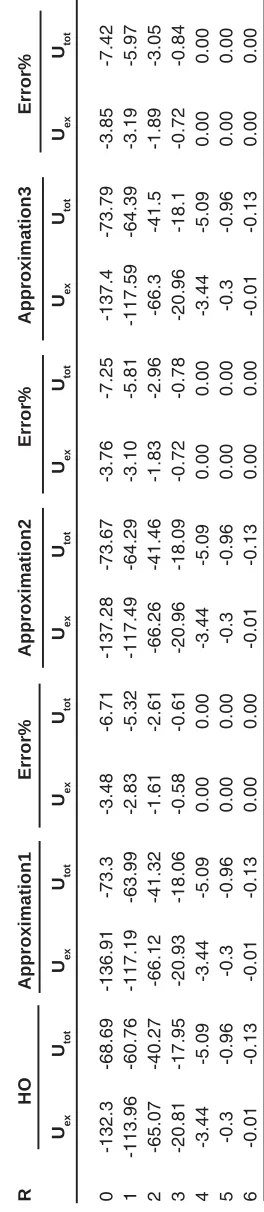
Table (1) contains the results for the
separation distance variation of the α-α interacting
pair calculated using BDM3Yn (n=1,2,3)- Reid force. Table (2) is the same as Table (1) expect Paris version of NN force was used. Part (a), (b) and (c) denote calculations using BDM3Yn with n=1,2 and 3 respectively. Both the tables were calculated for
projectile energy per nucleon EL/AP= 5.2 MeV/N.
The first column of each table shows the value of the nucleus-nucleus separation distance (R), the
second column shows both Uex and UD+Uex (
denoted by Utot) . The second column was calculated
using harmonic oscillator wave function to construct the diagonal and non diagonal densities. The third, forth and fiftieth column are our calculations by using the three approximations. The error on the tables are calculated as
Tables (1) and (2) show the results of α-α
calculated using a value b=1.33. The tables show that the effect of neglecting s-dependence increases as the NN force becomes corresponding to higher value of incompressibility coefficient. This effect is
about 30%(23%) in U ex (Utot) for the force BDM3Y2
-Reid type while it is less than 7% for BDM3Y1-Ried.
It decreases as the α–α separation distance
increases. For BDM3Y3 type of force which
corresponds to large value of compressibility coefficient, the corresponding error is too large at separation distance R=0, as Tables (1c) and (2c) indicate .This error becomes reasonable as the
separation distance between the two α particles
increases. The huge error obtained is due to the
small radius of α–particle (about 1.58 fm.) and its
large central density. Since the force BDM3Y3
corresponds to nuclear matter saturation curve in
which
A E
varies strongly when ρ becomes greater
than the saturation density ρ( 0.17fm3)
0
−
≅ ,we expect
large change in potential when the density changes
slightly .In other words the force BDM3Y3 is too
sensitive to the value of ρ when the latter has value
more than 0.17 fm-3 . In order to decrease this
error, á –particle is artifficially made less localised. For this purpose we increased
r 2
1 2
by about 13% to becomes (1.83 fm.) which corresponds to b=1.5 fm. Tables (3a) and (3b) are the same as (1c) and (2c) respectively except they are calculated using
b=1.5fm. These tables show that when the α–
particle becomes less localised, the error becomes reasonable.
For direct part
T
able 1a: Calculation of the exchange and tot
al
ααααα
-
α α α α α
potential using density dependent (BDM3Y
1
-Reid) NN interaction. Harmonic oscillator
wave functions used in the calculations to construct the densities. The second column covers r and s to calculations using
⎟ ⎠ ⎞ ⎜ ⎝ ⎛ − +⎟ ⎠ ⎞ ⎜ ⎝ ⎛ + = s s r r r r 2 1 r ρ 2 1 r ρ ρ 2 P 1 T
which the other columns are calculated by approximating the expression
()
(
)
2 P 1 T r ρ r ρ ρ r r + = .b=1.33 fm. R H O Approximation1 Error% Approximation2 Error% Approximation3 Error% Uex Utot Uex Utot Uex Utot Uex Utot Uex Utot Uex Utot Uex Utot 0 33.06 -22.79 -12.85 -68.7 138.87 -201.45 -16.01 -71.86 148.43 -215.31 -17.3 -73.15 152.33 -220.97 1 -14.48 -30.84 -34.84 -51.2 -140.61 -66.02 -36.78 -53.14 -154.01 -72.31 -37.52 -53.88 -159.12 -74.71 2 -31.38 -29.39 -34.35 -32.37 -9.46 -10.14 -34.76 -32.77 -10.77 -11.50 -34.88 -32.89 -11.15 -11.91 3 -11.38 -15.84 -11.58 -16.04 -1.76 -1.26 -11.62 -16.07 -2.11 -1.45 -11.63 -16.08 -2.20 -1.52 4 -1.81 -4.6 -1.82 -4.61 -0.55 -0.22 -1.82 -4.61 -0.55 -0.22 -1.82 -4.61 -0.55 -0.22 5 -0.15 -0.82 -0.15 -0.82 0.00 0.00 -0.15 -0.82 0.00 0.00 -0.15 -0.82 0.00 0.00 6 -0.01 -0.1 -0.01 -0.1 0.00 0.00 -0.01 -0.1 0.00 0.00 -0.01 -0.1 0.00 0.00 Table 1(b): Is the same as T
able (1a) but using density dependent ( BDM3Y
T
able 2(a): Is the same as T
able (1a) but for M3Y
Paris R H O Approximation1 Error% Approximation2 Error% Approximation3 Error% Uex Utot Uex Utot Uex Utot Uex Utot Uex Utot Uex Utot Uex Utot 0 -132.3 -68.69 -136.91 -73.3 -3.48 -6.71 -137.28 -73.67 -3.76 -7.25 -137.4 -73.79 -3.85 -7.42 1 -113.96 -60.76 -117.19 -63.99 -2.83 -5.32 -117.49 -64.29 -3.10 -5.81 -117.59 -64.39 -3.19 -5.97 2 -65.07 -40.27 -66.12 -41.32 -1.61 -2.61 -66.26 -41.46 -1.83 -2.96 -66.3 -41.5 -1.89 -3.05 3 -20.81 -17.95 -20.93 -18.06 -0.58 -0.61 -20.96 -18.09 -0.72 -0.78 -20.96 -18.1 -0.72 -0.84 4 -3.44 -5.09 -3.44 -5.09 0.00 0.00 -3.44 -5.09 0.00 0.00 -3.44 -5.09 0.00 0.00 5 -0.3 -0.96 -0.3 -0.96 0.00 0.00 -0.3 -0.96 0.00 0.00 -0.3 -0.96 0.00 0.00 6 -0.01 -0.13 -0.01 -0.13 0.00 0.00 -0.01 -0.13 0.00 0.00 -0.01 -0.13 0.00 0.00 T
able 1(c): Is the same as T
able (1a) but using density dependent ( BDM3Y
T
able 2(b): Is the same as T
able (2a) but using density dependent ( BDM3Y
2 ) force R H O Approximation1 Error% Approximation2 Error% Approximation3 Error% Uex Utot Uex Utot Uex Utot Uex Utot Uex Utot Uex Utot Uex Utot 0 -57.25 -50.4 -71.13 -64.29 -24.24 -27.56 -72.22 -65.37 -26.15 -29.70 -72.7 -65.85 -26.99 -30.65 1 -75.19 -47.7 -83.22 -55.73 -10.68 -16.83 -83.93 -56.45 -11.62 -18.34 -84.22 -56.74 -12.01 -18.95 2 -60.17 -35.05 -61.93 -36.81 -2.93 -5.02 -62.14 -37.02 -3.27 -5.62 -62.21 -37.09 -3.39 -5.82 3 -20.29 -16.66 -20.44 -16.81 -0.74 -0.90 -20.47 -16.84 -0.89 -1.08 -20.47 -16.84 -0.89 -1.08 4 -3.21 -4.82 -3.22 -4.82 -0.31 0.00 -3.22 -4.82 -0.31 0.00 -3.22 -4.82 -0.31 0.00 5 -0.26 -0.9 -0.26 -0.9 0.00 0.00 -0.26 -0.9 0.00 0.00 -0.26 -0.9 0.00 0.00 6 -0.01 -0.12 -0.01 -0.12 0.00 0.00 -0.01 -0.12 0.00 0.00 -0.01 -0.12 0.00 0.00 T
able 2(c): Is the same as T
able (2a) but using density dependent (BDM3Y
T
able 3(a): Is the same as T
a
ble (1c) but for using b=1.5 fm
R H O Approximation1 Error% Approximation2 Error% Approximation3 Error% Uex Utot Uex Utot Uex Utot Uex Utot Uex Utot Uex Utot Uex Utot 0 -53.17 -62.33 -59.2 -68.36 -11.34 -9.67 -59.68 -68.83 -12.24 -10.43 -59.88 -69.04 -12.62 -10.77 1 -51.27 -56.51 -55.07 -60.31 -7.41 -6.72 -55.4 -60.63 -8.06 -7.29 -55.53 -60.77 -8.31 -7.54 2 -36.09 -40.81 -37.09 -41.81 -2.77 -2.45 -37.19 -41.91 -3.05 -2.70 -37.23 -41.95 -3.16 -2.79 3 -15.05 -20.84 -15.17 -20.96 -0.80 -0.58 -15.19 -20.98 -0.93 -0.67 -15.2 -20.98 -1.00 -0.67 4 -3.6 -6.88 -3.61 -6.89 -0.28 -0.15 -3.61 -6.89 -0.28 -0.15 -3.61 -6.89 -0.28 -0.15 5 -0.51 -1.53 -0.51 -1.53 0.00 0.00 -0.51 -1.53 0.00 0.00 -0.51 -1.53 0.00 0.00 6 -0.04 -0.25 -0.04 -0.25 0.00 0.00 -0.04 -0.25 0.00 0.00 -0.04 -0.25 0.00 0.00 T
able 3(b): Is the same as T
able (2c) but for using b=1.5 fm
Table 4(a): Results of the direct part of a-a potential for BDM3Y1-Reid NN force using oscillator model densities with b=1.33 fm for the density of a particle. Vs(R) is calculated using
⎟ ⎠ ⎞ ⎜ ⎝ ⎛ + ⎟ ⎠ ⎞ ⎜ ⎝ ⎛ +
= s
2 1 -r ρ s 2 1 r ρ
ρ p r1 r T r2 r
and V(R) calculated using ρ ρp
( )
r1 ρT( )
r2 r r +=
t = 4 fm-1 t=2.5 fm-1 Full range
R V( R) Vs(R) Error V( R) Vs(R) Error V( R) Vs(R) Error
0 386.17 375.7 -2.79 -384.3 -364.3 -5.48 1.87 11.37 83.52
1 318.42 314.03 -1.4 -318.8 -309.8 -2.9 -0.35 4.24 108.32
2 169.06 170.82 1.03 -174.7 -178 1.84 -5.68 -7.19 21.06
3 53.03 54.41 2.54 -59.57 -62.91 5.31 -6.54 -8.5 23.06
4 9.47 9.75 2.87 -12.51 -13.46 7.01 -3.04 -3.7 17.91
5 0.97 1 2.74 -1.7 -1.85 7.83 -0.73 -0.85 13.86
6 0.06 0.07 15.83 -0.17 -0.21 21.36 -0.11 -0.14 24.19
Table 4(b): Is the same as Table (4a) but using density dependent BDM3Y2 force
t = 4 fm-1 t=2.5 fm-1 Full range
R V( R) Vs(R) Error V( R) Vs(R) Error V( R) Vs(R) Error
0 241.05 215.09 -12.07 -256 -208.6 -22.73 -14.95 6.51 329.69
1 237.37 229.01 -3.65 -242.8 -225.9 -7.49 -5.48 3.09 277.22
2 155.09 159.07 2.5 -158.3 -165.8 4.53 -3.17 -6.7 52.69
3 51.51 53.13 3.05 -57.26 -61.43 6.79 -5.75 -8.3 30.75
4 9.01 9.19 2.05 -11.94 -12.68 5.89 -2.93 -3.49 16.02
5 0.9 0.91 1.36 -1.59 -1.68 4.94 -0.7 -0.77 9.17
6 0.05 0.06 15.59 -0.15 -0.19 19.04 -0.1 -0.13 20.81
Table 4(c): Is the same as Table (4a) but using density dependent BDM3Y3 force
t = 4 fm-1 t=2.5 fm-1 Full range
R V( R) Vs(R) Error V( R) Vs(R) Error V( R) Vs(R) Error
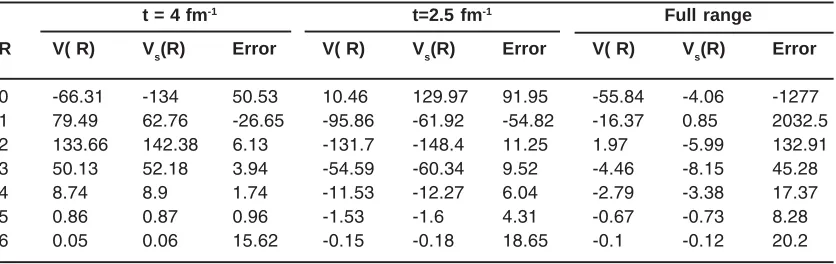
0 -66.31 -134 50.53 10.46 129.97 91.95 -55.84 -4.06 -1277
1 79.49 62.76 -26.65 -95.86 -61.92 -54.82 -16.37 0.85 2032.5
2 133.66 142.38 6.13 -131.7 -148.4 11.25 1.97 -5.99 132.91
3 50.13 52.18 3.94 -54.59 -60.34 9.52 -4.46 -8.15 45.28
4 8.74 8.9 1.74 -11.53 -12.27 6.04 -2.79 -3.38 17.37
5 0.86 0.87 0.96 -1.53 -1.6 4.31 -0.67 -0.73 8.28
6 0.05 0.06 15.62 -0.15 -0.18 18.65 -0.1 -0.12 20.2
dependence on the HI potential we consider
α
-α
interacting potential. The small mass number of
α
-particle produces large changes in the density distribution along the separation distance between the two centers of the interacting particles. This change in the density from point to point makes the
Table 5(a): Is the same as Table (4a) but for M3Y Paris
t = 4 fm-1 t=2.5 fm-1 Full range
R V( R) Vs(R) Error V( R) Vs(R) Error V( R) Vs(R) Error
0 465.36 448.28 -3.81 -401.7 -373.8 -7.49 63.61 74.53 14.65
1 393.3 386.15 -1.85 -340.1 -327.5 -3.84 53.2 58.63 9.27
2 218.96 221.83 1.3 -194.2 -198.8 2.31 24.8 23.08 -7.45
3 71.39 73.64 3.06 -68.52 -73.21 6.4 2.87 0.43 -561.6
4 13.06 13.52 3.39 -14.71 -16.03 8.26 -1.65 -2.51 34.42
5 1.36 1.41 3.15 -2.03 -2.23 9.08 -0.67 -0.82 19.18
6 0.09 0.1 15.72 -0.2 -0.26 22.04 -0.11 -0.16 26.15
Table 5(b): Is the same as Table (4b) but using density dependent BDM3Y2 force
t = 4 fm-1 t=2.5 fm-1 Full range
R V( R) Vs(R) Error V( R) Vs(R) Error V( R) Vs(R) Error
0 228.74 186.41 -22.71 -221.9 -155.4 -42.77 6.85 30.99 77.91
1 261.16 247.52 -5.51 -233.7 -209.9 -11.3 27.49 37.58 26.87
2 196.19 202.68 3.2 -171.1 -181.6 5.8 25.12 21.09 -19.14
3 68.91 71.55 3.69 -65.28 -71.13 8.23 3.63 0.42 -762
4 12.3 12.61 2.44 -13.9 -14.95 7.01 -1.6 -2.35 31.59
5 1.23 1.25 1.57 -1.87 -1.99 5.81 -0.64 -0.73 13.02
6 0.07 0.09 15.42 -0.18 -0.23 19.39 -0.11 -0.14 21.97
Table 5(c): Is the same as Table (4c) but using density dependent BDM3Y3 force
t = 4 fm-1 t=2.5 fm-1 Full range
R V( R) Vs(R) Error V( R) Vs(R) Error V( R) Vs(R) Error
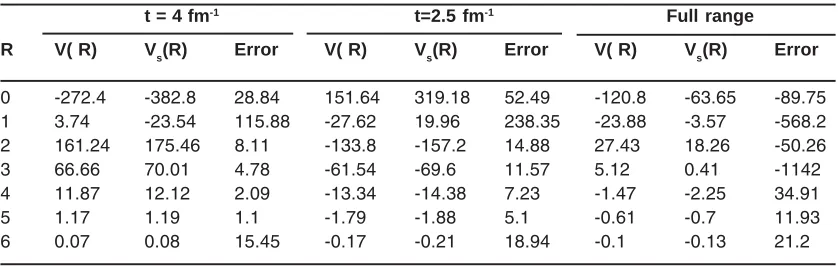
0 -272.4 -382.8 28.84 151.64 319.18 52.49 -120.8 -63.65 -89.75
1 3.74 -23.54 115.88 -27.62 19.96 238.35 -23.88 -3.57 -568.2
2 161.24 175.46 8.11 -133.8 -157.2 14.88 27.43 18.26 -50.26
3 66.66 70.01 4.78 -61.54 -69.6 11.57 5.12 0.41 -1142
4 11.87 12.12 2.09 -13.34 -14.38 7.23 -1.47 -2.25 34.91
5 1.17 1.19 1.1 -1.79 -1.88 5.1 -0.61 -0.7 11.93
6 0.07 0.08 15.45 -0.17 -0.21 18.94 -0.1 -0.13 21.2
we note that the density dependent contribution of the NN force contains the sum (
2
1
ρ
ρ
+
). This term is calculated usually by assuming that the value of (
2
1
ρ
ρ
+
) corresponds to the values of densities at the positions of the interacting nucleons (
)
(r
ρ
)
(r
ρ
1 1+
2 2). Another way is to evaluate the sum of the two densities at a point midway between the interacting nucleons so that it is expressed as
the sum
⎟ ⎠ ⎞ ⎜
⎝
⎛ + + −
) s 2 1 r (
ρ
) s 2 1 r (
ρ1r1 r 2r2 r
.If the interacting nuclei have large mass numbers the two approaches produce almost the same value of the density and the effect of s-dependence becomes larger. For strong overlap between light nuclei there is a large
chance that the total density ⎟
⎠ ⎞ ⎜
⎝
⎛ + + −
) s 2 1 r ( ρ ) s 2 1 r (
ρP 1 T 2
r r r r
Fig. 1: Coordinates used in the exchange part of the nucleus-nucleus interaction
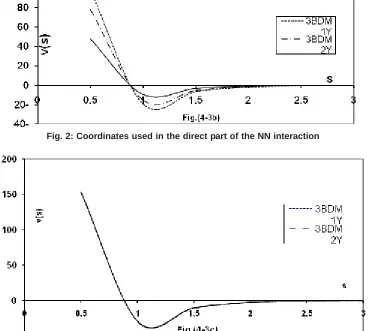
Fig. 2: Coordinates used in the direct part of the NN interaction
Fig. 3(b) Is the same as Fig.(3a) but at constant σσσσσ= σσσσσ0 fm-3
Fig. 3(c) Is the same as Fig.(3a) but at constant σσσσσ= 0.5ñ0 fm-3
densities. Since the NN interaction is of the form, )
αρ -cv(s)(1 ρ)
v(s, = β , the appearance of s in
ρ
produces a NN interaction potential value small compared to the case when s-dependence is ignored. So, we expect that the HI potential calculated, for small R-values, using the form
(
ρP(rr1)+ρT(rr2))
in NN force is enhanced comparedto that calculated by including
s
r
in the total density. This appears clearly for the NN force ranges 0.25 and 0.4 fm presented on tables (4) and (5) where the
α
-α
potential V(R) and Vs(R) are calculated
receptively using the expressions
(
ρP(rr1)+ρT(rr2))
and⎟ ⎠ ⎞ ⎜
⎝
⎛ + + − s)
2 1 r (
ρ
) s 2 1 r (
ρP 1 T 2
r r r r
in the NN force density dependent term. Table (4) shows the potential calculated, at different separation distances R, using the BDM3Yn(n=1,2,3) -Reid NN forces .The table
contains the contributions of V(R) and Vs(R)
resulting from one Yukawa term with ranges 0.25 and 0.4 fm. and the same quantities calculated using NN force which contains the two ranges. Table (5) is the same as table (4) except it is for Paris type of force. The tables show that for one Yukawa is greater than, in most cases, for small R values. The error in neglecting the s-dependence increases as the range of NN force increases. This is reasonable for all separation distances between the two interacting nuclei. For, calculated using one Yukawa term in becomes smaller than .This is because as the separation distance between the two nuclei increases, the sum has large chance to be greater than during the integration process on the volume elements. This behavior is clear on tables (4) and (5), for the two separate Yukawa ranges 0.25 and 0.4 fm. When the two Yukawa terms are combined
together to for m M3Y-force, V(R) and Vs(R)
becomes different in behavior than the case of single Yukawa term. For, V(R) is less repulsive or more attractive compared to V(R, s) .In the surface and tail regions V(R) becomes less attractive or
more repulsive than Vs(R).
For Reid type of NN force, the magnitude of the percentage error is too large in the inner region while it is smaller in the surface and tail regions. For Paris force the situation is different,
the error in the total potential is too large at R=3fm.This large value of error is accompanied by small error values for the two Yukawa ranges 0.25 and 0.4 fm. This can be interpreted if we remember that the direct part of HI potential calculated using Paris NN force is repulsive at small R values then it passes through zero and becomes attractive. For the distance R=3 fm. the value of potential is too
small and any small change between V(R) and Vs(R)
produces large value of error. The difference
between V(R) and Vs(R) together with the difference
in HI potential due to change of NN force can be understood from Figs.(3) and (4) .
Fig.(3) shows the variation of the direct part of Reid NN forces with the distance between the two interacting nucleons calculated at three different values of density. These values are , and where is the - particle density at the center of the nucleus. Fig.(4) is the same as Fig.(3) except it is for Paris interaction .It is noted that strong variation of NN force with internucleon distance produces
large difference between V(R ) and Vs(R) .This is
clear on table (4) for BDMN3Yn(n=1 ,2,3) forces at
where Fig.(3) shows rapid variation of v(s, ) with
the distance s for BDM3Y3 and slow variation for
BDM3Y1 .This interprets the large error in neglecting
the s-dependence produced at R<2 fm. for BDM3Y3
Reid force. In the surface and tail regions() the error produced by neglecting s-dependence is less than 50% because the shape of NN forces at and are almost similar and does not vary strongly with s. For Paris type of NN force shown in Fig.(4) , the
direct part of BDM3Y3 force is strongly attractive
for s < 1 fm. then it becomes repulsive. This produces highly attractive HI potential in the inner region for range 0.25 fm. and repulsive potential for
range 0.4 fm. The strong variation of BDM3Y3 for
small s-values Fig(4a) produces large error between V(R ) and V (R ,s) in the inner region . As the distance R increases Fig.(4b) and (4c) show that v(s, ) becomes highly repulsive at small s-values and weakly attractive for .This produces weakly attractive total potential in the tail region table(5).
REFERENCES
1. R.K.Gupta,W.Scheid and W.Greiner, Phys.
Rev. Lett. 35(9): 353 (1974).
2. D.Scharnweber,W.Greiner and W.Mosel,
3. W.Greiner and W.Scheid, J. Phys. Paris 32(C6): 91 (1971).
4. H.Holm and W.Greiner, Nucl. Phys.A195:
333 (1972) .
5. R.Sar tor,A.Faessler,S.B.Khodkikar and
Kerwald, Nucl. Phys. A354,467(1981) .
6. D.M.Brink and F. Stancu, Nucl. Phys.
A243,175(1975); F.Stancu and D.M.Brink, A270: 236 (1976) .
7. M.Ismail, M.Rashdan, A.Faessler, R.linden,
N.Ohtsuk and W.Wadia, ibid A490: 715 (1989); M.Ismail, H. Abozahra, Phs. Rev. C53:53(1996) .
8. J.Blucki,J.Randrup ,W.J.Swiatecki , and
C.F.Tsang ,Ann. Phys.(NY), 105: 427 (1977).
9. G.R.Satchler and W.G.Love, Phys. Rep.55:
183 (1979).
10. J.W.Negele and D.Vautherin, Phys. Rev. C5:
1472 (1972), C11: 1032(1975).
11. Dao T.khoa, Nucl.Phys. A486 169 (1988).
12. Dao T.Khoa and W.Von Oertzen, Phys.Lett.
304: 8 (1993).
13. Dao T.Khoa and W.Von Oertzen and H.G.
Bolhen,Phys. Rev. Cha: (1994)1652.
14. Dao T.Khoa and W.Von Oertzen, Phys. Lett.
B 342: 6 (1995).
15. Dao T.Khoa et.al., Phys. Rev. Lett.74: 134
(1995).
16. Dao T.Khoa ,G.R.Satchler and W.Von
Oertzen, Phys.Rev. C56: 954 (1997).
17. B.Sinha,Phys.Rep. 20: (1975).
18. A.K.Chaudhuri,D.N.Basu and B.Sinha, Nucl.
Phys.A43: 415 (1985); A.K.Chaudhuri and
B.Sinha ,Nucl.Phys. A455: 169 (1986).
19. S.Misicu and W.Greiner, Phys. Rev.C66:
044606 (2002).
20. M.El.Azab Farid and G.R. Satchler, Nucl.
Phys.A438: 525 (1985).
21. D.A. Goldberg et al.,Phys. Rev. C7: 1938
(1973).
22. H.G. Bohlen et al., Z. Phys. A308: 21 (1982).
23. H.G. Bohlen et al., Z. Phys. A322: 241 (1985).
24. E. Stiliais et al., Phys. Lett. B223: 291 (1989).
25. G.Bertsch et.al, Nucl. Phys. A284: 199
(1977).
26. A.M.Kobos et al.,Nucl. Phys. A384: 65 (1982);
A.M.Kobos et al.,Nucl. Phys. A425: 205
(1984).
27. M.E.Brandon and G.R.Satchler, Phys. Rep.
285: 14 (1997).
28. W.G.Love and L.W.Owen,Nucl. Phys. A239:
74 (1975).
29. M.Golin,F.petrovich and D.Robson,
Phys.Lett. B64: 253 (1976).
30. M.E. Brandan, M.Rodigueg-Villafuerte and
A.Ayala, Phys. Rev. C41: 1520 (1990).
31. M.E. Brandan and G.R. Satchler Phys. Lett.
B256: 311 (1991).
32. H.J.Krappe,J.R.Nix,and A.J.Sierk, Phys.
Rev.C20: 992(1979).
33. M.M. Osman, Balkan Phys. Lett. 6: 25 (1998).
34. M. Ismail,M.M. Osman and F. Salah,Phys.
Lett. B378: (1996)40;M. Ismail, F. Salah and M.M. Osman,Phys. Rev.C54: 3308 (1996).
35. B.Sinha, and S.A. Moszkowski, Phys. Lett.
B81: 289 (1979).
36. A.Faessler,W.H.Dickoff,M.Trefz and M.Trefz
and M.Rhoades- Brown, Nucl. Phys. A 428: 2710 (1984).
37. D.A.Saloner and C.T. Toepffer, Nucl. Phys.
A283: 108 (1977).
38. M.Ismail, A.Y.Ellithi, Choas Solitons and
Fractals, 14(9): 1425 (2002)
39. X.Campi,and A.Bonyssy, Phys. Lett. B73:
263 (1978)
40. J.Phys.G2: 285 (1976)
41. S.Sartor and F.I.Stancu, Phys. Rev.C29:
1756 (1984).
42. L.G.B.Goldfarb, P.Nagel, Nucl. Phys.A34: 494