Strong Limit Theorems for the Bayesian Scoring Criterion
in Bayesian Networks
Nikolai Slobodianik [email protected]
Department of Mathematics and Statistics York University
4700 Keele Street, Toronto, ON M3J 1P3, Canada
Dmitry Zaporozhets [email protected]
Steklov Institute of Mathematics at St. Petersburg 27 Fontanka, St. Petersburg 191023, Russia
Neal Madras [email protected]
Department of Mathematics and Statistics York University
4700 Keele Street, Toronto, ON M3J 1P3, Canada
Editor: Max Chickering
Abstract
In the machine learning community, the Bayesian scoring criterion is widely used for model selec-tion problems. One of the fundamental theoretical properties justifying the usage of the Bayesian scoring criterion is its consistency. In this paper we refine this property for the case of binomial Bayesian network models. As a by-product of our derivations we establish strong consistency and obtain the law of iterated logarithm for the Bayesian scoring criterion.
Keywords: Bayesian networks, consistency, scoring criterion, model selection, BIC
1. Introduction
Bayesian networks are graphical structures which characterize probabilistic relationships among variables of interest and serve as a ground model for doing probabilistic inference in large systems of interdependent components. A basic element of a Bayesian network is a directed acyclic graph (DAG) which is bound to an underlying joint probability distribution by the Markov condition. The absence of certain arcs (edges) in a DAG encodes conditional independences in this distribution. DAG’s not only provide a starting point for implementation of inference and parameter learning algorithms, but they also, due to their graphical nature, offer an intuitive picture of the relationships among the variables. It happens too often that researchers have only a random sample from a prob-ability distribution and face a problem of choosing the appropriate DAG between a large number of competing structures. This, effectively, constitutes the model selection problem in the space of Bayesian networks. The methodology which is concerned with solving such task is called Bayesian structure learning.
Suppose that the data consists of n i.i.d. random vectors X1, . . . ,Xnwith each Xihaving the
un-known probability distribution P. We define a probability spaceΩwith measure Pr for infinite i.i.d.
network with the distribution P (see Section 2 for formal definitions and examples), however not all of them are optimal for future analysis. Indeed, since the presence of an arc (edge) does not neces-sarily guarantee direct dependency between corresponding variables, a complete DAG constitutes a Bayesian network with any probability distribution, yet provides no information about conditional independences in P. It is natural to seek structures which not only form a Bayesian network with P, but also entail only conditional independences in this distribution. These DAGs are called faithful to P or else perfect maps of P. Unfortunately, it turns out that not all probability distributions have an associated faithful structure. In this case it is desirable to identify a structure which satisfies certain “optimality” properties with respect to P. Roughly speaking, we want to include only those edges that are necessary for describing P.
A scoring criterion for DAGs is a function that assigns a value to each DAG under consideration based on the data. Suppose M is the set of all DAGs of a fixed size. Under the Bayesian approach to structure learning, the DAG m is chosen from M such that m maximizes the posterior probability given the observed data D:
p(m|D,ψ) = p(m|ψ)p(D|m,ψ) p(D|ψ) =
p(m|ψ)R
Ωmp(D|m,Θm,ψ)p(Θm|m,ψ)dΘm
∑m∈Mp(m|ψ)
R
Ωmp(D|m,Θm,ψ)p(Θm|m,ψ)dΘm
, (1)
where Θm denotes the set of parameters of the conditional distributions of each “node given its
parents” for all the nodes of the DAG m, Ωmdenotes the domain of these parameters, and ψ
de-notes the system of parameter priors. The quantity P(D|m,ψ) is called the marginal likelihood,
Bayesian scoring criterion or else Score of the graph m. We denote it asscoreB(D|m). Assuming
∑m∈Mp(m|ψ) =1 for all m∈M, the Bayesian scoring criterion provides a measure of posterior
certainty of the graph m under the prior systemψ.
It is quite interesting to see if the Bayesian scoring criterion is consistent, that is, as the size of data D approaches infinity, the criterion is maximized at the DAG which forms a Bayesian network with P and has smallest dimension. Based on the fundamental results of Haughton (1988) and Geiger et al. (2001), the consistency of Bayesian scoring criterion has been established for the class of multinomial Bayesian networks. Chickering (2002) provides a detailed sketch of the proof. Further, for the same model class, if P admits a faithful DAG representation m, then m has the smallest dimension among all DAGs which form a Bayesian network with P (see, for example, Neapolitan, 2004, Corollary 8.1) . Therefore, due to consistency of the Bayesian scoring criterion, we can conclude that if P admits a faithful DAG representation m then, in the limit, the Bayesian scoring criterion will be maximized at m. This last result is naturally expected: as more information becomes available, a scoring criterion should recognize the properties of the underlying distribution P with increasing precision.
It may be possible to re-derive our results using the machinery of VC classes (Vapnik, 1998) or empirical process theory (e.g., van der Vaart and Wellner, 1996), but to our knowledge this has not yet been done. However, one point of our paper is to show that the results are amenable to fairly transparent and accessible proofs, and do not require the overhead of these well-developed theoretical frameworks. That being said, we note that our method assumes that the networks have fixed finite size, and other approaches may be better suited to handling the situation in which the network size gets large.
The rest of the paper is organized as follows. Background and notation appear in Section 2, with some illustrative examples. Our results are presented in Section 3. Section 4 contains some discussion. Proofs appear in the Appendix.
2. Background
A directed graph is a pair (V,E), where V ={1, . . . ,N} is a finite set whose elements are called nodes (or vertices), and E is a set of ordered pairs of distinct components of V . Elements of E are called edges (or arcs). If(i1,i2)∈E we say that there is an edge from i1 to i2. Given a set of nodes{i1,i2, . . . ,ik}where k≥2 and(ir,ir+1)∈E for 1≤r≤k−1, we call a sequence of edges ((i1,i2), . . . ,(ik−1,ik))a path from i1 to ik . A path from a node to itself is called a directed cycle. Additionally, a directed graph is called a directed acyclic graph (DAG) if it contains no directed cycles. Given a DAG m= (V,E), a node i2is called a parent of i1if there is an edge from i2to i1. We write Pa(i)to denote the set of parents of a node i. A node i2is called a descendant of i1if there is a path from i1to i2, and i2is called a nondescendant of i1if i2is not a descendant of i1.
Suppose m= (V,E) is a DAG, and X ={ξ1, . . . ,ξN} is a random vector that follows a joint
probability distribution P. For each i, let ξi correspond to the ith node of V . For A⊂V , letξA
denote the collection of variables{ξi: i∈A}. (In the literature, sometimes this collection is written simply as A. We will occasionally following this convention, but in mathematical expressions about probabilities we usually prefer to distinguish clearly between the set of variables A and their values
ξA.) In particular, ξPa(i)describes the states of the parents of node i. We say that (m,P)satisfies
the Markov condition if each component of X is conditionally independent of the set of all its
nondescendants given the set of all its parents. Finally, if(m,P) satisfies the Markov condition,
then we say that(m,P)is a Bayesian network, and that m forms a Bayesian network with P. See
Neapolitan (2004) for more details.
The independence constraints encoded in a Bayesian network allow for a simplification of the joint probability distribution P which is captured by the factorization theorem (Neapolitan, 2004, Theorem 1.4):
Theorem 1 If(m,P)satisfies the Markov condition, then P is equal to the product of its conditional distributions of all nodes given the values of their parents, whenever these conditional distributions exist:
P(ξ1, . . . ,ξN) = N
∏
i=1
P ξi|ξPa(i)
.
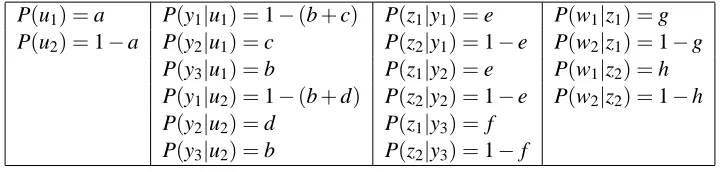
P(u1) =a P(y1|u1) =1−(b+c) P(z1|y1) =e P(w1|z1) =g P(u2) =1−a P(y2|u1) =c P(z2|y1) =1−e P(w2|z1) =1−g
P(y3|u1) =b P(z1|y2) =e P(w1|z2) =h P(y1|u2) =1−(b+d) P(z2|y2) =1−e P(w2|z2) =1−h P(y2|u2) =d P(z1|y3) =f
P(y3|u2) =b P(z2|y3) =1−f Table 1: Constraints on distribution P
- -
-k
U
k
Y
k
Z
k
W
Figure 1: The DAG m for our first example.
0≤a,b,c, . . . ,g,h≤1. Note that, due to Theorem 1, the equations in Table 1 fully determine P as a function of a,b,c, . . . ,g,h. Further, since (m,P) satisfies the Markov condition, each node is conditionally independent of the set of all its nondescendants given its parents. For example, we
see that Z and U are conditionally independent given Y (written Z⊥⊥U|Y ). Do these conditional
independences entail any other conditional independences, that is, are there any other conditional independences which P must satisfy other than the one based on a node’s parents? The answer is
positive. For example, if(m,P)satisfies the Markov condition, then
P(w|u,y) =
∑
uP(w|z,u,y)P(z|u,y) =
∑
uP(w|z,y)P(z|y) =P(w|y)
and hence W ⊥⊥U|Y . Explicitly, the notion of “entailed conditional independence” is given in the
following definition:
Definition 2 Let m= (V,E)be a DAG where V is a set of random variables, and let A,B,C⊂V . We say that, based on Markov condition, m entails conditional independence A⊥⊥B|C if A⊥⊥B|C holds for every P∈Pm, where Pmis the set of all probability distributions P such that(m,P)satisfies the Markov condition.
We say that there is a direct dependency between variables A and B in P if A and B are not condi-tionally independent given any subset of V . Based on the Markov condition, the absence of an edge between A and B implies that there is no direct dependency between A and B. However, the Markov condition is not sufficient to guarantee that the presence of an edge means direct dependency. In
general, given a Bayesian network(m,P), we would want an edge in m to mean there is a direct
dependency. In this case the DAG would become what it is naturally expected to be—a graphi-cal representation of the structure of relationships between variables. The faithfulness condition as defined below indeed reflects this.
- -?
k
ξ1
kξ2
kξ3
k
ξ4
Figure 2: A second example of a DAG.
satisfies the faithfulness condition, we say that m and P are faithful to each other and we say m is a perfect map of P.
It is easy to see that the Bayesian network(m,P), where m is shown in Figure 1 and P satisfies
the constraints in Table 1, does not satisfy the faithfulness condition. Indeed, Table 1 implies that U ⊥⊥Z, but this independence is not entailed by m based on the Markov condition. As shown in Example 2.10 of Neapolitan (2004), the distribution P of this example has no perfect map. However, it is not hard to see that the DAG of Figure 1 is “optimal” in the sense that no DAG with fewer edges forms a Bayesian network with P.
In this paper we concentrate on Bayesian networks over a set of variables X ={ξ1, . . . ,ξN} ∼P
where each variable takes values from the set{1,2}. Let m be a DAG with nodes 1, . . . ,N. The
probability distributions in Pm can be parameterized according to the conditional distributions of
Theorem 1 as follows. For each node i, let|Pa(i)|be the number of parents of i and let qi(m) =
2|Pa(i)|be the number of possible states of the set of variablesξPa(i). Consider a fixed list of the qi(m)
possible states ofξPa(i). For j∈ {1, . . . ,qi(m)}, we shall write “ξPa(i)= j” to mean that the parents
of node i are in the states given by the jthitem in the list. For k=1,2 and j=1, . . . ,qi(m), we write
θi jk =P(ξi=k|ξPa(i)= j). Observe thatθi j2=1−θi j1. We shall writeΘmto denote the vector of allθi j1’s for m:
Θm = θi j1 : i=1, . . . ,N,j=1, . . . ,qi(m)
∈ [0,1]km,
where km=∑Ni=1qi(m). Then eachΘmin[0,1]km determines a probability measure P =PΘm such
that(m,P)is Bayesian network; and conversely, if(m,P)is a Bayesian network, then P =PΘm for
someΘm∈[0,1]km.
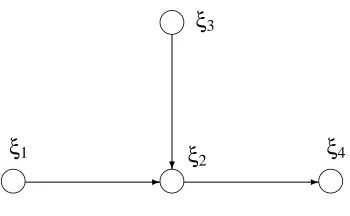
To illustrate this notation, consider the DAG m in Figure 2. Here, Pa(1) = /0=Pa(3), Pa(2) =
{1,3}, and Pa(4) ={3}, and so q1(m) =20=q3(m), q2(m) =22, and q4(m) =21. We could fix the list of possible states ofξPa(4)to be “1,2”, and the list forξPa(2)to be “(1,1), (1,2), (2,1), (2,2)”
(with the understanding that the ordering is(ξ1,ξ3)). For the latter list, we have for example
θ231 = P ξ2=1|ξPa(2)=3
= P(ξ2=1|(ξ1,ξ3) = (2,1) ). Since Pa(3) =/0, P(ξPa(3)=1) =1, andθ311is simply P(ξ3=1). We can write
and km =1+4+1+2 =8.
Let D=Dn={X1, ...,Xn}be fully observed data of size n generated according to Pr, and let Ni jkbe the number of cases in the database D such that node i takes value k while its parent setξPa(i)
takes the values corresponding to j.
A probabilistic model
M
for a random vector X= (ξ1, . . . ,ξN)is a set of possible jointproba-bility distributions of its components. If the probaproba-bility distribution P is a member of a model
M
,we say P is included in
M
. Let m be a DAG(V,E). A Bayesian network model is a pair (m,F)where F is a set of possible parameter vectorsΘm: eachΘmin F determines conditional probability
distributions for m, such that the joint probability distribution PΘm of X (given by the product of
these conditional distributions) satisfies the Markov condition with m. (E.g., for the DAG m of Fig-ure 2, the most general choice of F is[0,1]8, but F could also be a subset of[0,1]8.) For simplicity,
we shall usually omit F when referring to a Bayesian network model (m,F). In a given class of
models, if
M
2includes the probability distribution P, and if there exists noM
1(in the class) suchthat
M
1includes P andM
1has smaller dimension thanM
2, thenM
2is called a parameter optimalmap of P. (E.g. the DAG of Figure 1 is a parameter optimal map of the distribution P of Table 1.) For the Bayesian network models we shall work with in this paper, the dimension of a model m is km =∑Ni=1qi(m). A detailed discussion of probabilistic model selection in the case of Bayesian networks could be found in Neapolitan (2004).
In order to proceed further we would also need a formal definition of consistency. In this defini-tion we assume that the dimensions of the probabilistic models are well-defined. For a more detailed discussion of the definition of consistency see, for example, Neapolitan (2004), Gr¨unwald (2007) and Lahiri (2001).
Definition 4 Let Dn be a set of values (data) of a set of n mutually independent random vectors X1, . . . ,Xn, each with probability distribution P. Furthermore, let score be a scoring criterion over some class of models for the random variables that constitute each vector. We sayscoreis consistent for the class of models if the following two properties hold:
1. If
M
1includes P andM
2does not, then limn→∞Pr(score(Dn,
M
1)>score(Dn,M
2)) =1.2. If
M
1andM
2both include P andM
1has smaller dimension thanM
2, then limn→∞Pr(score(Dn,
M
1)>score(Dn,M
2)) =1.Additionally, we say that the scoring criterion is strongly consistent if, in both cases 1 and 2, it selects the appropriate model almost surely:
Pr(∃N :∀n≥N score(Dn,
M
1)>score(Dn,M
2)) =1.As an example, let m1be the DAG of Figure 2, let m2be the DAG obtained from m1by adding
an arc from node 3 to node 4, and let m0be the DAG obtained from m1 by removing the arc from
node 2 to node 4. For i=0,1,2, let
M
i be the probabilistic model consisting of all probabilitydistributions with which mi forms a Bayesian network. Let P be a probability distribution in
M
1such the components of Θm1 are eight distinct numbers in (0,1). Then
M
0 does not contain Pdimension that
M
2. If scoreis consistent, then in a situation with lots of data, scorewill be very likely to rankM
1over eitherM
0orM
2. However, consider an infinite stream of data X1,X2, . . .sampled independently from P. Suppose that after each new observation, we ask scoreto choose
among
M
0,M
1andM
2. Consistency says that the expected proportion of score’s correct choicestends to 1 as n tends to infinity. But strong consistency says more: if scoreis strongly consistent,
then with probability one it will make the correct choice for all but finitely many values of n.
3. Results
In this paper we consider the case of binomial Bayesian networks with independent Beta(αi j1,αi j2) priors for the parametersθi j1 (note thatθi j2=1−θi j1), whereαi j1,αi j2>0. We choose the beta family as it is the conjugate prior for the Binomial distribution. According to (1), the value of the Bayesian scoring criterion can be calculated as follows:
p(Dn|m) = Z
Ωm
p(Dn|m,Θm)p(Θm|m)dΘm
= N
∏
i=1 qi(m)
∏
j=1 Z 1
0
θNi j1+αi j1−1
i j1 (1−θi j1)
Ni j2+αi j2−1 1
Beta(αi j1,αi j2) dθi j1
= N
∏
i=1 qi(m)
∏
j=1
Beta(Ni j1+αi j1,Ni j2+αi j2) Beta(αi j1,αi j2)
= N
∏
i=1 qi(m)
∏
j=1
Γ(Ni j1+αi j1)Γ(Ni j2+αi j2)
Γ(Ni j1+Ni j2+αi j1+αi j2) ·
Γ(αi j1+αi j2)
Γ(αi j1)Γ(αi j2) , (2)
which coincides with the well-known formula by Cooper and Herskovits (1992).
Throughout this paper we produce several asymptotic expansions “in probability” and “almost
surely”, always with respect to our probability measure Pr onΩ. We derive several properties of
the marginal likelihood (2). We shall show that, for any model m,
log p(Dn|m) =nCm+O(
p
n log log n) a.s., (3)
where Cm is a constant independent of n. We strengthen this result by showing how to obtain a
positive constantσmsuch that
lim sup n→∞
log p(Dn|m)−nCm √
2nloglogn =σm and lim infn→∞
log p(Dn|m)−nCm √
2nloglogn =−σm a.s. (4)
We note that “in probability” versions of the above statements also follow from our methods (as in the proofs of Corollaries 12 and 10):
log p(Dn|m) = nCm+Op(√n), (5)
log p(Dn|m)−nCm
Additionally, we will be using the approximation of the Bayesian scoring criterion via maximum log-likelihood:
log p(Dn|m) =log N
∏
i=1 qi(m)
∏
j=1 ˆ
θNi j1
i j1(1−θˆi j1)Ni j2
!
−1
2kmlog n+Op(1), (6)
where ˆθi j1 is the MLE ofθi j1 and km=∑Ni=1qi(m) is the dimension of the model m. This is the efficient approximation of Bayesian score commonly known as BIC which was first derived in Schwarz (1978) for the case of linear exponential families. In Haughton (1988) his result was made more specific and extended to the case of curved exponential families—the type of model that includes Bayesian networks, as is shown in Geiger et al. (2001).
In this work, we attempt to get insight into the rate of convergence of the Bayes factor comparing
two models m1 and m2. Our result strengthens the well known property of consistency of the
Bayesian scoring criterion (e.g., see Chickering, 2002) and is expressed as the following theorem.
Theorem 5 In the case of a binomial Bayesian network class, for the Bayesian scoring criterion
based on independent beta priors, the following two properties hold:
1. If m2includes P and m1does not, then there exists a positive constant C(P,m1,m2)such that logscoreB(Dn|m2)
scoreB(Dn|m1)
= C(P,m1,m2)n+O(
p
n log log n) a.s.
and
logscoreB(Dn|m2) scoreB(Dn|m1)
= C(P,m1,m2)n+Op( √
n).
2. If m1and m2both include P and dim m1>dim m2where dim mk=∑Ni=1qi(mk), k=1,2,then
logscoreB(Dn|m2) scoreB(Dn|m1)
= dim m1−dim m2
2 log n+O(log log n) a.s.
and
logscoreB(Dn|m2) scoreB(Dn|m1)
= dim m1−dim m2
2 log n+Op(1).
In particular, the Bayesian scoring criterion is strongly consistent.
It follows from the consistency property of the Bayesian scoring criterion that if P admits a faithful DAG representation, then the limit of the probability that a consistent scoring criterion chooses a model faithful to P, as the size of data approaches infinity, equals 1. Our result in Theorem 5 strengthens this claim as follows:
Corollary 6 If(m1,P)satisfies the faithfulness condition and(m2,P)does not, then with probabil-ity 1, scoreB(Dn|m1)
scoreB(Dn|m2) approaches infinity at exponential rate in n when m2 does not include P, and
Theorem 7 If m2includes P and m1does not, then there exist Cm1,m2>0 andσm1,m2>0 such that:
lim sup n→∞
logscoreB(Dn|m2)
scoreB(Dn|m1)−nCm1,m2 σm1,m2
√
2n log log n = 1 a.s.,
lim inf n→∞
logscoreB(Dn|m2)
scoreB(Dn|m1)−nCm1,m2 σm1,m2
√
2n log log n = −1 a.s.
and also
logscoreB(Dn|m2)
scoreB(Dn|m1)−nCm1,m2
√
n
D
→ N(0,σm1,m2).
The constants Cm1,m2 andσm1,m2 from the above theorem could be defined as follows.
Definition 8 Consider a single observation X = (ξ1, . . . ,ξN)from P. Define
φi jk(X) =
logθi jk ifξi=k andξPa(i)= j
0 otherwise
and define
τ(X,m) =
N
∑
i=1 qi(m)
∑
j=1 2
∑
k=1
φi jk(X).
Then define Cm1,m2 andσm1,m2 respectively to be the mean and the standard deviation ofτ(X,m1)− τ(X,m2). Also define
Ci,m= qi(m)
∏
j=1
h
θθi j1
i j1(1−θi j1) 1−θi j1
iP(ξPa(i)=j)
.
Observe that we have
τ(X,m) =
N
∑
i=1
logθi,ξPa(i),ξi.
We shall show (see Lemma 13) thatτ(X,m) =log P(X), and (see proof of Lemma 9) that
Cm1,m2=
N
∑
i=1
logCi,m2
Ci,m1
. (7)
Observe that for any i, the constant Ci,mdepends only on the conditional probabilities P(ξi|ξPa(i))
of the model m; therefore, if models m1and m2have the same set of parents of the ith node, then
Ci,m1 =Ci,m2 and the i
thterm in (7) is zero.
4. Conclusion
In this paper we proved the strong consistency property of the Bayesian scoring criterion for the case of binomial Bayesian network models. We obtained asymptotic expansions for the logarithm of Bayesian score as well as the logarithm of the Bayes factor comparing two models. These results are important extensions of the consistency property of the Bayesian scoring criterion, providing insight into the rates at which the Bayes factor favors correct models. The asymptotic properties are found to be independent of the particular choice of beta parameter priors.
The methods we used are different from the mainstream. One typical way to investigate the properties of Bayesian score is to use BIC approximation and hence reduce the problem to investi-gation of the maximum log-likelihood term. In this paper we use expression (9) where the first term is the log-likelihood evaluated at the true parameter.
If we use the results of Theorem 5 in the approximation of Bayes scoring criterion by BIC (6),
we can see that given two models m1and m2, if both of them include the generating distribution P
then their maximum log-likelihoods are within O(log log n)of each other, and if one of the models
does not include P then the maximum log-likelihoods differ by a leading order of C(P,m1,m2)n.
These are the rates obtained by Qian and Field (2002, Theorems 2 and 3) for the case of model selection in logistic regression. This observation advocates for the existence of a unified approach for a very general class of models which can describe the rates at which Bayesian scoring criterion and its approximations favor correct model choices.
Acknowledgments
We would like to thank H´el`ene Massam, Yuehua Wu, Guoqi Qian, Chris Field, and the referees for their constructive and valuable comments and suggestions. A part of this work was done during the stay of the second author at the Institute of Mathematical Stochastics, University of G¨ottingen. He is thankful to M. Denker for his hospitality during this visit. This work was supported in part by a Discovery Grant from NSERC Canada (NM), Russian Foundation for Basic Research (DZ)(09-01-91331-NNIO-a, 09-01-00107-a), Russian Science Support Foundation (DZ) and Grant of the President of the Russian Federation (DZ)(NSh-638.2008.1).
Appendix A.
In this section we provide proofs for the basic facts in this paper and for Theorems 5 and 7. Note that part 1 of Theorem 5 follows directly from Theorem 7. In our derivations we first assume that
the parameter prior of every node follows a flat Beta(1,1)distribution. At the end, we shall show
how the results can be extended to the case of general beta priors.
We will start from the expression for the marginal likelihood (2). Noticing that Beta(x+1,y+
1) =
(x+y+1) x+xy−1
we obtain the expression for the Bayesian scoring criterion via binomial coefficients:
p(Dn|m) =
"
N
∏
i=1 qi(m)
∏
j=1
(Ni j1+Ni j2+1)
Ni j1+Ni j2 Ni j1
#−1
Let P(k,n,θ) = nk
θk(1−θ)n−k. Substituting n k
=θkP(1(k−,nθ,)θn)−k into (8) withθtaken asθi j1we obtain an expression for log p(Dn|m), which will be the fundamental core of our proof:
log p(Dn|m) =
N
∑
i=1 qi(m)
∑
j=1
h
log
θNi j1
i j1(1−θi j1) Ni j2
−log P(Ni j1,Ni j1+Ni j2,θi j1)−log(Ni j1+Ni j2+1)
i
. (9)
The rest of the Appendix is organized as follows. In Lemma 9 we derive the law of iterated
log-arithm for the first term of (9) by using the functionτ(X,m)introduced in Definition 8. Lemma 11
states asymptotic expansions of each of three terms in (9) hence providing us with an opportunity to
get an expansion for p(Dn|m). Asymptotic expressions (3), (4) and (5) are immediate consequences
of this lemma. Lemma 13 establishes a fundamental result regarding the log-likelihood evaluated at the true parameter value. It is followed by the proofs of Theorems 5 and 7.
Lemma 9 Recall the notation of Section 2 and Definition 8. For model m, let T(m) =Tn(m) =
∑N
i=1∑ qi(m)
j=1 log
θNi j1
i j1(1−θi j1)Ni j2
. Then the following laws of the iterated logarithm hold almost surely:
lim sup n→∞
T(m)−n∑Ni=1logCi,m
σm√2n log log n
= 1, lim inf
n→∞
T(m)−n∑Ni=1logCi,m
σm√2n log log n
= −1, (10)
lim sup n→∞
[T(m1)−T(m2)]−nCm1,m2 σm1,m2
√
2n log log n = 1, lim infn→∞
[T(m1)−T(m2)]−nCm1,m2 σm1,m2
√
2n log log n = −1. (11)
Proof It is not difficult to see that T(m) =∑nr=1τ(Xr,m)and
E(τ(X,m)) = N
∑
i=1 qi(m)
∑
j=1 2
∑
k=1
P ξPa(i)= j
θi jklogθi jk = N
∑
i=1
logCi,m.
By the law of the iterated logarithm applied to T(m)we conclude that
lim sup n→∞
T(m)−n∑Ni=1logCi,m
σm√2n log log n
= 1,
where σm is the standard deviation of τ(X,m). Further, applying the law of the iterated
loga-rithm to T(m1)−T(m2), we obtain the equalities (11) whereσm1,m2 is the standard deviation of τ(X,m1)−τ(X,m2).
T(m1)−T(m2) = nCm1,m2+O(
p
n log log n) a.s., (12)
N
∑
i=1 qi(m)
∑
j=1
logθNi j1
i j1 (1−θi j1)Ni j2
= n
N
∑
i=1
logCi,m+Op(√n), (13)
[T(m1)−T(m2)]−nCm1,m2
√
n
D
→ N(0,σm1,m2). (14)
Proof Obviously, (12) is a direct consequence of (11). Applying the central limit theorem to T(m)
and T(m1)−T(m2)in the proof of Lemma 9 instead of the law of the iterated logarithm we obtain
(13) and (14).
Lemma 11 The following asymptotic expansions hold:
N
∑
i=1 qi(m)
∑
j=1 log
θNi j1
i j1(1−θi j1)Ni j2
= n
N
∑
i=1
logCi,m+O(
p
n log log n) a.s.,
Ni j1+Ni j2+1 = n
P ξPa(i)= j
+o(1)
a.s., (15)
log P(Ni j1,Ni j1+Ni j2,θi j1) = − 1
2log n+O(log log n) a.s., (16)
log P(Ni j1,Ni j1+Ni j2,θi j1) = − 1
2log n+Op(1). (17)
Proof The first expression follows from (10). Further, note, that each of the variables Ni jkis a sum of i.i.d. Bernoulli variables. Based on the law of the iterated logarithm for the number of successes
in n Bernoulli trials, as n→∞
Ni jk = nθi jkP(ξPa(i)= j) +O(
p
nloglogn) a.s., (18)
which immediately implies (15). Additionally, using the central limit theorem instead of the law of the iterated logarithm we obtain:
Ni jk = nθi jkP(ξPa(i)= j) +Op(√n). (19) Next, we will be using the following version of Local De Moivre-Laplace theorem (see for example p. 46 of Chow and Teicher 1978):
If n→∞and k=kn→∞are such that xkn−
1
6 →0, where xk=√k−np
np(1−p), then
P(k,n,p) = p 1
2πnp(1−p)e
According to the law of the iterated logarithm, xk = √k−np
np(1−p) =O(
√
loglogn) a.s., for the case
where k is the number of successes in n i.i.d. Bernoulli trials of probability p. Notice that any
such xk satisfies the condition xkn−16 →0. Therefore we can use (20) to approximate the binomial
probability in (9), specifically:
log P(Ni j1,Ni j1+Ni j2,θi j1)
=−log
q
2π(Ni j1+Ni j2)θi j1(1−θi j1)−
(Ni j1−(Ni j1+Ni j2)θi j1)2 2(Ni j1+Ni j2)θi j1(1−θi j1)
+o(1) a.s. (21)
The first term in this expansion can be simplified based on (15):
−log
q
2π(Ni j1+Ni j2)θi j1(1−θi j1) = − 1
2log n+O(1) a.s. (22)
Applying (18) to the second term we conclude that as n→∞:
−(Ni j1−(Ni j1+Ni j2)θi j1) 2 2(Ni j1+Ni j2)θi j1(1−θi j1)
= O(log log n) a.s. (23)
Now, (21) could be simplified further based on (22) and (23) to obtain (16). Finally, we can prove (17) analogously to (16) by using (19) instead of (18). Therefore the proof of the lemma is com-plete.
Now it is easy to derive the expansions announced in Sect. 3.
Corollary 12 Properties (3), (4) and (5) of the marginal likelihood P(Dn|m)hold.
Proof Using (10), (15) and (16) in (9) and denoting Cm de f
= ∑Ni=1logCi,mwe get (4). Further, (3) is a direct consequence of (4). Finally, (5) can be proved by substituting (15), (13) and (16) into (9).
Lemma 13 Suppose the probability distribution P is a member of the model m. Let T(m) =
∑N
i=1∑ qi(m)
j=1 log
θNi j1
i j1(1−θi j1)Ni j2
for model m. Then T(m) =log P(Dn).
Proof Since P is a member of the model m, we know that(m,P) satisfies the Markov condition. Therefore, by the factorization theorem (Theorem 1), we obtain
P(Dn) = N
∏
i=1 qi(m)
∏
j=1
θNi j1
i j1 (1−θi j1)Ni j2
Next, we will prove Theorems 5 and 7. Note that part 1 of Theorem 5 directly follows from Theorem 7.
Geiger et al. (2001) showed that each of the competing Bayesian network models m could be represented as a C∞connected manifold of dimension∑Ni=1qi(m)embedded in
R
N. In order to keep the notation simple we will be denoting this manifold as m. Every probability distribution for a finite sample space belongs to an exponential family. Therefore, there exists a set ofζi, i=1,2, . . . ,i.i.d.observations from an underlying distribution Pθ0 belonging to a full exponential family in standard
form with densities f(ζ,θ) =exp(ζθ−b(θ))with respect to a finite measure on
R
N, withθ∈Θ the natural parameter space, such thatlog N
∏
i=1 qi(m)
∏
j=1 ˆ
θNi j1
i j1 (1−θˆi j1)Ni j2
!
=n sup
φ∈m∩Θ
(Ynφ−b(φ)), (24)
where Yn= (1/n)∑ni=1ζi.
Theorem 2.3 of Haughton (1988) provides an expansion of the logarithm of the Bayesian scoring criterion via maximum log-likelihood and, together with (24), guarantees (6). It follows from (3), (6) and (24) that
n sup
φ∈m∩Θ
(Ynφ−b(φ)) =Cmn+Op(
p
n log log n). (25)
Suppose m2 includes P and m1 does not. In this case, Haughton (1988, p.346) guarantees that
as n→∞, we have
Pr sup
φ∈m1∩Θ
(Ynφ−b(φ)) +ε< sup
φ∈m2∩Θ
(Ynφ−b(φ))
!
→1
for someε>0, and by (25) we obtain Cm1 <Cm2. Hence,∑
N i=1log
Ci,m2
Ci,m1 >0. Now, the result of
Theorem 7 can be obtained by using (15), (11) and (16) in (9), and by using (15), (14) and (16) in (9).
Now, suppose both m1 and m2 include the true distribution P and km2 <km1. For part 2 of
Theorem 5, direct application of Lemma 13, (16) and (15) provides the “almost surely” result, while Lemma 13, (17) and (15) prove the “in probability” result.
Finally, we shall show that the results of Theorems 5 and 7 hold for the case of general beta priors. It is not difficult to see that Stirling’s approximation implies
lim z→∞z
b−aΓ(z+a)
Γ(z+b) =1. (26)
Denote as ψ1 the flat Beta(1,1) system of priors and denote asψ2 the system which, for each
p(m|D,ψ2) p(m|D,ψ1)
= N
∏
i=1 qi(m)
∏
j=1
Beta(Ni j1+αi j1,Ni j2+αi j2) Beta(Ni j1+1,Ni j2+1) ·
1 Beta(αi j1,αi j2)
= N
∏
i=1 qi(m)
∏
j=1
Γ(Ni j1+αi j1)Γ(Ni j2+αi j2)Γ(Ni j1+Ni j2+2)
Γ(Ni j1+1)Γ(Ni j2+1)Γ(Ni j1+Ni j2+αi j1+αi j2)·
1 Beta(αi j1,αi j2)
∼ N
∏
i=1 qi(m)
∏
j=1
Nαi j1−1
i j1 N
αi j2−1
i j2
(Ni j1+Ni j2)αi j1+αi j2−2·
1 Beta(αi j1,αi j2)
.
Therefore, using (18) we can conclude that there exists a constant c>0 such that:
lim n→∞
p(m|D,ψ2) p(m|D,ψ1)
= c a.s.,
which implies that the results of Theorems 5 and 7 extend to the case of general beta parameter priors.
References
David M. Chickering. Optimal structure identification with greedy search. Journal of Machine Learning Research, 3:507–554, 2002.
Yuan S. Chow and Henry Teicher. Probability Theory: Independence, Interchangeability, Martin-gales. Springer-Verlag, New York, 1978.
Gregory F. Cooper and Edward Herskovits. A bayesian method for the induction of probabilistic networks from data. Machine Learning, 9:309–347, 1992.
Dan Geiger, David Heckerman, Henry King, and Christopher Meek. Stratified exponential families: Graphical models and model selection. The Annals of Statistics, 29(2):505–529, 2001.
Peter D. Gr¨unwald. The Minimum Description Length Principle (Adaptive Computation and Ma-chine Learning). The MIT Press, 2007.
Dominique M. A. Haughton. On the choice of a model to fit data from an exponential family. The Annals of Statistics, 16(1):342–355, 1988.
Parhasarathi Lahiri. Model selection. Institute of Mathematical Statistics, Beachwood, Ohio, 2001.
Richard E. Neapolitan. Learning Bayesian Networks. Prentice Hall, 2004.
Guoqi Qian and Chris Field. Law of iterated logarithm and consistent model selection criterion in logistic regression. Statistics and Probability Letters, 56(1):101, 2002.
Aad W. van der Vaart and Jon A. Wellner. Weak Convergence and Empirical Processes. Springer-Verlag, New York, 1996.