P.B.Kamdi
et al
, International Journal of Computer Science and Mobile Applications,
Vol.2 Issue. 12, December- 2014, pg. 58-62 ISSN: 2321-8363
©2014, IJCSMA All Rights Reserved, www.ijcsma.com 58
Review: Data Mining Approach for
Image Retrieval in Multimodal Fusion
Using Frequent Pattern Tree
P.B.Kamdi
III Sem M.Tech CSE, Vidarbha Institute of Technology, Nagpur, India
[email protected]
Prof. Pravin Kullurkar
Assistant Professor, Vidarbha Institute of Technology, Nagpur, India
[email protected]
Abstract: The retrieving method proposed in this project utilizes the fusion of the images multimodal
information (textual and visual) which is a recent trend in image retrieval researches. Retrieving method
combines two different data mining techniques to retrieve semantically related images: clustering and
Frequent Pattern Tree Based Algorithm. The clustering technique is constructed at the offline phase. The
frequent pattern rules are used between the text semantic clusters and the visual clusters of the images to use
it at the online phase. Efficient algorithms for mining frequent item sets are crucial for mining association
rules as well as for many other data mining tasks. Methods for mining frequent item sets have been
implemented using an FP-tree, for storing compressed information about frequent item sets. In this project
image with text as an input and produce accurate occurrences of the image, Lot of experimental results have
demonstrated that these algorithms perform extremely well.
Keywords: fusion, clustering, FPT, multimodal
1.
INTRODUCTION
P.B.Kamdi
et al
, International Journal of Computer Science and Mobile Applications,
Vol.2 Issue. 12, December- 2014, pg. 58-62 ISSN: 2321-8363
©2014, IJCSMA All Rights Reserved, www.ijcsma.com 59
visual features (color, shape etc) and textual features (metadata and related text). This fusion of the images is termed as multimodal information (textual and visual) which is a recent trend in image retrieval researches.
Web based system combines two different data mining techniques to retrieve semantically related images:
• Clustering
• Frequent Pattern Tree base algorithm.
Every day, a large amount of image data are being generated. Image data are generated from business images, medical images and satellite images and so on. Due to large amount of images increase the size of image databases. If we analyses these images in database, they can revale useful information to human users. There is a shortage of effective tools for searching and finding useful patterns from these images.
The World Wide Web is as the largest global image sets. Image mining is technique that can automatically extract semantically meaningful information from image data. The challenge in image mining is to determine how low-level pixel representation contained in a image sequence can be efficiently and effectively processed to identify high level spatial objects and their relationships.
2.
RELATED WORK
In literature, Raniah A. Alghamdi Mounira Taileb ―A New Multimodal Fusion Method Based on Association Rules Mining for Image Retrieval‖ author in this paper deals with the combines two different data mining
techniques to retrieve semantically related images: clustering and association rules mining algorithm. The
association rules mining is constructed at the offline phase where the association rules are discovered between
the text semantic clusters and the visual clusters of the images to use it later at the online phase. The experiment
was conducted on much more images from Wikipedia collection. The experiment was compared to an online
image retrieving system and to the proposed system but without using association rules . [1]
Goasta Grahne, Jianfei Zhu ―Fast Algorithms for Frequent Item set Mining Using FP-Trees‖ author in this paper
focus on efficient algorithms for mining frequent item sets are crucial for mining association rules as well as for
many other data mining tasks. Methods for mining frequent item sets have been implemented using a prefix-tree
structure, called as an Frequent Pattern-tree. Numerous experimental results have demonstrated that these
algorithms perform extremely well. In this paper, we present a novel Frequent Pattern-array technique that
greatly reduces the need to traverse Frequent Pattern-trees, thus obtaining improved performance for Frequent
Pattern-tree-based algorithms. For sparse data Frequent Pattern tree technique works well. Furthermore, we
present new algorithms for mining all, maximal, and closed frequent item sets. [2]
P.B.Kamdi
et al
, International Journal of Computer Science and Mobile Applications,
Vol.2 Issue. 12, December- 2014, pg. 58-62 ISSN: 2321-8363
©2014, IJCSMA All Rights Reserved, www.ijcsma.com 60
To provide high accuracy on the top ranked results, Cross reference Re ranking employs a cross-reference (CR) strategy to fuse multimodal cues. Generally, multimodal features (text and visual) are first utilized to rerank the initial returned results and then all the ranked clusters from different modalities are cooperatively used to infer the shots with high relevance. Results show that the search quality, generally on the top-ranked results, for improving their significances. [3]
Henning Muller, Samuel Duc, Ivan Eggel and Adrien Depeursinge ―Mobile Medical Visual Information Retrieval‖ proposed a mobile access to peer– reviewed medical information based on textual search and
content–based visual image retrieval. Web–based interfaces are generally designed for limited screen space.
These were developed to query via web services a medical information retrieval engine optimizing the amount
of data to be transferred in wireless form. Multimodal (Visual and textual) retrieval engines with state of the art
performance were integrated. Obtained result show a good usability of the software. There future use in clinical
environments has the potential of increasing quality of patient care through bedside access to the medical
literature in context. [4]
M. Bastan and all H. Cam, U. Gudukbay, and O. Ulusoy ―Bilvideo-7: an MPEG-7- compatible video indexing and retrieval system‖ focus on Early prototype multimedia database management systems used the
query-by-keyword paradigm to respond to user queries. For providing examples or sketches users needed to formulate
their queries. The query-by-keyword paradigm, on the other hand, has emerged due to the desire to search
multimedia content in terms of semantic concepts using keywords or Visual and textual retrieval engines with
state of the art performance were integrated. Results obtained show a good usability of the software. Future use
in clinical environments has the potential of increasing quality of patient care through bedside access to the
medical literature in context.Sentences rather than low-level multimedia descriptors. After all, it's much easier
to formulate some queriesby using keywords. However, some queries are still easier to formulate by examples
or sketches-for example, the trajectory of a moving object. [5]
3.
PROBLEM DEFINITION
In existing system there is no technique to search taking image as input and get efficient result by matching
features of the image. Currently, most Web based images search engines rely purely on textual metadata. That
produces a lot of garbage in the results because users usually enter that metadata manually which is inefficient,
expensive and may not capture every keyword that describes the image.
4.
PROJECT OBJECTIVES
The objective of proposed techniques is
• To trace references of images from image database using multimodal fusion method for the given query image.
• To extract the images in efficient way along with above, FP-tree algorithm is used
P.B.Kamdi
et al
, International Journal of Computer Science and Mobile Applications,
Vol.2 Issue. 12, December- 2014, pg. 58-62 ISSN: 2321-8363
©2014, IJCSMA All Rights Reserved, www.ijcsma.com 61
5.
INVESTIGATIONAL OUTCOME
To achieve the objective, we have proposed following techniques;
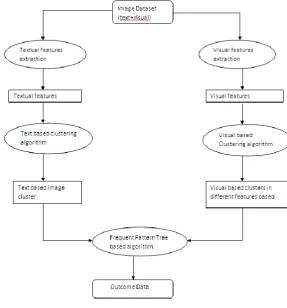
This method combines two different data mining techniques for retrieving image : clustering and
frequent pattern tree mining (FPT) algorithm.
It uses FPT algorithm to explore the relations between text semantic clusters and image visual features
clusters building a decision tree in the space of frequent patterns as an alternative for the two phases
approach:
Offline and online phase:
In the offline phase, the relations among the clusters will be identified from different modalities to
construct the frequent pattern rules.
On the other hand, the online phase (retrieving phase) uses the generated Tree pattern, to retrieve the
related images of the query.
Fig. Architectural Diagram
6.
CONCLUSION
P.B.Kamdi
et al
, International Journal of Computer Science and Mobile Applications,
Vol.2 Issue. 12, December- 2014, pg. 58-62 ISSN: 2321-8363
©2014, IJCSMA All Rights Reserved, www.ijcsma.com 62
REFERENCES
[1] Raniah A. Alghamdi, Mounira Taileb, Mohammad Ameen, Faculty of Computing and Information Technology, King Abdulaziz University, Saudi Arabia – Jeddah, ―A New Multimodal Fusion Method Based on Association Rules Mining for Image Retrieval‖, 17th IEEE Mediterranean Electrotechnical Conference, Beirut, Lebanon, 13-16 April 2014
[2] Goasta Grahne, Jianfei Zhu Grahne, Member, IEEE, and Jianfei Zhu, Student Member, IEEE ―Fast Algorithms for Frequent Item set Mining Using FP-Trees‖ IEEE Transaction On Knowlegde And Data Engineering, VOL. 17, NO. 10, October 2005
[3] S. Wei , Y. Zhao , Z. Zhu , N. Liu, ―Multimodal Fusion for Video Search Reranking‖, IEEE Transactions on Knowledge and Data Engineering, 2010, v.22 n.8, p.1191-1199.
[4] Adrien Depeursinge, Samuel Duc, Ivan Eggel and Henning M¨uller ― Mobile Medical Visual Information Retrieval‖ IEEE Transactions on Knowledge and Information Technoloy In Biomedicine, VOL. 17, NO. 11, October 2011
[5] M. Bastan, H. Cam, U. Gudukbay, and O. Ulusoy, "BilVideo-7: An MPEG-7 Compatible Video Indexing and Retrieval System", IEEE MultiMedia, 2010, vol. 17, no. 3, pp. 62-73.
[6] R. Agrawal, T. Imielinski, and A. Swami, ―Mining Association Rules between Sets of Items in Large Databases,‖ Proc. ACMSIGMOD Int’l Conf. Management of Data, pp. 207-216, May 993.
[7]. S. Wu and S. McClean, ―Performance prediction of data fusion for information retrieval‖. Information Processing, Management, 2006. 42(4): p. 899-915.
[8] Ernst, R.: ―Co design of embedded systems: status and trends‖, Proceedings of IEEE Design and Test,
April–June 1998, pp.45–54
[9]H. Müller, P. Clough, Th. Deselaers, B. Caputo, ―ImageCLEF‖ (ser. The Springer International Series on Information Retrieval), vol. 32, pp.95 -114, 2010, Springer-Verlag.
[10] M. Ferecatu and H. Sahbi, ―TELECOM ParisTech at ImageClefphoto 2008: Bi–modal text and image retrieval with diversity enhancement‖. In: Working Notes of CLEF 2008, Aarhus, Denmark.
[11] T. Gass, T. Weyand, T. Deselaers, and H. Ney. ―FIRE in ImageCLEF 2007: Support vector machines and logistic models to fuse image descriptors for photo retrieval‖. In: CLEF 2007 Proceedings. Lecture Notes in Computer Science (LNCS), 2007, vol 5152. Springer, pp 492–499.
[12] R. Bellman, ―Adaptive Control Process: A Guided Tour‖. Princeton University Press, 1961.
[13] P. K. Atrey , M. A. Hossain , A. E. Saddik and M. S. Kankanhall "Multimodal fusion for multimedia analysis: A survey", Multimedia Syst., vol. 16, no. 3, pp.1432 -1882, 2010.
[14] C. Lau, D. Tjondronegoro, J. Zhang, S. Geva, and Y. Liu, ―Fusing visual and textual retrieval techniques to effectively search large collections of wikipedia images" 2007, p. 345-357.