International Journal of Current Research in
Biosciences and Plant Biology
ISSN: 2349-8080 (Online)
●Volume 3
● Number 3 (March-2016) Journal homepage: www.ijcrbp.comOriginal Research Article doi: http://dx.doi.org/10.20546/ijcrbp.2016.303.012
Diversity of Invasive Alien Plants in Soor Sarovar Bird Sanctuary
(SSBS), Keetham, Agra, India
Vijay V. Wagh*
Plant Diversity Systematics and Herbarium Division, CSIR- National Botanical Research Institute, Lucknow- 226 001, Uttar Pradesh, India
*Corresponding author.
A b s t r a c t A r t i c l e I n f o
Present study provides the comprehensive list of invasive alien plants of Soor Sarovar Bird Sanctuary, Keetham, Agra. In study area total of 76 species under 67 genera and 35 families have been found as invasive alien plant. Of total only 09 species have been found introduced intentionally, while the other species introduced unintentionally. In terms of nativity the majority of invasive plants reported from American continent (61%). The life form category shows that 56 species are herbs, 11 species of shrubs, 4 species of climbers, 4 species of trees and only one liana species. The invasive alien species possess serious threat to local biodiversity, effects crop production and human health. Therefore systematic study about the invasive plant species is required.
Accepted: 04 March 2016 Available Online: 06 March 2016
K e y w o r d s Biodiversity Invasive plants
Soor Sarovar Bird Sanctuary Threat
Introduction
Alien species are non-native or exotic organisms that occur outside their natural adapted ranges and dispersal potential (McGeoch et al., 2010). These invasive species are widely distributed in all kinds of ecosystems throughout the world and include all categories of living organisms. Nevertheless, plants, mammals, and insects comprise the most common types of invasive alien species in terrestrial environments (Raghubanshi et al., 2005). An important requirement for successful colonization of invaders is open habitat with reduced competition. Generally, the microsites created by grazing may be occupied by invader species (Singh, 1976; Sinha, 1976; Sawarker, 1984).
Invasive alien plant caused an impact worldwide (Mooney and Hobbs, 2000), there are still many regions such as Asia and Neighbouring region in the world where basic information on naturalized plant taxa and plant invasions is lacking (Corlett, 1988; Enmoto, 1999;
Meyer, 2000). Database establishment of naturalized species is the first step in the development of invasion biology, and will also serve as a stepping stone for further detailed studies on the biology and impact of individual species (Wu et al., 2004). Naturalization has been recognized as the first phase of biological invasions. A naturalized species is the species that can consistently reproduce and sustain populations over many generations without direct intervention by humans (Richardson et al., 2000; Pyšek et al., 2002). Many
invasive plant species cause economic and/or
environmental damage, and referred to as alien pests or weeds (Richardson et al., 2000).
impact of Lantana camara on the biodiversity of Melghat Tiger Reserve, Maharashtra by Sawarker (1984), Pandey and Parmar (1994) worked on the exotic flora of Rahasthan. Kshirsagar (2005) made a very interesting study on the origin, present status and distribution of exotic plants of South Gujarat, Alien flora of Doon valley has been done by Negi and Hajra (2007), Sekar (2012) made a comprehensive study on the invasive alien plants of Indian Himalayan region, Das and Durah (2013) worked on invasive alien plant of Johrat, Assam, Srivastava et al. (2014) and Wagh and Jain (2015) made study on the North Eastern Uttar Pradesh and Western Madhya Pradesh of India respectively.
From thorough literature survey it was found that the only study on floristic diversity and ethnomedicinal uses of plant of Soor Sarovar Bird Sanctuary was done by Rani et al. (2009). So far no comprehensive study on the diversity of invasive alien plants is conducted on this region. The present study would be helpful for the academician, botanist and ecologist as basic information
for future research towards conservation and
management of the invasive alien plants of this region.
Materials and methods
Study site
A Keetham lake also known as Soor Sarovar National Bird Sanctuary which has been declared in 1991 Soor Sarovar Bird Sanctuary potential as a natural wonder has been recognised by the Uttar Pradesh forest department. Recently has been declared as National wetland in November 2007 by central forest and Ministry of environment (Gautam and Gautam, 2008). Keetham lake a place that ignited by passions of lord Krishna and Radha and inspired the famous poet Surdas to compose the Bhakti Kavya.
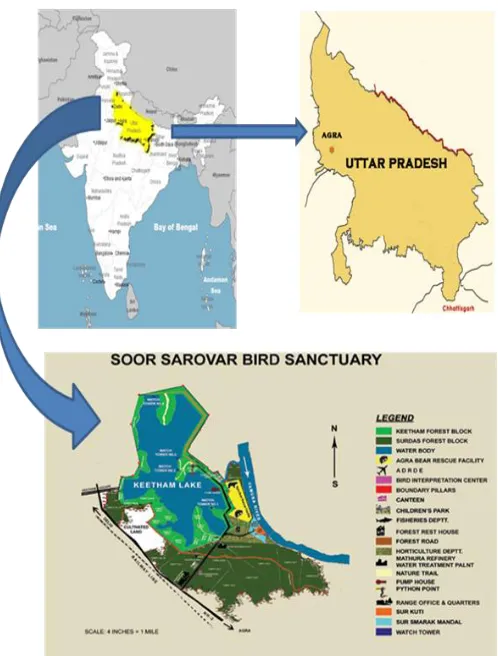
Soor Sarovar lake is located at a distance of 20 km from Agra city in Uttar Pradesh and a distance 180 Km from Delhi (Fig. 1). Keetham initially covering an area of 4.03 sq. kms has been expanded to an impressive area of 7.83 sq. kms. This pentagonal shaped lake’s depth varies from 5m to 8m. Soor Sarovar ―Keetham Lake‖ from the riverine belt of the
Yamuna River. Keetham also has wild life
conservation in form of bear rescue facility and python point as well. Further this lake is surrounded by different kinds of wild vegetations. During the field survey it was observed that the natural wild
vegetation is depleting day by day and in place
Prosopis juliflora and Lantana camara are growing
gregariously that posing a severe threat to the natural vegetation of Soor Sarovar Bird Sanctuary.
Fig. 1: Map of Soor Sarovar Bird Sanctuary.
Field survey and data collection
Extensive and intensive survey was undertaken for the collection of invasive alien plants in Soor Sarovar Bird Sanctuary during 2015. The collected specimens was processed for herbarium preparation by standard methods (Lawrence, 1951) and identified with the help of local floras and published literature (Hooker, 1822 - 1883; Cooke, 1901-1908; Duthie, 1903-1929; Gamble and Fisher, 1915-1936; Maheshwari, 1963; Verma
et al., 1993, Khanna and Kumar, 2000, Khanna et al.,
Results and discussion
A total 76 species distributed in 67 genera and 35 families recorded as invasive alien in Soor Sarovar Birad Sanctuary, Keetham. The family Asteraceae is the most dominant family with 12 species followed by Euphorbiaceae (7 species) Convolvulaceae (6 species), Solanaceae (5 species), Amaranthaceae (4 species) and Malvaceae, Mimosaceae and Poaceae (3 species each) (Fig. 2). These dominant families contributed 41% of the alien invasive flora of the Soor Sarovar Bird Sanctuary, Keetham. The genera with the highest number of alien
species are Ipomoea (4 species), Alternanthera, Cassia,
Chenopodium, Datura, Euphorbia and Jatropha (2
species each) (Table 1). These top genera contributed 21% taxa of alien flora of SSBS. Life form category shows that 56 species of herbs, 11 species of shrubs, 4 species of climbers, 4 species of trees and only one species in liana category (Fig. 3).
A total 11 different geographic region in terms of nativity are recorded in the present study. Among these (89%) are contributed by the four major geographic region i.e., continent of America, Africa, Brazil and Europe. The American continent contributed majority (69%) while Africa (10%), Brazil and Europe (4% each). Of the total alien plant species in SSBS 45 species are judged as naturalized, 21 interfering and 10 noxious (Fig.4). The most alarming condition is the number of noxious species that are harmful to the natural species. Further some of these species are known to be highly allergic and causing diseases in human being (Saxena, 1991 and Tripathi, 1999). Only 9 species namely
Prosopis juliflora, Portulaca oleracea, Leucaena leucophloea, Lantana camara, Eichhornia crassipes, Duranta repens, Ageratum conyzoides, Chenopodium
album and Celosia argentea have been introduced
deliberately and rest of them unintentionally through trade exchange including grain import.
Table 1. List of Invasive plant species found in Soor Sarovar Bird Sanctuary, Keetham, Agra, India.
Family Botanical name Common
name
Collection number
Life
form Habitat Nativity
Mode of
introduction Categories
Acanthaceae Peristrophe paniculata
(Forssk.) Brummitt
Panicled fold wing
258122 Herb W Tropical
America
Ui Interfering
Ruellia tuberosa L. Minnie root 258120 Herb AR Tropical America
Ui Naturalized
Amaranthaceae Alternanthera sessilis (L.)
R.Br. ex DC.
Joy weed 258101 Herb RB Tropical
America
Ui Naturalized
Alternanthera philoxeroides (Mart.) Griseb.
Alligator weed 258077 Herb W Tropical
America
Ui Naturalized
Celosia argentea L. Silver cock’s comb
258104 Herb CF Tropical
Africa
Fd Naturalized
Gomphrena celosioides Mart. Bachelor’s button
258125 Herb CF Tropical
America
Ui Naturalized
Apocynaceae Calotropis procera (Aiton) R.
Br.
Rubber bush 258092 Shrub W Tropical
Africa
Ui Interfering
Araceae) Pistia stratiotes L. Water cabbage 258123 Herb Tropical
America
Ui Naturalized
Arecaceae Borassus flabellifer L. Sugar palm 258130 Tree W Tropical
Africa
Ui Naturalized
Asclepiadaceae Cryptostegia grandiflora
R.Br.
Rubber vine 258134 Liana CF Madagascar Ui Interfering
Asteraceae Acanthospermum hispidum
DC.
Bristly starbur 258114 Herb W Brazil Ui Naturalized
Ageratum conyzoides L. Chick weed 258090 Herb W Tropical America
O Noxious
Blumea obliqua (L.) Druc Clustered blumea
258118 Herb W Tropical
America
Ui Interfering
Echinops echinatus Roxb. Indian globe thistle
258103 Herb W Afghanistan Ui Naturalized
Eclipta prostrata (L.) L. False daisy 258140 Herb AR Tropical America
Ui Naturalized
Lagascea mollis Cav. American softhead
258124 Herb AR, CF Tropical Cent.
America
Ui Noxious
Parthenium hysterophorus L. Congress weed 258106 Herb W Tropical North America
Ui Noxious
Sonchus oleraceus L. Sow thistle 258152 Herb RB Mediterranean Ui Interfering
Synedrella nodiflora (L.) Gaertn.
Tridax procumbens L. Coat button 258116 Herb CF Tropical Cent. America
Ui Naturalized
Xanthium strumarium L. Common cocklebur
258143 Herb AR Tropical
America
Ui Noxious
Gnaphalium polycaulon Pers. Many stemmed cudweed
258105 Herb W Tropical
America
Ui Interfering
Cactaceae Opuntia elatior Mill. Prickly pear 258157 Shrub AR, W Tropical
America
Ui Noxious
Caesalpiniaceae Cassia occidentalis L. Coffee weed 258132 Shrub W Tropical South
America
Ui Naturalized
Cassia tora L. Sickle senna 258154 Herb W Tropical South America
Ui Noxious
Capparidaceae Cleome viscosa L. Asian spidar
flower
258159 Herb W Tropical
America
Ui Naturalized
Chenopodiaceae Chenopodium album L. Goose foot 258100 Herb CF Europe Fd Interfering
Chenopodium murale L. Australian spinach
258086 Herb CF, W Tropical
America
Ui Naturalized
Convolvulaceae Convolvulus arvensis L. Field bind
weed
258163 Herb F, W Europe Ui Naturalized
Evolvulus nummularius (L.) L.
Round leaf bind weed
258156 Herb W Tropical
America
Ui Naturalized
Ipomoea carnea Jacq. Bush morning glory
258160 Shrub W Tropical
America
Ui Interfering
Ipomoea hederifolia L. Scarlet morning glory
258131 Climber F Tropical
America
Ui Interfering
Ipomoea nil (L.) Roth Ivy morning glory
258098 Climber FE, W North America Ui Interfering
Ipomoea pestigridis L. Tiger foot morning glory
258128 Climber W Tropical East
Africa
Ui Interfering
Cuscutaceae Cuscuta reflexa Roxb. Beggar weed 258062 Climber P Mediterranean Ui Interfering
Euphorbiaceae Ricinus communis L. Castor bean
plant
258079 Tree W, CF Africa Ui Interfering
Croton bonpalndianus Baill. Rushfoil 258150 Herb W Temperate South America
Ui Naturalized
Euphorbia heterophylla L. Fire plant 258161 Herb CF Tropical America
Ui Naturalized
Euphorbia hirta L. Garden spruge 258102 Herb CF Tropical America
Ui Naturalized
Jatropha curcas L. Bardados nut 258136 Shrub AR, CF Tropical America
Ui Naturalized
Jatropha gossypifolia L. Black physicnut
258158 Shrub AR Brazil Ui Naturalized
Chrozophora rottleri (Geiseler) A.Juss. ex Spreng.
Rottler’s chrozophora
258119 Herb W Tropical Interfering
Fabaceae Indigofera linifolia (L. f.)
Retz.
Narrowleaf indigo
258126 Herb AR Tropical South
America
Ui Naturalized
Lamiaceae Hyptis suaveolens (L.) Poit. Chinese mint 258117 Herb AR Tropical
America
Ui Interfering
Ocimum americanum L. Common basil 258082 Herb W Tropical America
Ui Naturalized
Liliaceae Asphodelus tenuifolius Cav. Onion weed 258127 Herb A Trop. America Ui Interfering
Malvaceae Malvastrum
coromandelianum (L.) Gar.
Broom weed 258094 Herb W Tropical
America
Ui Naturalized
Sida acuta Burm. f. Common wire weed
258091 Herb W Tropical
America
Ui Naturalized
Urena lobata L. Caesar weed 258149 Shrub W Tropical Africa
Ui Interfering
Martyniaceae Martynia annua L. Devil’s claw 258107 Herb W Tropical
America
Ui Naturalized
Mimosacceae Prosopis juliflora (Swartz)
DC.
Mesquite 258108 Tree W Mexico Af Naturalized
Leucaena leucocephala (Lamk.) de Wit
White popinac 258109 Tree W Tropical
America
Fo Noxious
Onagraceae Ludwigia octovalvis (Jacq.) Raven
Mexican primrose willow
258148 Herb RB Tropical
America
Ui Naturalized
Oxalidaceae Oxalis corniculata L. Indian sorrel 258095 Herb CF Europe Ui Naturalized
Papaveraceae Argemone mexicana L. Mexican poppy 258099 Herb W Tropical South
America
Ui Noxious
Piperaceae Peperomia pellucida (L.)
Kunth
State pencil plant
258139 Herb AR Tropical South
America
Ui Naturalized
Poaceae Chloris barbata Sw. Swollen mind
mill grass
258080 Herb W Tropical
America
Ui Naturalized
Cynodon dactylon (L.) Pers. Bermuda grass 258151 Herb W Africa Ui Naturalized
Saccharum spontaneum L. Kans grass 258147 Herb RB Tropical West Asia
Ui Interfering
Pontederiaceae Eichhornia crassipes (Mart.)
Solms
Water hyacinth 258111 Herb A Tropical
America
O Naturalized
Portulacaceae Portulaca oleracea L. Purslane 258137 Herb W Tropical S.
America
Fd Naturalized
Primulaceae Anagalis arvensis L. Red thick weed 258097 Herb CF Europe Ui Naturalized
Rubiaceae Spermacoce hispida L. Jointed button
weed
258145 Herb AR Tropical
America
Ui Interfering
Solanaceae Datura innoxia Mill. Thorn apple 258138 Shrub W Tropical
America
Ui Noxious
Datura metel L. Devil’s trumpet 258112 Shrub W Tropical America
Ui Interfering
Nicotiana plumbaginifolia Viv.
Tex-mex tobacco
258133 Herb W Tropical
America
Ui Naturalized
Physalis minima L. Ground cherry 258129 Herb W Tropical America
Ui Naturalized
Solanum nigrum L. Black nightshade
258113 Herb CF Tropical
America
Ui Naturalized
Sterculiaceae Waltheria indica L. Sleepy
morning
258115 Herb F Tropical
America
Ui Interfering
Tiliaceae Corchorus tridens L. Fodder jute 258146 Herb AR, W Tropical
Africa
Ui Naturalized
Triumfetta rhomboidea Jacq. Burr bush 258142 Herb W Tropical America
Ui Naturalized
Typhaceae Typha angustifolia Bory &
Chaub.
Lesser Indian reed mace
258135 Herb RB Tropical
America
Ui Naturalized
Verbenaceae Duranta repens L. Gold dew drop 258110 Shrub CF America Af Naturalized
Lantana camara L Wild sage 258121 Shrub F Tropical America
O Noxious
Zygophyllaceae Tribulus terrestris L. Puncture vine 258141 Herb W Tropical
America
Ui Naturalized
Habitat: W—Wastelands; CF-Cultivated fields; F-Forests; AR-Along roadside; A-Aquatic; P-Parasites; RB-River beds.
Mode of introduction: Af-Agroforestry; Fd-Food; Fo-Fodder; O-Ornamental; Ui-Unintentional.
Fig. 2: Dominant families of Invasive alien plant species in SSBS.
Lantana camara and Prosopis juliflora are the most
dominant species that acquired a large geographic area of
the Soor Sarovar Bird Sanctuary. Lantana camara was
first introduced in 1809 in Calcutta Botanical Garden for ornamental purpose (Thakur et al., 1992; Kannan et al., 2013). Now days it occurs all over the India ranging from tropical, subtropical and temperate region of the country (Kannan et al., 2013). There are several factors responsible for the successful invasion of the species like uncontrolled growth, absence of herbivores and pathogen
(Keane and Crawley, 2002). Lantana camara is very
efficient at nutrient uptake (Bhat et al., 1994) because of this potential it grow luxuriantly even in nutrient poor soil.
fuel. Prosopis juliflora has shown to be tolerant to draught and salinity (Pasiecznik et al., 2001) and also
shows low palatability. Prosopis juliflora invasion speed
is very high, due to this there is a reduction in fodder plants for wild as well as rearing cattle such as goat.
They feed on the fruit of Prosopis juliflora in absence of
the fodder plant that leads into the dispersal of the seed in surrounding areas. These are the factors are responsible for the successful invasion of the species and that affect the local biodiversity.
Fig. 3: Life form of invasive alien plant species in SSBS.
Fig. 4: Status of invasive alien plant species in SSBS.
The present study reports the dominant life form category is herbaceous species and it represent (73%) of the total invasive alien plants. The factor greater viability and withstand in adverse condition helps herbaceous species in invasion though out the SSBS. Invasive species of Asteraceae exhibited a much higher reproductive capacity than those of other families. This high reproductive potential is achieved by partitioning of reproductive capital into a large number of propagules that are minute, light, and wind dispersed (Saxena and Ramakrishnan, 1982) similar result was observed by other workers in different parts of India such as (Rao and Murugan, 2006) found that the Asteraceae is dominating family in alien flora of India, in Uttar Pradesh
(Singh et al., 2010), in Indian Himalayan region (Sekar, 2012), in Johrat, Assam (Das and Duarah, 2013), in North eastern Uttar Pradesh (Srivastava et al., 2014) and in Western Madhya Pradesh (Wagh and Jain, 2015). Biological invasions of alien plants present one of the most serious threats to the indigenous biological diversity. Invasive alien plants have caused extensive economic and ecological damage throughout the world.
In India Ageratum conyzoides, Parthenium
hysterophorus, Lantana camara and Eupatorium
adenophorum are major invaders and causing huge loss
to indigenous species diversity in this part of the world (Dogra et al., 2009). Likewise invasive plant species like
Ageratum conyzoides, Lantana camara, Prosopis
juliflora, Parthenium hysterophorus, etc. are poses a
major threat to indigenous biological diversity of Soor Sarovar Bird Sanctuary too.
Conclusion
The vegetation of Uttar Pradesh is known for its great diversity. Uttar Pradesh is one of the richest biodiversity zones of India. Therefore study on the impact of alien invasive plants on native phytodiversity of this region and their management is a need of hour. The invasive alien species possess serious threat to local biodiversity, affects crop production and human health. Therefore systematic study about the invasive plant species is required to provide adequate knowledge of the ecological and environmental consequences caused by invasive alien species and how to address it.
Conflict of interest statement
Authors declare that they have no conflict of interest.
Acknowledgement
The author is thankful to Director, CSIR- National
Botanical Research Institute Lucknow, for
encouragement and providing facilities to carry out the work. The study has been carried under in house project OLP-0083.
References
Bhatt, Y.D., Rawat, Y.S., Singh, S.P., 1994. Changes in ecosystem functioning after replacement of forest by Lantana shrubland in Kumaun Himalaya. J. Veg. Sci. 5, 67-70.
Corlett, R.T., 1998. The naturalized flora of Singapore. J. Biogeogr. 15, 657-663.
Das, K., Duarah, P., 2013. Invasive alien plant species in the roadside areas of Johrat, Assam: Their harmful effects and beneficial uses. J. Engg. Res. Appl. 3(5), 353-358.
Dogra, K.S., Kohli, R.K, Sood, S.K., 2009. An assessment and impact of three invasive species of Himanchal Pradesh, India. Int. J. Biodiv. Conser.1, 4-10.
Duthie, J.F., 1903-1922. Flora of Upper Gangetic Plain and the Adjacent of Siwalik and Sub-Himalayan Tracts. Vols. 1-3. Botanical Survey of India, Calcutta.
Enmoto, T., 1999. Naturalized weeds from foreign countries into Japan. In: Biological Invasions of Ecosystem by Pests and Beneficial Organisms (Eds.: Yano, E., Matsuo, K., Shiyomi, M., Andow, D. A.). National Institute of Agro-Environmental Science, Tsukuba, Japan. 1-14.
Gamble, G.S., Fischer, C.F.C., 1957. Flora of Presidency of Madras. Vols. 1-3. Botanical Survey of India, Calcutta, India.
Gautam, R., Gautam, R.K., 2008. Variation in Physiochemical characteristic in Sur Sarovar. J. Natcon. 20(2), 343-348. Hooker, J.D., 1822-1883. The Flora of British India. 7 Vols. L.
Reeve & Co., London.
Kannan, R., Shackleton, C.M., Uma Shaanker, R., 2013. Reconstructing the history of introduction and spread of the invasive species, Lantana, at three spatial scales in India. Biol. Invasions. 15, 1287-1302.
Keane, R.M., Crawley, M.J., 2002. Exotic plant invasions and the enemy release hypothesis. Trends Ecol. Evol. 17, 164-170.
Khanna, K.K., Kumar, A., 2000. Additions to the taxa of Angiosperms: Flora of Madhya Pradesh Vol. II. J. Econ. Tax. Bot. 24, 177-180.
Khanna, K.K., Kumar, A., Dixit, R.D., Singh, N.P., 2001. Supplement to the Fora of Madhya Pradesh. Botanical Survey of India, Calcutta.
Kshirsagar, S.R., 2005. Origin, present status and distribution of exotic plants in South Gujarat. Ind. J. Forestr. 28, 136-143.
Lawrence, G.H.M., 1951. Taxonomy of Vascular Plants. Macmillan, New York.
Maheshwari, J.K., 1963. The Flora of Delhi. Gossain & Co. Pvt. Ltd., Calcutta.
McGeoch, M.A., Butchart, S.H.M., Spear, D., Marais, E., Kleynhans, E.J., Symes, A., Chanson, J., Hoffmann, M., 2010. Global indicators of biological invasion: Species numbers, biodiversity impact and policy responses. Diver. Distrib. 16(1), 95-108.
Meyer, J.Y., 2000. Preliminary review of the invasive plants in the Pacific islands. In: Invasive Species in the Pacific: A Technical Review and Draft Regional Strategy (Ed.: Sherley, G.). South Pacific Regional Environmental Programme, Samoa. pp.85-114.
Mooney, H.A., Hobbs, R.J., 2000. Invasive Species in a Changing World. Island Press, Washington, DC, USA. Negi, P.S., Hajra, P.K., 2007. Alien flora of Doon Valley,
Northwest Himalaya. Curr. Sci. 92(7), 968-978.
Pandey, R.P., Parmar, P.J., 1994. The exotic flora of Rajasthan. J. Econ. Taxon. Bot. 18, 105-121.
Pasiecznik, N.M., Felker, P., Harris, P.J.C., et al. 2001. The
Prosopis juliflora–Prosopis pallida complex: a
monograph. HDRA, Coventry Proceedings of a Conference held at the Central Arid Zone Research Institute, Jodhpur, Rajasthan, India. November 21–23, 1993. The Prosopis Society of India and The Henry Doubleday Research Association. pp.17-20.
Pyˇsek, P., S´adlo, J., Mand´ak, B., 2002. Catalogue of alien plants of the Czech Republic. Preslia. 74(2), 97-186. Raghubansh, A.S., Rai, L.C., Gaur, J.P., Singh, J.S., 2005.
Invasive alien species and biodiversity in India. Curr. Sci. 88(4), 539-540.
Rani, R., Gautam, R., Gautam, R.K., 2009. Floristic survey of medicinal plants in Sur Sarovar wet land, Keetham, Agra India. J. Appl. Nat. Sci. 1(2), 196-200.
Rao, R.R., Murugan, R., 2006. Impact of exotic adventives weeds on native biodiversity in India: Implications for Conservation. In: Invasive Alien Species and Biodiversity in India (Eds.: Rai, L.C., Gaur, J.P.). Banaras Hindu University, Varanasi. pp.93-109.
Richardson, D.M., Pyˇsek, P., Rejm´anek, M., Barbour, Dane Panetta, M.G. F., West, C.J., 2000. Naturalization and invasion of alien plants: concepts and definitions. Diver. Distrib. 6(2), 93-107.
Sawarker, V.B., 1984. Lantana camara on wildlife habitats with special reference to the Melaghat Tiger Reserve. Cheetal. 26, 24-38.
Saxena, K.G., 1991. Biological invasion in the Indian sub-continent: review of invasion by plants. In: Ecology of Biological Invasion in the Tropics (Ed.: Ramakrishnan, P.S.). International Scientific Publications, New Delhi, India. pp.53–73.
Saxena, K.G., Ramakrishnan, P.S., 1982. Partitioning of biomass and nutrients in the secondary successional herbaceous population subsequent to slash and burn. Proc. Indian Nat. Sci. Acad. 8, 807-818.
Sekar, K.C., 2012. Invasive alien plants of Indian Himalayan region diversity and implication. Amer. J. Plant Sci. 3, 177-184.
Singh, K.P., Shukla, A. N., Singh, J.S., 2010. State level inventory of invasive alien plants, their source regions and use potential. Curr. Sci. 99(1), 107-114.
Singh, P., 1976. Lantana weed and Lantana lace bug. Ind. Forestr. 102, 474-478.
Sinha, P.M., 1976. Studies on the use of some weedicides on
Lantana camara. Ind. Forestr. 102, 298-305.
Srivastava, S., Dvivedi, A., Shukla, R.P., 2014. Invasive alien species of terrestrial vegetation of north eastern Uttar Pradesh. Int. J. For. Res. Article ID 959875, 9p. doi: 10.1155/2014/959875.
Sujay, Y.H., Sattagi, H.N., Patil, R.K., (2010). Invasive alien insects and their impact on agroecosystem. Karnataka J. Agric. Sci. 23, 26-34.
management through natural insect pests in India. Ind. Forestr. 118, 466-486.
Tripathi, S., 1999. Plant diversity of grassland of north-eastern
U.P. with emphasis on population of Parthenium
hysterophorus L. (Ph.D. thesis), Gorakhpur University, Gorakhpur, India.
Verma, D.M., Balakrishnan, N.P., Dixit, R.D., 1993. Flora of Madhya Pradesh – Vol. I. Botanical Survey of India, Calcutta.
Wagh, V.V., Jain, A.K., 2015. Invasive alien flora Jhabua district, Madhya Pradesh, India. Int. J. Biodiver. Conserv. 7(4), 227-237.
Wu, S. H., Hsieh, C. F., Rejm´anek, M., 2004. Catalogue of the naturalized flora of Taiwan. Taiwania. 49, 16-31.
How to cite this article: