ISSN: 2306-9007 Gutiérrez-Diez, Piñón-Howlet, Sapién-Aguilar & Chavez-Márquez (2017) 939
I
www.irmbrjournal.com September 2017I
nternationalR
eview ofM
anagement andB
usinessR
esearchVol. 6 Issue.3
R
M
B
R
ERP´s Implementation Methodologies Review
MARÍA DEL CARMEN GUTIÉRREZ-DIEZ
Universidad Autónoma de ChihuahuaEmail: [email protected] Tel: +116144251083
LAURA CRISTINA PIÑÓN-HOWLET
Universidad Autónoma de ChihuahuaEmail: [email protected] Tel: +116141691623
ALMA LILIA SAPIÉN-AGUILAR
Universidad Autónoma de ChihuahuaEmail: [email protected] Tel: +116144420040
IRMA LETICIA CHAVEZ MARQUEZ
Universidad Autónoma de ChihuahuaEmail: [email protected] Tel: +116144420040
Abstract
In the 1990s, Enterprise Resource Planning (ERP) systems were the pioneers in business process management, by replacing legacy systems which became obsolete. These first implementations faced countless problems, but mainly, the lack of experience of all the parties involved. Quite a few of these experiences and difficulties have been documented over the years; But, all this literature being very different from each other, makes it difficult to unify criteria. However, some have proposed an integrative methodology from the study of the published literature. This research develops the descriptive-comparative analysis between the integration approach and the methodologies used in practice, such as the ones used by consulting firms like: Ernst & Young and Deloitte; ERP development firms: SAP and Oracle, as well as OpenERP and OpenBravo, from the open software community. The results point to Deloitte's proposal as the most complete, although the majority of these methodologies neglect the tactical aspect of such implementations.
Key Words: ERP, Implementation, Methodologies, Open Source Software, Integrative Approach, Development Firms ERP Methodologies, Consulting Firms Erp Methodologies.
Introduction
ISSN: 2306-9007 Gutiérrez-Diez, Piñón-Howlet, Sapién-Aguilar & Chavez-Márquez (2017) 940
I
www.irmbrjournal.com September 2017I
nternationalR
eview ofM
anagement andB
usinessR
esearchVol. 6 Issue.3
R
M
B
R
years, experience has been gained, but such projects continue to be overwhelming for many organizations (Alshawi, Themistocleous, & Almadani, 2004; Ligus, 2004; Addo-Tenkorang & Helo, 2011). Many of these experiences and difficulties have been documented over the years in extensive collections of literature that present cases, methodologies and critical success factors around these processes. However, all this literature being very different from each other, makes it difficult to unify criteria. Despite this, some have proposed an integrative methodology; from the study of published literature proposal made by authors like: Al-Mashari, Zairi and Al-Mudimigh (2001) and Al-Mudimigh, Zairi, & Al-Mashari (2002).
According to Gartner (2017), their curent ERP software definition , in what they call postmodern era is:
“A technology strategy that automates and links administrative and operational business capabilities, such as finance, human resources, purchasing, manufacturing and distribution) with appropiates level of integration that balance the benefits of vendor-delivered integration agains business flexibility and agility”
These ERP systems were developed for product-centric companies, like manufacturing and distribution organizations. However, organizations implementing ERP continue to struggle, according to the ERP 2015 Report by Panorama Consulting Solutions, because they cost more than budgeted, take longer than expected, and are failing at higher rates (O'Donnell, 2015).
It is then the objective of this work to perform a descriptive-comparative analysis between this integrative approach and the methodologies used in practice by the main consulting firms: Ernst & Young and Deloitte; and development firms: SAP and Oracle, as well as the free software community, as emerging players within this market. The above will allow to establish according to the integrative approach, which aspects have been left aside by these methodologies, and therefore must be strengthened, in order to achieve better ERP implementations.
Literature Review
ERP
ISSN: 2306-9007 Gutiérrez-Diez, Piñón-Howlet, Sapién-Aguilar & Chavez-Márquez (2017) 941
I
www.irmbrjournal.com September 2017I
nternationalR
eview ofM
anagement andB
usinessR
esearchVol. 6 Issue.3
R
M
B
R
Mayancela, 2010; Gripe & Rodello, 2011; Kowanda, Firdaus, & Pasaribu, 2015). It can be said that ERP systems reached their maturity in the mid-1990s.
The scope of systems has been extended to include support functions such as order management, financial management, warehousing, distributed production, quality control, asset management, and human resource management. In addition, in the most recent years front functions such as sales force and automation of marketing and e-commerce have been included (Shehab et al., 2004; Díaz, Ruiz & Gonzales, 2005; Vanyi, 2008).
ERP Implementation Methodologies
The following describes some methodologies for the implementation of ERP systems. As mentioned above, some of these methodologies are owned by the same system manufacturers, others are owned by consulting companies.
Total Solution
Ernst & Young LLP has developed an approach called "Total Solution", this approach is based on five components:
1) Value proposition: This component builds the business case (Business Case). The key to success before each process can start is to make sure they make sense for the business. The following questions must be answered before each process begins.
2) Reality Check: This phase is a review of the organization due for change. Since many people will oppose change, it is necessary to be anticipated.
3) Alignment Approach: Here are the expectations of short and long term change. Both short and long term benefits are key to the success of any project. Even if some people disagree with the change, it is easy to accept if progress is visible. In this phase the following tasks are performed:
4) Success Dimension: The perfect combination of people, experience, skills, methods and administration is essential for the success of the project. The team responsible for implementation should be staffed by personnel with expertise in process and change management, as well as experience in the industry. 5) Delivery Value: Measure results and celebrate success. A project that does not demonstrate measurable
results throughout the process will fade. People would lose enthusiasm and expectations about the new way of working would become a broken promise. It should be ensured that each project delivers "dividends" on a continuous basis in addition to minimizing risks (Leon, 2008).
Fast Track Plan
The Deloitte & Touche consulting group argues that its Fast Track Plan methodology can improve and accelerate ERP implementation regardless of whether business objectives involve global reengineering, process improvement or software replacement. The five phases of the Fast Track Plan with their respective activities help achieve a fast and high quality business transformation. This methodology consists of the following stages:
1) Scope and Planning.- Starts the planning of the project. 2) Vision and Goals.- Vision and goals are identified.
3) Re-design.- Starts the development and design of the software. 4) Configuration.- Integration is planned.
ISSN: 2306-9007 Gutiérrez-Diez, Piñón-Howlet, Sapién-Aguilar & Chavez-Márquez (2017) 942
I
www.irmbrjournal.com September 2017I
nternationalR
eview ofM
anagement andB
usinessR
esearchVol. 6 Issue.3
R
M
B
R
Fast Track Plan is designed to reflect and integrate decisions regarding business redesign, organizational change and performance, in addition to training, process and system integrity as well as technical architecture.
This methodology identifies five areas (groups) as individual elements that will be carried out through the five phases. These areas are:
1) Project Management.- Includes project organization, risk analysis, planning, monitoring, communication, budget management and quality control.
2) Information Technology.- Includes selection of hardware and telecommunications equipment, facilities, operation, software design, development and implementation.
3) Processes and System Integrity.- Includes security and control audits.
4) Change Leadership.- Includes organizational design, policies, procedures, and measurable performance. 5) Training and Documentation.- Includes the design and development of training for the work team, users
and management (León, 2008).
ASAP
In 1996 the SAP Software company presented its implementation methodology: Accelerated SAP (SAP Accelerated, ASAP) with the aim of streamlining the implementation projects of its product. ASAP was geared towards new customers so they used SAP knowledge and experience gained from thousands of deployments around the world. This methodology is specifically oriented to small and medium-sized companies that are in the process of adopting SAP (Lau, 2005). Each phase is composed of a group of work packages. These work packages in turn are composed of activities, and each activity is composed of a group of tasks. The phases of the ASAP methodology, also known as ASAP Roadmap, are:
1) Project Preparation: Define initial planning and preparation for the SAP project. The steps taken in this phase will help identify and plan areas of primary interest to consider, as well as objectives, scope, planning and definition of the work team. In this phase the work team is integrated and all management standards are established, such as the frequency of meetings, weekly reports, monthly reports, project documentation, etc. It also identifies a communication plan that clearly defines global communication methods and processes to share all project information.
2) Business Plan (Blueprint): It is used to understand the objectives of the organization and determine the processes required to support those objectives. In general, the goal of this phase is the creation of a business plan, which is a detailed document of the results obtained during the reunions and meetings in which the requirements were reviewed. This document will allow the working group to define the scope and only focus on the SAP processes required by the organization. The business plan will consist of a graphical view of the structure of the organization as well as a preliminary version of the business processes in both graphic and written format.
3) Implementation: The implementation the processes defined in the previous phase. The objectives of this phase are final implementations in the system, general tests and the release of the system in production environment (operation).
ISSN: 2306-9007 Gutiérrez-Diez, Piñón-Howlet, Sapién-Aguilar & Chavez-Márquez (2017) 943
I
www.irmbrjournal.com September 2017I
nternationalR
eview ofM
anagement andB
usinessR
esearchVol. 6 Issue.3
R
M
B
R
5) Entry into Production and Support: The objective of this phase is to migrate from the test environment to production. A group within the organization must be prepared to address end-user issues and support the different areas involved in migration. This phase is also used to monitor transactions and improve system performance. At the end of this stage the implementation project will be completely closed (Lau, 2005).
AIM (Applications Implementation Methodology)
Used by Oracle, this methodology is similar to traditional software project management methodologies. AIM is a methodology based on six phases:
1) Definition Phase: During this phase the project is planned, the objectives of the organization are determined and the feasibility of the project is verified with the agreed time, resources and budgets. 2) Operational Analysis Phase: In this phase the implementation team needs to understand the operation of
the organization, analyze it in detail and determine the requirements of the organization and the constraints of the system in order to identify the differences between them.
3) Solution Design Phase: Used to create solution designs that cover future requirements and processes based on the results of the Operational Analysis phase.
4) Construction Phase: Once the design is accepted, the designed and tested software system is validated at this stage. Here they will usually make the changes required in the analysis phase, that were not covered in the original software package.
5) Transition Phase: Once the system is fully configured the final result is implemented within the organization and the end-users are moved to this new scheme.
6) Production Phase: This phase takes place when the organization begins to use the ERP in the production environment (Rashmi, 2006).
Nowadays Oracle offers its new "unified" implementation approach, known as: Oracle Unified Method (Oracle Unified Method).
Microsoft Dynamics Sure Step
Since its creation in 2007, existing work methods have been modified and new ones have been added generating a methodology that guides during the process of delivering a solution. Sure Step not only covers the delivery, but the solution planning as well as the sales process (Shankar & Bellefroid, 2011). It is based on six phases:
1) Diagnosis: Known as a pre-implementation phase to assist the client in determining the type of solution that Microsoft Dynamics will provide.
2) Analysis: This is the first phase of implementation. It includes the assignment of the project leader, the project plan, the functional requirements, requirements analysis and the project startup board.
3) Design: Defines how the business requirements will be solved. This phase includes the configuration of the system as well as the modifications required to adjust the solution to the customer requirements discovered in the analysis phase.
4) Development: It involves the modifications of programming required to solve the requirements of the user.
5) Implementation: In this phase the transition to the Microsoft Dynamics solution begins. This phase includes activities such as training, modifications, pilot testing and migration.
ISSN: 2306-9007 Gutiérrez-Diez, Piñón-Howlet, Sapién-Aguilar & Chavez-Márquez (2017) 944
I
www.irmbrjournal.com September 2017I
nternationalR
eview ofM
anagement andB
usinessR
esearchVol. 6 Issue.3
R
M
B
R
OpenERP
Due to its modularity, the developer collaboration in OpenERP has been widely integrated, allowing any company to choose from the wide range of functions available. The elements of the following methodology are described through different phases:
1) Requirements Analysis and Planning: This stage defines the work team, the costs and benefits of the project and prepares the following phases of implementation. This phase answers questions such as: what is going to be configured?, will the software adapt or change the working method?
2) Deployment: In this phase, the database and the OpenERP system are ready for the production environment. For this you must install OpenERP on the server as well as create and configure the databases.
3) Training: In this phase two types of training are carried out. The technical training is oriented to the system administrators so that in the future they are able to develop, modify and adapt the modules of OpenERP within the organization. The training of the users is oriented so that they use the system in the production environment as fast as possible.
4) The objective of this phase is to ensure that users get maximum productivity in the use of the system by answering their questions. Maintenance ensures that the system continues performing the required functions and is always available (OpenERP, n.d.)
OpenBravo Implementation Framework
The OpenBravo implementation methodology (n.d.) is based on five stages:
1) Preparation: The work team is defined, as well as the planning detail and initial kick-off.
2) Definition: The activities on this phase are: the detailed extraction of requirements, the functional design as well as the migration strategy, and the definition and design of interfaces.
3) Iterative Prototype: In this phase the system parametrization and configuration, the technical design of interfaces and developments, as well as the unit tests, are carried out.
4) Final preparation: Integrated testing, data migration as well as training for end users are carried out. 5) Startup and Support: In this phase the system is carried out in a production environment, final
adjustments are made as well as support and corrections.
Materials and Methods
The present investigation was of a descriptive nature, supported with the pertinent revised and available documentary up to 2014. Seven implementation methodologies were analyzed: TotalSolution, FastTrack, ASAP, AIM, SureStep, OpenERP and OpenBravo. The selection of these methodologies was based on their popularity as the most representative for consulting firms, development firms and open source solutions (Riegner, 2011; Schatz, Egri & Saucer M, 2011; Gartner, 2017).
Each of these methodologies was analyzed according to the proposed methodology from Al-Mashari, Zairi and Al-Mudimigh (2001) and Al-Mudimigh, Zairi, & Al-Mashari (2002). Which proposes the following elements:
1. Project management, which includes project planning and programming, monitoring and feedback and risk management
ISSN: 2306-9007 Gutiérrez-Diez, Piñón-Howlet, Sapién-Aguilar & Chavez-Márquez (2017) 945
I
www.irmbrjournal.com September 2017I
nternationalR
eview ofM
anagement andB
usinessR
esearchVol. 6 Issue.3
R
M
B
R
3. Training, the complexity of these applications demand rigorous training, which if not carried out can lead to drastic consequences and is considered one of the main reasons for the failure of ERP implementations.
4. Level of implementation:
a) Strategic, evaluation of current legacy systems.
i.Vision and objective of the project ii. Implementation strategy
iii. Commitment / support of senior management iv. Business analysis
v. Benchmarking
b) Tactical.
i. Customer Inquiry ii. Hire Consultants
iii. Business Process Reengineering iv. Selection of ERP software v. Deployment approach
c) Operating.
i. Business Process Modeling ii. System configuration iii. Final preparation
iv. Exit to production /Deployment
Theoretical Framework
Though ERP systems are being widely implemented in many organisations there is a lack of an unified approach toward the these kind of implementations.These authors (Al-Mashari, Zairi and Al-Mudimigh, 2001; Al-Mudimigh, Zairi, & Al-Mashari 2002), provide a framework based on an extensive review of the essentical critical success factors. According to the authors of this integrative approach, an ERP implementation represents a socio-technical challenge, which requires a different outlook from other kind of technologica innovations to implement. It requires a balanced perspective which should consider behavioural process and actions. This involves a macro-implementation at the strategic level, and micro-implementation at operational level. This balanced perspective should include considerations socio-technical, as well as steps clearly defined for each one of the levels involved. They propose this integrative framework based on an extensive review of factors and essential elements that contribute to a successful implementation of ERP.
ISSN: 2306-9007 Gutiérrez-Diez, Piñón-Howlet, Sapién-Aguilar & Chavez-Márquez (2017) 946
I
www.irmbrjournal.com September 2017I
nternationalR
eview ofM
anagement andB
usinessR
esearchVol. 6 Issue.3
R
M
B
R
analysis; v. Benchmarking; b) Tactical: i. Customer Inquiry; ii. Hire Consultants; iii. Business Process Reengineering; iv. Selection of ERP software; v. Deployment approach; c) Operating; i. Business Process Modeling; ii. System configuration I; iii. Final preparation; iv. Exit to production /Deployment .
Analysis
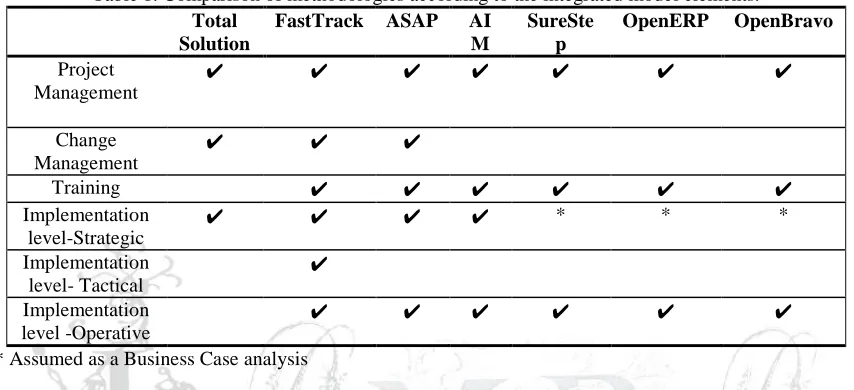
The following is a comparative table with the results obtained from this research:
Table 1. Comparison of methodologies according to the integrated model elements. Total
Solution
FastTrack ASAP AI
M
SureSte p
OpenERP OpenBravo
Project Management
✔ ✔ ✔ ✔ ✔ ✔ ✔
Change Management
✔ ✔ ✔
Training ✔ ✔ ✔ ✔ ✔ ✔
Implementation level-Strategic
✔ ✔ ✔ ✔ * * *
Implementation level- Tactical
✔
Implementation level -Operative
✔ ✔ ✔ ✔ ✔ ✔
* Assumed as a Business Case analysis
The above comparison shows the elements available to evaluate each one of the methodologies presented. As can be observed FastTrack methodology from Deloitte & Touche is the one which fulfills all of the factors evaluated. Meanwhile Total Solution, from Ernst & Young seems to be the poorest evaluated. Both belonging to consulting firms. From the development organisations ASAP from SAP is the one which came as 2nd. best. And finally, Sure Step, OpenERP and OpenBravo are all tied in last place.
Discussion
When comparing the different methodologies already mentioned with the unified methodology proposed by Al-Mashari, Zairi and Al-Mudimigh (2001) and , the following was found: firstly, we must establish the different origins of the methodologies analyzed here: the first two come from consulting firms, another three belong to the main software development companies of ERP and the last two have their origin in the free software community. The Total Solutions and Fast Track methodologies, used by consulting houses, by not supporting any particular software, are more general in their recommendations and include considerations more oriented to project management and change management (Zafeiropoulos, et al., 2009; Panorama Consulting Solutions, 2012) . Although it should be mentioned that Deloitte's Fast Track offers on its website versions of its methodology focused on both SAP and Oracle products. Regarding SAP methodologies, Oracle and Microsoft obviously seek first to do their sales work, leaving project management as well as risk management a bit aside when making the change, assuming their consultants and clients will take over. ASAP explicitly mentions that it assumes that the conditions for change are given. They subsequently make the recommendations relevant to the implementation, very oriented to the analysis of the processes affected by the new software, as well as the training of end-users.
ISSN: 2306-9007 Gutiérrez-Diez, Piñón-Howlet, Sapién-Aguilar & Chavez-Márquez (2017) 947
I
www.irmbrjournal.com September 2017I
nternationalR
eview ofM
anagement andB
usinessR
esearchVol. 6 Issue.3
R
M
B
R
project. The benefits of these applications are explained by being part of the free software community. They leave aside the management considerations of both the project and the change, just as it seems to assume the strategic implementation part, considering only doing a business case analysis and training of the users (Golden, 2005; Gianni, 2009).
Conclusion
After the comparison between the already enumerated characteristics of each one of the methodologies, with the unified model that serves as reference, it is observed that the aspects of: project management, change management, training and some aspects of implementation (mainly strategic and operational) are met. Although it should be mentioned that some aspects, such as Benchmarking, are not mentioned in any of the methodologies studied, while the level of tactical implementation is practically unaddressed, since none of the methodologies refer to consulting suppliers or customers. Some of the proposals, mainly those that are not related to a particular software, could consider the possibility of evaluating different software products, but the rest, assume that the selection of the product has already been made.
Regarding possible recommendations, it is feasable to complement the methodologies analyzed with the aforementioned aspects and to evaluate the results obtained from their application. It is also possible to observe a tendency in which consulting firms are those that offer more complete and objective methodologies, since they are not directly linked to a house developer of these applications. Potential clients can benefit from this impartiality .
References
Addo-Tenkorang R. & Helo P. (2011). Enterprise Resource Planning (ERP): A Review Literature Report. Congress WCECS 2011. San Francisco California.
Alshawi, S. Themistocleous, M. , y Almadani, R. (2004). Integrating diverse ERP systems: A case study. The Journal of Enterprise Information Management. Emerald Group Publishing Limited.
Al-Mashari, M., Zairi, M. & Al-Mudimigh, A. (2001). ERP Implementation: An integrative Methodology. European Centre for Best Practice Management.
Al-Mudimigh, A., Zairi, M., & Al-Mashari, M. (2002). ERP software implementation: an integrative framework. Towards the E-Society, Volume 74 of the series IFIP International Federation for Information Processing. Springer. pp 549-560
Colmenares, L. E. (2005). Un estudio exploratorio sobre los factores críticos de éxito en la implantación de sistemas de planeación de recursos empresariales (ERP) en Venezuela. JISTEM - Journal of
Information Systems and Technology Management, 2(2), 167-187.
https://dx.doi.org/10.4301/S1807-17752005000200005
Computer Economics (2012). Technology Trends 2011/2012. Estados Unidos.
Díaz A., Ruiz M., & Gonzales J. (2005) Implantación de un sistema ERP en una organización. Revista de
Investigación de Sistemas e Informática. Peru.
Donnelly, N. (2011). Implementing Dynamics NAV: Key Success. Ed. ECKO House Publishing. Estados Unidos.
Gartner (2017), Gartner Peer insights. Recovered June 28, 2017, from:
https://www.gartner.com/reviews/market/single-instance-erp-for-product-centric-midmarket-companies.
Gianni V. (2009) A Study of Open Source ERP Systems.
Golden B. (2005). Succeeding with Open Source. Estados Unidos. Pearson.
ISSN: 2306-9007 Gutiérrez-Diez, Piñón-Howlet, Sapién-Aguilar & Chavez-Márquez (2017) 948
I
www.irmbrjournal.com September 2017I
nternationalR
eview ofM
anagement andB
usinessR
esearchVol. 6 Issue.3
R
M
B
R
Lau L. (2005). Managing Business with SAP: Planning, Implementation and Evaluation, Estados Unidos. Idea Group Publishing.
León A. (2008). ERP Demystified [2nd. Ed.]. Nueva Deli. Tata McGraw-Hill.
Ligus R. G. (2004) The 12 Cardinal Sins of ERP Implementation. Recovered 9 June, 2014, from http://rockfordconsulting.com/the-12-cardinal-sins-of-erp-implementation.htm.
Metaxiotis K., Psarras J., y Ergazakis K.A. (2003) Production Scheduling in ERP Systems: an AI based approach to face the gap, Business Process Management Journal, Vol. 9, No. 2.
Morocho J. & Mayancela O. (2010). Definición de Metodología para la Implementación de Software Libre y Open Source en la Universidad Politécnica Salesiana Sede Cuenca. Tesis de Pre-grado. Universidad Politecnica Salesiana de Ecuador. Recovered 29 June, 2017 from http://dspace.ups.edu.ec/handle/123456789/423?mode=full.
O´Donnell, J. (2015). Informe-muestra-aumento-de-las-tasas-de-fracaso-para-las-implementaciones-de-ERP. Recovered July, 9, 2016, from:
http://searchdatacenter.techtarget.com/es/noticias/4500245454/Informe-muestra-aumento-de-las-tasas-de-fracaso-para-las-implementaciones-de-ERP
OpenBravo Blogs (2008). Recovered 11 November 2012, from http://planet.openbravo.com/?cat=12 OpenERP Book (s.f.). Recovered 11 November 2012, from http://doc.openerp.com/v6.0/book/index.html Orlicky J. (1975). Material Requirements Planning: The New Way of Life in Production and Inventory
Management. New York. McGraw-Hill.
Panorama Consulting Solutions (2012). 2012 ERP Report: A Panorama Consulting Solutions Research Report. Estados Unidos.
Kowanda, D. Firdaus, M. & Pasaribu, R. (2015). Opportunity of Free Open Software ERP Systems a Competitive Advantage for Small & Mediums Enterprises. Proceeding of 1st Unnes International Conference on Research Innovation & Commercialization for the Better Life 2015 ISSN: 2460-5832,
Semarang, Indonesia. Recovered June 29, 2017, from:
https://www.researchgate.net/publication/290821519_Opportunity_of_Free_Open_Source_ERP_Syste m_as_a_Competitive_Advantage_for_Small_and_Medium_Enterprise.
Rashmi A. (2006). Oracle 11i: The Complete Reference. Ed. Firewall Media. Nueva Deli.
Riegner M. (2011). Implementación del ERP: cada maestrito con su librito. EvaluandoERP.com, Recuperado de http://www.evaluandoerp.com/Content.aspx?Id=1055
Schatz A., Egri P. & Saucer M. (2011) Open Source ERP: Reasonable Tools for Manufacturing SMEs. Fraunhofer Institute for Manufacturing Engineering and Automation. Alemania. Recovererd June 29, 2017 from http://www.ossdirectory.com/oss-knowhow/details/kbarticle/open-source-erp-reasonable-tools-for-manufacturing-smes/
Shankar C. & Bellefroid V. (2011). Microsoft Dynamics Sure Step. Reino Unido. Packt Publishing. Shehab M., Sharp M., Supramaniam L., Spedding T. (2004). Enterprise Resource Planning An Integrative
Review’, Business Process Management Journal, Vol. 10, No. 4. Valyi R., (2008). White Paper on ERP Open Source. Smile. France.
Zafeiropoulos, I., Pagourtzi, E., Litsa, A., & Askounis, D. (2009). Installing an ERP System with a methodology based on the principles of goal directed project management. JISTEM - Journal of
Information Systems and Technology Management, 6(3), 357-394.