Monetary independence in a financially integrated
world: what do measures of interest rate
co-movement tell us?
Enisse Kharroubi and Fabrizio Zampolli*
Abstract
Does global financial integration reduce the independence of monetary policy or its effectiveness? Do flexible exchange rates offer sufficient insulation from foreign monetary and financial developments? To provide an answer to these questions, this paper summarises the outcome of ongoing research conducted at the BIS on the measurement of co-movements in short- and long-term interest rates across countries. The sensitivities of domestic short-term interest rates to their foreign counterparts are found to be increasing in financial openness and exchange rate stability, as predicted by Mundell’s trilemma hypothesis. By contrast, long-term yield sensitivities are increasing in financial openness, but their relationship with exchange rate stability is non-monotonic. Excluding pegged exchange rates or very stable currencies, which display a high degree of sensitivity, the relationship for other currencies is negative: that is, a more volatile exchange rate is associated with larger long-term interest rate spillovers from core countries. Estimates of domestic short- to long-run interest rate pass-through also show that greater exchange rate flexibility does not necessarily translate into stronger control of the long end of the yield curve.
Keywords: Mundell’s trilemma, international monetary and financial system, government bond yields, interest rate spillovers, interest rate pass-through
JEL classification: E52; F42; G15; O57.
* Enisse Kharroubi is a Senior Economist and Fabrizio Zampolli a Principal Economist in the Monetary
1. Introduction
With the global financial system becoming more complex and integrated than ever,1 doubts have emerged concerning the ability of central banks to control domestic monetary and financial conditions by running an independent monetary policy. This paper asks whether these concerns are legitimate.
The issue of policy independence can be seen through the lenses of Mundell’s trilemma hypothesis (Mundell (1963)).2 Absent restrictions on capital movement, monetary policy can be independent only if exchange rates are flexible: that is, the more flexible the exchange rate, the larger the scope for a central bank to set its policy rate independently from those prevailing abroad. Alternatively, a country that wants to run an independent monetary policy, but dislikes exchange rate flexibility cannot allow unrestricted capital movements.
That said, greater leeway in setting policy rates does not necessarily amount to greater monetary policy effectiveness. As a result of financial globalisation, domestic monetary and financial conditions may have become more responsive to external financial conditions, even when exchange rates are free to float. Consistent with this view, Rey (2013), and Miranda-Agrippino and Rey (2015) find the existence of a strong global financial cycle, driven largely by monetary policy in the United States and investors’ risk aversion (as proxied by a common index of US option-implied stock market volatility, the VIX). Rey (2016) also shows that US monetary policy shocks have a strong influence on credit spreads, output and inflation in a number of AEs operating under floating exchange rate regimes.
While flexible exchange rates have never offered perfect insulation from external developments, greater financial integration may have further diminished their capacity to act as a buffer. For instance, in the presence of significant inflows of foreign currency credit (especially in dollar), currency appreciation may contribute to improve lenders and borrowers’ balance sheets, and, through this channel, compress risk premia and boost credit supply (Bruno and Shin (2015), and Hoffman et al (2016)).3 Such an effect may thus offset any negative impact of appreciation on trade and output.
The influence of external financial conditions may have become so prominent that the trilemma has morphed into a dilemma. In a provocative paper, Rey (2013) argues that without capital controls countries may have very little or no room for setting monetary policy independently. This pessimistic view, however, does not appear to be fully warranted by existing evidence. The finding of a strong global financial cycle is likely to reflect interdependence and common shocks. By itself, it does not tell much about how the autonomy and the effects of monetary policy on
1 For an overview of how the global monetary and financial system has evolved, see Bank for
International Settlements (2015).
2 In its simplest formulation, the trilemma hypothesis posits that a country can choose only two of the
following three elements of policy: 1) capital mobility; 2) monetary policy independence; or 3) fixed exchange rates. In reality, countries do not face binary choices but trade-offs. For example, without restrictions on capital movements, a country may face a trade-off between exchange rate stability and monetary policy independence. Such a trade-off may improve if a country imposes restrictions on capital movements (see Aizenman (2010) and Aizenman et al (2015)).
domestic financial conditions vary with the degree of the exchange rate flexibility. This is still an open question empirically.
This paper summarises ongoing research bearing on this question. Kharroubi and Zampolli (forthcoming) provide estimates of short- and long-term interest rates co-movements across countries and of short- to long-term rate pass-throughs. They also examine how these estimates vary with the volatility of the exchange rate and measures of capital account openness.
The key findings from Kharroubi and Zampolli (forthcoming) lend support to the view that more flexible exchange rate regimes buy greater monetary independence as predicted by the trilemma hypothesis, but at the potential cost of weaker effectiveness in controlling the longer end of the yield curve. Specifically, country-specific short-term rate sensitivities to core countries are found to be positively related to both financial openness and exchange rate stability, thus confirming results from a number of other recent studies (Shambaugh (2004), Klein and Shambaugh (2013), Obstfeld et al (2005), Obstfeld (2015) and Aizenman et al (2015)).
By contrast, while long-term interest rate sensitivities are increasing in financial openness, their relationship with exchange rate stability is non-monotonic: excluding pegged exchange rates or very stable currencies, which display high sensitivity, the relationship for other currencies (including for most EMEs) is negative. That is, a more volatile exchange rate is associated with larger interest rate spillovers from core countries. This is, to the best of our knowledge, a novel finding.4 A possible interpretation is that the volatility of the exchange rate tends to amplify the response of (local currency) sovereign risk premia to changes in core countries’ interest rates. This finding is also confirmed by estimates of domestic short- to long-term rate pass-through: central banks seem to have greater influence on long-term interest rates only at intermediate levels of exchange rate volatility. That is, the pass-through is lower not only for pegged or very stable currencies, but also for the very volatile ones.
The rest of the paper is organised as follows. Section 2 reviews recent studies that have examined interest rate co-movements in an attempt to shed light on the trilemma. Section 3 describes in greater detail the method used in ongoing research (Kharroubi and Zampolli (forthcoming)). Section 4 presents the key results of this research. Section 5 concludes.
2. A glimpse on the recent empirical literature on the
trilemma
Monetary policy independence is often identified with the freedom to set policy rates independently of those of other countries. Hence, the most obvious way to test the trilemma assumption is to estimate how strongly short-term interest rates co-move across countries and how the strength of this relationship varies with the degree of exchange rate volatility and capital account openness.
4 While Obstfeld (2015) finds that the co-movement of long-term interest rates is high regardless of
In the recent empirical literature on the trilemma (Shambaugh (2004), Obstfeld et al (2005), Klein and Shambaugh (2013), and Obstfeld (2015)), co-movement is usually measured by an estimate of coefficient 𝛽𝛽 in a panel regression of changes in countries’ interest rates ∆𝑟𝑟𝑗𝑗𝑗𝑗 on those of a base or dominant currency ∆𝑟𝑟𝑏𝑏𝑗𝑗:
∆𝑟𝑟𝑗𝑗𝑗𝑗=𝛽𝛽∆𝑟𝑟𝑏𝑏𝑗𝑗+𝛾𝛾′𝑥𝑥𝑗𝑗𝑗𝑗+𝜀𝜀𝑗𝑗𝑗𝑗 (1)
where j indicates a generic country and 𝑥𝑥𝑗𝑗𝑗𝑗 other possible determinants. The latter could also include variables that capture common global influences, such as the VIX index of US stock market volatility. The coefficient 𝛽𝛽 is assumed to vary with an indicator of the exchange rate regime adopted by country j, an indicator of capital account openness and other structural indicators, as summarised by 𝑧𝑧𝑗𝑗𝑗𝑗: 5
𝛽𝛽=𝛽𝛽1+𝛽𝛽2𝑧𝑧𝑗𝑗𝑗𝑗 (2)
The literature finds support for the trilemma hypothesis. Shambaugh (2004) uses a measure of de facto exchange rate regime – based on the actual volatility of the exchange rate vis-à-vis that of a base country – and finds for a large sample of both AEs and EMEs over the period 1973–2000 that countries which do not peg their exchange rates display significantly less interest rate sensitivity than counties that let their exchange rates float. This finding is robust to controlling for capital account openness. Moreover, controlling for time effects or trade shares does not suggest that trade interdependence or common shocks are important, although common influences may not be fully captured by such variables.
The post-2000 environment of very rapid financial globalisation has not invalidated these earlier findings. Using a more recent sample, Klein and Shambaugh (2013) find that, in the absence of capital restrictions, interest rate sensitivity continues to be larger for peggers than for floaters, with soft pegs providing an intermediate degree of monetary autonomy.6 They also find that mild restrictions on capital flows do not raise monetary independence much: walls rather than gates may be needed. Furthermore, controlling explicitly for the globalisation of banking does not alter these conclusions. As shown by Goldberg (2013), the exchange rate regime remains by far the most important variable in determining interest rate sensitivity, despite the fact that the share of foreign bank lending in domestic credit supply tends to raise interest rate sensitivity slightly for peggers and floaters.
The analysis of interest rate co-movements within the context of the trilemma literature has been recently extended to long-term yields. Obstfeld (2015) finds that the co-movement of long-term rates under floating exchange rates is quite high and statistically not different from that under pegged exchange rates, whereas the co-movement of short-term interest rates continues to be dependent on the exchange rate regime. This means that central banks may have less control over the long end of the yield curve. Hence, to the extent that the long-term interest rate matters in the monetary transmission mechanism or in reducing financial stability risks, greater financial integration may have worsened the trade-offs currently faced by central banks in small open economies or EMEs.
5 This amounts to estimating a panel regression (1) augmented with interactive terms such as 𝑥𝑥
𝑗𝑗𝑗𝑗𝑧𝑧𝑗𝑗𝑗𝑗.
Alternatively, if 𝑧𝑧𝑗𝑗𝑗𝑗 is an indicator variable, one can assume that all coefficients in (1) vary with 𝑧𝑧𝑗𝑗𝑗𝑗.
6 Soft peggers include countries that manage their exchange rate vis-à-vis major countries but keep
The method typically used in the cited literature, and summarised by specifications (1) and (2), has at least two potential drawbacks. One concerns the treatment of common factors or shocks. For example, a rise in oil prices and global inflation may lead to a wave of policy rate increases in many oil-importing countries. Similarly, tight trade linkages and other factors may make business cycles more highly synchronised across countries. Failure to control for these common factors may lead to a higher estimate of interest rate co-movements. But this estimate should not be taken as evidence of lack of monetary independence: authorities may choose similar policies because they face similar conditions rather than because they are compelled to do so. Global investors’ risk aversion, as captured by the VIX index, is also another important common factor, although it is unclear a priori whether it leads to over- or under-estimating interest rate spillovers (Obstfeld (2015)).
Common influences can be controlled for in regressions such as (1) and (2) by adding time fixed effects or variables known to have a common influence such as the VIX index. Yet, in fixed-coefficient panel regressions, this amounts to assuming that common factors have the same influence on every countries. This is clearly unrealistic and may therefore not be a good approximation in all applications.
Another potential limitation is that these studies do not allow for sufficient country heterogeneity. Their purpose is to compare mean effects among country groups such as peggers versus non-peggers. That is, 𝛽𝛽 in (2) is assumed to be homogeneous across individual countries even if it can hypothetically be significantly different within the same group. If sample size is too small, there may be no alternative. Otherwise, not explicitly allowing for country heterogeneity within similar groups in the analysis may make it more difficult or impossible to uncover economically relevant relationships between the effects of interest rate and country characteristics – for example, when several factors can simultaneously determine the cross-sectional distribution and/or when the relationship is non-linear or of unknown shape. Furthermore, if the effect is sufficiently heterogeneous across countries, using fixed-coefficient panel regressions may lead to econometrically inconsistent estimates (Pesaran and Smith (1995)).
Hence, a natural alternative to estimating a panel regression (1) with interactive terms (2) is to estimate:
∆𝑟𝑟𝑗𝑗𝑗𝑗=𝛽𝛽𝑗𝑗∆𝑟𝑟𝑏𝑏𝑗𝑗+𝛾𝛾𝑗𝑗′𝑥𝑥𝑗𝑗𝑗𝑗+δ𝑗𝑗𝑓𝑓𝑗𝑗+𝜀𝜀𝑗𝑗𝑗𝑗 (3)
where the coefficients are allowed to vary by country j=1,2,…,N; and 𝑓𝑓𝑗𝑗 is a vector of variables representing common factors (some or all of which may be unobserved).7 Another advantage is that the common factors are allowed to have a different influence on countries. Provided there are enough countries and sufficiently long time series, (3) can be estimated by running individual regressions for each country j. The average of the estimated coefficients would measure the mean effect, similarly to the
𝛽𝛽 estimated in (1)–(2). Most importantly, in a second step the distribution of estimates from (3) can be analysed by running cross-country regressions such as:
𝛽𝛽𝑗𝑗=𝜑𝜑0+𝜑𝜑1𝑧𝑧̅𝑗𝑗+𝑢𝑢𝑗𝑗 (4)
where 𝑧𝑧̅𝑗𝑗 indicates the set of country characteristics (usually the average of 𝑧𝑧𝑗𝑗𝑗𝑗 in (2)).
7 In applications, regressions such as (3) may also involve lags of the dependent and independent
In the context of the recent trilemma literature (Aizenman et al (2015)) follow a similar two-step procedure and find that the trilemma is alive and well: not only do policy rates co-move in the direction predicted by the trilemma, but so do equity prices and real effective exchange rates. However, they are not able to draw any firm conclusion on term spreads (ie the difference between the 10-year long-term rate and the policy rate) “because of the consistent lack of robust results”. Instead, the findings presented in this paper concern the long-term interest rate.
3. Research method and data
Our ongoing research (Kharroubi and Zampolli (forthcoming)) is closely related to Obstfeld (2015) and Aizenman et al (2015). Like in Obstfeld (2015), the analysis uses a similar reduced-form econometric specification and focuses on both short- and long-term interest rates. There are, however, a few key differences. First, the analysis controls more extensively for common factors. Second, it does not use a fixed coefficient panel regression but estimates country-specific interest rate sensitivities through regressions such as (3). It then runs cross-section regressions such as (4) of the betas on indicators of the exchange rate regime, capital account regime and other controls. Third, unlike Obstfeld (2015), the analysis estimates the pass-through from domestic short- to long-term interest rates. In this case, it controls for the full set of observed and unobserved common factors by adding to the original regression cross-section averages of the dependent and independent variables (Pesaran (2006)). Similarly to Aizenman et al (2015), the analysis adopts a two-step procedure such as the one discussed above, but it is able to draw conclusions on the behaviour of long-term interest rates.
The sample consists of an unbalanced panel of monthly observations over the period M1 1999 to M12 2014 for 49 countries, including both AEs8 and EMEs.9 The main variables in the analysis are the short- and the long-term interest rate. The former is a three-month treasury bill rate, if available, or a proximate money market rate. The latter is a 10-year government bond yield. Both are sourced from Global Financial Data (GFD) or, in the absence of GFD data, from Datastream.
In the first step, three types of regression such as (3) are run. The first regresses the domestic short-term interest rate on the base country’s short-term rate, while the second regresses the domestic long-term rate on the base country’s long-term rate. Both regressions include as control variables changes in domestic consumer price inflation, in real GDP and in the log of the VIX index.10 Given the monthly frequency, real GDP is interpolated. Common factors other than the VIX index are controlled for by using changes in oil (or commodity) price inflation, global inflation and global
8 Australia, Austria, Belgium, Canada, Cyprus, Denmark, Finland, France, Germany, Greece, Iceland,
Ireland, Italy, Japan, Malta, Netherlands, Norway, Portugal, Spain, Sweden, Switzerland and United Kingdom.
9 Brazil, Bulgaria, Chile, China, Colombia, Croatia, Czech Republic, Hong Kong (SAR China), Hungary,
India, Indonesia, Israel, Latvia, Mexico, Philippines, Poland, Romania, Russia, Singapore, Slovakia, Slovenia, South Africa, Korea, Thailand, Turkey, Malaysia and New Zealand.
10 In Obstfeld (2015) control variables include the change in real GDP (rather than the change in GDP
output. The third is a regression of the domestic long-term rate on the domestic short-term rate (pass-through). This regression uses the same set of domestic variables as controls with the exception of the variables proxying common factors. Instead, following Pesaran (2006), common factors are proxied by adding cross-section averages of the dependent variable as well as of all the regressors.11 All regressions are specified as autoregressive distributed lag models (Chudik and Pesaran (2015)). Local projections methods (LPs) are then employed to compute impulse response functions directly (Jorda (2005)).
In the second step, the trilemma hypothesis is tested by running a set of
cross-sectional regressions of the estimated interest rate sensitivities of two indicators. The
first is the Chinn-Ito index of financial openness, which is compiled on the basis of information provided by the IMF (see Chinn and Ito (2006) and (2008) for details). This is a de jure index that takes on continuous values between 0 and 1 (from perfectly closed to perfectly open, respectively). The second is a de facto index of exchange rate
stability, also normalised between 0 and 1. It equals 1 if a country is a pegger – that
is, if the country keeps its exchange rate vis-à-vis its base country within a band of – /+2%. Alternatively, if the country is not a pegger, the index is inversely related to the annual standard deviation of the monthly change in the country’s nominal exchange rate (see Aizenman et al (2010) for details).
Control variables include indicators of macroeconomic performance and stability, such as the average inflation rate, average output growth and the respective volatility of those variables. Additional variables are the average interest rate differential vis-à-vis the base country and its volatility. Intuition suggests that when the interest rate falls in a core country and perceived risk is low, capital may flow more strongly into higher-yielding currencies, putting relatively more pressure on interest rates to decline in such currencies than in lower-yield currencies, other things equal.12 This process should work in reverse when core countries’ interest rates rise. At the same time, a higher volatility of interest rate differentials would act to dampen capital flows and hence create depreciating pressures on receiving countries’ asset prices.
11 Pesaran’s (2006) method for proxying common factors cannot be applied directly to the first two
types of regression. The presence on the right-hand side of a base country’s rate makes the country-specific betas, 𝛽𝛽𝑗𝑗 (𝑗𝑗= 1,2, … ,𝑁𝑁), semi-identified. That is, these coefficients are identified only if the
average beta, 𝛽𝛽=𝐸𝐸(𝛽𝛽𝑖𝑖), is known but the latter cannot be estimated directly (see Kharroubi and
Zampolli (forthcoming) for details). This problem, instead, does not arise when estimating the domestic short- to long-term interest rate pass-through. In this case the cross-sectional information can be fully exploited to obtain estimates of pass-through that are robust to both observed and unobserved common factors (Pesaran (2006)).
12 High interest rate currencies typically earn a larger excess returns than low interest rate currencies
4. Main findings
The main findings from the ongoing research of Kharroubi and Zampolli (forthcoming) can be summarised as follows.13
First, the sensitivity of short-term interest rates behaves as predicted by the
trilemma. Table 1 shows the outcome of cross-sectional regressions of estimated
short-run betas on financial openness and exchange rate stability using regression methods robust to the presence of outliers. These betas are increasing with financial openness and exchange rate stability. This result does not change if the sample is restricted to the pre-crisis period (M1 1999 to M8 2008). The positive association with exchange rate stability is particularly robust to the inclusion of control variables.
Second, the sensitivity of long-term interest rates conforms to the trade-offs
highlighted by the trilemma: while it increases with financial openness, its relationship
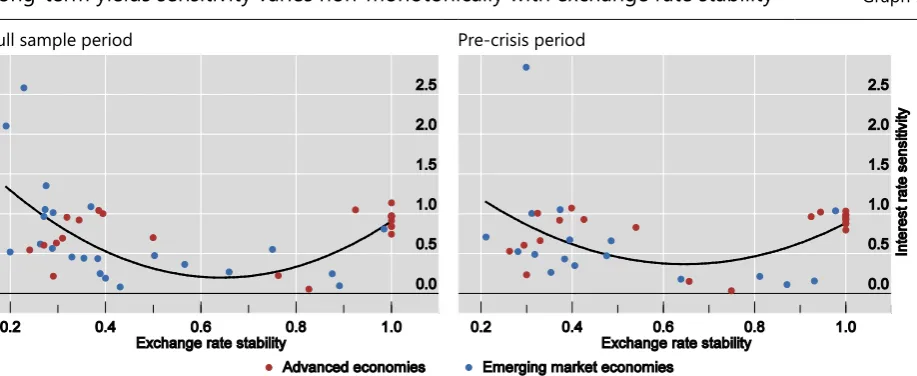
with exchange rate stability is non-monotonic. A simple scatter plot (Graph 1)
illustrates this point. The sensitivity tends to be larger at the limits of the distribution. At the right-hand limit of the horizontal scale are countries that belong to the euro zone or are hard pegs such as Hong Kong SAR and Denmark (1 indicates a hard peggers). This group of countries comprises mostly AEs and displays relatively high betas that are mostly concentrated in a narrow range (0.75–1). At the opposite extreme are countries exhibiting very volatile exchange rates vis-à-vis their base country and displaying on average similarly high, albeit more disperse, sensitivities than peggers. By contrast, countries in the intermediate range display lower sensitivities. Hence, excluding hard pegs, the relationship tends to be negative: the less stable the exchange rate, the stronger is the co-movement of long-term interest rates with those of the base country. And this remains true even if the sample is
13 These findings come with a health warning: they are still preliminary and may change numerically
and be refined as the research is finalised. However, they are not expected to change qualitatively.
Short-run interest rate sensitivity: cross-section regressions Table 1
Full period sample: Pre-crisis period:
(1) (2) (3) (4)
Financial openness 0.9274 *** 0.3926 1.0980 *** 0.3932 (0.329) (0.474) (0.350) (0.535) Exchange rate stability 1.2859 *** 1.3892 *** 1.4361 *** 1.5219 *** (0.316) (0.320) (0.329) (0.352)
Inflation 0.0204 -0.0207
(0.087) (0.142) Inflation volatility -0.0364 -0.0261 (0.073) (0.138)
GDP growth -0.1199 * -0.1343 *
(0.068) (0.080) Output growth volatility 0.0131 0.0057 (0.088) (0.104) Average differentials 0.0404 0.0047 (0.049) (0.080) Differential volatility -0.0044 0.0850 (0.077) (0.103)
Observations 49 49 48 47
R-squared 0.460 0.562 0.482 0.545
(1) (2) (3) (4)
1.3770 *** 1.9408 *** 1.2041 ** 0.8564 (0.465) (0.619) (0.490) (0.562) 1.5414 *** 1.6514 *** 1.3106 ** 1.0726 ** (0.472) (0.504) (0.502) (0.495)
0.2077 ** 0.0612 (0.088) (0.106) -0.1478 * 0.0017 (0.086) (0.088) 0.0152 -0.1254 (0.120) (0.103) -0.0191 0.1435 (0.198) (0.171) 0.0264 0.0324 (0.064) (0.073) -0.1733 -0.3627 * (0.154) (0.187)
49 48 47 47
0.398 0.451 0.487 0.567
restricted to the pre-crisis period. The existence of such a non-linear relationship may explain why fixed-coefficient panel regressions such as those used by Obstfeld (2015) find a relatively similar long-term yield co-movement between pegging and non-pegging countries, but that an analysis of cross-sectional estimates based on linear specification do not find a robust relationship (eg Aizenman et al (2015)).
Table 2 shows that this non-monotonic relationship is robust to controlling for capital openness, which has a strong positive effect on long-term yield co-movements, as well as to controlling for other variables. The non-monotonic relationship with exchange rate stability is modelled using a quadratic specification, which turns out to be statistically significant. As an aside, a potentially interesting result is that long-term yield sensitivities tends to be higher, other things equal, in countries that experience a larger average interest rate differential and a lower volatility.
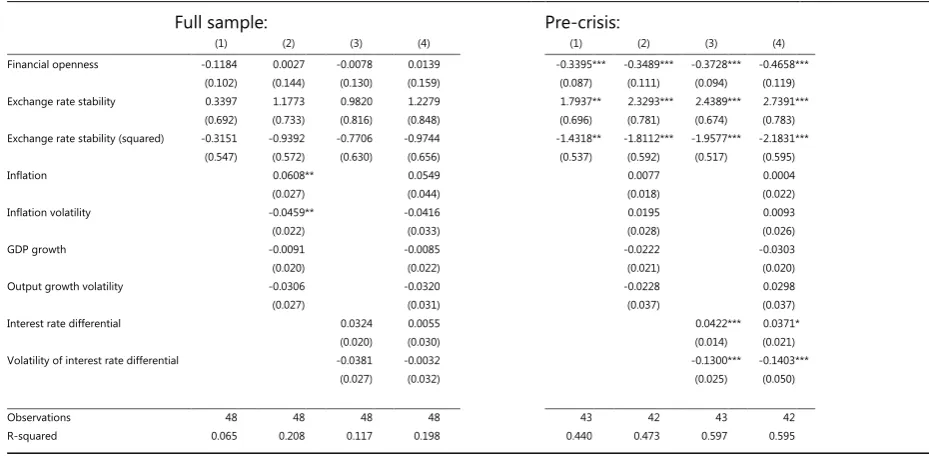
Third, the pass-through from domestic short- to long-run interest rates also varies
non-monotonically with exchange rate stability. Table 3 shows that, while the size of
the pass-through is linearly and positively related to financial openness, it has an inverted U-shaped relationship with exchange rate stability. Again, this reflects the finding that in countries that have a hard peg or a very stable currency the domestic pass-through tends to be relatively low, similarly to countries that have highly volatile currencies. Yet, excluding hard pegs, the pass-through tends to increase as the volatility of the exchange rate diminishes.
Long-term yields sensitivity varies non-monotonically with exchange rate stability1 Graph 1
Full sample period Pre-crisis period
1 Negative estimates of interest sensitivity, which are statistically insignificant, are dropped from the scatter plots. The black line is a quadratic
Long-run interest rate sensitivity: cross section regressions Table 2
Full sample: Pre-crisis:
(1) (2) (3) (4)
Financial openness 0.5752 *** 0.6784 ** 0.6128 ** 0.7242 ** (0.175) (0.310) (0.229) (0.299) Exchange rate stability -4.0334 *** -4.1625 ** -3.3575 ** -2.9582 *
(1.182) (1.628) (1.450) (1.627) Exchange rate stability (squared) 3.1206 *** 3.2912 ** 2.7191 ** 2.4446 *
(0.935) (1.271) (1.119) (1.260)
Inflation 0.0491 -0.0896
(0.060) (0.085) Inflation volatility -0.0271 0.0810 (0.048) (0.062)
GDP growth 0.0431 0.0221
(0.045) (0.041) Output growth volatility -0.1293 ** -0.0729 (0.061) (0.059) Interest rate differential 0.1130 *** 0.1560 **
(0.035) (0.058) Volatility of interest rate differential -0.1868 *** -0.2110 ***
(0.048) (0.061)
Observations 49 48 49 48
R-squared 0.352 0.390 0.510 0.557
(1) (2) (3) (4)
0.7044 *** 0.7576 *** 0.8417 *** 0.5702 *** (0.164) (0.203) (0.197) (0.172) -4.0723 *** -4.1112 *** -3.9847 *** -2.3112 **
(1.307) (1.436) (1.412) (1.128) 3.1809 *** 3.2083 *** 3.1473 *** 1.7291 * (1.007) (1.089) (1.081) (0.858)
-0.0266 -0.0665 ** (0.034) (0.031) 0.0700 0.1701 *** (0.051) (0.058) -0.0274 -0.0159 (0.039) (0.030) 0.0063 0.0138 (0.068) (0.053) 0.0157 0.1368 *** (0.031) (0.030) 0.0491 -0.5702 *** (0.052) (0.082)
43 42 42 41
0.487 0.592 0.510 0.830
Regressions are robust to outliers. Standard errors in parentheses. ***, ** and * denote statistical significance at 1%, 5% and 10% respectively. Source: Kharroubi and Zampolli (forthcoming)
Domestic short- to-long-term yields pass-through: cross-section regressions Table 3
Full sample: Pre-crisis:
(1) (2) (3) (4)
Financial openness -0.1184 0.0027 -0.0078 0.0139 (0.102) (0.144) (0.130) (0.159) Exchange rate stability 0.3397 1.1773 0.9820 1.2279 (0.692) (0.733) (0.816) (0.848) Exchange rate stability (squared) -0.3151 -0.9392 -0.7706 -0.9744 (0.547) (0.572) (0.630) (0.656)
Inflation 0.0608 ** 0.0549
(0.027) (0.044) Inflation volatility -0.0459 ** -0.0416 (0.022) (0.033)
GDP growth -0.0091 -0.0085
(0.020) (0.022) Output growth volatility -0.0306 -0.0320 (0.027) (0.031) Interest rate differential 0.0324 0.0055 (0.020) (0.030) Volatility of interest rate differential -0.0381 -0.0032 (0.027) (0.032)
Observations 48 48 48 48
R-squared 0.065 0.208 0.117 0.198
(1) (2) (3) (4)
-0.3395 *** -0.3489 *** -0.3728 *** -0.4658 *** (0.087) (0.111) (0.094) (0.119) 1.7937 ** 2.3293 *** 2.4389 *** 2.7391 *** (0.696) (0.781) (0.674) (0.783) -1.4318 ** -1.8112 *** -1.9577 *** -2.1831 ***
(0.537) (0.592) (0.517) (0.595) 0.0077 0.0004 (0.018) (0.022) 0.0195 0.0093 (0.028) (0.026) -0.0222 -0.0303 (0.021) (0.020) -0.0228 0.0298 (0.037) (0.037) 0.0422 *** 0.0371 * (0.014) (0.021) -0.1300 *** -0.1403 *** (0.025) (0.050)
43 42 43 42
0.440 0.473 0.597 0.595
5. Conclusion
Does global financial integration reduce the independence of monetary policy or its effectiveness? Do flexible exchange rates offer sufficient insulation from foreign monetary and financial developments? Based on the ongoing research summarised in this paper (Kharroubi and Zampolli (forthcoming)), the answers to these questions are affirmative. Evidence based on short-term interest rate co-movements suggests that central banks retain some degree of monetary independence, which depends inversely on the degree of exchange rate stability they are prepared to accept.
Short-term interest rate correlations, however, do not tell the whole story. The finding of a negative relationship between long-term yield co-movements for non-pegging countries indicates that central banks may have significantly less control on the long end of their yield curve than on their short end. Not only do flexible exchange rates not provide sufficient insulation from external conditions, but they could also amplify their effects on the domestic economy. Hence, to the extent that long-term interest rates are sufficiently important for the monetary transmission mechanism or for financial stability,14 the independence allowed by flexible exchange rates does not necessarily translate into greater policy effectiveness.
Our findings raises at least two issues warranting further research. The first is to understand the theoretical mechanisms behind the stylised facts uncovered in the empirical analysis. For example, does the positive link between long-term yield spillovers and exchange rate volatility reflect higher term premia or exchange rate risk premia or both? The second is to extend the empirical analysis to variables other than government bond interest rates (eg equity prices, credit growth, etc) and see how the co-movement of these variables with their foreign counterparts varies with the exchange rate regime and the degree of capital account openness.
14 For example, Turner (2014) argues that EMEs may have become more sensitive to the long-term
References
Aizenman, J (2010): “The impossible trinity (aka the policy trilemma)”, Working Paper, University of California, Santa Cruz, May.
Aizenman, J, M Chinn and H Ito (2010): “The emerging global financial architecture: tracing and evaluating new patterns of the trilemma configuration”, Journal of
International Money and Finance, vol 29, no 4, pp 615–641.
Aizenman, J, M Chinn and H Ito (2015): “Monetary policy spillovers and the trilemma in the new normal: periphery country sensitivity to core country conditions”, NBER
Working Paper, no 21128, April.
Bank for International Settlements (2015): 85th Annual Report.
Bruno, V and H S Shin (2015): “Capital flows and the risk-taking channel of monetary policy”, Journal of Monetary Economics, vol 71, pp 119–132.
Borio, C and H Zhu (2012): “Capital regulation, risk-taking and monetary policy: a missing link in the transmission mechanism?”, Journal of Financial Stability, vol 8, pp 236–51.
Chinn, M and H Ito (2006): “What matters for financial development? Capital controls, institutions, and interactions”, Journal of Development Economics, vol 81, no 1, pp 163–192.
Chinn, M and H Ito (2008): “A new measure of financial openness”, Journal of
Comparative Policy Analysis, vol 10, no 3, pp 309–322.
Chudik, A and M Pesaran (2015): “Common correlated effects estimation of heterogeneous dynamic panel data models with weakly exogenous regressors”,
Journal of Econometrics, vol 188, no 2, pp 393–420.
Hofmann, B, I Shim and H S Shin (2016): “Sovereign yields and the risk-taking channel of currency appreciation”, BIS Working Papers, no 538, January
Goldberg, L (2013): “Banking globalization, transmission, and monetary policy autonomy”, Sveriges Riksbank Economic Review, no 3, pp 161–193.
Kharroubi, E and F Zampolli: “Interest rate pass-through and co-movement in the global financial system: what drives country heterogeneity?”, BIS Working Papers, forthcoming.
Klein, M and J C Shambaugh (2013): “Rounding the corners of the policy trilemma: sources of monetary policy autonomy”, NBER Working Paper, no 19461, September. Jorda (2005): “Estimation and inference of impulse responses by local projections”,
American Economic Review, vol 95, no 1, pp 161–182.
Lustig, H and A Verdelhan (2007): “The cross section of foreign currency risk premia and consumption growth risk”, American Economic Review, vol 97, no 1, pp 89–117. Lustig, H, N Roussanov and A Verdelhan (2011): “Common risk factors in currency markets”, Review of Financial Studies, vol 24, no 11, pp 3731–3777.
Mundell, R (1963): “Capital mobility and stabilization policy under fixed and flexible exchange rates”, Canadian Journal of Economics and Political Science, vol 29, no 4, pp 475–485.
Obstfeld, M (2015): “Trilemmas and tradeoffs: living with financial globalization”, BIS
Working Papers, no 480, January.
Obstfeld, M, J Shambaugh and A Taylor (2005): “The trilemma in history: tradeoffs among exchange rates, monetary policies, and capital mobility”, Review of Economics
and Statistics, vol 87, no 3, pp 423–438.
Pesaran, M (2006): “Estimation and inference in large heterogeneous panels with a multifactor error structure”, Econometrica, vol 74, no 4, pp 967–1012.
Pesaran, M and R Smith (1995): “Estimating long-run relationships from dynamic heterogeneous panels”, Journal of econometrics, vol 68, no 1, pp 79–113.
Rey, H (2013): “Dilemma not trilemma: the global cycle and monetary policy independence”, paper presented at the Jackson Hole Economic Policy Symposium, hosted by the Federal Reserve Bank of Kansas City, in Proceedings, Economic Policy
Symposium, Jackson Hole, pp 285–333..
Rey, H (2016): “International channels of transmission of monetary policy and the Mundellian trilemma”, IMF Economic Review, vol 64, no 1, pp 6–35.
Shambaugh, J (2004): “The effect of fixed exchange rates on monetary policy”,
Quarterly Journal of Economics, vol 119, no 1, pp 301–352.