ISSN: 2306-9007 Khafajy, Alzoubi & Aljanabee (2016) 302
I
www.irmbrjournal.com March 2016I
nternationalR
eview ofM
anagement andB
usinessR
esearchV
ol. 5 Issue.1R
M
B
R
Analyzing the Effect of Knowledge Management Processes in
The Services’ Quality in Iraqi Commercial Banks
NEAMAH A. KHAFAJY
Professor of Management, Amman Arab University, POBox.2234 Amman.11953-Jordan.
Email: [email protected]
HAITHAM M. ALZOUBI
Associate Professor of Management, Skyline University, POBox. 1797, Sharija, UAE.
Email: [email protected]
Tel: +971556717768
AZZAM K. ALJANABEE
Master of business Administration, Amman Arab University, POBox.2234 Amman.11953-Jordan.
Email: [email protected]
Abstract
The study aimed to determine the effect of knowledge management processes which are represented by knowledge acquisition, knowledge sharing, knowledge application, knowledge retention, and knowledge storage in the banking services quality including reliability, assurance, connection, responsiveness, empathy and tangibility. The population of the study is Iraqi commercial banks, while the sample consisted of 121 senior managers of them. Results of regression analysis and multiple linear regression analysis showed a limited effect of knowledge management processes in the banking services’ quality. The study recommended the necessity of enhancing the managers’ awareness to make sure of the sustainability of the banking services quality in terms of improving and reengineering the knowledge management processes that are compatible with the changes in the Iraqi banks environment in light of electronic and virtual business world so as to achieve excellence in the knowledge economy and the virtual economy.
Key Words: Knowledge Management Processes, Services’ Quality, Iraqi Commercial Banks.
Introduction
ISSN: 2306-9007 Khafajy, Alzoubi & Aljanabee (2016) 303
I
www.irmbrjournal.com March 2016I
nternationalR
eview ofM
anagement andB
usinessR
esearchV
ol. 5 Issue.1R
M
B
R
Recently, some intellectuals have argued that knowledge is a phenomenon can be measured, developed, shared and transferred (Jaradat, Almaani and Alshleh, 2011).
knowledge management processes which are considered one of the organization’s intangible assets, its importance has increased though application and sharing knowledge in addition to its role in raising the employees’ efficiency and developing the businesses organizations’ competitive ability including the organizations’ and the employees’ accumulative experience in addition to the management distinguished ways and whatever they need to do their work. In other words, it is the solution to the complicated problems facing the organizations. Using traditional methods to acquire knowledge and skills to do the organization’s activities in light of business environment which changes continuously has no longer considered the appropriate methods, as it has become a necessity to acquire and update knowledge according to work requirements so as to enhance the employees’ skills and experience to be more interactive and ready to solve problems facing them. And because the commercial banks are one of the important factors in the local and international economic systems for its role in the social and economic development field, knowledge plays a significant role in the sustainability of the commercial banks because it affects greatly the banking services quality.
Accordingly, knowledge gets involved in all the commercial activities starting from attracting the customer and gaining his loyalty till making critical decisions concerning the commercial banks. The increase of the interest in the services industries was in line with the increase of the awareness of the scholars in the services sector (including the commercial banks) in the quality importance and its role in increasing productivity, market share, excellence in the market, gaining the customers’ satisfaction and return on investment. Noticeably, the quality through the concentration on the customer has become very important in the current era. In the international competitive commercial area, the customers look for goods and services with high value. Therefore, it has become an obligation for the business organizations’ management to maintain, continuously, its efficiency in providing services that meet its customers or otherwise these organizations will lose their reputation and rank in the market, while its process of innovation probably drive for profits (Grant et al. 2002).
The Iraqi commercial banking sector is new compared to the banking sector in the regional and international countries because Iraq was a socialist country where the government banks have the major role in the Iraq economic sector’s activities. After the political changes had taken place in Iraq, the private commercial banks sector role started to be significant in the Iraqi economic growth.
Theoretical Background
ISSN: 2306-9007 Khafajy, Alzoubi & Aljanabee (2016) 304
I
www.irmbrjournal.com March 2016I
nternationalR
eview ofM
anagement andB
usinessR
esearchV
ol. 5 Issue.1R
M
B
R
Gulati and Khera (2013) tested the role of knowledge management tools and the human resources’ practices in sharing knowledge, focuced on the importance of Tacit Knowledge sharing and its reflection in the employees’ behaviors towards the customers of the Indian banks, it concluded sharing knowledge between the employees affects positively reduction of the work average turnover. It recommended the necessity of appointing individuals who are expert and skillful in dealing with the customers.
Mean while, Hamed (2011) discussed the impact of knowledge management on taking management decisions in the Saudi banking sector. The status of knowledge management and management decisions taking of the biggest ten Saudi commercial banks was diagnosis in terms of capitals and number of the employees. Results showed positive relation between management knowledge with management decisions-making and between knowledge sharing and availability with decisions decisions-making in particular, whereas Alzatma (2011) investigated the impact of knowledge management requirements and its processes on the performance of the technical institutes in Gaza Strip. Results showed that the availability of knowledge needs of the Middle Technical Institutes was high compared to the availability of cognitive awareness and the impact of management knowledge on performance was limited.
Alqehewi (2010) diagnosed the role of knowledge management strategy in achieving the organizational goals of telecommunications corporations. It pointed to the limitation of organizational goals’ achievement in the telecommunications corporations according to a survey compared to some international corporations in addition to the managers’ lack of awareness of strategic choices of knowledge management and some managers’ weakness in investing and enhancing results of achieving the corporations and its employees’ goals as a result to the knowledge management practices’ limitation.
On the other hand, Ahmadi, Daraei and Kalam (2012) analyzed the effective elements in the knowledge sharing in the banking sector in Iran specially the effective elements in knowledge sharing between the employees (trust, information systems, organization culture, incentive system). The study also investigated the efficiency of the organized culture in the employees’ attitudes towards knowledge sharing and results showed weakness in the banking work culture and the incentives system has major role in addicting the employees’ attitudes towards knowledge sharing. The study recommended greater role to the banks’ managers in improving the culture of knowledge sharing though having the employees’ relations improved and developed.
Significance of the Study
The previous studies were the motive to expand thinking of the management knowledge processes in terms of acquisition, retention, sharing, application and storage and to analyze their effect in the banking services quality dimensions represented by Reliability, assurance, connection, Responsiveness, Empathy and tangibility, since this study consider a remarkable to examine and checked the study variables theoretically and practically in the Iraqi banks sector either in general and the commercial ones in particular. The study aimed to identify these banks’ managers’ awareness of knowledge management processes and the banking services quality using a questionnaire that was scenically arbitrated by the previous studies and a group of experts and arbitrators in the banking field. The study was limited to the Iraqi commercial banks including their location and their managers in addition to the study’s variables. Although this study varies from previous studies in terms of goals, attitudes and results but they all addressed the issue of knowledge management and quality in general and the banking services quality with electronic trend in particular.
Dialectical of the Study and its Model
ISSN: 2306-9007 Khafajy, Alzoubi & Aljanabee (2016) 305
I
www.irmbrjournal.com March 2016I
nternationalR
eview ofM
anagement andB
usinessR
esearchV
ol. 5 Issue.1R
M
B
R
of goods and services in line with the customers’ needs specially after legislating new laws that allow the foreign banks to have its branches inside the Iraqi banking sector. The foreign banks’ long experience in the field of banking work obligates the management of Iraqi commercial banks to develop itself and get benefit of every available opportunity specially in information technology sector trying at the same time to use is knowledge to support its services quality. Consequently, this study came to analyze the effect of knowledge management processes in the services quality in the Iraqi commercial banks.
The Study’s Model
The model’s idea based on the possibility of improving the banking services quality relying on knowledge management processes approach which gives the banks the capability to achieve its goals and be pioneer in the competitive markets.
Hypotheses of the Study
Based on the study’s problem, and previous studies’ attitudes, and current study’s goals, the following null hypotheses were proposed as expected solutions:
HO: There was no statistical significant effect at the level of significance (a=0.05) of the knowledge management processes (acquisition, retention, application, sharing and storage knowledge) in the banking services quality and its dimensions (reliability, assurance, connection, responsiveness, empathy and tangiblity) in the Iraqi commercial banks.
HO1 There is no statistical significant effect at the level of significance (a=0.05) of the knowledge
management processes in reliability.
HO2 There is no statistical significant effect at the level of significance (a=0.05) of the knowledge
management processes in assurance.
HO3 There is no statistical significant effect at the level of significance (a=0.05) of the knowledge
management processes in connection.
HO4 There is no statistical significant effect at the level of significance (a=0.05) of the knowledge
management processes in responsiveness.
HO5 There is no statistical significant effect at the level of significance (a=0.05) of the knowledge
management processes in empathy.
Reliability
Assurance
Connection
Responsivenes
s
Empathy
Tangibility
Knowledge
Management
Processes
Knowledge
acquisition
Knowledge sharing
Knowledge
application
Knowledge storage
Knowledge
retention
ISSN: 2306-9007 Khafajy, Alzoubi & Aljanabee (2016) 306
I
www.irmbrjournal.com March 2016I
nternationalR
eview ofM
anagement andB
usinessR
esearchV
ol. 5 Issue.1R
M
B
R
HO6 There is no statistical significant effect at the level of significance (a=0.05) of the knowledge
management processes in tangiblity.
Methodology of the Study
The descriptive Approach was used to describe the Iraqi commercial banks’ managers’ opinions about knowledge management processes (acquisition, retention, application, sharing and knowledge storage and the banking services quality and its dimensions (reliability, assurance, connection, responsiveness, empathy and tangiblity). Furthermore, the analytic approach was used to measure the effect of knowledge management processes in the banking services quality and to identify the sample’s opinions about the study’s model’s variables.
Population and Sample of the study
The population of the study which consisted of the operating mangers in the high and moderate management of Iraqi commercial banks was 30 banks with more than 400 branches according to Iraqi central bank’s statistics. The sample of the study consisted of ten Iraqi commercial banks which were selected using the convenience method because of the prevailing security situations in the country of the study and the availability of the mangers (the study’s participants) in their banks. Out of 400 managers represented high and moderate management of the commercial banks, 121 managers and manger’s assistant were selected randomly. The questionnaires were distributed to the sample to identify their views about services quality presented by the banks and its knowledge management processes.
Instrument of the Study
The questionnaire which was used as the basic instrument for collecting data consisted of two parts: First: knowledge management processes including the following items: knowledge acquisition, retention, application, sharing and storage. The study gets benefit of the previous studies (Al-Banna, 2012; Mubaideen, 2012; Ahmadi, Daraei and Kalam 2012; Hamed, 2011). Second: Banking services quality including the following dimensions: tangiblity, reliability, responsiveness, assurance, empathy, professionalism, and confidentiality. The study gets benefit of the previous studies (Okoe Adjei and Osarenkhoe 2013; Tirtar, 2012; Ankrah, 2012; Sangeetha, 2012).
Validity & Reliability of the Instrument
The face validity of the questionnaire was checked. The adequacy and appropriateness of a questionnaire’s items were assessed by presenting them to a set of experts and arbitrators in banking, information technology, banking services quality and applied statistics. Additionally, the reliability of the questionnaire was checked through using Cronbach Alpha to measure the questionnaire’s items’ internal consistency. The values of Cronbach Alpha which ranged from (0.65) to (0.85) are accepted once to adopt the questionnaire as a tool of measurement.
Data Analysis and Results
Description of the Managers’ Perception Towards Study Variables
ISSN: 2306-9007 Khafajy, Alzoubi & Aljanabee (2016) 307
I
www.irmbrjournal.com March 2016I
nternationalR
eview ofM
anagement andB
usinessR
esearchV
ol. 5 Issue.1R
M
B
R
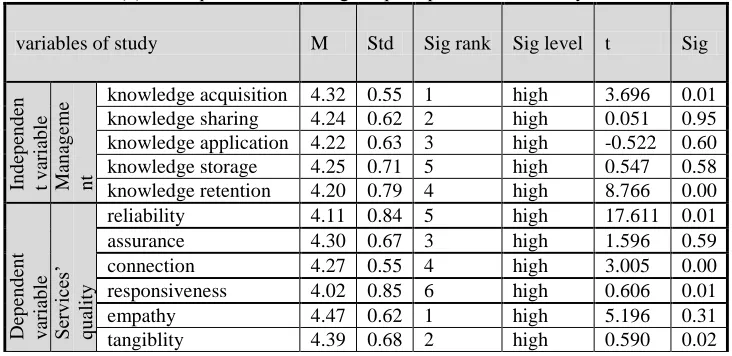
considered a high degree based on the test criteria. These results revealed the Iraqi commercial banks’ managers’ high positive attitudes towards the previous processes.
Table (1) Description of the managers’ perception towards study variables
variables of study M Std Sig rank Sig level t Sig
In d ep en d en t v ar iab le Kn o wled g e Ma n ag em e n t Pro ce ss es
knowledge acquisition 4.32 0.55 1 high 3.696 0.01
knowledge sharing 4.24 0.62 2 high 0.051 0.95
knowledge application 4.22 0.63 3 high -0.522 0.60
knowledge storage 4.25 0.71 5 high 0.547 0.58
knowledge retention 4.20 0.79 4 high 8.766 0.00
Dep en d en t v ar iab le Ser vices’ q u ality
reliability 4.11 0.84 5 high 17.611 0.01
assurance 4.30 0.67 3 high 1.596 0.59
connection 4.27 0.55 4 high 3.005 0.00
responsiveness 4.02 0.85 6 high 0.606 0.01
empathy 4.47 0.62 1 high 5.196 0.31
tangiblity 4.39 0.68 2 high 0.590 0.02
Results of one-sample kolmogorov – smirnov Test as showed in table (2) which indicate that the variables of study’s model were normally distributed.
Table (2) Results of One-Sample Kolmogorov – Smirnov Test
variables of study Items Z Calculated sig
Knowledge management processes 121 387.0 38570
Services’ quality 121 387.0 38530
Tabled z=1.96 at the leve of significant = 0.05 and test 2- tailed
Results of Variance Inflation Factors as it is illustrated in table (3) showed lack of multicollinearity between the independent variables; the knowledge management processes. These results were confirmed by the values of VIF test criteria as the knowledge management processes’ values were less than the test’s critical value. Additionally, Tolerance values revealed lack of multicollinearity between knowledge management processes.
Table (3) Results of Variance Inflation Factors
Independent variable Collinearity Statistics
VIF Tolerance
knowledge acquisition 181.3 38..1
knowledge sharing 18015 38701
knowledge application 18100 38..3
knowledge storage 181.3 38.77
knowledge retention 18105 38...
Hypothesis Testing
ISSN: 2306-9007 Khafajy, Alzoubi & Aljanabee (2016) 308
I
www.irmbrjournal.com March 2016I
nternationalR
eview ofM
anagement andB
usinessR
esearchV
ol. 5 Issue.1R
M
B
R
and knowledge storage) in the baking services quality and its dimensions (reliability, assurance, connection, responsiveness, empathy and tangibility) in the Iraqi commercial banks.
Table (4) Results of ANOVA test between knowledge management processes and Services’ quality
Source SOS MS DF F*
calculated sig
knowledge management processes in Services’ quality
Regression 00058.0. .0581.. 5
0.8.01 3803
Remains 017.83.7 1.87.0 116
Total ....8... 121
* table value of F=2.52 at level of significance (0.05).
Based on the results illustrated in table (5), we can conclude:
a) The Regration Coefficient () of the knowledge management processes on Services’ quality of; (acquisition and retention knowledge) was statistically significant and therefore there was statistical significance effect at the level of significance (a=0.05) to the processes mentioned previously in the banking services quality of the Iraqi commercial banks. These results were confirmed by the calculated(t) value of the knowledge acquisition (3.989) and its significance ( 0.010) in addition to the calculated (t) value of Sustaining knowledge process (8.768) and its significance (0.000) which is less than the level of significance (a=0.05). Considering these results, the null hypothesis is rejected
b) The coefficient of determination (R2) value (0.51) showed that sustaining knowledge interprets (51%) of the changes in the banking services quality and (49%) of the changes could be attributed to other variables were not included in study Model.
Table (5) Results for Multi Linear Regression of knowledge management processes in Services’ quality
knowledge management
processes dimensions t* sig B r r
2
constant 24.158 3.889 0.000
0.71 0.51
knowledge acquisition 1.415 08... 0.010 0.238
knowledge sharing 0.015 0.051 0.959 3833.
knowledge application -0.140 -0.522 0.603 -0.036
knowledge retention 2.003 8.768 0.000 0.616
knowledge storage 0.128 0.547 0.585 0.038
* table value of t=1.65. at level of significance (0.05).
The Results of First Sub-hypothesis Test illustrated in table (6), then we can conclude:
a) The Regration Coefficient () of one of the knowledge management processes (knowledge
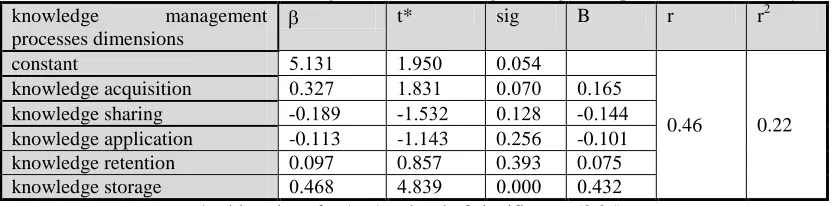
retention) on reliability, was statistically significant and so there was statistical significance effect at the level of significance (a=0.05) to the process mentioned previously in reliability as a dimension of the banking services quality. These results were confirmed by the calculated (t) value of the knowledge retention (4.839) and its signifigance (0.000) which is less than the level of significance (a=0.05). Considering these results, the null hypothesis is rejected (partially) as the other knowledge management processes have no effect in reliability as a dimension for the banking services quality in Iraq.
ISSN: 2306-9007 Khafajy, Alzoubi & Aljanabee (2016) 309
I
www.irmbrjournal.com March 2016I
nternationalR
eview ofM
anagement andB
usinessR
esearchV
ol. 5 Issue.1R
M
B
R
Table (6) Results for Multi Linear Regression of knowledge management processes in reliability
knowledge management
processes dimensions
t* sig B r r2
constant 58101 18.53 3835.
0.46 0.22
knowledge acquisition 38007 18.01 38373 38105
knowledge sharing -381.. -18500 3810. -381..
knowledge application -0.113 -1.143 0.256 -0.101
knowledge retention 0.097 0.857 0.393 0.075
knowledge storage 38.0. .8.0. 38333 38.00
* table value of t=1.65. at level of significance (0.05).
The results of second sub-hypothesis test illustrated in table (7), then we can conclude:
a) The Regration Coefficient () of the following knowledge management processes on assurance, were statistical significant of: knowledge sharing (0.007), knowledge application (0.008) and knowledge retention (0.001) and so there was statistical significance effect at the level of significance (a=0.05) to the process mentioned previously in assurance. In light of these results, the null hypothesis is rejected (partially) and the other knowledge management processes have no effect in assurance.
b) The coefficient of determination (R2) value (0.22) showed that the following processes (retention,
sharing and knowledge application) interprets (22%) of the changes in the banking services quality and (78%) of the changes could be attributed to other variables were not included in Multiple Linear Regression Model.
Table (7) Results for Multi Linear Regression of knowledge management processes in assurance
Knowledge management
processes dimensions
t* sig B r r2
Constant .8507 .8.7. 38333 -3830.
0.47 0.22
knowledge acquisition -38300 -38.0. 3800. 3805.
knowledge sharing 38077 08700 38337 -38005
knowledge application -380.. -080.0 3833. 0.298
knowledge retention 0.262 3.336 0.001 0.113
knowledge storage 0.103 1.280 0.203
* table value of t=1.65. at level of significance (0.05).
The results of third sub-hypothesis test illustrated in table (8), then we can conclude:
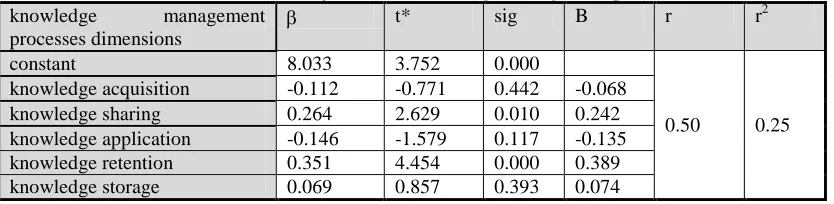
a) The Regration Coefficient () of two of the knowledge management processes of: (knowledge retention and sharing) were statistically significant on connection and so there was statistical significance effect at the level of significance (a=0.05) to the process mentioned previously in connection. These results were confirmed by their calculated (t) value (.8.5./0800.) respectively and their signifigance value (0.010/ 0.000) was less than the level of significance (a=0.05). In light of these results, the null hypothesis is rejected (partially) as the other knowledge management processes have no effect in connection.
b) The coefficient of determination (R2) value (0.25) showed that the following processes
ISSN: 2306-9007 Khafajy, Alzoubi & Aljanabee (2016) 310
I
www.irmbrjournal.com March 2016I
nternationalR
eview ofM
anagement andB
usinessR
esearchV
ol. 5 Issue.1R
M
B
R
Table (8) Results for Multi Linear Regression of knowledge management processes in connection
knowledge management
processes dimensions
t* sig B r r2
constant 8.033 3.752 0.000
0.50 0.25
knowledge acquisition -0.112 -0.771 0.442 -0.068
knowledge sharing 0.264 2.629 0.010 0.242
knowledge application -0.146 -1.579 0.117 -0.135
knowledge retention 0.351 4.454 0.000 0.389
knowledge storage 0.069 0.857 0.393 0.074
* table value of t=1.65. at level of significance (0.05).
The results of fourth sub-hypothesis test illustrated in table (9), then we can conclude:
a) The Regration Coefficient () of two of the knowledge management processes of: (knowledge acquisition and retention) were statistically significant on responsiveness and so there was statistical significance effect at the level of significance (a=0.05) to the processes mentioned previously in responsiveness. These results were confirmed by their calculated (t) value (5.807/3.177) respectively and their signifigance value (0.000/ 0.002) was less than the level of significance (a=0.05). In light of these results, the null hypothesis is rejected (partially) as the other knowledge management processes have no effect in responsiveness.
b) The coefficient of determination (R2) value (0.32) showed that the following processes
(knowledge acquisition and retention) interpret (32%) of the changes in the banking services quality and (68%) of the changes could be attributed to other variables which are not included in Multiple Linear Regression Model.
Table (9) Results for Multi Linear Regression of knowledge management processes in responsiveness
knowledge management
processes dimensions
t* sig B r r2
constant 38130 383.3 38.0.
0.56 0.32
knowledge acquisition 38550 08177 38330 38007
knowledge sharing -381.1 -185.7 38115 -3810.
knowledge application 38335 383.. 38.05 3833.
knowledge retention 0.547 5.807 0.000 0.483
knowledge storage 0.014 0.148 0.883 0.012
* table value of t=1.65. at level of significance (0.05).
The results of fifth sub-hypothesis test illustrated in table (10), then we can conclude:
a) The Regration Coefficient () of two of the knowledge management processes (knowledge
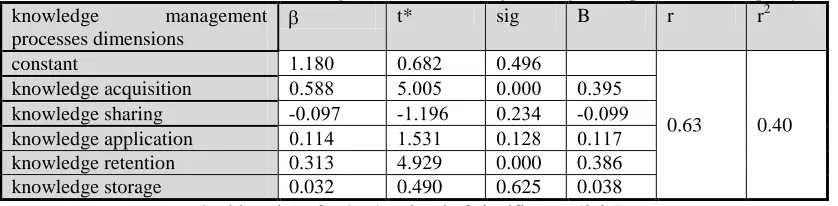
acquisition and retention) wrer statistically significant on empathy and so there was statistical significance effect at the level of significance (a=0.05) to the processes mentioned previously in Empathy. These results were confirmed by their calculated (t) value (4.929/5.005) respectively and their signifigance value (0.000/ 0.000) was less than the level of significance (a=0.05). In light of these results, the null hypothesis is rejected (partially) as the other knowledge management processes have no effect in Empathy.
b) The coefficient of determination (R2) value (0.40) showed that the processes (knowledge
ISSN: 2306-9007 Khafajy, Alzoubi & Aljanabee (2016) 311
I
www.irmbrjournal.com March 2016I
nternationalR
eview ofM
anagement andB
usinessR
esearchV
ol. 5 Issue.1R
M
B
R
Table (10) Results for Multi Linear Regression of knowledge management processes in empathy
knowledge management
processes dimensions
t* sig B r r2
constant 181.3 380.0 38..0
0.63 0.40
knowledge acquisition 385.. 58335 38333 380.5
knowledge sharing -383.7 -181.0 3800. -383..
knowledge application 3811. 18501 3810. 38117
knowledge retention 0.313 4.929 0.000 0.386
knowledge storage 0.032 0.490 0.625 0.038
* table value of t=1.65. at level of significance (0.05).
The results of sixth sub-hypothesis test illustrated in table (11), then we can conclude:
a) The Regration Coefficient () of three of the knowledge management processes (knowledge
acquisition, retention and sharing) were statistically significant on tangiblity and so there was statistical significance effect at the level of significance (a=0.05) to the processes mentioned previously in tangiblity. These results were confirmed by their calculated (t) value (3.666, 2.326, 3.958) respectively and their signifigance value (0.000/ 0.002, 0.000) was less than the level of significance (a=0.05). In light of these results, the null hypothesis is rejected (partially) as the other knowledge management processes have no effect in tangiblity.
b) The coefficient of determination (R2) value (0.30) showed that the processes (knowledge
acquisition, sharing and retention) interpret (70%) of the changes in the banking services quality and (60%) of the changes could be attributed to other variables which are not included in Multiple Linear Regression Model.
Table (11) Results for Multi Linear Regression of knowledge management processes in tangibility
knowledge management
processes dimensions
t* sig B r r2
constant 38700 38003 38753
0.55 0.30
knowledge acquisition 38037 08.5. 38333 38007
knowledge sharing -380.7 -08000 38300 -38030
knowledge application 381.3 18..5 3835. 38101
knowledge retention 0.304 3.665 0.000 0.309
knowledge storage 0.115 1.345 0.181 0.112
* table value of t=1.65. at level of significance (0.05).
Discussion
Results of the Multiple Linear Regression analysis revealed partial statistical significant effect at the level of significance (a=0.05) between the knowledge management processes and the dimensions of the banking services quality. Additionally, these results indicate that the increase of the commercial banks’ management interest in all the processes of knowledge management could help in improving the banking services quality.
Discussion of the results of first sub-hypothesis:
ISSN: 2306-9007 Khafajy, Alzoubi & Aljanabee (2016) 312
I
www.irmbrjournal.com March 2016I
nternationalR
eview ofM
anagement andB
usinessR
esearchV
ol. 5 Issue.1R
M
B
R
Discussion of the results of second sub-hypothesis:
Results of the Multiple Linear Regression analysis showed statistical significant effect to three of the knowledge processes which are (knowledge sharing, application and retention) in assurance which is one of the banking services quality’s dimensions. It could be concluded that increasing the commercial banks management’s awareness of sharing and retention knowledge is expected to improve significantly the banking services quality in future.
Discussion of the results of third sub-hypothesis:
Results of the Multiple Linear Regression analysis showed statistical significant effect to two of the knowledge processes which are (knowledge sharing and retention) in connection which is one of the banking services quality’s dimensions. It could be concluded that the increase in the commercial banks management’s awareness of sharing and retention knowledge is expected to improve significantly the banking services quality in future.
Discussion of the results of fourth sub-hypothesis:
Results of the Multiple Linear Regression analysis showed statistical significant effect to two of the knowledge processes which are (knowledge acquisition and retention) in responsiveness as one of the banking services quality’s dimensions. It is clearly that increasing the commercial banks’ management awareness of acquisition and retention knowledge is expected to improve the banking services quality in future.
Discussion of the results of fifth sub-hypothesis:
Results of the Multiple Linear Regression analysis showed statistical significant effect to two of the knowledge processes which are (knowledge acquisition and retention) in empathy which is one of the banking services quality’s dimensions. Based on this result, the increase of the commercial banks’ management awareness of these processes may improve the banking services in the future.
Discussion of the results of sixth sub-hypothesis:
Results showed statistical significant effect to three of the knowledge processes which are (knowledge acquisition, sharing and sustaining) in empathy which represented one of the banking services quality’s dimensions. It is clear that the increase of the commercial banks’ management awareness of these processes is expected to improve the banking services quality in the future.
The previous results revealed the significance of this study, as this study try to determine the effect of knowledge management processes in the services quality in the Iraqi commercial banks as it provides theoretical and statistical evidences for this effect. Additionally, the results showed the commercial banks management’s interest in the knowledge management processes and knowledge sharing, retention and acquisition were the highest in attracting the mangers’ attention. Moreover, the nature and the strength of these processes in the banking services quality were highlighted and the significance of these processes and their roles in improving the employees efficiency in the commercial banks were also highlighted through clarifying the employees’ needs to learn and acquire more and new skills that are compatible with the new businesses environment which may in turn helps the banks management to set strategies for developing knowledge management processes for its choices and dimensions that may help in increasing the sustainable competitive capability of the commercial banks either at present or in the future .
ISSN: 2306-9007 Khafajy, Alzoubi & Aljanabee (2016) 313
I
www.irmbrjournal.com March 2016I
nternationalR
eview ofM
anagement andB
usinessR
esearchV
ol. 5 Issue.1R
M
B
R
services quality. Generally, the results are compatible with the studies (Gulati and Khera, 2013; Ahmadi et al., 2012 Hamed, 2011; Alzatma, 2011; Alqehewi, 2010) and its contribution in which may attract scholars and researchers’ attention to examine more deep of the effect of knowledge management processes in the banking services quality
Recommendations
The following recommendations have been considered based on the results of this study:
The commercial banks’ management should assure the significance of management knowledge
processes as a way to develop and improve the banking services quality for its benefits as increasing the ability to meet the customers’ needs and the ability of creativity which affect positively its competitive advantage.
Inviting the commercial banks’ management to prepare specific and clear strategies concerning the management knowledge processes that determine the goals that the commercial banks like to achieve through utilizing the knowledge which the employees have and to make it a value affecting the banks’ services quality.
There should be a confirmation on the availability of databases requirements where the necessary information are kept. In addition to the development of the external and internal information networks and the development of the employees’ skills of using these networks in terms of acquisition, retention, application, sharing and knowledge storage to reengineer the banking services quality in future.
The necessity to take think of ways to update knowledge technology ,its tools and systems to estimate
the level of quality of the presented services according to the current and new customers’ expectations as a competitive power.
The possibility to examine the effect of knowledge management processes in the banking services quality based on the information technology in the Iraqi commercial banks. Consequently, it is a way to investigate the banks performance’s excellence and their goals’ achievement continuously within the Iraqi banking sector.
References
Ahmadi, Seyyed; Daraei, Mohammad and Kalam, Reza (2012) ‘Analysis of knowledge sharing in banking industry’, Interdisciplinary journal of contemporary research in business, vol. 4, no. 7, pp. 815-827. Al-Banna, Hussain (2012) ‘The Impact of Organizational Empowerment Strategy in Knowledge
Management Processes at Commerical Banks’, Unpublished Ph.D dissertation, Amman Arab
University, Jordan.
Ali, Hafizi and Ahmad Nor (2006) ‘Knowledge Management in Malaysian Banks: a New Paradigm’,
Journal of Knowledge Management Practice, vol. 7, no. 3.
Alqehewi, Laith (2010) ‘The Role of Knowledge Management Strategy in Accomplishing Organizational
Goals at Services Organizations’, Unpublished Ph.D dissertation, Amman Arab University, Jordan.
Alzatma, Nedal (2011) ‘The Impact of Knowledge Management on the excellence of Organizational Performance at Technical Institutes in Gaza Strip’, Unpublished Master Thesis, Islamic University. Gaza Strip.
Ankrah, Ebenezer (2012) ‘Technology and Service Quality in the Banking Industry in Ghana’, Information
and Knowledge Management, vol. 2, no. 8, pp. 52-59.
Chiran, Jayasundara (2008) ‘Knowledge Management in Banking Industries: uses and opportunities’,
Journal of the University Librarians Association OF Sri Lanka. Vol. 12, pp. 68-84.
Faruk, Muhammad; Al-Faruque, Md. and Akhter, Rbeya (2015) ‘knowledge management in banks and financial sector: Bangladesh perspective’, Asian Journal of Multidisciplinary Studies, vol. 3, no. 12, pp. 111-126.
Grant, Ken; Laney, Richard and Pickett Bill (2002) ‘A Process of Innovation in Marketing by SME’s,
ISSN: 2306-9007 Khafajy, Alzoubi & Aljanabee (2016) 314
I
www.irmbrjournal.com March 2016I
nternationalR
eview ofM
anagement andB
usinessR
esearchV
ol. 5 Issue.1R
M
B
R
Gulati, Karishma and Khera, Shikha (2013) ‘Role of HR Practices and KM Tools in Knowledge-Sharing
Behavior of Internal Customers at Commercial Banks in Delhi’, The IUP Journal of Knowledge
Management, vol. 12, no. 2, pp. 43-61.
Hamed, Saeed (2011) ‘The Impact of Knowledge Management on the Managerial Decision-Making in the Suadi Banking Sector’, Journal of King Saud university for Administrative Sciences, vol. 23, no. 1.
Jaradat, Naser; Almaani, Ahmed and Alshleh, Asma (2011) ‘Knowledge Management’, Ithraa Publishing
and Distribution, Amman, Jordan.
Mubaideen, Mohammad (2012) ‘Knowledge Management Application and Its Effect on Internal Processes Effectiveness’, International Business Research, vol. 5, no. 12, pp. 153-160.
Okoe, Abednego Feehi; Adjei, Judith Serwa; and Osarenkhoe, Aihie (2013) ‘Service Quality in the Banking Sector in Ghana’, International Journal of Marketing Studies, vol. 5, no. 2, pp. 81-89.
Rasoulinezhad, Ehsan (2011) ‘Measuring the Role of Knowledge Management Processes in the
Commercial Banks of Iran’, The Electronic Journal of Knowledge Management, vol. 9, no. 4, pp.
353-364.
Sangeetha, Jaya (2012) ‘Development of a Service Quality Scale for Multiple Technology Interfaces in
Commercial Banking’, Journal of Internet Banking and Commerce, vol. 17, no. 3, pp. 2-11.
Tholath, Deepa Ittimani (2013) ‘Knowledge Dimensions to Monitor Knowledge Growth in Service Sector’,
The IUP Journal of Knowledge Management, vol. 11, no. 3, pp. 29-40.
Tirtar, Hilmi (2012) ‘Quality banking services as a mechanism to activate the competitive advantage of the
bank’, Research paper at Faculty of Economic Sciences, University Mentouri Constantine, Algeria.
Wang, Lixia and Hussain, Iftikhar (2011) ‘Banking Sector Growth in China: Can Six-Sigma Be a
Solution?’, International Journal of Business and Management, vol. 6, no. 2, pp. 196-176.
Yamagata, Kazunori (2002) ‘Knowledge management in banking industry: comparative analysis between