Tribology in Industry
www.tribology.rsExperimental Study on an Influence of Bearing
Geometry and TiO
2
Nanoparticle Additives on the
Performance Characteristics of Fluid Film
Lubricated Journal Bearing
S.R. Suryawanshi
a, J.T. Pattiwar
baMechanical Engineering Department, MET’s IOE, BKC, Nasik, SPPU, Pune, India, bSMES SCOE, Nashik, SPPU, Pune, India.
Keywords:
Experimental test rig Pressure distribution Temperature rise Tribology Journal bearing
A B S T R A C T
The objective of this article is to study the performance characteristics of the journal bearing experimentally having different geometries operating with commercial Mobil grade lubricants that are used in power plant. Three grades of Mobil lubricants (DTE 24, DTE 25, and DTE 26) have been considered during the study. TiO2 nanoparticle additives have also been considered during the study as a lubricant additive to examine the performance of journal bearings. An analytical approach was presented in the author’s earlier work to obtain pressure and temperature profile. The dynamic characteristics such as stiffness and damping properties of journal bearings are represented in this paper. An experimental test rig is developed to accommodate any geometrical type of bearing. An elliptical journal bearing shows the superior performance than that of a plain bearing. The obtained experimental results are in a very good agreement with theoretical results for pressure and temperature profile.
© 2019 Published by Faculty of Engineering Corresponding author:
Shubham R. Suryawanshi
Mechanical Engineering Department, MET’s IOE, BKC, Nasik, SPPU, Pune, India.
E-mail:
1. INTRODUCTION
The rotating types of machinery are operating with an integral part known as hydrodynamic journal bearing of fluid film journal bearing. These journal bearings consist of stationery cylindrical bearing in which the journal rotates at a certain speed. The lubricating oil is supplied in the clearance space between the journal and bearing surface. The whirl instability phenomenon occurs during the operation of the
journal bearing system that changes the properties of lubricating oil. This is due to the heat generation in the system that eventually causes the temperature rise in the oil film of lubricating oil. This phenomenon tends to cause the metal to metal contact during running condition. Hence the action of whirl instability may lead to the damage of the system. It decreases the performance of the bearing and affects the lubricant viscosity as it depends on the temperature [9]. Many researchers are
R
ES
EA
R
carrying out research on the stability analysis of the journal bearing system, as it is the crucial area of the dynamics. However, the concept of instability created by oil whirl is not very clear. This needs a better understanding of the oil whirl and whip phenomenon to identify the fault in the system. To overcome the difficulties during the operation of the journal bearing system, this study promotes the performance evaluation of non-circular fluid film lubricated journal bearings operating with nanoparticle-based lubricants. An elliptical journal bearing has been considered as a non-circular shaped journal bearing to investigate the performance of journal bearing over the plain circular journal bearing. This paper extends the author’s analytical work [9,23] using the experimental methodology. The experimental analysis has been presented in this work to investigate the performance of the journal bearing with a wide range of operating conditions. The dynamic performance characteristics such as stiffness and damping coefficients are computed analytically in this work. Some of the following researchers have provided a study on the performance characteristics of the journal bearing system. Brito et al. [1] carried out the comparative analysis by an experimental method for the journal bearing system with one and two grooves respectively. The flow rate and temperature rise were reduced effectively with an increase in load and angle respectively as the number of grooves increased. Dhande and Pande [2] have presented a study based on an experimental approach considering a cavitation phenomenon. An effect of speed on the cavitation was presented in the range between 1000 to 5000 r.p.m. Cristea et al. [3,8] have experimentally performed the analysis on journal bearing from steady state to thermal stable state. The temperature and pressure profiles were plotted across the bearing surface at a wide range of oil flow rate and frictional torque. Mishra et al. [4] have studied the different contour plots for temperature in an elliptical (lobed) bearing. From the results, it was summarized that due to an elliptical geometry of the bearing, the temperature gets reduced and the cooling effect was also produced, but at the same time, the pressure distribution got hampered to some extent. Sehgal [5] investigated an offset half & elliptical journal bearing considering the thermal effects. The performance analysis was carried out on
CeO2 and ZrO2 nanoparticle additives on the performance of the ta-C coating. CeO2 nanoparticle additives have resulted in better anti-wear and ZrO2 nanoparticle additives have resulted in better anti-friction properties during the study. Bongfa et al. [13] investigated the tribological performance of crude Nigeria-based castor oil using the four ball tester to propose it as better lubricating oil than the mineral oil-based crankcase oils in the market. Gunnuang et al. [14] analyzed the performance of journal bearing using Al2O3 nanoparticles. Carreau viscosity model was implemented in the study for multigrade engine oil SAE 10W50. Results revealed that the load carrying capacity was increased after addition of Al2O3 nanoparticles but the film temperature remained almost the same. Solghar [15] have also taken Al2O3 as a lubricant additive in the base oil. The coefficient of friction and load carrying capacity were increased whereas the flow rate was decreased after addition of Al2O3 nanoparticles. Shenoy et al. [16] considered API-SF engine oil blended with three different nanoparticles such as nano-diamond, titanium dioxide (TiO2) and copper oxide (CuO) to analyze the performance of the fluid film journal bearing. Out of three nanoparticle additives, TiO2 showed the best performance for static characteristics. The load carrying capacity and friction were increased while end leakage was decreased significantly for journal bearing. Nicoletti [17] investigated the thermal properties and static characteristics of hydrodynamic journal bearing operating with nanolubricants. Six various nanoparticles Si, SiO2, Al, Al2O3, Cu and CuO were taken in the study with ISO VG 68 as a base fluid. It was observed that the volumetric heat capacity was increased with the addition of nanoparticles in the base fluid. Amongst six nanoparticles, the lubricant that contains CuO nanoparticles was found better to achieve higher volumetric heat capacity. Montazeri [18] focused on his research work based on ferrofluid as a lubricant using numerical and CFD technique. An effect of magnetic field on the performance of a bearing system was investigated. It was found that the attitude angle and load carrying capacity were increased effectively whereas the coefficient of friction was decreased when the bearing was operating with ferrofluid as a lubricant. Kushare and Sharma [19,20] exhaustively studied the hybrid journal bearing which had two lobes operating with non-Newtonian lubricants. It was convinced that the
offset factor in multi-lobe bearings influences the performance parameter as well as the stability of a system. The study based on surface roughness was conducted with respect to parameters for a range of offset factors. Wang et al. [21] considered a couple stress fluid as a lubricant to carry out thermohydrodynamic analysis. When journal bearing was operated with a couple stress lubricant, the load carrying capacity and frictional force were increased whereas the coefficient of friction was reduced. It was observed that the side leakage flow remained constant with couple stress lubricant. Aimen and Syahrullail [22] proposed a palm oil blended oil for engine oil over the mineral oil-based lubricant. Tribological properties were improved with the palm oil blended oil that tested with the help of four-ball tester.
A thorough study of the literature reveals that few researchers have focused on performance analysis of journal bearing operating with nanolubricant using an experimental method. Thus, this research work is aimed to bridge the gap in the literature by developing the journal bearing test rig for performance analysis. A plain circular and an elliptical bearing are considered in this study to identify the influence of bearing geometry on the performance. Titanium dioxide (TiO2) nanoparticles of size 40 nm and having 0.5% wt. have been considered as additives in three grades of lubricating oils. Theoretical analysis is presented in the author’s previous work in detail. The static characteristics such as pressure and temperature rise in the oil film are validated using an experimental test rig that is specially designed to accommodate any type of bearing configuration. In addition to this, dynamic performance characteristics such as stiffness and damping coefficients are also computed and discussed in this paper. The results obtained in this paper are expected to be helpful to the bearing designers, researchers and academicians concerned with the relevant study.
2. MATERIAL AND METHOD
The schematic view for a plain bearing is presented as shown in Fig. 1. Reynolds’s equation in two-dimensional form for hydrodynamic journal bearing is expressed as [2]:
1 3 1 3
0
2 12 12
U h p p
h h
x x x z z
Extending the above equation leads to the following expression:
3 3
2
2 2
12 12 2 2
h p h p UR h V h U h
R
z z R R t
(2)
For design purpose, it is sufficient to estimate the temperature rise of the fluid ∆T. This estimation is based on the simplified assumption that it is possible to neglect the heat conduction through the bearing material in comparison to the heat removed from the continuous replacement of fluid.
Fig. 1. Components of hydrodynamic force.
The following equation is used to compute the temperature rise in a fluid film [24]:
8.3
6
10 1 0.5
fR P
C T
Q
Q s
nRCL Q
(3)
The dimensionless parameters like Q
nRCL,
Qs Q and fR
C
are referred from the Raimondi Boyd
chart. The values of these dimensionless parameters for the various intermediate eccentricity ratios are computed using a linear interpolation technique.
2.1 Equations for an elliptical bearing
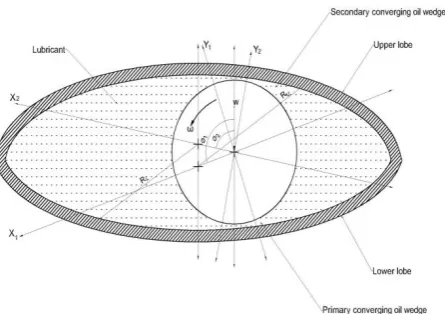
The elliptical journal bearing consisting of two lobes is represented in Fig. 2. The attitude angles for upper lobe and lower lobe are denoted by
1 and
2respectively.Fig. 2. Geometry of an elliptical journal bearing.
Table 1. Geometrical and operating parameters for bearing.
Parameter Value
Journal diameter, D 50 mm
Bearing length, L 50 mm
/
L Dratio 1
Clearance, C 0.05 mm
Type of lubricant Mobil grade (DTE 24, DTE 25,DTE 26)
Journal speed, N 500 -1000 r.p.m.
Load, W 1000 N
Clearance ratio, C R/ 0.002
Preload ratio for an elliptical
bearing, m 0.5
Major diameter of an elliptical
bearing 50.3 mm
Minor diameter of an elliptical
bearing 50.2 mm
Elliptical ratio, Em 0.5
The oil film thickness is computed as [5],
[1 1cos( 1)]
hCm Em for 0 180 (4)
[1 2cos( 2)]
hCm Em for 180 360 (5) where, Eccentricity at upper lobe,
1
2 2 2
[ 2 . . cos( )]
1 Em Em
(6)
Eccentricity at lower lobe,
1
2 2 2
[ 2 . . cos( )]
2 Em Em
(7)
1 tan
1 . cos
Em
(8)1 tan
2 . cos
Em
Elliptical ratio,
Ch Cm Em
Cm
(10)
The performance analysis for the elliptical bearing is evaluated based on its geometry.
Eccentricity ratio, attitude angle, Sommerfeld number are calculated for upper and lower lobe to evaluate the performance parameters mentioned in the Eqs. (6-9). However, for an elliptical bearing, the values are selected for the lower lobe region due to a loaded segment of bearing [2]. The geometrical and operating parameters for bearings are enlisted in Table 1.
2.2 Dynamic Characteristics
The stiffness and damping coefficients are represented in a fluid film as shown in Fig. 3. A steady state position of the journal is established by the load W. The journal moves away from its equilibrium position due to the dynamic force like rotor unbalance force resulting in whirl phenomenon. The film dynamic forces are expressed as:
Fig. 3. Dynamic properties of fluid film. .
.
XX XY XX XY
X
YX YY YX YY
Y
k k c c
F x x
k k c c
F y y
(11)
The dimensionless bearing stiffness and damping coefficients are given by,
. ij ij k c k W , . ij ij c c c W
and i j, x y, as a function of steady eccentricity ratio.
The linearized dimensionless stiffness and damping coefficients are given as [23],
2 2 2 2 4
2 2 16 . 1 XY k Q
(12)
2 2 2 2 4
2
(32 ) 2 16
. 1
YX
k Q
(13)
2 2 2 2 4
2
4 (32 ) 2 16
-. (1 ) YY k Q
(14)
2 2 4
4 2 16 - .
XX
k
Q
(15)
2 2 2 2
2 (1 ) 2( 8)
.
XX
c Q
(16)
2 2 2 2 4
2
2 2(24 )
.
(1 )
YY
c Q
(17)
2 2 2
8 2( 8) .
XY YX
c c
Q
(18) where,
1/ 22 2 2
1 1 16 Q (19)
2.3 Lubricant Selection
The Mobil DTE 20 series oils (DTE 24, DTE 25, and DTE 26) offers superior oxidation resistance. This property tends to extend the intervals for the replacement of oil and filter. In current days, the equipment manufacturers prefer these oils as they provide exceptional characteristics within a single product.
lubricant and an impact of TiO2 nanoparticles on the frictional and wear behaviour is represented in the author’s previous work [9,23].
Table 2. Physico-Chemical Properties of lubricants considered in the study [23].
Lubricant properties DTE 24 DTE 25 DTE 26
Viscosity, cSt @ 40°C
(without nanoparticle) 32.42 46.33 67.43
Viscosity, cSt @ 40°C (with
nanoparticle) 33.77 47.13 68.74
Pour Point, °C,
ASTM D97 -27 -27 -21
Flash Point, COC,
ASTM D92 220 232 236
Relative density/Specific
gravity 0.869 0.877 0.885
Density, kg/m3 869 877 885
Specific heat at constant
pressure, J/kgC 1951.0 1942.6 1934.3
Total acid number,
mgKOH/gr. ASTM D 664 0.5767 0.5367 0.5271
The viscosity of nanolubricant is computed using a modified Krieger-Dougherty viscosity model [9,23].
3. EXPERIMENTAL TEST RIG
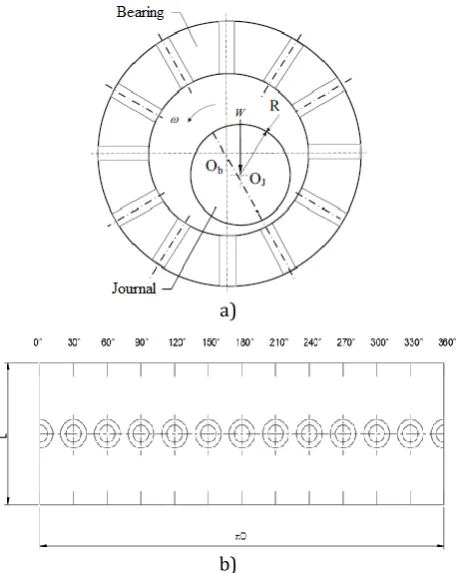
The detailed view of a journal bearing test rig is shown in Fig. 4a. The designed test rig mainly consists of a base frame, journal bearing assembly, loading system, belt drive, lubrication system, control, and measurement system. A base frame is prepared to mount all the components. This test rig is developed to fit all types of bearings viz. circular as well as non-circular geometry. The journal of 50 mm diameter is made up of EN8 grade driven by an electric motor. The journal is case hardened and cylindrical grinding is carried out on it. Phosphorous bronze material is selected for bearing and made to float on the journal. Twelve equidistant tapings of size ¼” BSP (6.35 mm) are provided on the peripheral surface of bearing as shown in Fig. 4b to locate the pressure and temperature measurement system. Each tap is located at 30° along the circumferential direction as shown in Fig. 5a. The circumferential location of sensor positions in the mid-plane of the bearing is represented in Fig. 5b. The sensors are mounted in each tap of a bearing to record the fluid film pressure and temperature. Inlet pressure and temperature of the oil is recorded at the start-up of each experimental trial. The journal is held
between two pedestal bearings for stable operation and connected to the shaft of A.C. motor through the belt drive mechanism. The speed of a journal is controlled by a variable frequency drive (Make- Delta) in an anticlockwise direction that is connected to an electric motor. The speed of a journal can be reached up to 1000 r.p.m. that is viewed on speed indicator and is sensed by a proximity sensor. For experimental analysis, the speed of a journal is varied between 500 r.p.m. to 1000 r.p.m as mentioned in Table 1.
a)
b)
The pressurized lubrication is provided through a hydraulic power pack. The capacity of the motor (0.5 h.p.) in the lubrication system is selected based on the oil flow through the system. The selected grade of lubricant is passed through the power pack with 0.4 MPa internal pressure and 25 °C inlet temperature to a maximum 10 % deviation due to atmospheric conditions for all the experiments. The lubricant is collected inside the side leakage tank through side flow and recirculated during the experiments. The loading arrangement on the journal bearing is given through the dial type spring balance and belt (1000 kg capacity).
a)
b)
Fig. 5. Schematic view of journal bearing: a) Angular location of pressure and temperature sensors; b) Circumferential view of bearing surface.
The load can be varied from 0 to 2 kN that is given through the lever mechanism. The oil flow is provided in the system that is controlled by a flow control valve. The pressure generated in the fluid film along the circumference of the bearing is measured with the help of glycerine filled pressure gauges (Make-Fiebig, 0-3000 psi). In a similar way, the temperature along the circumferential points is measured using K type thermocouples (Make-Honeywell, 0-600 °C) that are indicated on multipoint temperature indicator at various positions. Anti-vibration pads are provided at the base of a frame to reduce the vibration transmitted
to the foundation. The measurement parameters are noted after half an hour operation of the system as it attains a steady state condition [2]. The pressure gauges on journal bearing test rig are calibrated as per IS 3624 against the master gauge and accuracy found within the limit ±1% with maximum error 0.38 %. The uncertainty of measurement is recorded as ±0.74 % (95 % confidence level) of reading. Thermocouples are also calibrated as per IS 2054-1962 against master K type thermocouple with setpoint temperatures 50 °C, 100 °C, 150 °C with expanded uncertainty ±0.80 °C (95.45 % confidence level) and obtained readings are found within the standard error ±4.50 °C.
4. RESULTS AND DISCUSSION
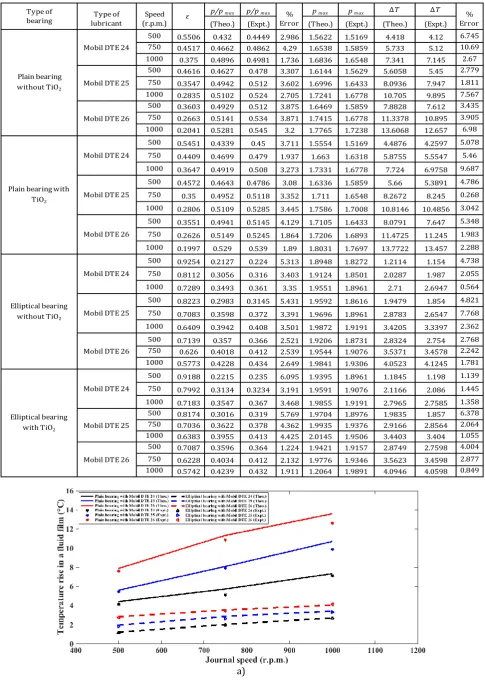
Three sets of readings are taken for each operating condition to get the desired accuracy and the mean reading is considered for analysis. The inlet pressure and inlet temperature readings are noted at the initial phase of each run after applying the load through a lever mechanism. After enriching a steady state, the film pressure and temperature readings along the periphery of a journal bearing are noted down. The pressure ratio and temperature rise in a fluid film are computed after the experimental trials and following plots (Figs. 6-7) have been obtained.
The values of
max
p p
ratio are taken from Raimondi-Boyd chart for the comparative analysis.
DTE 24 to Mobil DTE 26 the pressure ratio increases. The readings of pressure in a fluid film for the bearing configurations have been noted down at the steady condition. For an elliptical bearing, the pressure ratio is almost constant as 0.46 at the unloaded upper lobe as eccentricity ratio remains the same. However, the pressure ratio gets changed at the loaded lower lobe significantly due to variation in eccentricity ratio. As seen from the Fig. 6a and Table 3, when an elliptical bearing is operating with Mobil DTE 24 lubricating oil without TiO2 nanoparticle additives, the pressure distribution rises in the range of -2.73 % to 78.78 % as compared to the pressure distribution in the plain bearing running in the speed range of 500 to 1000 r.p.m. Similarly, the pressure distribution in an elliptical bearing rises over the pressure distribution in a plain bearing in the range of 19.45 % to 182.69 % for Mobil DTE 25 oil without TiO2 nanoparticle additives and in the range of 91.89 % to 351.01 % for Mobil DTE 26 oil without TiO2 nanoparticle additives for
same operating conditions. A similar procedure has been adapted for the comparative analysis of pressure ratio in both plain and elliptical journal bearings operating with the selected grades of the lubricating oils that contains TiO2 nanoparticle additives. Fig. 6b depicts the comparison of pressure distribution in the journal bearing for a wide range of operating conditions. When an elliptical bearing is operating with Mobil DTE 24 oil with TiO2 nanoparticle additives, the pressure distribution rises in the range of -2.48 % to 87.79 % over the pressure distribution in the plain bearing running in the speed range of 500 to 1000 r.p.m. Similarly, the pressure distribution in an elliptical bearing rises over the pressure distribution in a plain bearing in the range of 21.9 % to 187.12 % for Mobil DTE 25 oil without TiO2 nanoparticle additives and in the range of 96.68 % to 364.34 % for Mobil DTE 26 oil with TiO2 nanoparticle additives for same operating conditions. This indicates the increase in pressure distribution in the oil film when it contains TiO2 nanoparticle additives in the lubricating oils.
a)
b)
Table 3. Comparison between experimental and analytical data for performance analysis at different operating speeds.
p/pmax p/pmax pmax pmax ∆T ∆T (Theo.) (Expt.) (Theo.) (Expt.) (Theo.) (Expt.) 500 0.5506 0.432 0.4449 2.986 1.5622 1.5169 4.418 4.12 6.745 750 0.4517 0.4662 0.4862 4.29 1.6538 1.5859 5.733 5.12 10.69 1000 0.375 0.4896 0.4981 1.736 1.6836 1.6548 7.341 7.145 2.67
500 0.4616 0.4627 0.478 3.307 1.6144 1.5629 5.6058 5.45 2.779 750 0.3547 0.4942 0.512 3.602 1.6996 1.6433 8.0936 7.947 1.811 1000 0.2835 0.5102 0.524 2.705 1.7241 1.6778 10.705 9.895 7.567 500 0.3603 0.4929 0.512 3.875 1.6469 1.5859 7.8828 7.612 3.435 750 0.2663 0.5141 0.534 3.871 1.7415 1.6778 11.3378 10.895 3.905 1000 0.2041 0.5281 0.545 3.2 1.7765 1.7238 13.6068 12.657 6.98
500 0.5451 0.4339 0.45 3.711 1.5554 1.5169 4.4876 4.2597 5.078 750 0.4409 0.4699 0.479 1.937 1.663 1.6318 5.8755 5.5547 5.46 1000 0.3647 0.4919 0.508 3.273 1.7331 1.6778 7.724 6.9758 9.687
500 0.4572 0.4643 0.4786 3.08 1.6336 1.5859 5.66 5.3891 4.786 750 0.35 0.4952 0.5118 3.352 1.711 1.6548 8.2672 8.245 0.268 1000 0.2806 0.5109 0.5285 3.445 1.7586 1.7008 10.8146 10.4856 3.042 500 0.3551 0.4941 0.5145 4.129 1.7105 1.6433 8.0791 7.647 5.348 750 0.2626 0.5149 0.5245 1.864 1.7206 1.6893 11.4725 11.245 1.983 1000 0.1997 0.529 0.539 1.89 1.8031 1.7697 13.7722 13.457 2.288 500 0.9254 0.2127 0.224 5.313 1.8948 1.8272 1.2114 1.154 4.738 750 0.8112 0.3056 0.316 3.403 1.9124 1.8501 2.0287 1.987 2.055 1000 0.7289 0.3493 0.361 3.35 1.9551 1.8961 2.71 2.6947 0.564 500 0.8223 0.2983 0.3145 5.431 1.9592 1.8616 1.9479 1.854 4.821 750 0.7083 0.3598 0.372 3.391 1.9696 1.8961 2.8783 2.6547 7.768 1000 0.6409 0.3942 0.408 3.501 1.9872 1.9191 3.4205 3.3397 2.362 500 0.7139 0.357 0.366 2.521 1.9206 1.8731 2.8324 2.754 2.768 750 0.626 0.4018 0.412 2.539 1.9544 1.9076 3.5371 3.4578 2.242 1000 0.5773 0.4228 0.434 2.649 1.9841 1.9306 4.0523 4.1245 1.781 500 0.9188 0.2215 0.235 6.095 1.9395 1.8961 1.1845 1.198 1.139 750 0.7992 0.3134 0.3234 3.191 1.9591 1.9076 2.1166 2.086 1.445 1000 0.7183 0.3547 0.367 3.468 1.9855 1.9191 2.7965 2.7585 1.358 500 0.8174 0.3016 0.319 5.769 1.9704 1.8976 1.9835 1.857 6.378 750 0.7036 0.3622 0.378 4.362 1.9935 1.9376 2.9166 2.8564 2.064 1000 0.6383 0.3955 0.413 4.425 2.0145 1.9506 3.4403 3.404 1.055 500 0.7087 0.3596 0.364 1.224 1.9421 1.9157 2.8749 2.7598 4.004 750 0.6228 0.4034 0.412 2.132 1.9776 1.9346 3.5623 3.4598 2.877 1000 0.5742 0.4239 0.432 1.911 1.2064 1.9891 4.0946 4.0598 0.849 Elliptical bearing
without TiO2
Mobil DTE 24
Mobil DTE 25
Mobil DTE 26
Elliptical bearing with TiO2
Mobil DTE 24
Mobil DTE 25
Mobil DTE 26 Plain bearing
without TiO2
Mobil DTE 24
Mobil DTE 25
Mobil DTE 26
Plain bearing with TiO2
Mobil DTE 24
Mobil DTE 25
Mobil DTE 26
% Error Type of
bearing lubricantType of (r.p.m.)Speed ε Error%
b)
Fig. 7. Comparison of temperature rise in a fluid film for different lubricants at various speeds: a) without NP; b) with NP.
A good agreement between the theoretical pressure ratio and experimental pressure ratio is observed for all three grades of lubricant that represents the validation of the author’s theoretical work. The maximum 5.43 % of error is found between the theoretical and experimental pressure ratio during the analysis as shown in Table 3. However, the minor difference is observed in the experimental pressure readings due to the losses in the piping. Similarly, the temperature readings have been observed during an each trial for both the bearing configurations. Fig. 7a represents the comparative analysis of an experimental and theoretical temperature rise in the fluid film for plain as well as elliptical bearings operating with various conditions. Three grades of lubricating oils have been considered here without TiO2 nanoparticle additives. It has been observed that when an elliptical bearing is operating with Mobil DTE 24 oil without TiO2 nanoparticle additives, the temperature rise in the oil film decreases in the range of 63.08 % to 72.58 % as compared to the temperature rise in the plain bearing running in the speed range of 500 to 1000 r.p.m. Similarly, when the bearings were operated with Mobil DTE 25 oil without TiO2 nanoparticle additives, the temperature rise is reduced in the range of 64.43 % to 68.04 % in the elliptical bearing while in the case of Mobil DTE 26 oil without TiO2 nanoparticle additives, the temperature rise is reduced in the range of 64.06 % to 70.21 % in the elliptical bearing as compared to the plain bearing.
The similar procedure is adopted for the comparative analysis of an experimental and
well as the effect of atmospheric conditions. It is very remarkable to mention that the temperature rise is very low for an elliptical bearing configuration than that of a plain bearing through the experimental methodology also. It is very desirable as far as the performance of the system is concerned. The maximum 10.7 % of error has been found between the theoretical and experimental temperature rise in a fluid film
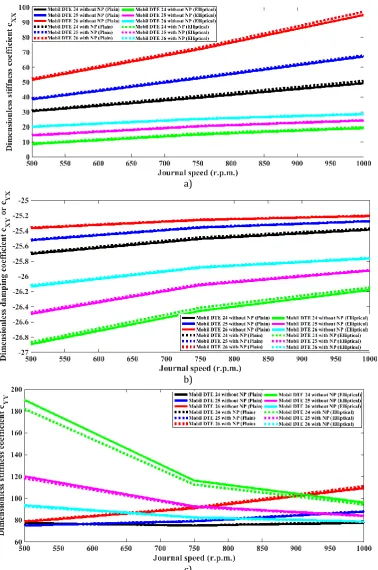
during the analysis. The Figs. 8-9 represent the variation in the dynamic properties (stiffness and damping) of the fluid film journal bearing. The stiffness and damping characteristics have been evaluated after the addition of TiO2 nanoparticles in the lubricant. The dynamic characteristics such as stiffness and damping properties are measured for both the bearings (plain and elliptical) as per Eqs. (12-19) at various operating conditions.
a)
b)
d)
Fig. 8. Variation in dimensionless stiffness coefficients with and without NP (TiO2) in the lubricant: a) k XX ; b) k XY;c) kYX and d) kYY.
Table 4. Dynamic properties for journal bearing at different operating speeds.
Type of bearing
Type of lubricant
Speed
(r.p.m.) ε Q(ε) k̅XY k̅YX k̅YY k̅XX c̅XX c̅YY c̅XY/ c̅YX
500 0.5506 0.292 6.630 -47.282 39.708 23.714 30.607 77.217 -25.704
750 0.4517 0.300 13.061 -44.236 28.516 23.983 39.569 75.025 -25.507
1000 0.375 0.305 19.235 -44.138 22.733 24.250 49.289 77.457 -25.386
500 0.4616 0.299 12.359 -44.402 29.418 23.951 38.526 74.997 -25.525
750 0.3547 0.307 21.168 -44.522 21.505 24.324 52.499 78.881 -25.358
1000 0.2835 0.311 29.592 -47.794 17.990 24.577 67.148 87.624 -25.275
500 0.3603 0.306 20.618 -44.396 21.833 24.303 51.580 78.449 -25.366
750 0.2663 0.312 32.176 -49.187 17.302 24.635 71.803 90.922 -25.258
1000 0.2041 0.314 44.654 -57.493 15.262 24.827 94.951 109.343 -25.205
500 0.5451 0.292 6.963 -47.032 38.935 23.725 31.034 76.956 -25.691
750 0.4409 0.301 13.846 -44.092 27.577 24.019 40.753 75.124 -25.489
1000 0.3647 0.306 20.196 -44.308 22.096 24.288 50.876 78.131 -25.372
500 0.4572 0.299 12.669 -44.324 29.012 23.966 38.985 75.002 -25.517
750 0.35 0.307 21.639 -44.641 21.237 24.341 53.292 79.267 -25.352
1000 0.2806 0.311 30.009 -48.008 17.870 24.587 67.894 88.140 -25.272
500 0.3551 0.307 21.128 -44.513 21.529 24.322 52.433 78.849 -25.359
750 0.2626 0.312 32.770 -49.527 17.162 24.648 72.881 91.712 -25.254
1000 0.1997 0.314 45.802 -58.353 15.142 24.839 97.121 111.187 -25.202
500 0.92538 0.257 -26.556 -126.030 391.742 24.931 8.652 190.294 -26.894 750 0.81121 0.268 -10.257 -75.898 134.062 24.023 14.977 116.306 -26.454
1000 0.72887 0.276 -4.078 -61.813 83.786 23.703 19.314 96.156 -26.179
500 0.82228 0.267 -11.262 -78.522 144.461 24.086 14.401 120.119 -26.494
750 0.70825 0.278 -2.750 -59.302 75.752 23.660 20.445 92.660 -26.116
1000 0.64089 0.284 1.320 -52.862 56.194 23.609 24.387 83.977 -25.924
500 0.71389 0.277 -3.107 -59.958 77.827 23.671 20.133 93.569 -26.133
750 0.62596 0.285 2.193 -51.729 52.867 23.614 25.328 82.517 -25.885
1000 0.57733 0.290 5.038 -48.634 43.784 23.665 28.619 78.725 -25.765
500 0.91884 0.258 -24.940 -120.530 357.305 24.862 9.063 182.108 -26.867
750 0.79924 0.269 -9.232 -73.310 124.127 23.961 15.599 112.556 -26.412
1000 0.71834 0.277 -3.393 -60.493 79.529 23.680 19.888 94.312 -26.147
500 0.81735 0.268 -10.807 -77.324 139.670 24.057 14.658 118.376 -26.476
750 0.70356 0.278 -2.455 -58.771 74.086 23.653 20.706 91.927 -26.102
1000 0.63834 0.284 1.470 -52.661 55.603 23.609 24.547 83.717 -25.918
500 0.70866 0.278 -2.775 -59.348 75.897 23.661 20.423 92.724 -26.117
750 0.62283 0.286 2.376 -51.503 52.204 23.616 25.529 82.229 -25.877
1000 0.57425 0.290 5.220 -48.466 43.284 23.670 28.841 78.531 -25.758
Elliptical bearing without
TiO2
Mobil DTE 24
Mobil DTE 25
Mobil DTE 26
Elliptical bearing with TiO2
Mobil DTE 24
Mobil DTE 25
Mobil DTE 26 Plain
bearing without TiO2
Mobil DTE 24
Mobil DTE 25
Mobil DTE 26
Plain bearing with TiO2
Mobil DTE 24
Mobil DTE 25
a)
b)
c)
Fig. 9. Variation in dimensionless damping coefficients with and without NP (TiO2) in the lubricant: a) cXX; b) cXY or cYX; and c) cYY.
These dynamic characteristics are depending on the eccentricity ratio. Hence, by considering the relevant eccentricity ratio, the dynamic properties have been evaluated as shown in Table 4. However, for an elliptical journal bearing, the eccentricity ratio in the loaded lobe has been
considered in the analysis as the eccentricity ratio in the unloaded lobe remains the same (
1=0.5). It has observed that after the addition of TiO2 nanoparticles in the lubricating oil, the dimensionless damping coefficients (_cXX ,
_
_
c YX ,
_
c
YY) and dimensionless stiffness
coefficients (_k XY,
_
k
YX ) increases whereas
dimensionless stiffness coefficients (_k XX ,
_
k YY) decreases for a plain as well as an elliptical bearing. It is also found that in an elliptical bearing the dimensionless stiffness coefficients (_k
XX ,
_
k
YY) and dimensionless damping
coefficient (_c
YY) increases significantly while other remaining dimensionless coefficients decreases due to an increase in the eccentricity ratio between X-Y and Y-X regions. It is also noted that in X-Y and Y-X region the plain bearing shows superior dynamic performance with an increase in speed. TiO2 nanoparticle additives influence the dynamic properties of the bearing that helps to improve the performance of the journal bearing system. Table 4 and Fig. 8a represents the comparison of dimensionless stiffness coefficient k XX in plain as well as elliptical journal bearings operating with a wide range of operating conditions. Due to the addition of TiO2 nanoparticles in the lubricants, the dimensionless stiffness coefficient k XX increases in the range of 0.02 % to 0.27 %. Similarly, Figs. 8b, 8c and 8d provides the comparison of dimensionless stiffness coefficientsk XY,kYXandkYY respectively in plain as well as elliptical journal bearings. The dimensionless stiffness coefficients k XY increased in the range of 1.84 % to 16.80 %, kYX increased in the range of 0.17 % to 4.36% and
kYYdecreased upto 8.79 %.
The Fig. 9 depicts the dimensionless damping coefficients in all the directions of journal bearings operating with various operating conditions. The Figs. 9a, 9b and 9c indicates the comparison of dimensionless damping coefficientscXX, cXY or
cYXand cYYrespectively. As seen in Table 4 and Fig. 9, the dimensionless damping coefficients cXX increases in the range of 0.77 % to 4.74 %, cXY or
cYX increases in the range of 0.02% to 0.16% and cYYdecreases upto 4.30 %. The dimensionless stiffness coefficients kYYandcYYhave been reduced in both journal bearings as the pressure of the lubricating oil is constant in the direction of oil film
thickness. Hence, the pressure gradient becomes zero in Y-Y direction and dynamic characteristics are considered as negligible in this region.
5. CONCLUSION
The plain and elliptical journal bearings operating with TiO2 nanoparticle based lubricants have been considered in this research study. An experimental approach has presented to evaluate the performance characteristics at different operating conditions. TiO2 nanoparticles (0.5 %wt.) have been added in the lubricants to analyze the performance of the bearings. The static and dynamic performance characteristics of a plain as well as an elliptical journal bearing have been evaluated and presented in this paper. The selected lubricants are implemented in the developed journal bearing test rig and rigorous experimentation is carried out on the test rig to validate the analytical results. The obtained experimental findings are in a very good agreement with the analytical results. The following conclusions have been drawn from the present study:
The bearing geometry plays a crucial role to analyze the performance of fluid film lubricated journal bearing. The static performance characteristics have been improved using an elliptical journal bearing over a plain journal bearing. The pressure distribution increases upto 78.78%, 182.69 % and 351.01 % in an elliptical bearing as compared to a plain bearing when operating with Mobil DTE 24, Mobil DTE 25 and Mobil DTE 26 respectively. Also in an elliptical bearing, the temperature rise decreases upto 72.58 %, 68.04 % and 70.21 % when it was operating with Mobil DTE 24, Mobil DTE 25 and Mobil DTE 26 lubricating oil respectively.
operating with Mobil DTE 24, Mobil DTE 25 and Mobil DTE 26 containing TiO2 nanoparticle reduces upto 73.60 %, 68.18 % and 70.26 % respectively.
Experimental findings for pressure ratio and temperature rise in a fluid film are compared with the analytical results and found very near to each other. An elliptical bearing operating with TiO2 nanoparticle based nanolubricant shows superior performance over other combinations.
TiO2 nanoparticle additives influence the dynamic properties such as stiffness and damping of the bearing that helps to improve the performance of the journal bearing system. The stiffness and damping properties of the oil film are improved with the addition of TiO2 nanoparticles in the lubricant. The dimensionless stiffness coefficients _k
XY,
_
k
YX and
_
k
XX are increased upto 16.80%, 4.36% and 0.27% respectively while_k
YYhas been decreased upto 8.79%.
The dimensionless damping coefficients _c XY
/_c
YX and
_
c
XX are increased upto 0.12% and
4.74% respectively whereas _cYY decreases by 4.30 %.
REFERENCES
[1] F.P. Brito, A.S. Miranda, J.C.P. Claro, M. Fillon, Experimental comparison of the performance of a journal bearing with a single and a twin axial groove configuration, Tribology International,
vol. 54, pp. 1–8, 2012, doi:
10.1016/j.triboint.2012.04.026
[2] D.Y. Dhande, D.W. Pande, Multiphase flow analysis of hydrodynamic journal bearing using CFD coupled Fluid Structure Interaction considering cavitation, Journal of King Saud University-Engineering Sciences, vol. 30, iss. 4,
pp. 345-354, 2018, doi:
10.1016/j.jksues.2016.09.001
[3] A.F. Cristea, J. Bouyer, M. Fillon, M.D. Pascovici, Transient Pressure and Temperature Field Measurements in a Lightly Loaded Circumferential Groove Journal Bearing from Startup to Steady-State Thermal Stabilization, Tribology Transactions, vol. 60, iss. 6, pp.
988-1010, 2017, doi:
10.1080/10402004.2016.1241330
[4] P.C. Mishra, R.K. Pandey, K. Athre, Temperature profile of an elliptic bore journal bearing, Tribology International, vol. 40, iss. 3, pp. 453– 458, 2007, doi: 10.1016/j.triboint.2006.04.009
[5] R. Sehgal, Experimental Measurement of Oil Film Temperatures of Elliptical Journal Bearing Profile Using Different Grade Oils, Tribology Online, vol. 5, iss. 6, pp. 291–299, 2010, doi: 10.2474/trol.5.291
[6] K.G. Binu, K. Yathish, R. Mallya, B.S. Shenoy, D.S. Rao, R. Pai, Experimental study of hydrodynamic pressure distribution in oil lubricated two-axial groove journal bearing, Materials Today: Proceedings, vol. 2, iss. 4-5, pp. 3453–3462, 2015, doi: 10.1016/j.matpr.2015.07.321
[7] M. Kasai, M. Fillon, J. Bouyer, S. Jarny, Influence of lubricants on plain bearing performance: Evaluation of bearing performance with polymer-containing oils, Tribology International, vol. 46, iss. 1, pp. 190-199, 2012, doi: 10.1016/j.triboint.2011.03.009
[8] A.F. Cristea, J. Bouyer, M. Fillon, M.D. Pascovici, Pressure and Temperature Field Measurements of a Lightly Loaded Circumferential Groove Journal Bearing, Tribology Transactions, vol. 54, iss. 5,
pp. 806-823, 2011, doi:
10.1080/10402004.2011.604758
[9] S.R. Suryawanshi, J.T. Pattiwar, Effect of TiO2 Nanoparticles Blended with Lubricating Oil on the Tribological Performance of the Journal Bearing, Tribology in Industry, vol. 40, no. 3, pp. 370-391, 2018, doi: 10.24874/ti.2018.40.03.04
[10] K.G. Binu, B.S. Shenoy, D.S. Rao, R. Pai, A Variable Viscosity Approach for the Evaluation of Load Carrying Capacity of Oil Lubricated Journal Bearing with TiO2 Nanoparticles as Lubricant Additives, Procedia Materials Science, vol. 6,
pp. 1051–1067, 2014, doi:
10.1016/j.mspro.2014.07.176
[11] S. Baskar, G. Sriram, Tribological behavior of journal bearing material under different lubricants, Tribology in Industry, vol. 36, no. 2, pp. 127–133, 2014.
[12] X. Li, M. Murashima, N. Umehara, Effect of nanoparticles as lubricant additives on friction and wear behavior of tetrahedral amorphous carbon (ta-C) coating, Jurnal Tribologi, vol. 16, pp. 15-29, 2018.
[14] W. Gunnuang, C. Aiumpornsin, M. Mongkolwongrojn, Effect of Nanoparticle Additives on Journal Bearing Lubricated with Non-Newtonian Carreau Fluid, Applied Mechanics and Materials, vol. 751, pp. 137-142, 2015, doi: 10.4028/www.scientific.net/AMM.751.137
[15] A.A. Solghar, Investigation of nanoparticle additive impacts on thermohydrodynamic characteristics of journal bearing, Proceedings of the Institution of Mechanical Engineers, Part J: Journal of Engineering Tribology, vol. 229, iss. 10, pp. 1176–1186, 2015, doi: 10.1177%2F1350650115574734
[16] B.S. Shenoy, K.G. Binu, R. Pai, D.S. Rao, R.S. Pai, Effect of nanoparticles additives on the performance of an externally adjustable fluid film bearing, Tribology International, vol. 45, iss. 1,
pp. 38-42, 2012, doi:
10.1016/j.triboint.2011.10.004
[17] R. Nicoletti, The Importance of the Heat Capacity of Lubricants With Nanoparticles in the Static Behavior of Journal Bearings, Journal of Tribology, vol. 136, iss. 4, p. 5, 2014, doi: 10.1115/1.4027861
[18] H. Montazeri, Numerical analysis of hydrodynamic journal bearings lubricated with ferrofluid, Proceedings of the Institution of Mechanical Engineers, Part J: Journal of Engineering Tribology, vol. 222, iss. 1, pp. 51–60, 2007, doi: 10.1243%2F13506501JET314
[19] P.B. Kushare, S.C. Sharma, A study of two lobe non recessed worn journal bearing operating with non-Newtonian lubricant, Proceedings of the Institution of Mechanical Engineers, Part J: Journal of Engineering Tribology, vol. 227, iss. 12, pp. 1418–1437, 2013, doi: 10.1177%2F1350650113496083
[20] S.C. Sharma, P.B. Kushare, Two lobe non-recessed roughened hybrid journal bearing – A comparative study, Tribology International, vol.
83, pp. 51–68, 2015, doi:
10.1016/j.triboint.2014.10.024
[21] X. Wang, Thermohydrodynamic analysis of journal bearings lubricated with couple stress fluids, Tribology International, vol. 34, iss. 5, pp. 335–343, 2001, doi: 10.1016/S0301-679X(01)00022-6
[22] Y. Aiman, S. Syahrullail, Development of palm oil blended with semi synthetic oil as a lubricant using four-ball tester, Jurnal Tribologi, vol. 13, pp. 1-20, 2017.
[23] S.R. Suryawanshi, J.T. Pattiwar, Tribological performance of commercial Mobil grade lubricants operating with Titanium dioxide nanoparticle additives, Industrial Lubrication
and Tribology, vol. 71, iss. 2, pp. 188-198, 2018,
doi: 10.1108/ILT-04-2018-0147
[24] R. Tiwari, Rotor Systems: Analysis and Identification, CRC Press, pp. 107-120, 2007. [25] A. Harnoy, Bearing Design in Machinery, Marcel
Dekker Inc. New York, pp. 144-172, 2002. [26] D.D. Fuller, Theory and Practice of Lubrication
for Engineers, New York: Wiley, pp. 271-282, 1984.
Nomenclature
c Radial clearance, mm C Diametrical clearance, mm
e Eccentricity, mm
g Acceleration due to gravity, m/s2 h Oil variable film thickness, mm
Eccentricity ratiom
h Minimum oil film thickness, mm
o
h Film thickness at the point of peak pressure,
mm
D Diameter of journal, mm R Radius of journal, mm L Length of bearing, mm
N Rotational speed of journal, r.p.m.
n Rotational speed of journal, r.p.s.
Angular velocity, rad/sec.
P Bearing pressure, kPa p Pressure on fluid film, kPa W External load acting on shaft, N
Dynamic viscosity, MPa-s Angular coordinates, degree U Journal surface velocity, m/s
Attitude angle, degree
f Bearing frictional coefficient
T
Temperature rise in a film, °C Q Flow rate, m3/s
s
Q
Side flow rate, m3/s1
Eccentricity ratio at upper lobe for an elliptical bearing2
1
Attitude angle of upper lobe for an elliptical bearing, degree2
Attitude angle of lower lobe for an elliptical bearing, degreeh
C
Horizontal clearance for an ellipticaljournal bearing, mm
m
C
Minimum clearance when the center of shaft coincides with the center of elliptic bearing, mmm
E Elliptic ratio
U
R Radius of upper lobe for an elliptical bearing,
mm
L
R Radius of lower lobe for an elliptical bearing,
mm
m Preload ratio
X
F Dynamic force in X direction, N
Y
F Dynamic force in Y direction, N x
Displacement gradient in X direction, mm y
Displacement gradient in Y direction, mm
. x
Velocity gradient in X direction, mm/s
. y
Velocity gradient in Y direction, mm/s
XX
k Stiffness coefficient in X-X direction, N/m
XY
k Stiffness coefficient in X-Y direction, N/m
YX
k Stiffness coefficient in Y-X direction, N/m
YY
k Stiffness coefficient in Y-Y direction, N/m
XX
c Damping coefficient in X-X direction, Ns/m
XY
c Damping coefficient in X-Y direction, Ns/m
YX
c Damping coefficient in Y-X direction, Ns/m
YY
c Damping coefficient in Y-Y direction, Ns/m
Abbreviations
NP Nanoparticle
COF Coefficient of Friction WSD Wear Scar Diameter AC Alternating Current MCB Miniature Circuit Breaker LM Linear Bushing
ASTM American Society for Testing and Materials IS International Standards
GDQ Generalized Differential Quadrature CFD Computational Fluid Dynamics VFD Variable Frequency Drive FEM Finite Element Method FSI Fluid Structure Interaction ADI Alternating Direction Implicit FFT Fast Fourier Transform PTFE Polytetrafluoroethylene
CMRO Chemically Modified Rapeseed Oil NC Numerically Controlled
COC Cleveland Open Cup BSP British Standard Pipe psi Pound per square inch hp Horse power

![Table 2. Physico-Chemical Properties of lubricants considered in the study [23].](https://thumb-us.123doks.com/thumbv2/123dok_us/9806942.1966619/6.595.307.538.223.642/table-physico-chemical-properties-lubricants-considered-study.webp)