INTRODUCTION
Many decision-making problems involve a process that takes in several stages (multistage process) in such a way that at each stage, the process is dependent on the strategy choosen. Such type of problems are called Dynamic Programming Problems (D.P.P). Thus it is concerned with the theory of multistage decision process, i.e the process in which a sequence of interrelated decisions has to be made. A D.P.P is a decision-making problem in n-variables, the problem being sub-divided into n-subproblems each sub-problem being a decision-making problem in one variable only. The solution to a D.P.P is achieved sequencially starting from one stage to the next till the final stage is reached.
The concept of D.P.P is largely based upon the principle of optimality. “An optimal policy has the property that what ever the initial state and initial decisions are, the remaining decisions must constitute an optimal policy with regard to the state resulting from the first decision”². D.P.P is a
Study of assembly line scheduling,
An application of dynamic programming
SANJUKTA MOHANTY and PRAFULLA K. BEHERA
Department of Computer Science and Applications North Orissa University Sriramchandra Vihar, Takatpur Baripada, Mayurbhanj (India).
Department of Computer Science and Application Utkal University, Vani Vihar Bhubaneswar - 751 004 (India).
(Received: November 07, 2010; Accepted: September December 11, 2010)
ABSTRACT
This papers describes the design and implementation of an optimized base scheduling algorithm for multiple assembly lines (i = 1,2,…..,n) to solve manufactureing problems in a factory. The scheduling goal is to delivery products just in time in case of rush order comes in and when the customer wants the product to be manufactured as quickly as possible. If the demand of the product is high, then to increase the production rate in few time, the multiple assembly line scheduling technique can be applied.
Keywords: Dynamic programming, Assembly line, Scheduling, Optimization.
mathematical technique dealing with the optimization of multistage decision process. In D.P.P the optimum solution is obtained in an orderly manner.
if there are n machines each of which can perform m different kinds of work. Then question arises that if k jobs are to be performed what policy should be adopted for producing products in such a way that the total value of the products produced is maximized and also products should be produced in time.
If the dynamic programming problem is solved by using the recursive equation starting from the first through the last stage, i.e obtaining the sequence f1 → f2 → f3 → …… → fN the computation involved is called the forward computational procedure. If the recursive equation is formulated
in a different way so as to obtain the sequence fN
→ fN-1 → ……→ f1. Then the computation is known
as the backward computational procedure2,3.
Dynamic programming algorithm can be broken into a sequence of four steps. That are
´ Characterize the structure of an optimal
solution.
´ Recursively define the value of an optimal
solution.
´ Compute the value of an optimal solution in
a bottom-up fashion.
´ Construct an optimal solution from computed
information.
Dynamic programming can design and implement an optimized- base scheduling algorithm for multiple assembly lines i (i = 1,2…m). It solves manufacturing problems to find the fastest way through a factory using multiple assembly lines. The increasing market demand for product variety forces the manufacturer to design multilevel assembly lines for which products can be manufactured as quickly as possible. If occasionally a rush order comes in and costomer wants the product to be manufactured as quickly as possible, then this problem can easily
be solved using multilevel assembly line scheduling1.
Basic concept of assembly-line scheduling
In manufacturing systems, the assembly line has become one of the most valuable researches to accomplish the real world problems related to them. A manufacturing system could be defined as a collection of integrated equipment (including production machines and tools, material handling and work-positioning devices and
computer systems) and human resources, whose function is to perform one or more processing and/ or assembly operations on raw material, a part, or set of parts. In this study, the discussion will focus
on assembly line system6.
In a manufactureing company manufacturing problems can be solved using assembly line scheduling. Assembly line scheduling design consists of one or more assembly lines, with more than one workstations in each assembly line. Each assembly line contains equal number of stations. The functions of stations in a assembly line are different. But the working functions of stations in a assembly line is same as the working functions of corresponding stations of other assembly lines. For example the jth station on assembly line 1 performs the same function as jth station on other assembly lines. The stations are built in different times and with different technologies.
Characteristics of assembly lines
An assembly line consists of a sequence of tasks, each having an operational processing time and a set of precedence relations, is widely adopted
in manufacturing plans7. There is a work element
and workstations as a part in assembly lines. Then, it is better to know about a element and workstation first, before knowing all about the assembly lines. A work element is the smallest unit productive work that adds values to the product, such as tightening (thinning/reduction) a screw, welding, inserting a gear assembly. A workstation is also dubbed as a collection of a set of work elements that are performed there. A product is passed down the line and visits each workstation in sequence. An assembly line contains of a set of sequential workstations, typically connected by a continuous material handling system. It is designed to assemble component parts of a product and perform any related operations to produce the finished product. There also other components in there, namely workers (manual and robotics), a material handling system (conveyors), buffers, unloading and storage
space, layout (linear, u-shape and others)4.
Also few definations of assembly lines are
given by few researchers. Baker and Scholl8 said
J 1 2 3 4 5 6
a1,j 7 9 3 4 8 2
a2,j 3 5 6 4 2 3
a3,j 2 3 5 4 7 6
li[j]
l1[j] 2 3 1 1 2
l2[j] 2 3 2 2 2
l3[j] 3 3 3 3 3
f* 28
l* 1
fi[j]
f1[j] 9 17 13 17 25 26
f2[j] 7 12 17 21 23 26
f2[j] 5 8 13 17 24 30
J: 1 2 3 4 5
T1
2,j 1 2 4 5 1
T1
3,j 7 2 4 1 2
T2
1,j 2 1 5 6 3
T2
3,j 4 3 6 5 2
T3
1,j 3 1 4 2 5
T3
2,j 4 2 1 5 3
i: 1 2 3
ei 2 4 3
xi 1 3 4
means of mass and large scale productions. They are also dubbed as flow-oriented production systems which are still typical in the industrial production of high-quantity standardized commodities and even gain importance in
low-volume production of customized products. Lusa9
said that assembly lines could be defined as a production system made up of a ser ies of workstations that are connected by a conveyor belt or a similar system that transports the object that
is being assembled. Yaman10 stated that assembly
lines are an example of flow lines which is the most commonly used system in a mass-production
environment. Assembly lines enable the assembly of complex products by workers who have received
a short training period11. Thus, an efficient assembly
line design, as a part of a manufacturing system, is a vital problem for some companies. An assembly line is a usual solution for medium and high-production volumes.
Design of assembly-line scheduling problem
Manufacturing problems can be solved using assembly line scheduling techniques. For example, Motor corporations produce automobiles in a factory that have multiple assembly lines. Each assembly line has n working stations, numbered j = 1,2,…..,n. When a lot enters an assembly line, it passes through that line only. Occasionally a special rush order comes in, and customer wants the product to be manufactured as quickly as possible. For rush orders the lot still passes through the n stations in order, but the factory manager may switch the partially-completed product from one assembly line to other after any station. The efficiency of jth station on line i is not equal with the jth stations on other assembly lines. The jth stations on assembly lines are made up of different technologies.
The objective of this paper is to develop a recursive algorithm to determine the fastest way through the factory, in case of rush order. We have to determine which station to choose from line 1, which station to choose from line 2,………., which station to choose from line m in order to minimize the total time through the factory for one product. Also if the demand of the product is high, then to increase the production rate in few time the lot changes an assembly line.
Notations used in the proposed recursive algorithm
(We have mentioned only S1,j, Sm,j and T1 m,j, T
2
1,j, where j = 1 to n, but not all the stations Si,j and Ti,j, because diagram will be
much more complex)
Fig. 1: Assembly line scheduling with ‘m’ assembly lines and ‘n’ stations
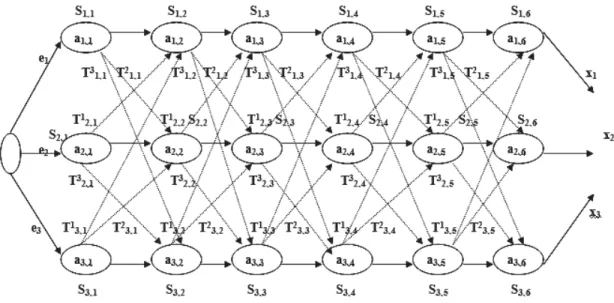
Fig. 2: Assembly line scheduling with 3 assembly lines and 6 work stations
balanced. An automobile chassis (in this paper we have taken the product as an automobile in motor corporation) enters each assembly line has parts added to it at a number of stations and a finished auto exits at the end of the line.
The following notations are used in our algorithm.
´ i - This is the assembly line, i = 1,2,...,m.
´ n - Each assembly line has n stations, where
n>1 and numbered j = 1,2,...,n.
´ Si,j - This is denoted as jth station on line i,
For example:
S1,j - This is jth station on line 1. S2,j - This is jth station on line 2.
´ ai,j - This is the assembly time required at
station Si,j.
´ ei - This is the entry time for the chassis to
enter assembly line i.
´ xi - This is an exit time for completed auto to
exit assembly line i.
´ T1
i,j - This is the time to transfer a chassis
away from assembly line i after having gone
through the station Si,j, where i =
2,3,……….,m and j = 1,2,……….,n-1 to the
respective stations Si,j, where i = 1 and j =
2,3,……….,nof assembly line 1.
That is for i = 2 and j = 1,2,……….,n-1
T1 2,1,T
1
2,2,……….,T
1
2,n-1 - These are the
times required to transfer a chassis away from assembly line 2 after having gone through the stations S2,1,S2,2,……….,S2,n-1 of assembly line 2 to
assembly line 1 of stations S1,2,S1,3,……….,S1,n
respectively.
For i = 3 and j = 1,2,……….,n-1
T1 3,1,T
1
3,2,……….,T
1
3,n-1 - These are the
times required to transfer a chassis away from assembly line 3 after having gone through the stations S3,1,S3,2,……….,S3,n-1 of assembly line 3 to
assembly line 1 of stations S1,2,S1,3,……….,S1,n
respectively.
………...
………...
For i = m and j = 1,2,……….,n-1
T1 m,1,T
1
m,2,……….,T
1
m,n-1 - These are the
times required to transfer a chassis away from assembly line m after having gone through the
stations Sm,1,Sm,2,……….,Sm,n-1 of assembly line m
to assembly line 1 of stations S1,2,S1,3,……….,S1,n
respectively.
T2
i,j- This is the time to transfer a chassis
away from assembly line i after having gone through
the station Si,j, where i = 1,3,4,……….,m and j =
1,2,……….,n-1 to the respective stations Si,j, where
i = 2 and j = 2,3,……….,nof assembly line 2.
That is for i = 1 and j = 1,2,……….,n-1
T2 1,1,T
2
1,2,……….,T
2
1,n-1 - These are the
times required to transfer a chassis away from assembly line 1 after having gone through the stations S1,1,S1,2,……….,S1,n-1 of assembly line 1 to
assembly line 2 of stations S2,2,S2,3,……….,S2,n
respectively.
For i = 3 and j = 1,2,……….,n-1
T2 3,1,T
2
3,2,……….,T
2
3,n-1 - These are the
times required to transfer a chassis away from assembly line 3 after having gone through the stations S3,1,S3,2,……….,S3,n-1 of assembly line 3 to
assembly line 2 of stations S2,2,S2,3,……….,S2,n
respectively.
………...
………...
For i = m and j = 1,2,……….,n-1
T2 m,1,T
2
m,2,……….,T
2
m,n-1 - These are the
times required to transfer a chassis away from assembly line m after having gone through the
stations Sm,1,Sm,2,……….,Sm,n-1 of assembly line m
to assembly line 2 of stations S2,2,S2,3,……….,S2,n
respectively.
T3
i,j- This is the time to transfer a chassis
away from assembly line i after having gone through
the station Si,j, where i = 1,2,4,5,……….,m and j =
1,2,……….,n-1 to the respective stations Si,j, where
i = 3 and j = 2,3,……….,nof assembly line 3.
That is for i = 1 and j = 1,2,……….,n-1
T3 1,1,T
3
1,2,……….,T
3
1,n-1 - These are the
times required to transfer a chassis away from assembly line 1 after having gone through the stations S1,1,S1,2,……….,S1,n-1 of assembly line 1 to
assembly line 3of stations S3,2,S3,3,……….,S3,n
respectively.
For i = 2 and j = 1,2,……….,n-1
T3 2,1,T
3
2,2,……….,T
3
2,n-1 - These are the
times required to transfer a chassis away from assembly line 2 after having gone through the stations S2,1,S2,2,……….,S2,n-1 of assembly line 2 to
assembly line 3 of stations S3,2,S3,3,……….,S3,n
respectively. ……… ………... ……… ………...
For i = m and j = 1,2,……….,n-1
T3 m,1,T
3
m,2,……….,T
3
m,n-1 - These are the
times required to transfer a chassis away from assembly line m after having gone through the
stations Sm,1,Sm,2,……….,Sm,n-1 of assembly line m
to assembly line 3 of stations S3,2,S3,3,……….,S3,n
respectively.
………... ………...
Tm
i,j - This is the time to transfer a chassis
away from assembly line i after having gone through
the station Si,j, where i = 1,2,3,……….,m-1 and j =
1,2,……….,n-1 to the respective stations Si,j, where
i = m and j = 2,3,……….,nof assembly line m.
That is for i = 1 and j = 1,2,……….,n-1
Tm 1,1,T
m
1,2,……….,T
m
1,n-1 - These are the
times required to transfer a chassis away from assembly line 1 after having gone through the stations S1,1,S1,2,……….,S1,n-1 of assembly line 1 to
assembly line m of stations Sm,2,Sm,3,……….,Sm,n
respectively.
For i = 2 and j = 1,2,……….,n-1
Tm 2,1,T
m
2,2,……….,T
m
2,n-1 - These are the
times required to transfer a chassis away from assembly line 2 after having gone through the stations S2,1,S2,2,……….,S2,n-1 of assembly line 2 to
assembly line m of stations Sm,2,Sm,3,……….,Sm,n
respectively.
………... ………... For i = m-1 and j = 1,2,……….,n-1:
Tm m-1,1,T
m
m-1,2,……….,T m
m-1,n-1 - These are the times
required to transfer a chassis away from assembly
line m-1 after having gone through the stations S
m-1,1,Sm-1,2,……….,Sm-1,n-1 of assembly line m-1 to
assembly line m of stations Sm,2,Sm,3,……….,Sm,n
respectively.
´ fi[j] - This is the fastest possible time to get a
chassis from the starting point through
station Si,j. This gives the value of optimal
solution to subproblem.
´ li[j] - This is the line number, 1 or 2 or……….or
m, whose station j-1 is used in a fastest way
through station Si,j where i = 1,2,……….,m
and j = 2,3,……….,n. We have not defined
here li[1] because no station precedes station
on the lines i = 1,2,……….,m.
´ f* - This is the fastest time to get a chassis all
the way through the factory.
´ l* - This is the line whose station n is used in
a fastest way through the entire factory.
MATERIAL AND METHODS
The fastest way of the auto can be
considered through station S1,j or S2,j or ……….or
Sm,j where j=1,2,……….,n.
´ If the fastest way of the auto will be
considered through station S1,j, then it must go
through station j-1 on lines 1,2 or 3,...,or m. So
there are mc
1 choices for the fastest way through
station S1,j. That is,
´ The fastest way through station S1,j-1 and
then directly through station S1,j. The time for going
from station j-1 to station j on the same line being negligible.
Or
The fastest way through station S2,j-1, a
transfer from line 2 to line 1, then through station S1,j. The transfer time being T1
2,j-1.
...
………... Or
In this way the last choice is that, the auto
chassis could have come from station Sm,j-1 and then
been trasfered to station S1,j, the transfer time being T1
m,j-1.
Therefore there are mc
1 choices for the fastest way
through station S1,j. So in this case the chassis must
go through station j-1 on lines 1 or 2 or 3 or………or m.
´ If the fastest way of the auto will be
considered through station S2,j, then it must go
through station j-1 on lines 1,2 or 3,...,or m. So
there are mc
1 choices for the fastest way through
station S2,j.
That is,
The fastest way through station S2,j-1 and
then directly through station S2,j. The time for going
from station j-1 to station j on the same line being negligible.
Or
The fastest way through station S1,j-1, a
transfer from line 1 to line 2, then through station
S2,j. The transfer time being T2
1,j-1. ……………………………………………………………………………………………………………………………………………………
Or
In this way the last choice is that, the auto
chassis could have come from station Sm,j-1 and then
been trasfered to station S2,j, the transfer time being T2
m,j-1.
Therefore there are mc
1 choices for the
fastest way through station S2,j. So in this case the
chassis must go through station j-1 on lines 1 or 2 or 3 or………or m.
……… In this way there are mc
1 choices for the fastest way
through each stations S1,j,S2,j,……….,Sm,j. Therefore
the total number of choices through stations Si,j is
m * mc
1 = m * m = m 2.
A recursive solution
In dynamic programming paradism the value of an optimal solution is defined recursively in terms of the optimal solutions to subproblems. Here the subproblems are considered as to find the fastest way through station j on the lines i = 1,2,……….,m for j = 1,2,……….,n.
Let fi[j] denote the fastest possible time to get a chassis from starting point through station Si,j.
Here also we have to determine the fastest time to get a chassis all the way through the factory
which is denoted by f*. The chassis has to get all
the way through station n on lines 1 or 2 or……….or m and then to the factory exit. Since the faster of these ways is the fastest way through the entire factory, we have
f* = min ( f
1[n] + x1, f2[n] + x2,……….,fm[n] + xm ).
To get the fastest way through station 1 on lines i = 1,2,……….,m a chassis just goes directly to that station. Thus we have
f1[1] = e1 + a1,1 f2[1] = e2 + a2,1
………... ………... fm[1] = em + am,1
Now to compute fi[j] for j = 2,3,……….,n we have
mc
1 choices discussed in the section 5. From
mc 1
choices, using 1st choice we have,
f1[j] = f1[j-1] + a1,j and in the latter cases we have , f1[j] = f2[j-1] + T1
2,j-1 + a1,j
……….…….….………….……….. f1[j] = fm[j-1] + T1
m,j-1 + a1,j
f1[j] = e1 + a1,1, if j = 1.
= min ( f1[j-1] + a1,j, f2[j-1] + T1
2,j-1 + a1,j,……….,
fm[j-1] + T1
m,j-1 + a1,j ), if j >= 2.
f2[j] = e2 + a2,1, if j = 1.
= min ( f2[j-1] + a2,j, f1[j-1] + T2
1,j-1 + a2,j,……….,
fm[j-1] + T2
m,j-1 + a2,j ), if j >= 2.
……….…….….……….….. fm[j] = em + am,1, if j = 1.
= min ( fm[j-1] + am,j, f1[j-1] + Tm
1,j-1 + am,j, f2[j-1] +
Tm
2,j-1 + am,j,………., fm-1[j-1] + T m
m-1,j-1 + am,j ), if j
>= 2.
Now we consider li[j] be the line number 1 or 2
or……….or m whose station j-1 is used in a fastest
way through station Si,j for i = 1,2,……….,m and j =
2,3,……….,n.
Let l* be the line whose station n is used in a fastest
way through the entire factory.
Counting the fastest times
The fi[j] values give the optimal solutions
to subproblems. fi[j] depends on the values of f1
[j-1], f2[j-1],……….,fm[j-1]. The fastest way the factory
can be computed by computing the fi[j] values in
order of increasing station numbers j = 1,2,……….,n.
Proposed algorithm-1
1. For k = 1 to n, fk[1] = ek + ak,1
2. For j = 2 to n,
3. Do if f1[j-1] + a1,j <= f2[j-1] + T1
2,j-1 + a1,j && f3
[j-1] + T1
3,j-1 + a1,j && ……….&& fm[j-1] + T 1
m,j-1 +
a1,j
4. Then f1[j] = f1[j-1] + a1,j
5. l1[j] = 1
6. Else if f2[j-1] + T1
2,j-1 + a1,j <= f1[j-1] + a1,j &&
f3[j-1] + T1
3,j-1 + a1,j &&……….&& fm[j-1] + T 1
m,j-1 + a1,j
7. Then f1[j] = f2[j-1] + T1 2,j-1 + a1,j
8. l1[j] = 2
9. Else if f3[j-1] + T1
3,j-1 + a1,j <= f1[j-1] + a1,j &&
f2[j-1] + T1
2,j-1 + a1,j &&……….&& fm[j-1] + T 1
m,j-1 + a1,j
10. Then f1[j] = f3[j-1] + T1 3,j-1 + a1,j
11. l1[j] = 3 // mc
1 number of conditions have been
checked to compute fi[j] for i = 1 and j>=2
(lines 3 to 12) ……….………
12. Else if fm[j-1] + T1
m,j-1 + a1,j <= f1[j-1] + a1,j &&
f2[j-1] + T1
2,j-1 + a1,j &&……….&& fm-1[j-1] + T 1
m-1,j-1 + a1,j
13. Then f1[j] = fm[j-1] + T1 m,j-1 + a1,j
14. l1[j] = m
15. If f2[j-1] + a2,j <= f1[j-1] + T2
1,j-1 + a2,j && f3[j-1]
+ T2
3,j-1 + a2,j && f4[j-1] + T 2
4,j-1 + a2,j &&
……….&& fm[j-1] + T2
m,j-1 + a2,j // To compute
fi[j] for i = 2 and j >=2 16. Then f2[j] = f2[j-1] + a2,j 17. l2[j] = 2
18. Else if f1[j-1] + T2
1,j-1 + a2,j <= f2[j-1] + a2,j &&
f3[j-1] + T2
3,j-1 + a2,j &&……….&& fm[j-1] + T 2
m,j-1 + a2,j
19. Then f2[j] = f1[j-1] + T2 1,j-1 + a2,j
20. l2[j] = 1
21. Else if f3[j-1] + T2
3,j-1 + a2,j <= f2[j-1] + a2,j &&
f1[j-1] + T2
1,j-1 + a2,j && f4[j-1] + T 2
4,j-1 + a2,j
&&……….&& fm[j-1] + T2 m,j-1 +a2,j
22. Then f2[j] = f3[j-1] + T2 3,j-1 + a2,j
23. l2[j] = 3// mc
1 number of conditions have been
checked for i = 2 (lines 15 to 24)
……….…….….……….….. 24. Else if fm[j-1] + T2
m,j-1 + a2,j <= f1[j-1] + T 2
1,j-1 +
a2,j && f2[j-1] + a2,j && f3[j-1] + T2
3,j-1 + a2,j
&&……….&& fm-1[j-1] + T2 m-1,j-1 + a2,j
25. Then f2[j] = fm[j-1] + T2 m,j-1 + a2,j
26. l2[j] = m // The followimg dots indicate that
mc
1 * (m-3) number of conditions have been
checked for i = 3 to m-1
……….….……….….. 27. If fm[j-1] + am,j <= f1[j-1] + Tm
1,j-1 + am,j && f2[j-1]
+ Tm
2,j-1 + am,j && ……….&& fm-1[j-1] + T m
m-1,j-1
+ am,j //To compute fi[j] for i = m and j >=2 28. Then fm[j] = fm[j-1] + am,j
29. lm[j] = m
30. Else if f1[j-1] + Tm
1,j-1 + am,j <= f2[j-1] + T m
2,j-1 +
am,j && f3[j-1] + Tm
3,j-1 + am,j && ……….&& fm
[j-1] + am,j
31. Then fm[j] = f1[j-1] + Tm
m,j-1 + am,j
32. lm[j] = 1
33. Else if f2[j-1] + Tm
2,j-1 + am,j <= f1[j-1] + T m
1,j-1 +
am,j && f3[j-1] + Tm
3,j-1 + am,j && ……….&& fm
[j-1] + am,j
34. Then fm[j] = f2[j-1] + Tm 2,j-1 + am,j
35. lm[j] = 2// mc
1 number of conditions have been
checked for i = m (lines 27 to 36)
……….……..……..………. 36. Else if fm-1[j-1] + Tm
m-1,j-1 + am,j <= f1[j-1] + T m
1,j-1 + am,j && f2[j-1] + T m
2,j-1 + am,j && ……….&&
fm[j-1] + am,j
37. Then fm[j] = fm-1[j-1] + Tm
m-1,j-1 + am,j
38. lm[j] = m-1//The following steps will calculate
f* and l*
39. If f1[n] + x1 <= f2[n] + x2 && f3[n] + x3 &&……….&& fm[n] + xm
40. Then f* = f
1[n] + x1
41. l* = 1
42. Else if f2[n] + x2 <= f1[n] + x1 && f3[n] + x3 &&……….&& fm[n] + xm
43. Then f* = f
2[n] + x2
44. l* = 2 //dots indicate that, conditions have
been checked for f* and l*
……….…….….……….….. 45. Else if fm[n] + xm <= f1[n] + x1 && f3[n] + x3
&&……….&& fm-1[n] + xm-1
46. Then f* = f
m[n] + xm
47. l* = m
Constructing the fastest way through the factory, Algorithm - 2
The following algor ithm pr ints the sequence of stations used in the fastest way through the factory.
1. i = l*
2. For j = 2 to n
3. Do i = li[j]
4. print “line” i, “station” j-1
5. Print “line” l* “station” n
Example with results
We have taken a problem with 3 assembly lines and 6 stations each. Also we have traced the path of the chassis which is shown in the Fig. 3.
Applying the algorithm to the above data
we have the following tabulated values of fi[j] where
i = 1 to 3 and j = 1 to 6, li[j] where i = 1 to 3 and j = 2 to 6, f* and l*
From Algorithm – 2 we have traced the following optimum path for the above data:
Line 2 station 1 Line 3 station 2 Line 1 station 3 Line 1 station 4 Line 2 station 5 Line 1 station 6
DISCUSSION
Our proposed algorithm examines a problem in scheduling m automobile assembly lines, where after each station, the auto under construction can stay on the same line or move to other. This algorithm determines which station to choose from line 1 and which to choose from line 2 and so on in order to minimize the total time through the factory for one auto.
AKNOWLEDGEMENTS
This study is based on the success of achieving the goal of production. As par t of manufacturing systems, the assembly line has become one of the most valuable researches to accomplish the real world problems related to them.
REFERENCES
1. Thomas H. Cormen, Charles E. Leiserson,
Ronald L. Rivest, Clifford Stein: Introduction to Algor ithms, second edition, PHI Publications, 324-330 (2003).
2. Kanti Swarup, P.K. Gupta, Man Mohan:
Operations Research, Sultan Chand & Sons Publications, Twelfth revised Edition, 247-249 (2006).
3. S.D. Shar ma: Operations Research,
Thirteenth Edition, Kedar Nath Ram Nath &
Co Publishers, Meerut, 1107-1115 (2001).
4. Muhammad Zaini, Matondang and
Muhammd Ikhwan Jambak, “ Soft Computing in Optimizing Assembly Lines Balancing “ ,
Journal of Computer Science 6(2): 141-162
(2010).
5. Luigi Martino and Rafael Pastor, “Heuristic
Catalunya, 1-20 (2007).
6. Groover, M.P., Automation, Production
System and Computer-Integrated
Manufactur ing. 3rd Edn. Prentice Hall
International, Inc., Upper Saddle River, New Jersey, 375 (2008).
7. Tasan, S.O. and A. Tunali, “A review on the
Current of genetic algorithm in assembly line
balancing”, Int. J. Manuf., 19: 49-60 (2008).
8. Baker, C. and A. Scholl, “A Survey on
problems and methods in generalized assembly lline balancing”, Eur. J. Operat
Res., 168: 694-715 (2006).
9. Lusa, A., “A Survey of the literature on the
multiple or parallel assembly line balancing
problem”, Eur.J. Ind. Eng., 2: 50-72 (2008).
10. Yaman, R., “An assembly line design and
construction for a small manufacturing
company”, Assembly Automat 28: 163-172
(2008).
11. Gunasekaran, A. and P. Cecile,
“Implementation of productivity improvement strategies in a small company”, Technovation,