CrossMark Published by DiscoverSys
ABSTRACT
Background: Self-efficacy is one of the determinants of effective communication between the nurse and the patient, and promotion of communication skills can increase it.
Aim: This systematic and meta-analysis study aims to investigate the effectiveness of communication skills training on the self-efficacy of nurses.
Methods: PubMed, Science Direct, CINAHL and Web of science were searched up to 2017, for relevant studies. Studies that assessed the effect of communication skills training on the self-efficacy of nursing personnel were included in the study. Finally, 10 studies were selected. In this study, novice and nursing students were not considered. The standard deviation (SD) mean of changes in communication self-efficacy was used to assess Hedges’ g to be used as a size effect for meta-analysis. DerSimonian and Liard random effects model was included in the study in order to summarize the effects.
Results: Meta-analysis findings showed that communication skills training could improve nurses’ self-efficacy (Hedge’s g = 0.51, 95% CI: 0.311-0.699, p<0.001). Education was also affected by increasing the self-efficacy based on the random-effects model. Its effect retained significant in single group trials. The effectiveness of communication skills training was higher in studies with the intervention group compared with control groups. The quality of studies was investigated based on Cochran. Most studies were qualitatively low.
Conclusion: Educational programs for nurses’ communication improve their feelings towards self-efficacy communication. Due to the importance of self-efficacy in communication skills development, training related communication skills should be considered as a permanent program in hospitals.
Keywords: Communication programs, self-efficacy, nurse
Cite this Article: Ardakani, M.F., Sharifabad, M.A.M., Bahrami, M.A., Abargouei, A.S. 2018. The effect of communication skills training on the self-efficacy of nurses: a systematic review and meta-analysis study. Bali Medical Journal 8(1): 144-152. DOI:10.15562/bmj.v8i1.1315
The effect of communication skills training on the
self-efficacy of nurses: a systematic review and
meta-analysis study
Mojtaba Fattahi Ardakani,1* Mohammad Ali Morowati Sharifabad,2
Mohammad Amin Bahrami,3 Amin Salehi Abargouei4
INTRODUCTION
The communication between nurses and patients is one of the basic principles in nursing care and is of the important strategies for improving the quality of care.1 Communication level between nurses and
patients is one of the primary patient’s experience.2
Several studies have identified communication as a pre-requisite factor for revealing patient symptoms, concerns, and issues, and thereby a vital skill to obey of the treatment, diagnostic, health promo-tion, and rehabilitation programs.3-5
Given that good communication in care is of great importance, significant issues such as lack of information, inappropriate information and lack of accountability are still reported in patient satis-faction surveys.6 One of the most critical issues in
improving the relationship with the patient is when nurses feel that their communication is effective, which Bandura defines as self-efficacy.7 Self-efficacy
is defined by believing in the ability of a particu-lar task and is a key concept in explaining health intention and behavior.8 This issue influences all
aspects of nurses’ performance, including the abil-ity to think optimistically, be patient with problems,
and ultimately complete tasks correctly. People with low self-efficacy have pessimistic thoughts about their abilities; therefore, they are avoided in any situation that, according to them, exceeds their abilities. In contrast, individuals with high self-efficacy consider hard tasks as challenges that can dominate them. They choose challenging tasks, their self-efficacy will be improved faster, and their efforts will be sustained if problems are encoun-tered.9 Previous research studies have shown that
communication training may improve
commu-nication self-efficacy.10 Higher communication
self-efficacy was found to be the result of commu-nication skills training which can lead to improved
communication performance.11
Therefore, training courses should be conducted on the trustworthiness and ability of nurses and doctors in providing care12 and in these training
courses, introspection and self-awareness should be considered as the behavior promotion.13 Given that
at least half of nursing education courses is done in clinical environments, clinical education has a basic role in creating professional skills in nursing 1Ph.D. Candidate in Health
Education and Promotion, Health Services Department, School of Public Health, Shahid Sadoughi University of Medical Sciences, Yazd, Iran
2Professor, Health Education Department, School of Public Health, Shahid Sadoughi University of Medical Sciences, Yazd, Iran 3Associate Professor, Healthcare Management Department, School of Management and Medical Informatics, Shiraz University of Medical Sciences, Shiraz, Iran 4Assistant Professor, Nutrition Department, School of Public Health, Shahid Sadoughi University of Medical Sciences, Yazd, Iran
*Corresponding to:
Mojtaba Fattahi Ardakani, Ph.D. Candidate in Health Education and Promotion, Health Services Department, School of Public Health, Shahid Sadoughi University of Medical Sciences, Yazd, Iran [email protected]
Received: 2018-08-30 Accepted: 2018-10-17 Published: 2019-04-01
Volume No.: 8
Issue: 1
First page No.: 144
P-ISSN.2089-1180
E-ISSN.2302-2914
students. In recent years, communication skills training has been the main component of nursing education curriculums in advanced countries and is recognized as one of the continuing nursing educa-tion.14 The training of communication skills that
has been done includes combined training includ-ing simulation, scenario, role-playinclud-ing, and feedback and group discussion that has been done in many studies.6,10,14-20 However, considering related studies
that have been done, there has been no systematic work on the effectiveness of communication skills training on the nursing staff’s self-efficacy. The current meta-analysis plays an important role by providing overall estimates of the effect of commu-nication skill training on nurses’ self-efficacy. The authors conducted this meta-analysis based on Prospero quality standards (CRD42017073927) for reporting. It was sought to answer the question, “Does the communication skill training affect nurs-ing self-efficacy?”
METHODS
PubMed®, CINAHL®, Web of science and Science Direct® were used in many intervention studies; furthermore, some technical terms including education, nursing communication skills training, self-efficacy, self-concept, confidence, nursing education research, communication skills training, and nursing personnel were utilized. Self-efficacy, self-confidence, and self-concept are used in nursing contexts interchangeably. Although these concepts are related, they have different attri-butes. Since self-concept and confidence represent personal features that have a stable influence on behavior, whereas self-efficacy shows a temporary characteristic associated with a specific situation.21
Therefore, reference lists were searched to find more studies about communication skill train-ing and nurse self-efficacy. It was found that a researcher used a double-entry verification process for extraction to ensure consistency. Randomized control trial, experimental and non-experimental designs were included in some research studies. Inclusion criteria were nurses, communication skill training including simulation, role play, scenar-io-based and whatever had been about promoting communication interventions, and self-efficacy outcomes. Thus nurse students and novices were excluded from the study. The studies included in this systematic review are summarized in Table 1.
Statistical Analysis
Mean differences of self-efficacy and standard deviation in single group studies and control group studies were investigated using Hedges’g in order
to measure the effects of meta-analysis. Cohen has classified the effect size in to small, moderate and large (0.49 = small, 0.5 to 0.8 = moderate, 0.81 = large) which shows the result of effect size study.27
The authors performed random-effects meta-analysis to investigate pooled effectiveness estimates. Both within-study variance and between-study heterogeneity were taken into account in the investigation.28 The studies were evaluated by
the inversion of within-study variance along with the between-study heterogeneity provided by the DerSimonian and Laird (1986) method. The weight depends on the accuracy and size of the studies in the calculation of the overall estimate. The current research study reports both estimates and 95% confidence intervals (CI).
For each analysis, the authors also measured the heterogeneity and performed bias tests. Regarding heterogeneity, the total dispersion in effect sizes (Q) and the related p-value was calculated. The I2 was used to evaluate the variation observed in effec-tiveness estimates in the studies; I2 varies from 0% (indicating that all of the heterogeneity is “false”) to 100% (indicating that all of the heterogeneity is “real” and requires further examination and expla-nation). In general, I2 values over 50% represent extreme heterogeneity.29
Furthermore, formal significance testing was used to determine whether the heterogeneity was significantly far from zero. The study bias was also assessed graphically by Egger’s test.30 Furthermore,
Duval’s and Tweedie’s trim and fill-in cases of
asym-metry were used.31 The predetermined subgroup
analysis revealed the excessive heterogeneity sources. The comprehensive Meta-Analysis soft-ware did the analysis.
Quality assessment
The Cochrane Collaboration was used to assess the bias risk. Features of interest in a standard ‘Bias risk’ table were; sequence generation (selection bias), allocation sequence concealment (selection bias), participants and personnel’s blinding (performance bias), outcome assessment blinding (detection bias), incomplete outcome data (attrition bias), selective outcome reporting (reporting bias) and
other possible sources of bias.32 These domains
were classified as yes (low bias risk), no (high bias risk) or unclear.
RESULT
Table1 Observational prospective studies eligible to include in the systematic review and meta-analysis
Main result (self-efficacy) Intervention Sample Design Country Title Author
Mean difference after six months: 1.51 p<0.01 Lecture and recording video for feedback 43 RCT Denmark The effect of
training in communication skills on medical doctors’ and nurses’ self-efficacy Ammentorp (2007)22
F = 25.4, p<0.001 Ancova test Lecture, scenarios and role play 33 RCT USA
A course for nurses to handle difficult communication situations. A randomized controlled trial of impact on self-efficacy and performance Doyle
(2009)15
The self-efficacy scores increased up to 14.8% In Neonatal nurses Lecture, Roleplay, feedback 20 One single study Denmark Coach training
can improve the self-efficacy of neonatal nurses. A pilot study Ammentorp
(2009)23
Mean difference after 6 month =1.04 P=0.001 videotaped scenarios, role-plays, and simulated communication 88 One Single study Denmark Communication Skills Training Increases Self-Efficacy of Health Care Professionals Nørgaard (2012)24 Control group:before:55.74(4.41) CI=-1.41-2.63
t = 0.618 df = 30 P=0.541
After:55.12(3.91) Experimental
Before=56.90(5.35), after=56.73(6.61), CI=-2.13 - 2.47, t = 0.146 df = 41 P=0.885 Lecture and Pamphelet 31 Control 42 Intervention experimental study Iran
The Effect of Communication Skills Training on Quality of Care, Self-Efficacy, Job Satisfaction and Communication Skills Rate of Nurses in Hospitals of Tabriz, Iran Khodadai
(2013)25
Pre-test 71.96, post-test 77.32,T=.3.03 df =24 p=0.006 Action-oriented 25 One single study USA
Effect of Action-Oriented Communication Training on Nurses’ Communication Self-Efficacy Raica (2009)16
Self-efficacy increased, but nurses not different. Video
demonstration and Role play 19
One single study England A development of
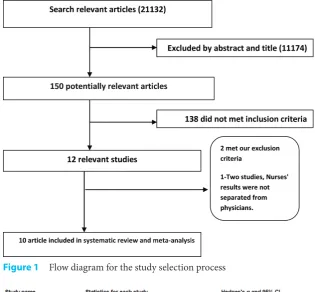
and pediatric patients, were identified. In total, 21132 articles were found in the initial searching(-pubmed=9254,since direct=1000,Cinahl=10878). After the elimination of duplicates, 11174 articles remained. Through reading the title and abstract, 150 articles were excluded. By reading the full text of articles, 20 articles were excluded and 12 articles remained. Finally, 12 observational studies, includ-ing 3 Randomized Control Trial (RCT) studies,15,19,22
2 experimental studies20,25 and 7 pretest and posttest
designs16-18,23,24,26,29 were considered for inclusion
in the systematic review, and 10 studies (out of 16 papers included unsystematic review) includ-ing 2 RCT studies,15,19 2 experimental studies20,25
and 6 pretest and posttest designs16,18,23,24,26,33 were
included in the meta-analysis (Figure 1).
The studies included in this systematic review are summarized in Table 1. The following studies were introduced into the meta-analysis, such as 2 studies related to the effect of the self-conscious program.16,33 Secondly, 2 reviews with the impact
of the curriculum on the way of communicat-ing in difficult situations.18,20,32 Third, 3 studies
of a communication skills training program on self-efficacy of nurses.15,29,31 Then, a review of the
effect of a coach training program for nurses in
the neonatal department.30 At least, a
compara-tive study of a scenario-based simulation training
Table1 Continue
Main result (self-efficacy) Intervention
Sample Design
Country Title
Author
Overall, nurses’ self-efficacy significantly improved [t(1016) = 31.17, p < .001] from pre-(M = 3.31, SD = .88) to post-training pre-(M = 4.05, SD = .65).
didactic and experiential small group role plays 342
One single study USA
The
implementation and evaluation of a communication skills training program for oncology nurses Banjere
(2017)18
Mean communication self-efficacy scores (F(1.19, 70.36) = 4.85, p = 0.025, partial 2 = 0.08) than the control group.
Test=- 4.59 p<0.001, partial = 0.263 t1, t test Control:
case based communication Experimental: simulate based communication 30 Control,
30
Intervention RCT
Taiwan The effects of
scenario-based communication training on nurses’ communication competence and self-efficacy and myocardial infarction knowledge HSU
(2014)19
Self efficacy in pretest: 1,247.45 ± 244.10 Post test= 1,430.39 ± 125.68
Control= 1,355.53 ± 210.90,Podt test= 1,380.50± 179.20
H= 20.118, P<.001**,Post Hoc Test Integreted and
Role play 62:
Intervention and 55: Control quasi-exp.
research China
Evaluation of an Integrated Communication Skills Training Program for Nurses in Cancer Care in Beijing, China
Liu (2007)20
Nurses’ self-efficacy in responding empathically significantly increased pre (M = 3.59, SD = .67) - to post-training (M p<0.001.). = 4.26, SD = .55, Empathy with aptient
Training empathy 246
Exp. study one single study USA
Responding empathically to patients: Development, implementation, and evaluation of a communication skills training module for oncology nurses Pehrson
(2016)26
: Randomized Controlled Trial RCT
program using a non-simulation educational program19 its impact on the self-efficacy scale. In
the survey of Khodadadi et al.,25 the
communica-tion skill training was conducted in lectures and pamphlets. This intervention did not significantly increase the self-efficacy of nurses about patients.29
In the study of Parle et al.,17 and Ammentrop
et al.,30 the study group includes physicians and
nurses. The results of these two groups were not separated; therefore, they were not entered into the meta-analysis.
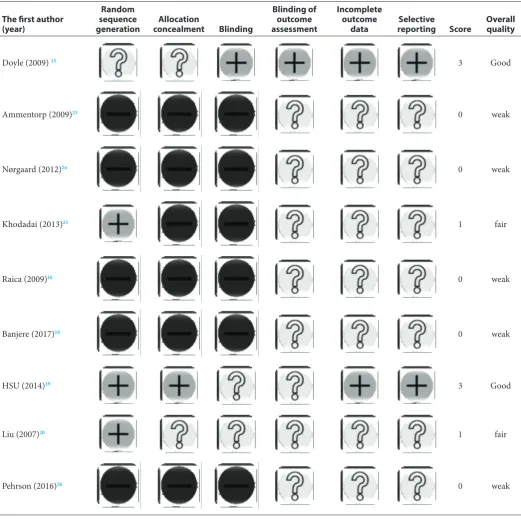
Assessment of Bias Risk
Two studies entered in the systematic review had good qualities based on aspects selected for the quality assessment,15,29 and two studies were
clas-sified as fair.20,25 Nine studies did not report any
method used to conceal the participants’ alloca-tion,15,16,18,20,23-26 and eight studies did not mention
incomplete outcome data.16,18,20,23-26,33 Regarding
analysts’ blinding, one of the studies tried to address this source of bias.15 No particular outcome evidence
was found in the included studies (Table 2).
Table 2 Study quality and risk of bias assessment using Cochrane Collaboration’s tool(34)
The first author (year)
Random sequence
generation concealmentAllocation Blinding
Blinding of outcome assessment
Incomplete outcome
data reportingSelective Score Overallquality
Doyle (2009) 15 3 Good
Ammentorp (2009)23 0 weak
Nørgaard (2012)24 0 weak
Khodadai (2013)25 1 fair
Raica (2009)16 0 weak
Banjere (2017)18 0 weak
HSU (2014)19 3 Good
Liu (2007)20 1 fair
Results of Meta-analysis
Ten studies reported self-efficacy outcomes. A Likert-type scale was used in 6 studies. A 10 point scale was used in 2 studies. A 100 point scale was used in 2 studies. The meta-analysis results from 10 studies are revealed in Figure 2. The results suggest that the effect of communication skills training increases self-efficacy. The effect of communication skills training was moderate (Hedges’g = 0.51, 95 % CI: 0.31 to 0.70 p < 0.001) (Figure 2). Among the studies, there was evidence of heterogeneity (Cochrane Q test, Q statistic = 45.4, p < 0.001, I2 = 80.18).
Considering the heterogeneity between the studies, they were divided into two subgroups. The
effect of communication skills training in interven-tional studies without control group (Hedges’g = 0.37, 95% CI: 0.18 to 0.448 p <0.001) and in inter-ventional studies with control group (Hedges’g = 0.78, 95 % CI: 0.24 to 1.37 p <0.001), was reported to be poor and strong respectively (Figure 3). In the studies without control group (Cochrane Q test, Q statistic = 13.79, p = 0.017, I2 = 63.74), and in studies with control group (Cochrane Q test, Q statistic = 15.94, p <0.001, I2 = 81.18) heterogeneity has been seen.
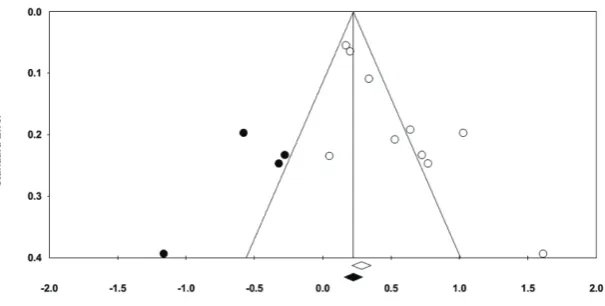
Sensitivity Analysis and Publication Bias Analyzing Sensitivity Levels and Publication Bias A sensitivity analysis could not show any signifi-cant change regarding the effect of communication skill training on self-efficacy after removing the studies from meta-analysis. Publication bias was found in the meta-analysis examining the impact of communication skill training on self-efficacy scale by Begg’s (p = 0.025) and Egger’s asymmetry tests (p = 0.003). Duval’s and Tweedie’s trim and fill test also indicated that even with the addition of four studies, the bias existed between studies (Figure 4).
DISCUSSION
The results of the random-effects meta-analysis, which was performed on 10 studies, showed the effect of communication skills training on nurses’ self-efficacy improvement. When nurses believe that they can communicate with the patient, there will be better communication with the patient. In the study of Prussia et al.,35 it was concluded that
self-efficacy directly affects the individual perfor-mance. It also plays a mediating role in how to manage and lead individual behaviors and perfor-mance. The nurse does not tend to communicate with the hard situations, such as anger. Nurses with less self-efficacy are more vulnerable to stress and labor pressure; therefore, they perceive that work and care are difficult and this perception leads to a decrease in the performance of a person.36 Bandura
has argued that educating and expressing the expe-riences of successful individuals can improve the understanding of communication; furthermore, training with communication scenarios, role-play-ing and handlrole-play-ing stressful situations can reduce stress and improve self-efficacy.8 In reviewing the
studies, researchers have used a variety of educa-tional methods to improve communication skills and self-efficacy. Moreover, communication skills training did not increase self-efficacy in nurses.25
The lack of intervention in this study could be due to training methods. Lecture and pamphlet training were utilized in order to promote communication
Figure 1 Flow diagram for the study selection process
skills level. While in other studies, for commu-nication skill training, several methods such as group discussion, role-play, and training with film and lecture were utilized.16,17,19,31,32 The use
of hybrid methods in this study showed that it could increase nurses’ self-efficacy. Meta-analysis results showed that the interventions used by the control group to compare the effect had a greater impact on self-efficacy. In general, studies using the control group for comparison are scientifically better. Although review studies have examined the effect of communication skills training on nursing students and nurses, the specific effect of nication skills training on improving the commu-nication skills of nurses has not been analyzed.36,37
For instance, in a communication skills training study, no significant difference was found between students’ self-efficacy.38 Furthermore,
investiga-tion of review studies results showed that lack of communication skills training had affected the improvement of self-efficacy, which could reduce the inconsistency in the results.37,39
In the study of Franklin and Lee,40 the effect of
simulation training on self-efficacy improvement
was conducted in nursing students. The results showed that practice based on simulation could increase self-efficacy. This study was based on simulation training, while in the present study, the effect of communication skills training on nurses was studied.
Heterogeneity between Studies
Analysis of control conditions can help to achieve real results. In 6 pretest-posttests the only method of assessment was the effect of communication skills training on self-efficacy. In 2 studies, a non-randomized control group was used. Only two randomized controlled trials (RCTs) were used. Multiple study methods can lead to heterogeneity of studies. Increasing self-efficacy would be possi-ble in communication skills training without using a control group. The number of people in groups was also different, which could lead to heteroge-neity. In one study, self-efficacy increased in both control and intervention groups.19 In the control
group communication skills were also trained; however, the method of training was different from the intervention group.
Diversity in interventions can lead to hetero-geneity among studies. In some interventions, feedback, role-playing, and lecturing were used in promoting communication skills. As against in some of other interventions, lectures and feedback as well as a number of them, self-awareness was used. These different methods can lead to hetero-geneity of studies. Another potential reason is self-assessment of the ability of nurses before the intervention, which can affect the actual increase in self-efficacy.41
Using various methods of self-efficacy eval-uation can also lead to heterogeneity. In some studies, the Likert scale was used, as well as in some studies, ten scores or 100 scores scales used. Difference self-assessment estimation can affect the heterogeneity of studies, and one of the problems of behavioral interventions is the use of various evalu-ation methods. Only Cronbach’s alpha was used for psychometric assessment of the questionnaire of studies. Other techniques, such as factor analysis, were not used to determine the reliability of studies that could affect the heterogeneity of studies. Strengths and Limitations
This study aimed to analyze the effect of commu-nication skills on the self-efficacy of nursing personnel which previous studies had not reviewed this scale. This study specifically evalu-ated the impact of communication skills training on nurses’ self-efficacy. The results of this study strongly demonstrated that the use of several
Figure 3 Forest plot showed overall effect of communication skill training on self-efficacy as well as subgroup analysis based on study design
educational methods could lead to increased self-efficacy and using one approach cannot have a significant effect. One of the weak points of this study is to combine the use of multiple interven-tions that their comparison can lead to heteroge-neity of results. Different methods also measured the self-efficacy scale.
CONCLUSION
The combination of communication skills training can increase the communication efficacy of nursing personnel. This result could be a way for research-ers to apply the communication skills training systematically.
CONFLICTS OF INTEREST
Authors state that there are no conflicts of interest.
REFERENCES
1. McGilton K, Robinson HI, Boscart V, Spanjevic L. Communication enhancement: nurse and patient satis-faction outcomes in a complex continuing care facility. Journal of Advanced Nursing. 2006;54(1):35-44. 2. McCabe C. Nurse–patient communication: an
explora-tion of patients’ experiences. Journal of clinical nursing. 2004;13(1):41-9.
3. Sabzevari S, Soltani Arabshahi K, Shekarabi R, Koohpayehzadeh J. Nursing students’ communication with patients in hospitals affiliated to Kerman University of Medical Sciences. Iranian Journal of Medical Education. 2006;6(1):43-9.
4. Hemsley B, Sigafoos J, Balandin S, Forbes R, Taylor C, Green VA, et al. Nursing the patient with severe com-munication impairment. Journal of advanced nursing. 2001;35(6):827-35.
5. Stewart MA. Effective physician-patient communication and health outcomes: a review. CMAJ: Canadian Medical Association Journal. 1995;152(9):1423.
6. Ammentorp J, Sabroe S, Kofoed PE, Mainz J. The effect of training in communication skills on medical doctors’ and nurses’ self-efficacy - A randomized controlled trial. Patient Education and Counseling. 2007;66(3):270-7. 7. Wolf ZR. Healthy communication in the healthcare
envi-ronment. The Pennsylvania Nurse. 2005;9:12-3.
8. Bandura A. Self-efficacy: toward a unifying theory of behavioral change. Psychological Review. 1977;84(2):191. 9. Karademas EC, Kalantzi-Azizi A. The stress process,
self-ef-ficacy expectations, and psychological health. Personality and individual differences. 2004;37(5):1033-43.
10. Norgaard B, Ammentorp J, Kyvik KO, Kofoed PE. Communication Skills Training Increases Self-Efficacy of Health Care Professionals. Journal of Continuing Education in the Health Professions. 2012;32(2):90-7. 11. Gulbrandsen P, Jensen BF, Finset A, Blanch-Hartigan D.
Long-term effect of communication training on the rela-tionship between physicians’ self-efficacy and performance. Patient education and counseling. 2013;91(2):180-5. 12. Heaven CM, Maguire P. Training hospice nurses to
elicit patient concerns. Journal of Advanced Nursing. 1996;23(2):280-6.
13. Stewart M. Patient-centered medicine: transforming the clinical method: Radcliffe Publishing; 2003.
14. Kourkouta L, Papathanasiou IV. Communication in nurs-ing practice. Materia socio-medica. 2014;26(1):65.
15. Doyle D, Copeland HL, Bush D, Stein L, Thompson S. A course for nurses to handle difficult communication situa-tions. A randomized controlled trial of impact on self-effi-cacy and performance. Patient education and counseling. 2011;82(1):100-9.
16. Raica DA. Effect of action-oriented communication train-ing on nurses’ communication self-efficacy. Medsurg Nursing. 2009;18(6):343.
17. Parle M, Maguire P, Heaven C. The development of a training model to improve health professionals’ skills, self-efficacy and outcome expectancies when communi-cating with cancer patients. Social science & medicine. 1997;44(2):231-40.
18. Banerjee SC, Manna R, Coyle N, Penn S, Gallegos TE, Zaider T, et al. The implementation and evaluation of a communication skills training program for oncology nurses. Translational Behavioral Medicine. 2017:1-9. 19. Hsu L-L, Chang W-H, Hsieh S-I. The effects of
sce-nario-based simulation course training on nurses’ communication competence and self-efficacy: a random-ized controlled trial. Journal of Professional Nursing. 2015;31(1):37-49.
20. Liu J-E, Mok E, Wong T, Xue L, Xu B. Evaluation of an integrated communication skills training program for nurses in cancer care in Beijing, China. Nursing research. 2007;56(3):202-9.
21. Zulkosky K, editor Self‐efficacy: a concept analysis. Nursing Forum; 2009: Wiley Online Library.
22. Ammentorp J, Sabroe S, Kofoed P-E, Mainz J. The effect of training in communication skills on medical doctors’ and nurses’ self-efficacy: A randomized controlled trial. Patient education and counseling. 2007;66(3):270-7.
23. Ammentorp J, Kofoed P-E. Coach training can improve the self-efficacy of neonatal nurses. A pilot study. Patient education and counseling. 2010;79(2):258-61.
24. Nørgaard B, Ammentorp J, Ohm Kyvik K, Kofoed PE. Communication skills training increases self‐efficacy of healthcare professionals. Journal of Continuing Education in the Health Professions. 2012;32(2):90-7.
25. Khodadadi E, Ebrahimi H, Moghaddasian S, Babapour J. The effect of communication skills training on quality of care, self-efficacy, job satisfaction, and communication skills rate of nurses in hospitals of Tabriz, Iran. Journal of caring sciences. 2013;2(1):27.
26. Pehrson C, Banerjee SC, Manna R, Shen MJ, Hammonds S, Coyle N, et al. Responding empathically to patients: Development, implementation, and evaluation of a com-munication skills training module for oncology nurses. Patient education and counseling. 2016;99(4):610-6. 27. Borenstein M, Hedges LV, Higgins J, Rothstein HR.
References: Wiley Online Library; 2009.
28. Kontopantelis E, Reeves D. metaan: Random-effects meta-analysis. Stata Journal. 2010;10(3):395.
29. Higgins JP, Thompson SG, Deeks JJ, Altman DG. Measuring inconsistency in meta-analyses. BMJ: British Medical Journal. 2003;327(7414):557.
30. Egger M, Smith GD, Schneider M, Minder C. Bias in meta-analysis detected by a simple, graphical test. BMJ. 1997;315(7109):629-34.
31. Duval S, Tweedie R. Trim and fill: a simple funnel-plot-based method of testing and adjusting for publication bias in meta‐analysis. Biometrics. 2000;56(2):455-63. 32. Higgins JP, Green S. Cochrane handbook for systematic
reviews of interventions. Version; 2005.
33. Engin E, Cam O. Effect of self-awareness education on the self-efficacy and sociotropy–autonomy characteristics of nurses in a psychiatry clinic. Archives of psychiatric nurs-ing. 2009;23(2):148-56.
34. Higgins J, Green S. Cochrane handbook for systematic reviews of interventions: Wiley Online Library, 2008. 35. Prussia GE, Anderson JS, Manz CC. Self-leadership
36. Moore PM, Rivera Mercado S, Grez Artigues M, Lawrie TA. Communication skills training for healthcare professionals working with people who have cancer. The Cochrane Library. 2013.
37. Kruijver IP, Kerkstra A, Francke AL, Bensing JM, van de Wiel HB. Evaluation of communication training programs in nursing care: a review of the literature. Patient education and counseling. 2000;39(1):129-45.
38. Kameg K, Howard VM, Clochesy J, Mitchell AM, Suresky JM. The impact of high fidelity human simulation on self-efficacy of communication skills. Issues in mental health nursing. 2010;31(5):315-23.
39. Grant MS, Jenkins LS. Communication education for pre-licensure nursing students: literature review 2002– 2013. Nurse education today. 2014;34(11):1375-81.
40. Franklin AE, Lee CS. Effectiveness of simulation for improvement in self-efficacy among novice nurses: A meta-analysis. Journal of Nursing Education. 2014;53(11):607-14.
41. LeFlore JL, Anderson M, Michael JL, Engle WD, Anderson J. Comparison of self-directed learning versus instructor-modeled learning during a simulated clinical experience. Simulation in Healthcare. 2007;2(3):170-7.