The Impact of Servant Leadership on Turnover Intention, with Job
Satisfaction Mediating (Case Study on Pangeran Beach Hotel Padang)
Agung Indra Pranata 1, Dr. Rahmi Fahmy2
1. Master Student, 2.Head (Dr). Rahmi Fahmy
Magister Management of Andalas University, Padang, Indonesia Email - 1[email protected], 2[email protected]
1. INTRODUCTION:
The rivalry in the business world nowadays is very tight and competitive. Every corporation is required to be able to improve their performance at any time, so the costs can be reduced. The idea behind this is that by improving performance, corporations can earn the benefits of continuous competition. A major corporation refers to a corporation with the ability to adapt the changing times and to stay competent in facing tight competition. The management is required to be more prepared to improve the quality of their corporation. A good quality of the corporation is reflected on the performance of the whole corporation. To achieve this ideal performance, without a doubt the corporation has to be able to manage all of the workers in their environment.
According to Yulk (2010), a successful organization needs an effective leader with relevant leadership skills, which includes the ability to visualize the changes in the future which will affect the business operation and to devise a plan to tackle said changes. The impact of globalization, demographical changes, social structure shifting, and technology advancements allowed people to work together that requires contemporary leaders to bridge the social identity limitation between many groups of people with various background of perspectives, values, and culture.
One of the common issue faced by organizations is turnover. Turnover is a major issue that developed during the management of natural resources. A previous research regarding turnover is, Turnover Intention (TI) refers to the conscious and deliberate intention to leave an organization and has been one of the main challenges faced by an organization. TI has been proven to be strongly correlated with the actual turnover (Han & Jekel, 2011).
Pangeran Beach is an institution or a corporation that specializes in the service field, specifically hospitality. Pangeran Beach Hotel is one of the first 4-star hotel in Padang City. The institution is located in Jl. Ir. H. Juanda 79, Padang, Indonesia. There are many facilities in the hotel, such as coffee shop, meeting rooms, ballrooms, fitness center, swimming pool, restaurant, to name a few. As a 4-star hotel, Pangeran Beach has 179 rooms available.
With this varying facilities, great reputation, and the tight competition in the hospitality business in Padang, the Padang Beach Hotel management should prepare a fair management system that also has a competent leader so that the job satisfaction of the employees can be improved and reduced the turnover level.
Based on the preceding explanation, the researchers are intrigued to discover the impact of Servant Leadership on the Turnover Intention, with job satisfaction mediating (A Case Study on Pangeran Beach Hotel Padang).
2. LITERATURE REVIEW: Turnover Intention
Turnover Intention is defined as one’s thought (intention) to leave their current job (Mor Barak et al., 2001). According to Takase (2010), the Turnover Intention is a complex process that emerges from a negative psychological response towards a certain working condition or organization and this response then developed into either the decision to leave or reflected in the withdrawal behavior which may include the intentional neglect of work or the current action to attain a better job opportunities. This intention to leave is one’s thought about leaving their job in the near future (Mobley, 1982). The Turnover Intention implies one’s intention to leave the organization where they work which could indicate the violation of the relationship between the employee and the organization (Cho et al., 2009).
Abstract: This research aims to discover the impact of Servant Leadership on the Turnover Intention with job satisfaction mediating in Pangeran Beach Hotel Padang. This research is a quantitative exploratory research. The sampling technique that was used is the purposive sampling, with the 153 people as the population. This research also uses SEM-PLS with smart PLS 2 program. The result shows that servant leadership has a significant positive impact on job satisfaction, servant leadership also has a significant negative impact on turnover intention, job satisfaction has a negative significant impact on turnover intention, and job satisfaction variable takes a partial role mediating the impact of servant leadership towards turnover intention in Pangeran Beach Hotel Padang.
Job Satisfaction
Job satisfaction is one’s general attitude towards their job which shows the difference between the amount of rewards accepted and the amount that they believe they should have received (Robin, 2007). Job satisfaction, in general, is a positive or negative attitude of someone towards their job. In this context, the positive spiritual status of someone is equal with their job satisfaction, and negative attitude will show job dissatisfaction (Mathur et al., 2011).
Servant Leadership
The Current Servant Leadership theory plays a pivotal role in this case. This “servant” type of leadership was first introduced by Greenleaf (1977) more than 30 years ago, and was recently rediscovered by other researchers. In servant leadership, the goal of service is embedded in the leader-follower relationship. The main difference of servant leadership with other type of leadership is that the servant leader genuinely cares about their subordinates. Franklin (2010) defined the Servant Leadership as a type of leadership which mainly focuses on the subordinates while the problem of the organization is secondary. Ebener and O’Connell (2010) showed that the servant leader creates a service culture in the organization and it affected the believes, assumptions, values, and the behavior of the employees.
3. PREVIOUS RESEARCHES REVIEW AND HYPOTHESIS:
A research done by McCann et. al (2014) titled “Servant Leadership, Job Satisfaction, and Organizational Performance in Rural Community Hospitals” showed that every Servant Leadership subscales, except the altruistic healing, have a positive and significant correlation with the extrinsic satisfaction and HCAHPS. The result supports the hypothesis that there is a correlation between the Servant Leadership, extrinsic satisfaction, and HCAHPS. Another research done by Turgut et. al(2017) titled “The Role of Job Satisfaction Moderation on The Correlation between Servant Leadership and Turnover Intention” showed that there is a significant positive impact between Servant
Leadership and Job Satisfaction. Based on these researches, hypothesis 1 is proposed, which is:
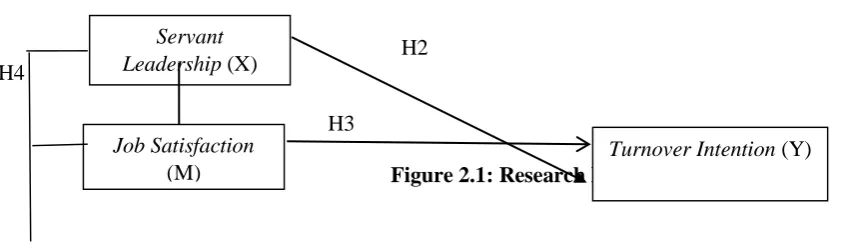
H1: Servant Leadership has a significant positive impact on Job Satisfaction
A research done by Turgut et. al (2017) titled “The Role of Job Satisfaction Moderation on The Correlation between Servant Leadership and Turnover Intention” showed that there is a significant negative effect between the
impact of Servant Leadership and Turnover Intention. A research done by Xin Le Ng et. al (2016) titled “The Impact of Servant Leadership on Employees’ Turnover Intention” showed that there is a negative and significant impact of Servant
Leadership on the Turnover Intention. Based on these researches, hypothesis 2 is proposed, which is:
H2: Servant Leadership has a significant negative impact on Turnover Intention
A research done by Yin-Fah et. al (2010) titled “Exploratory Study of Turnover Intention among Employees in Private Sector” showed a significant positive correlation between the impact of job satisfaction and turnover intention. Another research done by Yamazakia and Petchdee (2015) titled “The Turnover Intention, Organizational Commitment, and Specific Job Satisfaction among the Production Employees in Thailand” showed that job satisfaction, which has
self-development, HR policy, and supervisor domains, has a significant negative impact on turnover intention. Based on these researches , hypothesis 3 is proposed, which is:
H3: Job Satisfaction has a significant negative impact on Turnover Intention
A research conducted in Thailand by Nopphong and Phithagom (2017) titled “The Impact of Contemporary Leadership on Job Satisfaction, Organizational Commitment, and Turnover Intention: A Case Study on Construction Industry in Thailand” showed that there is a correlation between leadership and Turnover Intention which was partially mediated by job satisfaction. Another research conducted in Turkey by Bayarcelik and Findikli (2016) titled “The Mediating Effect of Job Satisfaction on the Relationship between Organizational Perception and Turnover Intention”
showed that the perception of procedural distributive equality has a direct effect on job satisfaction and it reduces the intention to quit the job. Based on these researches , hypothesis 4 is proposed, which is:
H4: Job Satisfaction has a partial mediating role on Turnover Intention
Research Model
H2 H4 H1
H3
Figure 2.1: Research Model
4. METHOD:
This research is a quantitative explanatory research, where the model and the problem solving analysis is done by using statistical analysis to empirically examine the relationship between the research variables. The population of this research is the whole 153 employees of Pangeran Beach Hotel Padang. As for the sample of this research is the permanent worker which consists of 112 employees. Equation Modelling (SEM) or the simultaneous equation will be used to analyze the obtained data which will be calculated through a computer by using the smart PLS (Partial Least Square) 2.0.
5. RESEARCH RESULTS AND DISCUSSION: Participants Characteristics
This research was carried out on all of the 112 permanent employees of Pangeran Beach Hotel Padang by using questionnaires. All of the 112 employees participated in this research, in other words, the questionnaire has a respond rate of 100%.
Based on gender. 54.5 % of the participants were male and 45.5% were female. The majority of the participants are aged in the range of < 25 years old (34.8%) and the smallest group of participants are aged in the range of > 46 years old. The majority of the participants had received their bachelor’s degree (62.4%) while only 1.2% of the participants had received their master’s degree. The majority of the participant have worked for 4-6 years (43 participants or 38.3%) and the smallest group of participants only work for < 1 year (4 participants or 3.5%). Lastly, the majority of the participants (82 participants) earns >Rp 3.500.000, while the rest 30 participants (26.7%) earn between Rp 2.500.00 to 3.500.00.
Model Data Measurement Tests (Outer Model)
The result of the outer loading shows that there are six invalid indicators caused by below 0,40 loading values, which includes SL1, SL11, SL17, SL18, SL26, SL30. In this research, the value of AVE on all variables has fulfilled the required condition, with the required rule of thumb (AVE>0.50)
Table 4.4 Reliability and Validity Test
Cronbach'sAlpha Average Variance Extracted
(AVE) Composite Reliability
SL 0.969 0.620 0.973
KK 0.923 0.503 0.937
TI 0.745 0.634 0.838
Source: PLS Data Processing Result, 2018
Structural Model Test (Inner Model)
The structural model test of this research is shown in the table below:
Table 4.10Path coefficients (Mean, STDEV, T-Values)
Original sample (o)
Sample mean (m)
Standard deviation (STDEV)
T-STATISTICS
(O/STERR) P-Values KK
-> TI
-0.426883 -0.454829 0.078583 5.432251 0.001
SL -> KK
0.501095 0.519930 0.067618 7.410641 0.001
SL -> TI
-0.213909 -0.236445 0.051485 4.154751 0.002
Source: PLS Data Processing Result, 2018 Note: The test was done on the one-tailed significance level
*) Significant at p<0.05
The table shows that the Servant Leadership variable has a positive impact on the job satisfaction with the
Servant Leadership (X)
Job Satisfaction
(M)
Leadership variable has a negative impact on Turnover Intention with the original sample value of -0.213 and is significant because of the statistical p-value of 0.002 (below 0.05). In addition, the table also shows that the job satisfaction variable has a negative impact on Turnover Intention with the original sample value of -0.426 and is significant because of the statistical p-value of 0.001 (below 0.05).
The VAF formula, with the formula from Hair et al, (2010) was used to see the mediating role of job satisfaction variable on the impact of Servant Leadership towards Turnover Intention. The mediating variable test can also be seen on the VAF value of each mediating variables. If the VAF value is above 80% then the role of mediating variable is classified as the “full mediating” category. If the VAF value is between 20% and 80% then it is classified as the “partial mediating” category and if the VAF value is below 20% then it can be concluded that there is little to no mediating effect.
MEDIATION USING VAF:
𝑉𝐴𝐹 = 𝐼𝑛𝑑𝑖𝑟𝑒𝑐𝑡 𝑒𝑓𝑓𝑒𝑐𝑡
𝐷𝑖𝑟𝑒𝑐𝑡 𝐸𝑓𝑓𝑒𝑐𝑡 + 𝐼𝑛𝑑𝑖𝑟𝑒𝑐𝑡 𝐸𝑓𝑓𝑒𝑐𝑡
If Indirect Effect: A x B, and Direct Effect: C, then
𝑉𝐴𝐹 = 𝐴 𝑥 𝐵 𝐶 + 𝐴 𝑥 𝐵
Hypothesis 4
VAF = 0.5010 x (-0.42688) / (-0.2139) + (A x B) = (-0.213866) / (-0.2139) + (-0.213866)
= (-0.213866) / (-0.427766) = 0.49996 = 49%
It can be seen on the above calculation that the mediating role of job satisfaction is 49%. Based on this, it can be concluded that the job satisfaction variable has a partial mediating role.
Note: The test was done on the one-tailed significance level *) Significant at p<0.05
6. DISCUSSION:
The Impact of Servant Leadership on Job Satisfaction
The first hypothesis sees the impact of Servant Leadership on job satisfaction. Based on the results, it can be seen that Servant Leadership has a significant positive impact towards job satisfaction. The result validates H1. The positive correlation indicates that if the Servant Leadership variable has a high rate, then the job satisfaction variable will also has a high rate, this is based on table 4.16 that shows Servant Leadership has a significant positive impact (0.501) on job satisfaction. This result can also be explained through the description of the Servant Leadership variable. The result of each statements on the Servant Leadership subscale has a mean of 4.085, which means that the characteristic of the leader in Pangeran Beach Hotel Padang is considered to have met or near the Servant Leadership (a serving leader) criteria, that resulted in the increase of employees’ satisfaction. This result is supported by previous researches by McCann et al (2014) and Turgut et al (2017), that showed the same result which is that Servant Leadership has a significant positive impact on the employees’ job satisfaction.
The Impact of Servant Leadership on Turnover Intention
The Impact of Job Satisfaction on Turnover Intention
The third hypothesis sees the impact of Job Satisfaction on Turnover Intention. From the data shown, we can see that Job Satisfaction has a significant negative impact on Turnover Intention. The result validates the third hypothesis. The negative correlation indicates that if the Job Satisfaction variable was high, then the turnover intention of the Pangeran Beach Hotel employees will decrease, This is based on table 4.16 which showed that Job Satisfaction has a significant negative impact (-0.426) on turnover intention. This result can also be explained through the description of job satisfaction variable. The result of each statements on the Job Satisfaction subscale has a mean of 4.001. It can be concluded from the table that the employees agreed that they are satisfied with their current job.
The Mediating Role of Job Satisfaction on the Impact of Servant Leadership towards Turnover Intention From the mediating formula of Hair et al (2010), with the VAF (Variance Accounted For) formula method, it is obtained that job satisfaction has a rate of 49% of mediating the impact of servant leadership towards turnover intention. This indicates that the role of job satisfaction mediating is considered as partially mediating between servant leadership on the (Y) variable which is the turnover intention variable. This result validates H4. The job satisfaction variable partially mediating the impact of servant leadership towards turnover intention. This means that if the Pangeran Beach Hotel management wants to decrease turnover intention of their employees they need to optimize the role of job satisfaction.
7. RECOMENDATION:
Based on the results, there are several practical implications that is expected to be implemented through various policy by the management which could possibly decrease the level of turnover intention and increase job satisfaction of Pangeran Beach Hotel Padang employees. These implications are as follow:
a. From the average achievement rate of the given answers from each participants, the lowest average achievement on the servant leadership variable is on the servant leadership22 item (SL22) “My leader are not afraid to take risks and do things that is needed” with a mean value of 4.017. This result indicates that the leader in Pangeran Beach Hotel
Padang isn’t brave enough to take risks that is needed for the good of the company. Therefore, the leader should be braver to take decisions which is considered as important for improving the company, and will lead to the increase of the employees’ job satisfaction and also the decrease of turnover intention.
b. In addition, based on the lowest average achievement given by the participants, which is on the job satisfaction variable on the Job Satisfaction5 item (KK5) “I had the chance to do something for other people” with a mean value of
3.397. This shows that the frequency of the answer on the question is placed between “neutral” and “agree”. It can be concluded from this research that the employees feel that they are not free to help fellow employees in Pangeran Beach Hotel Padang. Therefore, if the management wants to optimize the increase of employees’ job satisfaction, they should give more freedom and opportunities for the whole employees to help each other.
c. The Pangeran Beach Hotel Management should maintain the servant leadership that currently exists in the organization. This is because of the leadership type is suited with the characteristics of the service company such as the hospitality industry. It can be seen that the average answer rate of the participants on the turnover intention variable was 2.29 or they disagree to have the intention to quit their current job.
Based on the results, it can be concluded that the servant leadership gives a positive impact on the company stability of Pangeran Beach Hotel, with quite high job satisfaction and low turnover intention as proof that indicates the success of the the positive impact given by servant leadership. Therefore, the management of Pangeran Beach Hotel should prepare their new leader candidates to have the same characteristics with the current leaders. This is done to maintain the practice of servant leadership in Pangeran Beach Hotel even after the current leaders have retired or no longer work in Pangeran Beach Hotel Padang.
REFERENCES:
1.
Bayarcelik Ebru Beyza, Findikli Afacan Mine. 2016. The Mediating Effect of Job Satisfaction On
The Relation Between Organizational Justice Perception And Intention To Leave. Procedia - Social
and Behavioral Sciences 235 ( 2016 ) 403
–
411
2.
Cho, S., Johanson, M.M., Guchait, P. (2009). Employees
’
intent to leave: a comparison of
determinants of intent to leave versus intent to stay.
International Journal of Hospitality
Management
, 28 (3), pp.374
–
381.
3.
Ebener, D. R., & O'Connell, D. J. (2010). How might servant leadership work?
Nonprofit
Management and Leadership, 20
(3), 315-335. http://dx.doi.org/10.1002/nml.256
4.
Franklin, S. D. (2010).
The Influence of Spirituality on Servant Leadership among Small Business
5.
Greenleaf, R. K. (1977). Servant-leadership: A journey into the nature of legitimate power and
greatness. New York: Paulist Press.
6. Hair, J. F., Black. W. C., Babin. B. J.; and Anderson. R. E. (2010),
Multivariate Data Analysis,
7th
ed. Pearson Prentice Hall, New Jersey.
7.
Han, G.H. and Jekel, M. (2011),
“
The mediating role of job satisfaction between leader-member
exchange and turnover intentions
”
, Journal of Nursing Management, Vol. 19 No. 1, pp. 41-49.
8.
Mathur, Garima; Banerjee, Richa; Pygnavil, Rajesh S.; Tripathi, Shikha; Pathak, Arti; Sharma,
Bhavana and Meera Kaul
Upadhyay (2011), “Stress and Job Satisfaction
-
A Study of Academicians”
in: A Systematic Guide to Write a Research Paper, Ed: Bhakar, S.S. and Mehda, S., Excel Books,
First Edition, p:219
9.
McCann Jack Thomas, Daniel Graves & Lieven Cox. 2014. Servant Leadership, Employee
Satisfaction, and Organizational Performance in Rural Community Hospitals. International Journal
of Business and Management; Vol. 9, No. 10; 2014 ISSN 1833-3850 E-ISSN 1833-8119.
Published by Canadian Center of Science and Education.
10.
Mobley, W.H., 1982. Employee Turnover: Causes, Consequences, And Control, MA,
Addison-Wesley Publishing. Philippines.
11.
Mor Barak, Michalle E., Nissly, J. A. ve Levin, A., 2001, “Antece
dents to retention and turnover
among child welfare, social work, and other human service employees: What can we learn from
past research? A review and metanalysis”,
Social Service Review
, 75(4), s:625-661.
12.
Nopphong Kerdngern1 and Phithagorn Thanitbenjasith. 2017. International Journal of Engineering
Business Management Volume 9: 1
–
8
13.
Robbins, Stephen P and Timothy A. Judge. 2007.
Organizational Behavior
. New Jersey : Pearson
Prentice Hall.
14.
Takase, M. (2010). A concept analysis of turnover intention: Implications for nursing management.
Collegian, 17(1), 3
–
12. http://dx.doi.org/10.1016/j.colegn.2009.05. 001.
15.
Turgut Hakan, Beckmezci Mustafa, Fikert Ates. 2017. The Moderating Role of Job Satisfaction
on the Relationship between Servant Leadership and Turnover Intention. Journal of Business
Research Turk. DOI: 10.20491/isarder.2017.273
.Reaserchgate..
16.
Xin Le Ng1, Sang Long Choi2 & Khairiah Soehod1..2016. The Effects of Servant Leadership on
Employee’s Job Withdrawal
Intention. Asian Social Science; Vol. 12, No. 2; 2016 ISSN
1911-2017 E-ISSN 1911-2025. Published by Canadian Center of Science and Education.
17. Yamazakia Yositaka dan Sorasit Petchdeel, 2015. Turnover Intention, Organizational
Commitment, and Specific Job Satisfaction among Production Employees in Thailand
Journal
of Business and Management
Volume 4, Issue 4 (2015), 22-38 ISSN 1995 E-ISSN2291-2002