Organized by G. V. S. E. T., Jaipur. Available Online at www.ijpret.com178
INTERNATIONAL JOURNAL OF PURE AND
APPLIED RESEARCH IN ENGINEERING AND
TECHNOLOGY
A PATH FOR HORIZING YOUR INNOVATIVE WORK
EXPERIMENTAL STUDY OF CHARACTERIZATION OF AA6061 WITH SIC AND CSA
VISHAL ANAND1, DR. M.P SINGH2
1.Research Scholar, Jagannath University Jaipur, India
2.Professor, JECRC, Jaipur, India
Accepted Date: 19/03/2018; Published Date: 01/04/2018
Abstract:The area of composite material is one of the most fascinating topic to many researchers of Material Science. This paper is written to draw some more interest in the field of composites. The aluminum and aluminum alloys are most dominant when composites are prepared. The behavior of Aluminum alloy 6061 composite with coconut shell ash and Sic is determined in this paper. The different quantities of CSA and Sic chosen and composites are prepared. AA 6061 selected due to its excellent property of hardness, wear resistance, ductility and good strength to weight ratio. The fabrication of product is done by most appropriate one i.e. stir casting in electric furnace. The composite then formed is machined to desired shape and the part is tested for tensile, compressive, hardness and impact strength. The experiment showed very good result and ultimately enhances the property of Aluminum Alloy 6061.
Keywords: Aluminum 6061, CSA- Coconut Shell Ash, MMC-Metal Matrix Composites, Sic –Silicon carbide, Stir Casting, Mechanical Properties.
Corresponding Author: VISHAL ANAND
Access Online On:
www.ijpret.com
How to Cite This Article:
Vishal Anand, IJPRET, 2018; Volume 6 (8): 178-185 PAPER-QR CODE
SPECIAL ISSUE FOR
NATIONAL LEVEL CONFERENCE
Organized by G. V. S. E. T., Jaipur. Available Online at www.ijpret.com179
INTRODUCTION
The emergence of alloy took place due the inefficient property of monolithic material and the emergence of composites took place due to demand of more efficient material which an alloy could not be fulfilled. In this paper a new composite material is prepared which helps in advance application such as aerospace, health care, defense and space research. Aluminum gains the interest due to its light weight property along with rust proof tendency. To add some extra property or to increase its strength to weight ration aluminum alloy is used. According to the study made and the application area identified Aluminum Alloy 6061 is selected. After selection of appropriate material, the method to make MMC is Stir Casting which is supposed to be most suitable method to prepare such reinforcement. [5]
The reason of selection of these materials is due to following properties:
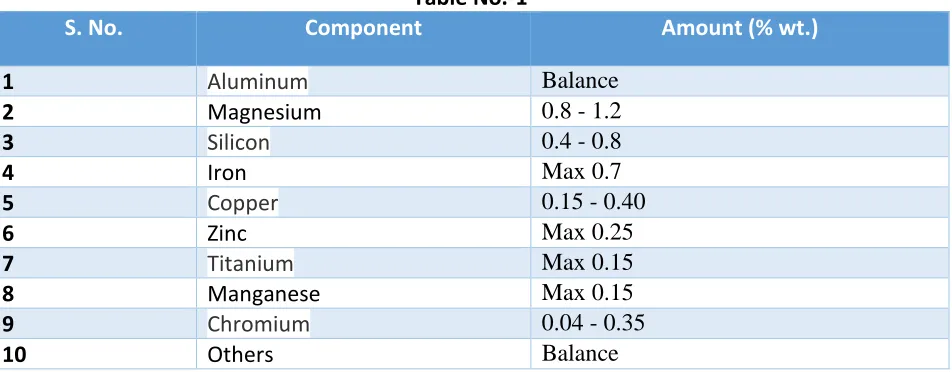
Al 6061T6: Chemical composition:
Table No.-1
S. No. Component Amount (% wt.)
1 Aluminum Balance
2 Magnesium 0.8 - 1.2
3 Silicon 0.4 - 0.8
4 Iron Max 0.7
5 Copper 0.15 - 0.40
6 Zinc Max 0.25
7 Titanium Max 0.15
8 Manganese Max 0.15
9 Chromium 0.04 - 0.35
10 Others Balance
Key properties of AA 6061:
1. Medium to high strength.
2. Good toughness
3. Good surface finish
4. Excellent corrosion resistance to atmospheric conditions
5. Good corrosion resistance to sea water
6. Can be anodized
7. Good weldability and brazability
8. Good workability
Organized by G. V. S. E. T., Jaipur. Available Online at www.ijpret.com180
Physical Properties:
Density: 2.7 g/cm3
Melting Point: Approx. 580°C Modulus of Elasticity: 70-80 GPa Poisson’s Ratio: 0.33
Mechanical Properties:
Ultimate Tensile strength=260-310 MPa 0.2 % Proof Stress=240-276 MPa
Brinell hardness number (500 Kg load, 10mm ball) =95-97 Elongation (50mm dia. %) =9-13 [3]
Silicon Carbide Key properties:
1. Low density
2. Low thermal efficiency 3. High strength
4. High thermal conductivity 5. High elastic modulus 6. High hardness
7. Excellent thermal shock resistance 8. Superior chemical inertness
Coconut Shell Ash Composition:
Table 2
Element Al2O3 CaO Fe2O3 K2O MgO
% 15.6 0.57 12.4 0.52 16.2
Element Na2O SiO2 MnO ZnO
% 0.45 45.05 0.22 0.3
Key Properties of CSA:
1. Low Cost
2. Light weight MMC achieved
3. Good thermal resistance
4. High hardness [4]
Experimental Procedure
Composition and parameters selected:
Materials used for preparing of Composite materials:
1. Silicon Carbide Powder 800 mesh-360g
Organized by G. V. S. E. T., Jaipur. Available Online at www.ijpret.com181
3. Aluminum 6061- 1.52 Kg
Casting Parameters:
Table 3
S.No Aluminum 6061 (weight in gm)
Sic (weight in gm) CSA (weight in gm)
1 368 24 8
2 336 48 16
3 304 72 24
4 272 96 32
5 240 120 40
Total= 1520g =360 g = 120 g
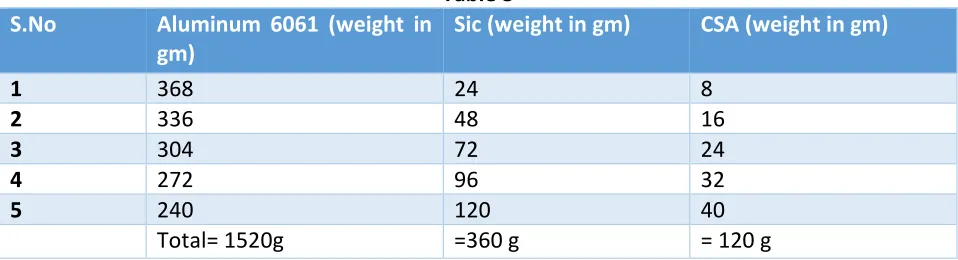
400 g comes from the calculation of weight with the help of density of Aluminum 6061 and
the volume required by the specimen. After finding the overall weight required the variation in the % wt. is made to prepare different samples for testing.
Sic taken from the range from 6% to 30% by weight.
CSA taken from the range from 2% to 10% by weight.
III Casting Parameters and Method
Fig 1 Methods of making composites
Organized by G. V. S. E. T., Jaipur. Available Online at www.ijpret.com182
Fig.2 Stir Casting Setup [1]
This setup contains an electric furnace on the top of which a stirrer is attached at one end and another end is connected to a motor. This furnace helps in attaining the required temperature
of 7000C within 15-20 minutes to melt the Aluminum. The motor is set at low rpm of 60-80 rpm
to get the reinforcement uniformly distributed.
Process involved:
1. The furnace is started and the temperature is set at 7000C.
2. The block or rod of Aluminum is kept in the furnace.
3. After 15-20 minutes when the Aluminum is melted the reinforcement is poured with the
help of funnel in the furnace.
4. The motor of stirrer is allowed to start at the set rpm of 60-80 rpm which helps in proper
mixing of the components added.
5. The molten matrix is then poured to the mold and after solidification the required casting is
prepared.
IV All mechanical tests
Although mechanical test consists of various tests i.e. Tensile, compressive, hardness, fatigue, stiffness, bending etc. But the application area selected is the fuselage skin and automobile chassis. According to the application area all tests are not required because all properties are not evident here. The tests which is relevant in this account are tensile, hardness and impact tests.
Test 1: Tensile Test
Organized by G. V. S. E. T., Jaipur. Available Online at www.ijpret.com183
Table 4
S.No. Component Tensile Strength (MPa)
1 Al 6061 138
2 Al 6061 +5% Sic+3% CSA 156
3 Al 6061 +10% Sic+6% CSA 168.8
4 Al 6061 +15% Sic+9% CSA 170.2
5 Al 6061 +20% Sic+12% CSA 144.4
6 Al 6061 +25% Sic+15% CSA 162
Test 2: Hardness test
Table 5
S.No. Component Brinell Hardness No.
1 Al 6061 75
2 Al 6061 +5% Sic+3% CSA 89
3 Al 6061 +10% Sic+6% CSA 94
4 Al 6061 +15% Sic+9% CSA 102
5 Al 6061 +20% Sic+12% CSA 100
6 Al 6061 +25% Sic+15% CSA 98
Test 3: Izod Impact Test
Table 6
S.No. Component Impact Test (Nm)
1 Al 6061 8
2 Al 6061 +5% Sic+3% CSA 10
3 Al 6061 +10% Sic+6% CSA 12
4 Al 6061 +15% Sic+9% CSA 17
5 Al 6061 +20% Sic+12% CSA 14
6 Al 6061 +25% Sic+15% CSA 13
Test 4: Elongation Test
Table 6
S.No. Component Elongation %
1 Al 6061 12
2 Al 6061 +5% Sic+3% CSA 3.2
3 Al 6061 +10% Sic+6% CSA 4
4 Al 6061 +15% Sic+9% CSA 4.2
5 Al 6061 +20% Sic+12% CSA 3
Organized by G. V. S. E. T., Jaipur. Available Online at www.ijpret.com184
V Result and Discussion
Following charts shows the results obtained from tests conducted on the composites.
Fig 3 Tensile Test Result
Tensile test shows a gradual improvement on the strength when the reinforcement is increased but a sudden fall at specimen 5 is observed, then again value increases.
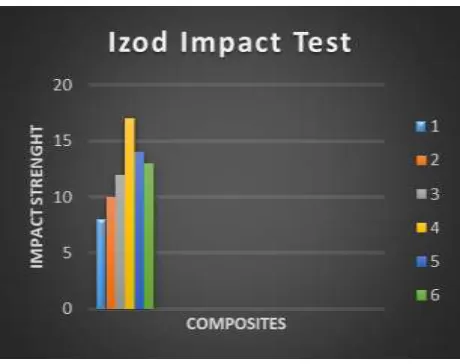
Fig 4 Impact Test Result
Organized by G. V. S. E. T., Jaipur. Available Online at www.ijpret.com185 0 20 40 60 80 100 120 h a rd n es s b h n composites
Hardness Test
1 2 3 4 5 6
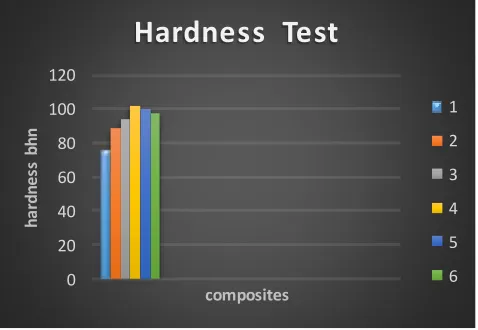
Fig 5 Hardness Test Result
Hardness test shows a gradual improvement on the strength when the reinforcement is increased but a sudden fall at specimen 5 is observed, then again value increases.
Above tests signifies that the best combination of the composites is the specimen 4 which contains Al 6061 +15% Sic+9% CSA.
REFERENCES
1. https://www.google.co.in/search?q=stir+casting&source=lnms&tbm=isch&sa=X&ved=0ahU
KEwjwnurMm_zWAhXKL48KHfAkDlUQ_AUICigB&biw=1034&bih=647#imgrc=TQTPclp_m8hCw M: Accessed 5 January 2018.
2. N. Rajesh And Dr. M. Yohan “Recent Studies In Aluminium Metal MatrixNano Composites
(Ammncs) – A Review” International Journal Of Mechanical Engineering And Technology
(Ijmet)Volume 7, Issue 6, November–December 2016, Pp.618–623, Article Id: Ijmet_07_06_061,
Issn Print: 0976-6340 And ISSN Online: 0976-6359. Pg. No-618-619.
3. Aniruddha V. Muley “Tribological Studies On Aluminum Based Metal MatrixHybrid
Composite: An Overview” International Journal of Mechanical and Production Engineering, ISSN: 2320-2092, Volume- 4, Issue-10, Oct.-2016. Page No.-23-26.
4. Ravi Butola*, Ranganath M.Singari, Ashwani Bandhu, R S Walia “Characteristics and
Properties of Different Reinforcements in Hybrid Aluminium Composites: A Review”
International Journal of Advanced Production and Industrial Engineering. ISSN: 2455–8419
IJAPIE-SI-MM 511 (2017) 71–80.
5. Khalil Abdelrazek Khalil El-Sayed M. Sherif , A. M. Nabawy, Hany S. Abdo , Wagih W. Marzouk