Research Article ISSN: 2319-507X Sharad Jain, IJPRET, 2013; Volume 1(8): 196-202 IJPRET
Available Online At www.ijpret.com
INTERNATIONAL JOURNAL OF PURE AND
APPLIED RESEARCH IN ENGINEERING AND
TECHNOLOGY
A PATH FOR HORIZING YOUR INNOVATIVE WORKBER PERFORMANCE ANALYSIS OF WRAN IEEE 802.22 USING FORWARD ERROR
CORRECTION
SHARAD JAIN1, RAHUL KOSHTI2
1. Assistant Professor, Electronics & Communication Engineering Department, Lord Krishna
College of Technology, Rau Pithampur Bypass Road, Opp. StiI. Ltd., Indore (M.P.).
2. Assistant Professor, Electronics & Communication Engineering Department, Sri Auro
bindo Institute of Technology, Indore-Ujjain Highway, Near Mr-10 Crossing, Indore (M.P.).
Accepted Date:
27/02/2013
Publish Date:
01/04/2013
Keywords
WRAN;
IEEE802.22;
PHY layer;
CR;
OFDMA
Corresponding Author Mr. Sharad Jain
Abstract
IEEE 802.22 WRAN (Wireless Regional Area Network) is the
first wireless standard which provides the unlicensed
operation in VHF/UHF TV broadcast bands from 54 MHz to 862
MHz with full features of CR technologies. The IEEE802.22
working group was formed in November 2004. The first draft
of the standard was available in May 2006 but much work still
pending however the standard was expected to finalize in first
quarter of 2010 but was finally published in July 2011[1]. In
this paper to evaluate the BER performance of the system, its
Physical layer is introduced & modeled in MATLAB [2]. To
evaluate the performance of the system we draw out the BER
(Bit error Rate) of the system for QPSK & QAM-16 modulation
Available Online At www.ijpret.com INTRODUCTION
The TV broadcast bands in the
high-VHF/low-UHF range are ideal for covering
large areas in sparsely populated rural
environments because of lower industrial
noise and ionospheric reflections,
reasonable antenna sizes, and good
non-line-of-sight (NLOS) propagation
characteristics. The development of the IEEE
802.22 WRAN standard is aimed at using
cognitive radio techniques to allow sharing
of geographically unused/underused
spectrum allocated to the television
broadcast service, on a non interfering basis,
to bring broadband access to hard-to-reach
low-population-density areas typical of rural
environments, and is therefore timely and
has the potential for wide applicability
worldwide. CR effectively reuses the finite
frequency resources by intelligent
recognition of ideal frequency bands using
spectrum sensing [3][4][5]. IEEE 802.22
WRANs are designed to operate in the TV
broadcast bands while ensuring that no
harmful interference is caused to the
incumbent operation (i.e., digital TV and
analog TV broadcasting) and low-power
licensed devices such as wireless
microphones [6].
The IEEE 802.22 WRAN standard will provide
wireless broadband access to a rural area of
typically 17–30 km or more in radius (up to a
maximum of 100 km) from a base station
(BS).[6] It can serve up to 255 fixed units of
customer premises equipment (CPE) with
outdoor directional antennas located at
nominally 10 m above ground level, similar
to a typical VHF/UHF TV receiving
installation. The minimum peak throughput
delivered to CPE at the edge of coverage will
be equivalent to 1.5 Mb/s in the
downstream (DS) direction (BS to CPE) and
384 kb/s in the upstream (US) direction (CPE
to BS).
Basically WRAN system has the similar
aspects of WiMAX. The key difference is the
service cell coverage and the coexistence
with the Primary users which has the
priority rights on the TV bands. WRAN is
fixed point to multi-point (PMP) system and
its connectivity between the base station
(BS) and the Consumer premise Equipments
(CPEs) is possible in both line-of-sight (LOS)
Research Article ISSN: 2319-507X Sharad Jain, IJPRET, 2013; Volume 1(8): 196-202 IJPRET
Available Online At www.ijpret.com 2.PHYSICAL & MAC LAYER
The physical layer & MAC layer performs
important task in the operation of WRAN.
The PHY layer performs the three primary
functions-the main data communication, the
spectrum sensing function & the
geolocation function. The last two provides
the necessary functionality to support the
cognitive abilities of the system. The
physical layer must be able to adapt to
different conditions. Also it should be
flexible for jumping from one channel to
another without error in Transmission and
hence this feature of physical layer is known
as dynamic frequency hopping required for
adjusting The Band width dynamically,
modulation and coding scheme. MAC layer
is based on cognitive Radio technology. The
MAC layer has two structures frame and
super frame. A super frame will be formed
by many frames. The Super Frame will have
a super frame control header and a
preamble. These will be sent by the base
station in every channel when a CPE is
turned ON, it will sense the spectrum, find
out which channels are available and will
receive all the information to attach to the
BS.
3.IEEE 802.22 PHY layer system model
overview
It supports multiple physical specifications.
The 802.22 OFDMA PHY is based on OFDMA
modulation, which includes OFDM
modulation & subcarrier allocation.
A.OFDMA
OFDM belongs to a special transmission
scheme of multicarrier modulation in which
high bit rate data stream is divided into
several parallel lower bit rate streams. Each
stream is modulated on separate carrier
called, subcarriers .OFDM is the most
spectral efficient version of the multicarrier
modulation. In OFDM all the subcarrier are
orthogonal to each other over one symbol
duration. Because of the orthogonality there
is no need of non overlapping subcarriers to
eliminate the ICI [7] now the subcarriers
overlap to each other thus saves the
bandwidth. The no. of subcarriers in the
OFDMA symbol is always the size of FFT.
There are no. Of subcarriers in the OFDMA
symbol as follows
Available Online At www.ijpret.com
• Null carriers-no data is transmitted on
these carriers & are used to prevent leakage
of energy into adjacent channels
• Pilot carrier -are used for channel
estimation & synchronization purpose
Since the OFDMA is the multiuser version of
OFDM so to enable the multiple access sub
channels are used which are formed by
grouping the data subcarriers. The all
subcarrier that are used to make a
channel are distributed across all the
subcarriers. Number of different sub
channels is allocated to the particular
order to send & receive data. There are two
parts in one OFDMA symbol in time domain.
The cyclic prefix (CP) time & u
time. CP is used to remove the effect of ISI &
ICI in multipath scenario.
CP is the copy of the last part of the
symbol which is appended in the front of
the transmitted OFDM symbol. The length
of CP or guard time interval must
such that it is longer than the maximum
delay spread of the multipath
The figure 1 shows the advantage of CP.
Available Online At www.ijpret.com no data is transmitted on
these carriers & are used to prevent leakage
of energy into adjacent channels
are used for channel
estimation & synchronization purpose
Since the OFDMA is the multiuser version of
OFDM so to enable the multiple access sub
channels are used which are formed by
grouping the data subcarriers. The all
to make a sub
are distributed across all the
Number of different sub
allocated to the particular user in
order to send & receive data. There are two
parts in one OFDMA symbol in time domain.
CP) time & useful symbol
time. CP is used to remove the effect of ISI &
CP is the copy of the last part of the OFDM
which is appended in the front of
symbol. The length
interval must be chosen
such that it is longer than the maximum
delay spread of the multipath channel [7].
The figure 1 shows the advantage of CP.
Fig 1. Cyclic Prefix addition
B.Simulation model
Matlab has been used to simulate the
physical layer of the system [
Fig 2. PHY layer set up
1) Random data generation
binary data is generated for simulation
purpose.
2) Randomizer- Convert the binary
sequence to the random sequence to avoid
long sequence of ‘0’ & ‘1’ to
Synchronization.
Fig 1. Cyclic Prefix addition
B.Simulation model
Matlab has been used to simulate the
system [2].
PHY layer set up
Random data generation- Random
binary data is generated for simulation
Convert the binary
sequence to the random sequence to avoid
Research Article ISSN: 2319-507X Sharad Jain, IJPRET, 2013; Volume 1(8): 196-202 IJPRET
Available Online At www.ijpret.com 3) FEC coding- Convolution code with code
rate ½ is used as FEC.
4) Interleave- It rearranges the ordering of
the sequence of the symbols in predefined
manner. Two types of interleaving are used
i.e. Time Interleaving & Frequency
interleaving.
5) Modulator-QPSK & QAM 16
modulations are used for simulation.
6) Buffer- Buffer is used to stack the data.
7) Subcarrier allocation- Pilots are guard
subcarrier are inserted in this stage.
8) IFFT- Inverse fast Fourier Transform
converts the frequency domain data set
into corresponding time domain. It also
generates the sample of the waveform
which satisfies the condition of
orthogonality.
9) Cyclic prefix- CP copies the last section
of a symbol &pastes it to the beginning of
symbol. After these operations the data are
delivered to the channel[8]
10) Channel- AWGN & RICIAN channel are
used for simulation in this paper.
C. Forward Error Correction
Convolutional code
Convolution code with code rate ½ is the
only mandatory code for WRAN system.
They operate on data stream, not static
block.
Convolutional codes have memory that uses
previous bits to encode or decode following
bit. It is denoted by (n,k,L) where L is the
memory depth. In Matlab Trellis description
is used to to define encoder connections.
Viterbi algorithm is used for decoding.
4.SIMULATION PARAMETERS
Primitive parameter
TV channel bandwidth (MHz)- 6,7 or 8 MHz
Total no. of subcarriers - 2048
No. of guard subcarriers - 368
No. of used subcarrier – 1680
No. of data subcarriers- 1440
No. of pilot subcarriers- 240
Guard time to useful symbol time ratio-1/8
5. RESULTS
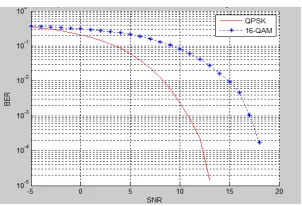
Fig. 3 shows SNR vs BER performance of
WRAN without FEC using QPSK & 16-QAM in
AWGN channel. Fig .4 shows SNR vs BER
performance of Convolution code using
QPSK & 16-QAM in AWGN channel. Fig 4
presents improvement in performance as
Available Online At www.ijpret.com of 10-3, QPSK gives approximate 5 dB gain
& 16-QAM gives approximate 2.5 dB gain.
Fig. 3 BER vs SNR performance of WRAN without FEC using QPSK & 16-QAM in AWGN channel.
Fig.4 BER vs SNR performance of WRAN with CC using QPSK &16-QAM in AWGN channel.
Fig. 5 shows SNR vs BER performance of
WRAN without FEC using QPSK & 16-QAM in
RICIAN channel. Fig.6 shows SNR vs BER
performance of Convolution code using QPSK
& 16-QAM in RICIAN channel. . Fig 6 presents
improvement in performance as compared
to Fig.5 as it shows for BER value of 10-3
,QPSK gives approximate 3 dB gain &
16-QAM gives approximate 1.3dB gain.
Fig. 5 BERvs SNR performance of WRAN
without FEC using QPSK & 16-QAM in
RICIAN channel.
Fig.6 BER vs SNR performance of WRAN with CC using QPSK &16-QAM in RICIAN channel.
6. CONCLUSION
In this paper IEEE802.22 PHY layer is
simulated & performance curve are
concluded for AWGN & RICIAN channel. It
has concluded that CC gives significant
performance improvement to without
coding. Same simulation can be carried out
for other fading channel with different FEC &
different code rate for future work.
Research Article ISSN: 2319-507X Sharad Jain, IJPRET, 2013; Volume 1(8): 196-202 IJPRET
Available Online At www.ijpret.com 1. IEEE 802.22 Working group on Wireless
Regional Area Networks,” Functional
requirements for the 802.22 WRAN,”
Doc#:IEEE802.22/-05/0007r46
2. Hwang, S.H., Um, J.S., Song, M.S., Kim,
C.J., Park, H.R., & Kim, Y.H.,”Desihn &
Verification of IEEE 802.22 WRAN Physical
layer (Invited paper),” Proc. International
Conf. Cognitive Radio Oriented Wireless
Networks & Communications, IEEE Press,
May.,pp.1-6,doi:10.1109/CROWNCOM.
2008.4562542(2008)
3. S. Haykin,” Cognitive radio: Brain
empowered wireless communications” IEEE
J. sel. AreasComm.Vol.23, no.2, pp.201-220,
Feb.2005.
4. J. Mitola,” Cognitive Radios: Making
Software Radios more personal” IEEE
PersonalCommunications, vol.6, no. 4,
August1999
5. J. Mitola,” Cognitive Radios: An
integrated agent architecture for software
defined radio”, PhD Dissersation, Royal inst.
Techno.(KTH),Stockholm,Sweden2000
6. Functional Requirements for the IEEE
802.22WRAN standard, IEEE
802.22-05/0007r46,sep.2005.
7. Richard van Nee, Ramjee Prasad “OFDM
forWireless Multimedia Communication”
Artechhouse publishers,2000.
8. Ahmadi, M., Rohani, E., Naeeni, P.M., &
Fakhraie, S.M.”Modelling & Performance
Evaluation of IEEE 802.22 Physical layer”2nd
International Conference on future