Developing Native-Like Listening Comprehension
Materials
7HDFKHUV¶DQG
P
XSLOV
Perceptions of a Digital
Approach
Herri Mulyono
([email protected])
University of Muhammadiyah Prof. DR. HAMKA (UHAMKA), Jakarta
Devi Nur Vebriyanti
([email protected])
Indraprasta University, Jakarta
This paper reported the attempt teachers did in developing native-like (NLS) listening materials for their EFL learners using a text-to-speech (TTS)
WHFKQRORJ\ 2EVHUYDWLRQ ZDV FDUULHG RXW WR UHFRUG WHDFKHUV¶ SURFHGXUHVfor developing NLS materials. Interview with teachers were undertaken to explore their¶ SHUFHSWLRQV WRZDUGV WKH 1/6 OLVWHQLQJmaterials and the benefits they gained from developing instructional media using technology. In addition, a questionnaire was distributed to 65 eight-grade pupils to gather information related to their opinions regarding the listening materials developed and used by their teachers. The findings show that teachers and pupils responded positively towards the NLS materials for listening comprehension. In addition, teachers were found to have more confidence in teaching listening skill while using the technology. There are three conditions which endorse this teaching confidence: the suitability of instructional materials used with the learning
FXUULFXOXPDQGSXSLOV¶OHYHORI(QJOLVKSURILFLHQF\WHDFKHUV¶VHOI-efficacy to the teaching task, and the integration of technology in classroom teaching. The study suggests that TTS system can be used as computer assisted language learning (CALL) application particularly in the development of listening comprehension materials. The study also confirms earlier studies that teacher professional development can be promoted through integrated training on technology for classroom use.
Artikel ini melaporkan kegiatan guru dalam membuat materi mendengarkan (listening) yang mirip dengan penutur asli (NLS) untuk pembelajaran bahasa Inggris menggunakan teknologi text-to-speech (TTS). Observasi dilakukan untuk merekam prosedur yang dilakukan guru. Wawancara dilakukan untuk mengetahui persepsi guru terhadap NLS dan untuk mengetahui manfaat yang guru peroleh terhadap pengembangan materi melalui teknologi. Kuestioner diberikan kepada 65 siswa kelas 8 untuk mengetahui pendapat mereka terhadap materi belajar yang dikembangkan oleh guru. Data menunjukan bahwa guru dan murid memberikan respon positif terhadap pengembangan materi NLS. Di samping itu rasa percaya diri guru dalam mengajarkan kemampuan mendengarkan dengan teknologi juga meningkat. Ada tiga kondisi yang memungkinkan rasa percaya diri meningkat: kecocokan antara materi yang digunakan dengan kurikulum dan tingkat kemampuan bahasa Inggris siswa, keyakinan guru terhadap tugas mengajar, dan integrasi teknologi dengan pengajaran di kelas. Studi ini merekomendasikan bahwa sistem TTS dapat digunakan untuk pengajaran bahasa melalui komputer, khususnya dalam mengembangkan bahan ajar mendengarkan. Studi ini juga mendukung penemuan studi sebelumnya yang menyatakan bahwa untuk mengembangkan profesionalitas guru dapat dilakukan melalui penggunaan teknologi di kelas.
INTRODUCTION
Despite the increasingly prevalent issue of an English as an International Language (EIL),
many English as a Foreign L
voice and accents for listening materials in order to promote the best model for real English
language use. Recent developments in computer technology have enabled English teachers to
provide their pupils with listening materials by NS. There is a plethora of listening materials
recorded by NS available online that English teachers may select for classroom use. A
number of websites such as BBC (British Broadcasting Company), British Council, VOA
(Voice of America), CNN (Central News Network) and other similar web pages offer direct
access to the real world examples of English spoken by NS.
However, the use of audio materials from websites in classroom practice does not
seem always to promote pupils' listening comprehension skills due to validity issues
including lack of universal validity and pupils' experience. The use of audio materials
available online does not correspond to the classroom procedure (Sha, 2010). She argues
that, as the online materials intend to cover a wide range of audiences (e.g. various ages),
addition, many EFL learners often experience difficulties in comprehending fluent, natural
conversation due to a lack of experience (Chang & Read, 2006). According to Chang and
Read (2006) such difficulties in comprehending listening task encountered by many EFL
learners create a stressful learning environment that, in turn, may diminish the validity of
listening comprehension task. These two issues on listening material validity are believed to
accomplishment of the intended
outcomes (Brindley & Slatyer, 2002).
In the Indonesian context, many English teachers still rely on the listening materials
available online for listening comprehension (see Cahyono & Widiati, 2010; Suarcaya,
2011; Sulistyawati, 2013). Because of this dependency on online materials, teachers have
encountered two prominent problems in classroom practices that consequently lead them to
avoid carrying out listening activities in their classroom teaching (Adnan, 2012). The first
technical problem deals with facilities and technical support provided by schools to help
teachers access the listening materials online. Although the Indonesian government has
provided strong support for technology integration at schools (Firman & Tola, 2008), many
English teachers are still restricted to the internet access (Son, Robb, & Charismiadji, 2011).
Two profound factors, namelya limited budget and an unreliable internet connection are
believed to discourage teachers and students from either streaming or downloading audio
materials available on websites (Suarcaya, 2011; Sukmaningrum, 2012). The second problem includes the English proficiency. Quite often classroom teachers serve their pupils with audio materials
obtained online as they are without any adjustment. Accordingly, many Indonesian pupils
perceive these online materials spoken by the NS as difficult to understand (Muljanto, 2012;
Silviyanti, 2014). This negative perception towards the listening materials spoken by NS then impacts on pupi(see Hasan, 2000).
The application of text-to-speech (TTS) in computer-assisted language learning
(CALL) continues to inspire debate. Such debate is particularly driven by the question of
whether TTS applications are ready to be used in the EFL learning classroom (Handley,
2009). For its proponents, the TTS application for listening comprehension is seen as an
alternative solution to the difficulties that teachers encounter in promoting listening
comprehension materials spoken by the natives. The TTS application is considered as an
advantage for teachers in adapting the native speaker voice to contextualize listening (Sha, 2010). Likewise, such
machine, pronunciation model, and conversational partner (Handley, 2009; Handley &
Hamel, 2005)!" # $
TTS application in listening material development particularly the benefits L2 teachers and
pupils may drive from such an application. The present study attempts to answer the
following research questions:
1. % s -created NLS listening
comprehension materials using TTS application?
2. How do
TTS application contribute to their classroom teaching practice?
Text-to-speech Application in an EFL Classroom
Recently, there has been increasing interests in the application of text-to-speech (TTS) in
EFL listening classrooms (e.g. Ming-Kuan & Young, 2010; Sha, 2010). The present study
has sought three conditions that become an impetus for such an application for listening
comprehension: the appropriate pronunciation model, the communicative expressions that
promote natural dialogue, and the practical benefits. In terms of its role in the EFL
classroom, text-to-speech (TTS) application seems to be identical to a pronouncing tool, in
that it is used exclusively for the teaching of pronunciation (González, 2007; Kilickaya,
2006; Sobkowiak, 2003). Few studies have demonstrated that TTS application suggests an
appropriate NS pronunciation to EFL learners (e.g. Damper, Marchand, Adamson &
Gustafon, 1999; Handley, 2009; Sobkowiak, 2003). Damper !s (1999) study, for
example, has shown that a TTS system can accurately pronounce 72% English words. Although, Damper et al. acknowledge that, when Elovitz et al.(1976) good pronunciation criteria are applied, the accuracy drops to approximately 25.7 % of words that are
pronounced correctly.
Many researchers have driven their interest to the development of expressive or
emotive text voice within TTS applications in order to promote natural conversation (for example see Campbell, Hamza, Hoge, Tao, & Bailly, 2006; Schröder, 2009)!" (2006) TTS application review, for instance, mentions that English voice quality of Voice
Text & a TTS application & #'
$!#"(2009) study shows that the accuracy and naturalness of the voice in TTS applications were positive at the level of phonetic
pronunciation. However, Handley points out that such a measure does not apply to the
prosodic aspect, and the quality of the phonetic pronunciation was indeed found to be higher
than of the prosodic. This finding, therefore, indicates that the TTS application may work
satisfactorily for production of a single word, like in a talking dictionary, but it is unlikely to
function adequately as a conversational partner due to an unnatural quality of voice. Handley
identifies some contributing factors for this: voice distortion, inability to model change
adjustment, and uncovered prosodic natural speech.
In addition, TTS application in the EFL classroom is primarily driven by its practical
benefits. According to Sha (2010, p. 640), there are considerable practical reasons for
utilizing TTS in the development of listening materials: flexibility and adaptability of the
technology, adjustable voice speed, availability of numerous speakers, ease of distribution,
and greater cost-effectiveness than traditional speech recording. These practical benefits
facilitate teachers in a number of ways. First, flexibility and adaptability of TTS application
$ the listening
com!# need. And third, the produced audio materials are easy to keep and can be used anytime
teachers need them.
Native-like Listening Materials
The terms native speaker (NS) has been widely discussed in literature (e.g. Davies, 1991;
Jourdain, 2000; Medgyes, 1992). Lee (2005) summarizes six features that draw what NS is,
including acquiring the language in early childhood and continued use of the language,
knowledge of the language, communicative competence and the ability to use it naturally in
varied social settings. The term speaker (NLS) refers to someone with the ability to #'-free, yet has qualities which in native speakers frequently raise at least doubts whether it is native or non- ( (Ringbom, 1993, p. 5, as cited in Jourdain, 2000, p. 187).
In the present study, NLS competence is defined by two traits. First, NLS definition ' ((Hyltenstam, 1988, p. 70). The NLS referred to in the present study is not a human that utters or produces English words, but a machine (or computer application):
Second, in the EFL classroom, NS and non-NS teachers, though different, both
(Medgyes, 1992). The NLS materials in the
present study combine the value of NS pronunciation (Davies, 1991; Jourdain, 2000;
Medgyes, 1992) with the value of the non-NS teacher in encountering common classroom
issues (for example see Árva & Medgyes, 2000; Kurniati, 2012; Medgyes, 1992). The use of
NLS materials which promotes the use of native American or British English speaker
accents the authenticity of the
language (see Major, Fitzmaurice, Bunta, & Balasubramanian, 2002), and at the same time
may provide a contextual learning environment. The present study endeavours to contribute
to a growing body of research on the use of TTS synthesis in the CALL context (Handley,
2009).
In promoting native-like but understandable listening comprehension for Indonesian
pupils, the present study perceives speech control as an alternative solution. Many leading
authors believe controlling native speaker speech either by reducing the rate or by adding
pauses may assist in (e.g. Flaherty,
1979; Griffiths, 1990, 1991; Zhao, 1997). However, this speech control appears to some extent, to violate what Kilickaya (2006) '(r in a broader term '((see Brown, 2004; Harmer, 2007). Therefore, the definition of native-like voice in the present study may not fit the aspects of fluency and extemporaneous
discourse of NS as suggested by Davies (1991) and Medgyes (1992).
Technology Integration and THDFKHUV¶Professional Development
There is ample literature discussing the interconnection between technology integration and
teachers professional development. Many authors suggest that professional development is
vital, particularly in helping teachers to preserve with changes, familiarize themselves with a
new method, and make their teaching effective through integration of technology (Lawless
& Pellegrino, 2007). When teachers benefit from professional development integrated with
technology, they are more likely to feel comfort with using technology to facilitate their
teaching, boost their confidence as well as to improve their expertise to reshape learning
curricula (Mulqueen, 2001).
A review of the literature suggests that technology integration in teacher professional
that includes sharing information about technology (types of software and available tool for
teaching) and learning how to use certain software. Specifically, teachers seem to require
training on how they can use technology to help them achieve particular instructional goals
(Ertmer, 2005).
In addition to the above three conditions, Schrum (1999) argues that effective
professional development should include prospect for teachers to work with other
colleagues. This collaborative work may allow teachers to
experiences, gain supports from their school community and eventually they could solve any
potential issues during technology integration in classroom practices. The amount of
contacts teachers maintain for technology integration in their professional development and
the support they gain from other colleagues in the process have been shown as factors that (Drent & Meelissen, 2008).
METHODS
Design of the Study
The present study employed a mixed method approach that combined the qualitative and
quantitative research strands. A narrative qualitative design was adopted as it promoted
wider opportunity for teachers to gain knowledge through their teaching experience (Xu &
Connelly, 2009). In this qualitative design, classroom observation was carried out to gain
understanding of how teachers plan NLS listening materials, develop and eventually use
such materials in the listening classroom. Additionally, teacher interviews were undertaken
at the end of the listening sessions. The teacher interviews were done to explore
experience of using technology to develop NLS listening materials and their perceptions of
the NLS materials for the listening comprehension. To validate the result of the qualitative
analysis, a questionnaire was distributed to the pupil participants to collect data related to
their perceptions of the listening comprehension materials, which were developed and used
by their teachers.
Participants
The present study was conducted at a junior secondary school in Jakarta, Indonesia. Two
English teachers and 65 pupils aged between 13-14 years old voluntarily participated in the
study. The two teachers were both female, and their participation was motivated by their
teachers had similar abilities in using computers such as office and presentation applications,
and some online skills including online browsing, email correspondence, and uploading and
downloading files from and into local storage. ) and their computer
competence benefited the study as it encouraged teachers to integrate technology into their
classroom practices (Baylor & Ritchie, 2002).
Computer Training
Prior to the study, the two teacher participants attended three computer-training sessions with
total of three hours. As suggested by Jeneatte (2002), the computer training was carried out to
introduce a new computer technology i.e. TTS application that fit
needs. The training was also purposefully done to enable teachers to use a TTS application
that helped them technically develop the NLS listening materials. When teachers were
competent enough to use technology, teachin classroom
practise was expectedly to grow.
In the first session of the training, teachers were introduced to the TTS application
and its potential uses for listening comprehension. In the second session, teachers were
trained to develop a listening script and to convert the scripts into a native-like voice. This
text-to-sound conversion was done using the NR application. In the third session, teachers
were taught to smooth the voice using a sound modification application. During the third
session, teachers were also trained on how to use the materials they had created in the
listening classroom.
In the study, the teachers used Natural Reader Education v.9.1 Gold (henceforth NR).
The NR application was selected based on the state of its art applications as discussed in
Mulyono (2014) including the Speech Application Language Tags (SALT) technology, the
availability of numerous natural voices, maximum 148kHz sampling rate, and 48kHz 16 bit
stereo output frequency. At the outset, t *
laptops. The two laptops operated Windows 7 with 64bit Microsoft (MS) Word 2007. The
NR add-in was also installed into the MS Word application to facilitate the teachers in
converting the text to voice directly from their MS Word documents. The NR application is
also available online; however, because the internet access at the research site was not
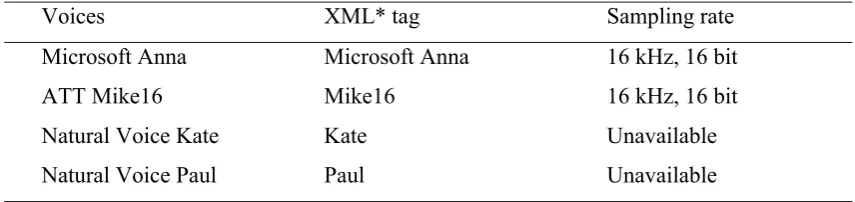
reliable, the offline version of NR was used. As shown in Table 1, four out of 10 American
However, in the present study the teachers used only two of these: Natural voice Kate and
natural voice Paul due to their naturalness.
Table 1:NS voices installed in the NR application
The total duration of the training was about six hours. It was three hours longer than initially
planned because teachers needed more time to become familiar with the TTS application in
order to use it properly. Although teachers spent more hours to adapt the new TTS
#'+( ilst the training sessions as a
challenge to promote the integration of TTS technology in their listening classroom (see
Evans-Andris, 1995).
The Development Procedures
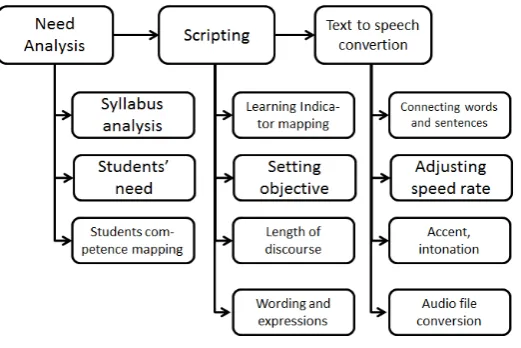
The development of the NLS EFL listening covered three stages including a needs analysis,
scripting, and text-to-voice conversion (see Figure 1). Under a needs-analysis framework, a
needs analysis was done to connect the instructional tasks to real-world target tasks (see Long
& Crookes, 1992).
Voices XML* tag Sampling rate
Microsoft Anna Microsoft Anna 16 kHz, 16 bit
ATT Mike16 Mike16 16 kHz, 16 bit
Natural Voice Kate Kate Unavailable
Natural Voice Paul Paul Unavailable
Figure 1: The NLS Development procedure
In the preparation for the listening scripts, teachers first set learning objectives and
planned listening comprehension materials. Teachers searched for references from the course
books and internet web pages to develop a listening script. The script was developed to be of
between 2-4 minutes in duration. Since teachers were granted access to the development of # ' # ((Milton, 2005, p. 252). During the process of script writing, teachers were given information on how to rotate the script with pauses, speed of the
voice, and expressions. Teachers were taught to use some tagged texts already available on
the TTS application to attribute pauses, speeds, and expressions in the script. Some examples
of the tagged texts are shown below:
<set xml=true><VOICE REQUIRED="NAME=Kate" ><set xml=true><rate speed="-1" > I'm really sorry <set xml=true><silence msec="10000" / > I don't mean it
<set xml=true><silence msec="10000" / >
<set xml=true><VOICE REQUIRED="NAME=Kate" ><set xml=true><rate speed="-1" ,)-$.,-./01111/2,
However, teachers experienced difficulty in inserting such tagged texts into the script.
Teachers were not familiar with XML and its use was seen to be complicated for them.
Alternatively, teachers were trained to use dot (.) and comma (,) to replace XML code for
(Teacher clicks the speaker menu, selects Natural Voice Kate)
3 ,
.
3
(Stop, or convert to audio file)
(Create new audio file)
(Teachers clicks speaker, selects Natural Voice Paul) .
.
) .
(Stop, or convert to audio file)
(Teachers merge the audio files)
Soon after the script was ready, the teachers converted it into speech using the NR
application. This text-to-voice conversion was done directly from the add-in menu in the
4%!3*#e speeds range from -10 to
10, with 0 as the default. In the study, the speed of NS voice was set within the range of -1 to
0. Some pauses were also added between sentences to control the speed. An additional sound
modification application was utilized to merge some audio files created. Teachers used output
frequency 48 kHz 16 bit stereo to produce an audio file. This 48kHz output is believed to
ensure the highest quality of sound (Mulyono, 2014; Sha, 2010). Finally, the produced NLS
voice was then converted into *.mp3 audio file format with 128 kbit rate and saved in a local
drive. The conversion into *.mp3 was applied to allow teacher to play the audio file from
their mp3 player and share it with colleagues.
FINDINGS AND DISCUSSIONS
7HDFKHUV¶DQGPupils¶ Perceptions
The two teachers in the present study responded positively about the NLS materials.
Teachers said that the NLS materials corresponded to their classroom needs. The TTS
application had facilitated the teachers in self-developing listening materials that suited the
suggested an appropriate pronunciation model for both teachers and their pupils. Teachers
also opined that the NLS materials suited the English competency of the pupils and fitted the
context of their daily life. Teacher A commented:
“The NR application is very helpful in that I can create listening materials based upon my needs and the pupils’ as well. However, it provides only about 90% of all the things needed.”
Additionally, teacher B commented:
“You know, I tend to skip the listening session because I faced many obstacles, particularly in providing the materials. I used to get the listening materials from course book’s CDs and British
Council. … However, the materials did not suit the standard of
competence as in the learning syllabus and the materials were not appropriate to the pupils’ ability; for example, the native voice was too fast, and the vocabulary used was too advanced for the
pupils’ level. … I tried the NLS materials, and I found that such
materials suited my needs, and the pupils could get the materials based on their level.”
5 as positive. The NLS listening materials at a more appropriate speaking speed provided more opportunities for
them to comprehend. Compared to the listening materials pupils used to use, a large number
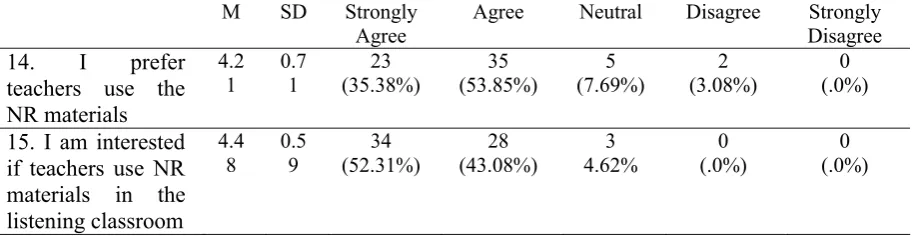
of pupils (89.23%, n=65) expressed their preference for having the NLS materials in the
classroom (see Table 2). Furthermore, 95.39% of the pupils felt that they were motivated
with such use of NLS materials.
Table 2: Profile of pupils’ perception of the NLS materials
M SD Strongly Agree
Agree Neutral Disagree Strongly
Disagree
14. I prefer teachers use the NR materials 4.2 1 0.7 1 23 (35.38%) 35 (53.85%) 5 (7.69%) 2 (3.08%) 0 (.0%)
The finding indicates two qualities of NLS materials that s, such as intelligibility and comprehensibility. From the intelligibility aspects, teachers perceived that the NLS sound from the audio file was clear so
that pupils could understand the information conveyed. Additionally, the NLS materials may
serve well as a pronunciation model for their pupils during the listening comprehension. The
clear and natural sounding speech from the NLS in the materials also encouraged the two
teachers to use such materials to practise their own English pronunciation. Teacher A
commented:
'Although there is a little problem with the sound, 90% of it works. I could provide listening materials based on the pupils’ ability and the needs of the curriculum. … Also, I sometimes use it to improve my pronunciation ability.”
However, the finding showed that some L1 words were mispronounced. Teacher A said:
“The learning objective of the English teaching at the junior
secondary school is specifically to enable pupils to use English in their daily life, understand things that pupils meet every day, or that are closer to them … When talking about a park, for example, pupils are familiar with “Taman Mini.” As I converted such a name into the NR application, it was pronounced quite weirdly.”
From the comprehensibility aspect, the study found that the pupils were better able to
understand the information from the NLS materials when the speech rate was lowered to -1.
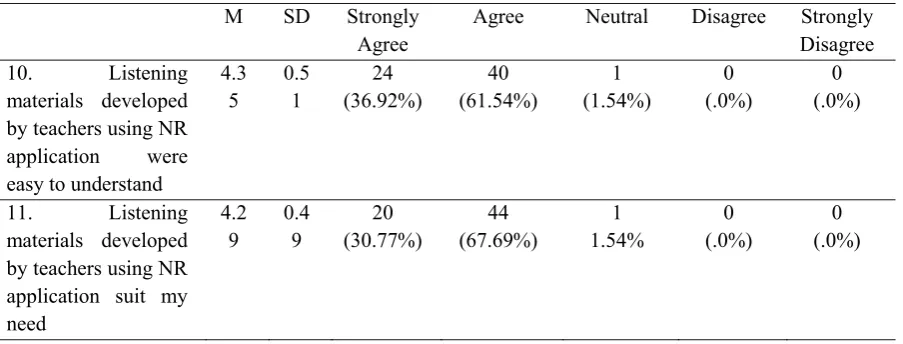
In total, 98.46% (n=65) of pupils expressed that the materials developed by teachers using
the TTS application were easy to understand (see Table 2). Most of the pupils (98.67%) also
opined that the materials suited their needs.
Table 3: Pupils' perception of the comprehensibility aspect
M SD Strongly
Agree
Agree Neutral Disagree Strongly
Disagree 10. Listening
materials developed by teachers using NR application were easy to understand
Asked about the reasons for modifying the speed rate, teacher B acknowledged that such a ! She reasoned:
“… I adjust the materials to their ability, so they could easily understand them and catch the meaning.”
However, the finding showed that such a modification disadvantaged the NLS materials
with a rough voice transition sound that distracted their naturalness. Teachers reported that,
during the text-to-speech conversion, the pitch of one word to another from the NLS
materials did not seem very stable and, therefore, sounded like a robot. The natural voice
Kate and Paul did not seem quite as natural sounding as their developer claims. Teacher B
said:
“The problem appears when we adjust the speed of the voice. Sometimes after the conversion, the voice sounded a bit flat though the pupils still could manage to understand.”
The above findings on speed modification confirm those of earlier studies that a reduced rate
may (Griffiths, 1990, 1991; Zhao,
1997). Likewise, the additional pauses on the NLS materials suggest factors contributing to
ion (Zhao, 1997). Pupils have more time to
understand the information from the NLS materials due to the reduced the rate and
additional pauses. However, despite these benefits, such an attempt significantly causes the
distortion of NS speech, and, therefore, may alter its naturalness (Flaherty, 1979; Griffiths,
1990, 1991). Sha (2010) argues that the alterations of the naturalness of the voice ensues at
the same time as the modification is made. He states that if the speed of the voice is reduced,
all vowels, pauses and particular voiced consonants are strained accordingly; yet, voiceless
consonants remain unaffected. This unnatural sound eventually affects the quality of the
prosodic voice of the NLS materials.
The findings show that the voice produced by TTS application was similar to native
English speaker and comprehensible. Although the prosodic sound quality of the NLS
materials is low, the study demonstrates that such a low quality does not directly to influence !) responded that they were not concerned with whether or not the NLS materials sound natural. Pupils
responded that they could still comprehend the information from the NLS materials
(1998) earlier study indicating that the synthetic speech has shown to be more difficult for
pupils either to listen or to comprehend compared to a natural voice. Delogu et al., whose
study was participated in by 15 young adults aged between 19 and 23, argue that the
synthetic voice requires more cognitive and memory capacity for young adults to listen to
and comprehend than those listening to natural speech. The difference of these two findings can particularly be explained from the listener age. Many leading researchers on TTS
one of various factors that may affect the
intelligibility of voice produced by a TTS system (Jones, Berry, & Stevens, 2007). The pupil
participants of this study, aged 13-14, were secondary pupils with limited knowledge of
English. According to Sha (2010), these pupils, who were beginners in English, were
unlikely to be familiar with different accents of English, and thus are considered prosody
deaf. This prosody deafness has made them unable to distinguish accents from different
English speakers. Accordingly, the modification of sound which resulted in the alteration of
the prosodic sound quality may not affect their apprehension towards the information given
through the TTS product.
The study shows that speech modification done by the two teachers in the TTS
system thus appears as a dubious solution. The reduction of the speech suggests some
benefits for EFL learners, yet it concurrently lowers the quality of sound produced by the
system. Such a condition remains unchanged unless the default NS speed is appropriate for the learners and is available (Zhao, 1997). Nevertheless, th comprehension towards the information from the NLS materials is not significantly affected
by its prosodic sound quality. This finding, therefore, has indicated that despite its low
prosody sound quality, the TTS voice can still be used for listening comprehension materials
in an EFL classroom, in particular for pupils with low proficiency of English.
Contribution to THDFKHUV¶ Teaching Practices
The result of this
comprehension grows when they were able to develop the listening materials themselves
using TTS application. From classroom observation, teachers were shown enthusiastic to
learn and utilize the NR application to develop NLS listening comprehension materials. The
two teachers participating in the study said that the NR application was a new technology for
classroom instruction, particularly in listening sessions. Accordingly, teachers were shown
to promote their strong commitment to the development of NLS listening materials.
The two teachers worked collaboratively during the development of the NLS
listening comprehension materials. They set instructional objectives together, and
collaboratively developed the learning materials. The two teachers were open for critiques
and accepted suggestion from the researchers. During the text-to-speech conversion stage,
teachers shared knowledge and discussed the difficulty they encountered together. As
teachers perceived the NLS materials to fit the learning syllabus as well as the classroom
needs, teachers were committed to developing more NLS materials and using them in their
listening classrooms.
The findings also show
their interaction with the new technology such as NR. Eventually, having benefitted from
the technology integration in the NLS listening material development, they shared their
experiences with other colleagues and invited them together to develop NLS materials for
their pupils. Teacher A said:
“A few days ago I shared about this (using Natural Reader for
listening comprehension) with my friends, and they were interested to initiate such use as well.”
) to
develop the instructional material using the TTS application contributes to their teaching
confidence as well as a strong commitment to such use of NLS materials in classroom
practice. Teachers in the study found that they were capable of using technology and serving ppropriate listening materials. 3#
has !3
in the study had already possessed positive attitude towards technology as well as
self-efficacy for computer use. Teachers were also given supervision during the development of
NLS materials. The findings confirm an earlier study conducted by Drent and Meelissen
(2008). Drent and Meelissen found that teachers with solid internal motivation to improve
the quality of their teaching practice tend to take the initiative to achieve their goals.
4# educational experts for their
professional development is believed to influence the innovative use of technology (Drent &
Meelissen, 2008). ) #computer
knowledge teachers gained from the overall process of the development of listening
comprehension materials using technology contributes to their personal professional
development.
CONCLUSIONS
The TTS application like Natural Reader has given EFL teachers a greater opportunity to
self-develop their own native-like but still comprehensible listening materials. Teachers and
their pupils perceived the NLS materials positively and felt that such materials met EFL
listening classroom needs. In addition, the computer training addressed what the teachers needed and accordingly !) during the NLS listening material development facilitated them to share knowledge and discuss the
challenges they met together. It should be noted that teachers participating in the study had a
positive attitude towards the use of technology in the EFL classroom prior to the experiment. % # development of listening materials using TTS applications may vary. While this study practices, it involved just two teachers and their classrooms, which is a small sample size.
The result thus may not be generalizable.
REFERENCES
Adnan, A. (2012). Pengajaran menyimak bahasa Inggris: Masalah dan solusinya. Lingua Didaktika: Jurnal Bahasa dan Pembelajaran Bahasa, 6(1).
Árva, V., & Medgyes, P. (2000). Native and non-native teachers in the classroom. System, 28(3), 355-372.
Baylor, A. L., & Ritchie, D. (2002). What factors facilitate teacher skill, teacher morale, and perceived student learning in technology-using classrooms? Computers & Education, 39(4), 395-414.
Brindley, G., & Slatyer, H. (2002). Exploring task difficulty in ESL listening assessment. Language Testing, 19(4), 369-394.
Brown, H. D. (2004). Language assessment: Principles and classroom practices. New York: Longman.
Cahyono, B. Y., & Widiati, U. (2010). The teaching of EFL Listening in the Indonesian context: The state of the art. TEFLIN Journal, 20(2), 194-211.
Chang, A. C.-S., & Read, J. (2006). The Effects of listening support on the listening performance of EFL learners. TESOL Quarterly, 40(2), 375-397. doi: 10.2307/40264527
Damper, R. I., Marchand, Y., Adamson, M. J., & Gustafson, K. (1999). Evaluating the pronunciation component of text-to-speech systems for English: a performance comparison of different approaches. Computer Speech & Language, 13(2), 155-176. Davies, A. (1991). The native speaker in applied linguistics. Edinburgh Edinburgh University
Press.
Delogu, C., Conte, S., & Sementina, C. (1998). Cognitive factors in the evaluation of synthetic speech. Speech Communication, 24(2), 153-168.
Drent, M., & Meelissen, M. (2008). Which factors obstruct or stimulate teacher educators to use ICT innovatively? Computers & Education, 51(1), 187-199.
Ertmer, P. A. (2005). Teacher pedagogical beliefs: The final frontier in our quest for
technology integration? Educational Technology Research and Development, 53(4), 25-39. doi: 10.1007/BF02504683
Evans-Andris, M. (1995). Barrier to computer integration: micro-interaction among computer co-ordinators and classroom teacher in elementary school. Journal of Rsearch on Computing in Education, 28, 29-45.
Firman, H., & Tola, B. (2008). The future of schooling in Indonesia. Journal of International Cooperation in Education, 11(1), 71-84.
Flaherty, E. (1979). Rate-controlled speech in foreign language education. Foreign Language Annals, 12(4), 275-280.
González, D. (2007). Text-to-speech applications used in EFL contexts to enhance pronunciation TESL-EJ Journal, 11(2).
Griffiths, R. (1990). Facilitating listening comprehension through rate-control. RELC Journal, 21(1), 55-65.
Griffiths, R. (1991). Pausological research in an L2 context: A rationale, and review of selected studies. Applied Linguistics, 12(4), 345-364.
Handley, Z. (2009). Is text-to-speech synthesis ready for use in computer-assisted language learning? Speech Communication, 51(10), 906-919.
Handley, Z., H, & Hamel, M.-J. (2005). Establishing a methodology for benchmarking speech synthesis for computer-assisted language learning (CALL). Language Learning & Technology, 9(3), 99-120.
Harashima, H. D. (2006). Review of "VoiceText". Electronic Journal of Foreign Language Teaching, 3(1), 131-135.
Harmer, J. (2007). The practice of English language teaching (4th ed.). Essex: Pearson Education Limited.
Hasan, A. S. (2000). Learners' perceptions of listening comprehension problems. Language, Culture and Curriculum, 13(2), 137-153.
Hew, K., & Brush, T. (2007). Integrating technology into K-12 teaching and learning: current knowledge gaps and recommendations for future research. Educational Technology Research and Development, 55(3), 223-252. doi: 10.1007/s11423-006-9022-5 Hyltenstam, K. (1988). Lexical characteristics of near-native second-language learners of
Swedish. Journal of Multilingual & Multicultural Development, 9(1-2), 67-87. Jeneatte, L. (2002). Setting up a course in ICT for language teachers: Some essential
considerations. CALL-EJ, 4(1).
Jones, C., Berry, L., & Stevens, C. (2007). Synthesized speech intelligibility and persuasion: Speech rate and non-native listeners. Computer Speech & Language, 21(4), 641-651. Jourdain, S. (2000). A native-like ability to circumlocute. The Modern Language Journal,
Kilickaya, F. (2006). 'Text-to-speech technology': What does it offer to foreign language learners? CALL-EJ, 7(3).
Kurniati, A. D. (2012). My native speaker teachers: A language learning reflection. Ekspresi, X, 11-18.
Lawless, K. A., & Pellegrino, J. W. (2007). Professional development in integrating
technology into teaching and learning: Knowns, unknowns, and ways to pursue better questions and answers. Review of Educational Research, 77(4), 575-614. doi:
10.2307/4624911
Lee, J. J. (2005). The native speaker: An achievable model? Asian EFL Journal, 7(2), 152-163.
Long, M. H., & Crookes, G. (1992). Three approaches to task-based syllabus design. TESOL Quarterly, 26(1), 27-56. doi: 10.2307/3587368
Major, R. C., Fitzmaurice, S. F., Bunta, F., & Balasubramanian, C. (2002). The effects of nonnative accents on listening comprehension: Implications for ESL assessment. TESOL Quarterly, 36(2), 173-190. doi: 10.2307/3588329
Medgyes, P. (1992). Native or non-native: who's worth more? ELT Journal, 46(4), 340-349. Milton, J. C. P. (2005). From parrots to puppet masters: Fostering creative and authentic
language use with online tools. In B. Holmberg, M. Shelly & C. White (Eds.),
Distance education and languages: Evolution and change (pp. 242-257): Multilingual Matters.
Ming-Kuan, T., & Young, S. S. C. (2010, 12-16 April 2010). Applying speech techniques to practice listening and speaking skills for EFL learners: An exploratory study. Paper presented at the Third IEEE International Conference on Digital Game and Intelligent Toy Enhanced Learning (DIGITEL).
Muljanto, S. (2012). Analysis of barriers in listening comprehension among junior high school students. English Review, 1(1), 78-85.
Mulqueen, W. E. (2001). Technology in the classroom: Lessons learned through professional development. Education, 122(2), 248-256.
Mulyono, H. (2014). Creating native-like but comprehensible listening texts for EFL learners using NaturalReader. TESL-EJ, 18(1).
Nation, I. S. P., & Newton, J. (2009). Teaching ESL/EFL listening and speaking. New York: Routledge.
Schröder, M. (2009). Expressive speech synthesis: Past, present, and possible futures. In J. Tao & T. Tan (Eds.), Affective information processing (pp. 111-126). London: Springer.
Schrum, L. (1999). Technology professional development for teachers. Educational Technology Research and Development, 47(4), 83-90. doi: 10.1007/BF02299599 Sha, G. (2010). Using TTS voices to develop audio materials for listening comprehension: A
digital approach. British Journal of Educational Technology, 41(4), 632-641. doi: 10.1111/j.1467-8535.2009.01025.x
Silviyanti, T. M. (2014). Looking into EFL students' perceptions in listening by using English movie videos on YouTube. Studies in English Language and Education, 1(1), 45-63. Sobkowiak, W. (2003). TTS in EFL CALL - Some pedagogical considerations. Teaching
English with Technology, 3(4), 3-11.
Son, J. B., Robb, T., & Charismiadji, I. (2011). Computer literacy and competency: A survey of Indonesian teachers of English as a foreign language. CALL-EJ, 12(1), 26-42. Suarcaya, P. (2011). Web-based audio materials for EFL listening class. TEFLIN Journal,
22(1).
Sulistyawati, H. (2013). Authentic listening materials: Benefits, challanges, and how they can be used for teaching listening. Paper presented at the 60th TEFLIN International Conference, Depok.
Xu, S., & Connelly, F. M. (2009). Narrative inquiry for teacher education and development: Focus on English as a foreign language in China. Teaching and Teacher Education, 25(2), 219-227.