An in-‐depth review of the scientific and policy
issues associated with additive manufacturing
Adeola I. Adediran, Andrzej Nycz & Lonnie J. Love
Manufacturing Systems Research, Energy and Transportation Science Division, Oak Ridge National Laboratory, 1 Bethel Valley Rd, Oak Ridge, TN 37831
Corresponding author: [email protected]
Keywords:
Additive Manufacturing, 3D printing, 3D Printing Cost, Error Risk, Part Failure,
Manufacturing Regulation, Direct Metal Laser Sintering, Manufacturing Optimization.
Executive Summary: Historically, manufacturing processes have been predominantly subtractive, i.e. three-‐dimensional objects were created by successively cutting material away from a solid block, by scraping, machining, turning or dissolving. Additive manufacturing (AM) or three-‐dimensional (3D) printing, in contrast, is controlled material addition, implemented by successively depositing layers of material until a predesigned shape is formed. AM represents an innovative manufacturing technology, and is set to transform production processes from design to manufacture, and to eventual distribution to end users, ultimately leading to an increase in energy efficiency and a reduction in gas emissions for future generation of industries. The unique capability of this technology to produce intricate geometries with customizable material properties has made it a widely interesting and welcome development among scientists, industry and the general public. Its wide acceptance has continued to make 3D printing technology more openly accessible, and low-‐ cost desktop printing, with the capability to reproduce 3D objects from medical prostheses to weapons, is rapidly increasing in availability to the public. However, most research and media attention has been focused on the ingenuity of this ground-‐breaking technology and its wide range of possibilities. Very little consideration is being given to the adverse effects of the seemingly unstoppable advancement of AM technology and unrestricted access to 3D printing techniques. Also, proponents of AM technology rarely take into account the overall life-‐cycle cost and risks of failure of the manufactured part. Despite the promising prospects of this novel development, there are still concerns about how printed products will perform over time, the consistency of their quality, and the types and safety of materials used with this technology, especially with very large-‐ scale additive-‐manufactured products. This paper brings to light some scientific and policy risks and challenges concerning the material science and engineering aspects of these issues. Matters discussed include life-‐cycle cost analysis, end-‐product safety and quality assurance/control, regulation gaps, digital piracy, and resulting loopholes in safety and national security. The paper also presents potential options for curbing these risks, and otherwise adapting to the eventualities which, with certain inevitable factors in play, may lie beyond control.
Background and Prospects of Additive Manufacturing Technology
Many industrial applications for Additive Manufacturing (AM) have been developed over the last few years. Industries such as aerospace, automotive and medical are embracing the advantages of AM and implementing the technology successfully. Although additive manufacturing systems have been used by aerospace
prospects in these industries are already growing
fast. For instance, Airbus is exploring 90 separate cases where AM might be applied on its next generation commercial aircraft. GE Aviation is also set to manufacture up to 100,000 parts with AM by 2020. Four supposedly critical aspects the aerospace industry expects to derive value from additive manufacturing have been identified: reduction of lead times, reduction of component weight, reduction of production and operational costs, and reduction of the negative environmental impacts of production.
In the automotive industry, likewise, strides are being made to work toward a holistic approach for metal-‐based additive manufacturing. Audi, a German automobile maker, and EOS, an e-‐ manufacturing solutions company, are now coming together to focus on high-‐end solutions centered around additive manufacturing. The premium automobile maker is said to be set to operate its own AM solution as it implements technology and learns from the expertise of EOS, creating a new Ingolstadt-‐based 3D printing center.
The advantages of additive manufacturing are now widely recognized, and are being projected to transform manufacturing processes for many industries. From the building of customized prosthetic limbs and of body tissues from living cells to the design of limited edition jewelry, to scientists recreating a life-‐size replica of the Shelby Cobra sports car, the range of possibilities of 3D printing technology is already vast.
With more companies developing production equipment, more materials becoming available and more end-‐user industries adopting the technology, it has been predicted that the growth in the Additive Manufacturing industry will be a rapid and substantial one. Wohlers Associates – industry experts in providing technical and strategic consulting on the new developments and trends in rapid product development and additive manufacturing – reported in 2013 that the market for 3D printing, consisting of all products and services worldwide, grew by 24.1% in 2010, 29.4% in 2011, and 28.6% in 2012 (from $1.714 billion in 2011 to $2.204 billion in 2012). The average annual growth (CAGR) of the industry over the past 25 years is estimated to be 25.4%. The 3D printing industry is expected to continue strong double-‐digit growth over the next several years, with the global value of the industry currently estimated to reach
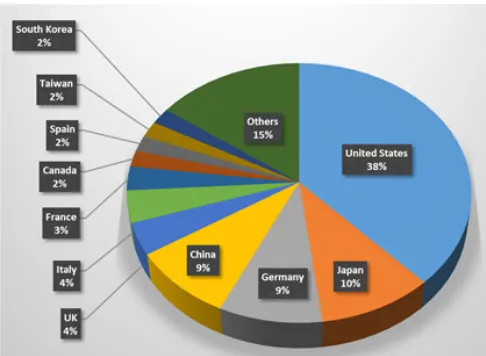
over $10 billion by 2021. A regional breakdown of the introduction of metal AM machines published in the 2012 Wohlers report also validates that the industry is a truly global one, and governments around the world have identified AM as a growth industry and are funding research projects to further develop the technology.
Table 1: Expected growth in global value of AM products and services.
Fig. 1: Global share in terms of the number of metal powder Additive Manufacturing machines introduced
3D printing has been described as a disruptive technology because, due to a reduction in cost and the development of direct metal technologies, we are able to visualize a disruption in the manner in which products are being made in virtually all industries — architecture, consumer products, construction, industrial design, automotive, aerospace, food, engineering, biotechnology and fashion. The additive
AM INDUSTRY (PRODUCTS AND SERVICES)
WORLDWIDE PROJECTED VALUE
2015 $4 billion
2017 $6 billion
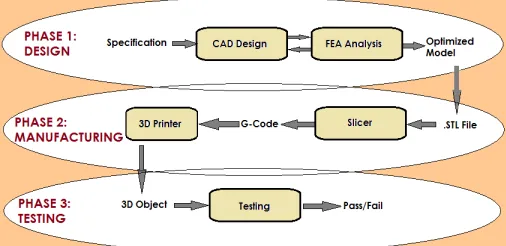
manufacturing process occurs in a series of phases,
each with multiple steps. A typical additive manufacturing process chain is shown in Figure 2. The process includes computer-‐aided design, finite element analysis, and computer-‐controlled AM followed by testing and assembly.
Fig. 2: Outline of additive manufacturing process chains
The design phase includes computer-‐aided design (CAD) and finite element analysis (FEA). The product is modelled based on the desired dimensions, properties and functionalities. The manufacturing phase – where the AM process begins to diverge from traditional manufacturing – includes slicing the 3D model and printing the object. The final design of the object is converted to *.STL (STereoLithography) format, and then into a tool path code which encodes the motion of the printer head along x, y, and z directions, the amount of material to extrude, and the movement speed of the head. During this step, the tool path code is loaded into the printer and the object is produced. Finally, for quality control or validation, a prototype printed part may be subjected to either destructive or non-‐ destructive mechanical and physical testing.
Additive manufacturing techniques offer a higher degree of creative flexibility, allowing the use of multiple materials in the course of construction, as well as the ability to print multiple colors and color combinations simultaneously. Parts can now be created with complex geometries and shapes that in many cases are impossible to create without 3D printing. For example, the technology is particularly attractive for the processing of advanced materials such as titanium, where conventional processes can be excessively expensive, and with some alloys which can only be manufactured under high cooling rates.
Problem Statement
Metal AM does offer new possibilities, not only in design, but also in the choice of materials. However, these alluring capabilities also bring with them serious concerns that seem to be going unheeded, and data suggests that those risks could end up costing several industries billions of dollars. Potentially costly issues surrounding the continued development and adoption of the process, and which require some careful thought and attention, are outlined here.
Firstly, although the material properties and equipment employed in additive manufacturing have been highly rated in reliability by industry practitioners, the additive process is less mature than the conventional subtractive processes. Scientifically, there is a concern about how these printed products will perform over time, the consistency of their quality, and the types and safety of materials used with the technology.
Secondly, and from a policy standpoint, there are concerns about the adverse effects of unrestricted access to 3D printing techniques. 3D printing technology, as stated earlier, has been described as disruptive. However, it is thought that the process of 3D printing is not the real disruption, but the fact that anyone is free to own a 3D printer and create seemingly anything imaginable, from human bones to product parts. Consumers are now having access to 3D systems at retail stores allowing them to create their own products at home. Anyone today can begin creating and selling a variety of products even from the comfort of their homes. Over time, mass quantities of uninspected products, with a high risk of failure, may flood the market. This presents quality control gaps and has the potential to impact both public safety and national security. The introduction of a turnkey solution to manufacturing coupled with growing freedom of use thus forms the basis of the policy concerns regarding end-‐product integrity.
A second policy concern is the potential for increased digital piracy due to the presence of easily distributable digital content in the additive manufacturing process. The impending challenge of preserving intellectual property rights could amount to huge revenue losses.
additive manufacturing is both higher in cost, and
more cost-‐effective, compared to traditional manufacturing techniques. Due to the complexities of measuring additive manufacturing costs however, current studies are limited in their scope. Many of the current studies examine the production of single parts. Those that examine assemblies tend not to examine supply chain effects such as inventory and transportation costs along with the benefit of decreased risk to supply disruption. It is therefore not very certain that additive manufacturing yields significant cost savings compared to conventional methods, making it very possible to be, in fact, overall more expensive.
I. Safety and Part Failure Risk
• Does lighter weight retain safety?
Across many industries, manufactured parts are being redesigned for weight savings through additive manufacturing. In aerospace manufacturing research, there is the desire to drive down the cost and weight of aircraft, and improve economy and design aesthetics. Weight costs fuel, and attempts to decrease cost and conserve energy eventually come down to cutting off excess weight from all parts on an airplane. Eliminating one pound in weight from a Boeing 737 (which weighs about 65 metric tons), can save hundreds of thousands of dollars per year. Per GE’s estimate, more effective part designs could save about $10 million or more throughout the industry. Different industries have likewise indicated readiness to pay for weight reduction, with spacecraft, aircraft and automobile industries willing to pay up to about $10,000, $1,000 and $10 respectively per kilogram of weight reduction. However, there remains a requirement to adhere to stringent Federal Aviation Administration (FAA) regulatory and compliance standards. Complex additive manufacturing processes must therefore be developed to meet the industry’s stringent requirements and to ensure that products can achieve the robust performance levels established by traditional manufacturing methods. This could pose a challenge in that achieving these standards with additive manufacturing may be more cumbersome and introduce more undesirable alterations than with traditional manufacturing. Also, the research into lighter-‐weight printed products may require materials such as plastics and nanofibers that are new to a manufacturer.
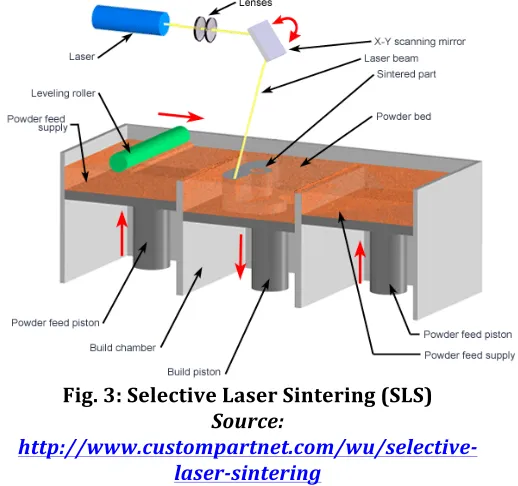
Contaminated, defective, or incorrect materials may result in a faulty product. Eventually, the materials used may even create an overall greater failure risk than those presented by the 3D printer itself . Considering this, and for a better acceptance of AM, barriers in terms of application knowledge and standards for material quality need to be overcome. As a case study, GE Aviation – one of the top aircraft engine suppliers – is planning to use laser powder bed additive manufacturing to print high performance parts on a new jet engine. The process, also known as Selective Laser Sintering (SLS) is an AM technique that uses a laser to sinter powdered material, typically metal, with the laser automatically aimed at points in space defined by a 3D model, binding the material together to create a solid structure. A schematic representation of this process is shown in Figure 3.
Fig. 3: Selective Laser Sintering (SLS)
Source:
http://www.custompartnet.com/wu/selective-‐ laser-‐sintering
internal combustion engine. The excess of air in a
lean-‐burn engine combusts more of the fuel and emits fewer hydrocarbons. High air-‐to-‐fuel ratios can also be used to reduce losses caused by other engine power management systems such as throttling losses.) Engine designers claim additive technology can optimize fuel and air mixing, a key component of designing a good fuel nozzle, and also presents the freedom to generate hidden channels and complex geometries that are otherwise near-‐ impossible to fabricate with ordinary welding or machine tools.
The additive manufacturing process is also said to solve a major problem in fuel nozzle design – fuel nozzle coking. Traditional fuel nozzles spray fuel into the combustor at temperatures as hot as 3000 degrees, which gradually leads to the deposition of carbon on the inside of the nozzle, reducing the fuel spray efficiency and engine durability. The additively manufactured nozzle is supposed to eliminate coking with its internal support ligaments and cooling pathways incorporated into its design, making the part up to five times more durable than its machined equivalent. The success of this process would also open up the possibility of redesigning several aircraft components, potentially allowing engineers to save massive amounts of weight across multiple components on an aircraft engine. On the other hand, the failure of the process, particularly of the engine parts produced and used in aircrafts, could lead to accidents and massive losses of life, revenue and infrastructure. Thus, while additive manufacturing offers significant advantages in terms of light weight, there is a need for an introduction of government regulation and inspection to reinforce or review quality and safety standards.
• Risk Mitigation Efforts in the Industry
Large scale additive manufacturing is already being vigorously explored, especially in the aerospace industry. However, although the material properties and equipment employed in this venture have been highly rated in reliability by industry practitioners, the technology is still undergoing maturity, and therefore, the assurance of safety in using 3D-‐ printed parts is justifiably queried. The level of awareness and acknowledgement of the associated risks by major industry players applying AM technology in their operation is thus brought under scrutiny. The Federal Aviation Administration, for instance, says it is making efforts to understand the implications of 3D printing in the aerospace industry.
The aerospace industry further assures safety of these parts in that, to meet the stringent conditions necessary to ensure safety in air travel, manufacturers are inherently required to satisfy a long list of complex requirements for even the simplest part, and that in addition, the consistent production of parts with identical, well-‐understood properties requires that both materials and production processes be understood to a very high level.
It has also been argued that topology optimization process adds a whole new dimension to metal 3D printing, and can often consolidate multi-‐part assemblies into a stronger single part. This is said to be capable of reducing the likelihood of part failure by eliminating fasteners and connectors, although the process is still largely under development, and has not yet been proven to be satisfactorily effective in practical application.
While these claims suggest that some conscious efforts are being made to address the risks surrounding the adoption of AM technology, the sufficiency of these claims in assuring of product reliability and consumer safety is questioned, considering the gravity of the implications of a 3D-‐ printed part failure.
II. Policy Concerns
• Quality Assurance and Quality Control Gaps
inherent nature of such machines themselves, and
mode of operation. The relative ease of additive manufacturing thus calls for attention to the fact that the zeal, particularly of unlicensed individuals, to rapidly roll out mass quantities of a printable part could leave a big gap for production of substandard items, leading to part failure and endangering the lives and health of end users.
On another note, even while printing under proper licensing and regulatory conditions, a defective product could still come out of a 3D printer. However, because of the multiple contributors to the production process—the printer manufacturer, software designer, materials supplier, distributor and retailer, identifying who is liable for the failure will be a challenge.
• National Security
Another pressing concern with open access to 3D printing technology is the ability for anyone, anywhere, to eventually have the means of creating a weapon such as a firearm. At present, it may be easier for an individual with criminal intentions to obtain a weapon illegally via other means; however, with the advancement of additive manufacturing technology, and new composite materials being fabricated over the next decade, this issue could become more pronounced. A more troubling prospect involves the technology being used to render detection of weapons and nuclear proliferation more difficult, which by itself makes the case for understanding the possible uses of the technology. According to New York representative Steve Israel, in 1988, when the Undetectable Firearms Act was passed, the notion of a 3D-‐printed plastic firearm slipped through metal detectors and onto planes in secure environments was fiction. The problem is today a reality.
Currently in some countries like Germany and Australia, there are laws requiring a permit in order to purchase a firearm. While this serves to impede unlawful possession of such weapons, this restriction may lose effectiveness if the freedom of owning a 3D printer continues to be open to all. For instance, a simple CAD (Computer-‐Aided Design) file could be downloaded and a gun fabricated within hours. Such weapons will become cheaply available to nearly everyone. Therefore, there will be a need in the very near future for government to come up with means of governing the possession of 3D printers, or otherwise restricting the kind of items that can be
printed, while at the same time ensuring that citizens are not deprived their fundamental rights to freedom.
3D printing technology offers the ability to produce a wide range of objects that cannot be controlled yet, and as noted in a white paper released by researchers at the National Defense University, there are national security risks that need to be analyzed in the near future, and addressing criminal and legal concerns will require active cooperation across multiple agencies in the national security community.
• Intellectual Property (IP) and Digital Piracy
The digitization of physical artefacts allows for global sharing and distribution of designed solutions. It lowers the barriers to manufacturing, and allows everyone to become an entrepreneur. Open-‐source 3D printing technology however also increases the risk of design theft as an original software file could easily be used to produce counterfeit products, given that majority of current digital software recipes are unpatented, allowing copies to be made and sold by anyone.
Expensive designer objects can also be reverse-‐ engineered and sold at a cheaper price. For product managers, this can mean an increased opportunity for counterfeit products to enter the marketplace. While there has not been a tremendous number of IP issues involving 3D printing yet, it could become a major problem in the near future. As more and more 3D models of products are sold online, an entire underground market for these files will certainly emerge, and billions of dollars will be lost due to file sharing.
This potential digital piracy situation is comparable to the way the internet challenged the movie and music industries for copyrights, trademarks, and infringement as a result of illegal downloads. According to new research from Gartner, the negative ramifications of 3D printing for businesses, particularly those that rely on licensing deals and intellectual property (IP) to generate revenue, are going to become an expensive problem in the next few years. The current intellectual property legislation also does not explicitly regulate 3D printing, and will have to rush to catch up with the change in the business market that will be brought about by this technology.
In terms of economics, another issue with AM
technology is that it is yet to be established as a more cost-‐effective alternative to traditional methods, implying a possibility of being overall more expensive in reality, as the technology progresses. Due to the complexities of measuring additive manufacturing costs, current studies are limited in their scope. Some researchers claim that the associated costs could impede the growth and slow down the adoption of additive manufacturing technology, because the cost of fabricating a product using additive manufacturing processes exceeds that of traditional methods in many cases. Current studies reveal that material costs constitute a major proportion of the cost of a product fabricated using additive manufacturing. Today, layer manufacturing is burdened by the still high costs for materials, and more importantly for high-‐end AM machines. In addition to the associated material, processing and tooling costs, additional administrative over-‐head costs, and energy consumption, space rental and ancillary equipment may affect the total cost by 10%. On the other hand, some are of the opinion that AM has a lower cost of manufacture, relative to traditional machine tooling, and that the fact that AM can make manufacturing cheaper will help push the technology out to businesses. Because this form of manufacturing removes the drive for economy of scale, as it is as cheap to produce one item as many, AM is already being used widely in the creation of industrial prototypes. For example, the shoe company Converse is now able to create prototypes swiftly in the West, rather than having to send the designs to its manufacturing base overseas – which is both costly and time consuming. Studies show that additive manufacturing technology is cost effective for manufacturing small batches with continued centralized manufacturing. However, mass production is still not cost-‐effective, but may eventually be, with increased automation.
Although researchers make efforts to engineer more cost-‐effective methods of implementing additive manufacturing technology, some barriers are still encountered. In aerospace research for instance, many high-‐performance polymers are found to be attractive from a cost perspective. However, the high cost of testing for aerospace applications makes focusing on multiple materials simultaneously cost prohibitive. For this reason, and because additive manufacturing processes rely primarily on the input of thermal energy, viable materials for additive
processes must have very specific viscosity and other properties to be processed successfully.
What can be done? – Design and Policy Recommendations
Additive manufacturing is a continually evolving technology and, as the technology matures, there are new materials being engineered, new properties being discovered, and improved processes being employed. Therefore, it is at present impossible to designate specific materials or processes as the safest means of guarding against part failure of additive manufactured parts. The several interconnected components involved in additive manufacturing processes, both in the scientific and in the political, also make it difficult to establish definite policies certain to be effectual in mitigating the challenges of additive manufacturing as discussed. Furthermore, the undeniable rights and freedom of use of personally owned items add more constraints against laying down governing rules to curb the concerns around 3D printing. Nevertheless, properly implemented risk management strategies can alleviate the problems, and some preventive and adaptive approaches, as highlighted here, may be worth considering.
The risk of part failure in 3D-‐printed parts could be managed with a two-‐ended approach, one from the end of the manufacturer, and the other from the end of consumer protection. From the industry end, manufacturing process optimization is the key element. As stated earlier, the additive manufacturing process consists of the design, manufacturing, and testing phases. To achieve an optimal design that meets all the necessary specifications in the design phase, the elastic properties of the material must be known beforehand to conduct the simulations. The knowledge of these properties will guide any modifications made to the design until the final product is attained. Also, real-‐world usage data and finite-‐element analyses should be combined to continuously improve the functionality and integrity of the printed product. In the manufacturing phase, alterations to printing orientation for economic use of the printer can also significantly affect the performance of the final part, and thus should be reasonably minimized.
manufacturing features significant changes in
several manufacturing parameters, which would necessitate considerable revision of the performance metrics focused on. The increased chance of warping for instance, arising from the layer-‐by-‐layer deposition of heated material (a problem not as pronounced in conventional cutting and milling operations), presents a more profound need for checking inter-‐layer bond strength and guarding against products with such thermal defects.
Other policy challenges associated with 3D printing can equally be managed. To approach these challenges, perhaps the first step is to consider what has been done in other industries that have faced similar issues. The possible influx of counterfeit or substandard products and ease of printing dangerous items can be compared to events in the food and drug industry. The US Food and Drug Administration has devised means of ensuring that poisonous or expired foods and drugs are not distributed to consumers. It might be useful to analyze how illegal food and drug manufacturers are monitored and prevented from operation, and a similar solution can be fashioned for the additive manufacturing industry to curb problems arising from open access to 3D printing technology.
In the same vein, the issue of intellectual property and digital piracy could be addressed by considering the evolution of distributable digital media, such as music, videos and movies. The music industry faced major copyright infringement challenges between 1999 and 2001, when a company named Napster founded a peer-‐to-‐peer file sharing internet service, allowing easy sharing of audio files with other participants. Music enthusiasts were able to download for free, copies of songs that were otherwise difficult to obtain. However, following a lawsuit by the Recording Industry Association of America (RIAA), the company was ordered to prevent the trading of copyrighted music on its network. Although this was a corrective measure rather than a preventive one, it would be useful to consider how the music industry has safeguarded intellectual property of its members since, and enact similar measures to protect digital software, and reduce the opportunities for counterfeit products to enter the marketplace.
Furthermore, it could be possible to enforce restrictions against redistributing CAD files and reproducing 3D parts. One way to restrict redistribution would be to design printing machines
to only be able to print items that have proper printing permissions. This would mean either that such machines accept only self-‐designed CAD drawings of parts using some form of authentication, or that procured CAD files will be required to have appropriate permissions encrypted within, before they can be printed. This strategy could also be extended to ensure that appropriate quality assurance and quality control standards are followed for 3D-‐printed parts; some sort of digital authorization could be incorporated into the process to allow only parts endorsed as safe or fit for printing to be reproduced on a 3D printer.
Finally, a few cost-‐cutting strategies can be employed in additive manufacturing processes. The cost of raw materials can be reduced through economies of scale as additive manufacturing is increasingly adopted. The reduced cost in raw material might then propagate further adoption of additive manufacturing. Researchers further suggest that there may also be economies of scale in raw material costs if particular materials become more common rather than an excess of different materials. Technologies can also often be adopted alongside each other, with greater benefits than if they were adopted individually. For instance, laser sintering has a relatively low investment costs compared with other additive technologies.
Also, experts affirm that additive manufacturing of metal parts combined with part redesign can have a positive repercussion on cost saving, and modifying the component shape to exploit AM potentialities could yield significant cost reduction.
Conclusion and recommendation for further study
AM is a prospective game changer with implications and opportunities that affect not just individual industries, but the economy as a whole. Some liken it to the next industrial revolution. In terms of economics, AM has the potential to lower the costs from design to manufacturing, and with additive techniques, several parts made of the same material can be replaced by one integrated assembly, thus largely reducing cost, time and quality problems resulting from assembling operations. Assembly cost is also minimized through part consolidation.
few concerns that can result in grave economic,
environmental and even human loss. Additional safety concerns associated with additive manufacturing, other than those discussed in this paper, will need to be studied further. For instance, the safety of the 3D printing process for consumer use, will also need to be reviewed. Areas in need of attention are hazard concerns such as thermal radiation, fumes and other associated risks that might make the self-‐owned 3D printing systems a safety compromise. With the growing open access to 3D printing technology, the process also needs to be entirely safe for deployment in homes or other non-‐ traditional manufacturing environments that do not
have standard operational safety guidelines incorporated in their setup.
Because of its remarkable ability to produce a wide variety of objects, AM can have significant national security implications and a much more complicated production scenario than the business and manufacturing world typically encounters. Therefore, to fully harness the present-‐day benefits and future potential of 3D printing technology, it is wise to carefully assess the multiple potential risks for today as well as potentially unknown risks that will continue to evolve as the technology revolutionizes the face of manufacturing.
References
3DPrint. "3 Dangers Society Faces from 3d Printing." 3DPrint.com, https://3dprint.com/81526/3d-‐
print-‐dangers/.
Adediran, Adeola, and Akinola Oyedele. "Operational Aspects and Regulatory Gaps in Additive Manufacturing." In Additive Manufacturing Handbook: Product Development for the Defense
Industry, edited by Vhance V. Valencia and David
Liu Adedeji B. Badiru, 7: Taylor and Francis/CRC Press, Boca Raton, FL, 2017.
Alec. "3d Systems Completes Ge Aircraft Bracket Challenge with Metal 3d Printing Solution."
http://www.3ders.org/articles/20160505-‐3d-‐ systems-‐completes-‐ge-‐aircraft-‐bracket-‐
challenge-‐with-‐metal-‐3d-‐printing-‐solution.html.
Atzeni, Eleonora, and Alessandro Salmi. "Economics of Additive Manufacturing for End-‐Usable Metal Parts." The International Journal of Advanced
Manufacturing Technology 62, no. 9-‐12 (2012):
1147-‐55.
Bindl, Stefan. "Driving the Future of Metal Additive Manufacturing: Eos Tells Us About Their Partnership with Audi." By Sarah Anderson Goehrke (2017).
Brugger, Tim. "The Dark Side of 3d Printing."
http://www.aol.com/article/2014/02/05/the-‐
moral-‐dilemma-‐of-‐3d-‐printing/20823680/.
Campbell, Thomas, Christopher Williams, Olga Ivanova, and Banning Garrett. "Could 3d Printing Change the World." Technologies, Potential, and Implications of Additive Manufacturing, Atlantic
Council, Washington, DC (2011).
Conner, Brett P, Guha P Manogharan, Ashley N Martof, Lauren M Rodomsky, Caitlyn M Rodomsky, Dakesha C Jordan, and James W Limperos. "Making Sense of 3-‐D Printing: Creating a Map of Additive Manufacturing Products and Services."
Additive Manufacturing 1 (2014): 64-‐76.
CustomPartnet. "Selective Laser Sintering."
http://www.custompartnet.com/wu/selective-‐
laser-‐sintering.
GE. "Additive Manufacturing." In GE Imagination at work. GEGlobalResearch. "3d Printing Creates New Parts for
Aircraft Engines."
http://www.geglobalresearch.com/innovation/3
d-‐printing-‐creates-‐new-‐parts-‐aircraft-‐engines.
Greenberg, Andy. "As Plastic Firearm Ban Passes House, 3d-‐Printed Guns Fair Game for Now." Forbes, 2013.
Isaza, JF, and PC Aumund-‐Kopp. "Additive Manufacturing with Metal Powders: Design for Manufacture Evolves into Design for Function." Powder Metall.
Rev 3, no. 2 (2014): 41-‐50.
Kang, Hyun-‐Wook, Sang Jin Lee, In Kap Ko, Carlos Kengla, James J Yoo, and Anthony Atala. "A 3d Bioprinting System to Produce Human-‐Scale Tissue Constructs with Structural Integrity." Nature
biotechnology 34, no. 3 (2016): 312-‐19.
Krassenstein, Brian. "Ornl 3d Prints Working Shelby Cobra Replica -‐-‐ President Obama Approves." 3DPrint.com, https://3dprint.com/36433/3d-‐
printed-‐shelby-‐cobra/.
Lind, Michael, and Joshua Freedman. Value Added:
America's Manufacturing Future. 2012.
Long, E. . "Additive Manufacturing Creates Tremendous Opportunities, as Well as Risks."
https://3dprint.com/44105/3d-‐printing-‐risks/.
Lyons, Brett. "Additive Manufacturing in Aerospace: Examples and Research Outlook." The Bridge, 2012.
———. "Additive Manufacturing in Aerospace: Examples and Research Outlook." The Bridge 42, no. 1 (2012).
Markets, Smartech. "Additive Manufacturing in Aerospace: Strategic Implications." White paper.
Consulted at:
Mayer.Brown. "How to Explore the Potential and Avoid
the Risks of Additive Manufacturing."
https://www.mayerbrown.com/files/uploads/D ocuments/PDFs/2013/June/Three-‐Dimensional-‐
Thinking-‐Brochure_Additive-‐Manufacturing.pdf.
McNulty, Connor M, Neyla Arnas, and Thomas A Campbell. "Toward the Printed World: Additive Manufacturing and Implications for National Security." Defense Horizons, no. 73 (2012): 1. Menta, R. "Riaa Sues Music Startup Napster for $20
Billion." MP3 Newswire,
http://www.mp3newswire.net/stories/napster.h
tml.
Organovo Holdings, Inc. "Organovo Fact Sheet." San Diego: Organovo Holdings, Inc, 2015.
RAEng. "Additive Manufacturing: Opportunities and Constraints."
http://www.raeng.org.uk/publications/reports:
Royal Academy of Engineering, 2013.
Ruffo, M, Chris Tuck, and R Hague. "Cost Estimation for Rapid Manufacturing-‐Laser Sintering Production for Low to Medium Volumes." Proceedings of the Institution of Mechanical Engineers, Part B:
Journal of Engineering Manufacture 220, no. 9
(2006): 1417-‐27.
Thomas, Douglas S, and Stanley W Gilbert. "Costs and Cost Effectiveness of Additive Manufacturing." US
Department of Commerce. Consulted at:
http://nvlpubs. nist. gov/nistpubs/Special
Publications/NIST. SP 11 (2014): 76.
Torda, Roger. "Video: Printing a High Performance Fuel Nozzle." https://www.asme.org/engineering-‐ topics/media/aerospace-‐defense/video-‐printing-‐
high-‐performance-‐fuel-‐nozzle.
Wagstaff, Keith. "Despite Plastic Gun Ban, 3-‐D Printed Firearms Still Have a Future." NBC News, 2013. Wohlers, Terry. Wohlers Report 2012. Wohlers Associates,
Inc, 2012.
———. "Wohlers Report 2013: Additive Manufacturing and 3d Printing State of the Industry–Annual Worldwide Progress Report, Wohlers Associates." Inc., Fort Collins (2013).
Wohlers, Terry T. Wohlers Report 2010: Additive Manufacturing State of the Inudstry: Annual
Worldwide Progress Report. Wohlers Associates,
2010.
Zelinski, Peter. "Additive Manufacturing and Cost Per Kilogram."
http://www.additivemanufacturing.media/blog/ post/additive-‐manufacturing-‐and-‐cost-‐per-‐
kilogram.
Zeltmann, Steven Eric, Nikhil Gupta, Nektarios Georgios Tsoutsos, Michail Maniatakos, Jeyavijayan Rajendran, and Ramesh Karri. "Manufacturing and Security Challenges in 3d Printing." JOM (2016): 1-‐10.
Zurich, Zurich Insurance Company Ltd. "The Disruptive Technology of 3d Printing: Could It Disrupt Your Business Risk?": Zurich Insurance Company Ltd, 2015.
Corresponding Author Bio – Adeola Adediran earned her Bachelor of Science in Computer Engineering from University of Lagos, Nigeria in 2012. Her primary research interest is incorporating innovations in robotics and automation techniques into manufacturing to tackle the problem of energy inefficiency in the industry. She is currently working with Dr. Lonnie Love at the National Transportation Research Center (NTRC) of the Oak Ridge National Laboratory on exploring the possibility of large scale metal additive manufacturing through laser metal deposition with wire (LMD-‐w). Her current project is developing a robust process control for automatic defect detection and correction in the LMD-‐w process. The research goal is to reduce stock material waste to yield substantial cost and energy savings in manufacturing, with focus on the aerospace industry.
Acknowledgements: The authors thank Dr. Lee Riedinger of the Energy Science and Engineering Department, University of Tennessee, for inspiring and supervising this work. We would also like to express our profound appreciation to Dr. Suresh Babu, Dr. Rapinder Sawhney and Dr. Chad E. Duty, all of the University of Tennessee, for their invaluable insights and contributions to this study. The work described in this paper was jointly supported by the Manufacturing Systems Research group of the Manufacturing Demonstration Facility, Oak Ridge National Laboratory, and the Bredesen Center for Interdisciplinary Research and Graduate Education, University of Tennessee. Portions of this study are adapted from Adediran, A. and Oyedele, A (2017), “Operational Aspects and Regulatory Gaps in Additive Manufacturing,” in Badiru, et al (2017), Additive Manufacturing Handbook: Product Development for the Defense Industry, Taylor and Francis/CRC Press, Boca Raton, FL.