Available Online at www.ijpret.com 426
INTERNATIONAL JOURNAL OF PURE AND
APPLIED RESEARCH IN ENGINEERING AND
TECHNOLOGY
A PATH FOR HORIZING YOUR INNOVATIVE WORK
PERFORMANCE CHARACTERISTICS OF CI ENGINE USING SIMAROUBA BIODIESEL
WITH VARYING COMPRESSION RATIO AND INJECTION PRESSURE
BHARAT AHER1, MADHUKAR TANDALE2
1. Assistant Professor, Mechanical Engg. Department, Parikrama College of Engineering, Kashti, Daund, Maharashtra India 402103 2. Professor, Mechanical Engg. Department, Dr. Babasaheb Ambedkar Technological University Lonere, Raigad, Maharashtra, India 402103
Accepted Date: 05/03/2015; Published Date: 01/05/2015
\
Abstract: Consumption of fossil fuels and petroleum products in India is continuously rising the recent years. India is expected to at least double its fuel consumption in the transportation sector by 2030. The alternative option for conventional vehicular fuels is biodiesel, which can be produced from the feedstock available abundantly in the developing countries due to their agricultural base. Few countries, including India, have developed a keen interest in utilizing the potential of biodiesel and accordingly framed policies to promote biodiesel production and use. Indian National Biodiesel Policy does permit the production of biodiesel from non-edible vegetable oils. Bio-diesels produced from vegetable oils not only provide energy security but also reduces harmful emissions including greenhouse gases. In this regard, current work done on Simarouba Glauca finds suitability of simarouba oil as a potential source in near future. Experimentation is carried on various blends B5, B10, B20 and B30 with varying compression ratio and injection pressure. Compression ratio as 18 and injection pressure of 220 bar are the investigated as optimum parameters for single cylinder engine using 30% biodiesel
Keywords:Biodiesel, Simarouba Biodiesel, CI engine, Brake Thermal Efficiency
Corresponding Author: MR. BHARAT AHER
Access Online On:
www.ijpret.com
How to Cite This Article:
Bharat Aher, IJPRET, 2015; Volume 3 (9): 426-433
Available Online at www.ijpret.com 427
INTRODUCTION
CI Engines are well known as better power source due to high thermal efficiency, fuel economy, higher compression ratio, lean air-fuel mixture operation, good reliability, higher performance, and fuel economy compared to Spark Ignition Engine. Owing to low fuel consumption, CI Engines have become increasingly attractive for small Lorries, various agriculture machines and passenger cars [1, 3, 4]. Besides, CI Engines run on diesel, dual fuel such as LPG, CNG, bio-gas, producer gas, with diesel as pilot fuel, and alternative fuels like bio-diesel, its blend with diesel. Also, diesel, bio-diesel fuels are non volatile, more viscous and self lubricating [3]. However, biodiesel is emerging efficient and economical alternative fuel for diesel in CI Engines without any considerable modifications in existing engine [4].
1.1 Indian Petroleum scenario
At present, India is producing only 30% of the total petroleum fuels required. The remaining 70% is being imported, which costs about Rs. 80,000 crore every year. It is an astonishing fact that mixing of 5% bio-diesel fuel to the present diesel fuel is made available in our country, which can save about Rs. 4000 crore every year. It is estimated that India will be able to produce 288 metric tons of bio-diesel by the end of 2012, which will supplement 41.14% of the total demand of diesel fuel consumption in India. The planning commission of India has launched a bio-fuel project in 200 districts from 18 states in India. It has recommended two plant species, viz. Jatropha and Karanja for bio-diesel production. The recent auto fuel policy document states that bio-fuels are efficient, eco-friendly and 100% natural energy alternative to petroleum fuels [6].
1.2 Biodiesel- an Alternative to Diesel
Biodiesel is a renewable fuel produced from vegetable oil or animal fat through a chemical process and it can be defined as fatty acid ethyl or methyl esters made from virgin or used vegetable oils (both edible and non-edible) and animal fats. It is a clean burning alternative fuel, produced from domestic, renewable resources. It can be used in CI Engines with little or no modifications. Biodiesel is simple to use, biodegradable, nontoxic, and essentially free of sulfur and aromatics.
2.Biodiesel used for experimentation
Simarouba glauca is used for experimentation which is obtained from the seeds of Simarouba tree, commonly known as paradise tree. It is a multipurpose tree, capable of growing on
Available Online at www.ijpret.com 428 m above sea level. Its seeds contain 50-65% oil that can be extracted by conventional methods.
Simarouba glaucais grown widely across South America, Central America, and India [23].
BOTANICAL NAME - Simarouba glauca DC
FAMILY – Simarobaceae
COMMON NAMES - Paradise tree, Simarouba, Aceituno, Lakshmi tharu.
Figure 1 Simarouba tree and fruits
3. Properties of Simarouba oil methyl ester
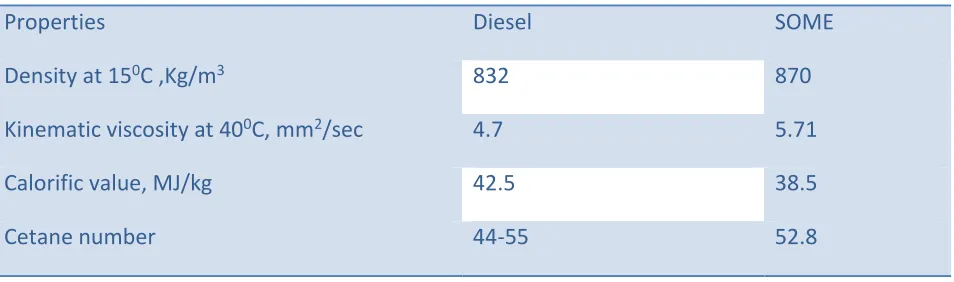
The important properties of Simarouba oil methyl ester are comparable with those of diesel as shown in Table 1.
Table 1 Properties of SOME
Properties Diesel SOME
Density at 150C ,Kg/m3 832 870
Kinematic viscosity at 400C, mm2/sec 4.7 5.71
Calorific value, MJ/kg 42.5 38.5
Cetane number 44-55 52.8
4. Experimental Set-up
The engine tests were conducted on a single cylinder four-stroke, naturally aspirated, open chamber water-cooled CI engine. The engine was operated at a rated constant speed at 1500
rev/min and had a conventional fuel injection system. Figure 4.1 shows the schematic diagram
Available Online at www.ijpret.com 429
Figure 2 Schematic of engine set-up
Figure 3 Overall view of engine-setup
Figure 3 shows the overall view of engine set-up. Nozzle used for the experimentations are 3 hole, 4 hole and 5 hole nozzle each of hole diameter 0.3 mm.
5 . Results
Figure 4 Effect of varying compression ratio on BTE
B
T
E
,
%
Loading ,%
Speed:1500 rpm, Hole on nozzle:3 hole Injection timing:23° BTDC,
Fuel used: SOME30%
Available Online at www.ijpret.com 430
Figure 5 Effect of varying compression ratio on BSFC
6. Effect of Nozzle Hole Geometry and Injection opening pressure on performance of BTE, BSFC
Figure 6 Effect of varying injection opening pressure (IOP) and nozzle hole geometry on BTE
Figure 7 Effect of varying injection opening pressure (IOP) and nozzle hole geometry on
B S F C, k g/k Wh loading, %
Speed:1500 rpm, nozzle hole:3H Injection timing:23° BTDC
Fuel used: SOME 30% CR15
CR16 CR17 CR 18 B TE , %
No. of holes on nozzle
Speed:1500rpm, CR:18, Injector:3Hole, 4Hole & 5Hole (0.3mm dia.),
Inj.Timing:23°BTDC, Fuel Used: SOME 30% 160 bar 180 bar 200 bar 220 bar B SFC, k g /k Wh
No. of holes on nozzle
Speed:1500rpm, CR: 18, Injector:3Hole,
4Hole & 5Hole (0.3mm dia.),
Inj.Timing:23°BTDC, Fuel Used: SOME 30%
160 bar 180 bar
Available Online at www.ijpret.com 431
Figure 8 Effect on BTE at varying load for SOME-Diesel blends
Figure 9 Effect on BSFC at varying load for SOME-Diesel blends
7. DISCUSSION
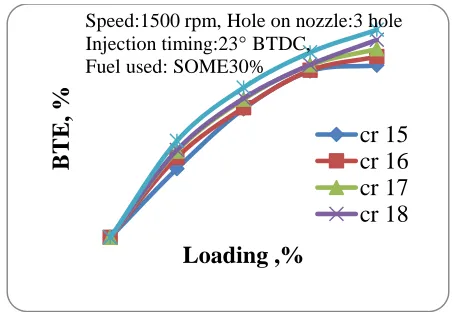
The effects of compression ratio on brake thermal efficiency of BD30 are shown in Figure 4. With varying compression ratio as 15, 16, 17 and 18, it is observed from the figure that CR 18 gives better performance. This increase in efficiency for higher CR may be due to to the reduced ignition delay. Also the BSFC also decreases with increase in load and CR, this may be due to lower volatility and higher cetane number of biodiesel compared to diesel fuel which will result in improved combustion at higher compression ratios.
As we know that, the injection rate depends upon the fuel injector nozzle area and injection pressure. Higher the injection rates result in higher fuel air mixing rates, and hence higher heat
BT
E,
%
Loading, % Injection pressure: 205 bar Injection Timing: 23° BTDC CR: 17.5, Hole on nozzle: 3 hole
B5 B10 B20 B30 Diesel
B30(optimized)
B
S
F
C,
k
g/k
Wh
Loading, % Injection pressure: 205 bar Injection Timing: 23° BTDC CR: 17.5, Hole on nozzle: 3 hole
B5
B10
Available Online at www.ijpret.com 432 release rates. The higher heat release rates and shorter overall combustion process that results from the increased injection rate decrease the minimum BSFC at optimum injection timing [7].
The injection timing for these experiments was set to 23o BTDC. From figure 6 it is clear that as
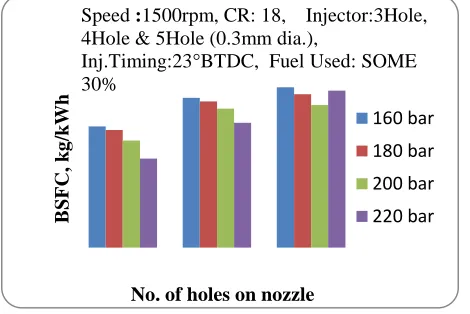
pressure increase the BTE also increases, the possible reason may be stated as, increase in IOP leads to better atomization of fuel, improved spray characteristics and mixing with air were better; which improved premixed combustion and rapid combustion rate, so it is clear that 3 hole nozzle gives better break thermal efficiency, with lower brake specific fuel consumption and smoke emission. It gives efficiency 27.9% at 220 bar pressure which is maximum than 4 & 5 hole nozzle. Also from figure 7 it is observed that 3 hole nozzle gives lesser smoke emission than 4 & 5 hole nozzle.
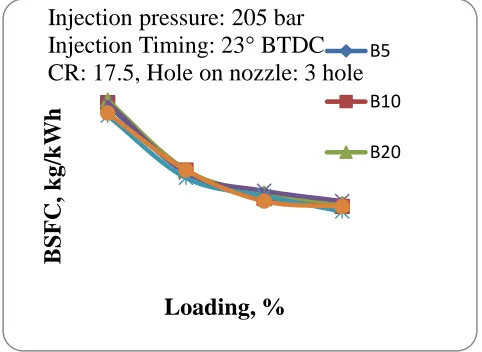
Figure 6 shows amongst all blends tested, the B10 is found to give better BTE a value of 26.86%. Higher BTE for B10 may be occurred due to effective trade-off between less viscous, higher energy content energy diesel fuel and oxygenated fuel SOME.
7. CONCLUSIONS
Compression Ratio: From exhaustive experiments at four different compression ratios of 15, 16, 17 and 18, it was concluded that at higher compression ratio 18 is best suited for SOME 30%
operationwith maximum BTE and minimum smoke emission.
Injection Pressure & Number of Nozzle Holes: Increasing injection pressure from 180 to 220 bar and increasing the number of nozzle holes from 3H to 5H in the injector are improved the engine performance for 30% SOME. The IOP for all nozzles hole (3H, 4H and 5H) were found to be optimum at injection pressure of 220 bar & at 3hole nozzle
The tests conducted on diesel engine under standard conditions shows that among the Simarouba oil methyl ester blends tested, BD10 gave the best performance. The brake thermal efficiency of the engine with BD10 blend at 100% load was 26.9% which is the closer to diesel operation.
Available Online at www.ijpret.com 433
8. REFERENCES
1. MEF (Ministry of Environment & Forests), (2007), Ministry of power. Bureau of energy efficiency, Government of India: Addressing Energy Security and Climate Change.
2. Renewables 2013, Global status Report.
3. Bora, (2012), Performance of diesel engine using biodiesel obtained from mixed feed stocks, Renewable and Sustainable Energy Reviews, Volume 16, Issue 8, Pages 5479-5484.
4. S. Jaichandar, (2011), The Status of Biodiesel as an Alternative Fuel for Diesel Engine – An Overview, Journal of Sustainable Energy & Environment 2 , 71-75.
5. P. K. Devan, N.V. Mahalakshmi,(2007),“Utilization of unattended methyl ester of paradise oil as fuel in diesel engine”, Renewable and Sustainable Energy Reviews, pg. 1828–1833.
6. P. K. Devan, (2008), “A study of the performance, emission and combustion characteristics of a compression ignition engine using methyl ester of paradise oil–eucalyptus oil blends”, Renewable and Sustainable Energy Reviews, pg. 675- 680