Organized by S.V.B.I.T., Gandhinagar. Available Online at www.ijpret.com318
INTERNATIONAL JOURNAL OF PURE AND
APPLIED RESEARCH IN ENGINEERING AND
TECHNOLOGY
A PATH FOR HORIZING YOUR INNOVATIVE WORK
STUDY ON UTILIZATION OF FLY ASH AS A REPLACEMENT OF CEMENT AND FINE
AGGREGATES IN CONCRETE
PARTH UPADHYAY1, SAHILSINH VAGHELA1, LAV BHAVSAR1, JAYDEEP YAVA1, KAUSHAL RAVAL2
1. U. G. Student, Civil Department, SVBIT, Unava, Gandhinagar, Gujarat – 382650. 2. Assistant Professor, Civil Department, SVBIT, Unava, Gandhinagar, Gujarat - 382650
Accepted Date: 27/01/2018; Published Date: 01/03/2018
Abstract: Now a days the construction activity is increases. The material we use is not in good quality in some cases. It is necessary to replace natural sand in concrete by an alternate material partially, without compromising the quality of concrete. Dig sand is one such material which can be used to replace sand as fine aggregate. The present study is intended at utilizing mine sand as fine aggregate replacing natural sand and also the compressive strength of the water cured specimens is measured on the 7,14,28 Days. Split Tensile strength, Flexural Strength, Here we have conducting a test on concrete by using fly ash and m sand. With using these materials we have find out strength on a concrete by adding partial replacement on cement with fly ash and complete replacement of sand.
Keywords: Concrete, Fly Ash, Cement, Fine Aggregate (Sand), Workability and Compressive Strength
Corresponding Author: PARTH UPADHYAY
Access Online On:
www.ijpret.com
How to Cite This Article:
Parth Upadhyay, IJPRET, 2018; Volume 6 (7): 318-323 PAPER-QR CODE
SPECIAL ISSUE FOR
NATIONAL LEVEL CONFERENCE
Organized by S.V.B.I.T., Gandhinagar. Available Online at www.ijpret.com319 INTRODUCTION
Fly ash, also known as "pulverised fuel ash" in the United Kingdom, is a coal combustion product that is composed of the particulates(fine particles of fuel) that are driven out of coal-fired boilers together with the flue gases[11]. Ash that falls to the bottom of the boiler is called bottom ash. In modern coal-fired power plants, fly ash is generally captured by electrostatic precipitators or other particle filtration equipment before the flue gases reach the chimneys[11]. Together with bottom ash removed from the bottom of the boiler, it is known as coal ash. Depending upon the source and makeup of the coal being burned, the components of fly ash vary considerably, but all fly ash includes substantial amounts of silicon
dioxide (SiO2) (both amorphous and crystalline)[14], aluminium oxide (Al2O3) and calcium
oxide(CaO), the main mineral compounds in coal-bearing rock strata.[11]
There are two types of fly ash one is class C and second is class F. Fly ash is an industrial waste material and we can found it easily. Fly ash in the concrete mix efficiently replaces Portland cement that in turn can aid in making big savings in concrete material prices.[14]
It effectively combines with alkalis from cement, which thereby prevents the destructive expansion.Aggregates are crystalline or granular rocks that are extracted for use in the construction industry. There are two types of aggregate, one of them known is fine aggregate (<4.75mm) and second is coarse aggregate (>4.75mm).Cost saving – few research studies have shown a significant reduction in construction costs if RAC is used. Decrease in compressive strength of concrete (10-30%).[11,14,15,16].
Organized by S.V.B.I.T., Gandhinagar. Available Online at www.ijpret.com320
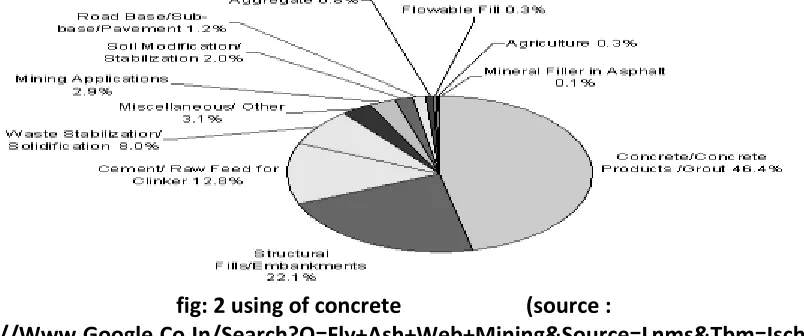
Figure 2 Web mining
fig: 2 using of concrete (source :
(Https://Www.Google.Co.In/Search?Q=Fly+Ash+Web+Mining&Source=Lnms&Tbm=Isch&Sa= X&Ved=0ahukewjh8pog_Edyahvi6y8khxujaqsq_Auicygc&Biw=1517&Bih=735#Imgrc=NW4QR
CKKXDRXVM) OBJECTIVES
Research background information on the basic materials of fly ash, cement and fine aggregate. Research the chemical and physical properties of fly ash, cement, and fine aggregate (sand), and determine the feasibility of replacing cement and sand with fly ash. Research the effects of combining fly ash into the concrete mixture. Concrete mixtures with different percentages of fly ash were prepared to be tested.
Methodology
1.1-Overview
The main purpose of this research was to investigate the potential of replacing the cement and fine aggregate( sand) by fly ash in concrete mixtures and identify the properties of the mixture, its durability, expansion, and also its fresh and hardened properties.
In order to achieve this goal a comprehensive laboratory study on the mechanical properties of concrete mixtures with different ratios of fly ash as a replacement of cement and fine aggregate was performed. All concrete mixing and testing were performed in the engineering laboratory of school of engineering at Charles Darwin University.
1.2-Process of experiments
The flow chart below illustrates the process of completing the thesis including the experimental part of it.
Define problem or task
1. Determine aims and objects
2. Get the required material
Organized by S.V.B.I.T., Gandhinagar. Available Online at www.ijpret.com321
4. Cure the Sample
5. Conduct the require test
6. Collect data
7. Perform calculation
8. Analyse the result
9. Draw conclusions
1.3-Properties of concrete
As mentioned in the previous sections above, that the properties of concrete are classified into two categories: Fresh and hardened.
1.3.1-Fresh Concrete properties
Fresh concrete properties include slump, workability, bleeding, setting time, water demand and air content. However, not all the tests can be conducted at the lab. In this experiment, a slump test was conducted to test the workability of concrete specimens with different ratio of fly ash.
1.3.2-Hardened Concrete properties
Compressive and tensile strength of concrete are the main hardened concrete properties. In order to determine these, compression test and tensile tests can be conducted. However, for this particular research tensile strength of fly ash concrete was not tested as concrete is not strong in tension as in compression unless reinforcement exists which is not the case in this research. As a result only a compression test was performed to test the effects of fly ash on the concrete’s strength.
MATERIALS AND MIX PROPORTIONS 1.4.1- Materials
Portland cement, fine aggregate and coarse aggregate (20mm) were supplied by U-cart Minimix Concrete in Darwin. On the other hand, fly ash was purchased interstate because the NT does not supply this material and it was shipped to Darwin from BC Sands based in New South Wales.
1.4.2-Mixture Proportions for the cement replacement
A total of 6 concrete mixes were prepared; one of the mixes was made of 100% ordinary Portland cement (no Fly ash content). The remaining 5 mixes were prepared by adding fly ash content as partial replacement to cement i.e. 10%, 20%, 30%, 40%, 50%. The amount of water, coarse aggregate and fine aggregate were constant for all the mixes.
MATERIALS AND METHODS
Organized by S.V.B.I.T., Gandhinagar. Available Online at www.ijpret.com322
and include the manufacturer's name and address. Subheadings should be used. Methods in general use need not be described in detail.[18]
RESULT AND CONCLUSION
The study was conducted evaluate the strength of concrete with ash. Concrete mix design was done for M 30 grade concrete. Fly ash is rich cementitious industrial waste which has the great potential to substitute Portland cement. The optimum use of fly ash between 10-20 % of replacement cement for high volume fly ash concrete. The 28 days target strength of the mix can be achieved with a replacement of 20% of fly ash with the cement. The super plasticizer help for compensating the loss in early age strength by reducing water binder ratio and increasing the workability of the mix. The efforts to be made by to entrepreneur to establish the RMC plants in the state government should come out with the infrastructure project use for fly ash concrete to a development.
REFERENCES
1. Subramani. T, Sakthi Kumar. D, Badrinarayanan. S "Fem Modelling and Analysis of Reinforced
Concrete Section with Light Weight Blocks Infill " International Journal of Engineering Research and Applications, Volume. 4, Issue. 6 (Version 6), pp 142 - 149, 2014.
2. Alidoust .O, Sadrinejad .I, and Ahmadi .M. A. “A Study on Cement-Based Composite
Containing Polypropylene Fibers and Finely Ground Glass Exposed to Elevated Temperatures” World Academy of Science, Engineering and Technology, 2007, pages 162–167.
3. Ahmad Shayan “Value-added Utilisation of Waste Glass in Concrete” IABSE Symposium
Melbourne, 2002, pages 1-11.
4. Mageswari .M and Dr. Vidivelli .B “The Use of Sheet Glass Powder as Fine Aggregate
Replacement in Concrete” The Open Civil Engineering Journal, Vol 4, 2010 , pages 65-71.
5. Subramani, T. “Experimental Investigations on Coir Fibre Reinforced Bituminous Mixes”
International Journal of Engineering Research and Applications, Vol.2, Issue.3, pp 1794-1804, 2012.
6. D. L. Venkatesh Babu, S.C. Natesan, “Studies on Strength and Durability Characteristics of
High Performance Silica Fume Concrete”, Proceedings of the INCONTEST 2003, pp.262 – 267, September 2003.
7. Report on “High Volume Fly Ash Concrete Technology -Fly Ash Status Summary Report In
India”supported by Canadian International Development Agency (CIDA).
8. Sumit A Balwaik, S P Raut “Utilization of Waste Paper Pulp by Partial Replacement of Cement
in Concrete” International Journal of Engineering Research and Applications, (IJERA) ISSN: 2248-9622, YCCE, Nagpur-10, Maharashtra, India.
9. Ganesan K., Rajagopal K., Thangavelu K., “Effects of the Partial Replacement of Cement with
Organized by S.V.B.I.T., Gandhinagar. Available Online at www.ijpret.com323
10. T. Phani Madhavi1, V.Sampathkumar2, P.Gunasekaran3 1Assistant Professor, 2Professor,
3Student, Department of Civil Engineering, Sathyabama University, Chennai, Tamilnadu, India.
11. https://en.wikipedia.org/wiki/Fly_ash
12. http://civilengineersforum.com/fly-ash-in-concrete-advantages-disadvantages/
13.
http://www.earthheritagetrust.org/pub/learning-discovery/aggregates/introduction/introduction-1-what-are-aggregates/
14. https://www.flickr.com/photos/nottsexminer/sets/72157648287982930
15. http://inviconindia.com/index.html
16. http://www.intheairwebreathe.net/html/what_is_in_fly_ash__.html
17. https://www.heatingandprocess.com/product/product-category/hopper-heating/
18. http://www.africanethnomedicines.net/journal.php