JER|
Journal of
ELT Research
Vol. 3, No. 2, 2018, 120-141 DOI: 10.22236/JER_Vol3Issue2
Using Evaluation to Motivate Students in an Extensive
Reading Program
Kelly Quinn
Center for General Engineering Education, Nagoya Institute of Technology, Japan
DOI: 10.22236/JER_Vol3Issue2pp120-141
Extensive reading, sometimes referred to as Free Reading or Book Flood, is a system of language instruction where students are encouraged to read a large volume of level appropriate material. According to Wodinsky and Nation (1998) extensive reading should focus on comprehension of the material and enjoyment. Students choose what they want to read and are not compelled to read or finish books that they find uninteresting. One of the founding principles of the original proponents of extensive reading is that the pleasure of reading “is its own reward” (Day & Bamford, 1998), and so assessment should be minimized or eliminated entirely. As extensive reading has gained in popularity, this premise has been challenged. This presentation compares two reading classes, one where students read without evaluation of their comprehension and one where students, after completing the book, had to take a short quiz to test their understanding. The goal of the project was to see the effect of evaluation on the amount of reading that students did. While the best students read an equivalent or greater amount without evaluation than they did when reading with evaluation, some students read much less. The presentation will explain the background for the study, materials used, and method of evaluation. Finally, it will offer some possible explanation of why certain students might require evaluation for motivation.
Keywords: extensive reading, evaluation, e-learning
Extensive reading, kadang disebut juga Free Reading atau Book Flood, merupakan sistem dalam pembelajaran bahasa dimana siswa didorong untuk membaca secara luas materi yang sesuai dengan tingkatan mereka. Menurut Wodinsky dan Nation (1998), extensive reading harus fokus pada pengertian dan hiburan. Siswa memilih sendiri apa yang mereka ingin baca dan tidak perlu menyelesaikan buku yang menurut mereka tidak menarik. Salah satu prinsip dasar dari extensive reading adalah kesenangan membaca ‘merupakan penghargaan diri sendiri’ (Day & Bamford, 1998), dan dengan demikian penilaian harus diminimalisir atau dihapus sama sekali. Tulisan ini membandingkan dua kelas membaca. Satu kelas diminta membaca tanpa evaluasi, sedangkan kelas lainnya diminta untuk menjawab pertanyaan setelah selesai membaca. Tujuan proyek ini adalah melihak efek evaluasi dari membaca yang dilakukan siswa. Hasil penelitian menunjukan bahwa sebagian besar siswa membaca lebih banyak tanpa evaluasi, sedangkan beberapa membaca lebih sedikit. Tulisan ini menjelaskan latar belakang penelitian, materi yang digunakan, dan metode evaluasi. Tulisan ini juga menawarkan penjelasan mengapa siswa tertentu mungkin saja memerlukan evaluasi sebagai motivasi.
* Corresponding author. Email: [email protected]
ISSN: 2502-292X, e-ISSN 2527-7448.
© 2018, English Education Program, Graduate School
Journal of
ELT Research
| 121INTRODUCTION
Extensive Reading, sometimes referred to as Free Reading or Book Flood, is a system of language instruction where students are encouraged to read a large volume of level appropriate material. According to Wodinsky and Nation (1998) extensive reading should focus on comprehension of the material and enjoyment. Students choose what they want to read and are not compelled to read or finish books that they find uninteresting. This belief in the primacy of choice is very important to extensive reading theory. For proponents of extensive reading it is the pleasure that comes from reading that provides the motivation to students. No outward pressure is necessary. As students read interesting material at their level, they will find the experience so pleasurable that they will naturally want to continue.
The benefits of extensive reading are well documented and extend beyond the skill of reading. According to Nunan (2003), reading is comprehension where readers combine their own background knowledge with information from a text to construct meaning. The skills learners develop from reading will improve their total language competence.
Students are often most concerned with improving their oral proficiency and believe that conversation courses are the best way to improve. Students with these goals can often resist reading. However, much research concludes that participation in an extensive reading program was the most effective predictor of oral communicative ability (Huang & Van Naerssen, 1987). Extensive reading encodes the context and collocations and usage of vocabulary into students’ unconscious, and this knowledge becomes active and useful when they speak. By reading extensively, vocabulary, expressions, the natural rhythms of dialogue are imprinted into students’ brains. When they encounter the language in a conversation or spontaneous environment, the previously imprinted knowledge is accessed, like muscle memory or reflexes developed from playing a sport in one’s youth, and increases comprehension and competence. On tests that incorporate writing, the benefits of extensive reading are also clear.
According to Hafiz and Tudor (1990), extensive reading leads to significant improvement in writing ability. This is also due to the natural way that chunks of linguistic input are encoded into the students’ memory. Also, organization and logic is said to improve with extensive reading. This also would lead to improvements in student writing.
Motivated students usually have some goal in mind: studying abroad or working or doing an internship. Students can be reluctant to believe in the benefits of extensive reading, preferring instead to study directly for a test. The focus on reading for pleasure and the lack of follow up quizzes can lead students from high stakes testing cultures to disregard the benefits. However, according to Gradman and Hanania (1991), extensive reading is the most important direct contributor to TOEFL test score.
In fact, several studies including Green and Oxford (1997) conclude that extensive reading is highly related to proficiency. Because of this, although more research is certainly needed regarding the mechanism of language acquisition through extensive reading, current research indicates there are benefits for students and so it is recommended that extensive reading be included in an English language curriculum.
after completing the book, had to take a short quiz to confirm that they had read the book and that they had understood the basic elements of the story they read. In the second semester, students read without evaluation of their comprehension or confirmation that they had read the books that they claimed to. The goal of the project was to see the effect of evaluation on the amount of reading that students did. While the best students read an equivalent or greater amount without evaluation than they did when reading with evaluation, a majority of students read much less. The presentation will explain the background for the study, materials used and method of evaluation. Finally, it will offer some possible explanation of why certain students might require evaluation for motivation.
METHOD
The students in this study were from a private university in Japan. They were first year English majors. In the first semester, the students were introduced to the concept of extensive reading. It was explained how extensive reading would help their overall language proficiency. In the first semester students were given a goal of reading 100 thousand words. The school library contains an extensive collection of adapted readers. Students were able to choose books from the adapted readers in the library and then after finishing the book, they were instructed to take a quiz on the mreader.org website to confirm that they had read and understood the book.
The website mreader.org was started at Kyoto Sangyo University. The website allows registered teachers to create accounts for their students. The site allows teachers to set reading goals for individual students, and the website tracks students’ progress toward reaching that goal. The website contains a database of quiz questions for the most popular adapted readers from major publishers such as Oxford, Longman, Cambridge, etc.
Journal of
ELT Research
| 123FINDINGS AND DISCUSSION
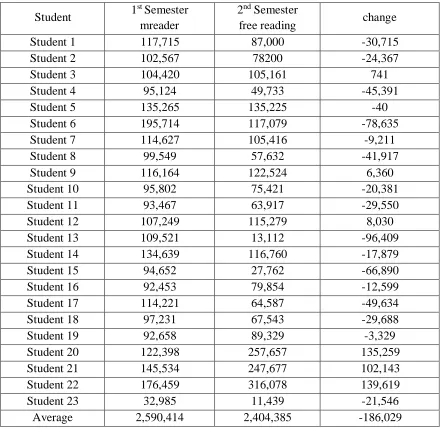
The number of words students read are summarized in Table 1 below.
Table 1. Words read as recorded by mreader and free reading.
Student 1
st Semester
mreader
2nd Semester
free reading change
Student 1 117,715 87,000 -30,715
Student 2 102,567 78200 -24,367
Student 3 104,420 105,161 741
Student 4 95,124 49,733 -45,391
Student 5 135,265 135,225 -40
Student 6 195,714 117,079 -78,635
Student 7 114,627 105,416 -9,211
Student 8 99,549 57,632 -41,917
Student 9 116,164 122,524 6,360
Student 10 95,802 75,421 -20,381
Student 11 93,467 63,917 -29,550
Student 12 107,249 115,279 8,030
Student 13 109,521 13,112 -96,409
Student 14 134,639 116,760 -17,879
Student 15 94,652 27,762 -66,890
Student 16 92,453 79,854 -12,599
Student 17 114,221 64,587 -49,634
Student 18 97,231 67,543 -29,688
Student 19 92,658 89,329 -3,329
Student 20 122,398 257,657 135,259
Student 21 145,534 247,677 102,143
Student 22 176,459 316,078 139,619
Student 23 32,985 11,439 -21,546
Average 2,590,414 2,404,385 -186,029
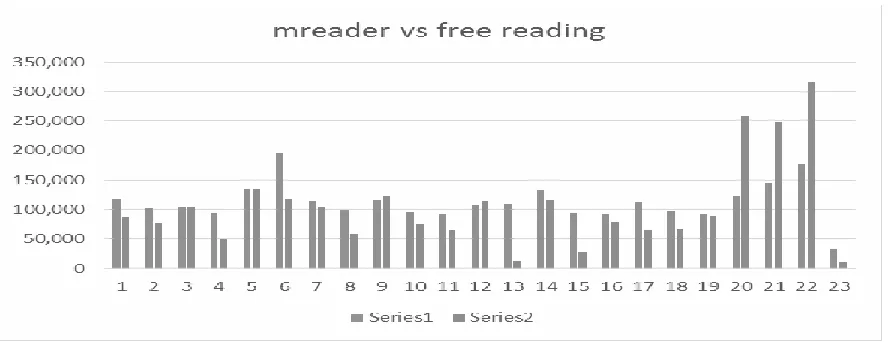
Figure 1. Words read as recorded by mreader and free reading
The data are even more striking in a bar graph. Fewer than fifty percent of the students read 100 thousand words in the second semester. Moreover, only six students read as many words or more words than they did in the first semester.
One of the key claims that extensive reading advocates make is that the pleasure of reading is itself a motivating force and given access to level appropriate reading material student reading rates will only continue to improve and extend their reading. Of the students who read more, only three of the students increased their reading by more than ten percent. On the other hand, among students whose reading declined, a majority showed significant decreases. Finally for the students who failed to reach the goal of 100 thousand words in the first semester by a significant margin, in the second semester, they showed a decline of over 65%, the second highest decline.
CONCLUSION
In conclusion, the majority of students benefited from being held accountable for their reading. Total words read dropped off considerably when evaluation no longer occurred. The use of mreader correlated with an increase in the amount that students read. While causality is not necessarily determined by correlation, it would seem that the use of regular quizzes worked as a motivating factor for many students. Why this should be, could be explained by the education culture to which the students are acclimated.
Japan has a high stakes test culture. Students’ educational careers are determined by exams in junior and senior high school. It is quite possible that students internalize the idea that what is important is “on the test.” Anything not on the test, is consequently considered of lesser importance. By eliminating the quizzes, teachers may be signaling to the students that extensive reading is not important, exactly opposite to the message they intended to send.
Similarly, for non-English major students who are busy with a heavy course-load from their major subjects, such as engineers, general education English classes probably already have a lower priority in students’ minds than their major subject courses.
Journal of
ELT Research
| 141This sort of cultural bias towards testing will not be overcome by a single lecture on the value of extensive reading. Students will need to be convinced that extensive reading will help them reach their goals more effectively than cramming vocabulary or studying test strategies with a test prep book.
REFERENCES
Gradman, H., & Hanania, E. (1991). Language learning background factors and ESL proficiency. Modern Language Journal, 75(1), 39-51.
Green, J. M., & Oxford, R. (1995). A closer look at learning strategies, L2 proficiency and gender. TESOL Quarterly, 29(2), 261-297.
Hafiz, F. M., & Tudor, I. (1990). Graded readers as an input medium in L2 learning. System, 18(1), 31-42.
Huang, X., & van Naerssen, M. (1987). Learning strategies for oral communication. Applied Linguistics, 8(3), 287-307.
Nunan, D. (2003). Practical English Language Teaching. Boston: McGraw Hill.