The Comparative Analysis of MCDA Methods SAW and COPRAS
Valentinas Podvezko
Vilnius Gediminas Technical University Sauletekio av. 11, LT-10223, Vilnius, Lithuania e-mail: [email protected]
In recent years, quantitative multicriteria methods have been widely used for comparative evaluation of complicated technological and social-economic processes, as well as for determining the best alternative among the available options and ranking the alternatives based on their significance for a particular purpose. Professor of Vilnius Gediminas Technical University E.K. Zavadskas was the first to use these methods in Lithuania in the mid-eighties of the last century for evaluation, substantiation and choosing of optimal technological solutions at various stages of construction (Завадскас 1987). In this period, new multicriteria evaluation methods were being developed and widely used in the world in various scientific and practical areas. Later, numerous disciples and colleagues of prof. Zavadskas as well representatives of various scientific schools extensively used the considered methods in Lithuania.
The main concept behind the quantitative evaluation methods is integration of the values of the criteria describing a particular process and their weights (significances) into a single magnitude, i.e. the criterion of the method. For some particular (maximizing) criteria the largest value is the best, while for others (minimizing criteria) the smallest value is the best. The units of criteria measurement are also different. The alternatives compared are ranked according to the calculated values of the criterion of the method. Great numbers of multicriteria evaluation methods, based on different logical principles and having different complexity levels and the inherent features, have been created in the world. There is hardly any ‘best’ multicriteria evaluation method. Therefore, a parallel use of several multicriteria evaluation methods as well as the analysis of the spread of estimates and averaging of the values obtained may be recommended for evaluating complicated multifaceted objects and processes. The method SAW (Simple Additive Weighting) is one of the simplest, natural and most widely used multicriteria evaluation methods. It clearly demonstrates the idea of integrating the values and weights of criteria into a single estimating value – the criterion of the method. However, SAW uses only maximizing evaluation criteria, while minimizing evaluation criteria should be converted into the maximizing ones by the respective formulas prior to their application. This limitation is eliminated in the method COPRAS (Complex Proportional Assessment). The authors of the method, E. K. Zavadskas and his disciple A.Kaklauskas suggested that the influence of maximizing and minimizing evaluation criteria should be assessed separately. In this case, the component, taking into account
the effect of maximizing criteria, matches the estimate yielded by the method SAW.
Despite the fact that the method COPRAS is most commonly used in Lithuania, its main characteristics and properties have not been clearly defined and demonstrated. However, the awareness of these properties allows us to show the benefits of the method’s application, to predict the influence of minimizing criteria values on the final result (estimate), to check the calculations and to take into account possible instability of estimates yielded by the method due to the specific character of the actual data.
The paper describes the main features of multicriteria evaluation methods SAW and COPRAS and their common and diverse characteristics, as well as defining and demonstrating the properties of the method COPRAS, which are of great theoretical and practical value.
All theoretical statements are illustrated by numerous examples and calculations.
Keywords
:
decision making, MCDA, SAW method, COPRAS method, comparative analysis IntroductionIn practice, a decision-making person (DM) is often faced with the problem of choosing the best alternative from the available options. This may be the choice of the best technological or investment variants. In particular, the choice of the best technological or investment project or determination of an enterprise which is the best according to its financial and commercial activities or strategic potential, etc. should be made. Besides, the above problems may embrace the evaluation of the development of the state regions or various states, etc. None of these processes or phenomena can be evaluated by a single magnitude because it is hardly possible to find a characteristic which could integrate all relevant aspects of the considered issue.
In recent years, multicriteria methods have been increasingly used for quantitative evaluation of complicated economic or social processes (Figueira et al. 2005; Ginevicius 2008; Ginevicius, Podvezko 2004; Ulubeyli, Kazaz 2009; Kaklauskas et al. 2007; Kracka et al. 2010; Liaudanskiene et al. 2009; Plebankiewicz 2009; Podvezko 2007, 2009; Podvezko, Podviezko 2010; Selih et al. 2008; Turskis et al. 2009; Ustinovichius et al. 2007; Urbanavicienė et al. 2009a,b; Zavadskas, Vaidogas 2008, Zavadskas et al. 2007a,b, 2010; Zavrl et al. 2009).
The considered methods are based on the matrix
Aj (j=1,2,…,n) compared, statistical data or expert
estimates and the criteria weights (significances) ωi
(i=1,2,…,m), where m is the number of criteria and n is the number of the alternatives (objects) compared (
m
i i 1
1
ω
= =
∑
).The aim of the evaluation is to choose the best alternatives, ranking the alternatives Aj, i.e. arranging them in the order
of their significance to the research object by using quantitative multicriteria evaluation methods. None of these methods can be used formally without a preliminary analysis. Each method is characterized by specific features and has some advantages. To apply quantitative multicriteria evaluation methods, the type of criteria (minimizing or maximizing) should be determined. The best values of maximizing criteria are the largest values, while the smallest values are the best for minimizing criteria. The criteria of quantitative evaluation methods usually integrate normalized (dimensionless) criteria values
r
~
ij and weightsω
i.In Lithuania, such multicriteria evaluation methods as SR (Sum of Ranks), GM (Geometric Mean), SAW (Simple Additive Weighting), TOPSIS (Technique for Order Preference by Similarity to an Ideal Solution), a compromise classification approach VIKOR (Visekriterijumsko Kompromisino Rangiranje (in Serbian)), COPRAS
(Complex Proportional Assessment) and PROMETHEE
(Preference Ranking Organisation Method for Enrichment Evaluation) are used, but the most commonly used methods are SAW, COPRAS and TOPSIS. The first two have much in common possessing, however, quite a few different properties. Their advantages also differ. Though these methods are widely used, many of their features have not been analysed yet. In the present work, the methods SAW
and COPRAS are thoroughly investigated and compared. The main features of COPRAS are defined and demonstrated, and their stability with respect to data variation is investigated. The possibilities of using SAW
and COPRAS for evaluating the criteria of hierarchically structurized composite numbers of the same level are defined. All theoretical statements are illustrated by examples and calculations.
The method SAW
SAW (Simple Additive Weighting) is the oldest, most widely known and practically used method (Hwang, Yoon 1981; Chu et al. 2007; Ginevicius, Podvezko 2008 a,b,c; Ginevicius et al. 2008c; Podvezko 2008; Ginevicius, Gineviciene 2009; Zavadskas et al. 2007c; Chu et al. 2007; Jakimavicius, Burinskiene 2009; Podvezko et al. 2010; Sivilevicius et al. 2008). The criterion of the method Sj
clearly demonstrates the main concept of multicriteria evaluation methods – the integration of the criteria values and weights into a single magnitude. This is also reflected in its name.
The sum Sj of the weighted normalized values of all the criteria is calculated for the j-th object:
Sj
1
m
i ij i
r
ω
=
=
∑
%, (1)where ωi is weight of the i-th criterion (
m
i i 1
1
ω
= =
∑
); r~ij is normalized i–th criterion’s value for j–th object; i=1,...,m;j=1,…,n; m is the number of the criteria used, n–is the number of the objects (alternatives) compared.
The largest value of the criterion Sj corresponds to the best alternative. The alternatives compared should be ranked in the decreasing order of the calculated values of the criterion Sj.
SAW may be used if all the criteria are maximizing. This is a drawback of this method, though minimizing criteria can be easily converted to the maximizing ones by the formula:
minj ij ij
ij
r r
r
= , (2)
where rij is i-th criterion’s value for j-th alternative, min ij
j r is the smallest i-th criterion’s value for all the
alternatives compared, rij denotes the converted values. Thus, the smallest criterion value ij min ij
j
r = r acquires the
largest value equal to unity.
In many papers (Hwang, Yoon 1981; Zavadskas, Kaklauskas 1996, etc.), normalization z (or transformation) of the initial data is used, so that the best criterion value (the largest one for a maximizing criterion and the smallest one for a minimizing criterion) would get the largest value equal to unity. As mentioned above, it is recommended to use formula (2) for transforming minimizing criteria. The transformation formula used for maximizing criteria is as follows:
max
ij ij
ij j
r r
r
= , (3)
where max ij
j r is the largest i-th criterion’s value of all alternatives.
Another SAW limitation is the requirement that all criteria values
r
ij should be positive. In the opposite cases (migration balance and similar cases), negative values are transformed to positive values, using, for example, the formula (Ginevicius, Podvezko 2007a):min 1
ij ij ij
j
r = +r r + . (4)
Due to this transformation, the smallest negative value is turned to unity.
Table 1 The criteria of economic growth of different countries (2003)
Country Criteria
Types of criteria
Estonia Latvia Lithuania Poland
value rank value rank value rank value rank
1 Annual growth of the GDP, % max 5.1 3 7.5 2 9.7 1 3.8 4
2 Annual growth of production, % max 9.8 2 6.5 4 16.1 1 8.4 3
3 Average annual salary, euro, % max 430 2 298 4 306 3 501 1
4 Unemployment rate, % min 9.3 1 10.3 2 11.6 3 19.3 4
5 Export/import ratio, % max 0.70 3 0.55 4 0.73 2 0.79 1
Sum of ranks - 11 - 16 - 10 - 13
Rank of the country - - 2 - 4 - 1 - 3
We can see that four criteria are maximizing, while one (unemployment rate) is minimizing. A typical case of the use of multicriteria evaluation methods is considered, when none of the countries seems to be the best, and the ranks of particular criteria range to a great extent.
Let us transform the data provided in Table 1 by using
formulas (2)-(3).
The transformed values of five criteria describing the economic development of four countries are given in Table 2. The criteria weights (column 3 in Table 2) are determined by the experts of the Finance Ministry of Lithuanian Republic (Ginevicius et al. 2006).
Table 2 The data of Table 1 transformed by using formulas (2)-(3)
Country
Criteria Weights Estonia Latvia Lithuania Poland
1 Annual growth of the GDP 0.35 0.526 0.773 1.0 0.392
2 Annual growth of production 0.10 0.609 0.404 1.0 0.522
3 Average annual salary, euro 0.17 0.858 0.595 0.599 1.0
4 Unemployment rate 0.25 1.0 0.903 0.802 0.482
5 Export/import ratio 0.13 0.886 0.696 0.924 1.0
The values of SAW criterion Sj,calculated based on the data taken from Table 2 by formula (1), are given in Table 3.
Table 3
SAW criterion Sj values obtained by transforming the data by formulas (2)-(3)
Method Estonia Latvia Lithuania Poland
SAW (
j
S ) 0.756 0.728 0.872 0.610
Rank 2 3 1 4
This is a common application of multicriteria evaluation methods: two out of five results (3rd and 5th) obtained for Poland are the best, while two other values (1st and 4th) are the worst. Their weights are the largest, therefore, the country is ranked the last according to the evaluation by the method SAW.
The values of the criterion Sj range from zero to unity when the transformation of the data by formulas (2)-(3) is used: 0<Sj≤1
The method SAW, like some other multicriteria methods, can yield the distorted evaluation data, e.g. the value of an alternative of one of the criteria greatly exceeds the values of other alternatives, while the weight (significance) of this criterion is the largest. In this case, the alternative may be assessed as the best, though the values of its other criteria are relatively small.
SAW with its data transformation by formulas (2)-(3) has some disadvantages: the largest value of the criterion
of the method Sj may be about the unity, while the smallest value may approach zero. However, the difference in estimates of the compared alternatives can hardly be determined from the first sight. The relative Sj values can be determined by normalizing them by the formula:
1 j
j n
j j
S S
S
=
=
∑
% , (5)
where S%j is the normalized value of the criterion Sj, n is the number of alternatives (
1
1 n
j j
S =
=
∑
% ). Thus, the value jS%
Normalized values of the criterion Sj taken from
Table 3 are given in Table 4 ( 4
1 j
j
S =
=
∑
2.
966).Table 4
Normalized values S%j of the criterion Sj from Table 3
In practice, it is more convenient to use SAW with ‘classical’ normalization (
1
1 n
ij j
r =
=
∑
% ) (Ginevicius,Podvezko 2007a,b):
1 ij
ij n
ij j
r
r
r
==
∑
%
, (6)where
r
ij is i-th criterion’s value for j-th alternative. In using this type of normalization, the SAWcriterion’s Sj sum of values of all n alternatives is equal to unity:
1 1 1 1 1
1
n n m m n
j i ij i ij
j j i i j
S ωr ω r
= = = = =
= = =
∑
∑∑
%∑ ∑
% , (7)i.e. normalized values of the criterion Sj of SAW, which may be used for evaluating hierarchically structured alternatives of the same level are calculated (Ginevicius, Podvezko 2003, 2007b). In this case, it is also easier to compare different estimates of the alternatives.
The values of Table 1, normalized by using formula (6) are given in Table 5. The values of the minimizing 4th
criterion were preliminarily transformed by formula (2) (row 4, Table 2). Normalized by using formula (6) values of the maximizing criteria, do not depend on the fact whether they were preliminarily transformed by formula (3) or not.
Table 5 The data of Table 1 normalized by formulas (6) and (2)
Country
Criterion Estonia Latvia Lithuania Poland
1 Growth of the gross national product 0.195 0.287 0.372 0.146 2 Annual growth of industrial production 0.240 0.159 0.395 0.206
3 Average annual work payment 0.280 0.194 0.199 0.326
4 Unemployment rate 0.314 0.283 0.252 0.151
5 Export/import ratio 0.253 0.199 0.264 0.285
The values of SAW criterion Sj, based on the normalized values taken from Table 5, are given in Table 6.
Table 6 The values of SAW criterion Sj based on the normalization
performed by using formulas (3) and (5)
Method Estonia Latvia Lithuania Poland SAW( )Sj 0.251 0.246 0.301 0.202
Rank 2 3 1 4
The ranks of the countries investigated have not changed as before (Table 3), and the values of the criteria
j
S% (Table 4) and Sj (Table 6) are practically the same. Let us consider the main features of the method SAW. It has the following positive characteristics and features:
1) The criterion Sj of the method SAW reflects the main concept underlying quantitative multicriteria evaluation methods, consisting in integrating the criteria values and weights into a single magnitude – the criterion of the method.
2) The calculation algorithm of the method is not complicated, being implemented either without the help of a computer or by applying very simple computer programs.
3) Normalized values of the evaluation SAW criterion
Sj (or S%j ) help visually determine the differences between the alternatives compared.
However, SAW also has some disadvantages:
1) All the values of the criteria Ri (i=1,...,m) should be
maximizing. Minimizing criteria should be transformed to maximizing ones, for example, by formula (2) before being used in the analysis.
2) All the values of the criteria Ri (i=1,...,m) should be
positive. The evaluation results, i.e. the values of the criterion Sj, depend on the type of their transformation to positive values.
3) The estimates yielded by SAW do not always reflect the real situation. The result obtained may not be logical, with the values of one particular criterion largely differing from those of other criteria.
The method COPRAS
In 1996, the researchers of Vilnius Gediminas Technical University (Zavadskas, Kaklauskas 1996) created a method of complex proportional evaluation COPRAS (Complex Proportional Assessment). It is used for multicriteria evaluation of both maximizing and minimizing criteria values. This is the advantage of the method COPRAS over the SAW method. The method
j
S 0.756 0.728 0.872 0.610
j
COPRAS is widely used by its authors, their disciples and specialists evaluating complex processes by quantitative multicriteria methods (Kaklauskas et al. 2005, 2006, 2008, 2010; Zavadskas et al 2008a,b,c, 2009a,b; Zavadskas, Antucheviciene 2007; Banaitiene et al. 2008; Lepkova et al. 2008; Ginevicius, Podvezko 2007d;Ginevicius et al.
2008a,b; Podvezko 2008; Sarka et al. 2008; Sliogeriene et al. 2009; Datta et al. 2009; Hofer 2009; Karbassi et al.
2008; Mickaityte et al. 2008; Mazumbar 2009; Mazumbar
et al. 2010; Bindu Madhuri et al. 2010a,b; Schieg 2009; Tupenaite et al. 2010). In this method, the influence of maximizing and minimizing criteria on the evaluation result is considered separately. The evaluation component
j
S+ of the j-th alternative of maximizing criteria matches
the sum Sj (1) of normalized weighted values in the method
SAW. This implies that if only maximizing criteria and classical normalization (6) of criteria values are used, the calculation results obtained by the method COPRAS match the data yielded by the method SAW (Ginevicius, Podvezko 2007a).
The values of the criterion Zj in COPRAS are obtained by the formula:
– min – 1 – min – 1 – n j j
j j n
j j j S S Z S S S S = + = = +
∑
∑
, (8)where
1
m
j i ij
i
S+ ω+ +r
=
=
∑
% (9)is the sum of maximizing weighted criteria values
r
~
+ij, normalized by formula (6) for each j-th alternative;– –
1 m
j i ij
i
S ω−r
=
=
∑
% (10)is the sum of minimizing weighted normalized criteria values
r
%
−ij; j=1,2,...,n; n is the number of the compared alternatives; min min jj
S− = S− is minimal S-j value of
minimizing criteria of all the alternatives. The sign ‘+’ shows that only normalized values of j-th alternative’s maximizing criteria
r
~
+ij, multiplied by their weights ω+i, are summed up. Similarly, the sign ‘–’ applies to minimizing criteria and their weights ω−i.The formulas (8) and (10) also show the inherent inconsistency of COPRAS: the value of the most important alternative of a minimizing criterion
r
%
−ij is the smallest, however, the largest criterion weightω
−i matches it, while the sum of these weighted values S-j is in the denominator of the criterion (8). This may lead to incorrect evaluation of the alternatives.In order to use the same notation in all multicriteria evaluation methods, which would be different from the original (Zavadskas, Kaklauskas 1996), we will denote the criterion values by
r
ij (instead ofx
ij) and their weights –by
ω
i, as well as differently denoting maximizing and minimizing weights byω
+i andω
−i, respectively (rather than byq
i in the original). The criteria values normalized by formula (6) will be denoted byr
%
ij (the authors use normalization with the weights1 ij i ij n ij j
x q
d
x
=⋅
=
∑
,i.e., in our case, dij =ωi ijr%), while the criterion of the method will be denoted by Zj rather than by QJ, used in the method VIKOR (Opricovic, Tzeng 2004). If only maximizing criteria are used, Zj =S+j =Sj.
The concept underlying the method COPRAS is quite clear: the estimate of the j-th alternative Zj is directly proportional to the effect produced by maximizing criteria S+j and inversely proportional to the sum of the weighted
normalized values of minimizing criteria – the component S-j.
The criterion Zj (8) may be expressed in a more compact form as follows:
The same constant S–min(Ginevicius et al. 2004) in the numerator and denominator of the formula (8) can be cancelled, and the formula will be of the form:
– 1 – 1 – 1 n j j
j j n
j j j S Z S S S = + = = +
∑
∑
, (11)or
j j j
Z =Z+ +Z− , (12)
where Z+j =S+j is the component of the effect of all maximizing criteria (9), while
– 1 – 1 – 1 n j j j n j j j S Z S S = − = =
∑
∑
. (13)Is the component of the effect of all minimizing criteria.
The numerator and denominator of the formula may be
divided by the expression –
1
n
j j S− S
=
=
∑
. Thus, thenormalized value – –
– – 1 j j j n j j S S S S S = = =
∑
% , rather than the sum S-j
of the weighted normalized values of the j-th alternative’s all minimizing criteria, will be found in the numerator of the formula (11).
–
1 –
1 1
j j n
j
j j
Z S
S S +
=
= +
∑
%
. (14)
This formula can hardly facilitate the calculation of the criterion Zj, but it better reflects the concept underlying the method COPRAS.
The normalized value S%−j, replacing the sum S-j in the numerator, reduces the influence of minimizing criteria on the total evaluation result Zj (by increasing the numerator of the second summand), particularly, if the number of minimizing criteria is small. The sum of inverse minimizing criteria
1 –
1 n
j= S j
∑
in the numerator can also reduce the influence of the result obtained: the values ofj
S
− may be about zero, i.e. their inverse value in the numerator of the formula (13-14) may become very large.Therefore, the results yielded by COPRAS may be sensitive to slight data variation, and the ranks assigned may differ from those obtained by using other methods. Let us demonstrate the calculation results of two data variants by methods COPRAS, SAW and TOPSIS. SAW is based on classical normalization (6), with minimizing criteria converted to the maximizing ones (2). Two sets of data are given in Table 7.
Two versions of the alternatives A1, A2 and A3, described by four criteria R1, R2, R3 and R4 are considered.
The data referring to them differ to a small extent. In particular, the values of the first three criteria are the same, while the value of the fourth criterion of the first alternative
r
41=105 is replaced byr
41=110 andr
42=215 is substituted forr
42=200.Table 7
Illustration of instability of COPRAS application
Criteria Direction Weights ωi
Variant I Variant II
A1 A2 A3 A1 A2 A3
R1 max 0.26 42 71 53 42 71 53
R2 max 0.23 19 18 20 19 18 20
R3 min 0.24 13 11 12 13 11 12
R4 min 0.27 105 215 149 110 200 149
The data referring to two variants of the third alternative have completely matched. The calculation
results yielded by COPRAS compared to the data obtained by SAW and TOPSIS are given in Table 8.
Table 8
Calculation results yielded by COPRAS, SAW and TOPSIS
Method Variant I Variant II
A1 A2 A3 A1 A2 A3
COPRAS S+j 0.142 0.184 0.164 0.142 0.184 0.164
S-j 0.147 0.199 0.165 0.151 0.191 0.168
Zj 0.332 0.334 0.335 0.332 0.334 0.335
Rank 1 3 2 3 2 1
TOPSIS 0.575 0.423 0.539 0.526 0.471 0.494
Rank 1 3 2 1 3 2
SAW 0.337 0.327 0.336 0.340 0.336 0.331
Rank 1 3 2 1 2 3
As it has been shown in the Table, the ranks assigned to the alternatives by all three methods – COPRAS,
TOPSIS and SAW have matched for the first variant. The values of the 3rd criterion have slightly changed in the 2nd variant, however, the ranks obtained by COPRAS (Table 8) have changed places (3-2-1 instead of 1-3-2), The ranks given by TOPSIS have not changed, and the rank assigned to the best 3rd alternative by SAW has not changed either, though the 1st and 2nd alternatives have changed places. The results obtained show that COPRAS may be less stable than other methods in the case of data variation, while the ranks of the alternatives given by COPRAS may differ to great extent from those yielded by other methods. This not only reveals the particular problems associated with
COPRAS application, but also demonstrates common
approaches to evaluating multicriteria methods. Thus, each multicriteria method has its advantages and disadvantages and, therefore, simultaneous use of several methods and the analysis of causes of estimates’ variation may be recommended.
Property 1. The sum 1 n j j S+ S+
=
=
∑
of the evaluation componentsof all n alternatives of maximizing criteria S+j is equal to
the sum of maximizing criteria weights
1 m i i ω+ =
∑
: 1 1 n m j i j iS+ S+ ω+
= =
=
∑
=∑
. (15).A similar result is obtained for minimizing criteria:
–
1 1
n m
j i
j i
S− S ω−
= =
=
∑
=∑
. (16)Proof.
1 1 1 1 1 1
n n m m n m
j i ij i ij i
j j i i j i
S+ S+ ω+ +r ω+ r+ ω+
= = = = = =
=
∑
=∑∑
% =∑ ∑ ∑
%=and
– – –
1 1 1 1 1 1
n n m m n m
j i ij i ij i
j j i i j i
S− S ω−r ω− r ω−
= = = = = =
=
∑
=∑∑
%=∑ ∑ ∑
% = .This result was interpreted (Zavadskas, Kaklauskas 1996) so that the sum of the components of maximizing (and minimizing) criteria
1 n
j j S+ S+
=
=
∑
is equal to the sumof normalized weighted values:
1 1 1 1 1
1
n m n m n
ij
j i n ij
j i j i j
ij j
r
S S d
r ω + + + + + = = = = = + = =
∑
=∑∑
=∑∑
∑
(as mentioned above, the authors denoted
1
ij
ij i n
ij j r d r ω + + + = =
∑
).Conclusion. The sum of normalized weighted values
of all maximizing and minimizing criteria of the compared alternatives is equal to the sum of the criteria weights
1 m i i ω =
∑
(in the considered case, to unity):1
m i i j j
S S S ω
= + = + =
∑
. Actually, 1 mj j i
i
S S+ S ω+
= = + =
∑
+ 1 m i i ω− =∑
= 1 m i i ω =∑
.Property 2. The sum of minimizing criterion
components Z−j (13) of COPRAS evaluation criterion Zj is equal to the sum of weights of minimizing criteria
1 m i i ω− =
∑
: 1 1 n m j i j iZ− ω−
= =
=
∑
∑
. (17)Proof. – 1 1 1 – 1 – – 1 – –
1 – 1 1
1 – 1 1 . 1 n j n n j j n j j j j j n
j n n m
j
j i
n
j j j i
j j S Z Z S S S S S S S ω = − − = = = = − = = = = = = = = ⋅ = = =
∑
∑
∑
∑
∑
∑
∑
∑
∑
(18)Explanation. The constant –
1 n j j S =
∑
is placed in thenumerator of formula (18), while the constant
1 – 1 n
j= S j
∑
isplaced in the denominator. Then, the constant 1 –
1 n
j= S j
∑
isreduced in the fraction and the equation (16) is used.
Conclusion. When the method COPRAS is used, the
sum of the evaluation components Z+j and Z−j, i.e. the sum of the criterion’s Zj values is equal to the sum of the
criteria weights 1 m i i
ω
=∑
(in the considered case, to unity):1 1 1
n n n
j j j
j j j
Z+ Z− Z Z
= = = + = = =
∑
∑
∑
1 m i i ω =∑
. (19)In particular, formulas (12), (15) and (14) will be used:
1 1 1 1 1 1
n n n
j j j
j j j
m m m
i i i
i i i
Z Z+ Z− ω ω ω
= = = = + = − =
= + = + =
∑
∑
∑
∑
∑
∑
.As proved above (see (7)), this result is also valid for the sum of the criteria of SAW Sj, using classical
normalization technique (6):
1 1 1 n m j i j i S ω = = = =
∑
∑
.example, in the monograph of the authors of COPRAS
approach ((Zavadskas, Kaklauskas, Banaitiene 2001), the calculation results of the evaluation process are provided (267-268 pp. Table 6.20). The values of the COPRAS
evaluation components S+j, S-j of maximizing and
minimizing criteria and the evaluation criterion Zj are given in Table 9, while the sums of all these values are presented in the last column of this table.
Table 9
The results obtained in multicriteria evaluation of the alternatives of plots
1 2 3 4 5
S+j 0.1374 0.1292 0.1109 0.1116 0.0496
5
1 j
j
S+ S+
=
=
∑
=0.5385S-j 0.1405 0.0898 0.0855 0.0983 0.0470
5
1 j j S− S−
=
=
∑
=0.4611Zj 0.1908 0.2129 0.1988 0.1880 0.2093
5
1 j
j
Z Z
=
=
∑
=0.9998The rounded off sum of 12 maximizing criteria
weights 12 1 i i ω+ =
∑
= 0.5387, as well as the sum of theweights of two minimizing criteria
2
1 i
i
ω
− =∑
=0.4611 andthe sum of weights of all 14 criteria
14 1 i i
ω
=∑
= 12 1 i iω
+ =∑
+ 2 1 i iω
− =∑
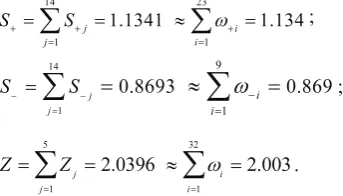
= 0.9998, calculated based on the data presented in Table 6.20 of the above-mentioned monograph, agreed with the respective values of S+, S- and Z given in Table 9.Let us consider another example, representing one of the recent cases of COPRAS applications (Sliogeriene et al.
2009). Thirty two criteria, including 23 maximizing and 9 minimizing criteria, were used. The calculations also demonstrated the validity of the results obtained by using the method COPRAS:
14 23
1 1
1.1341 1.134
j i
j i
S+ S+ ω+
= = =
∑
= ≈∑
= ; 14 1 9 1 0.8693 0.869 jj i i
S− S− ω
= = − =
∑
= ≈∑
= ; 5 32 1 1 2.0396 2.003 j i j iZ Z ω
= =
=
∑
= ≈∑
= .Property 2 and the conclusion made allow us to compare the methods COPRAS and SAW: the sum of the criteria values of all n alternatives obtained by using these two methods is equal to the sum of the criteria weights
1 m i i ω =
∑
(in the considered case, to unity):1 1 1
n n m
j j j
j j i
S S Z Z ω
= = =
=
∑
=∑
= =∑
(20)
where Sj, is SAW criterion, Zj is COPRAS criterion (SAW is
based on ‘classical’ normalization (6)), S and Z are the
respective general estimates of all the alternatives evaluated by these methods.
The equality (20) allows COPRAS (and SAW) to be applied to the evaluation of hierarchically structured complex values of the same level (Ginevicius, Podvezko 2006, 2007c) to obtain normalized values of all higher level alternatives (if
1 1 m i i ω = =
∑
).As mentioned above, when only maximizing criteria are used, the results of calculation by COPRAS agree with the data yielded by SAW, i.e. for each j-th alternative we get:
S+ j= Sj = Z j = Z+j (j=1,2,...,n).
In a common case, the evaluation components of maximizing criteria, describing the alternatives by both methods, match each other, i.e. S+j= Zj, with all j=1,2,...,n.
Their sums,
1
n
j j
S+ S+
=
=
∑
and1
n
j j
Z+ Z+ =
=
∑
, also agree.Due to this, the sums of evaluation components of all minimizing criteria – 1 1 1 – 1 – 1 n j n n j j n j j j j j S Z Z S S = − − = = = =
∑
=∑
∑
∑
and – –1 1 1
n n m
j i ij
j j i
S− S ω−r
= = =
=
∑
=∑∑
% ,obtained by COPRAS and SAW, will also agree.
the method, also accounts for the result obtained. A great number of the performed real case calculations confirms that the difference between the values of the criteria of the above two methods is insignificant. Thus, the evaluation of the development rate of Lithuanian regions (Ginevicius,
Podvezko 2009), based on these two methods (see Table 10), yielded practically the same results (with the difference being 10-4) because only two out of fourteen criteria were minimizing.
Table 10
An example illustrating the evaluation results yielded by COPRAS and SAW: the data obtained in multicriteria
evaluation of social and economic development of Lithuanian regions in 2006 – 2007
Method
Criterion
Region
Alytus Kaunas Klaipėda Marijam-polė
Panevėžys Šiauliai Tauragė Telšiai Utena Vilnius
2006
SAWSj 0.0931 0.1016 0.1259 0.0906 0.0849 0.0870 0.0732 0.0929 0.0878 0.1628 COPRASZj 0.0931 0.1017 0.1260 0.0906 0.0849 0.0871 0.0732 0.0930 0.0878 0.1627
2007
SAWSj 0.0928 0.0990 0.1149 0.0854 0.0913 0.0834 0.0742 0.1077 0.0867 0.1646 COPRASZj 0.0928 0.0991 0.1149 0.0854 0.0912 0.0834 0.0742 0.1077 0.0868 0.1646
The solution of the problem associated with the comparative analysis of five different building technologies (Ginevicius et al. 2008b), where more than a
half (five) of the nine evaluation criteria were minimizing, has also shown that the evaluation results yielded by the above two methods differ insignificantly (Table 11).
Table 11
The results obtained in multicriteria evaluation of wall insulation alternatives for the main building of VGTU
Method Wall insulation alternative No
Ltd1 Ltd2 Ltd3 Ltd4 Ltd5 SAW 0.2188 0.2050 0.1977 0.1884 0.1901 COPRAS 0.2186 0.2051 0.1978 0.1891 0.1909
However, other evaluation results (Ginevicius, Podvezko 2008b) demonstrated a more significant
difference (Table 12), though, in that case, only 3 out of 15 criteria were minimizing.
Table 12
The results obtained in comparing the reliability of Lithuanian commercial banks by multicriteria methods
The calculation results show that the values of the criteria of the methods COPRAS and SAW usually agree, while the evaluation results may differ. The calculation results obtained by using COPRAS depend on the number of minimizing criteria and their values. However, these problems require further investigation.
Conclusions
The methods SAW and COPRAS are widely used for multicriteria evaluation. Though they may seem to be different, both methods have a number of common features and properties.
Some important COPRAS properties, allowing us to more accurately evaluate and validate the calculation results, are defined and proved mathematically.
The cases, when COPRAS may be unstable due to data variation, and the results obtained may differ from the data, yielded by other multicriteria evaluation methods, are described.
Common properties of the methods SAW and COPRAS
allow them to be used for comparison and evaluation of criteria describing hierarchically structured complex magnitudes, which are of the same hierarchical level.
Method Banks 1 2 3 4 5 6 7 8 9 10 SAW Value 0.1034 0.1475 0.1682 0.1609 0.0605 0.0730 0.0759 0.0695 0.0740 0.0699
Rank 4 3 1 2 10 7 5 9 6 8
COPRAS Value 0.1052 0.1512 0.1673 0.1622 0.0646 0.0763 0.0833 0.0708 0.0626 0.0563
References
Banaitiene, N., Banaitis, A., Kaklauskas, A., & Zavadskas, E. K. (2008). Evaluating the life cycle of a building: A multivariant and multiple criteria approach. Omega - International Journal of Management Science, 36 (3), 429-441. Bindu Madhuri, Ch., Anand Chandulal, J., Padmaja, M. (2010a). Selection of best web site by applying COPRAS-G
method. International Journal of Computer Science and Information Technologies, 1(2), 138-146.
Bindu Madhuri, Ch., Anand Chandulal, J. (2010b). Evaluating web sites using COPRAS-GRA combined with grey clustering. International Journal of Engineering Science and Technology, 2(10), 5280-5294.
Chatterjee, P., Athawale, V. M., & Chakraborty, S. (2011). Materials selection using complex propoptional assessment and evaluation of mixed data methods. Matherials &Design, 32(2), 851-860.
Chu, MT., Shyu, J., Tzeng, GH., & Khosla, R. (2007). Comparison among three analytical methods for knowledge communities group-decision analysis. Expert systems with applications,33(4), 1011-1024.
Datta, S., Beriha, G. S., Patnaik, B., & Mahapatra, S. S. (2009). Use of compromise ranking method for supervisor selection: A multi-criteria decision making (MCDM) approach. International Journal of Vocational and Technical Education,1(1), 7-13.
Figueira, J., Greco, S., & Ehrgott, M. (2005). Multiple criteria decision analysis: State of the art survey. Springer.
Ginevicius, R. (2008). Normalization of quantities of various dimensions. Journal of Business Economics and Management, 9(1), 79-86.
Ginevicius, R., & Gineviciene, V. B. (2009). The compliance of master’s degree studies with the economic needs of the country. Technological and Economic Development of Economy, 15(1), 136-153.
Ginevicius, R., & Podvezko, V. (2003). Quantitative Evaluation of Significance of Hierarchically Structured Indexes. Modelling and Simulation of Business Systems. International Conference on Modelling and Simulation of Business Systems, May13–14, 2003, Vilnius, Lithuania, p. 22-25.
Ginevicius, R., & Podvezko, V. (2004). Quantitative Assessing the Accuracy of Expert Methods.Inzinerine Ekonomika-Engineering Economics(5), 7-12.
Ginevicius, R., & Podvezko, V. (2006). Comprehensive evaluation of economic and social development of Lihuanian regions based on a structured set of criteria. 4th International Conference Citizens and Governance for Sustainable Development,September 28-30, 2006, Vilnius, Lithuania, p.194-199.
Ginevicius, R., & Podvezko, V. (2007a). Some problems of evaluating multicriteria decision methods. International Journal of Management and Decision Making, 8(5/6), 527-539.
Ginevicius, R., & Podvezko, V. (2007b). Complex assessment of sustainable development of state regions with emphasis on ecological and dwelling conditions. Ekologija 53 Suppl, 41-48.
Ginevicius, R., & Podvezko, V. (2007c). The effect of complex evaluation the reliability of calculation results. The 4th International Scientific Conference Business and Management’2006. The 14th International Scientific Conference
Enterprise Management: Diagnosis, Strategy, Efficiency. Selected papers. October 5-6, 2006 Vilnius, Lithuania, 27-30. Ginevicius, R., & Podvezko, V. (2007d). The influence of complex evaluation methods on rating the alternative solution of
wall insulation. 9th International Conference Modern building materials structures and techniques. Mai 16-18, 2007 Vilnius, Lithuania. Selected papers. Vol.1, 248-251.
Ginevicius, R., & Podvezko, V. (2008a). Multicriteria graphical-analytical evaluation of the financial state of construction enterprises. Technological and Economic Development of Economy,14(4), 452-461.
Ginevicius, R., & Podvezko, V. (2008b). Multicriteria evaluation of Lithuanian banks from the perspective of their reliability for clients. Journal of Business Economics and Management, 9(4), 257-267.
Ginevicius, R., & Podvezko, V. (2008c). Housing in the context of economic and social development of Lithuanian regions. Int. J. Environment and Pollution, 35(2/3/4), 309-330.
Ginevicius, R., & Podvezko, V. (2009). Evaluating the changes in economic and social development of Lithuanian counties by multiple criteria methods. Technological and Economic Development of Economy,15(3), 418–436. Ginevicius, R., Podvezko, V., & Mikelis, D. (2004). Quantitative evaluation of economic and social development of
Lithuanian regions. Ekonomika, 65, 67-80.
Ginevicius, R., Butkevicius, A., & Podvezko, V. (2006). Complex Evaluation of Economic Development of the Baltic States and Poland. Ekonomický Časopis,54(9), 918-930.
Ginevicius, R., Podvezko, V., & Bruzge, S. (2008a). Evaluating the Effect of State Aid to Business by Multicriteria Methods. Journal of Business Economics and Management, 9(3), 167-180.
Ginevicius, R., Podvezko, V., & Andriuskevicius, A. (2008c). The effectiveness of diversification of construction enterprise activities, The 25th International Symposium on Automation and Robotics in Construction: selected papers, June 26-29. 2008 Vilnius, Lithuania, 759-763.
Hofer, N. L. (2009). An evaluation of neighbourhood sustainability assessment frameworks using ecosystems resilience as the evaluation criteria. Master Science in Planning, the University of British Columbia (Vancouver), 217 p.
Hwang, C. L., & Yoon, K. (1981). Multiple Attribute Decision Making-Methods and Applications, A State of the Art Survey, Springer Verlag, Berlin, Heidelberg, New York.
Jakimavicius, M., & Burinskiene, S. (2009). A GIS and multi-criteria-based analysis and ranking of transportation zones of Vilnius citi. Technological and Economic Development of Economy,15(1), 39-48.
Kaklauskas, A., Zavadskas, E. K., & Raslanas, S. (2005). Multivariant design and multiple criteria analysis of building refurbishments. Energy and Buildings, 37 (4), 361-372.
Kaklauskas, A., Zavadskas, E. K., Raslanas, S., Ginevicius, R., Komka, A., & Malinauskas, P. (2006). Selection of low-e windows in retrofit of public buildings by applying multiple criteria method COPRAS: A Lithuanian case. Energy and Buildings, 38 (5), 454-462.
Kaklauskas, A., Zavadskas, E. K., & Trinkunas, V. (2007). A multiple criteria decision support on-line system for construction. Engineering Applications of Artificial Intelligence, 20 (2), 163-175.
Kaklauskas, A., Zavadskas, E. K., & Galiniene, B. (2008). A Building’s Refurbishment Knowledge-based Decision Support System. International Journal of Environment and Pollution, 35 (2/3/4), 237-249.
Kaklauskas, A., Zavadskas, E. K., Naimaviciene, J., Krutinis, M., Plakys, V., & Venskus, D. (2010). Model for a Complex Analysis of Intelligent Built Environment. Automation in Construction,19(3), 326-340.
Karbassi, A. R., Abduli, M.A., & Neshastehriz, S. (2008). Energy saving in Tehran international flower exhibition's building. International Journal of Environmental Research,2(1), 75-86.
Kracka, M., Brauers, W. K. M., & Zavadskas, E. K. (2010). Ranking Heating Losses in a Building by Applying the MULTIMOORA. Inzinerine Ekonomika-Engineering Economics, 21(4), 352-359.
Lepkova, N., Kaklauskas, A., & Zavadskas, E. K. (2008). Modelling of facilities management alternatives. International Journal of Environment and Pollution,35 (2/3/4), 185-204.
Liaudanskiene, R., Ustinovicius, L., & Bogdanovicius, A. (2009). Evaluation of Construction Process Safety Solutions Using the TOPSIS Method. Inzinerine Ekonomika-Engineering Economics(4), 32-40.
Mazumdar, A. (2009). Application of multi-criteria decision making (MCDM) approaches on teachers’ performance evaluation and appraisal. National Institute of Technology, Rourkela, Indija, p. 40.
Mazumdar, A., Datta, S., & Mahapatra, S.S. (2010). Multicriteria decision-making models for the evaluation and appraisal of teacher’ performance. International Journal of Productity and Quality Management, 6(2), 213-230.
Mickaityte, A., Zavadskas, E. K., Kaklauskas, A., & Tupenaite, L. (2008). The concept model of sustainable buildings refurbishment. International Journal of Strategic Property Management, 12 (1), 53-68.
Opricovic, S., & Tzeng, G. H. (2004). Compromise solution by MCDM methods: A comparative analysis of VIKOR and TOPSIS. European Journal of Operational Research, 156, 445-455.
Plebankiewicz, E. (2009). Contractor Prequalification Model Using Fuzzy Sets. Journal of Civil Engineering and Management, 15(4), 377-385.
Podvezko, V. (2007). Determining the level of agreement of expert estimates. International Journal of Management and Decision Making, 8(5/6), 586-600.
Podvezko, V. (2008). Comprehensive evaluation of complex quantities. Business:Theory and Practice, 9(3), 160-168 (in Lithuanian).
Podvezko, V. (2009). Application of AHP technique. Journal of Business Economics and Management, 10(2), 181-189. Podvezko, V., & Podviezko, A. (2010). Dependence of multi-criteria evaluation result on choice of preference functions
and their parameters. Technological and Economic Development of Economy, 16(1), 143-158.
Podvezko, V., Mitkus, S., & Trinkuniene, E. (2010). Complex evaluation of contracts for construction, Journal of Civil Engineering and Management, 16(2), 287-297.
Selih, J., Kne, A., Srdic, M., & Zura, M. (2008). Multiple-criteria decision support system in highway infrastructure management. Transport, 23(4), 299-305.
Sivilevicius, H., Zavadskas, E. K., & Turskis, Z.(2008). Quality Attributes and Complex Assessment Methodology of the Asphalt Mixing Plant. The Baltic Journal of Road and Bridge Engineering,3(3), 161-166.
Sarka, V., Zavadskas, E. K., Ustinovichius, L., Sarkiene, E., & Ignatavicius, C. (2008). System of project multicriteria decision synthesis in construction. Technological and Economic Development of Economy, 14(4), 546-565.
Schieg, M. (2009). Model for integrated project management. Journal of Business Economics and Management, 10(2), 149-160.
Tupenaitė, L., Zavadskas, E. K., Kaklauskas, A., Turskis, Z., & Seniut, M. (2010). Multiple criteria assessment for built and human environment. Journal of Civil Engineering and Management, 16(2), 257-266.
Turskis, Z., Zavadskas, E. K., & Peldschus, F. (2009). Multi-criteria Optimization System for Decision Making in Construction Design and Management. Inzinerine Ekonomika-Engineering Economics(1), 7-17.
Ulubeyli, S., & Kazaz, A. (2009). A Multiple Criteria Decision-Making Approach to the Selection of Concrete Pumps.
Journal of Civil Engineering and Management, 15(4), 369-376.
Urbanaviciene, V., Kaklauskas, A., Zavadskas, E. K., & Seniut, M. (2009a). The web-based real estate multiple criteria negotiation decision support system: a new generation of decision support systems. International Journal of Strategic Property Management, 13 (3), 267-286.
Urbanaviciene, V., Kaklauskas, A., & Zavadskas, E. K. (2009b). The conceptual model of construction and real estate negotiation. International Journal of Strategic Property Management, 13 (1), 53-70.
Ustinovichius, L., Zavadskas, E. K., & Podvezko, V. (2007). Application of a quantitative multiple criteria decision making (MCDM-1) approach to the analysis of investments in construction. Control and Cybernetics,36(1), 251-268. Uzsisaityte, L., & Martinaitis, V. (2010). Optimal solution of public building renovation in terms of life cycle. Journal of
Environment Enginnering and Landscape Management, 18(2), 102-110.
Zavadskas, E. K., & Kaklauskas, A. (1996). Multicriteria Evaluation of Building (Pastatų sistemotechninis įvertinimas).
Vilnius: Technika.
Zavadskas, E. K., & Antucheviciene, J. (2007). Multiple criteria evaluation of rural building's regeneration alternatives.
Building and Environment, 42, 436-451.
Zavadskas, E. K., & Vaidogas, E. R. (2008). Bayesian Reasoning in Management Decisions on the Choice of Equipment for the Prevention of Industrial Accidents. Inzinerine Ekonomika-Engineering Economics(5), 32-40.
Zavadskas, E. K., Kaklauskas, A.,&Banaitiene, N. (2001). Multiple criteria analysis of a building’s life cycle (Pastato gyvavimo proceso daugiakriterinė analizė). Vilnius: Technika.
Zavadskas, E. K., Kaklauskas, A., Peldschus, F., & Turskis, Z. (2007a). Multi-attribute assessment of road design solutions by using the COPRAS method. The Baltic Journal of Road and Bridge Engineering, 2 (4), 195-203.
Zavadskas, E., Viteikiene, M., & Saparauskas, J. (2007b.) Sustainable development assessment of cities and theirs residential districts. Ekologija, 53 Suppl., 49-54.
Zavadskas, E. K., Turskis, Z., Dejus, T., & Viteikiene, M. (2007c). Sensitivity analysis of a simple additive weight method. International Journal of Management and Decision Making, 8(5/6), 555-574.
Zavadskas, E. K., Kaklauskas, A., Turskis, Z., & Tamosaitiene, J. (2008a). Selection of the effective dwelling house walls by applying attributes values determined at intervals. Journal of Civil Engineering and Management, 14(2), 85-93. Zavadskas, E. K., Kaklauskas, A., Turskis, Z., & Tamosaitiene, J. (2008b.) Contractor selection multi-attribute model
applynig COPRAS method with grey interval numbers, in 20th International Conference/Euro Mini Conference on Continuous Optimization and Knowledge-Based Technologies (EurOPT 2008), May 20-23, 2008 Neringa, Lithuania. Vilnius: Technika, 241-247.
Zavadskas, E. K., Kaklauskas, A., Turskis, Z., Tamosaitiene, J., & Kalibatas, D. (2008c). Assessment of indoor environment applynig COPRAS method with attributes determined in intervals, in 7th International Conference on Environmental Engineering, May 22-23, 2008 Vilnius, Lithuania, 1-3, 907-912.
Zavadskas, E. K., Kaklauskas, A., & Vilutiene, T. (2009a). Multicriteria evaluation of apartment blocks maintenance contractors: Lithuanian case study. International Journal of Strategic Property Management, 13 (4), 319-338.
Zavadskas, E. K., Kaklauskas, A., Turskis, Z., & Tamosaitiene, J. (2009b). Multi-Attribute Decision-Making Model by Applying Grey Numbers. Informatica, 20(2), 305-320.
Zavadskas, E. K., Turskis, Z., Ustinovichius, L., & Shevchenko, G. (2010). Attributes Weights Determining Peculiarities in Multiple Attribute Decision Making Methods. Inzinerine Ekonomika-Engineering Economics, 21(1), 32-43.
Zavrl, M. S., Zarnic, R., & Selih, J. (2009). Multicriterial Sustainability Assessment of Residential Buildings.
Technological and Economic Development of Economy, 15(4), 612-630.
Завадскас, Э. К. 1987. Комплексная оценка ресурсосберегающих решений в строительстве. [Zavadskas, E.K.
Valentinas Podvezko
SAW ir COPRAS metodų analizė ir palyginimas
Santrauka
Praktikoje dažnai sprendimą priimančiam asmeniui iš keleto pasiūlytų variantų, galimų veiklos alternatyvų reikia pasirinkti geriausią. Tai gali būti geriausio technologinio arba investicinio projekto pasirinkimas, geriausios pagal finansinę, komercinę veiklą įmonės nustatymas arba jų strateginio potencialo palyginimas, šalies regionų ir atskirų šalių plėtros įvertinimas ir daug kitų uždavinių. Nė vieno iš jų neįmanoma aprašyti ir išreikšti vienu dydžiu, rodikliu, nes sunku išskirti tokią jo savybę, kuri jungtų reiškinio visus esminius aspektus.
Pastaruoju metu socialinių ir ekonominių reiškinių, sudėtingų procesų kiekybiniam vertinimui vis plačiau taikomi daugiakriteriai metodai. Pasaulyje sukurta dešimtys daugiakriterių metodų, kurie vienas nuo kito skiriasi savo logika, sudėtingumu, specifika, ypatumu. Nėra geriausio daugiakriterio metodo. Vertinant sudėtingą procesą galima rekomenduoti kartu taikyti keletą metodų, analizuoti vertinimų nesutapimo priežastį ir priimant sprendimą taikyti rezultatų vidurkį.
Daugiakriteriai metodai iš esmės skiriasi nuo kitų optimizavimo metodų. Daugiakriterių metodų pagrindą sudaro rodiklių, apibūdinančių lyginamus
objektus (alternatyvas) Aj (j=1, 2, … , n), statistinių duomenų arba ekspertų vertinimų matrica R= rij ir rodiklių reikšmingumai (svoriai) ωi (i=1, 2, … ,
m), čia m – rodiklių skaičius, n – lyginamų objektų (alternatyvų) skaičius. Vertinimo tikslas – taikant kiekybinius daugiakriterius metodus, atrinkti geriausią alternatyvą, ranguoti lyginamus objektus Aj tyrimo tikslo atžvilgiu, t. y. išdėstyti juos svarbumo eilės tvarka. Nei vieno metodo negalima pritaikyti formaliai, iš karto. Kiekvienas metodas turi savo pranašumą, ypatumą. Taikant kiekybinius daugiakriterius vertinimo metodus, nustatoma, kokio pavidalo – maksimizuojamas arba minimizuojamas yra kiekvienas rodiklis. Maksimizuojamųjų rodiklių geriausios reikšmės didžiausios, minimizuojamųjų rodiklių geriausios reikšmės mažiausios. Kiekybinių daugiakriterių metodų kriterijai dažniausia sujungia rodiklių bedimenses (normalizuotas) reikšmes ir rodiklių svorius.
Lietuvoje praeito šimtmečio devintajame dešimtmetyje, siekdamas vertinti skirtingų statybos etapų efektyvumą ir ieškodamas jų optimalių technologinių sprendimų, daugiakriterius metodus pradėjo taikyti VGTU profesorius E. K. Zavadskas. Tuo pačiu laiku ir pasaulyje buvo sukurta nemažai naujų daugiakriterių metodų, kurie buvo taikomi skirtingose mokslo ir praktikos srityse. Lietuvoje vėliau šiuos metodus plačiai taikė prof. E. K. Zavadsko mokiniai, jo kolegos, taip pat ir skirtingų sričių mokslininkai.
Iš taikomų Lietuvoje daugiakriterinių metodų – vietų sumos, geometrinio vidurkio, SAW (Simple Additive Weighting), TOPSIS (Technique for Order Preference by Similarity to an Ideal Solution), kompromisinio klasifikavimo metodas VIKOR (VIsekriterijumsko KOmpromisino Rangiranje serbiškai), COPRAS (Complex Proportional Assessment), PROMETHEE (Preference Ranking Organisation Method for Enrichment Evaluation) – dažniausiai taikomi SAW, COPRAS ir TOPSIS:du pirmieji turi daug bendrų savybių, nors nemažai pranašumųir skirtumų.
SAW (Simple Additive Weighting) yra pats seniausias, tipinis, labiausiai žinomas ir dažniausiai praktikoje taikomas metodas. Metodo kriterijus tiksliai atspindi kiekybinių daugiakriterių metodų idėją – rodiklių reikšmių ir jų svorių sujungimą į vieną dydį. Tai atitinka ir metodo pavadinimas. Skaičiuojama visų rodiklių pasvertų normalizuotų (bedimensių) reikšmių suma kiekvienam j-m objektui. Geriausią variantą atitinka didžiausia kriterijaus reikšmė. Lyginamuosius variantus reikia išdėstyti (ranguoti) metodo kriterijaus suskaičiuotųreikšmių mažėjančia tvarka.
SAW metodą galima taikyti, jeigu visi rodikliai maksimizuojamieji. Tai yra SAW metodo apribojimas ir nepatogumas. Tačiau minimizuojamuosius rodiklius nesunku pertvarkyti į maksimizuojamuosius.
1996 metais Vilniaus Gedimino technikos universiteto mokslininkai E. K. Zavadskas, A. Kaklauskas (1996) sukūrė kompleksinį proporcingo įvertinimo metodą COPRAS (Complex Proportional Assessment). COPRAS metodas taikomas daugiakriterio vertinimo procese, taikomi ir maksimizuojamieji, ir minimizuojamieji rodikliai. Tuo COPRAS metodas pranašesnis už SAW metodą. Metodą plačiai taiko autoriai, jų mokiniai ir sudėtingų procesų kiekybinių daugiakriterių vertinimų specialistai. COPRAS metode atskirai vertinama maksimizuojamųjų ir minimizuojamųjų kriterijų (rodiklių) įtaka vertinimo rezultatui. Maksimizuojamųjų rodiklių j-os alternatyvos vertinimo komponentė sutampa su SAW metodo pasvertų normalizuotų reikšmių suma, t. y. jei taikomi tik maksimizuojamieji rodikliai ir rodiklių reikšmių klasikinė normalizacija (kiekvieno rodiklio normalizuotų reikšmių suma lygi vienetui), tai COPRAS metodo skaičiavimo rezultatai sutampa su SAW metodo rezultatais.
SAW ir COPRAS metodai plačiai taikomi, tačiau į daugelį jų savybių ir ypatumų dar nebuvo atkreiptas dėmesys. Šiame darbe plačiai išnagrinėti SAW ir COPRAS metodai, jie išanalizuoti ir palyginti, suformuluotos ir įrodytos SAW ir COPRAS metodo savybės bei ištirtas COPRAS metodo stabilumas duomenų svyravimo atžvilgiu. Suvokiant šias savybes, galima motyvuoti metodų taikymą, prognozuoti minimizuojamųjų rodiklių įtakos laipsnį bendram vertinimo rezultatui, operatyviai patikrinti skaičiavimo rezultatų teisingumą. SAW ir COPRAS metodus galima taikyti praktikoje, vertinant hierarchiškai struktūrizuotų sudėtinių dydžių vieno lygmens rodiklius. Visi teoriniai rezultatai iliustruoti pavyzdžiais ir skaičiavimais.
Raktažodžiai: daugiakriteriai vertinimai, MCDA, SAW metodas, COPRAS metodas, metodų palyginimas.
The article has been reviewed.