https://doi.org/10.5194/we-19-27-2019
© Author(s) 2019. This work is distributed under the Creative Commons Attribution 4.0 License.
Water-mediated changes in plant–plant and biological
soil crust–plant interactions in a temperate forest
ecosystem
Clara Pissolito1, Irene A. Garibotti2, Santiago A. Varela3, Verónica Arana4, Marina Gonzalez-Polo2, Paula Marchelli4, and Octavio Bruzzone5
1Agroecología y Desarrollo Rural, IRNAD (CONICET-UNRN), Instituto de Investigación en Recursos Naturales, El Bolsón, Argentina 2Instituto de investigaciones en Biodiversidad y Medioambiente, INIBIOMA,
CONICET-Universidad Nacional Comahue, Bariloche, Argentina 3INTA EEA Bariloche, Grupo de Ecología Forestal, Bariloche, Argentina
4IFAB (INTA-CONICET), Unidad de Genética Ecológica y Mejoramiento Forestal, Bariloche, Argentina 5IFAB (INTA Bariloche-CONICET), Grupo de Biometría, Bariloche, Argentina
Correspondence:Clara Pissolito ([email protected], [email protected])
Received: 31 October 2018 – Revised: 18 March 2019 – Accepted: 20 March 2019 – Published: 9 April 2019
Abstract. In the quest to understand how biotic interactions respond to climate change, one area that remains poorly explored is how interactions involving organisms other than vascular plants will respond. However the interactions between plants and biological soil crusts (BSCs) are relevant in many ecosystems and they will likely respond uniquely to climate change. Simultaneous considerations of both plant–plant and plant–BSC interactions may substantially improve our understanding of this topic. The aim of this study is to assess whether water availability differentially affects the biotic effects of BSCs and pioneer shrubs on the early life-history stage of tree seedling growth. We conducted a greenhouse factorial experiment with soil surface cover (bare soil, soil covered by a creeping shrub and BSC covered soil) and water regime (control and drought) as factors. We monitoredNothofagus pumilio(a native tree species of ecological and economic relevance) seedling water status and growth as well as changes in soil water content and soil properties. The shrub cover had a positive effect on soil water conservation and on the water balance of seedlings under water stress. However, its effect was negative for seedling growth under both water conditions. The BSC also contributed to soil water conservation and apparently added nutrients to the soil. The net effect of the BSC on seedling growth was negative under full-watering conditions but positive under water stress conditions. This result highlights how the studied biotic interactions, and especially interactions involving BSCs, depend on changes in water availability.
1 Introduction
Interest in studying the impacts of biotic interactions and en-vironmental change is growing since it is now clear that bi-otic interactions play a central role in how plant communi-ties may respond to global change (Tylianakis et al., 2008). For instance, plants influence their surrounding environment, changing microclimatic conditions by altering radiation, air and soil temperatures (Callaway and Walker, 1997). These environmental changes and their impact on other organisms
in turn interact with changes in macroclimatic conditions. Therefore, the future climate plants will experience will de-pend not only on global change scenarios but also on neigh-boring organisms.
formu-lation, copious evidence has been found in support of the SGH (He et al., 2013). However, evidence has also been found indicating that the SGH is not universal (Maestre et al., 2005; Bowker et al., 2010). Recent reformulations of the SGH also describe a hump-shaped response of positive in-teractions to environmental stress, with inin-teractions shifting back to neutral or negative at the extremes of gradients, par-ticularly if aridity is involved (Bowker et al., 2010; Butter-field et al., 2016). Also, several studies indicate that shrubs are often the life form most likely to have a net positive effect on other organisms since they change microsites be-neath their canopies by improving physical conditions (Pug-naire and Luque, 2001), while they have softer competitive effects compared to other life forms such as grasses (Gómez-Aparicio, 2009; Butterfield and Briggs, 2011). To date, the SGH remains a broad and useful theoretical frame for under-standing changes in biotic interactions along environmental gradients and predicting how these interactions could be af-fected by climate change; however, further studies are needed (Dullinger et al., 2007).
One area that has received less attention is how biotic in-teractions involving other organisms besides vascular plants respond to change (but see Maestre et al., 2010; Doxford et al., 2012). Organisms such as mosses and lichens are also involved in biotic interactions within plant communities but have morphological and physiological traits and responses to environmental changes that can be very different from those of vascular plants. For example, many of these organisms are poikilohydric (i.e., their water content varies passively ac-cording to water availability) meaning that their response to drought are unlikely to resemble those of vascular plants.
In some situations, lichens, bryophytes, algae and cyanobacteria can form a cohesive structure on the soil sur-face denominated biological soil crust (BSC; Belnap et al., 2016). The BSC influences environmental and biotic con-ditions, including changes in temperature, moisture, water runoff, nutrient availability and microbial activity (Belnap, 2003), thus affecting vascular plants. The positive impacts of BSC on vascular plants include increased seed trapping (Zhang et al., 2016) and augments in the availability of water and nutrients (Pendleton et al., 2003; Breen and Lévesque, 2006; Langhans et al., 2009). Negative effects are associ-ated with physical barriers or specific exudates from BSCs that prevent seed entrapment and germination (Serpe et al., 2006; Langhans et al., 2009), direct competition for water and nutrients (Thiet et al., 2014) and reduced rain infiltration (Kidron, 2014; Xiao and Hu, 2017; Shi et al., 2018). Neu-tral or mixed positive and negative effects have also been re-ported (Zaady et al., 1997; Su et al., 2007; Funk et al., 2014). The BSC’s effects on vascular plants varies depending on plant traits (Zaady et al., 1997; Zhang and Belnap, 2015), the morphology and chemical characteristics of the BSC species (Serpe et al., 2006; Langhans et al., 2009) and environmen-tal conditions (Su et al., 2007; Langhans et al., 2009). Pre-vious studies have demonstrated the ecological relevance of
BSCs in arid and semiarid areas (Weber et al., 2016) and in other harsh and sparsely vegetated environments such as po-lar deserts or high mountain communities (Gold et al., 2001; Breen and Lévesque, 2006; Schmidt et al., 2008; Garibotti et al., 2011; Dvorský, 2014). However, studies examining how their impacts change along gradients are rare (but see Maestre et al., 2010; Xiao and Hu, 2017). Other noticeable knowledge gaps include their roles in temperate forest sys-tems, although they have also been described in this habitat (Büdel, 2001), and in South America (Weber et al., 2016).
The aim of this study was to assess whether water avail-ability differentially affects the biotic effects of BSCs and pioneer shrubs on the early plant life-history stage of tree seedling growth. This study usesNothofagus pumilio(Poepp. et Endl.) Krasser seedlings as a focal organism, since this species is one of the most widely distributed trees in the Patagonian forests. Furthermore,N. pumilio has great eco-logical and economic relevance; it is the species that com-monly forms the altitudinal tree line, protecting the heads of watersheds, and at lower elevation it produces valuable timber and summer grazing grounds. Patagonian forests are already facing a desiccating trend in climatic conditions: de-crease in precipitation and inde-crease in temperature, which is expected to intensify according to climate change scenarios, especially toward the north of their distribution (Barros et al., 2014). This can have important ecological consequences sinceN. pumilioforest dynamics and establishment patterns are greatly shaped by climatic trends (Rodríguez-Catón et al., 2016; Srur et al., 2016). We hypothesized that the cover of shrubs and the BSC have a facilitative effect onN. pumilio seedlings under water shortage since they modulate abiotic stress by increasing soil water availability. In addition, we hypothesized that the BSC would have an additional positive effect by increasing soil fertility while shrubs compete with seedlings for nutrient resources. Exploring this topic could improve our understanding of biotic interactions and help predict the ecological responses of these forests to climate change.
2 Materials and methods
2.1 Study system
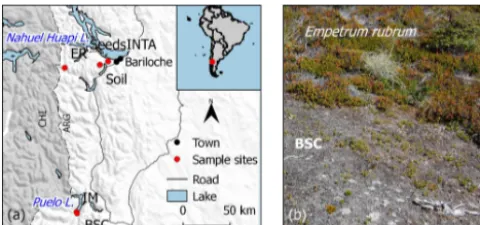
con-Figure 1.Location of the experimental station (INTA) and sam-pling sites of soil, inert (IM) and plant materials(a); mosaic of Em-petrum rubrum and biological soil crust (BSC) in a natural open area within aNothofagus pumilioforest(b).
ditions (temperature rise and precipitation decrease) which have already been observed and are predicted to persist (Bar-ros et al., 2014). We selected Nothofagus pumilio as a fo-cal organism, as it is a native deciduous tree forming pure or mixed stands over a great variety of environmental conditions along and across the Patagonian Andes. Creeping shrubs and BSCs are common cover types in areas where N. pumilio forests have been altered, and also in forest margins and above the forest tree line (Fig. 1b; Ferreyra et al., 2006), and as such they represent organisms with which recruiting N. pumilioindividuals would interact. As a creeping shrub we selectedEmpetrum rubrum(Vahl ex Willd.) which is widely distributed in the subantarctic islands, Fuegian Archipelago and all along the Patagonian Andes, forming dense woody carpets 2–12 cm tall that grow trailing the soil surface (Fer-reyra et al., 2006).
The BSC used in this experiment was dominated by the lichens Cladonia pocillum, C. subulata,C. cyathomorpha, Diploschistes muscorum and Placynthiella uliginosa; the moss Racomitrium lanuginosum; cyanobacteria, and to a lesser extent the lichenPeltigera polydactylonwhich has N-fixing photobionts. Nomenclature follows Calvelo and Lib-eratore (2002) for lichens and Brummit and Powell (1992) for bryophytes.
2.2 Experimental design
The experiment was conducted under greenhouse conditions during a 38-day period starting 25 February 2014 (austral summer), in an experimental station of INTA (National In-stitute of Agricultural Technology) in Bariloche, northern Patagonia (Fig. 1a). To test our hypotheses, we compared the response ofN. pumilioseedlings to water deficit under three contrasting soil cover types. The design included two factors: soil cover type with three levels (bare soil, soil covered by the BSC and soil covered by the shrub Empetrum rubrum) and watering regime with two levels (drought and control) in a 3×2 factorial design. There were three replicates per level of each factor; thus the total number of microcosms was 18. The
greenhouse was kept well ventilated during the study; maxi-mum and minimaxi-mum daily temperatures were 20◦C (±3) and 7◦C (±4) respectively, registered with a wireless thermome-ter (WHO100; Sinomethermome-ter Instruments, Shenzhen, China).
2.2.1 Microcosm construction
Each microcosm consisted of a 10 L polypropylene cylindri-cal container (22.5 cm diameter, 28.5 cm height) filled in the same way for all treatments, differing only in the top layer according to the soil cover type factor. To ensure proper drainage, containers were filled in the bottom with a 7 cm deep layer of inert materials (rocks, 5 cm diameter and 5 cm deep; gravel<2 cm diameter and 2 cm deep; and interspaces filled with sand) obtained from a river bank, and holes were drilled at the base of the containers. The middle part of the containers had a layer of 15 cm of naturalN. pumilio forest soil. Natural soils of N. pumilioforests at this lati-tude are andosols, which are derived from volcanic materi-als (Etchevehere, 1972; del Valle, 1998). The soil used had a loam texture and was thoroughly mixed before filling the mi-crocosms in order to homogenize it and minimize possible differences among replicates. To ensure homogeneity in the content of the containers, the height of each layer was mea-sured from outside with a ruler. The containers were topped with live patches of eitherE. rubrumor BSC, while for the bare soil treatment the forest soil was left as the top layer. TheE. rubrum patches were collected from an area where this species forms a monospecific 5 cm tall cover of theN. pumilioforest floor by cutting cores (15 cm in diameter and 10 cm deep) with a shovel, and the patches were transported in closed plastic bags to the experimental station. The bot-tom of the cores was then scraped by hand to remove soil, and the chunks of shrub carpet were placed with bare roots in trays with running water for 48 h. This washing procedure removed the remaining soil from the roots and was carried out to ensure that no extra soil was added to the microcosms. This procedure also has been proven to wash out rooting in-hibitors and to enhance rooting of other native species (Rolón et al., 2013). Finally, the chunks ofE. rubrumwith clean bare roots were planted on top of the containers until the com-plete surface was covered. The BSC was obtained by cut-ting square patches (10cm×10 cm, 3 cm deep) from an open area with homogeneous BSC cover and they were placed in empty containers for transportation. At the experimental sta-tion we arranged the patches on top of the filled containers and trimmed the edges to obtain a complete cover.
National Park (42◦110S, 71◦410W and 41◦090S, 71◦180W, respectively), in areas with very low human impact (Fig. 1).
2.2.2 Seedling production
Nothofagus pumilio seedlings used in the experiment were grown in a nursery at INTA from seeds collected by the authors in March 2011, from a matureN. pumiliostand in Nahuel Huapi National Park (Fig. 1). Seeds were collected at the time of their natural dispersal from several parent trees, pooled and stored in paper bags at 4◦C until used. Prior to sowing, seeds were stratified at 4◦C for 60 d on cotton moistened with 1 % fungicide (Vitavax®FLO, Lujan Agrí-cola, Mendoza, Argentina) to break dormancy. Three and a half months following emergence, six seedlings (15–20 cm tall with 10 true leaves and no yellowing or signs of her-bivory) were transplanted into each container to a depth of 10 cm and allowed to acclimatize to the microcosm condi-tions for two weeks prior to the initiation of the experiment.
2.2.3 Watering regime
The control treatment was watered to saturation three times a week throughout the experiment and allowed to drain through holes at the bottom of the microcosms. The drought treatment was watered to saturation (i.e., pot capacity sensu Passioura, 2006) at the beginning of the experiment, and thereafter watered once a week with a variable amount of water determined as 50 % of the weight loss by evapotran-spiration since the previous watering; so that a progressively smaller amount of water was used each time in order to achieve a gradual drop in the substrate moisture content. Wa-tering of the drought treatment was suspended during the last two weeks of the experiment.
2.3 Variables measured
The volumetric water content (VWC; % v/v) of soil was mea-sured in all microcosms three times a week for 38 d using a time domain reflectometer (HydroSense with 12 cm rod sen-sors, CS620 Campbell Scientific Inc., Logan, Utah, USA). Midday stomatal conductance (gs; mmol H2O m−2s−1) was measured 3 d a week in fully expanded leaves of six seedlings per treatment, also for the 38-day experiment, with a leaf porometer (SC-1, Decagon Devices Inc., Pullman, Washing-ton, USA). All VWC and gs measurements were performed between 09:00 and 11:00 when the greenhouse was in full sunlight. The water status of seedlings was monitored by measuring pre-dawn water potential (9pd; MPa) in the ter-minal shoots of three seedlings per treatment with a pres-sure chamber (PMS 1000, PMS Instrument Company, Cor-vallis, Oregon, USA). Measurements of9pdwere performed only three times when a substantial drop in VWC was de-tected (on days 14, 31 and 38 since the experiment onset) as it was a destructive procedure. At the end of the
experi-ment two seedlings from each container were harvested and dried at 65◦C to constant weight to determine the aerial and underground biomass (g). Soil was sampled (0–3 cm depth from each cover type) before starting the experiment (n=1) and sampled from each treatment at the end of the exper-iment (n=3). Soil samples were sieved through a 2 mm mesh and air dried for 1 week to measure the pH in water and the electrical conductivity (1 : 2.5 and 1 : 5 soil–water ra-tio, respectively). Phosphorous (P) was extracted in 0.5 M NaHCO3(1 : 20, soil–solution ratio) and determined by the molybdate–ascorbic acid method (Kuo, 1996). Total carbon (C) and nitrogen (N) were determined by dry combustion (Thermo Electron, FlashEA 1112, Rodano, Milan, Italy). In-organic N was evaluated using 2 N KCl extracts, and then ammonium was determined by the indophenol-blue method and nitrate by copperized Cd reduction (Keeney and Nelson, 1982).
2.4 Data analysis
Differences in final soil properties, seedling dry weights andS/Rs (shoot-to-root ratios) among treatments, includ-ing their combinations, were compared with two-way anal-ysis of variance (ANOVA) followed by Bonferroni post hoc tests with type of soil cover and watering conditions as fac-tors. The significance of main factors or their interaction was determined according to α=0.05. If the main factors were significant and the interaction between factors was not significant, differences among treatment combinations were determined according to a Bonferroni corrected α=0.003 (αcorrected=α/c; where c=k(k−1)/2 and k=number of treatment combinations; in our case k=6 ). One-way repeated-measures ANOVAs were used to test the effect of the watering regime on seedling water potential. This vari-able was transformed by applying the natural logarithm of the absolute value in order to achieve normality and homo-geneity of variances.
statisti-cal analyses were performed with InfoStat (Di Rienzo et al., 2017), except the ARIMA models, which were performed in R using the “arima” function of the “tseries” library.
To quantify the outcome of interactions between N. pumilio seedlings and E. rubrum and the BSC, we calcu-lated the relative interaction index (RII) which measures the net balance of biotic interactions on plant biomass (Armas et al., 2004). RII is expressed as RII=(Bw−Bo)/(Bw+Bo), where Bw is the dry weight of the target species growing with an accompanying organism and Bo is the weight of the target species in absence of interactions. The RII of a target plant ranges from−1 for a plant completely outcompeted by another plant to+1 for a plant facilitated by another plant.
3 Results
3.1 Soil conditions under different surface covers
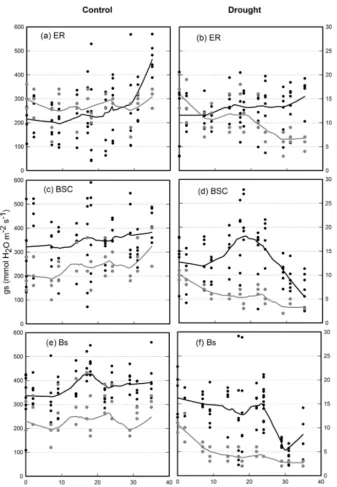
Throughout the experiment, soil water content was relatively stable in the control of all three substrates, with average val-ues of 13.6±1.2 %, 11.6±1.8 % and 11.3±1.5 % (mean ± SE), for E. rubrum, BSC and bare soil treatments, re-spectively (Fig. 2a, c, e). Fluctuations corresponded to the watering events. Under reduced watering, soil VWC rapidly dropped below 5 % v/v after 10 d for bare soil, while persist-ing for about 20 d above 5 % v/v for crusted soils and was above 10 % v/v for the soils covered byE. rubrum(Fig. 2b, d, f). The bare soil and BSC substrate types showed a consid-erable drop in the VWC when watering was suspended after the 25th day of the experiment (Fig. 2d, f).
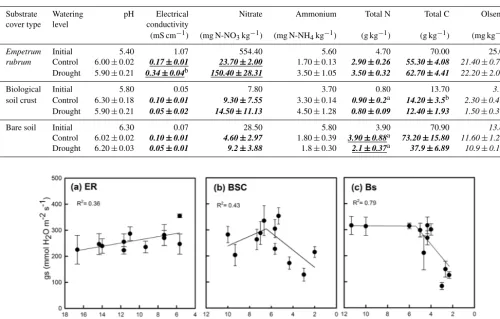
In the initial soil samples, we found differences in most chemical and physical variables measured among soils cov-ered by BSC, bare soils, or soils covcov-ered byE. rubrum (Ta-ble 1). At the end of the experiment, differences in soil prop-erties between the control and drought conditions were non-significant for soils covered by BSC, but there was a signif-icant effect (p <0.05) of watering conditions on the nitrate content and electrical conductivity of theE. rubrumcovered soils and on the total nitrogen content of bare soils. One in-teresting yet not significant trend is the higher final concen-tration of ammonium observed under drought compared to the control for the soil covered by E. rubrum (Table 1). It is also worth mentioning the slight increase in nitrate and ammonium concentrations in the BSC covered soils at the end of the experiment in comparison to the initial concen-tration, while theE. rubrumand bare soil treatments showed an opposing pattern of decreasing concentrations in both the control and drought conditions at the end of the experiment (Table 1).
3.2 Seedlings’ performance and growth
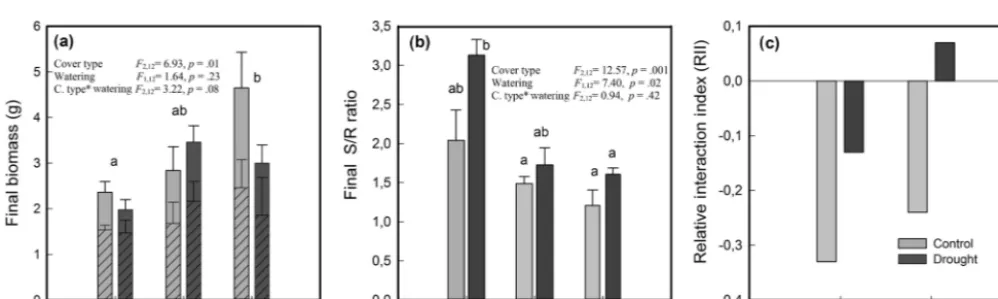
The interaction index (RII) was negative for seedlings grown withE. rubrumunder both watering conditions (Fig. 5c). A positive value of RII was obtained for seedlings growing in
soils covered by BSC under restricted watering, but a nega-tive value under full watering was observed (Fig. 5c).
The stomatal conductance (gs) of seedlings growing in soils covered byE. rubrumdid not decrease due to limited watering, but on the contrary gs slightly increased in both wa-tering conditions as the experiment progressed (Fig. 2a, b). Under restricted watering, there was a negative relationship between seedlings’ gs and soil VWC (Fig. 3a), but the out-come of the ARIMA model indicated no explanatory effect of VWC on gs (Table 2). In addition, the9pdof seedlings did not differ significantly between watering conditions and did not vary significantly during the whole experiment (Fig. 4a). At the end of the experiment, seedlings grown in soils cov-ered byE. rubrumhad significantly lower total biomass in comparison to those grown in bare soil, which was mainly due to a reduced development of roots (Fig. 5a, b).
In soils covered by BSC, water-restricted seedlings had higher values of gs at intermediate conditions of soil VWC, although soil VWC did not explain the tendency of gs as drought conditions intensified (Figs. 2d and 3b, Table 2). Seedlings subjected to water stress showed a significant de-crease in their9pd as drought intensified (Fig. 4b). At the end of the experiment, seedling biomass was slightly greater under stress than under the well-watered condition, but dif-ferences in biomass were not statistically significant (Fig. 5a, b).
In seedlings growing in bare soils, gs slightly increased in the fully watered condition as the experiment progressed, whereas in seedlings subjected to low watering conditions gs abruptly diminished when the soil VWC fell below 5.5 % v/v (Figs. 2e, f and 3c). In the water-restricted treatment, the soil VWC had an explanatory effect on gs and this tendency was strongly time dependent (Table 2). The9pdwas significantly depressed in the water stressed seedlings relative to control seedlings (Fig. 4c). Seedlings growth was not significantly different between the reduced and full-watering conditions (Fig. 5a).
4 Discussion
Figure 2.Volumetric water content of soil (VWC, in gray) and stomatal conductance ofNothofagus pumilioseedlings (gs, in black) grown in different treatments of soil cover and under conditions of full and restricted watering (control and drought, respectively). Crosses are mean values for each measured date and lines are locally weighted polynomial regressions (LOESS) performed on all values for each date. ER, soil covered byEmpetrum rubrum; BSC, soil covered by biological soil crust; and Bs, bare soil.
seedlings and between BSC and tree seedlings in a temperate forest ecosystem.
4.1 Potential effects ofEmpetrum rubrumon the tree seedlings
Previous studies in different temperate forests of Patago-nia have shown that shrubs have an overall positive effect
Table 1.Properties of bare soil and soils covered by biological soil crust andEmpetrum rubrumbefore (initial) and after applying a full watering (control) and a partial soil drying regimen (drought) during a 38-day period. Values are means±1 standard error (n=3). Differences among final conditions were determined using two-way ANOVA followed by Bonferroni post hoc comparisons. Bold values represent significant interaction between substrate type and watering level (p≤0.05). Underlines and italics represent significance of simple main effects (watering level and substrate type, respectively) (p≤0.05). Within each column and substrate cover type, values sharing a letter (a, b or c) are not statistically different from each other (Bonferroni-correctedp≤0.003).
Substrate Watering pH Electrical Nitrate Ammonium Total N Total C Olsen P cover type level conductivity
(mS cm−1) (mg N-NO3kg−1) (mg N-NH4kg−1) (g kg−1) (g kg−1) (mg kg−1)
Empetrum Initial 5.40 1.07 554.40 5.60 4.70 70.00 25.00
rubrum Control 6.00±0.02 0.17±0.01 23.70±2.00 1.70±0.13 2.90±0.26 55.30±4.08 21.40±0.78a Drought 5.90±0.21 0.34±0.04b 150.40±28.31 3.50±1.05 3.50±0.32 62.70±4.41 22.20±2.09a
Biological Initial 5.80 0.05 7.80 3.70 0.80 13.70 3.10
soil crust Control 6.30±0.18 0.10±0.01 9.30±7.55 3.30±0.14 0.90±0.2a 14.20±3.5b 2.30±0.49b Drought 5.90±0.21 0.05±0.02 14.50±11.13 4.50±1.28 0.80±0.09 12.40±1.93 1.50±0.37b
Bare soil Initial 6.30 0.07 28.50 5.80 3.90 70.90 13.80
Control 6.02±0.02 0.10±0.01 4.60±2.97 1.80±0.39 3.90±0.88a 73.20±15.80 11.60±1.29c Drought 6.20±0.03 0.05±0.01 9.2±3.88 1.8±0.30 2.1±0.37a 37.9±6.89 10.9±0.18c
Figure 3.Relationship between volumetric water content (VWC) of soil and stomatal conductance (gs) ofNothofagus pumilioseedlings grown in different treatments of soil cover under conditions of restricted watering. ER, soil covered byEmpetrum rubrum; BSC, soil covered by biological soil crust; and Bs, bare soil. Note the different range of thexaxis for panel(a). Values are the average per measuring date, and fitted regressions are linear or piecewise linear. Statistical analyses of the influence of soil VWC on seedling gs are detailed in Table 2.
be due to the greater biomass of the shrub compared to the tree seedlings at this stage. Another possibility is interfer-ence effects, which have been widely documented for other ericaceous shrubs (Nilsson and Wardle, 2005). For example, allelopathic compounds of congeneric E. hermaphrodium have strong ecological impacts in boreal forests affecting soil microbiota, tree seedling growth and nutrient uptake among other factors (Nilsson et al., 1993; Nilsson and War-dle, 2005). More specifically in Patagonia, a negative effect of E. rubrumon the growth of other plants has been pre-viously observed in Tierra del Fuego (southern Patagonia), where grasses were not able to recover in sheep-grazed sec-ondary succession terrains that had been colonized by E. rubrum(Collantes et al., 1989). It has been hypothesized that inhibition of the growth of other plants may be mediated by
the slow decay of organic matter (Collantes et al., 1989) or a strong allelopathic activity of the species (Mongelli et al., 1997).
sim-Figure 4.Predawn water potential (9pd) values forNothofagus pumilioseedlings grown in different soil cover types and under conditions of full and restricted watering (control and drought, respectively). ER, soil covered byEmpetrum rubrum; BSC, soil covered by biological soil crust; and Bs, bare soil. Values are the means of three replicates per treatment±standard error. Significance values (p) are from one-way, repeated-measures ANOVAs testing the effects of watering regime over time. Wilks indicates the Wilks’ lambda value.
Figure 5.(a)Final biomass (dry weight) of shoot (striped pattern) and root (plain colored),(b)shoot-to-root ratio (S/R) and(c)relative interaction index (RII) ofNothofagus pumilioseedlings grown in different cover types and under conditions of full and restricted watering (control and drought, respectively). ER, soil covered byEmpetrum rubrum; BSC, soil covered by biological soil crust; and Bs, bare soil. Biomass andS/Rratio values are means of 3 replicates±standard error. Significance values (p) are from two-way ANOVAs testing effects of soil cover type and watering regime. If main effects or interactions were significant individual comparisons are not shown. Different lower-case letters indicate significantly different values by a posteriori tests at (p≤0.05) for interaction, or (p≤0.003) for main effects.
ilar decrease in the allelopathic activity of a shrub with in-creasing environmental stress has been described in semiarid systems (Hortal et al., 2015).
The presence of shrubs can be associated with an increase in soil moisture (Butterfield et al., 2016; Michalet and Pug-naire, 2016). This is consistent with our results which show that this cover type contributed positively to soil volumet-ric water content (VWC), probably by slowing water loss in comparison to bare soil. This resulted in seedlings not ex-hibiting water deficit signals under the restricted watering regime because the drop in soil water content at the end of the experiment was most likely insufficient to induce a de-crease in seedlings’ performance.
Table 2. Results of the best fit autoregressive integrated moving average (ARIMA) models of the variation in stomatal conductance ofNothofagus pumilioseedlings grown under water restriction in three soil cover conditions, using soil volumetric water content as the explicative variable. The parameters in the model are AR, au-toregressive coefficient;I, integrated error term; and MA moving average term.Xis the linear regression coefficient of the explica-tive variable.
Condition Model AIC Coefficient Calculated value ±1 SE
Empetrum AR (0) 110.796 I −1.366±0.927
rubrum I(1) MA1 −1.020±0.420
MA (2) MA2 0.020±0.330
Biological AR (0) 130.809 I −11.089±25.438 soil crust I(1) MA1 −0.308±0.285 MA (2) MA2 1.000±1.116
Bare soil AR (2) 127.234 I −9.354±4.147
I(1) X −17.615±5.729
MA (1) AR1 −0.113±5.729 AR2 −0.631±0.225 MA1 −1.000±0.277
4.2 Potential effects of the biological soil crust on the tree seedlings
In agreement with predictions of the SGH, we found that the effect of BSC on tree seedling growth switched from negative to positive as water availability was reduced. One of the facil-itative mechanisms involved could have been improved soil water conservation; a more gradual decrease in soil VWC as water restriction increased in comparison to bare soil. Previ-ous research indicates that the hydrological role of BSC is the result of the interplay among characteristics of BSC, the soil (mainly texture) and the rain event (Whitney et al., 2017). For instance, positive effects on soil moisture have been linked to fine-textured soil, small rain events (Zhang et al., 2008) and well-developed BSC (Whitney et al., 2017), while reductions in soil moisture have been reported for coarse-textured soils and moss-dominated BSC (Xiao et al., 2016) or early suc-cessional stages of the BSC (Whitney et al., 2017). In our case, the soil was of intermediate texture and the magnitude of the watering events changed throughout the study; so al-though relevant these factors may not have played a deter-mining role. The observed effect on soil water more likely was related to the characteristics of the BSC, which was well developed with an important lichen component (Thiet et al., 2014; Whitney et al., 2017).
What is interesting about our findings is how this increase in soil moisture related to seedling performance. When con-sidering the effect of the BSC on theN. pumilioseedlings’ gs, we found that it improved as soil water availability was reduced up to a level around 6 % v/v. We presume that the rel-atively low gs measured at the beginning of the experiment is associated with a negative effect of the activity of the BSC,
and that the enhanced seedling physiological performance as drought accentuated could be related to a shift in the balance of the interaction as the BSC desiccated, with the BSC reduc-ing its negative effect on the seedlreduc-ings while maintainreduc-ing pos-itive effects on water balance. A competpos-itive role of the BSC is also supported by our results as there was a lack of an effect of soil water on seedling gs, which provides evidence for an active role of the BSC on soil hydrology. Thereafter, severe drought stress gave rise to an abrupt decline in seedling water status, with a soil VWC value around 6 % probably indicat-ing the species threshold for stomatal closure, which is simi-lar to otherNothofagusspecies (Piper et al., 2007; Varela et al., 2010). Therefore, our results for seedling gs are in agree-ment with a hump-shaped SGH model.
Another mechanism fostering seedling growth could be re-lated to nitrogen cycling. Previous research indicates that one of the BSC’s most important ecological roles is atmospheric carbon and nitrogen fixation (Weber et al., 2016). The BSC used in this study contains the lichenPeltigera polydactylon, which has nitrogen-fixing photobionts. We found that the lev-els of ammonium and nitrate slightly increased at the end of the experiment in soils covered by the BSC, while they de-creased in the other substrate types. This suggests that N may have been added to the system by the BSC during the exper-imental period.
Our measurements are insufficient to discriminate direct competitive effects of the BSC (Belnap and Lange, 2003; Serpe et al., 2006; Funk et al., 2014; Thiet et al., 2014) from possible indirect effects of BSCs such as interference mediated by allelopathic compounds or unfavorable ther-mal changes (Soudzilovskaia et al., 2011). Nonetheless, our results do indicate that BSC–plant interactions can change from negative to positive over short time spans and non-linearly over varying water availability. This is in line with previous work indicating that negative and positive effects of BSCs on vascular plants operate together (Thiet et al., 2014), and that the net outcome cannot be linearly predicted by abi-otic conditions (Lett et al., 2018). These findings highlight the variability in the response of BSC organisms (Li et al., 2018), and BSC–plant interactions to future climate varia-tions (Weber et al., 2016).
5 Concluding remarks
in-terdependent. Also, our results highlight the complexity of making predictions about future responses of BSC–plant in-teractions to climate change. The identity of the organisms comprising the BSC, the characteristics of the underlying soil and the climate of each ecosystem should be acknowledged when making predictions about the effects of climate change on the BSC and subsequent effects on vascular plants. Ul-timately our results suggest that some predictions made in the context of global change like upwards movement of al-titudinal tree lines need to incorporate the effects of biotic interactions (Hillerislambers et al., 2013).
Data availability. All original data can be requested from the cor-responding author.
Author contributions. CP, IAG, VA and PM conceptualized the work. CP, SAV, VA and PM carried out the assays and acquired data. MGP carried out soil analysis. CP, IG, SAV and OB carried out data analysis. All authors participated in writing and editing.
Competing interests. The authors declare that they have no con-flict of interest.
Acknowledgements. We thank Abel Martinez, Mario Huentu, Maria Marta Azpilicueta, Mario López and Pierre Pitte for their help in producing the seedlings, for data collection, for fieldwork and for producing the map. The manuscript was improved with comments from Agustina Barros, Ricardo Villalba and Mariana Chiuffo. We also thank the National Parks Administration of Argentina. This study was partially funded by ANPCyT (grant: PICT 1417), CON-ICET (PIP 112-2011010-0809), the Inter-American Institute for Global Change Research (CRN2047) and INTA (PNFOR1104063).
Review statement. This paper was edited by Daniel Montesinos and reviewed by Rachel Thiet and one anonymous referee.
References
Armas, C., Ordiales, R., and Pugnaire, F. I.: Measuring plant in-teractions: a new comparative index, Ecology, 85, 2682–2686, https://doi.org/10.1890/03-0650, 2004.
Barros, V. R., Boninsegna, J. A., Angela, I., Chidiak, M., Magrín, G. O., and Rusticucci, M.: Climate change in Argentina: trends, pro-jections, impacts and adaptation, WIREs Clim. Chang., 6, 151– 169, https://doi.org/10.1002/wcc.316, 2014.
Belnap, J.: Biological soil crusts in deserts: a short review of their role in soil fertility, stabilization, and water rela-tions, Arch. Hydrobiol. Suppl. Algol. Stud., 50, 113–126, https://doi.org/10.1127/1864-1318/2003/0109-0113, 2003. Belnap, J. and Lange, O. L.: Structure and functioning of biological
soil crusts: a synthesis, Biol. Soil Crusts Struct. Funct. Manag., 226, 471–479, 2003.
Belnap, J., Weber, B., and Büdel, B.: Biological soil crusts as an organizing principle in drylands, in: Biological soil crusts: an or-ganizing principle in drylands, edited by: Weber, J. B. B. and Budel, B., 3–13, Springer International Publishing, Switzerland, 2016.
Bertness, M. D. and Callaway, R. M.: Positive interac-tions in communities, Trends Ecol. Evol., 9, 191–193, https://doi.org/10.1016/0169-5347(94)90088-4, 1994.
Bianchi, E., Villalba, R., Viale, M., Couvreux, F., and Marticorena, R.: New precipitation and temperature grids for Northern Patag-onia: advances in relation to global climate grids, J. Meteo-rol. Res., 30, 38–52, https://doi.org/10.1007/s13351-015-5058-y, 2016.
Bowker, M. A., Soliveres, S., and Maestre, F. T.: Compe-tition increases with abiotic stress and regulates the di-versity of biological soil crusts, J. Ecol., 98, 551–560, https://doi.org/10.1111/j.1365-2745.2010.01647.x, 2010. Box, G. E. P. and Jenkins, G. M.: Time series analysis
forecast-ing and control, Revised Ed., Holdem-Day, Inc., San Francisco, USA, 1976.
Breen, K. and Lévesque, E.: Proglacial succession of biological soil crusts and vascular plants: biotic interactions in the High Arctic, Can. J. Bot., 84, 1714–1731, https://doi.org/10.1139/b06-131, 2006.
Brummit, R. K. and Powell, C. E.: Authors of Plants Names, Royal Botanical Garden, Kew, UK, 732 pp., 1992.
Büdel, B.: Biological soil crusts in European temperate and mediter-ranean regions, in Biological crusts: stracture, function and man-agement, vol. 150, edited by: Belnap, J. and Lange, O. L., 75–86, Springer-Verlag, Berlin Heidelberg, Germany, 2001.
Bustamante-Sánchez, M. A., Armesto, J. J., and Halpern, C. B.: Bi-otic and abiBi-otic controls on tree colonization in three early suc-cessional communities of Chiloé Island, Chile, J. Ecol., 99, 288– 299, https://doi.org/10.1111/j.1365-2745.2010.01737.x, 2011. Butterfield, B. J. and Briggs, J. M.: Regeneration niche
differen-tiates functional strategies of desert woody plant species, Oe-cologia, 165, 477–87, https://doi.org/10.1007/s00442-010-1741-y, 2011.
Butterfield, B. J., Bradford, J. B., Armas, C., Prieto, I., and Pug-naire, F. I.: Does the stress-gradient hypothesis hold water? Disentangling spatial and temporal variation in plant effects on soil moisture in dryland systems, Funct. Ecol., 30, 10–19, https://doi.org/10.1111/1365-2435.12592, 2016.
Callaway, R. M. and Walker, L. R.: Competition and facilitation: a synthethic approach to interactions in plant communities, Ecol-ogy, 78, 1958–1965, 1997.
Calvelo, S. and Liberatore, S.: Catálogo de los líquenes de la Ar-gentina, Kurtziana, 29, 7–170, 2002.
Collantes, M. B., Anchorena, J., and Koremblit, G.: A soil nutri-ent gradinutri-ent in MagellanicEmpetrumheathlands, Plant Ecol., 80, 183–193, 1989.
del Valle, H. F.: Patagonian soils: a regional synthesis, Ecol. Aus-tral., 8, 103–123, 1998.
Di Rienzo, J. A., Casanove, S., Balzarini, M. G., Gonzalez, L., Tablada, M., and Robledo, C.: InfoStat versión 2017, Universi-dad Nacional de Córdoba, available at: https://www.infostat.com. ar/?lang=en (last access: 3 April 2019), 2017.
interactions along a latitudinal gradient, J. Ecol., 101, 465–474, https://doi.org/10.1111/1365-2745.12036, 2012.
Dullinger, S., Kleinbauer, I., Pauli, H., Gottfried, M., Brooker, R., Nagy, L., Theurillat, J., and Holten, J. I.: Weak and variable re-lationships between environmental severity and small-scale co-occurrence in alpine plant communities, J. Ecol., 95, 1284–1295, https://doi.org/10.1111/j.1365-2745.2007.01288.x, 2007. Dvorský, M.: Ecology of alpine plants in NW Himalaya, University
of South Bohemia, Czech Republic, 2014.
Etchevehere, P. H.: Los Suelos de la Region Andino-Patagónica, in La Region de los Bosques Andino-Patagonicos, edited by Milan Dimitri, pp. 83–95, Colección Científica de INTA, Buenos Aires, Argentina, 1972.
Ferreyra, M., Ezcurra, C., and Clayton, S.: High Mountain Flowers of the Patagonian Andes, LOLA, Buenos Aires, Argentina, 2006. Funk, F. A., Loydi, A., and Peter, G.: Effects of biological soil crusts and drought on emergence and survival of a Patagonian peren-nial grass in the Monte of Argentina, J. Arid Land, 6, 735–741, https://doi.org/10.1007/s40333-014-0022-8, 2014.
Garibotti, I. A., Pissolito, C. I., Villalba, R., Garibotti, I. A., Pis-solito, C. I., and Villalba, R.: Spatiotemporal pattern of primary succession in relation to meso-topographic gradients on recently deglaciated terrains in the Patagonian Andes, Arct. Antarct. Alp. Res., 43, 555–567, https://doi.org/10.1657/1938-4246-43.4.555, 2011.
Garreaud, R. D., Lopez, P., Minvielle, M., and Rojas, M.: Large-scale control on the Patagonian climate, J. Climate, 26, 215–231, https://doi.org/10.1175/JCLI-D-12-00001.1, 2013.
Gold, W. G., Glew, C., and Dickson, L. G.: Functional influences of cryptobiotic surface crusts in an alpine tundra basin of the Olympic Mountains, Washington, USA, Northewest Sci., 75, 315–326, 2001.
Gómez-Aparicio, L.: The role of plant interactions in the restoration of degraded ecosystems: A meta-analysis across life-forms and ecosystems, J. Ecol., 97, 1202–1214, https://doi.org/10.1111/j.1365-2745.2009.01573.x, 2009. He, Q., Bertness, M. D., and Altieri, A.: Global shifts towards
pos-itive species interactions increasing environmental stress, Ecol. Lett., 16, 695–706, https://doi.org/10.1111/ele.12080, 2013. Henríquez, J. M. and Lusk, C. H.: Facilitation of Nothofagus
antarctica(Fagaceae) seedlings by the prostrate shrubEmpetrum rubrum(Empetraceae) on glacial moraines in Patagonia, Austral Ecol., 30, 877–882, 2005.
Hillerislambers, J., Harsch, M. A., Ettinger, A. K., Ford, K. R., and Theobald, E. J.: How will biotic interactions influence climate change – induced range shifts?, Ann. NY Acad. Sci., 1297, 112– 125, https://doi.org/10.1111/nyas.12182, 2013.
Hortal, S., Bastida, F., Moreno, J. L., and Garcia, C.: Bene-factor and allelopathic shrub species have different ef-fects on the soil microbial community along an environ-mental severity gradient, Soil Biol. Biochem., 88, 48–57, https://doi.org/10.1016/j.soilbio.2015.05.009, 2015.
Jacoby, W. G.: Loess: a nonparametric, graphical tool for depicting relationships between variables, Elect. Stud., 19, 577–613, 2000. Keeney, D. R. and Nelson, D. W.: Nitrogen-inorganic forms, in Methods of Soil Analysis, Part 2, edited by: Miller, R. H. and Keeney, D. R., 643–698, Soil Society of America, Madison, USA, 1982.
Kidron, G. J.: Do mosses serve as sink for rain in the Negev Desert? A theoretical and experimental approach, Catena, 121, 31–39, https://doi.org/10.1016/j.catena.2014.05.001, 2014.
Kitzberger, T., Steinaker, D., and Veblen, T.: Effects of climatic vari-ability on facilitation of tree establishment in northern Patagonia, Ecology, 81, 1914–1924, 2000.
Kuo, S.: Phosphorus, in Methods of Soil Analysis. Part 3. Chemical methods, edited by: Sparks, D. L., Page, A. L., Helmke, P. A., Loeppert, R. H., Soltanpour, P. N., Tabatabai, M. A., and John-ston, C. T., 869–919, Soil Society of America, Madison, USA, 1996.
Langhans, T. M., Storm, C., and Schwabe, A.: Biological soil crusts and their microenvironment: impact on emergence, sur-vival and establishment of seedlings, Flora, 204, 157–168, https://doi.org/10.1016/j.flora.2008.01.001, 2009.
Lenaerts, J. T. M., van den broeke, M. R., van Wessem, J. M., van de Berg, W. J., Van Meijgaard, E., van Ulft, L., and Schaefer, M.: Extreme precipitation and climate gradi-ents in Patagonia revealed by high-resolution regional atmo-spheric Climate modeling, Am. Meteorol. Soc., 27, 4607–4621, https://doi.org/10.1175/JCLI-D-13-00579.1, 2014.
Lett, S., Wardle, D., Nilsson, M., and Teuber, L. M.: The role of bryophytes for tree seedling responses to winter climate change: Implications for the stress gradient hypothesis, J. Ecol., 106, 1142–1155, https://doi.org/10.1111/1365-2745.12898, 2018. Li, X., Jia, R., Zhang, Z., Zhang, P., and Hui, R.:
Hydrolog-ical response of biologHydrolog-ical soil crusts to global warming: a ten-year simulative study, Glob. Change Biol., 10, 4960–4971, https://doi.org/10.1111/gcb.14378, 2018.
Maestre, F. T., Valladares, F., and Reynolds, J. F.: Is the change of plant – plant interactions with abiotic stress predictable?? A meta-analysis of field results in arid environments, J. Ecol., 93, 748–757, https://doi.org/10.1111/j.1365-2745.2005.01017.x, 2005.
Maestre, F. T., Bowker, M. A., Escolar, C., Puche, M. D., Soliveres, S., Maltez-Mouro, S., García-Palacios, P., Castillo-Monroy, A. P., and Martínez, I.: Do biotic interactions modulate ecosystem functioning along stress gradients? Insights from semi-arid plant and biological soil crust communities, Philos. T. Roy. Soc., 365, 2057–2070, https://doi.org/10.1098/rstb.2010.0016, 2010. Michalet, R. and Pugnaire, F. I.: Facilitation in communities:
un-derlying mechanisms , community and ecosystem implications, Funct. Ecol., 30, 3–9, https://doi.org/10.1111/1365-2435.12602, 2016.
Mongelli, E., Desmarchelier, C., and Coussi, J.: The potential ef-fects of allelopathic mechanisms on plant species diversity and distribution determined by the wheat rootlet growth inhibition bioassay in South American plants, Rvista Chil. Hist. Nat., 70, 83–89, 1997.
Nilsson, M. and Wardle, D. A.: Understory vegetation as a forest ecosystem driver: evidence from the northern Swedish boreal forest, Front. Ecol. Environ., 3, 421–428, 2005.
Nilsson, M., Zackrisson, O., and Fengyou, W.: Allelopathic effects byEmpetrum hermaphroditumon development and nitrogen up-take by roots and mycorrhizae ofPinus silvestris, Can. J. Bot., 71, 620–628, 1993.
lev-els inAustrocedrus chilensisgrowing within and outside shrubs, J. Veg. Sci., 20, 1064–1071, 2009.
Odén, P. christopher, Brandtberg, P.-O., Anderson, R., Gref, R., Za-ckrisson, O., and Nilsson, M.: Isolation and characterization of a germination inhibitor from leaves ofEmpetrum hermaphroditum Hagerup, Scand. J. For. Reaserch, 7, 497–501, 1992.
Passioura, J. B.: The perils of pot experiments, Funct. Plant Biol., 33, 1075–1079, 2006.
Pendleton, R. L., Pendleton, B. K., Howard, G. L., and Warren, S. D.: Growth and nutrient content of herbaceous seedlings associ-ated with biological soil crusts, Arid L. Res. Manag., 17, 271– 281, https://doi.org/10.1080/15324980301598, 2003.
Piper, F. I., Corcuera, L. J., Alberdi, M., and Lusk, C. H.: Differ-ential photosynthetic and survival responses to soil drought in two evergreenNothofagusspecies, Ann. For. Sci., 64, 447–452, 2007.
Pugnaire, F. I. and Luque, M. T.: Changes in plant interactions along a gradient of environmental stress, Oikos, 93, 42–49, https://doi.org/10.1034/j.1600-0706.2001.930104.x, 2001. Raffaele, E. and Veblen, T. T.: Facilitation by nurse shrubs
of resprouting behavior in a post-fire shrubland in north-ern Patagonia, Argentina, J. Veg. Sci., 9, 693–698, https://doi.org/10.2307/3237287, 1998.
Rodríguez-Catón, M., Villalba, R., Morales, M. S., and Srur, A.: Influence of droughts on Nothofagus pumilio forest de-cline across northern Patagonia, Argentina, Ecosphere, 7, 1–17, https://doi.org/10.1002/ecs2.1390, 2016.
Rolón, A., Mari, C., Fernández, H. M., Dezzotti, A., and Orlov, D.: Efecto del ácido indolbutírico sobre el enraizamiento de es-tacas juveniles de verano deNothofagus nervosayNothofagus pumilio, Rev. la Fac. Agron. La Plata, 111, 91–98, 2013. Schmidt, S. K., Reed, S. C., Nemergut, D. R., Grandy, A. S.,
Cleve-land, C. C., Weintraub, M. N., Hill, A. W., Costello, E. K., Meyer, A. F., Neff, J. C., and Martin, A. M.: The earliest stages of ecosystem succession in high-elevation (5000 metres above sea level), recently deglaciated soils, P. Roy. Soc. B, 275, 2793–2802, https://doi.org/10.1098/rspb.2008.0808, 2008.
Serpe, M. D., Orm, J., Barkes, T., and Rosentreter, R.: Germination and seed water status of four grasses on moss-dominated biolog-ical soil crusts from arid lands, Plant Ecol., 185, 163–178, 2006. Shi, W., Wang, X., Zhang, Y., Pan, Y., Hu, R., and Jin, Y.: The ef-fect of biological soil crusts on soil moisture dynamics under dif-ferent rainfall conditions in the Tengger Desert, China, Hydrol. Process., 32, 1–12, https://doi.org/10.1002/hyp.11493, 2018. Soudzilovskaia, N. A., Graae, B. J., Douma, J. C., Grau, O., Milbau,
A., Shevtsova, A., Wolters, L., and Cornelissen, J. H. C.: How do bryophytes govern generative recruitment of vascular plants??, New Phytol., 190, 1019–1031, https://doi.org/10.1111/j.1469-8137.2011.03644.x, 2011.
Srur, A. M., Villalba, R., Rodríguez-Catón, M., and Amoroso, M. M.: Establishment ofNothofagus pumilioat upper treelines across a precipitation gradient in the Northern Patagonian An-des, Arct. Antarct. Alp. Res., 48, 755–766, 2016.
Su, Y.-G., Li, X.-R., Cheng, Y.-W., Tan, H.-J., and Jia, R.-L.: Effects of biological soil crusts on emergence of desert vascular plants in North China, Plant Ecol., 191, 11–19, https://doi.org/10.1007/s11258-006-9210-8, 2007.
Thiet, R. K., Doshas, A., and Smith, S. M.: Effects of biocrusts and lichen-moss mats on plant productivity in a US sand dune ecosystem, Plant Soil, 377, 235–244, https://doi.org/10.1007/s11104-013-2002-8, 2014.
Tylianakis, J., Didham, R., Bascompte, J., and Wardle, D.: Global change and species interactions in terrestrial ecosys-tems, Ecol. Lett., 11, 1351–1363, https://doi.org/10.1111/j.1461-0248.2008.01250.x, 2008.
Varela, S. A., Gyenge, J. E., Fernández, M. E., and Schlichter, T.: Seedling drought stress susceptibility in two deciduous Nothofagus species of NW Patagonia, Trees, 24, 443–453, https://doi.org/10.1007/s00468-010-0412-2, 2010.
Weber, B., Belnap, J., and Büdel, B.: Synthesis on Biological Soil Crust Research, in: Biological Soil Crusts: An Organizing Princi-ple in Drylands, edited by: Webber, B., Büdel, B., and Belnap, J., 527–534, Springer International Publishing, Switzerland, 2016. Whitney, K. M., Bradford, J. B., Duniway, M. C., Vivoni, E. R.,
Bel-nap, J., and Reed, S. C.: Ecohydrological role of biological soil crusts across a gradient in levels of development, Ecohydrology, 10, 1–18, https://doi.org/10.1002/eco.1875, 2017.
Xiao, B. and Hu, K.: Moss-dominated biocrusts decrease soil moisture and result in the degradation of artificially planted shrubs under semiarid climate, Geoderma, 291, 47–54, https://doi.org/10.1016/j.geoderma.2017.01.009, 2017.
Xiao, B., Hu, K., Ren, T., and Li, B.: Moss-dominated biologi-cal soil crusts significantly influence soil moisture and temper-ature regimes in semiarid ecosystems, Geoderma, 263, 35–46, https://doi.org/10.1016/j.geoderma.2015.09.012, 2016.
Zaady, E., Gutterman, Y., and Boeken, B.: The germina-tion of mucilaginous seeds of Plantago coronopus, Re-boudia pinnata, and Carrichtera annua on cyanobacterial soil crust from the Negev Desert, Plant Soil, 190, 247–252, https://doi.org/10.1023/A:1004269031844, 1997.
Zhang, Y. and Belnap, J.: Growth responses of five desert plants as influenced by biological soil crusts from a temperate desert, China, Ecol. Res., 30, 1037–1045, 2015.
Zhang, Y., Aradottir, A. L., Serpe, M., and Bertrand, B.: Interactions of biological soil crusts with vascular plants, in: Biological Soil Crusts: An Organizing Principle in Drylands, edited by: Weber, B., Büdel, B., and Belnap, J., 385–406, Springer International Publishing, Switzerland, 2016.