Galley
Pro
of
Vol. 8, No. 2, (2018), pp 39–54 DOI:10.22067/ijnao.v8i2.61465
New variable neighborhood search
method for minimum sum coloring
problem on simple graphs
Kh. Erfani∗, S. Rahimi and J. Fathali
Abstract
The minimum sum coloring problem (MSCP) is to find a legal vertex coloring forG using colors represented by natural numbers (1,2, . . .) such that the total sum of the colors assigned to the vertices is minimized. The aim of this paper is to present the skewed variable neighborhood search (SVNS) for this problem based on a new structure of neighborhoods. To increase the speed of the neighborhood search process, we present the new concepts of holder vertex and set. Tested on 23 commonly used benchmark instances, our algorithm shows acceptable competitive performance with respect to recently proposed heuristics.
Keywords: Minimum sum coloring; Variable neighborhood search; Skewed variable neighborhood search; Chromatic sum; Holder vertex; Holder set; Reducer set.
1 Introduction
The general graph coloring is one of the most well-known problems in combi-natorial optimization. Besides its theoretical significance as a canonical NP-Hard problem [9], graph coloring arises naturally in a variety of real-world
∗Corresponding author
Received 31 December 2016; revised 17 June 2017; accepted 28 February 2018 Kh. Erfani
Department of Applied Mathematics, Shahrood University of Technology, Shahrood, Iran. e-mail: [email protected]
S. Rahimi
Department of Applied Mathematics, Shahrood University of Technology, Shahrood, Iran. e-mail: [email protected]
J. Fathali
Department of Applied Mathematics, Shahrood University of Technology, Shahrood, Iran. e-mail: [email protected]
Galley
Pro
of
applications such as timetable problems [3], warehouse management [29], frequency allocation in mobile network [28], register allocation in optimizing compilers [4], scheduling problem [8], design and operation of exible manufac-turing systems [10]. For example, in computer systems with multiprocessors that are in competition over resources, we might seek an allocation under which no two jobs with conflicting requirements are executed simultaneously while minimizing the average completion time of the jobs.MSCP is closely related to the basic graph coloring problem. It was proposed by Kubicka [21] in the field of graph theory and by Supowit [30] in the field of VLSI design.
Suppose that G = (V, E) is a simple undirected graph (without loop, multi, and directed edge) with vertex set V ={v1, v2, . . . , vn} and edge set
E ⊆ V ×V. A proper vertex k-coloring of G is an assignment of positive integers to its vertices by function c : V → {1,2, . . . , k} such that no two adjacent vertices are assigned the same number (i.e. c(vi)̸=c(vj),∀(i, j)∈
E). The color of a vertexvis denoted by c(v).
A legal k-coloring can also be defined as partition ofV in tokindependent
setsV1, V2, . . . , Vksuch that for allu, v∈Vi(i= 1, . . . , k),(u, v)∈/ E. In other
word,c can also be represented as a partition ofV in tokmutually disjoint independent set (called color classes) V1, V2, . . . , Vk such that
∪n
i=1Vi = V
andv∈Vi if and only ifc(v) =i.
The general graph coloring problem (GCP) is to determine a proper k-coloring with a minimum value of k. This value is called the chromatic number of G and denoted byχ(G). A related problem to the GCP is the minimum sum coloring problem (MSCP), which is to find a proper coloring
c={V1, V2, . . . , Vk}such that the following total sum of color labels, denoted
by∑cG, to be minimized.
∑
c
G=
n
∑
i=1
c(vi) =
k
∑
i=1
i|Vi|.
Now the vertex chromatic sum or minimum sum coloring ofGis denoted by∑G, and defined as
min
{ ∑
c
G|c∈C
}
,
whereCis the collection of all proper coloring ofG. The vertex strength ofG
denoted bys(G), is the smallest numbers, where there is a proper coloringc
withscolors such that∑c(G) =∑G. It is clear thats(G) is lower bounded by χ(G). The distance between s(G) and χ(G) can be large. Indeed there are many instances in whichs(G)>> χ(G) [21].
Galley
Pro
of
is expected to require an exponential complexity. Also, it has several practi-cal applications including VLSI design, scheduling, and distributed resource allocation (see [24] for a list of references for more application).Due to its high computational complexity, no polynomial-time algorithm can solve or approximate the problem efficiently unlessP =N P. In the past several decades, much effort has been devoted to developing various heuristic and metaheuristic algorithms. For the purpose of practical solving of the general MSCP, several heuristic algorithms have recently been proposed to find suboptimal solutions. This class of algorithms has been mainly devel-oped since 2009 and is not proved the optimality of the solution found. Some examples of the heuristic algorithms include tabu search [2], greedy algo-rithms [23], genetic and memetic algoalgo-rithms [5, 17–19, 26, 32], breakout local search [1], iterated local search [15] , ant colony [6] as well as heuristics based on independent set extraction [33, 34]. But in contrast, some kinds of liter-ature have addressed the issue of theoretical bounds that formally proved, included [7, 11, 12, 16, 22, 31] for instance.
In recent years, variable neighborhood search (VNS) has been proven as a very effective and adaptable metaheuristic, used for solving a wide range of complex optimization problems. In this paper, we design and test a VNS algorithm for finding proper colorings, which correspond to upper bounds of the chromatic sum. In the literature on graph coloring several proposals appeared, combining the following characteristics: partial vs complete color-ings, proper vs improper colorcolor-ings, fixed vs variable k (see [15] for a review).
We opt vectorX with size of|V| for a solution representation consisting of colors that must be proper. We then devise a search strategy that borrows ideas from modified VNS method called skewed VNS method (SVNS) towards special kind of neighborhood. The fact that increasing the number of colors may decrease the chromatic sum was the main motivation of definition of such new neighborhood structure (see Fig. 1).
In the following sections, we first provide integer nonlinear mathematical formulation along with a definition ofNkneighborhood structure of MSCP. In
Galley
Pro
of
2 Modeling and
N
kNeighborhoods of MSCP
2.1 Modeling
LetG= (V, E) be a simple undirected graph with vertex setV ={v1, v2, . . . , vn}
and edge setE⊆V ×V. Although the MSCP can be formulated as a binary quadratic problem, we also presented another formulation of this problem. Define variable xi as the color of vertex i fori = 1,2, . . . , n. Therefore the
integer nonlinear mathematical formulation is defined as follows:
M in
n
∑
i=1
xi
s.t.
|xi−xj| ≥1 :∀(i, j)∈E (1)
1≤xi≤n , integer :i= 1,2, . . . , n (2)
The previous model can be reduced with elimination of redundant constraints and suitable changing of variables,
P) M in
n
∑
i=1
xi (3)
s.t.
|xi−xj| ≥1 :∀(i, j)∈E (4)
xi≥0, integer :i= 1,2, . . . , n (5)
This mathematical formulation expresses MSCP correctly, since each vector
X = (x1, x2, . . . , xn) that satisfies equations (4) and (5) is a proper coloring
c for Gand the objective function (3) minimizes∑cG. ∑(X) denotes the sum of colors of proper coloringc. It should be noted that this model does not claim abouts(G) and focuses on∑G. By assuming thatS be set of all proper coloring ofG,P can be written briefly as follows:
P) M in −→1.X (6)
s.t.
X ∈S, (7)
where−→1.Xis the inner product of−→1 = (1,1, . . . ,1) andX. Indeed∑(X) =
∑n
i=1xi = −→1.X. According to the description stated above, any feasible
solution forP is a vectorX= (x1, x2, . . . , xn) satisfied equations (4) and (5).
Galley
Pro
of
2.2 New Neighborhoods for MSCP
We know that the neighborhood is an important element that influences the local search procedure. So, searching for feasible spaces is meaningless with-out knowing the definition of the neighborhood. Therefore according to the mathematical model of the previous part, we introduce neighboring structure for MSCP here. To read more about neighborhoods for this problem you can see [1, 14, 15, 17].
Definition 1. Let X and S be a feasible solution and feasible space of
P, respectively. Fork= 0,1, . . . , n, a neighborhoods ofX are defined by
Nk(X) ={Y ∈S |Y is greater than X in at most k element.} (8)
In fact, Nk(X) contains all of the feasible solutions (proper coloring) that
are greater thanX in thekelement at most. The size of theNk(.) becomes
bigger ifkincreases. Indeed|Nk(.)| ∈O(
(n k
)
) and we have
N0(X)⊆N1(X)⊆ · · · ⊆Nk(X)
As you can see, these neighborhoods will be nested; that is, each one contains the previous. So if X is locally optimal with respect to Nk, then it will be
locally optimal with respect to Ni for i = 0,1, . . . , k−1. Also, if it is not
to be locally optimal w. r. t. Ni, then it will not be locally optimal w. r.
t. Ni fori=k+ 1, . . . , n. ClearlyS =Nn(X). But it’s important to know
the minimum value of ksuch that Nk =S. In other words, for which value
ofkthe neighborhoodNk is exact? For a given neighborhoodN if any local
optimal is also global optimal, thenN is exact [27].
To clarify the issue, Figure 1 shows an illustrative example forNk(.). The
numbers that are in and out the vertices are vertex number and vertex color, respectively. With the given 3-coloringX (left figure), we achieve the subop-timal sum of 18 whileY leads to chromatic sum of 15 (right figure). By Defi-nition 1,N0(X) ={X} andY /∈N0(X), N1(X) butY ∈Nk(X)f orallk≥2.
Therefore by starting withX, we achieve the locally optimalY w. r. t. N2, that is also globally optimal.
The next important point that should be noted is about the size ofNk. As
Galley
Pro
of
3 3
2
1 1
2
2 3
1
(a)X= (1,2,3,3,3,1,1,2,2)
1 1
4
1 2
1
1 3
1
(b)Y = (2,4,3,1,1,1,1,1,1)
Figure 1: An illustrative example forNk(.)
3 Holder and Reducer Set
Definition 2. k-holder set: Given a proper coloring X= (x1, . . . , xn) and
k-element subset H ={t1, t2, . . . , tk} fromV. H is a k-holder set, when for
some v∈N(H)1and index 0≤r≤kthe following two conditions hold:
1) xtr< xv;
2) For any vertexw∈N(v)\H, we havexw̸=xtr.
In such case, we say that H holds vertex tr.
Especially in above definition whenk= 1, we obtain 1-holder set called
holder vertex. Indeed, for two adjacent vertices a and b, we say a holds b
and denoted bya↗b, if Definition 1 is stated fork= 1. Consider again the graph of Figure 1a with 3-coloringX. Both two setsH1={1}andH2={2} are holder vertices according to Definition 2. H1 is agood holder vertex be-causeH1holds 4,5,9,8 and when its color is increased the objective function
Galley
Pro
of
is reduced three units. In contrast H2 is not a good one because no change does happen when its color starts to increase. Thus, the holding feature not sufficient to improve the objective function and should havereduction prop-erty.Definition 3. k-reducer set: Given a proper coloring X. The k-holder set H is a k-reducer set, when the objective function is improved (reduced) by increasing its color of vertices.
The above definitions lead us to the following obvious propositions, which more specifies the relationship betweenNk and these two new concepts.
Proposition 1. The proper coloring X is locally optimal w.r.t. Nk if and
only ifGhas no k-reducer set.
Proposition 2. The proper coloringX is a global optimal if and only if there existsk0∈Z+ such that Ghas no k-reducer set w.r.t. X for anyk≥k0.
For a given solutionX, if Ghas no k-holder set for any k∈Z+, then it has no k-reducer set for anyk∈Z+ and so according to Proposition 2X is globally optimal.
4 VNS Method with respect to
N
kfor MSCP
Galley
Pro
of
Algorithm 1 Skewed variable neighborhood search for MSCPAdjacency matrix of graphG, Select the set of neighborhood struc-turesNk, k= 1, . . . , kmax. Find an initial proper coloringX and its value
∑
(X). SetXopt←−X. Choose a stopping condition and a parameter
value α. A solution Xopt and its value
∑
(Xopt). stopping condition
not reached Set: k←−1 k ≤kmax Generate a solution X′ at random
from the kth neighborhood of X or perturb X, randomly./*Shaking or Perturbing */ Apply some local search method withX′ as initial solu-tion. Denote withX′′the so obtained local optimum. /*Local search*/
∑
(X′′)<∑(Xopt)Xopt←−X′′
∑
(Xopt)←−
∑
(X′′) /*Improvement or not*/ ∑(X′′)−αρ(X, X′′) <∑(X) X ←− X′′ k←− 1 k ← k+ 1 /*Move or not.*/
easy to find, for example, the hamming distance when solutions are described by boolean vectors or the Euclidean distance in the continuous case. Here we use p-norm distance for p=1,2. P-norm is a class of vector norms, denoted by||.||p, is defined as
||X||p= (|x1|p+|x2|p+· · ·+|xn|p)
1
p p≥1, X∈Rn
and the distance between to two n-vectors X andY based on this norm, is defined as
||(X, Y)||p= (|x1−y1|p+|x2−y2|p+· · ·+|xn−yn|p)
1 p
Algorithm1 presents the general SVNS algorithm for the MSCP, whose ingredients are detailed in the following. It has four main phases, shaking or perturbing, local search, improve or not and move or not. Usually, the second phase will have maximum computing time. SVNS starts with an initial random coloring X, which must be proper. In the first phase (line 4) we use shaking or perturbing at random. Indeed, we decide shaking to shake against perturbing strategy with probabilitypin each iteration of local search procedure. kmax, the maximum value for the size of neighborhoods,
must be identified at first. In local search phase (line 6), we apply variable neighborhood descent (VND) as an ingredient of VNS method. This method is illustrated in Algorithm 2. Then SVNS check to ensure that any improve-ment has happened or not (lines 8–11)? In lines 13–18 it decides on moving to the new solution or increasing k. SVNS iterates these steps while the maximum number of iterations since the last improvement is reached.
Galley
Pro
of
perturbation mechanismwill be used to improve solution quality and jumping from local optimums (attractors).
Algorithm 2 Variable neighborhood descent
Select the set of neighborhood structures Nl, l = 1, . . . , lmax. Find
an initial proper coloring X and its value ∑(X). A solution X and its value∑(X). there is improvement Set l ←− 1 l ≤ lmax Find the
best neighborX′ of X (X′ ∈ Nl(X))./*Exploration of Neighborhood*/
∑
(X′)<∑(X) X←X′ l←−1 l←l+ 1 /*Move or not*/
4.1 Order of Falling
According to Section 2, the existence of k-holder sets are anecessary condition
for the existence of k-reducer sets. Therefore, we will use this necessary condition for recognition of reducer sets. Then we increase all color of vertices in reducer set forfalling the colors of remaining vertices. It is important that the remaining vertices meet in what order to take maximum falling of color vertices happens.
Suppose graphG with proper coloring X. Construct weighted directed graph D= (V(D), E(D), W) fromGas follows:
1) V(D) =V(G).
2) E(D) ={(a, b)|a, b∈V(D) &a↗b}.
3) ∀e= (a, b)∈E(D), we=xb−xa.
D is a weighted directed graph with no directed cycle, multiple edge, and loop. Actually, D is a directed acyclic graph (DAG). The longest directed path inD can help us to find the best order of falling.
Although the longest path problem is NP-hard for a general graph, it has a linear time solution for directed acyclic graphs. The idea is based on topological sorting. Topological sorting for a DAG is a linear ordering of vertices such that for every directed edge (u, v), vertex ucomes before v in the ordering. Topological sorting for a graph is not possible if the graph is not a DAG.
Galley
Pro
of
another proper 3-coloring Y = (2,1,2,1,3,1,2,1) with sum 13 is obtained from X. In fact,Y ∈N1(X). Now we can apply the above process for new solutionY.With this idea, the examination of all elements ofNk to find a local optimum
ofNk is not necessary and therefore the exploration velocity of neighbors in
local search phase of Algorithm 1 increases.
2
3
5
4
6
7
8
1
1
2
3
4
1
2
1
1
(a)GwithX= (1,2,3,1,4,1,2,1)
2
3
5
4
6
7
8
1
1
1
1
2
1
2
(b) The weighted DAGD
Figure 2: An illustrative example for the order of falling
4.2 Perturbation Mechanism
Consider the sub optimal solutionX, which has not any suitable falling order. Indeed the weighted DAG D is an empty or low-density graph. Increasing the value ofkusually is not useful and lead to increase the computation time. In these cases, local search procedure may be induced to cycle between two or more locally optimal solutions and leading to search stagnation. So, to jump from this situations we change inX to create some good falling orders. We will choose vertex (or vertices) that has more interruptions for holding of the other vertices and increase their colors to produce holder vertices and consequently generate orders of falling to decrease objective function.
We explain this mechanism on the example shown in Figure 3. We have plotted this example on two-dimensional axis vertex-color. The horizontal and vertical axises are the index and color of vertices respectively. Suppose
kmax= 1, and we stop in proper coloringX = (1,2,2,2,2,1) (Fig.3a). There
gen-Galley
Pro
of
vertices
1 2 3 4 5 6
colors 1 1.1 1.2 1.3 1.4 1.5 1.6 1.7 1.8 1.9 2
(a) Local optimal that isn’t global
vertices
1 2 3 4 5 6
colors 1 1.2 1.4 1.6 1.8 2 2.2 2.4 2.6 2.8 3
(b) Increasing the color of vertex 3
vertices
1 2 3 4 5 6
colors 1 1.5 2 2.5 3
(c) Vertex 6 becomes a holder vertex
vertices
1 2 3 4 5 6
colors 1 1.1 1.2 1.3 1.4 1.5 1.6 1.7 1.8 1.9 2
(d) Global optimal
Figure 3: An illustrative example for perturbation mechanism
erate holder set by increasing the color of some vertices. But which vertices? Increasing color of one or even all 2,3,4, and 5 causes nothing in order to improve the solution. But increasing color of vertex 1 (or 6) is very useful because it causes to generate holder and reducer set H = {6}(Figs.3c,3b). If now we apply local search w.r.t N1 on new solution Y = (3,2,2,2,2,1), then we get the new better proper coloring (2,1,1,1,1,2), which is globally optimal (Fig.3d).
5 Experimental Results
Our SVNS algorithm is programmed inMATLAB(R2015a) and compiled on a PC with 2.7 GHz CPU and 4 Gb RAM. The 23 of well-known benchmark graphs fromCOLOR22002−2004 in the literature, which is commonly used to test sum coloring algorithms is considered in Table 1 and Table 2. The
Galley
Pro
of
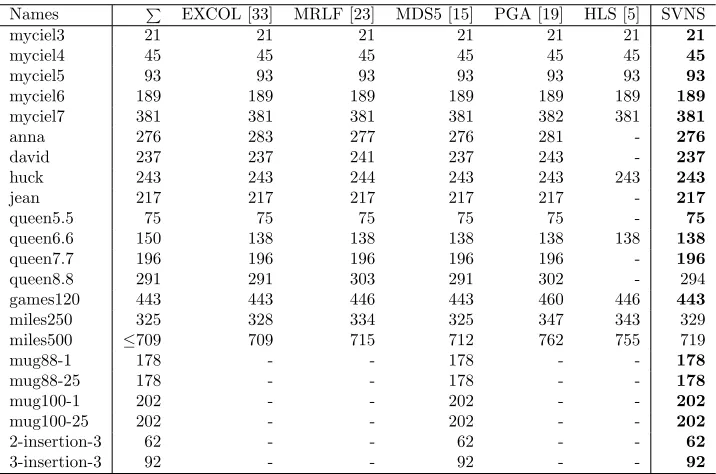
reported values are based on 10 independent runs. Table 1 gives the detailed characteristics of these benchmark graphs. Columns 1–6 indicate the num-ber of vertices (|V|), the number of edges (|E|), the density d = 2mnn−1, the chromatic sum (∑) and the smallest number of required colors (k) of graphs. Columns 7–9 present detailed computational results of our SVNS algorithm: Best result obtained (∑∗) with the number of required colors (k∗), average coloring sum (Avg.) and standard deviation (Std.). The results, for instances, of COLOR02 benchmark indicate that SVNS attained the best-known result for 19 instances, and was unable to reach the current best result for four instances (homer, queen8.8, miles250 and miles500). Table 2 reports the
Table 1: Computational results of SVNS on 23 COLOR02 instances
Characteristics of graphs SVNS
Instances |V| |E| d ∑ k ∑∗(k∗) Avg. Std.
myciel3 11 20 0.36 21 4 21 (4) 21.0 0.0
myciel4 23 71 0.28 45 5 45 (5) 45.0 0.0
myciel5 47 236 0.22 93 6 93 (6) 93.0 0.0
myciel6 95 755 0.17 189 7 189 (7) 189.0 0.0
myciel7 191 2360 0.13 381 8 381 (8) 381.4 0.52
anna 138 986 0.05 276 11 276 (11) 276.3 0.48
david 87 812 0.11 237 11 237 (11) 238.6 0.84
huck 74 602 0.11 243 11 243 (11) 243.0 0.0
jean 80 508 0.08 217 10 217 (10) 217.1 0.31
homer 561 1629 0.01 - 10 1163 (13) 1168.5 3.5
queen5.5 25 160 0.53 75 5 75 (5) 75.0 0.0
queen6.6 36 290 0.46 138 7 138 (8) 138.2 0.42
queen7.7 49 476 0.4 196 7 196 (7) 197.4 4.4
queen8.8 64 728 0.36 291 9 294 (9) 301 5.33
games120 120 638 0.09 443 9 443 (9) 445.3 1.56
miles250 128 387 0.05 325 8 329 (8) 333.2 2.1
miles500 128 1170 0.11 ≤709 20 719(20) 728.2 7.03
mug88-1 88 146 0.04 178 4 178 (4) 178.0 0.0
mug88-25 88 146 0.04 178 4 178 (4) 178.0 0.0
mug100-1 100 166 0.03 202 4 202 (4) 202.0 0.0
mug100-25 100 166 0.03 202 4 202 (4) 202.0 0.0
2-insertion-3 37 72 0.11 62 4 62 (4) 62.0 0.0
3-insertion-3 56 110 0.07 92 4 92 (4) 92.0 0.0
Galley
Pro
of
Table 2: Comparative results between our SVNS algorithm and five reference approaches on the set of COLOR02 instancesNames ∑ EXCOL [33] MRLF [23] MDS5 [15] PGA [19] HLS [5] SVNS
myciel3 21 21 21 21 21 21 21
myciel4 45 45 45 45 45 45 45
myciel5 93 93 93 93 93 93 93
myciel6 189 189 189 189 189 189 189
myciel7 381 381 381 381 382 381 381
anna 276 283 277 276 281 - 276
david 237 237 241 237 243 - 237
huck 243 243 244 243 243 243 243
jean 217 217 217 217 217 - 217
queen5.5 75 75 75 75 75 - 75
queen6.6 150 138 138 138 138 138 138
queen7.7 196 196 196 196 196 - 196
queen8.8 291 291 303 291 302 - 294
games120 443 443 446 443 460 446 443
miles250 325 328 334 325 347 343 329
miles500 ≤709 709 715 712 762 755 719
mug88-1 178 - - 178 - - 178
mug88-25 178 - - 178 - - 178
mug100-1 202 - - 202 - - 202
mug100-25 202 - - 202 - - 202
2-insertion-3 62 - - 62 - - 62
3-insertion-3 92 - - 92 - - 92
time are not available for all the reference algorithms. Also the symbol “-” means that the information is not available.
6 Conclusion
Galley
Pro
of
Acknowledgements
Authors are grateful to there anonymous referees and editor for their con-structive comments.
References
1. Benlic, U. and Hao, J. K.A study of breakout local search for the minimum sum coloring problem, pp. 128–137, Springer Berlin Heidelberg, Berlin, Heidelberg, 2012.
2. Bouziri, H. and Jouini, M. A tabu search approach for the sum coloring problem, Electronic Notes in Discrete Math. 36 (2010) 915–922.
3. Burke, E. K., McCollum, B., Meisels, A., Petrovic, S. and Qu, R.A graph-based hyper-heuristic for educational timetabling problems, Eur. J. Oper. Res. 176 (2007), no. 1, 177 – 192.
4. de Werra, D., Eisenbeis, Ch.,Lelait, S. and Marmol, B.On a graph- theo-retical model for cyclic register allocation, Discrete Appl. Math. 93 (1999), no. 23, 191 – 203.
5. Douiri S.M. and Elbernoussi, S.New algorithm for the sum coloring prob-lem, Int. J. Contemporary Math. Sci. 6 (2011) no. 9-12, 181–192.
6. Douiri S. M. and Elbernoussi, S.A new ant colony optimization algorithm for the lower bound of sum coloring problem, J. Math. Model. Algorithms 11 (2012), no. 2, 181–192.
7. Erdos, P., Kubicka, E. and Schwenk, A. J. Graphs that require many colors to achieve their chromatic sum, In Proceedings of the Twentieth South-eastern Conference on Combinatorics Graph Theory and Comput-ing (Boca Raton, FL), vol. 71, 1990, pp. 17–28.
8. Gamache, M., Hertz, A. and Ouellet, J. O. A graph coloring model for a feasibility problem in monthly crew scheduling with preferential bidding, Comput. Oper. Res. 34 (2007), no. 8, 2384–2395.
9. Garey, M. R. and Johnson, D. S. Computers and intractability; a guide to the theory of np-completeness, W. H. Freeman & Co., New York, NY, USA, 1990.
10. Glass, C. A. Bag rationalisation for a food manufacturer, J. Oper. Res. Soc. 53 (2002), no. 5, 544–551.
Galley
Pro
of
12. Hajiabolhassan, H.,Mehrabadi, M. L. and Tusserkani, R.Tabular graphsand chromatic sum, Discrete Math. 304 (2005), no. 1-3, 11–22.
13. Hansen, P. and Mladenovic, N.Variable neighborhood search: Principles and applications, Eur. J. Oper. Res. 130 (2001) no. 3, 449–467.
14. Hao J. -K. and Wu, Q.Improving the extraction and expansion method for large graph coloring, Discrete Appl. Math. 160 (2012), no. 1617, 2397 – 2407.
15. Helmar, A. and Chiarandini, M. A local search heuristic for chromatic sum, Proceedings of the 9th Metaheuristics International Conference, MIC 2011 (L. D. Gaspero, A. Schaerf, and T. Stutzle, eds.), 2011, pp. 161–170. 16. Jiang, T. and West, D. B.Coloring of trees with minimum sum of colors,
J. Graph Theory 32 (1999), no. 4, 354–358.
17. Jin, Y.,Hao, J. K. and Hamiez, J. P.A memetic algorithm for the mini-mum sum coloring problem, Comput. Oper. Res. 43 (2014), 318 – 327. 18. Jin, Y. and Hao, J. -K.Hybrid evolutionary search for the minimum sum
coloring problem of graphs, Inf. Sci. 352 (2016), no. C, 15–34.
19. Kokosi´nski Z. and Kwarciany, K. On sum coloring of graphs with par-allel genetic algorithms, pp. 211–219, Springer Berlin Heidelberg, Berlin, Heidelberg, 2007.
20. Kroon, L. G., Sen, A. , Deng, H. and Roy, A.The optimal cost chromatic partition problem for trees and interval graphs, pp. 279–292, Springer Berlin Heidelberg, Berlin, Heidelberg, 1997.
21. Kubicka, E.The chromatic sum of a graph, Ph.D. thesis, Western Michi-gan University, MichiMichi-gan, 1989.
22. Kubicka, E. and Schwenk, A. J.An introduction to chromatic sums, Pro-ceedings of the 17th Conference on ACM Annual Computer Science Con-ference (New York, NY, USA), CSC ’89, ACM, 1989, pp. 39–45.
23. Li, Y. ,Lucet, C., Moukrim, A. andSghiouer, K. Greedy Algorithms for the Minimum Sum Coloring Problem, Logistique et transports (Sousse, Tunisia), March 2009, pp. LT–027.
24. Malafiejski, M.Sum coloring of graphs, pp. 55–65, AMS, Poland, 2004. 25. Mladenovic, N. and Hansen, P. Variable neighborhood search, Comput.
Oper. Res. 24 (1997) no.11, 1097–1100.
Galley
Pro
of
27. Papadimitriou, C. H. and Steiglitz, K.Combinatorial optimization: Algo-rithms and complexity, Prentice-Hall, Inc., Upper Saddle River, NJ, USA, 1982.28. Smith, D.H., Hurley, S. and Thiel, S.U. Improving heuristics for the frequency assignment problem, Eur. J. Oper. Res. 107 (1998), no. 1, 76 – 86.
29. Stecke, K. E.Design, planning, scheduling, and control problems of exible manufacturing systems, Ann. Oper. Res. 3 (1985), no. 1, 1–12.
30. Supowit, K. J. Finding a maximum planar subset of a set of nets in a channel, Trans. Comp.-Aided Des. Integ. Cir. Sys. 6 (2006), no. 1, 93–94. 31. Thomassen, C., Erdos, P. , Alavi, Y., Malde, P. J. and Schwenk, A. J.
Tight bounds on the chromatic sum of a connected graph, J. Graph Theory 13 (1989) no. 3, 353–357.
32. Wang, Y., Hao, J. K.,Glover, F. and Lu, Zh.Solving the minimum sum coloring problem via binary quadratic programming, CoRR abs/1304.5876 (2013).
33. Wu Q. and Hao, J. -K.An effective heuristic algorithm for sum coloring of graphs, Comput. Oper. Res. 39 (2012), no. 7, 1593 – 1600.
ﯽﻠﻌﺤﺘﻓ ﺮﻔﻌﺟ و فﺎﺑﺮﻌﺷ ﯽﻤﯿﺣر قدﺎﺻ ،ﺎﯿﻧرﺪﯿﺣ ﯽﻧﺎﻓﺮﻋ ﻞﯿﻠﺧ
یدﺮﺑرﺎﮐ ﯽﺿﺎﯾر هوﺮﮔ ،دوﺮﻫﺎﺷ ﯽﺘﻌﻨﺻ هﺎﮕﺸﻧاد
١٣٩۶ ﺪﻨﻔﺳا ٩ ﻪﻟﺎﻘﻣ شﺮﯾﺬﭘ ،١٣٩۶ دادﺮﺧ ٢٧ هﺪﺷ حﻼﺻا ﻪﻟﺎﻘﻣ ﺖﻓﺎﯾرد ،١٣٩۵ ید ١١ ﻪﻟﺎﻘﻣ ﺖﻓﺎﯾرد
یاﺮﺑ زﺎﺠﻣ ﯽﺳار یﺰﯿﻣآ ﮓﻧر ﻦﺘﻓﺎﯾ زا ﺖﺴﺗرﺎﺒﻋ (MSCP) ﻪﻨﯿﻤﮐ عﻮﻤﺠﻣ یﺰﯿﻣآ ﮓﻧر ﻪﻠﺌﺴﻣ : هﺪﯿﮑﭼ ﺖﺒﺴﻧ سﻮﺋر ﻪﺑ ﮓﻧر ناﻮﻨﻌﺑ ﻪﮐ یداﺪﻋا عﻮﻤﺠﻣ ﻪﮐ یرﻮﻄﺑ (...و٢و١) ﯽﻌﯿﺒﻃ داﺪﻋا زا هدﺎﻔﺘﺳا ﺎﺑ G فاﺮﮔ یاﺮﺑ برﻮﻣ ﺮﯿﻐﺘﻣ ﯽﮕﯾﺎﺴﻤﻫ یﻮﺠﺘﺴﺟ شور ﮏﯾ ﻪﻳارا ﻪﻟﺎﻘﻣ ﻦﯾا رد ﯽﻠﺻا فﺪﻫ .دﻮﺷ ﻪﻨﯿﻤﮐ ،ﺪﻧا ﺪﺷ هداد زا ﯽﮕﯾﺎﺴﻤﻫ یﻮﺠﺘﺴﺟ ﺖﻋﺮﺳ ﺶﯾاﺰﻓا یاﺮﺑ .ﺖﺳا ﺪﯾﺪﺟ ﯽﮕﯾﺎﺴﻤﻫ یﺎﻫ رﺎﺘﺧﺎﺳ ﺮﺑ ﯽﻨﺘﺒﻣ ،ﻪﻠﺌﺴﻣ ﻦﯾا شور لﻮﺒﻗ ﻞﺑﺎﻗ دﺮﮑﻠﻤﻋ ﺖﯾﺎﻬﻧ رد .ﺖﺳا هﺪﺷ هدﺎﻔﺘﺳا یا ﻪﻋﻮﻤﺠﻣ و ﯽﺳار ﯽﮔﺪﻧراﺪﻬﮕﻧ مﺎﻨﺑ یﺪﯾﺪﺟ مﻮﻬﻔﻣ .ﺖﺳا ﻪﺘﻓﺮﮔ راﺮﻗ ﻪﺴﯾﺎﻘﻣ درﻮﻣ ﺮﯿﺧا ﻪﻫد رد یرﺎﮑﺘﺑا شور ﺪﻨﭼ ﺎﺑ ،لواﺪﺘﻣ ﻪﻠﺌﺴﻣ ﻪﻧﻮﻤﻧ ٢٣ یور ،هﺪﺷ ﻪﯾارا