DEMOGRAPHIC RESEARCH
VOLUME 28, ARTICLE 19, PAGES 547-580
PUBLISHED 19 MARCH 2013
http://www.demographic-research.org/Volumes/Vol28/19/ DOI: 10.4054/DemRes.2013.28.19
Research Article
Occupational trajectories and occupational cost
among Senegalese immigrants in Europe
Ognjen Obu
ćina
© 2013 Ognjen Obućina.
This open-access work is published under the terms of the Creative Commons Attribution NonCommercial License 2.0 Germany, which permits use, reproduction & distribution in any medium for non-commercial purposes, provided the original author(s) and source are given credit.
1 Introduction 548
2 Research goals and hypotheses 550
3 Social context of Senegalese emigration 552
4 Data and measurement procedures 554
5 Descriptive statistics 556
6 Post-migration occupational attainment 560
6.1 Results 562
7 Correlates of post-migration occupational mobility 565
8 Occupational cost of migration 567
8.1 Fixed effects and random effects 569
8.2 Matching estimation 571
9 Concluding remarks 572
10 Acknowledgements 573
References 574
Occupational trajectories and occupational cost among Senegalese
immigrants in Europe
Ognjen Obućina1
Abstract
BACKGROUND
Immigration from Africa to Europe has increased substantially in recent decades. The main goal of this paper is to contribute to a better understanding of contemporary international migration processes by analyzing the occupational trajectories and occupational costs of Senegalese immigrants in three major European destination countries (France, Italy, and Spain).
OBJECTIVE
The first objective is to compare the occupational attainment of the Senegalese immigrants before and after migration to Europe, as well as to establish the determinants of the immigrants’ occupational attainment and occupational mobility levels after migration. Another major goal is to estimate the occupational cost of migration from Senegal to Europe. The central question this study intends to answer is how much, in terms of occupational status, Senegalese immigrants renounce by migrating to Europe, in both the short and the long term.
METHODOLOGY
The data stem from the Senegalese sample of the MAFE dataset. The standard OLS techniques are used in the analysis of occupational attainment, while discrete-time multinomial logit is used in the section on occupational mobility. The principal techniques for the estimation of occupational cost of migration are random effects with Mundlak correction and nearest-neighbor matching.
1 Demography Unit, Department of Sociology, Stockholm University, Sweden.
RESULTS
There is a U-shaped pattern of occupational mobility among Senegalese immigrants in Europe: the average occupational status of this group drops just after arrival in Europe, and then slowly improves with the duration of stay. The multivariate analysis reveals that education acquired in Europe plays an especially important role in the successful participation of this immigrant group in the labor market. The results show that there is a statistically significant occupational cost of migration from Senegal to Europe, but that the cost decreases with the duration of stay in Europe.
1. Introduction
After decades of empirical migration research, it has become clear that the migration decision-making process is affected by a complex and heterogeneous set of determinants. But most migration researchers agree that an individual’s desire to maximize his or her economic well-being is one of the principal factors influencing the decision to migrate, and some have argued that it is the single most important factor. However, the empirical findings suggest that a large proportion of immigrants endure a significant degree of economic hardship and vulnerability in their respective destination countries. While an immigrant’s absolute income usually rises as a result of migration, many immigrants do not seem to feel less deprived than they were in their country of origin. As this paper deals primarily with the experiences of Senegalese immigrants to Europe, it may be appropriate at this point to mention a study by Marfaing (2003), which revealed that a significant number of Senegalese immigrants residing in Germany say they would not choose to migrate to Europe if they had the chance to make the decision again, nor would they advise others to do so. Furthermore, the data used in this paper suggest that subjective poverty among immigrants is higher in the first few years in the destination country than in the last year prior to migration: for example, while 27.22% of immigrants reported that they were at least partly economically deprived in the last year prior to migration to Europe, 34.93% said they felt deprived in the first year after their arrival in Europe.
to a better understanding of the mechanisms of immigrant occupational trajectories by looking at the experiences of Senegalese immigrants in France, Italy, and Spain. Unless indicated otherwise, these three countries will be commonly referred to as ―Europe‖ throughout the rest of the paper.
A number of previous studies on this issue have identified a so-called ―U-shaped pattern‖ of occupational mobility among immigrants. More precisely, the evidence shows that immediately after landing in the destination country, the typical immigrant experiences some decline in occupational status. However it is expected that, with a longer duration of stay in the destination, most immigrants will see some improvement in their occupational status relative to their first job in the destination. The U-shaped pattern has been found in numerous studies carried out in various receiving countries: see Green (1999) for Canada; Bauer and Zimmermann (1999) for Germany; Chiswick, Lee, and Miller (2005) for Australia; Redstone Akresh (2006) for the USA; Rooth and Ekberg (2006) for Sweden; Simón et al. (2011) for Spain.
Most explanations for the U-shaped pattern of immigrant occupational trajectories are centered around the concept of country-specific skills: upon arrival, immigrants’ language skills are less than perfect, while their knowledge of the labor market and their access to information are more limited than among the natives. It is important to note that education acquired in the destination country is also considered a country-specific skill, and empirical findings suggest that it has a higher value on the labor market than education acquired in the country of origin (see Friedberg 2000). However, in addition to country-specific skills, some other factors may also facilitate or impede the process of immigrant occupational mobility. For example, immigrants may be particularly affected by the degree of segmentation of the labor market in the destination country (see Piore 1979). Furthermore, many immigrants (a large majority in the sample presented here) are required to obtain an appropriate work permit to access the labor market, which is seldom an easy task. In addition, educational credentials acquired abroad may not be recognized by the institutions of the destination country, and the practice of some occupations may require a license specific to the destination country (e.g., law, medicine, or dentistry). The subsequent upward mobility that a typical immigrant experiences is undoubtedly associated with the removal of the obstacles that were responsible for the initial decline in occupational status. As immigrants improve their language skills, they have easier access to labor market-related information, and many acquire additional education in the country of destination. Moreover, as the legal status of the average African immigrant in Europe improves with the duration of stay, institutional factors also become less of an obstacle2. Thus, with time, immigrants
2 To illustrate, more than half of the immigrants interviewed in the survey used in this paper did not have a
should have greater access to jobs than they did immediately after leaving their home countries.
Of course, the pattern described above is that of an average immigrant. In reality, not all immigrants experience downward mobility upon arrival. Among those who do, some experience only a minor occupational downgrading, while others suffer a more severe decline in job status. It has been documented that more educated immigrants in particular have a low degree of human capital transferability; i.e., they tend to experience a particularly sharp drop in their occupational status. However, they also tend to have the fastest upward mobility, partly because it is more profitable for them than for other immigrants to invest in additional human capital in the destination country (Duleep and Regets 1997). Moreover, different immigrant groups are faced with different contexts of reception (Portes and Böröcz 1989), and these differences are reflected in their treatment in the labor market in general and in the degree of transferability of their skills in particular. In their study of Spain, Simón et al. (2011) showed that the immigrants from developed countries will experience a ―shallower U‖ than immigrants from developing countries.
The rest of the paper is organized as follows. The main research goals and hypotheses are presented in Section 2. The aim of Section 3 is to familiarize the reader with the social context of Senegalese migration to Europe. Section 4 describes the dataset, as well as the measures of occupational attainment. The descriptive statistics on the post-migration occupational trajectories of Senegalese migrants are presented in Section 5. Section 6 features a multivariate analysis of occupational attainment, while the results of the discrete-time analysis of occupational mobility are presented in Section 7. We then move on to the estimation of the occupational cost of migration from Senegal to Europe in Section 8. Concluding remarks are presented in Section 9.
2. Research goals and hypotheses
country of origin with the first job in the destination. The aim here is to estimate the occupational cost as a function of the duration of stay in Europe.
Based on the theoretical models and empirical findings of similar studies, and taking into account the extent of the information available in the MAFE dataset, a number of hypotheses are proposed and tested in this paper. First, since the theoretical principles that underlie the U-shaped occupational pattern also apply to Senegalese immigrants in Europe, it is expected that the average occupational status in this group in the first year after arrival will be lower than that in the last year prior to leaving the country of origin. A gradual improvement in occupational status is expected to take place with the duration of stay in Europe. The second hypothesis relies on Friedberg’s findings on the transferability of skills, and predicts that education acquired in the destination country (or elsewhere in Europe) will have a stronger effect on upward mobility and occupational attainment than education obtained in Senegal (or elsewhere in Africa). The third hypothesis focuses on the legal status of immigrants in the labor market, and states that, due to limited access to the labor market in general, and to good jobs in particular, undocumented migrants will be disadvantaged in terms of occupational attainment. On the other hand, obtaining a work permit is expected to increase the chances of upward mobility.
3. Social context of Senegalese emigration
The African continent, and especially Sub-Saharan Africa, has seen a sharp increase in population in recent decades, and this trend is expected to continue. According to the projections of the United Nations Population Division (2009), the population of the African continent is likely to grow substantially, especially in Sub-Saharan Africa, where the population is expected to increase 50% between 2010 and 2030, and to double between 2010 and 2050. The population projections for Senegal are practically the same as those for the whole of Sub-Saharan Africa. These demographic forecasts, in combination with the bleak economic prospects for the region, prompted Hatton and Williamson (2001) to conclude that ―indeed, there is an excellent chance that by 2025 Africa will record far greater mass migrations than did nineteenth century Europe.‖ Migration flows from Africa to Europe and the USA have undoubtedly increased in recent years (for detailed evidence, see OECD, 2009 and Thomas, 2011), and in some European countries, such as France, Belgium, and Portugal, more than half of all immigrants from developing countries are African immigrants. However, at least as of 2013, the forecasts from the beginning of the century regarding the upcoming exodus from Africa now seem somewhat exaggerated. In fact, the bulk of African migration takes place within the continent (Spaan and van Moppes 2006).
ISTAT), and Spain (60,000 Senegalese-born in 2010, INE)3. While the sizes of the Senegalese-born population in these three countries seem to be very similar, the timing and the roots of the migration movements to each of three destinations are rather different. The link between Senegal and France emerged as a result of the colonial past and a strong French influence on the Senegalese administrative and educational systems. Thus, the migration of Senegalese to France can be considered an example of what Massey et al. (1993) labeled ―ideological links‖ in their explanation of the mechanisms of international migrations. Thus, the Senegalese immigrants in France can be compared with the Indian or Pakistani community in Britain, the Indonesian immigrants in the Netherlands, or the Maghrebi population in France. These ideological and cultural links led to an uninterrupted migration flow toward the former colonial power even after Senegal gained its independence. In contrast, the migratory movements to the two other destination countries under study in this paper began more recently. Italy became an attractive destination during the 1990s when many Senegalese looked for work in tourism and industry in northern Italy. Several years later, at the turn of the century, labor demand in construction and agricultural sector made Spain a popular destination for the Senegalese immigrants (Gerdes 2007).
While the three destination countries differ substantially in terms of their immigration traditions and the origins of their immigrant populations, the process of the integration of immigrants into the labor force is similar in many important respects across these countries. Bernardi et al. (2011) and Fullin and Reyneri (2011) found in their studies of Spain and Italy, respectively, that, even after controlling for observable characteristics, immigrants are strongly and persistently disadvantaged in terms of access to skilled occupations. Meanwhile, an OECD (2008) report on the labor market integration of immigrants noted that the French labor market is not particularly welcoming for recent immigrants. The three destination countries are also similar in terms of the skill levels of their immigrant populations, as the shares of the low-skilled in the total immigrant population of each country are among the highest in the EU-25 countries (ranging from 36.3% in Spain to 44.9% in France), and are thus comparable only to those of Greece and Portugal (OECD 2010). All three countries are also characterized by a relatively high share of the foreign-born in the low-skilled labor force.
3 The French and Italian figures only include documented migrants, while the Spanish data also include
4. Data and measurement procedures
standard errors obtained in the multivariate analyses are not reported. However, while it is important to be aware of the drawbacks of the sampling methodology used to construct the MAFE dataset, in interpreting the results I assume that the standard errors obtained in the multivariate analyses approximate those of a simple random sample. The significance levels are therefore reported in the tables and are also referred to in the text.
The MAFE data refer to immigrants’ experiences in different countries. Thus, in order to make comparisons of occupational status across countries, it is necessary to use an internationally comparable scale. In this paper, occupational status will be measured by the International Socio-Economic Index (henceforth referred to as ISEI), which was developed by Ganzeboom and Treiman (1996). The basis for the ISEI was the ISCO-88 occupational classification, which was adopted by the International Labor Organization (ILO). More precisely, each ISCO-88 occupational code is assigned an ISEI index on the metric scale between 16 and 90. However, the ILO has recently adopted a revised occupational classification, ISCO-08, which also prompted the development of a revised occupational status scale, ISEI-08. A more recent version of ISEI has been constructed using a new database that is more diverse cross-nationally. Moreover, unlike the previous version, the new database also considers women’s earnings. I therefore decided that the more recent version of ISEI is more appropriate than the previous version for use in this paper.4 In line with the approaches used in similar literature, all of the changes in job scores will be expressed as absolute differences rather than as percentages. Readers should also note that a somewhat generous definition of occupational mobility is applied in this paper: any positive change in ISEI, even if only by one point, is considered upward occupational mobility, while any negative change between two periods is considered downward mobility. Where appropriate, the European labor market history of the return migrants interviewed in Senegal is also included in the descriptive and multivariate analyses. The multivariate analyses of occupational mobility and occupational cost only refer to the years in which the survey respondents were aged 18 or older. Due to the nature of the research question, only immigrants with some African labor market experience are considered when analyzing whether the occupational trajectories have a U-shaped pattern. All of the other analyses of occupational status at destination also include the immigrants without pre-migration work experience. Around 4% of the employed immigrants surveyed in Europe can be considered circular migrants; i.e., migrants who returned to Africa at least once for at least one year after their initial arrival in Europe. The
4 The use of the new scale in this paper has been permitted by its author, Harry Ganzeboom. For details on
information about circular migrants is censored at the time of the initial return from Europe in all of the analyses presented in this paper.
5. Descriptive statistics
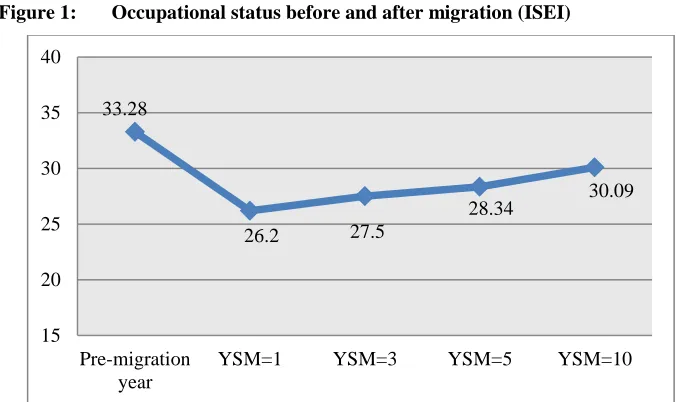
This section investigates the question of whether there actually is a U-shaped pattern of occupational attainment among the Senegalese in Europe, and, if so, how deep it is. The depth of the U-shaped pattern is expected to be affected by two major factors, with each working in the opposite direction. The transferability of skills varies greatly among the immigrant groups, as their respective countries of origin are characterized by different degrees of similarity with the destination country in terms of culture, language, labor market structure, and the educational system. However, as immigrants from developed countries generally have a flatter U than immigrants from developing countries, we expect to find that African immigrants will be penalized more in European labor markets than immigrants from more developed regions of the world. Thus, in terms of the transferability of skills, we expect the Senegalese immigrants to have a deep U curve. On the other hand, a significant share of Senegalese immigrants were employed in elementary and other low-status occupations prior to migration (see Table 3). This fact is expected to flatten the U curve for the simple reason that it is very likely that any job these low-skilled immigrants find in Europe will score the same or higher as measured by ISEI.
Figure 1: Occupational status before and after migration (ISEI)
Source: MAFE (weighted).
The predictions of the average occupational attainment before and after migration have been fulfilled, as the figure above shows. But the figures presented above are averages, and thus mask substantial heterogeneity in immigrants’ experiences in the process of integration into European labor markets. Table 1 reveals that only around one-half of the immigrants experience a drop in occupational status as a result of moving to Europe, while the occupational status of every fourth immigrant actually increases. Differences between men and women in terms of the change in occupational status after the migration to Europe seem to be of a rather modest magnitude.
33.28
26.2 27.5
28.34
30.09
15 20 25 30 35 40
Pre-migration year
Table 1: Change in occupational status (in %): Comparison of occupations in the last year before migration and the first year after migration
All Men Women
Downward 49.52 49.45 49.94
Upward 23.44 22.92 26.52
No change 27.04 27.63 23.54
Source: MAFE (weighted).
When we compare immigrants’ occupational attainment in the first year in Europe with that of subsequent years, two trends become evident, as can be seen in Table 2. First, in spite of the gradual improvement of average ISEI scores with the duration of stay in Europe, a significant share of African immigrants seem to be unable to move upward from their initial post-migration positions. Relative to the first post-migration job, only somewhat more than one-quarter of immigrants experience upward mobility by the end of the fifth year in Europe. Second, Senegalese women are less likely to experience upward mobility in their first five years in Europe, as only 15.68% manage to improve their positions.
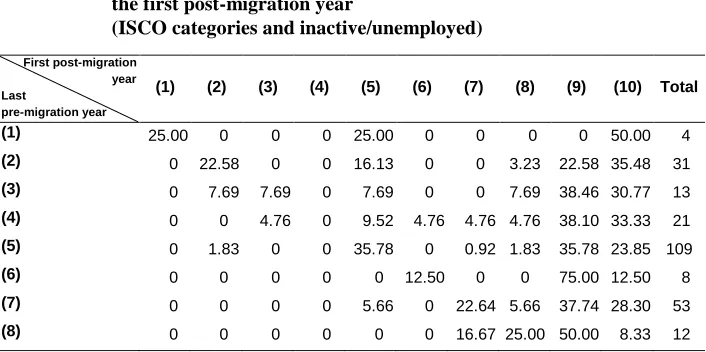
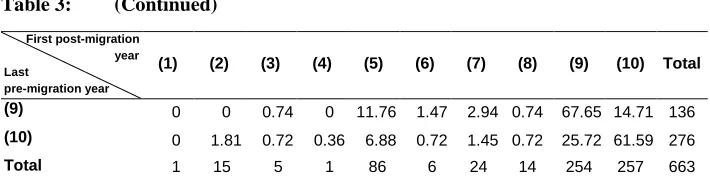
Table 3 presents a distribution of occupational categories in the last year prior to migration, as well as in the first year in Europe5. The occupational categories are defined according to the ISCO classification, but a separate single category is added for those who are inactive, unemployed, or in education. It is noteworthy that, with the exception of four immigrants who worked as managers prior to migration, all of the other occupational categories show a relatively high rate of transition to elementary occupations in the initial years after migration: almost twice as many immigrants were employed in elementary occupations in the first year in the destination country as in the last year in the home country. This is undoubtedly an important source of the average decline in occupational status after migration.
5 The totals represent absolute numbers, while the numbers in the inner cells of the table are expressed in
Table 2: Change of occupational status (in %), compared to the first year after migration
All Men Women
Between 1st and 3rd years
Upward 14.87 16.42 8.15
Downward 8.04 8.26 7.11
No change 77.09 75.32 84.74
Between 1st and 5th years
Upward 27.26 29.96 15.68
Downward 15.15 15.54 13.45
No change 57.59 54.50 70.87
Between 1st year and 2008
Upward 39.06 40.62 31.68
Downward 17.10 16.68 19.09
No change 43.84 42.71 49.23
Note: The comparison between the first and the third years, and the comparison between the first and the fifth years also consider the experiences of migrants who returned from Europe to Senegal before 2008. Excluding them does not affect the general conclusions.
Source: MAFE (weighted).
Table 3: Distribution of occupational categories in the last pre-migration and
the first post-migration year
(ISCO categories and inactive/unemployed)
First post-migration year Last
pre-migration year
(1) (2) (3) (4) (5) (6) (7) (8) (9) (10) Total
(1) 25.00 0 0 0 25.00 0 0 0 0 50.00 4
(2) 0 22.58 0 0 16.13 0 0 3.23 22.58 35.48 31
(3) 0 7.69 7.69 0 7.69 0 0 7.69 38.46 30.77 13
(4) 0 0 4.76 0 9.52 4.76 4.76 4.76 38.10 33.33 21
(5) 0 1.83 0 0 35.78 0 0.92 1.83 35.78 23.85 109
(6) 0 0 0 0 0 12.50 0 0 75.00 12.50 8
(7) 0 0 0 0 5.66 0 22.64 5.66 37.74 28.30 53
Table 3: (Continued)
Notes: The totals represent absolute numbers, while the figures in the inner cells are expressed in percentage terms. Occupational categories are defined as follows: (1) managers, (2) professionals, (3) technicians, (4) clerical support workers, (5) service and sales workers, (6) skilled agricultural workers, (7) craft workers, (8) machine operators, (9) elementary occupations, and (10) inactive, unemployed or in education.
Source: MAFE.
6. Post-migration occupational attainment
Previous research has shown that the first occupation after arrival in the destination country is the single most important determinant of the subsequent occupational trajectories among migrants (see McAllister 1995). Therefore, in order to gain a better understanding of the process of occupational attainment among the Senegalese in Europe, it is necessary to perform adequate analyses of both the first occupation and the current occupation in Europe. The dependent variable is the ISEI index, while the independent variables can be classified into several groups. First, a set of standard socio-demographic characteristics are included. These variables—such as gender, age
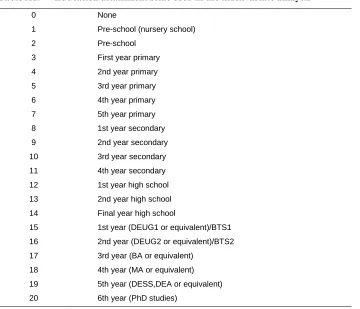
(and age squared), and education level—are also important predictors of occupational attainment among natives. Education level is measured on a continuous scale from zero to 20; details of what each value on the scale stands for can be found in Table A1 in the appendix. Whether the respondent has acquired European education credentials in order to attain the reported education level is indicated by a separate variable, years of
education in Europe. The variable network controls for the possible effect of personal
networks in the process of occupational attainment, and is equal to one if the respondent has an least one Senegalese-born friend or at least one member of the extended family living in the same country in the given year6. The latter group includes uncles, aunts, cousins, nephews and nieces. Unfortunately, there is no information in the dataset about the personal characteristics of the network members. Legal status in the labor market is indicated by a dummy for an immigrant without a valid work permit. Finally, a set of
6 Separate models have been estimated with an indicator for each type of relationship with the network
member. However, this produced no substantial difference from the model with the aggregate measure, which is reported here.
First post-migration year Last
pre-migration year
(1) (2) (3) (4) (5) (6) (7) (8) (9) (10) Total
(9) 0 0 0.74 0 11.76 1.47 2.94 0.74 67.65 14.71 136
(10) 0 1.81 0.72 0.36 6.88 0.72 1.45 0.72 25.72 61.59 276
variables is constructed using information on the labor market history of the Senegalese immigrants. Worked in Africa indicates whether having at least some pre-migration work experience affects the current job score, and, if so, in what way. The role of the duration of stay in the destination is famously associated with research on immigrant labor market integration, but some researchers, such as Husted et al. (2001), have asserted that the length of labor market attachment in the destination country also matters in this context. This is why the variable years spent inactive or unemployed in
Europe is also introduced into the model: it measures how many years after migration
the immigrant spent out of the labor market and out of education. In addition to the variables mentioned above, which are included in both models, years of stay in Europe
and ISEI score at the first job in Europe are included in the analysis of the current job
score7. As all of the observations in the first regression refer to the first year of respondents’ labor market experience in Europe, additional controls for the time period—i.e., decade dummies—are introduced into Model 1. In the second regression, all of the observations refer to the year 2008. Obviously, several explanatory variables are based on the experiences of immigrants across Europe, rather than only in the current country of residence. However, including two variables at the same time—one of which reflects immigrants’ experiences in the whole of Europe, while the other only refers to his or her experiences in the current country of residence—would inevitably lead to collinearity problems. Therefore, I chose to keep only the first variable in the model, based on the assumption that a Senegalese immigrant who arrives in a European country after having spent a number of years in another European country has some advantages relative to an immigrant coming directly from Senegal. Why should we believe that this is the case? First, immigrants residing in other European countries should have easier access to information, all other things being equal. Second, while employers may discriminate against work experience and education abroad, the level of discrimination varies significantly with regard to the part of the world in which the experience was gained (see Friedberg 2000). In other words, most European employers will place a higher value on work experience and education acquired in another European country than in Senegal or elsewhere in Africa.
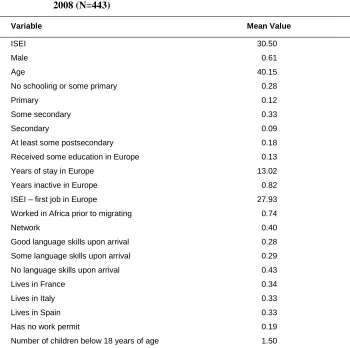
The characteristics of the sample of employed Senegalese at the time of survey are presented in Table A2 in Appendix.
7 Due to collinearity, years of stay in Europe cannot be included when analyzing the first occupation after
6.1 Results
The first column of Table 4 (Model 1) presents the results of the analysis of the occupational score in the first job in Europe. Holding all other variables constant, men’s occupational level is higher by around two points. Having a higher education level provides immigrants with access to better jobs, but gains from education are substantially more pronounced for immigrants who received some education in Europe prior to entering the labor market: all other things being equal (including education level), each year spent in education in Europe increases the occupational level in the first post-migration job by 1.67 points. Possessing the appropriate language skills prior to arrival appears to be an important asset, as the analysis suggests that having a solid grasp of the language of destination increases the first job score by almost 6.5 points relative to the average score of immigrants who arrive with no language skills. Interestingly, legal status is found to be a poor predictor of the first occupation, net of the other variables in the model. It may also seem surprising that personal networks do not affect the outcome when looking for the first job after migration. However, the interplay of networks and labor market performance is a separate research question, and a complex one at that. It should thus be given more attention in future research. Having some African work experience is positively associated with occupational status in the first job in Europe, but this finding does not reach the 10% significance level. Age, years spent inactive or unemployed in Europe, and interactions of destination and time period are not significant.
The second column of Table 4 (Model 2) shows the outcome of the OLS analysis of occupational status at the time of the survey, in 2008. As expected, occupational status in the first job in Europe is statistically significant, and the coefficient of 0.57 demonstrates the importance of the first job for subsequent occupational trajectories. In contrast, having African work experience is a poor predictor of occupational status at the time of the survey8. Each year of stay in Europe results in a job score increase of 0.16, net of other things, whereas each year in Europe the immigrant spent out of the labor market and out of education reduces the occupational status by 0.44 points. As in the analysis of the first job in Europe, education level, years of education in Europe, and language skills at arrival all have a positive impact on occupational status; but the effect of these variables is now somewhat weaker. There is no significant difference between men and women, while having no work permit reduces the occupational status by around three points on the ISEI scale. The outcomes for the other independent variables
8 Another way of looking at the effect of the African work experience on occupational trajectories in Europe
are rather similar to those in Model 1, as there is no evidence that age, networks, or destination are significantly associated with occupational status at the time of the survey.
However, the analysis presented above does not take into account several processes that might affect the selection into employment at destination at the time of the survey. For instance, around one-fifth of the Senegalese surveyed in Europe were outside the labor market in 2008. Moreover, the selection into employment does not seem to be random: for example, descriptive statistics suggest that women are clearly more likely to choose to stay out of the labor market, and the mean age of the employed is higher than that of the non-employed. The Heckman selection model is therefore used in order to test whether the mechanisms responsible for selection into employment also have an influence on occupational attainment. Also included in the selection equation, along with several variables used in the main model, is the number of the respondent’s children younger than 18 years of age, as well as the interaction of the female dummy and the number of children. The interaction variable is introduced because the number of children is not expected to have the same effect on the labor market participation decision for men and women. While coefficients in the selection equation are largely as expected (e.g., women are less likely to be employed and the number of children has different effects for men and women), there are no important changes in the main model relative to the OLS model presented in Table 4. Additionally, the parameters of the Heckman selection model suggest that selection bias is not statistically significant.9 Return migration to Senegal, as well as circular migration, are additional potential sources of selection issues in the analysis of the occupational attainment. The prevailing view in the migration literature is that the mechanisms of return migration are affected by the circumstances at both destination and origin, while the empirical analysis by Borjas and Bratsberg (1996) also indicated that return migration accentuates the type of selection that generated the immigrant flow in the first place. Using the same dataset as in this paper, Mezger (2008) showed that there is some evidence of positive selection on education into return to Senegal from Europe, which implies that the results reported in the second column of Table 4 should be interpreted with this previous empirical evidence in mind. On the other hand, if circular migrants are included in the analysis (in which case their duration of stay is calculated as the total length of their migration spells in Europe), no substantial differences are identified relative to the results presented in Table 4.
9
Table 4: Occupational status (ISEI) of Senegalese immigrants in Europe, OLS
Model 1: First job in Europe
Model 2: Job in 2008
Male 2.239** 1.045
Education level 0.315*** 0.173*
Years of education in Europe 1.669*** 0.833***
Years of stay in Europe 0.163**
First job in Europe (ISEI) 0.571***
Years inactive or unemployed in Europe -0.027 -0.440**
Worked in Africa 1.782 0.401
Network -0.995 -0.658
Age -0.300 0.272
Age squared 0.004 -0.004
Language skills at landing: Good (ref.)
Some -4.211*** -2.464
None -6.352*** -3.791**
Country of residence in 2008: France (ref.)
Italy 2.373
Spain 0.318
Undocumented -0.701 -2.976***
Constant 28.572*** 8.038
Control for country*decade interaction YES
N 553 443
R2 0.232 0.547
Note: *p<0.10; **p<0.05; ***p<0.01.
Source: MAFE.
7. Correlates of post-migration occupational mobility
While the previous section focused on the occupational attainment in the first year of labor market participation in Europe and at the time of the survey, the goal in this section is to observe the complete labor market history after migration, and to examine the patterns of post-migration occupational mobility among the Senegalese migrants. The empirical specification is based on a discrete-time multinomial logit model of competing risks. Except when mobility is not possible due to having a job with a minimum or maximum ISEI index, each survey respondent with a job is at risk of experiencing upward or downward occupational mobility between any two consecutive years t and t+1 that he or she spends in Europe. If an immigrant’s job score increases, the dependent variable is assigned a value of one, while if an occupational downgrading between the two periods is observed, the dependent variable takes a value of two. In all other cases, the dependent variable is equal to zero, and this value is also taken as the base category in the estimation presented below. The dependent variable does not include the transition to unemployment due to the very small number of cases observed. All of the independent variables refer to their values at time t, except for the change in legal status in the labor market, which is assigned a value of one if an immigrant obtains a work permit between the periods t and t+1. It should be noted that the number of individuals in the analysis in this section is slightly bigger than in the previous analysis. This is due to two factors: 1) we now also consider the European labor market trajectories of those immigrants who returned to Senegal prior to 2008; and 2) we also include information on the occupational histories of those immigrants who were not employed in 2008, but who were employed at some point after migrating to Europe and before the time of the survey. We also know that some of the Senegalese immigrants studied moved from one European country to another. As this is a discrete-time analysis with information referring to all years after leaving Africa, a single ―country dummy‖ was constructed that stands for all European countries other than France, Italy, and Spain. As in the previous section, the model controls for the interaction of the country dummies and the decade dummies.
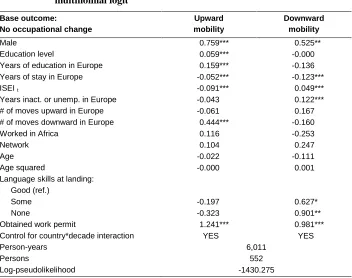
Table 5 shows that men are more occupationally mobile, both upward and downward. A higher general education level increases the likelihood of experiencing upward occupational mobility, as does education received in Europe. More precisely,
ceteris paribus, each year of education in Europe increases the likelihood of upward
experiencing upward or downward mobility between two consecutive years actually decreases with the duration of stay in Europe. This result can be interpreted as evidence of cumulative inertia (McGinnis 1968): the longer an individual stays in a particular state (place of residence, occupation, etc.), the less likely he or she is to move out of that state in the immediate future. Not too surprisingly, we find that the number of years in Europe the respondent spent unemployed or inactive in the labor market is positively correlated with the likelihood of experiencing downward mobility between two consecutive years. The results further suggest that the higher the job score at time t, the lower the probability of upward mobility, and vice versa. This can be interpreted in the following way: the higher the score, the less room there is to rise; while the lower the score, the more room there is to move upward. The same logic can be applied in explaining the positive and statistically significant link between the number of previous moves downward and the likelihood of experiencing upward mobility. Age is a poor predictor of occupational mobility, while a lack of language skills at arrival substantially increases the likelihood of downward mobility: all other things being equal, an immigrant who arrived without any knowledge of the language of the destination country is more than twice as likely to have experienced downward mobility as an immigrant who arrived with good language skills. As expected, obtaining a work permit increases the chances of upward mobility; but, somewhat less expectedly, it also increases the likelihood of downward mobility. A possible explanation for this result is that obtaining legal status in the labor market increases the chances of job change substantially, and some immigrants may switch to jobs that score lower on the ISEI scale, but are perceived as more secure. An alternative explanation is that the immigrants may change to jobs that score lower on the ISEI scale, but which are not necessarily seen as inferior by them.10 In line with the findings in the previous section, having some African work experience and network effects are not shown to be significant predictors of occupational mobility. Variables representing the interaction of destination and time period are, for the most part, not statistically significant, and are not reported in the table for the sake of space. The main difference which emerges from separate gender-specific analyses is that having language skills at arrival is a more powerful predictor of upward and downward mobility among women.
10 If the definition of occupational mobility is tightened in such a way that only the changes in ISEI of at least
Table 5: Occupational mobility after arrival in Europe, discrete-time multinomial logit
Base outcome:
No occupational change
Upward mobility
Downward mobility
Male 0.759*** 0.525**
Education level 0.059*** -0.000
Years of education in Europe 0.159*** -0.136
Years of stay in Europe -0.052*** -0.123***
ISEI t -0.091*** 0.049***
Years inact. or unemp. in Europe -0.043 0.122***
# of moves upward in Europe -0.061 0.167
# of moves downward in Europe 0.444*** -0.160
Worked in Africa 0.116 -0.253
Network 0.104 0.247
Age -0.022 -0.111
Age squared -0.000 0.001
Language skills at landing: Good (ref.)
Some -0.197 0.627*
None -0.323 0.901**
Obtained work permit 1.241*** 0.981***
Control for country*decade interaction YES YES
Person-years 6,011
Persons 552
Log-pseudolikelihood -1430.275
Notes: *p<0.10; **p<0.05; ***p<0.01. Significance levels adjusted for clustering by person.
Source: MAFE.
8. Occupational cost of migration
reasons: 1) relative to their first post-migration job, most immigrants experience some upward or downward mobility in the subsequent years spent in the destination country; and, 2) had they not migrated, the Senegalese immigrants would have been exposed to the dynamics of labor market at origin, which would have resulted in rather different occupational trajectories for many migrants.
costs for individuals at different education levels. However, because of the limited sample size, this issue must be left for future research.
8.1 Fixed effects and random effects
age of 16, regardless of where he or she lived during that time11. A certain number of respondents had accumulated some work experience in African countries other than Senegal, but, since the aim here is to estimate the occupational cost of migrating from Senegal to Europe, the information on occupational attainment in other African countries is excluded from the analysis. The findings are reported in Table 6.
Table 6: Occupational cost of migration from Senegal to Europe
Dependent variable: ISEI Fixed effects Random effects with Mundlak
correction
Ref: working in Senegal
0 – 5 years in Europe -5.826*** -5.898***
6 – 10 years in Europe -4.489*** -4.548***
11 – 15 years in Europe -3.263*** -3.340***
> 15 years in Europe -2.506*** -2.587***
R2 within 0.0614 0.0609
R2 between 0.3009 0.3379
R2 overall 0.2530 0.3022
Person-years 22,690
Persons 1,414
Notes: *p<0.10; **p<0.05; ***p<0.01. The other controls are age, age squared, education level, time period, and years of labor market experience accumulated since the age of 16. Gender and person-level means of variables included in the first model are also controlled for in the second model. The significance levels are adjusted for clustering by person.
Source: MAFE.
The fixed-effects and random-effects estimations with Mundlak correction yield almost identical estimates of occupational cost of migration. The results indicate that there is a statistically significant occupational cost of migration which decreases with the duration of stay, but does not disappear completely even after more than 15 years in Europe. In contrast, the negative relationship between the occupational cost and the duration of stay suggests that, after the initial drop in the occupational score after arrival, immigrants have more opportunities for upward mobility in the destination than non-migrants with similar characteristics in the home country. Separate estimations for men and women (not reported in the table) reveal that the occupational cost of migration is slightly higher for women, but that this difference fades with the duration of stay. For example, during the first five years in Europe the average occupational cost for men is 5.53 points, while for women it is 1.20 points higher. On the other hand,
11 An implicit assumption is that an immigrant who after migration spent a certain number of years in
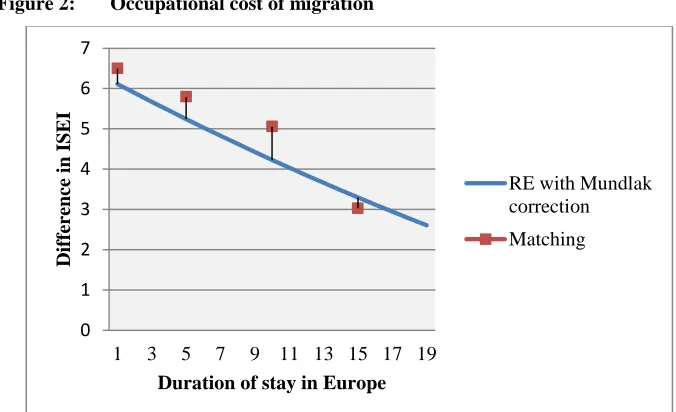
after more than 15 years in Europe, the corresponding figures for men and women are 2.60 and 2.90, respectively. In order to estimate the occupational cost on a more continuous scale, the specification presented above is modified so that non-migrants are assigned the value of 100 for duration of stay in Europe. Thus, in place of the categorical variable, the model now includes duration of stay in Europe and its squared term. Both variables are statistically significant. The occupational cost curve estimated in this way is presented in Figure 2, along with the results from Section 8.2. The conclusions remain largely unchanged when we compare them with the coefficients reported in Table 6.
8.2 Matching estimation
To test for the sensitivity of the results to methodological choices, the average occupational cost of migration from Senegal to Europe has also been estimated by applying bias-adjusted nearest-neighbor matching techniques (as described in Abadie et al. 2004). The basic idea is to compare the ISEI score of Senegalese immigrants at four different n periods after migration (n = 1, 5, 10, and 15; whereby n stands for years after migration to Europe) with the hypothetical ISEI score the immigrant would have had after the same number of years if he or she had not left Senegal. Migration is considered treatment for the purposes of this analysis: immigrants are the treated group, while non-migrants make up the untreated group. The occupational cost of migration is estimated as the average treatment effect, and each observed individual is matched with four individuals of the opposite group (the procedure allows observations to be used as a match more than once in the same estimation). The dependent variable is occupational status in year t+n (ISEI t+n).For immigrants, the year t refers to the last year before
migration to Europe, and, consequently, year t+n denotes the period n years after migration to Europe. For each non-migrant, the year t is chosen randomly in each estimation. The exact matching of migrants and non-migrants is done on two variables: gender and year interval (decade). The other covariates include age, education level, labor market experience accumulated since the age of 16, and an indicator for an employed person. All of these variables refer to their values in year t. As the sample size is relatively small, the procedure of random choice of year t for non-migrants and the subsequent estimation of occupational cost is repeated 10 times for each of n years after migration, in order to control for the robustness of findings. It is for this reason that the values in Figure 2 stand for the averages of 10 estimated coefficients for each year n.
associated with the process of selection into migration. Nevertheless, all four points in Figure 2 lie close to the occupational cost curve estimated by the random-effects regression. In other words, both techniques suggest the same pattern of occupational cost: it is slightly above six points on the ISEI scale immediately after migration, it slowly decreases with the duration of stay at the destination, but it does not seem to disappear, even after 15 years in Europe.
Figure 2: Occupational cost of migration
9. Concluding remarks
Based on both prominent theories from migration research and the contextual characteristics of contemporary African migration to Europe, I attempted in this paper to answer research questions regarding the occupational attainment, occupational mobility, and occupational cost of Senegalese immigrants to Europe; as well as to develop and test appropriate hypotheses.
The empirical analysis confirmed all of the three hypotheses proposed in the second section. First, the data on pre-migration and post-migration occupational mobility confirmed the hypothesis on the U-shaped pattern of occupational mobility for the Senegalese immigrants in the sample. But the improvement in occupational status took place slowly: by the end of the fifth year in Europe, only one out of four
0 1 2 3 4 5 6 7
1 3 5 7 9 11 13 15 17 19
Dif
fer
ence
in I
SE
I
Duration of stay in Europe
RE with Mundlak correction
immigrants had experienced upward mobility relative to the first year after migration. Second, relative to education acquired in the home country, education acquired in Europe was a more powerful instrument of occupational upward mobility. Third, having no work permit was associated with lower occupational attainment at the time of the survey, while obtaining a work permit substantially increased the chances of occupational mobility. In addition to these three findings, a number of other interesting results were obtained. When differences by gender were analyzed, men were found to be more occupationally mobile than women, both upward and downward. While the duration of stay in Europe was shown to be positively associated with occupational attainment in 2008, the discrete-time analysis indicated that the probability of experiencing upward mobility actually decreased with each additional year of residence in Europe. Having some or good skills in the language of the destination country upon arrival was shown to facilitate access to better jobs. There was very little evidence of differences between the three destination countries when these were measured by destination country dummies. The fixed-effects, random-effects, and nearest-neighbor matching estimations all showed that there was a statistically significant occupational cost of migration from Senegal to Europe, but also that the cost decreased with the duration of stay. The occupational cost of migration was initially somewhat higher for women, but this difference was found to diminish with a longer duration of stay in European countries.
10. Acknowledgements
References
Abadie, A., Drukker, D., Herr, J.L., and Imbens, G.W. (2004). Implementing matching estimators for average treatment effects in Stata. The Stata Journal 4(3): 290-311.
Akay, A., Bargain, O., and Zimmermann, K.F. (2011). Relative concerns of rural-to-urban migrants in China. Bonn: IZA – Institute for the Study of Labor. (IZA Discussion Paper no. 5480).
Bauer, T. and Zimmermann, K.F. (1999). Occupational mobility of ethnic migrants. Bonn:IZA – Institute for the Study of Labor. (IZA Discussion Paper no. 58).
Beauchemin, C., and González-Ferrer, A. (2011). Sampling international migrants with origin-based snowballing method: New evidence on biases and limitations.
Demographic Research 25(3): 103-134. doi:10.4054/DemRes.2011.25.3.
Bernardi, F., Garrido, L., and Miyar, M. (2011). The recent fast upsurge of immigrants in Spain and their employment patterns and occupational attainment.
International Migration 49(1): 148-187. doi:10.1111/j.1468-2435.2010.00610.x.
Borjas, G.J. (1991). Immigration and self-selection. In: Abowd, J.M. and Freeman, R.B. (eds.). Immigration, trade and the labor market. Chicago: University of Chicago Press: 29-76.
Borjas, G.J. and Bratsberg, B. (1996). Who leaves? The outmigration of the foreign-born. The Review of Economics and Statistics 78(1): 165-176. doi:10.2307/2109856.
Brodmann, S. and Polavieja, J.G. (2011). Immigrants in Denmark: Access to employment, class attainment and earnings in a high‐skilled economy.
International Migration 49(1): 58-90. doi:10.1111/j.1468-2435.2010.00608.x.
Carliner, G. (1980). Wages, earnings and hours of first, second and third generation American males. Economic Inquiry 18(1): 87-102. doi:10.1111/j.1465-7295. 1980.tb00561.x.
Chiswick, B.R. (1978). The effect of Americanization on the earnings of foreign-born
men. The Journal of Political Economy 86(5): 897-921. doi:10.1086/260717.
Constant, A. and Massey, D.S. (2003). Self-selection, earnings, and out-migration: A longitudinal study of immigrants to Germany. Journal of Population Economics
16(4): 631-653. doi:10.1007/s00148-003-0168-8.
Constant, A. and Massey, D.S. (2005). Labor market segmentation and the earnings of German guestworkers. Population Research and Policy Review 24(5): 489-512. doi:10.1007/s11113-005-4675-z.
Duleep, H.O. and Regets, M.C. (1997). The decline in immigrant entry earnings: Less transferable skills or lower ability? The Quarterly Review of Economics and
Finance 37(S1): 189-208. doi:10.1016/S1062-9769(97)90065-X.
Friedberg, R.M. (2000). You can't take it with you? Immigrant assimilation and the portability of human capital. Journal of Labor Economics 18(2): 221-251. doi:10.1086/209957.
Fullin, G. and Reyneri, E. (2011). Low unemployment and bad jobs for new immigrants in Italy. International Migration 49(1): 118-147. doi:10.1111/j.1468-2435.2009. 00594.x.
Ganzeboom, H.B.G. and Treiman, D.J. (1996). Internationally comparable measures of occupational status for the 1988 international standard classification of occupations. Social Science Research 25(3): 201-239. doi:10.1006/ssre. 1996.0010.
Ganzeboom, H.B.G. (2010). [electronic resource] International Stratification and Mobility File: Conversion Tools. Amsterdam: Department of Social Research Methodology. [http://www.harryganzeboom.nl/isco08/index.htm]
Gerdes, F. (2007). Country profile - Senegal. HWWI - Hamburg Institute of International Economics (Working paper series Focus Migration no. 10.)
Goel, S. and Salganik, M.J. (2010). Assessing respondent-driven sampling.
Proceedings of the National Academy of Sciences 107(15): 6743-6747.
doi:10.1073/pnas.1000261107.
Green, D.A. (1999). Immigrant occupational attainment: Assimilation and mobility over time. Journal of Labor Economics 17(1): 49-79. doi:10.1086/209913.
Groenewold, G. and Bilsborrow, R. (2008). 14 design of samples for international migration surveys: Methodological considerations and lessons learned from a multi-country study in Africa and Europe.In: Bonifazi, C., Okólski, M., Schoorl, J., and Simon, P. (eds.). International Migration in Europe – New Trends and
New Methods of Analysis. Amsterdam: Amsterdam University Press: 293-312.
Hatton, T.J. and Williamson, J.G. (2001). Demographic and economic pressure on emigration out of Africa. Bonn: IZA – Institute for the Study of Labor (IZA Discussion Paper no. 250).
Husted, L., Nielsen, H.S., Rosholm, M., and Smith, N. (2001). Employment and wage assimilation of male first-generation immigrants in Denmark. International
Journal of Manpower 22(1/2): 39-71. doi:10.1108/01437720110386377.
INE (2010). [electronic resource] Revisión del padrón municipal - Revision of the Municipal Register. Madrid: Spanish National Institute of Statistics. [http://www.ine.es]
INSEE (2007). [electronic resource]. Recensement, exploitation principale. Paris: French National Institute of Statistics and Economic Studies. [http://www.insee.fr]
ISTAT (2009). [electronic resource]. Statistics of Foreign Nationals. Rome: Italian Institute of Statistics. [http://en.istat.it]
Johnson, G.J. and Johnson, W.R. (2000). Perceived overqualification and dimensions of job satisfaction: A longitudinal analysis. The Journal of Psychology:
Interdisciplinary and Applied 134(5): 537-555. doi:10.1080/00223980
009598235.
Marfaing, L. (2003). Les Sénégalais en Allemagne. Quotidien et stratégies de retour. Paris: Karthala.
Massey, D.S., Arango, J., Hugo, G., Kouaouci, A., Pellegrino, A., and Taylor, J.E. (1993). Theories of international migration: A review and appraisal. Population
and Development Review 19(3): 431-466. doi:10.2307/2938462.
Mezger, C. (2008). Who comes back? The case of Senegalese returning to Dakar. Paris: MAFE Project, INED. (MAFE Working Paper no. 4).
McAllister, I. (1995). Occupational mobility among immigrants: The impact of migration on economic success in Australia. International Migration Review
McGinnis, R. (1968). A stochastic model of social mobility. American Sociological
Review 33(5): 712-722. doi:10.2307/2092882.
McKenzie, D.J. and Mistiaen, J. (2009). Surveying migrant households: A comparison of census‐based, snowball and intercept point surveys. Journal of the Royal
Statistical Society: Series A (Statistics in Society) 172(2): 339-360.
doi:10.1111/j.1467-985X.2009.00584.x.
Mundlak, Y. (1978). On the pooling of time series and cross section data. Econometrica
46(1): 69-85. doi:10.2307/1913646.
OECD (2008). Jobs for Immigrants (Vol. 2): Labour market integration in Belgium,
France, the Netherlands and Portugal. Paris: OECD.
OECD (2009). The future of international migration to OECD countries - regional note
West Africa. Paris: OECD.
OECD (2010). International Migration Outlook 2010. Paris: OECD.
Piore, M.J. (1979). Birds of Passage: Migrant labor and industrial societies. Cambridge: Cambridge University Press. doi:10.1017/CBO9780511572210.
Portes, A. and Böröcz, J. (1989). Contemporary immigration: Theoretical perspectives on its determinants and modes of incorporation. International Migration Review
23(3): 606-630. doi:10.2307/2546431.
Raijman, R. and Semyonov, M. (1995). Modes of labor market incorporation and occupational cost among new immigrants to Israel. International Migration
Review 29(2): 375-394. doi:10.2307/2546786.
Ratha, D. and Zhimei, X. (2007). Migration and remittances in Senegal. In: World Bank (ed.). Migration and Remittances Factbook 2008. Washington, DC: The World Bank: 194.
Redstone Akresh, I. (2006). Occupational mobility among legal immigrants to the United States. International Migration Review 40(4): 854-884. doi:10.1111/j.1747-7379.2006.00046.x.
Rooth, D.-O. and Ekberg, J. (2006). Occupational mobility for immigrants in Sweden.
International Migration 44(2): 57-77. doi:10.1111/j.1468-2435.2006.00364.x.
Spaan, E. and van Moppes, D. (2006). African exodus? Trends and patterns of international migration in sub-Saharan Africa. Nijemegen: Research Group Migration and Development, Radboud University. (Working papers Migration and Development series; Report No. 4).
Stark, O. and Bloom, D.E. (1985). The new economics of labor migration. The
American Economic Review 75(2): 173-178.
Thomas, K.J.A. (2011). What explains the increasing trend in African emigration to the U.S.? International Migration Review 45(1): 3-28. doi:10.1111/j.1747-7379. 2010.00837.x.
UNDP – United Nations Development Programme (2010). Human Development
Report. New York: Palgrave Macmillan.
United Nations Population Division. (2009). World Population Prospects: The 2008
Revision: Volume I: Comprehensive Tables. Department of Economic and Social
Affairs.
Appendix
Table A1: Education attainment scale used in the multivariate analysis
0 None
1 Pre-school (nursery school)
2 Pre-school
3 First year primary
4 2nd year primary
5 3rd year primary
6 4th year primary
7 5th year primary
8 1st year secondary
9 2nd year secondary
10 3rd year secondary
11 4th year secondary
12 1st year high school
13 2nd year high school
14 Final year high school
15 1st year (DEUG1 or equivalent)/BTS1
16 2nd year (DEUG2 or equivalent)/BTS2
17 3rd year (BA or equivalent)
18 4th year (MA or equivalent)
19 5th year (DESS,DEA or equivalent)
20 6th year (PhD studies)
Table A2: Mean values of selected variables, employed Senegalese in Europe, 2008 (N=443)
Variable Mean Value
ISEI 30.50
Male 0.61
Age 40.15
No schooling or some primary 0.28
Primary 0.12
Some secondary 0.33
Secondary 0.09
At least some postsecondary 0.18
Received some education in Europe 0.13
Years of stay in Europe 13.02
Years inactive in Europe 0.82
ISEI – first job in Europe 27.93
Worked in Africa prior to migrating 0.74
Network 0.40
Good language skills upon arrival 0.28
Some language skills upon arrival 0.29
No language skills upon arrival 0.43
Lives in France 0.34
Lives in Italy 0.33
Lives in Spain 0.33
Has no work permit 0.19
Number of children below 18 years of age 1.50