University of New Orleans University of New Orleans
ScholarWorks@UNO
ScholarWorks@UNO
University of New Orleans Theses and
Dissertations Dissertations and Theses
12-19-2008
Multiple Solutions on a Ball for a Generalized Lane Emden
Multiple Solutions on a Ball for a Generalized Lane Emden
Equation
Equation
Abeer Khanfar
University of New Orleans
Follow this and additional works at: https://scholarworks.uno.edu/td
Recommended Citation Recommended Citation
Khanfar, Abeer, "Multiple Solutions on a Ball for a Generalized Lane Emden Equation" (2008). University of New Orleans Theses and Dissertations. 901.
https://scholarworks.uno.edu/td/901
This Dissertation is protected by copyright and/or related rights. It has been brought to you by ScholarWorks@UNO with permission from the rights-holder(s). You are free to use this Dissertation in any way that is permitted by the copyright and related rights legislation that applies to your use. For other uses you need to obtain permission from the rights-holder(s) directly, unless additional rights are indicated by a Creative Commons license in the record and/ or on the work itself.
Multiple Solutions on a Ball for a Generalized Lane–Emden Equation
A Dissertation
Submitted to the Graduate Faculty of the University of New Orleans
in partial fulfillment of the requirements for the degree of
Doctor of Philosophy
in
Acknowledgments
I would like to acknowledge the encouragement and advice of a number of people
in the production of this thesis.
First, This dissertation would not be possible without valuable contributions of
my supervisor, Dr. Ralph Saxton. I would like to thank Dr. Saxton for devoting
time for providing me with many valuable sources and for commenting on the
preliminary drafts of this thesis as well as being a constant source of support,
encouragement and the sole provider of valuable comments on the content of this
research and suggestions on the direction of this work. This thesis work would not
have been possible without his great contributions.
I would also like to thank the members of my Dissertation committee: Dr. Jairo
Santanilla, Dr. Dongming Wei, Dr. Kazim M. Akyuzlu, Dr. Stanley Chin Bing
and Dr. David Hui for their feedback on this Ph.D thesis. Sincere thanks are also
extended to Dr. Lew Lefton for his encouragement.
I also wish to extend my most sincere thanks to Dr. Guido Filler, chair/chief
of the paediatrics department at Schulich school of Medicine and Dentistry, The
University of Western Ontario, London Health Sciences Center and Children’s
Hospital of Western Ontario, for his unlimited support and encouragement.
Acknowledgments are also made to my husband Mohammad Alomari for his
unlimited support and encouragement. Regards are also extended to my parents.
This thesis work is devoted to my dear loved daughter Noor and son Ahmad for
being the joy of my life and the source of never ending love.
Finally, I feel deeply indebted to the many people whose writings were the major
source of this research and hope that my work is, in fact, a continuation of their
Table of Contents
Abstract . . . v
1 Introduction and Scope of Thesis 1 1.1 Introduction . . . 2
1.2 Literature Review . . . 3
1.3 The Generalized Lane-Emden equation as a general model . . . 16
1.4 The Generalized Lane-Emden equation and applications . . . 17
1.4.1 The first application and literature . . . 17
1.4.2 The second application and literature . . . 19
1.5 Organization of the thesis . . . 22
2 Existence Of Solutions Using Variational Methods. 26 2.1 Weighted Sobolev embeddings . . . 29
2.2 Non-existence of solutions forq+ 1 ≥p∗ . . . 31
2.2.1 Non-existence of radial solutions for q+ 1 ≥p∗ . . . 31
2.2.2 Non-existence of general solutions for q+ 1≥p∗ . . . 37
2.3 Existence and nonuniqueness of infinitely many radially symmetric solutions to the Generalized Lane-Emden equation . . . 39
2.4 Existence of a radial solution to the initial value problem. . . 48
2.4.1 Solutions to the Generalized Lane-Emden equation are bounded 51 2.4.2 Decay estimates for radial solutions . . . 53
2.5 Some properties of radial solutions. . . 55
2.5.1 Maximum amplitude of radial solutions . . . 57
2.5.2 Existence of a finite number of zeros for a solution . . . 58
3 The Generalized Lane-Emden Equation and phase plane 61 3.1 The Generalized Lane-Emden equation as an autonomous system . 62 3.2 Existence of solutions in phase plane . . . 65
3.3 Local analysis of the autonomous system . . . 67
Abstract
In this work we study the Generalized Lane-Emden equation and the interplay
between the exponents involved and their consequences on the existence and non
existence of radial solutions on a unit ball inn dimensions. We extend the analysis to the phase plane for a clear understanding of the behavior of solutions and the
relationship between their existence and the growth of nonlinear terms, where we
investigate the critical exponent p∗ and a sub-critical exponent, which we refer to as ˆp. We discover a structural change of solutions due the existence of this sub-critical exponent which we relate to the same change in behavior of the
Lane-Emden equation solutions, for α, β = 0, andp = 2, due to the same sub-critical exponent. We hypothesize that this sub-critical exponent may be related to a
weighted trace embedding.
Chapter
1
1.1
Introduction
This work examines the behavior and multiplicity of the radial solutions to the
Dirichlet problem
∇ ·(|x|α|∇u|p−2∇u) +|x|β|u|q−1u= 0, x∈Ω (1.1)
u|∂Ω= 0, q >1,1< p ≤2, α, β ≥0
where Ω =Bn={x∈Rn:|x| ≤1} denotes the unit ball in Rn.
We are interested in the interplay between the exponents α, β, p and q and consequences for the existence and nonexistence of radial solutions to equation
(1.1).
This equation serves as a generalization to the Lane-Emden equation which has
attracted great interest in the literature and has undergone extensive research due
to its frequent use in mathematics and astrophysics.
The aim of studying the generalized form of the Lane-Emden equation and its
solutions is to develop a broader understanding of the general equations and to
develop analytical tools to analyze these equations to cover more applications as
1.2
Literature Review
The Lane–Emden equation,
∆u+uq = 0, x∈Rn, q >1, (1.2)
has for many years received attention by the scientific and mathematical
commu-nities for its frequent appearance in physical and astrophysical applications. It was
first introduced in 1869 by Homer Lane, [25], in his attempt to compute both the
temperature and the mass density in portions of the sun. In spite of the fact that
the results he obtained were incorrect near the surface of the sun, the values for
both quantities were reasonable at the interior, [4]. As a result the Lane–Emden
equation is still in use today to compute the structure of the interior of polytropic
stars.
The study of equation (1.2) came in to use again when it was initiated by R.
Emden in 1897 in problems of meteorology, [37]. In the 1920’s, it was extensively
studied by Thomas Fermi in the theory of atoms and electronic potential for a
value ofq= 52 andn = 3, [37] . Chandrasekhar subsequently introduced the Lane– Emden equation to astrophysics, for star equilibrium problems withn= 3, in 1937, [10].
Later, mathematicians including Nirenberg, Ni and Serrin, [21], [22], studied
detailed properties of the Lane–Emden equation in Rn, for general n.
Following Emden’s solution inR3 to (1.2) for the valueq= 5, (his solution reads
u=u(r) = 1
(1 + 13r2)12
where
r =
q
x2
a simple gener3lization was found for q = ~ in K" 8Jld S()lved in terms of r and
n, [37], with
whereD=~.
In 1986, it w~ W)W11 by Ni and Serrin,(37J, tllat equation (1.2) exhibits a
one--paralnet.er family of ground state solut.ion.'i, tJ > O on R", u{J:) -O 88 Ixl -:x>,
consisting of pO5itive, smooth solutions, parametrized by the value u{O} E (0.00).
In fa(!t alL sucl1 solutioos are sealed versions ()£ the solution with u{O) = 1
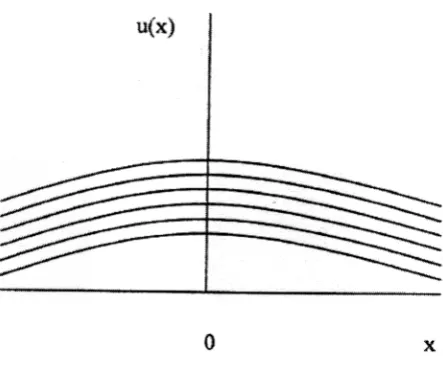
This holds true for q greater than or equal to the critical exponent ~ ' Figtlre
1.1, [371.
Figure 1.1
For q < nn+2−2, equation (1.2) no longer has solutions, radial or non radial, while for q = nn+2−2, the equation has been completely solved. Remarkably only radially symmetric, fast-decay solutions can exist, [24], [37].
Serrin and Zou later studied equation (1.2) on the deleted domainRn\ {0}. They
established nonexistence of solutions for q < nn−2, however they found existence and uniqueness of slowly decaying solutions for nn−2 < q < nn+2−2, [38].
The closely related Dirichlet problem,
∆u+uq = 0 in IBn, (1.3)
u >0 in IBn, u= 0 on ∂IBn,
has also been studied extensively by Serrin, [17]. He was able to prove that the
Sobolev critical exponent nn+2−2 “sets up a dividing number” for the existence and
nonexistence of positive solutions for (1.3). He showed that only forq < nn+2−2 there exist radial positive solutions to (1.3) while forq > nn+2−2, equation (1.3) has neither radial nor non radial solutions on a ball of radius r >0, [17].
In 1979, [21], Ni, Nirenberg and Gidas studied the Dirichlet problem,
∆u+f(u) = 0, (1.4)
|x|< R, u= 0 on ∂Ω,
where Ω = {x∈Rn:|x|< R},and showed that for a finite ball of radiusR >0
and f ∈ C1, if u > 0 is a positive solution in C2(Ω) of (1.4) then u is radially symmetric and ∂u∂r <0 for 0 < r < R, [21].
Gidas, Ni and Nirenberg followed up their paper on the Dirichlet problem in
Since then there has been considerable interest in positive solutions of the
semi-linear equation (1.4) in Rn, where the Rn case has been approached as a limiting
case of a finite ball. After Gidas , Ni and Nirenbergs contribution to the symmetry
of radial solutions of (1.4) in Rn, it became natural to look at radial solutions of
such problems on different types of domains and with differing conditions on u.
There has been considerable amount of literature on the radial solutions of
equa-tion (1.4). For example, Atkinson and Peletier, [1], [2] have established the existence
of ground state solutions, which tend to zero as the |x| → ∞, using the shooting method for equation (1.4) in Rn. This type of problem arises in phase transition
theory, in population genetics and the theory of nucleon cores with various
differ-ent forms of the nonlinearity f(u). Ground state is a term borrowed from physical
context in which this equation arises and by ground states mathematicians mean
solutions that tend to zero as x approaches infinity. The shooting method involves
varying of u(0), and the problem is to show that if u(0) is chosen sufficiently large
then the associated radially symmetric solution has a zero, that is, the Dirichlet
problem on some finite ball has a solution. Serrin and Mccloed have also studied
where Ω is a bounded smooth domain in Rn.
This equation is also referred to as Emden- Fowler equation in astrophysics. Here
u represents the density of a single star, [33].
This inspired the mathematicians thereafter to study the following problem
∆u+f(u,|x|) = 0, in Ω (1.6)
u >0 in Ω,u= 0 on ∂Ω
Where Ω is a smooth bounded domain in Rn and f(u,|x|) behaves as (|x|luq). Ni was interested in studying three types of positive radial solutions for equation
(1.5) withq >1 andl > −2. These solutions were the E-solutions, F-solutions and M solutions as termed by Chandrasekhar, [33].
An E- solution is a classical solution of (1.6) when the domain is a ball. An
F-solution is a classical solution of (1.6) when the domain is an annulus and an
M-solution is a solution to (1.7) where the domain is a punctured ball at zero.
Equation (1.7) is given as follows
∆u+f(u,|x|) = 0, in Ω\ {0} (1.7)
u >0 in Ω\ {0},u= 0 on ∂Ω , u→ ∞as |x| →0
In the context of our earlier discussion, the Lane-Emden problem in (1.2)
con-sidered on a bounded domain
∆u+uq= 0 in Ω (1.8)
u >0 in Ω and u= 0 on ∂Ω
E- solutions exist if and only if q < nn+2−2. It is a different case if the non-linearity depends on |x|. The Sobolev ”cut off exponent ”in this case is changed, in partic-ular, for
∆u+|x|luq = 0 , q >1.
A positive E-solution exists if and only if q < n+2+2n−2 l.
On the existence of F-solutions for equation (1.8), an F-solution exists for any
q > 1 and on an annulus. When the domain is a punctured ball at zero, with
l > −2, and 1 < q < n+2+2n−2 l there exists infinitely many M-solutions while for
q > n+2+2n−2 l, there exists no M-solutions. In general the solvability of such Dirichlet problems depends not only on the nonlinearity, but also on the geometry of the
domain, [33].
The following equation arises in geometry and physics and has been studied
extensively in recent years:
∆u+K(x)uq = 0, x∈Rn (1.9)
There has been a substantial body of research in to the question of existence
and non-existence of positive solutions decaying to zero as|x| → ∞of (1.9). Much of this research focused on the range of q values not including the Sobolev critical
positive, decaying solutions. Forq > p∗, variational methods are sufficient to prove the existence of such positive decaying solutions. Ni and Nirenberg have shown
that for K(r) bounded, positive and increasing eventually, equation (1.9) has no
positive radial solutions and for K(r) decreasing, equation (1.9) has infinitely many
solutions satisfying thatR
RnKu 2n
n−2dx = +∞, [29].
Radially symmetric solutions to equation (1.10)
∆u+K(x)uq = 0, (1.10)
q >1 in Rn, n >2
Satisfying the following ordinary differential equation corresponding to it
urr+ n−1
r ur+K(r)u
p = 0, r∈(0,∞) (1.11)
u(0) =α >0
where r=|x|, u+ =max{u,0}.
It is known that this ordinary differential equation under certain conditions on
K subject to the initial condition u(0) =α >0 has a unique radial solution u(r). This solution has been classified according to its behavior as r approaches infinity
as a crossing, slowly or rapidly decaying solution, [44].
Where the conditions on K were taken to be:
1) K(r) is continuous on (0,∞). 2) K(r)≥0 and K(r)6= 0 on (0,∞). 3) rK(r)∈L1(0,1)
A related problem with q = nn+2−2
∆u+K(x)unn+2−2 = 0, in Rn (1.12)
has been studied separately. The main existence result on positive solutions to
(1.12), given in [32] by Ni, can be summarized as follows. Let K(x) be bounded,
if |K(x)| decays faster than C
|x|2 at infinity for some constant C > 0, then (1.12) has infinitely bounded solutions in Rn with positive lower bound. Also if K(x) is negative and decays slower than |C
x|2 at infinity then (1.12) has no positive solutions
inRn. Ni showed that for K(x) greater than or equal to |xC|2 at infinity, (1.12) has
no positive solutions in R2.
In [13], Ding and Ni treat the case where K(x) is bounded and nonnegative and
obtain existence of infinitely many positive solutions.
As an application to the Lane-Emden equation consider the following
astrophys-ical problem which has been proposed by two astrophysicist, Bertin and Ciotti, as
model describing the dynamics of galaxies.
−∆u(x) = Φ(r)|u|q−2u, in R3 (1.13)
u(x)>0 in R3
R
R3Φ(r)u
with q > 1 in cylindrical coordinates in R3, (x
1, x2, x3) ∈ R3, r =
p
x2 1+x22,
z =x3 and u=u(r, z). The weight function is a non negative continuous function
depending on r only, vanishing both at zero and at infinity, where
Φ(r) = r2α
(1+r2)2+1α (α≥0)
and the condition R
R3Φ(r)u
q−1dx < +∞ guarantees that the solution carries a
finite total mass, [3].
Various other equations similar to (1.13) have been proposed to model other
phe-nomena of interest in astrophysics. As a second example we mention the Matukuma
equation which is used to model globular clusters of stars.
In 1930, T. Matukuma proposed the mathematical model
∆u+ u
q
1 +|x|2 = 0, x∈R
3 (1.14)
Based on his physical intuition to describe the dynamics of globular clusters of
stars, where u >0 is the gravitational potential with
R
R3
uq
4π[1+|x|2]dx
In representing the total mass, [26], [27], radial symmetry provides a natural
Over many years a significant amount of research has been invested in studying
the p-laplace operator. This is due to the enormous richness in applications of this
nonlinear operator.
The p-laplacian operator [∇ ·(|∇u|p−2u)] and its generalizations arise in the motion of incompressible non-newtonian fluids (p6= 2), pseudoplastic fluids (p < 2) and dilatant fluids (p > 2). Other applications of the p-laplace operator appear in flow through porous media (p= 3/2), Nonlinear Elasticity (p≥ 2), Glaciology (1 < p ≤ 4
3), reaction diffusion problems, petroleum extraction and Astronomy,
[31]. When p = 2 one recovers the Laplace equation and its generalizations, [31], [11].
Serrin, Gazzola and Tang have proved the existence of nonnegative,
nontriv-ial (ground state) radnontriv-ial solutions to a general equation involving the p-laplace
operator, [20]
∆pu+f(u) = 0, u > 0, in Rn (1.16)
Also they have proved the existence of positive radial solutions of the associated
homogeneous Dirichlet- Neumann free boundary problem
∆pu+f(u) = 0, u >0 in BR (1.17)
u= ∂u∂n = 0 on∂BR
where BR is an open ball in Rn with radius R > 0. The nonlinearityf(u) defined
for u > 0 is required to be Lipschitz continuous on (0,∞) in L1 on (0,1) with
R
BRf(s)ds <0 for small u >0.
The uniqueness of positive radial solutions to the Dirichlet problem
∇ ·(|∇u|p−2∇u) +f(u) = 0, in BR (1.18)
u >0 in BR , u= 0 on ∂BR
On the finite ball of radius R >0, n ≥3, 1 < p≤n, wheref(u) is taken to be the function µup+uq, µ >0 and 1≤ p < q ≤ n+2
n−2, has been proved by Erbe and
Tang, [17].
The case where the nonlinearity f(u) is (|u|q−1u), has been studied in Rn and
on the unit ball. Saxton and D.Wei have studied the nonlinear p-harmonic (1.18)
Dirichlet problem, adapting to the case p 6= 2 in [19], and have shown that for p and q satisfying the sub-critical Sobolev embedding condition, (1.18) has infinitely
many radially symmetric solutions,[36]. In chapter 2 of this thesis we follow the
approach used in [36].
The existence and multiplicity of positive radial solutions to the Dirichlet
prob-lem
−∆pu=q(|x|)f(u) (1.19)
x∈B1,u= 0, for x∈∂B1
Where B1 is the unit ball and the functions q : (0,1) → R+ and f : R → R are
As an application of the p-laplacian we mention the following example given in
[41] which shows how the p-laplacian operator my govern fluid flow in a porous
medium. A description used for fluid flow in rock-filled dams is the Missbach’s
exponential law, which inR2 states that
−κ∇Φ =|v|m−1v 1≤m≤2 (1.20)
where κ denotes the permeability, Φ the piezometric head and v = (u, v,0) the average seepage velocity vector.
The component-wise form equation (1.20) is
−κ(∇Φ)x =|v|m
−1
u, −κ(∇Φ)y =|v|m
−1
v (1.21)
Where κ∇Φ =|v|m
Therefore
u=−1/κ|∇Φ|1−mmΦ
x and v =−1/κ|∇Φ|
1−m
m Φ
y. (1.22)
Substituting the last two equations in the continuity equation one obtains the
p-harmonic equation
∇ ·(|∇Φ|p−2∇Φ) = 0 (1.23)
where p= (1 + m1), [41].
The p-laplacian also appears in the power-law stokes equation to model the
steady flow of a non-Newtonian fluid. The power-law stokes equation reads
−k∇ ·(|∇(u)|p−2∇(u)) +∇ν=f (1.24)
Where u(x) = (u1(x), ..., un(x)) denotes the velocity of a fluid particle at
x = (x1, ...xn) ∈ Ω, f = (f1, ...fn) denotes the body force and ν is the scalar
pressure. This model of non-Newtonian flow is very popular in chemical
engineer-ing, [8], as well as in geophysics, [40], for the design of the extrusion dies, [5], [30],
1.3
The Generalized Lane-Emden equation as a
general model
The generalized Lane-Emden equation
∇ ·(|x|α|∇u|p−2∇u) +|x|β|u|q−1u= 0, (1.1)
u|∂Ω = 0 , q >1, 1< p ≤2, α, β ≥0.
Generalizes the above equations and their applications for appropriate choices of
α, β,p and q.
Equations (1.2) , (1.3) and (1.8) can be obtained from equation (1.1) by choosing
α, β = 0 andp= 2.
Equation (1.5) can be obtained from (1.1) by setting α = 0, β = l > 0 , and
p= 2.
Equation (1.4) can be obtained from (1.1) be choosing α, β = 0 and p = 2, where f(u) may involve the non-linearity (|u|q−1u) or other functions of u. When
f(u) =λu+|u|q−1u, whereλ≥0 is a constant, the equation is referred to as the eigenvalue problem.
Equations (1.6) and (1.7) are obtained from the equation (1.1) by setting α= 0,
p= 2, and β = 0 or not depending on the nature of the functionf(|x|, u).
Equations (1.9), (1.10) and (1.12) are obtained from the equation (1.1) by
1.4
The Generalized Lane-Emden equation and
applications
In this thesis we will consider two application models of the Generalized
Lane-Emden equation from two different fields of science, Astronomy and Engineering.
The first application is given by the equation
∆u+|x|β|u|q−1u= 0 (1.25)
u|∂Ω = 0
q > 1, β ≥0, n >2
The second application is given by the equation
−∇ ·(|x|−ap|∇u|p−2∇u) = |x|−(a+2)p+c|u|q−1u (1.26)
u|∂Ω = 0
1< p≤2, q >1, a <−1, c >0
Where Ω is the unit ball in Rn.
1.4.1
The first application and literature
The equation
∆u+K(|x|)f(u) = 0 (1.27)
was proposed as a model describing the dynamics of Galaxies by G.Bertin, [6].
Based on the assumption that galaxies are axial symmetric, a cylindrical symmetry
of the problem was derived where f(u) = uq, u = u(r, z), K(|x|) = Ψ(r), where
Ψ(r) = (1+rr22)α1/2+α, α≥0 and r=
p
x2
1+x22,z =x3, [3].
Various equations similar to equation (1.27) have been proposed to model several
These models were used to model globular clusters of stars and so radial symmetry
was the natural symmetry assumption, [3].
Equation (1.27) has it’s roots from many mathematical and physical fields, e.g,
the scalar curvature equation (1.12), as well as the study of Riemannian Geometry
and scalar field equation for the standing wave of nonlinear Schrodinger and
Klein-Gordan equations. For K(|x|) = 1 we have the Lane-Emden equation that plays an important role in astrophysics, [28].
Extensive research was done on (1.27) and it’s generalizations by many
scien-tists in these fields. For example, in [29], [28], the nonlinearity f(u) is taken to equal |u|q−1u in Rn and K(r) is a smooth and positive function on (0,∞) where
K(r) ∈ L1(0,1) for q >1,n >2,
In our application we consider the following equation on a unit ball centered at
zero with K(x) =|x|β
∆u+|x|β|u|q−1u= 0, x∈Bn (1.28)
1.4.2
The second application and literature
Degenerate nonlinear elliptic equations of the type
−∇ ·(a(x)∇u) =g(λ, x, u), x∈Ω. (1.29)
Whereλis a real parameter, Ω is a (bounded or unbounded) domain inRn(n ≥2)
anda(x) is a nonnegative measurable weight function that is allowed to have zeros at some points, have long history and come from the consideration of standing
waves in anisotropic Schr¨odinger equation, [35]. Such problems of anisotropic media
can be regarded as equilibrium solutions of the evolution equations
ut =F(λ, u,∇u) in Ω×(0, T) (1.30)
Whereu=u(x, t) is the state of a certain system. The study of nontrivial solutions of the problem F(λ, u,∇u) = 0 in the given domain is motivated by important phenomena such as the irrotational flow of a fluid along a flat-bottomed canal
with F(λ,0,0) = 0. Other problems of this type also appear in reaction diffusion processes, [35],[9].
F may be taken to involve the quasilinear differential operator
∆pu=∇ ·(|∇u| p−2
∇u), 1< p <∞ (1.31)
The generalized Lane-Emden equation appears as an application in fluid
mechan-ics as a physical phenomena related to equilibrium of anisotropic media which
pos-sible are perfect insulators. For instance, if ˇT is the sheer stress and ∇puis the
ve-locity gradient then these quantities obey a relation of the formT(ˇx) = a(x)∇pu(x)
where∇pu=|∇u|p
−2∇
the nonlinear, inhomogeneous expression ∇ ·(a∇pu), which reduces to a∇ ·(∇pu)
for a being a constant, [7], [31].
For example, several existence results for the following eigenvalue problem
in-volving a p-laplacian and a nonlinear boundary condition on unbounded domains
appears in [31],
−∇ ·(a(x)|∇u|p−2∇u) =λf(x)|u|p−2u+q(x)|u|q−2u x∈Ω (1.32)
a(x)|∇u|p−2∇u·ν+b(x)|u|p−2u=f(x, u) ,x∈∂Ω
Where ν denotes the unit outward normal on the smooth boundary∂Ω, Ω⊂Rn
is an unbounded domain, λ 0, the functions a,b and h are positive while f and g are subcritical nonlinearities, 0 < a0 < a ∈ L∞(Ω), while b : ∂Ω → R is a
continuous function satisfying
c
(1 +|x|)p−1 ≤b(x)≤
C
(1 +|x|)p−1 (1.33)
for some constants 0 < c ≤ C, p, q, n ∈ R,1 < p < q < p∗ = nnp−p. For further examples see [11].
Quasilinear problems with variable coefficients also appear in the mathematical
model of the torsional creep ( elastic for p= 2, plastic as p approaches infinity ). This study is based on the observation that a prismatic material rod subject to
Where Ω⊂Rn is an open bounded domain withC1 boundary and 0∈Ω,
1 < p < n, 0≤a < n−pp, c >0, [42].
The existence of multiple solutions to equation (1.34) with asymptotically linear
term at infinity has been studied by Xuan, B in [42], where the asymptotically
linear term islim|t|→∞f(tt) =l <∞.
In our application (1.26) we take Ω to be the unit ball in n dimensions and
f(u) =|u|q−1u, a < −1 and c >0. This equation appears in physical phenomena related to equilibrium of anisotropic media which possibly are perfect insulators
1.5
Organization of the thesis
In this thesis we prove the existence and non-uniqueness of an infinite number of
solutions to the Generalized Lane-Emden equation in relation to a critical Sobolev
exponent using variational analysis as well as a complete phase plane analysis where
there appears another sub-critical exponent influencing the behavior of solutions.
A connection between both settings will be made subsequently.
We start with a weighted Sobolev embedding theorem in chapter 2. Then we
use the Pohozaev’s identity to prove the non-existence of both general and radial
solutions of the Generalized Lane-Emden equation for q+ 1≥p∗ = np(+nα+−βp),
1 < p ≤ 2, q > 1, α, β ≥ 0. Next we use the shooting argument to prove the existence and non-uniqueness locally and globally of an infinite number of radial
solutions to the corresponding ordinary differential equation for p < q+ 1< p∗, 1 < p ≤ 2, α, β ≥ 0. We end chapter 2 with few properties of these radial solutions.
In chapter 3 we move to phase plane analysis. We start by transforming the
Generalized Lane-Emden equation and its associated boundary condition in to an
autonomous system in phase plane. We perform complete phase plane analysis
which includes finding the finite critical points of the system, local behavioral
analysis of trajectories, global portraits and critical exponent analysis. In this
We start by providing definitions and notations that are a basis to our work in
this thesis. The symbol Ω will refer to a general domain subset of Rn and ∂Ω will represent the boundary of the domain.
Definition 1.5.1:
i) A function ω(x) defined on a domain Ω ⊂Rn is said to be a weight function
if it is strictly positive, finite measurable almost everywhere on Ω.
ii) Let ω(x) be a weight function and 1 ≤ p < ∞, the weighted Lebesgue space Lp(Ω, ω) is the set of all measurable functions u defined on Ω such that R
Ωω(x)|u(x)|
p
dx < ∞. The space Lp(Ω, ω) is a Banach space with the norm
kukLp(Ω,ω) = (
R
Ω|u(x)|
p
ω(x)dx)1/p.
iii) Let 1 ≤ p < ∞, ω is a weight function as defined in i), then the weighted Sobolev space W1,p(Ω, ω) is the set of all functions u ∈ Lp(Ω, ω) such that ∂x∂u
i ∈
Lp(Ω, ω) for all i = 1,2, ...., n. The space W1,p(Ω, ω) is a Banach space with the
norm
kukWk,p(Ω,ω) = [kuk
p
Lp(Ω,ω)+
P
∂u ∂xi
Lp(Ω,ω)]
1
p, (Appendix A2).
We will be using the symbol,→for continuous embedding and,→,→for compact embedding.
Taking ω(x) to be the function|x|α or|x|β and Ω =Bn, we define the following norms and function spaces.
Definition 1.5.2:
i) The weighted q+ 1 norm is:
kukLq+1(Bn,|x|β) = (
R Bn|x|
β|
u(x)|q+1dx)q+11 for 1≤q+ 1<∞.
and
k∇ukLp(Bn,|x|α) = (
R Bn|x|
α|∇
Definition 1.5.3:
W1,p(Bn,|x|α)≡nu∈Wloc1,p(Bn) :k∇ukLp(Bn,|x|α) =
R Bn|x|
α
(|u|p+|∇u|p)dx)1p <∞
o
and
Lq+1(Bn,|x|β
)≡nu∈Wlocq+1(Bn) :kuk
Lq+1(Bn,|x|β)=
R Bn|x|
β|
u|q+1dx)q+11 <∞
Chapter
2
In this chapter we use a shooting argument to prove the existence and
nonunique-ness of radial solutions to (1.1) inW1,p(Bn,|x|α)∩Lq+1(Bn,|x|β), where forq+ 1 < p∗, p∗ = pn(+nα+−βp) the following inequality kukLq+1(Bn,|x|β
) ≤ Ck∇ukLp(Bn,|x|α) holds
and the embedding W1,p(Bn,|x|α
) ,→ Lq+1(Bn,|x|β
) is compact, [42]. Then we
prove the non-existence of radial and general solutions on a star shaped domain
to (1.1) using Pohozaev’s identity for q+ 1 ≥p∗.
In this chapter we also prove that the class of all nontrivial solutions are bounded
below forp < q+ 1< p∗ = np(+nα+−βp), 1< p ≤2, q >1, α, β ≥0 by a constant depen-dent onp, n, α, β. We then prove that the maximum amplitude of radial solutions to the Generalized Lane-Emden equation occurs at the origin and establish the
existence of a finite number of zeros.
The Generalized Lane-Emden equation (1.1) may be considered as the
Euler-Lagrange equation for the functional
F(u) =
Z
Ω
(1
p|x| α|∇
u|p− 1
q+ 1|x|
β|
u|q+1)dx (2.1)
Upon taking the first variation of the functionalF(u) in (2.1) we have
δF(u) =δ
Z
Ω
(1
p|x| α
|∇u|p − 1
q+ 1|x|
β
|u|q+1)dx (2.2)
where δF(u) = ddF(u+w)|=0,∀w∈C0∞(Ω) and w=δu. Since
δ |∇u|p = p |∇u|p−2∇u · ∇δu and δ|u|q+1 = (q+ 1)|u|q−1uδu, we have
δF(u) =
Z
Ω
(|x|α|∇u|p−2∇u· ∇δu− |x|β|u|q−1uδu)dx (2.3)
Then
δF(u) =−
Z
Ω
[∇ ·(|x|α|∇u|p−2∇u) +|x|β|u|q−1u]δudx (2.4)
We consider radial solutions regular at the origin satisfying
That is
Z
Ω
u(∇ ·(|x|α|∇u|p−2∇u) +|x|β|u|q−1u)dx= 0 (2.6)
This simplifies in to
Z
Ω
(−∇u·(|x|α|∇u|p−2∇u) +|x|β|u|q+1)dx= 0 (2.7)
Hence
Z
Bn
|x|α|∇u|pdx=
Z
Bn
|x|β|u|q+1dx (2.8)
In this thesis we examine solutions for which the terms in this relation are finite.
Solutions to (1.1) satisfying Dirichlet boundary conditions on a domain Ω are
characterized as critical points of the energy functional (2.1). Studying the
exis-tence and qualitative properties of these critical points corresponds to studying
these properties for the solutions of the equation (1.1). This has been known to be
done using variational methods.
We consider the radial equation corresponding to the Generalized Lane-Emden
equation.
r1−n(rn+α−1|ur| p−2
ur)r+rβ|u| q−1
u= 0 (2.9)
Which after simplification and collecting like terms becomes
(p−1)rα|ur|p
−2
urr+ (α+n−1)rα−1|ur|p
−2
ur+rβ|u|q
−1
2.1
Weighted Sobolev embeddings
We start by stating two well known results (Theorems 2.1.1 and 2.1.2) and a
Conjecture. Theorem 2.1.1 and Conjecture 2.1.1 provide us with embedding results
needed for weighted Sobolev spaces and Theorem 2.1.2 is a trace embedding result
for unweighted spaces.
Before stating the theorem and the conjecture we define ˆp as the sub-critical exponent mentioned in the literature for the Lane-Emden equation (ˆp = 2(nn−−21)), [17]. In chapter 3 we obtain a sub-critical exponent through phase plane analysis,
again labeled ˆp, which corresponds to a change in the structure of solutions to the Generalized Lane-Emden equation, here ˆp= p(n+βn)+−α(p−+pβ−α). We also definep∗, the critical exponent for the Lane-Emden equation (p∗ = 2n
n−2), [17], where p
∗ = p(n+β)
α+n−p
for the Generalized Lane-Emden equation.
Theorem 2.1.1. Weighted Sobolev Embedding Theorem.
Let α, β ≥0, 1< p≤2 and p < q+ 1 ≤p∗, p∗ = pα(+nn+−βp). Then
kukLq+1(Bn,|x|β) ≤Ck∇ukLp(Bn,|x|α)and the embeddingW1,p(Bn,|x|α),→Lq+1(Bn,|x|β)
is continuous. If the upper bound for q+ 1 is strict then the embedding is compact, [42], (see appendix A1 for a proof ).
Theorem 2.1.2. Trace Embedding Theorem
Consider a unit ball in n dimensions, Bn. Let 1 ≤ q + 1 ≤ p,ˆ pˆ = p(n−1)
n−p ,
then W1,p(Bn) ,→ Lq+1(∂Bn) is continuous and the inequality kukLq+1(∂Bn) ≤
CkukW1,p(Bn) holds, [9].
Conjecture 2.1.1. Weighted Trace Embedding Theorem
W1,p(Bn,|x|α
),→Lq+1(∂Bn,|x|β
)is continuous and the inequalitykukLq+1(∂Bn,|x|β) ≤
CkukLp(Bn,|x|α) holds. If the upper bound ofq+ 1 is strict then the trace embedding
2.2
Non-existence of solutions for
q
+ 1
≥
p
∗In this section we prove the non existence of solutions for the generalized
Lane-Emden equation, radial and general, for q + 1 ≥ p∗ = np(+nα+−βp) using Pohozaev’s identity.
2.2.1
Non-existence of radial solutions for
q
+ 1
≥
p
∗Before we prove the nonexistence of solutions for q+ 1 ≥p∗ = np(+nα+−βp), consider the radial form of the Generalized Lane-Emden equation
(p−1)rα|ur|p
−2
urr+ (α+n−1)rα−1|ur|p
−2
ur+rβ|u|q
−1
u= 0 (2.10)
Upon multiplying (2.10) by ur we have:
(p−1)rα|ur| p−2
urrur+ (α+n−1)rα−1|ur| p−2
urur+rβ|u| q−1
uur = 0. (2.11)
Since
(p−1)rα|ur|p
−2
ururr = d dr[
p−1
p r
α|u
r|p]−α( p−1
p )r α−1|u
r|p, (2.12)
and
rβ|u|q−1uur = d dr[
1
q+ 1r
β|u|q+1
]− β
q+ 1r
β−1|u|q+1
, (2.13)
Equation (2.11) becomes
d dr[
p−1
p r
α| ur|p +
1
q+ 1r
β|
u|q+1] =−(α
p +n−1)r α−1|
ur|p+ β q+ 1r
β−1|
u|q+1.
(2.14)
Integrating both sides of equation (2.14) with respect to r from 0 to r we obtain
Rr
0
d ds[
p−1
p s α|u
s| p
+q+11 sβ|u|q+1]ds
=
Z r
0
[−(α
p +n−1)s α−1|u
s| p
+ β
q+ 1s
β−1|u|q+1
]ds (2.15)
and letting E(r) = p−p1rα|ur| p
+ q+11 rβ|u|q+1, we then have
E(r) =
Z r
0
[−(α
p +n−1)s α−1|u
s| p
+ β
q+ 1s
β−1|u|q+1
We examine bounded solutions such thatu(0) andur(0) are both finite, withα, β ≥
0,1< p ≤2, q >1. In particular, let u(0) =σ,|σ|<∞, ur(0) = 0, u(1) = 0, ur(1) = −δ,−δ ∈ (−∞,∞), consequently E(0) = 0 for α, β > 0. For α, β = 0, E(r) = p−p1|ur|p+q+11 |u|q+1 and E(0) =
|σ|q+1
q+1 . For reference on the case α, β = 0
see [36].
Therefore
E(r, σ) =
Z r
0
[−(α
p +n−1)s α−1|u
s|p+ β q+ 1s
β−1|u|q+1
]ds (2.17)
Consider (2.14) again, integrating both sides from to 1 with respect to r we have
p−1
p r
α|
ur|p|1+
1
q+ 1r
β|
u|q+1|1
=
Z 1
[−(α
p+n−1)r α−1|
ur|p+ β q+ 1r
β−1|
u|q+1]dr
(2.18)
Letting →0, for 1 < p≤2, q >1, u(0) =|σ|<∞, ur(0) = 0, u(1) = 0, ur(1) =−δ,−δ ∈ (−∞,∞), the integrand
R1
0 −(
α
p +n−1)r α−1|u
r|pdr is finite
for α≥0 and the integrandR01 q+1β rβ−1|u|q+1dr is finite forβ ≥0.
Let E1(r, σ) = r−βE(r, σ) = p−p1rα−β|ur|p + q+11 |u|q+1, next we prove that E1(r, σ) is a monotone decreasing function for a fixed value of σ.
Lemma 2.2.1. drdE1(r, σ)≤0forα, β ≥0,1< p≤2, q >1, u(0) =|σ|< ∞, ur(0) = 0, r ≥0.
Observe thatn−1 + αp +(p−p1)β >0 forα, β ≥0 and 1< p≤2, hence
dE1
dr ≤0 f or r≥0 (2.21)
Integrating (2.21) from 0 to r gives
E1(r)≤E1(0) f or r ≥0 (2.22)
Observe that the function,E1(r), is bounded provided thatα, β ≥0,1< p ≤ 2, q > 1,
ur(0) = 0 and u(0) =|σ| are finite, which in return implies that u(r) and ur(r)
are bounded. We therefore have
E1(r)≤
1
q+ 1|σ|
q+1
(2.23)
Integrating (2.21) with respect to r fromr= 0 tor= 1 gives the following estimate for ur(1) = −δ
E1(1)≤E1(0) (2.24)
Hence,
|δ|p ≤ p
(p−1)(q+ 1)|σ|
q+1
(2.25)
Lemma 2.2.2. Let u(r) satisfy (2.9), u(0) =σ, ur(0) = 0, α, β ≥0,1< p≤ 2, p∗ = pn(+nα+−βp), then
1
n+βr
nE(r, σ) =λ Z r
0
sn+β−1|u|q+1ds− 1
p∗r
n+α−1|u
r|p
−2
uru (2.26)
for r∈[0,1] and λ= q+11 − 1
p∗
Proof:
Consider
(rnE)r =rn−1(rEr+nE)
Where
Er =−( α
p +n−1)r α−1|u
r|p+ β q+ 1r
β−1|u|q+1
And
rEr =−( α
p +n−1)r α|
ur| p
+ β
q+ 1r
β|
u|q+1 (2.28)
Hence
rEr+nE = [−( α
p +n−1) +
n(p−1)
p ]r
α|u r|p+
n+β q+ 1r
β|u|q+1
(2.29)
Which simplifies in to
rEr+nE =−(
n+α−p
p )r
α|u r|
p
+ n+β
q+ 1r
β|u|q+1
(2.30)
Then
(rnE)r =−(
n+α−p
p )r
α+n−1|u
r|p+ n+β
q+ 1r
β+n−1|u|q+1
(2.31)
Now consider equation (2.10), upon multiplying by rn−1 we have
(p−1)rn+α−1|ur|p
−2
urr+ (α+n−1)rα+n−2|ur|p
−2
ur =−rβ+n−1|u|q
−1
u (2.32)
Note also that
(rn+α−1|ur|p
−2
ur)r= (p−1)rn+α−1|ur|p
−2
urr+(n+α−1)rn+α−2|ur|p
−2
ur (2.33)
Hence equation (2.32) can be written as
(rn+α−1|ur|p
−2
ur)r =−rβ+n−1|u|q
−1
u. (2.34)
And so
Equations (2.35) and (2.37) together give
(rn−1+α|ur|p
−2
uru)r =−rβ+n−1|u|q+1+rn+α−1|ur|p (2.38)
Now
( 1
n+βr
nE+ 1 p∗r
n+α−1|u
r|p
−2
uru)r =
1
n+β(r nE)
r+
1
p∗(r
n−1+α|u r|p
−2
uru)r
(2.39)
= n+1β[−n+pα−prn+α−1|u
r| p
+ nq+1+βrn+β−1|u|q+1]
+1
p∗[r
n+α−1|u
r|p−rn+β−1|u|q+1] (2.40)
Collecting like terms we have
(n+1βrnE+ 1
p∗rn+α−1|ur| p−2
uru)r =
[1
p∗ −
n+α−p p(n+β) ]r
n+α−1|u
r|p+ [
1
q+ 1 − 1
p∗]r
n+β−1|u|q+1
(2.41)
Since p∗ = pα(+nn+−βp) then [1
p∗ −
α+n−p
p(n+β)] = 0. Hence we have
( 1
n+βr
nE+ 1 p∗r
n−1+α|u r|
p−2
uru)r = [
1
q+ 1 − 1
p∗]r
n+β−1|u|q+1
(2.42)
Integrating both sides of equation (2.42) from 0 to r with respect to r gives
1
n+βr
nE+ 1 p∗r
n+α−1|u
r|p
−2
uru= Z r
0
( 1
q+ 1 − 1
p∗)s
n+β−1|u(s)|q+1
ds (2.43)
rearranging equation (2.43) gives the desired result
1
n+βr
nE =λ Z r
0
sn+β−1|u(s)|q+1ds− 1
p∗r
n+α−1|u
r| p−2
uru (2.44)
Where λ= (q+11 − 1
Theorem 2.2.1. For α, β ≥0,1< p≤2, q >1, u(0) =|σ|<∞, ur(0) = 0, q+ 1≥ p∗, p∗ = αp(+nn+−βp), no radial solutions exist for the generalized Lane-Emden equation.
Proof
Let r = r0 > 0 denote the value of r at which u(r) has its first zero such that
u(r0) = 0. Substituting this value in (2.44) gives the equation
1
n+βr n
0E(r0) = (
1
q+ 1 − 1
p∗)
Z r0
0
rn+β−1|u(r)|q+1dr. (2.45)
If q+ 1 = p∗, p∗ = np(+nα+−βp), then E(r0) = p−p1r0α|ur(r0)|
p
+ q+11 rβ0 |u(r0)|
q+1
= 0
and consequently ur(r0) = 0. Since r0 > 0, then u(r0) = 0 on (r0−, r0+) for
some >0, which violates the assumption on r0 being the first zero ofu(r).
If q+ 1 > p∗, then E(r0) < 0 for nontrivial solutions, which is a contradiction
since E(r) is positive for all r >0 and 1< p≤2,q >1, α, β ≥0. Therefore either
2.2.2
Non-existence of general solutions for
q
+ 1
≥
p
∗We also establish the nonexistence of more general solutions for q + 1 ≥ p∗ by applying Pohozaev’s identity to equation (1.1) .
Lemma 2.2.3. For α, β ≥ 0,1 < p ≤ 2, q > 1, q+ 1 ≥ p∗, p∗ = pα(+nn+−βp), there exist no solutions to the generalized Lane-Emden equation over any domain which
is smooth and star-shaped with respect to the origin.
Proof:
Multiplying (1.1) by x· ∇u on both sides of the equation and integrating by parts gives (appendix A3)
p−1
p
Z
∂Bn
|x|α|∇u|px·ndS+α+n−p
p
Z
Bn
|x|α|∇u|pdx=
Z
Bn
n+β q+ 1 |x|
β|
u|q+1dx
(2.46)
By (2.8)
R Bn|x|
α|∇
u|pdx=R Bn|x|
β|
u|q+1dx (2.8)
Combining the two identities (2.46) and (2.8), we obtain
p−1
p
Z
∂Bn
|x|α|∇u|px·νdS+n+α−p
p
Z
Bn
|x|β|u|q+1dx=
Z
Bn
n+β q+ 1 |x|
β|
u|q+1dx
(2.47)
Hence we have
p−1
p
Z
∂Bn
|x|α|∇u|px·νdS =−[n+α−p
p −
n+β q+ 1]
Z
Bn
|x|β|u|q+1dx (2.48)
It is clear that for nq++1β = n+pα−p , that is for q+ 1 =p∗ = pn(+nα+−βp),q >1, 1< p ≤2,
n >2,α, β ≥0, only trivial solutions exist for (1.1).
2.3
Existence and nonuniqueness of infinitely
many radially symmetric solutions to the
Generalized Lane-Emden equation
Proving the existence of infinitely many radially symmetric solutions to the
bound-ary value problem
(p−1)rα|ur| p−2
urr+ (α+n−1)rα−1|ur| p−2
ur+|r| β
|u|q−1u= 0 , (2.10)
u(1) =ur(0) = 0 (2.49)
is done using the shooting argument which relates (2.10), (2.49) to the initial value
problem (2.10) with initial conditions (2.50),
u(0) =σ, ur(0) = 0 (2.50)
The value ofσ is chosen in a manner that the solution to (2.10), (2.50) also satisfies
u(1) = 0. This solution exists for 1< p≤2,α, β ≥0,p < q+ 1< p∗ and is unique for r ∈ [0,1]( see section 2.4). Using the shooting argument we will be able to show that there exists a sequence{σn}, n= 1,2,3, ...of values ofσ, each of which
gives rise to a corresponding solution of (2.10), (2.49). Thus theσn parametrize an
infinite sequence of solutions,{un(r)}, n = 1,2,3, ... to the boundary value problem
(2.10), (2.49), with σn=un(0)→ ∞ asn → ∞.
We will also introduce a quantity measure we refer to as
χ(r, σ) = (r2α|ur|2(p
−1)
+r2βu2)1/2 (2.51)
We will use the property that
χ(r, σ)→ ∞ as|σ| → ∞ (2.52)
establish (2.52) by showing
E(r, σ)→ ∞as|σ| → ∞ (2.53)
uniformly inr ≥0.
Suppose that 0≤ρ≤1 and r=rρ(σ) are such that, for a finite σ, we have
u(rρ(σ)) = ρσ,|u(r)| ≥ |σ|ρ,∀0≤r ≤rρ(σ) (2.54)
u(r0(σ)) = 0, r1(σ) = 0 (2.55)
Definition 2.3.1:
Let Φp(x) = |x|p
−2
x, for x ∈ <, p > 1 and denote its inverse by Φp0(x), where
1
p0 +1p = 1.
Then we have the following estimate for rρ(σ).
Lemma 2.3.1. Let rρ(σ) be as defined above. Then for some positive constant C =C(p, n, α, β), rρ(σ) satisfies
|σ|−1θ (1−ρ) p−1
β+p−α ≤Cr
ρ(σ)≤ |σ|
−1
θ ρ− q
p+β−α(1−ρ) p−1
β+p−α (2.56)
Where θ = βq++1p−−αp and C = (p+p−β−1α)β+p−p−1α( 1
n+β)
1
β+p−α.
Proof:
Since
Φp0(−
1
rn+α−1) =
− 1
rn+α−1
p0−2
(− 1
rn+α−1) =−(
1
rn+p−α−11
) (2.59)
Then (2.58) gives
ur(r) = −(
1
rn+p−α−11
)Φp0(
Z r
0
sn+β−1Φq+1(u(s))ds) (2.60)
Integrating with respect to r both sides of equation (2.60) from 0 torρ(σ) we have
Z rρ(σ)
0
ur(r)dr =− Z rρ(σ)
0
1
rn+p−α−11
Φp0(
Z r
0
sn+β−1Φq+1(u(s))ds)dr (2.61)
Where
Z rρ(σ)
0
ur(r)dr =u(rρ(σ))−u(0) =ρσ−σ =−σ(1−ρ) (2.62)
Hence we have
σ(1−ρ) =
Z rρ(σ)
0
1
rn+p−α−11
Φp0(
Z r
0
sn+β−1Φq+1(u(s))ds)dr (2.63)
Since |u(r)| ≥ |σ|ρ for all 0 ≤ r ≤ rρ(σ), then |u(0)| ≥ |u(r)| ≥ |u(rρ(σ))| and
therefore|σ|ρ≤ |u(r)| ≤ |σ|for r ∈[0, rρ(σ)]. Hence we have
Rrρ(σ)
0
1
r
n+α−1
p−1
Φp0(Rr
0 s
n+β−1(|σ|ρ)qds)dr≤ |σ|(1−ρ)
≤
Z rρ(σ)
0
1
rn+p−α−11
Φp0(
Z r
0
sn+β−1(|σ|q)ds)dr (2.64)
Where
Φq+1(|σ|ρ) =|σρ|q
−1
|σ|ρ= (|σ|ρ)q, similarly Φq+1(|σ|) =|σ|q.
Evaluating the inside integrals of equation (2.64) gives
Rrρ(σ)
0
1
r
n+α−1
p−1
Φp0[(|σ|ρ)
q
n+β s n+β|r
0]dr ≤ |σ|(1−ρ)
≤
Z rρ(σ)
0
1
rn+p−α−11
Φp0[
|σ|q
n+βs n+β|r
Which forn+β >0 gives
Z rρ(σ)
0
1
rn+p−α−11
Φp0[
(|σ|ρ)q n+β r
n+β
]dr ≤ |σ|(1−ρ)≤
Z rρ(σ)
0
1
rn+p−α−11
Φp0[
|σ|q
n+βr n+β
]dr
(2.66)
Which in turn simplifies to
Z rρ(σ)
0
1
rn+p−α−11
[(|σ|ρ)
q
n+β r
n+β]p−11dr ≤ |σ|(1−ρ)≤
Z rρ(σ)
0
1
rn+p−α−11
[ |σ|
q
n+βr
n+β]p−11dr
(2.67)
Where
Φp0[
(|σ|ρ)q n+β r
n+β] =
(|σ|ρ)q n+β r
n+β]
p p−1−2
((|σ|ρ)
q
n+β r
n+β) = [(|σ|ρ)q n+β r
n+β]p−11 (2.68)
And
Φp0[
|σ|q
n+βr
n+β] = [ |σ| q
n+βr
n+β]p−11 (2.69)
Hence we have
((|σ|ρ)
q
n+β ) 1
p−1
Z rρ(σ)
0
r(β
−α+1)
(p−1) dr ≤ |σ|(1−ρ)≤( |σ|
q
n+β) 1
p−1
Z rρ(σ)
0
rβ−p−α+11 dr (2.70)
Forp > α−β, p >1, we have
( p−1
p+β−α)(
(|σ|ρ)q n+β )
1
p−1(r
ρ(σ))
(p+β−α)
p−1 ≤ |σ|(1−ρ)≤( p−1
p+β−α)(
|σ|q
n+β) 1
p−1(r
ρ(σ))
(p+β−α)
p−1
(2.71)
Hence
|σ|−θ1 (1−ρ)
(p−1)
(β+p−α) ≤Cr (σ)≤ |σ|− 1
θ ρ− q
(β+p−α)(1−ρ) (p−1)
solutions satisfying the associated boundary condition exist for θ >0. In section 2.4.2, theorem 2.4.1, we also prove that radial bounded solutions approach the
origin with zero slope for β−α+ 1>0, which in turn implies that θ = pq++1β−−αp is positive for 1< p ≤2,q >1, α, β ≥0.
Using Lemmas 2.2.2 and 2.3.1 we now prove (2.53)
Corollary 2.3.1. Let u(r) satisfy (2.9), (2.49), (2.50) and α, β ≥0,1< p ≤ 2, q+ 16=p, θ= pq++1β−−αp <0, then
E(r, σ) = p−p1rα|u r|
p
+ q+11 rβ|u|q+1 → ∞ as |σ| → ∞
uniformly for r ∈[0,1]
Proof:
By (2.26), for all r∈[0,1]
(n+β)λ
Z r
0
sβ+n−1|u|q+1ds = n+β
p∗ r
n+α−1|u
r|p
−2
uru+rnE(r, σ) (2.73)
Therefore for r ∈[0,1] and α≥0 then|rn+α−1| ≤ |rα|, and we have
(n+β)λ
Z r
0
sβ+n−1|u|q+1ds≤ n+β
p∗ r
α|u r|
p−1
|u|+E(r, σ) (2.74)
Using the arithmetic-geometric inequalityacbd≤ca+db,c+d= 1,a, b≥0, taking a=|ur|p,b =|u|p, c= 1− 1p, and d= 1p we have,
(n+β)λ
Z r
0
sβ+n−1|u|q+1ds≤ n+β
p∗ r
α[p−1 p |ur|
p
+ 1
p|u| p
] +E(r, σ) (2.75)
Multiplying by n+1β and using the arithmetic-geometric inequality again taking
a=|u|q+1,c= q+1p ,b = 1, d= 1− p
q+1 and for α≥β, r∈[0,1] we have
λ
Z r
0
sβ+n−1|u|q+1ds ≤ 1
p∗[
p−1
p r
α| ur|
p
+ 1
q+ 1r
β|
u|q+1+1
pr β
(1− p
q+ 1)]+ 1
n+βE(r, σ)
Equation (2.76) implies that for any r∈[0,1] and arbitrary rρ(σ)≤r
λ
Z r
0
sβ+n−1|u|q+1ds ≤[ n+α
(n+β)p]E(r, σ) +C
0
(2.77)
WithC0 = p1∗[
1
p −
1
q+1]
By (2.54), then for all r≥rρ(σ), andn+β >0 we have
λ
n+β(rρ(σ))
n+β(|σ|ρ)q+1 ≤[ n+α
(n+β)p]E(r, σ) +C
0
(2.78)
Using the inequality (2.56), for all r≥rρ(σ)
λ n+β |σ|
q+1
|ρ|q+1(1−ρ)
(β+n)(p−1)
β+p−α (|σ|−
1
θ)β+n ≤C([ n+α
(n+β)p]E(r, σ) +C
0
) (2.79)
It is clear that for θ < 0, q+ 1 > 0, β +n > 0, the energy function of solutions
E(r, σ)→ ∞ as |σ| → ∞ for any rρ(σ)≤r since ρ∈[0,1].
Integrating equation (2.60) on the interval (0,r) leads to defining the mapping
T given by
T u(r) =σ−
Z r
0
1
tn+p−α−11
Φp0(
Z r
0
sn+β−1Φq+1(u)ds)dt (2.80)
The fixed point u(r, σ) of T is a continuous function of the initial data σ and r
since the conditions 1 < p ≤ 2 < n, β ≥ 0 and p < q+ 1 < p∗ guarantee that the functional Φp0(Rr
0 s
n+β−1Φ
q+1(u)ds) is locally lipschitz (section 2.4). This and
equation (2.60) imply that ur(r, σ) is also a continuous function of σ and r.
Let χ= (r2α|u r|2(p
−1)
Proof:
A natural consequence of the uniform continuity of u(r, σ) and ur(r, σ) on r ∈ [0,1].
Lemma 2.3.3. Θ(r, σ)≥0 for all r ∈[0,1] and σ >0
Proof:
Suppose that there exists anr ∈(0,1] such that Θ(r, σ)<0 ( note that Θ(0, σ) =
π
2). Since u(r, σ) is continuous in r and u(0, σ) = σ > 0 then by (2.57) there
exists > 0 such that Θ(r, σ) > 0 for 0 < r ≤ . Then for a fixed σ > 0, by the continuity of Θ(r, σ) and the Mean Value Theorem, there exists r∗ > > 0 satisfying Θ(r∗, σ) = 0 and thus someδ >0 such that
i) in (r∗−δ, r∗), u(r, σ)>0 and ur(r, σ)<0.
ii) in (r∗, r∗+δ), u(r, σ)>0 and ur(r, σ)>0.
iii) u(r∗, σ)>0,ur(r∗, σ) = 0
If u(r) >0 for all r∈ (0, r∗), then let ˆr = 0. Ifu(r, σ)≤ 0 for some r ∈ (0, r∗), then i) implies thatuhas a local maximum at somes∈(0, r∗), whereur(s, σ) = 0,
and we let ˆr be the largest of possible values of s. Therefore there exists an ˆr in (0, r∗) such that ur(ˆr, σ) = 0 and u(r, σ)>0 in [ˆr, r∗].
Using (2.57) we have
Φp(ur(r∗, σ)) =−
1
r∗(n+α−1)
Z r∗
0
sn+β−1Φq+1(u(s))ds (2.83)
=− 1
r∗(n+α−1)
Z ˆr
0
sn+β−1Φq+1(u)ds−
1
r∗(n+α−1)
Z r∗
ˆ
r
sn+β−1Φq+1(u)ds (2.84)
And so
Φp(ur(r∗, σ)) =
ˆ
rn+α−1
r∗(n+α−1)Φp(ur(ˆr, σ))−
1
r∗(n+α−1)
Z r∗
ˆ
r
sn+β−1Φq+1(u)ds (2.85)
Since both ur(ˆr, σ) andur(r∗, σ) = 0 we have,
0 =− 1
r∗(n+α−1)
Z r∗
ˆ
r
Which implies u(r) = 0. Since u(r) > 0 by assumption on [ˆr, r∗], this leads to Θ(r, σ)≥0 by contradiction.
By differentiating Θ(r, σ) with respect to r and using (2.9) we obtain:
Θr(r, σ) =
(n+β−1)rα+β−1|u
r|p
−2
uur+r2β|u|q+1+rα+β|ur|p
χ2 (2.87)
Theorem 2.3.1. Θ(1, σ)→ ∞ as σ → ∞
Proof:
Write [s0,1] asUkm=1[rk, rk+1], where m is a positive integer, 0< s0 <1,rk < rk+1,
s0 =r1, rm+1 = 1 and the set{rk} m
k=1 contains all the zeros of uin [s0,1]. Since as
a function ofr, Θ is continuous in [rk, rk+1] and differentiable in (rk, rk+1).
We have,
Θ(1, σ)−Θ(s0, σ) =
m X
k=1
(Θ(rk+1, σ)−Θ(rk, σ)) (2.88)
=limδ→0
m X
k=1
(Θ(rk+1−δ, σ)−Θ(rk+δ, σ)) (2.89)
=limδ→0
m X
k=1
Z rk+1−δ
rk+δ
(n+β−1)rα+β−1|u
r| p−2
uur+r2β|u| q+1
+rα+β|u r|
p
χ2 dr
(2.90)
=
Z 1 s0
(n+β−1)rα+β−1|u
r| p−2
uur+r2β|u| q+1
+rα+β|u r|
p
χ2 dr (2.91)
The integrand in (2.94) equals
I = r
α+β|u
r|p+r2β|u|q+1 r2α|u
r|2(p
−1)
+r2βu2 (2.95)
by definition ofχ2.
Since p > 2(p− 1) and |ur(r)|,|u(r)| → ∞ if and only if E(r, σ) → ∞ we
conclude from corollary 2.3.1 and lemma 2.3.2 the integrand above approaches
infinity uniformly on [s0,1] as σ→ ∞ for q >1 and α, β ≥0.
Therefore
Θ(1, σ)→ ∞ as σ → ∞. (2.96)
By the continuity of Θ(1, σ) in σ and by (2.96) there exists a sequence of pairs
{σk, k} such that Θ(1, σk) = (2k
−1)π
2 as a result we have this theorem.
Remark: Θ(1, σ)→ ∞ asσ → −∞can be shown in the same manner.
Theorem 2.3.2. Let α, β ≥ 0,1 < p ≤ 2, p < q + 1 < p∗ = pα(+nn+−βp). Then (2.9),(2.49) has infinitely many radially symmetric solutions lying in
2.4
Existence of a radial solution to the initial
value problem.
In this section we prove the existence of a fixed point ofT(u(r)) of (2.80), for the initial value problem (2.10), (2.50), and show that this fixed point is continuously
dependent on the initial data uniformly on [0,1]. Let R > 0, σ be a real number and B
R(σ) = {u:u∈C[0, ],ku−σk∞ ≤R} where < p+β−α
q
(n+β)(p+β−α)p−1
Rq+1−p p+β
−α
q
1
qp−1, where for β − α + 1 > 0 we have ur(0) = 0. It is clear that BR(σ) is a closed subset of C[0, ]. We show that T
leaves B
R(σ) invariant and is a contraction on BR(σ) with respect to the
sup-norm. Suppose thatu∈BR(σ) then by (2.80)
|T u(r)−σ| ≤
Z r 0 1
tn+p−α−11
Φp0(
Z t
0
sn+β−1Φq+1u(s)ds)dt
(2.97) ≤ 1
(n+β)p−11
( p−1
p+β−α)r
β+p−α p−1 (kuk
∞)
q
p−1 (2.98)
≤ 1
(n+β)p−11
( p−1
p+β−α)
β+p−α
p−1 R
q
p−1 ≤R (2.99)
This inequality holds if and only if ≤ p+β−α
q
(n+β)(p+β−α)p−1
Rq+1−p p+β−α
q
1
(p−1)p−1 which
follows since p+β−α
q
1
(p−1)p−1 > p+β−α
q
1
qp−1 and <
p+β−qα (n+β)(p+β−α)p−1
Rq+1−p p+β−α
q
1
qp−1
thereforeT leaves B
R(σ) invariant.
Let u, v ∈BR(σ), then
T u(r)−T v(r) =
Z r 1
[Φ (
Z t
sn+β−1Φ (u(s))ds)−Φ (
Z t
Now
G(λ;t) = Φp0(
Z t
0
sn+β−1Φq+1(λu(s) + (1−λ)v(s))ds) (2.102)
since d
dzΦp0(z) = (p
0−1)|z|p0−2
and p0 = p−p1 then
Gλ(λ;t) = p−11
Rt
0 s
n+β−1Φ
q+1(λu(s) + (1−λ)v(s))ds
2−p p−1
·
Z t
0
sn+β−1q|λu(s) + (1−λ)v(s)|q−1(u(s)−v(s))ds (2.103)
By the mean value theorem
χ[u](t)−χ[v](t) =Gλ(λ;t) f or some 0< λ <1 (2.104)
Therefore by (2.101), (2.103), (2.104) we have
|T u(r)−T v(r)| ≤ p−q1Rr
0 1
t
n+α−1
p−1
[ Rt 0 s
n+β−1Φ
q+1(λu+ (1−λ)v)ds
2−p p−1
·
Z t
0
sn+β−1|λu(s) + (1−λ)v(s)|q−1|u(s)−v(s)|ds]dt (2.105)
Therefore
|T u(r)−T v(r)| ≤ q
p+β−α
1
(n+β)p−11
Rq+1p−−1pr
p+β−α
p−1 ku−vk
∞ (2.106)
Forr ∈[0, ] . Hence,
kT u(r)−T v(r)k∞≤Cku−vk∞ (2.107)
WhereC = p+βq−α 1
(n+β)p−11R
q+1−p p−1
p+β−α
p−1 <1 since < p+β−α
q
(n+β)(p+β−α)p−1
Rq+1−p p+β
−α
q
1
qp−1.
So T is a contraction on B
R(σ) and has a unique fixed point in BR(σ). It can
be verified that a fixed point of (2.80) is a solution of (2.9), (2.49). Using the
monotonic property of the energy inequality, E1r(r, α) ≤ 0, in lemma 2.2.1 we
observe that this solution is uniformly bounded on [0, r] for any r and therefore can be extended to [0,1].