Summary
The autism rating scale (ARS) investigates the personal level of experience of individuals with schizophrenia in real-world so-cial encounters. It originates from previous qualitative analyses based on in-depth interviews with persons with schizophrenia in clinical and research settings. The main purpose is to reliably collect “soft” phenomena that are traditionally not included in symptoms checklists, reflecting the subjective experiences of in-dividuals with schizophrenia in the real world. These subtle, ab-normal phenomena are reported by patients when asked about the way they experience and act in the world they actually live in. ARS includes 16 distinctive items grouped in 6 categories: hypo-attunement, invasiveness, emotional flooding, algorithmic conception of sociality, antithetical attitude toward sociality and
idionomia. For each item and category, an accurate description and a list of examples are provided. Different intensities of phe-nomena are assessed through a Likert Scale by rating each item according to its quantitative features (frequency, intensity, im-pairment and coping). ARS may help to discriminate schizophre-nia from other psychoses, and cluster A personality disorders from other personality disorders. This scale may also contribute to the assessment of features of clinical high risk or ultra high risk syndromes.
Key words
Autism • Phenomenology • Psychopathology • Schizophrenia • Social dysfunction • Subjective experience
Autism Rating Scale
Scala di Valutazione dell’Autismo
G. Stanghellini1,2, M. Ballerini3, P.H. Lysaker4,5
1 “G. d’Annunzio” University, Chieti, Italy, 2 “D. Portales” University”, Santiago, Chile; 3 Department of Mental Health, Florence, Italy; 4 Roudebush VA Medical Center, 5 Indiana University School of Medicine, Indianapolis, USA
Correspondence
Giovanni Stanghellini, DiSPUTer, “G. d’Annunzio” University, via dei Vestini 31, 66110 Chieti Scalo, Italy • E-mail: [email protected]
Introduction
One of the basic features of schizophrenic phenotypes lies in a disturbance of social relationships. Social dysfunction (Criterion B) is a basic diagnostic criterion 1 and a specific and autonomous psychopathological dimension of schiz-ophrenia. It is comprised of a set of related dysfunction that contribute and define course and outcome 2-4. There are two main limitations of the concept of “social dysfunction”: (1) it endorses a strictly behavioural-func-tionalist perspective in which deficits in social behaviour are emphasised; (2) these deficits are mainly defined and assessed in quantitative reduction of performance; (3) it encompasses too many heterogeneous domains of life, e.g. everyday functioning, social contacts, education, oc-cupation and consequences of stigmatisation 5 6.
As a consequence of these limitations, it is difficult if not impossible to distinguish social dysfunction in schizo-phrenia from social dysfunction in general or social dys-function that merely emerges in the face of adversity. The main shortcoming of most studies on social dysfunction in schizophrenia reflects these limitations since they do not properly investigate the personal level of experience in real-world functioning. Thus, there is a need to reliably
collect data reflecting the subjective experiences of peo-ple with schizophrenia in the real world.
In classical psychopathology, “autism” is the most famous construct depicting both the detachment in schizophre-nia from social milieu and their constitution of a private world either filled out by efflorescent imaginative inner life or emptied in a cold rarefaction leaving behind only odd and aloof simulacra. Introduced by Eugen Bleuler 7, autism was conceived as a defence mechanism for man-aging the conflicts between desires and reality testing. It was described as disengagement from everyday activities, emotional indifference, inappropriate behaviours and dereistic and overinclusive thinking. In a more phenome-nological-experiential vein, Kretschmer 8 depicted autism in schizophrenia as an emotional paradox: a form of emo-tional ataxia whose main features are coldness, lack of affective contact with other persons combined with irrita-bility and hypersensitivity to social stimuli, social anxiety and avoidant behaviour.
“mak-horizon of one’s own initiatives and one’s own plans for life, undergoes, through autism, a paradoxical distortion.
Box 1
Principle dimensions of schizophrenic autism.
• Cognitive-categorisation process: Semantic drifting:
deconstruction of the common symbolic register of meanings.
• Social syntonisation process: Emotional drifting:
dis-turbed emotional participation in the social world.
• Self setting-up process: Ontological
incomplete-ness: fragility of the tacit dimension of self-coher-ence that is at the base of both subjectivity and intersubjectivity.
• Establishment of values process: Antagonomic ethic
option: choice to distance oneself from common sense and take an eccentric stand in the face of the phenomenon of existence.
Construction of the questionnaire
The autism rating scale (ARS) investigates the personal level of experience of people with schizophrenia in real-world social encounters 6 18. Its main purpose is to reli-ably collect phenomena reflecting the subjective expe-riences of people with schizophrenia in the real world. It originates from previous qualitative analyses based on in-depth interviews with persons with schizophrenia in clinical and research settings 6 18-21. These studies reported “soft” phenomena that are traditionally not included in symptom checklists including difficulties constructing integrated representations of the mental activities of oth-ers. These subtle, abnormal phenomena are reported by patients when asked about the way they experience and act in the world they actually live in. Since the patients’ phenomenal universe is not confined to their symptoms, systematic explorations of anomalies in the patients’ ex-perience, e.g. of body, time, space, self and otherness, may provide a useful integration to the traditional
symp-tom-oriented approach 22. These abnormal phenomena
can be used as pointers to the fundamental alterations of the structure of subjectivity characterising schizophrenia. Psychopathological assessment should neither be con-fined to determining the presence or absence of a given symptom, nor should it simply focus on surface symptoms picked for their reliability. Rather, it should look for deeper phenomena that may emerge only from careful phenom-enological analysis. Especially in persons with severe mental disorders, which may affect their insight and/or capacity to correctly understand a given item of a rating scale, it is not advisable to assess abnormal phenomena using research tools based solely on yes-or-no answers 23. ing us adjust and modify our behaviour in a contextually
relevant manner but without distorting our overall goals, standards and identity” 11. Blankenburg characterised au-tism as a crisis of “common sense”: the lack of an im-plicit understanding of the axioms of everyday life (the background of tacit knowledge shared by a social group, through which its members conceptualise objects, situa-tions, and other persons’ behaviours) and of the natural attitude (being attuned to the world as it appears in every-day experience). The fundamental anomaly is understood to be in our preconceptual and precognitive grip on so-cial situations, a kind of prereflexive “indwelling” in the social world 12.
• Do you feel attuned to them?
• Do you feel like them?
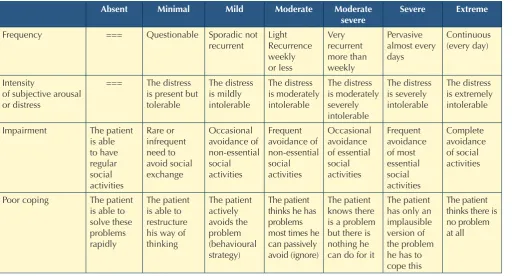
The result has been a rich and detailed collection of pa-tients’ self-descriptions related to emotional attunement/ disattunement, self-other demarcation/non-demarcation, emotion recognition/non-recognition, emotional/cogni-tive attitude towards others, endorsement/refusal of so-cial norms, etc. We created a database using patients’ self-reports from which we later developed categories based on structural similarities among social abnormal phenomena. These categories fulfill three formal criteria: reliability (they must consent consistent findings), discri-minant validity (for patients with different psychopatho-logical features), sensibility (ability to depict different in-tensities of a phenomenon). This last criterion is achieved by rating each item according to its quantitative features (frequency, intensity, impairment and coping) using a Lik-ert Scale (Table I).
ARS includes 16 distinctive items grouped in 6 catego-ries: hypo-attunement, invasiveness, emotional flooding, algorithmic conception of sociality, antithetical attitude toward sociality and idionomia (Appendix 1). For each item and category, an accurate description and a list of examples are provided.
The interview may take about 30-60 minutes.
As discussed in another paper 24, abnormal experiences in persons affected by schizophrenia cannot be reliably and validly assessed with scales reducing them to merely a matter of frequency or intensity 25-31. Their assessment requires a precise characterisation of the phenomenal quality of the experience. We need an in-depth, fine-tuned characterization of the phenomenal quality of ab-normal experiences that can only be provided by more flexible instruments. This characterisation can avoid di-agnostic mistakes, e.g. overdiagnosis or underdiagnosis of schizophrenia.
In order to investigate autism, during clinical interviews patients were asked questions such as:
• Do you have strange feelings when you are with other people?
• Which thoughts and feelings do you experience when you are with them?
• Do you have any ideas about what they are thinking or feeling?
• What do you think of the thoughts and feelings you had when you were with other people?
• What do you think of the others? Are you interested in them?
• Do you think that being with other persons is im-portant?
• Do you think that what they think is important?
TABLE I.
Table of severity. Tabella delle gravità.
Absent Minimal Mild Moderate Moderate severe
Severe Extreme
Frequency === Questionable Sporadic not recurrent Light Recurrence weekly or less Very recurrent more than weekly Pervasive almost every days Continuous (every day) Intensity
of subjective arousal or distress
=== The distress is present but tolerable The distress is mildly intolerable The distress is moderately intolerable The distress is moderately severely intolerable The distress is severely intolerable The distress is extremely intolerable
Impairment The patient is able to have regular social activities Rare or infrequent need to avoid social exchange Occasional avoidance of non-essential social activities Frequent avoidance of non-essential social activities Occasional avoidance of essential social activities Frequent avoidance of most essential social activities Complete avoidance of social activities
Poor coping The patient is able to solve these problems rapidly
The patient is able to restructure his way of thinking The patient actively avoids the problem (behavioural strategy) The patient thinks he has problems most times he can passively avoid (ignore)
The patient knows there is a problem but there is nothing he can do for it
The patient has only an implausible version of the problem he has to cope this
The Autism Rating Scale (ARS)
Who: patients with schizophrenia, or suspected to have
schizophrenia, or schizophrenia spectrum disorders. This scale may help to discriminate schizophrenia from other psychoses, and cluster A personality from other per-sonality disorders.
It may help to clarify features of clinical high risk or ultra high risk syndromes.
To complete the assessment, the patient should be com-pliant, motivated and have sufficient linguistic ability and introspective attitude.
This scale is not exhaustive of careful clinical assessment, and other scales should be employed, e.g. PANSS for symptomatology, quality of life (QoL) for social function-ing, SPI-A or Psychosis Proneness Scales for comprehen-sive evaluation of schizophrenic vulnerability.
What: this scale assesses “What it is like” to be a person
with schizophrenic autism in the social world.
It explores the subjective experience of inter-personal re-lationships, contacts, social situations as they present to patients in daily life
Where: this scale focuses on all kinds of “real-life social
situations”, e.g. home, work, school, leisure, friendship, people encountered in streets, bars, nightlife, buses, met-ro, trains, airports, cinemas, concerts, sport events, super-markets, shops, libraries, offices, etc.
When: this scale assesses these features during the last
three months before the interview.
How: the interviewer should employ the prompts
select-ed for each item to elicit spontaneous narratives. The patient’s narratives should be written verbatim. Note that patients often use metaphors to illustrate their subjective experience.
Behaviours are also explored. Some behaviours may be suggestive of qualitatively and quantitatively altered social experience, e.g. diminished social interests, interactions, refuse to experiment novel activities or contacts, reduced intimate relationships with significant mutual caring and sharing, reduced interpersonal involvement, neglect of ac-tivities of interest and initiative, loss of naturalness in social contacts, refusal of interpersonal bonds, new or unusual preoccupation with existential, metaphysical, religious, philosophical, or psychological themes, social naiveté, lack of delicacy or tact in social contexts, etc.
Assessing quantity (severity) of phenomena Rate severity addressing questions about: a) frequency;
b) subjective charge/impairment;
c) coping/ impairment in daily interpersonal relation-ships, activities, transactions, situations;
Hold the highest level reached (Table I).
If the patient shows different degrees of impairment in different domains, rate the higher score of impairment.
Prompts
Can you tell me how much time you spent with people during the last months?
What sort of things do you do with them?
Could you please describe this to me as much as you can? What is it like for you when you are with other people? What thoughts and feelings do you experience when you are with them?
Do you have any ideas about what they were thinking or feeling?
What do you think of the thoughts and feelings you had when you were with other people?
What do you think of the others? Are interested in them? Do you feel attuned to them?
Do you feel like them?
Items and categories of ARS
A1. Hypo-attunement
The immediate feeling of reduced attunement, i.e. emo-tional contact with other persons.
The pervasive feeling of inexplicability/incomprehensi-bility of people’s behaviours and social situations. Patients may feel hypo-attuned to flesh-and-blood oth-ers or to othoth-ers as impoth-ersonal entities (mankind, society, one’s own life context, the common sense world, social milieu, etc.).
Hypo-attunement may emerge also as the inability to grasp the immediate meaning and implicit rules of spe-cific every-day life situations.
Discriminate from:
• complaints or concerns about world-view (social, po-litical or religious issues) or about social, economic, personal status, love affairs, etc.;
• active and deliberate withdrawal coming from politi-cal religious or biographipoliti-cal reasons;
• active and deliberate withdrawal underpinned by an-tagonomia (the explicit refusal of social contacts); • feeling of detachment linked to the loss of vitality (as
in depressive states);
• consequence of a persecutory paranoid delusion or fear; • derealisation (it is predominantly the environment
that appears changed for the subject).
A1.1 Immediate feeling of distance detachment or lack of resonance
The immediate feeling of lacking natural and spontane-ous engagement, complaints of not being properly pre-sent in the world.
Patients may complain about the absence of the natural-ness of the world and other people.
This may sometimes be expressed as lack of resonance, a pervasive sense of not being affected, incited, moved, motivated, touched, attracted or stimulated by the exter-nal world and the others.
Examples:
• it is as if there were two worlds; • I cannot associate with other persons;
• it is as if my matter were separating from the world; • I always felt as if I belonged to another race;
• when I am with other persons a veil drops down that severs me from the others.
A1.2 Immediate feeling of inexplicability or incomprehensibility of other people and/or inability to grasp the meaning of social situations
The inability to grasp or decipher the intentions, emo-tions, believes, desires or needs of other people.
The lack of intuitive “grip” on social situations, of au-tomatic, pre-reflexive grasp of the meaning of everyday events, matters, situations, people and the implicit rules of human conduct or interactions.
Examples
• I feel unable to take part to things and situations as the others do;
• I simply cannot grasp what the others do;
• when I am with others I cannot express myself. I don’t lack words: I lack a piece of the situation;
• I lack the backbone of the rules of social life.
A1.3 Ego-syntonic feelings of radical uniqueness and exceptionality
The exaltation of one’s feelings of radical uniqueness and exceptionality.
On occasion, all this is claimed as the result of a free choice, the effect of a “diverse will”. Other times it is felt as a destiny, not as a deliberate choice.
The patients’ claim to feel “radically different from all other people” (category 1) is seemingly rooted in a pro-found metamorphosis of self-awareness.
It seems to be grounded in anomalous sensations, feel-ings of disconnectedness from commonly shared reality, and solipsistic experiences.
Examples:
• I’ve always thought to be radically different from all other people, perhaps an alien. It depended on all my strange thoughts that surprised me;
• I wake up very early in the morning and in the afternoon I go to sleep. In my head, there is another time zone;
• I am very sensible. I feel strange energies. This does not happen to everyone;
• I live from the reality I am able to build; • I don’t perceive what I feel, but what I imagine.
A2. Invasiveness
Feeling oppressed and invaded by the others, from without.
Discriminate from:
• delusional perception;
• depressive feeling of indignity guilt or inadequateness; • social phobia coming from hypersensibility to
judg-ment or difficulties to be assertive; • feelings of shame.
A2.1 Immediate feeling of hostility or oppression coming from the others
Immediate feeling to be somewhat invaded, overrun, flooded, constrained, threatened by the external world or by the other people, or to be somehow in a passive, dangerously exposed position, at the mercy of the world or other people.
Immediate and oppressive feeling of being at the centre of the world (self-reference, or centrality experiences) Examples:
• I feel driven by the human flood. It is a feeling of dan-ger, as if I were invaded;
• people oppress me;
• I feel as if I were the ego-centre of society;
• we, the abnormals, are more sensitive to things. We feel much more than normal;
• getting in touch with others scares me. They can harm me.
A2.2 Immediate feeling of lack of self-other boundaries
immediate feeling of being somehow “too open or trans-parent”, or of having extraordinarily “thin skin”, no “bar-riers”, etc.
Immediate feeling to be physically invaded or penetrated by other people’s gestures, speech, actions, or glances. A feeling of extreme anxiety or unease when standing close to or being touched by another (even by a close person), or when being hugged.
Examples:
• it’s like I had a hole ... sometimes it’s like they enter inside me through it;
• I feel people entering inside me;
• people oppress me even if they just move their head; • what happens around me gets into me directly as
cer-ebral perception;
A.2.2.3 Hyper-empathic experiences
The inability to take distance from other people deter-mined by immediate feelings of merging with other persons, hyper-empathy, direct mindreading of others, fusional or mimetic experience where one’s mental phe-nomena are intermingled with the others’.
Examples:
• I suffer from acute empathy and identification;
• I feel the mental states of others and I can no longer find myself;
• sometimes I vibrate with things around me;
• when I watch a person or a thing, I become part of it.
A3. Cenesthopathic/Emotional flooding
Feeling oppressed and submerged from within by parox-ysms of one’s emotions and bodily sensations evoked by interpersonal contacts.
Discriminate from:
• emotional flooding must be differentiated from inva-siveness (see above) since in the first case distressing feelings and emotions are experienced as coming from the inside, whereas in the second the person feels violated from without;
• panic attacks as fear to lose emotional self-control; • social phobia coming from hypersensibility to
judg-ment or difficulties to be assertive; • feelings of shame.
A3.1 Emotional paroxysms
Feeling overloaded by one’s distressing emotions in form of paroxysms when in front of others.
Strange bodily sensations, central-vegetative disturbanc-es, anxiety or other distressing emotions.
Examples of bodily sensations are acceleration of heart rate, breath rate, muscles tension or stiffness, etc.
Examples of distressing feelings are tension, nervousness, hostility, strain, weakness, etc.
Examples:
• when people get too close to me I feel tension inside; • when I am at work and a client approaches me, I start
trembling;
• I start to feel a weakness in myself;
• it’s like an internal block, a block of feelings.
A3.2 Coenesthetic paroxysms
Feelings of being oppressed by uncanny and incom-prehensible bodily sensations evoked by interpersonal contacts.
Examples are strange sensations of morphological change, pseudo-movements of part of the body or inside of the body, motor block, interference, proprioceptive or cenesthetic experiences, etc.
Examples:
• when I look someone straight in the eyes I feel strange vibrations inside;
• when I meet with people, it depends on the situation, I am taken by obscurity;
• it is something in my head, not a pain, I feel suffo-cated, my mind repressed, like psychic pain;
• when I look people in the eyes I feel a kind of heat in my head, in my back.
A4. Algorithmic conception of sociality
The conceptual, analytic, hyper-cognitive, hyper-rational-ist, hyper-reflective stance toward sociality.
Patients may endorse a mechanistic, strategic and in some way “mathematisable” (as in a chess game) conceptuali-sation of interpersonal transactions in everyday life. They try to make sense of the mental states of others that lie behind their behaviour and/or to understand the meaning of social situations and everyday life transac-tions by observing other people.
It is a sort of empirical study into the others’ transactions, or a kind of theoretical study (sociological, philosophical, etc.) of published accounts and researches.
This is meant to discover an explicit algorithm to make sense of the others’ behaviour, and to build up a method to take part in social interplay.
Discriminate from:
• obsessive doubts about daily life activities or regard-ing what to do with others.
A4.1 Observational (ethological) attitude
The attempt to make sense of the mental states of others that lie behind their behaviour and/or to understand the meaning of social situations through empirical observa-tions of other people in everyday life transacobserva-tions, or from the “scientific” analysis of the workings of “intelligent” mechanisms.
Patients may display an authentic interest, wonder, curi-osity about the humans’ way of life and toward the inti-mate workings of the others’ mind, but sometimes may be driven by feelings of mistrust and suspect.
Examples:
• I study people. I am curious. I want to understand how they are inside;
• they are not what they appear to be. One must go beyond appearances not to be cheated;
• I am like an anthropologist;
• others know the rules: I have to study them;
• I study persons, I want to get inside them to under-stand how they are inside;
• during my adolescence, I used to watch others to see what the right moment to be happy or to be sad.
A4.2 Pragmatical (need-for-interplay oriented) attitude
Attempts to develop or build up an explicit personal meth-od or algorithm to take part in specific social transactions. Patients try to get in touch with other persons, and are concerned with learning how to effectively interact with the others.
Sometimes these attempts are conducted via recurrent, systematic and pervasive “scientific” or “philosophical” analysis and personal in-depth studies.
These attempts may appear idiosyncratic, hyper-elabo-rated and not properly fitting the implicit meanings and modes of interpersonal relationships.
Examples:
• I am very interested in linguistics, I speak many lan-guages. I thought it was necessary to know the origin of words to achieve better communication with others; • I should make the algorithms to talk with him!; • I have studied a system to intervene at the right
mo-ment in conversations;
• it’s some mechanism, like a watch; I know it because it’s always the same;
• people have a system. I try to understand it. But then I don’t understand anything;
• I would like to insert a file for discourse in my memory to be used at the right moment.
A4.3 Theoretical (principles oriented) attitude
The purely theoretical, conceptual interest toward the phenomenon of sociality and possibly toward reality as a whole.
Patients are concerned with the exact mechanisms of self-world relation and try to study it through compulsive re-flections, analyses, speculations, etc.
Examples:
• I am more interested in the way it works than in mak-ing it work;
• I need to reflect upon every single aspect of existence so that this is the purpose of my existence;
• I am keen to find key rules;
• When I watch a game, say a football match, I am more interested in understanding the rules than in enjoying the game.
A5. Antithetic attitude towards sociality
Antithetic attitude toward sociality is comprehensive of antagonomia and abstract idealisation of sociality. Antagonomia is the feeling to be vulnerable to the influx coming from the external world and claim one’s inde-pendence as the most important value.
Conventional (common sense) assumptions, social-shared knowledge, common ways of thinking and behav-ing and immediate (empathic) relationships and emotion-al attunement are evemotion-aluated as dangerous sources of loss of individuation.
Abstract idealisation of sociality is replacing the engage-ment with “real” persons by a marked utopian interest in mankind or abstract humanitarian values.
Discriminate from:
• diminished social attunement (where impaired ability to intuitively make sense of others’ behaviour is pre-dominant);
• suspiciousness (where the need to read others’ minds stems from the idea that the other can be intentionally malignant);
• sexual ethic, political, religious, socio-cultural, orien-tation diversities.
A5.1 Antagonomia as the refusal of social shared knowledge and assumptions
A skeptical and reflecting attitude towards common sense, conventional knowledge and socially shared val-ues, and an attempt at bracketing them.
An explicit repugnance to common ways of thinking and behaving, a disdainful refusal of the ordinary way of be-ing and the taken-for-granted understandbe-ing of reality. The choice to distance oneself from common sense rules conventional meanings, values, beliefs and ordinary ways to convey them and take an eccentric stand in the face of commonly shared assumptions.
Sometimes a skeptical attitude may involve a critique at-titude toward conventional semantics. Its main character-istics are criticising the usual object-meaning pairing al-lowed for by common sense and the attempt to devise bet-ter tools to express one’s own idiosyncratic experiences. Examples:
• My aversion to common sense is stronger than my in-stinct to survive;
• what I detest more is being persuaded by others; • I don’t want to be trapped in their way of thinking; • I feel a deep aversion to the world, for the way others
manage to live in it;
• I will use my left hand for writing in order to activate a new part of my brain;
• It is not enough for me to take things as others do. They are happy with that. I need endless explanations of all that happens. “Why does that happen?” “What does that mean?” “How to explain it?”
A5.2 Antagonomia as distrust toward attunement with others
con-• immediate feeling of radical uniqueness and excep-tionality. Idionomia is originally given in these kind of experiences (e.g. disconnection from commonly shared reality, or quasi-solipsistic feelings of being the creator of one’s own reality) and tied up with emo-tions like exaltation and fascination. In idionomia, cognitive elaborations and strange and uncanny ex-periences prevail.
A6.1 Charismatic concerns
Feeling gifted (charisma originally means “gift”) with su-perior spiritual powers or chosen for an important escha-tological (eschatos means “ultimate”) task.
Examples:
• through suffering, from God I will have the power over the planet;
• I have this spiritual level. I have this privilege, I was given this task from God;
• mine is not an illness, it is an experiment. I was cho-sen for this. Something extremely important;
• I knew that I was given some powers from God to penetrate the deep sense of reality;
• I have been chosen for the experiment. It’s a privilege.
A6.2 Metaphysical concerns
Concern with metaphysical questions (e.g. what is real
vs. what is just appearance). Feeling captivated by the
perplexing metaphysical complexity of existence and by “what is going on in the backstage” of the ordinary ap-pearances, state of affairs, nature and human world. Examples:
• I must test the reality of reality;
• it is not enough for me to take things as the others do; • I don’t understand why this has to be called a table, and if the sun’s out why we have to say it’s a nice day; • I will use the left hand for writing in order to activate
a new part of my brain.
References
1 American Psychiatric Association. Diagnostic and Statistical Manual of Mental Disorders. Fifth ed. Arlington, VA:
Ameri-can Psychiatric Publishing 2013.
2 Lezenweger MF, Dworkin RH. The dimensions of schizo-phrenia phenomenology. Not one or two, at least three, per-haps four. Br J Psychiatry 1996;168:432-40.
3 Strauss JS, Carpenter WT, Bartko J. The diagnosis and un-derstanding of schizophrenia. III. Speculations on the pro-cess that underlies schizophrenic symptoms. Schizophr Bull
1974;11:61-75.
4 Sobin C, Blundell ML, Conry A, et al. Early, non-psychotic de-viant behavior in schizophrenia: a possible endophenotypic marker for genetic studies. Psychiatry Res 2001;25:101-13.
nections, a deliberate choice to distance oneself from the here and now other.
Immediate (empathic) relationships and interpersonal bonds are rejected and one’s own tendency to identify with the others is especially feared.
The contact with other human beings may be felt as a dangerous source of loss of identity and individuation or original thought.
Examples:
• interpersonal bonds have no reason to exist;
• I cannot reach them [other people], but I also don’t want to reach them;
• I am strange … I am not interested in having relation-ships with other person;
• loneliness allows you to be yourself because nobody influences you and you only think what you want.
A5.3 Abstract Idealisation
The endorsement of a kind of spiritual or intellectual utopian ideology, detached from concrete everyday interpersonal life. The engagement with single flesh-and-blood persons is replaced by an interest towards mankind as a whole or abstract humanitarian values.
Examples:
• I love Mankind, but I detest humans;
• in the world and among people there is a new culture, the culture of the encounter… the encounter between different races or between men and women… we must be courageous;
• I feel more bound to mankind in an abstract sense than to single persons;
• I believe in friendship that cannot accept falsehood.
A6. Idionomia
Idionomia (from classic Greek, idios, private and nomos, law) is characterised by an existential re-orientation driv-en by the exaltation of one’s own principles, interroga-tions, or world-view. This exalted existential standpoint does not allow integration or compromise with the oth-er’s point of view or with common sense.
Idionomia is comprehensive of metaphysical concerns (they are skeptical about the face value of phenomena) and charismatic concerns (they are convinced that they have a mission to accomplish).
Discriminate from:
• professional or amateur engagement in theoretical disciplines; if this is the case, people maintain the shared tenets and methodology of the discipline; • to be adept of political, religious, spiritual group.
amidst narratives of self and illness in schizophrenia: associ-ations with insight, neurocognition, symptom and function.
Acta Psychiatr Scand 2005;112, 64-71.
20 Lysaker PH, Davis LW, Lysaker JT. Enactment in schizophre-nia: capacity for dialogue and the experience of the inability to commit to action. Psychiatry 2006;69:81-93.
21 Lysaker PH, Bob P, Pec O, et al. Metacognition as a link which connects brain to behavior in schizophrenia.
Transla-tional Neuroscience 2013;4:368-77.
22 Stanghellini G, Rossi R. Pheno-phenotypes: a holistic ap-proach to the psychopathology of schizophrenia. Curr Opin
Psychiatry 2014;27:236-41.
23 Stanghellini G, Langer AI, Ambrosini A, et al. Quality of hal-lucinatory experiences: differences between a clinical and a non-clinical sample. World Psychiatry 2012;11:110-3. 24 Stanghellini G, Ballerini M, Cutting J. Abnormal
Bod-ily Phenomena Questionnaire. Journal of Psychopathology
2014;20:138-43.
25 Stanghellini G. The puzzle of the psychiatric interview. J
Phenomenological Psychol 2004;35:173-95.
26 Stanghellini G. The grammar of psychiatric interview: a plea for the second person mode of Understanding.
Psychopa-thology 2007;40:69-74.
27 Stanghellini G. Embodiment and schizophrenia. World
Psy-chiatry 2009;8:56-9.
28 Stanghellini G. The meanings of psychopathology. Curr
Opin Psychiatry 2009;22:559-64.
29 Stanghellini G. A hermeneutic framework for psychopathol-ogy. Psychopathology 2010;43:319-26.
30 Stanghellini G. Philosophical resources for the psychiatric interview. In: Fulford KWM, Davies M, Gipps R, et al.,
edi-tors. Oxford handbook of philosophy and psychiatry. Ox-ford/New York: Oxford University Press 2013, pp. 320-55.
31 Stanghellini G, Ballerini M. Qualitative analysis. Its use in psychopathological research. Acta Psychiatr Scand
2008;117:161-3.
5 Stanghellini G, Ballerini M. What is it like to be a person with schizophrenia in the social world? A first-person per-spective study on schizophrenic dissociality – Part 1: State of the art. Psychopathology 2011;44:172-82.
6 Stanghellini G, Ballerini M. What is it like to be a person with schizophrenia in the social world? A first-person per-spective study on schizophrenic dissociality – Part 2: meth-odological issues and empirical findings. Psychopathology
2011;44:183-92.
7 Bleuler E. Dementia praecox oder gruppe der schizo-phrenien. Leipzig: Deuticke 1911.
8 Kretschmer E. Korperbau und Charakter. Berlin: Springer 1921.
9 Minkowski E. La schizophrenie. Paris: Desclée de Brouwer
1927.
10 Blankenburg W. Der verlust der naturalichen selbverstan-dlickeit. Stuttgart: Enke 1971.
11 Urfer A. Phenomenology and psychopathology of schizo-phrenia: the views of Eugene Minkowski. Philos Psychiatry
Psychol 2001;8:279-89.
12 Parnas J, Bovet P. Autism in schizophrenia revisited. Compr
Psychiatry 1991;32:1-15.
13 Gundel H, Rudolf GAE. Schizophrenic autism. 2. Proposal for a nomothetic definition. Psychopathology 1993;26:304-12. 14 Stanghellini G, Ballerini M. Autism: disembodied existence.
Philos Psychiatry Psychol 2004;11:259-68.
15 Stanghellini G, Ballerini M. Criterion B (social dysfunction) in persons with schizophrenia: the puzzle. Curr Opin
Psy-chiatry 2007;20:582-7.
16 Stanghellini G, Ballerini M. Dis-sociality: the phenomeno-logical approach to social dysfunction in schizophrenia.
World Psychiatry 2002;1:102-6.
17 Stanghellini G. Psicopatologia del senso comune. Milano:
Cortina 2008.
18 Stanghellini G, Ballerini M. Values in persons with schizo-phrenia. Schizophr Bull 2007;33:131-41.
APPENDIx 1. ARS - Autism Rating Scale.
AuTISM
RATINg SCALE Frequency of Arousal Intensity or distress
Impairment Poor
Coping NAME: ______________________
CODE: ______________________
Classify in: (1) Absent; (2) Minimal; (3) Mild; (4) Moderate; (5) Moderate severe;
(6) Severe; (7) Extreme DD/MM/YYYY: ___/____/______
A1. Hypo-attunement 1.1 Distance, detachment or lack of resonance The immediatefeeling of distance and detachment, a sense of barrier between oneself and the other. The immediate feeling of lacking natural and spontaneous engagement, complaints of not being properly present in the world. Patients may complaint of absence of the naturalness of the world and of other people. Sometimes this may be expressed as lack of resonance, a pervasive sense of not being affected, incited, moved, motivated, touched, attracted or stimulated by the external world and the others.
1.2 Inexplicability or incomprehensibility The inability to grasp or decipher the intentions, emotions, believes, desires or needs of other people. The lack of intuitive “grip”
on social situations, of automatic, pre-reflexive grasp of the meaning of everyday events, matters, situations, people and of the implicit rules of human conduct or interactions.
1.3 Radical uniqueness and exceptionality The exaltation of one’s feelings of radical uniqueness and exceptionality. Sometimes, all this is claimed as the result of a free choice, the effect of a “diverse will”. Other times it is felt as a destiny, not as a deliberate choice. The patients’ claim to be “radi-cally different from all other people” (category 1) is seemingly rooted in a profound metamorphosis of self-awareness. It seems to be grounded in anomalous sensations, feelings of disconnectedness from commonly shared reality, and solipsistic experiences. A2. Invasiveness 2.1 Immediate feeling of hostility or oppression
coming from the others Immediate feeling to be somewhat invaded, overrun, flooded, constrained, threatened by the external world or by the other peo-ple, or to be somehow in a passive, dangerously exposed position, at the mercy of the world, or other people. Immediate and oppressive feeling of being at the center of the world(self-reference, or centrality experiences).
2.2 Immediate feeling of lack of self/other
boundaries Immediate feeling of being somehow “too open or transparent”, or of having extraordinarily “thin skin”, no “barriers”, etc. Im-mediate feeling to be physically invaded or penetrated by other people’s gestures, speech, actions, glances. A feeling of extreme anxiety or unease when standing close to or being touched by another (even by a close person), or when being hugged.
2.3 Hyper-empathic experiences The inability to take distance from other people determined by immediate feelings of merging with other persons, hyper-empathy, direct mindreading of others, fusional or mimetic experience where one’s mental phenomena are intermingled with the others’. A3. Emotional flooding 3.1 Emotional paroxysms in front of others Feeling overloaded by one’s distressing emotions in form of paroxysms when in front of others. Strange bodily sensations,
central-vegetative disturbances, anxiety or other distressing emotions. Examples of bodily sensations are acceleration of heart rate, breath rate, muscles tension or stiffness, etc. Examples of distressing feelings are tension, nervousness, hostility, strain, weakness, etc. 3.2 Coenesthetic paroxysms in front of others Feelings of being oppressed by uncanny and incomprehensible bodily sensations evoked by interpersonal contacts. Examples are
strange sensations of morphological change, pseudo-movements of part the body or inside of the body, motor block, interference, proprioceptive or coenesthetic experiences, etc.
A4. Algorithmic
conception of sociality 4.1 Observational – ethologically oriented – attitude The attempt to make sense of the mental states of others that lie behind their behaviour and/or to understand the meaning of so-cial situations through empirical observations of other people in everyday life transactions, or from the “scientific” analysis of the workings of “intelligent” mechanisms. Patients may display an authentic interest, wonder, curiosity about the humans’ way of life and toward the intimate workings of the others’ mind, but sometimes may be driven by feelings of mistrust and suspect.
4.2 Pragmatic – need-for-interplay oriented – attitude
Attempts to develop or build up an explicit personal method or algorithm to take part in specific social transactions. Patients try to get in touch with other persons and are concerned with learning how to effectively interact with the others. Sometimes these attempts are conducted via recurrent, systematic and pervasive “scientific” or “philosophical” analysis and personal in-depth studies. These attempts may appear idiosyncratic, hyper-elaborated and not properly fitting the implicit meanings and modes of interpersonal relationships.
APPENDIx 1. ARS - Autism Rating Scale.
AuTISM
RATINg SCALE Frequency of Arousal Intensity or distress
Impairment Poor
Coping NAME: ______________________
CODE: ______________________
Classify in: (1) Absent; (2) Minimal; (3) Mild; (4) Moderate; (5) Moderate severe;
(6) Severe; (7) Extreme DD/MM/YYYY: ___/____/______
A1. Hypo-attunement 1.1 Distance, detachment or lack of resonance The immediatefeeling of distance and detachment, a sense of barrier between oneself and the other. The immediate feeling of lacking natural and spontaneous engagement, complaints of not being properly present in the world. Patients may complaint of absence of the naturalness of the world and of other people. Sometimes this may be expressed as lack of resonance, a pervasive sense of not being affected, incited, moved, motivated, touched, attracted or stimulated by the external world and the others.
1.2 Inexplicability or incomprehensibility The inability to grasp or decipher the intentions, emotions, believes, desires or needs of other people. The lack of intuitive “grip”
on social situations, of automatic, pre-reflexive grasp of the meaning of everyday events, matters, situations, people and of the implicit rules of human conduct or interactions.
1.3 Radical uniqueness and exceptionality The exaltation of one’s feelings of radical uniqueness and exceptionality. Sometimes, all this is claimed as the result of a free choice, the effect of a “diverse will”. Other times it is felt as a destiny, not as a deliberate choice. The patients’ claim to be “radi-cally different from all other people” (category 1) is seemingly rooted in a profound metamorphosis of self-awareness. It seems to be grounded in anomalous sensations, feelings of disconnectedness from commonly shared reality, and solipsistic experiences. A2. Invasiveness 2.1 Immediate feeling of hostility or oppression
coming from the others Immediate feeling to be somewhat invaded, overrun, flooded, constrained, threatened by the external world or by the other peo-ple, or to be somehow in a passive, dangerously exposed position, at the mercy of the world, or other people. Immediate and oppressive feeling of being at the center of the world(self-reference, or centrality experiences).
2.2 Immediate feeling of lack of self/other
boundaries Immediate feeling of being somehow “too open or transparent”, or of having extraordinarily “thin skin”, no “barriers”, etc. Im-mediate feeling to be physically invaded or penetrated by other people’s gestures, speech, actions, glances. A feeling of extreme anxiety or unease when standing close to or being touched by another (even by a close person), or when being hugged.
2.3 Hyper-empathic experiences The inability to take distance from other people determined by immediate feelings of merging with other persons, hyper-empathy, direct mindreading of others, fusional or mimetic experience where one’s mental phenomena are intermingled with the others’. A3. Emotional flooding 3.1 Emotional paroxysms in front of others Feeling overloaded by one’s distressing emotions in form of paroxysms when in front of others. Strange bodily sensations,
central-vegetative disturbances, anxiety or other distressing emotions. Examples of bodily sensations are acceleration of heart rate, breath rate, muscles tension or stiffness, etc. Examples of distressing feelings are tension, nervousness, hostility, strain, weakness, etc. 3.2 Coenesthetic paroxysms in front of others Feelings of being oppressed by uncanny and incomprehensible bodily sensations evoked by interpersonal contacts. Examples are
strange sensations of morphological change, pseudo-movements of part the body or inside of the body, motor block, interference, proprioceptive or coenesthetic experiences, etc.
A4. Algorithmic
conception of sociality 4.1 Observational – ethologically oriented – attitude The attempt to make sense of the mental states of others that lie behind their behaviour and/or to understand the meaning of so-cial situations through empirical observations of other people in everyday life transactions, or from the “scientific” analysis of the workings of “intelligent” mechanisms. Patients may display an authentic interest, wonder, curiosity about the humans’ way of life and toward the intimate workings of the others’ mind, but sometimes may be driven by feelings of mistrust and suspect.
4.2 Pragmatic – need-for-interplay oriented – attitude
Attempts to develop or build up an explicit personal method or algorithm to take part in specific social transactions. Patients try to get in touch with other persons and are concerned with learning how to effectively interact with the others. Sometimes these attempts are conducted via recurrent, systematic and pervasive “scientific” or “philosophical” analysis and personal in-depth studies. These attempts may appear idiosyncratic, hyper-elaborated and not properly fitting the implicit meanings and modes of interpersonal relationships.
4.3 Speculative – theoretically oriented – attitude The purely theoretical, conceptual interest toward the phenomenon of sociality and possibly toward reality as a whole. Patients are concerned with the exact mechanisms of self-world relation and try to study it through compulsive reflections, analyses, specula-tions, etc.
APPENDIx 1. ARS - Autism Rating Scale (continued).
AuTISM
RATINg SCALE Frequency of Arousal Intensity or distress
Impairment Poor
Coping NAME: ______________________
CODE: ______________________
Classify in: (1) Absent; (2) Minimal; (3) Mild; (4) Moderate; (5) Moderate severe;
(6) Severe; (7) Extreme DD/MM/YYYY: ___/____/______
A5. Antithetical attitude toward sociality
5.1 Antagonomia as refuse of social shared
knowledge and assumptions A skeptical and reflecting attitude towards common sense, conventional knowledge and socially shared values, and an attempt at bracketing them. An explicit repugnance to common ways of thinking and behaving, a disdainful refusal of the ordinary way of being and the taken-for-granted understanding of reality. The choice to distance oneself from common sense rules conventional meanings, values, beliefs, and ordinary ways to convey them and take an eccentric stand in the face of commonly shared assump-tions. Sometimes a skeptical attitude may involve a critique attitude toward conventional semantics. Its main characteristics are criticizing the usual object-meaning pairing allowed for by common sense and the attempt to devise better tools to express one’s own often idiosyncratic experiences.
5.2 Antagonomia as distrust toward attunement
with others The overall distrust towards emotional attunement with other people, the refusal of intimate interpersonal connections, a delib-erate choice to distance oneself from the here and now Other. Immediate (empathic) relationships and interpersonal bonds are rejected and one’s own tendency to identify with the others is especially feared. The contact with other human beings may be felt as a dangerous source of loss of identity and individuation or original thought.
5.3 Abstract idealization The endorsement of a kind of spiritual or intellectual utopian ideology, detached from concrete everyday interpersonal life. The engagement with single flesh-and-blood persons is replaced by an interest towards the whole mankind or abstract humanitarian values.
A6. Idionomiaa 6.1 Charismatic Concerns Concern with metaphysical questions (e.g., what is real vs. what is just appearance). Feeling captivated by the perplexing meta-physical complexity of existence and by “what is going on in the backstage” of the ordinary appearances, state of affairs, nature and human world.
APPENDIx 1. ARS - Autism Rating Scale (continued).
AuTISM
RATINg SCALE Frequency of Arousal Intensity or distress
Impairment Poor
Coping NAME: ______________________
CODE: ______________________
Classify in: (1) Absent; (2) Minimal; (3) Mild; (4) Moderate; (5) Moderate severe;
(6) Severe; (7) Extreme DD/MM/YYYY: ___/____/______
A5. Antithetical attitude toward sociality
5.1 Antagonomia as refuse of social shared
knowledge and assumptions A skeptical and reflecting attitude towards common sense, conventional knowledge and socially shared values, and an attempt at bracketing them. An explicit repugnance to common ways of thinking and behaving, a disdainful refusal of the ordinary way of being and the taken-for-granted understanding of reality. The choice to distance oneself from common sense rules conventional meanings, values, beliefs, and ordinary ways to convey them and take an eccentric stand in the face of commonly shared assump-tions. Sometimes a skeptical attitude may involve a critique attitude toward conventional semantics. Its main characteristics are criticizing the usual object-meaning pairing allowed for by common sense and the attempt to devise better tools to express one’s own often idiosyncratic experiences.
5.2 Antagonomia as distrust toward attunement
with others The overall distrust towards emotional attunement with other people, the refusal of intimate interpersonal connections, a delib-erate choice to distance oneself from the here and now Other. Immediate (empathic) relationships and interpersonal bonds are rejected and one’s own tendency to identify with the others is especially feared. The contact with other human beings may be felt as a dangerous source of loss of identity and individuation or original thought.
5.3 Abstract idealization The endorsement of a kind of spiritual or intellectual utopian ideology, detached from concrete everyday interpersonal life. The engagement with single flesh-and-blood persons is replaced by an interest towards the whole mankind or abstract humanitarian values.
A6. Idionomiaa 6.1 Charismatic Concerns Concern with metaphysical questions (e.g., what is real vs. what is just appearance). Feeling captivated by the perplexing meta-physical complexity of existence and by “what is going on in the backstage” of the ordinary appearances, state of affairs, nature and human world.