The effect of behavior parent training on mothers of children with
attention deficit hyperactivity disorder
Mohsen Amiri
1, Ahmad Behpajooh
21Department of Psychology, University of Zanjan, Zanjan, Iran
2Department of Exceptional child Psychology, Faculty of Psyhcology and Educational Sciences,
University of Tehran, Tehran, Iran
Submitted: 6 March 2015
Accepted: 10 July 2015
Int J Behav Sci. 2016; 9(4): 220-226
Corresponding Author: Mohsen Amiri, PhD Department of Psychology, University of Zanjan, Zanjan,
Iran
E-mail: [email protected]
Abstract
Introduction: The purpose of the current study was to investigate the effect of training behavior modification methods on mothers of children with Attention Deficit Hyperactivity Disorder (ADHD) on reducing behavior problems and ADHD symptoms in their children’s.
Method: The research method was quasi-experimental with pre-test and post-test design and control group. To do so, 24 mothers of children with ADHD were selected and divided into experimental and control groups (12 mothers in each group). Participants filled the Revised Conners’ Parent Rating scale (CPRS-R) and Children’s Behavioral Performance at Home questionnaires. In the next step, the experimental group was instructed behavior modification methods in 9 ninety-minute sessions while the mothers in the control group went on their normal procedures. At the end of the instructional session, both groups filled out the mentioned questioners as the post-test. Covariance analysis and t test was used for analyzing data.
Results: The results of the analysis of the independent t test showed that instructing behavior modification methods improved children’s behavioral problems. At the same time, the analysis of covariance showed the training had decreased hyperactivity symptoms and ADHD index among the children of the experimental group, as compared to those of the control group. However, the training was shown to have no effect on attention deficit.
Conclusion: In conclusion, the findings of this study suggests that behavior modification training to mothers can help them decline their children’s behavioral problems.
Keywords: Attention Deficit Hyperactivity Disorder, Behavior Parent Training, Behavioral Problems
Introduction
Attention Deficit/ Hyperactivity Disorder is one of the most commonly- diagnosed childhood psychiatric disorders which is characterized by hyperactivity, impulsivity and attention deficit inappropriate to the child’s developmental level [1, 2]. Attention deficit/hyperactivity disorder (ADHD) is a chronic and debilitating disorder affecting 5% of all school-aged children [1]. Estimation of the prevalence of Attention Deficit/Hyperactivity Disorder varies between 5.9 to 7.1 percent based on the diagnostic criteria applied [3].
Children diagnosed with the disorder constitute a diverse, heterogeneous population being tremendously different in terms of the existence of symptoms, the pervasiveness of those symptoms in different situations and the amount of co morbid other disorders [4, 5].
In response, their parents may use maladaptive behaviors for controlling their children’s behavior, such as applying excessive control strategies, which contributes to the aggravation of the children’s condition, leading to consequences such as serious parent-child conflicts and exacerbation of the symptoms in children [7, 8].
Research suggests if parents do not adopt sound parenting practices in their interactions with their children, their children are more likely to develop symptoms of conduct disorders and oppositional problems in comparison to children from parents with more appropriate parenting [9, 10]. Rogers et al. [10] reported parents of children with ADHD had lower self-efficacy in their ability to help their children, spent less time to help their children in their academic lives, and used more coercive and punitive interactions; these negative cycle of interactions have consistently been shown to act as a risk factor for behavior problems among children with ADHD. Parenting is an important and challenging task which becomes even harder when the child shows symptoms like irritability, negative mood, inattention, incompliance and serious behavioral problems [4, 5], because each of these symptoms can impose excessive pressure on parents trying to manage and organize their children’s daily chores and activities [11].For the same reason, in most cases parents of these children turn to maladaptive behaviors for controlling their children’s misbehavior, such as applying excessive control strategies, which contribute to the aggravation of the children’s condition, leading to consequences such as serious parent-child conflicts and exacerbation of the symptoms in children [12, 13].
Regarding the importance of this issue, early interventions for families with behaviorally- disordered children focus on considering factors such as providing trainings for parents in managing children’s behavior so that they are helped to alleviate problems within their families [14].
Research also suggests children with ADHD have problems in outcome-directed regulation and maintenance of their behaviors, which in turn aggravates their problems in inhibition, initiation or continuation of their responses to the stimuli. Therefore, techniques which would increase our control over selection of stimuli and reinforcement would be effective in dealing with such children[15]. It’s noteworthy to mention although medication is the first-line approach in treating the disorder[16], research fails to demonstrate any long-term and enduring effects of medication after cessation, and, on the contrary, suggests that positive effects of the approach are only present during medication[14]. Moreover, parents and children are often extremely resistant to medication for its side effects such as loss of appetite, insomnia, headache, stomachache, and in some instances loss of weight [17].
For these reasons, psychosocial treatments have gained widespread attention because of their particular characteristics. Such treatments, in which behavior modification is done by parents at home, foster
promotion of various aspects of parental and familial functioning and help parents have a better cooperation and collaboration in the process of their children’s treatment, in the light of new information they gain[18]. Moreover, there is evidence attesting to the fact that clinical behavior therapy, in the forms of parent training and classroom interventions, bring about important improvements in the home and school behaviors of children with ADHD [8, 19]. Therefore, family-based interventions that focus on modifying antecedents and consequences of their child’s behavior by parents are the focus of behavioral parent training treatment for children with a ADHD [16, 20]. The effects of providing parental training on treating children’s non-complaint behaviors are well substantiated in the literature[21].
Although studies have shown the effectiveness of Parent Training Programs for creating improvements in some aspects of the behavioral functioning of children with ADHD, only a few studies have attended to the effectiveness of such programs for the overall treatment of these children’s behaviors [22]. Some of such studies will be reviewed in the following paragraphs.
In a study by Weinberg (1999)[23] on 34 parents who had children with ADHD, it was concluded that providing parents with parent training programs improved parents’ knowledge about the disorder, in general, and led to a decline in their parental stress. However, as for the decrease of their children’s symptoms and behavioral problems, results showed the program had been far from effective.
In addition, Huang et al. [11] found that after a 10-session parent training program for 23 parents of children with ADHD/ oppositional defiant disorder (ODD], 14 of the parents who managed to complete the program, reported both improved ADHD/ODD symptoms and home behaviors of their children.
Mathos et al. [24] investigated the effectiveness of the modification program for parent-child interactions for reducing symptoms of ADHD among 4-6 year-old preschoolers. Results revealed behavioral, hyperactivity and defiant behavior problems had declined in these children following the completion of the educational program by their mothers. At the same time, other research studies investigating the efficacy of training the techniques of behavioral therapy to mothers of children with ADHD on reduction of the symptoms of the disorder among these children, have shown behavioral interventions are effective for reducing symptoms of the disorder [16].
disorder. One aspect that can be mentioned about the need for such research, and this issue partly distinguishes this study with previous research, is the consideration of strict inclusion and exclusion criteria and using full diagnostic criteria, which partly results in the fact that the generalization of results to similar treatment groups be made with more certainty. On the other hand, in this research in order to try to eliminate human errors in the diagnosis of ADHD, besides the use of interviews and questionnaires, Qualitative EEG diagnostic procedure was used to identify the disorder more strongly. Moreover, there is little research to examine the impact of psychological intervention in enhancing the positive performance aspects in home environment, which have also been discussed in this study.
Method
This study was quasi-experimental in nature, with pre-test, post-test and a control group. The population of this study included all the mothers of children who were referred to the Atieh Therapeutic Center (in Tehran City) in the academic year 2009 (the data for this study were collected in 2009; however, due to some problems it has recently been analyzed and converted into a research paper) in order to have ADHD cured in their children. Twenty four mothers (12 mothers in the experimental group and 12 others in the control group) were recruited to participate in the study. The sampling method was convenience sampling and participants were matched and assigned randomly into experimental and control groups. In quantitative researches, the use of the biggest sample is considered a general rule. However, in many studies time and budget limitations limit the number of subjects in a sample. For this reason, researchers have proposed a rule to determine the minimum sample size required for different methods of research. In experimental studies, 15 people for each group has been suggested that, depending on the availability of participants, the number may change [25]. In the present study, the number of fifteen participants for each experimental and control groups were chosen. However, since the groups faced a loss of participants, the data were analyzed from twenty-four subjects which according to test assumptions, this issue did not pose a serious limitation.
The inclusion criteria for the participants of this study were as follows: The type of ADHD was one of the inclusion criteria, which in this study all children with this disorder were mainly affected by the combined type of ADHD. The age of the mothers was another inclusion criterion. All the mothers were between 37 to 39 years old. Single-parent or two-parent families were also considered, which in this study all of them were two-parent families. The number of children with ADHD was also considered which all households had a child with ADHD. Children’s age was another inclusion criterion. Mothers’ education was also considered, which all of them were college-educated in our sample. Not participating in more than two behavioral training
sessions was the exclusion criterion.
Students with ADHD were diagnosed through the Quantitative Electroencephalography (QEEG) interview and Conners Questionnaire. A questionnaire was given to both groups to determine their children’s behavioral performance and ADHD symptoms. Then training was provided for the experimental group. These variables were again measured after training was completed.
The controls were matched with respect to demographic characteristics. Level of parental education was used as an indicator of socioeconomic status. The mean age for children in the experimental group was 10.4 (SD = 1.4), whereas the mean age for children in the control group was 10.0 (SD = 1.5). Within the experimental group, the mean age for boys was 10.5 years (SD = 1.5), and the mean age for girls was 10.2 years (SD = 1.2). In the control group, the mean age for boys was 10.2 years (SD = 1.2), and the mean age for girls was 10.5 years (SD = 1.5). The mean age of parents in the experimental group was 38.2 years (SD =4.8), whereas the mean age for parents in the control group was 37.9 years (SD = 5.3). The average number of the siblings for the children in the experimental group was 4.6 (SD = 1.5), compared to 4.3 (SD = 1.6) for the control group.
The following instruments were used in this study: Conners’ Rating Scales (CRS): The CRS is a widely used instrument designed for the use of parents (Conners’ Parent Rating Scale; CPRS) and teachers (Conners’ Teacher Rating Scale; CTRS) to assess ADHD in children with the ages between 3and 17 [26] (Conners, Parker, Sitarenios, and Epstein, 1998). The CTRS consists of 28 items answered on a four-point Likert scale and 10 of the 28 items specifically assess hyperactivity [27].
The CPRS consists of 48 items, used to assess five different groups of childhood problems, including impulsivity-hyperactivity. All of the measures used in the study were translated into Persian.
Quantitative Electroencephalography (QEEG): In order to diagnose children with ADHD, QEEG was used in addition to clinical interviews by psychiatrist. QEEG, invented to investigate the brain’s function, is a method in which brain’s activation pattern is registered. In this method, electrodes illustrate brainwaves showing the subject’s cortex activation pattern in the form of figures, diagrams and pictures [28].
Monstra (2008) identified QEEG a useful tool for studying abnormal patterns of cortical activation among patients with ADHD, which can be used to differentiate healthy people from patients with the disorder. Moreover, the method has proved effective for diagnosing acute psychiatric disorders including various types of depression[28]. Chabot, Dimichelr and Prichep [29] compared 334 patients with ADHD and 245 patients with learning disability using QEEG. Results showed QEEG’s sensitivity and specificity to differentiate the disorders was at 0.97 and 0.84 respectively.
attention deficit/hyperactivity disorder. The questionnaire is consisted of 10 items with a six degree Likert scale from “never” to “always”, which assess the functional behavioral damages and problems in children with attention deficit/hyperactivity disorder [30]. The questionnaire has been developed based on an analysis of the behavioral problems of children in home. (Some examples of the questionnaire items are: “he/she stays quiet when necessary”, he/she sits in his/her place when necessary”). This questionnaire has been applied in some researches in order to investigate the effects of medical and psychological treatments interventions for children with attention deficit / hyperactivity disorder and its validity and reliability has been confirmed. In Murray et al.’s (2009) study, the reliability of this scale was obtained 0.98 and in McBurnet’s study (1997), the internal consistency of this scale was obtained 0.94 [30].
Parent training program: The present study adopted the parent training program developed by Barkley for parents of children with ADHD/ODD [31]. The goal of this program is to enhance the ability of parents to manage parenting stress and their children’s misbehavior through a series of steps. First, parents learn about the causes of misbehavior in defiant children and general concepts of behavior management. Second, parents learn how to increase their children’s compliance to parental commands by using direct, clear, and brief commands as well as by providing positive consequence contingent upon their children’s desirable behavior. Finally, parents learn how to reduce their children’s misbehavior by providing an immediate negative consequence contingent upon their children’s misbehavior.
There were nine weekly sessions and one booster session. Each session lasted approximately for 90 minutes. For each session, parents were asked to complete specific homework. At the beginning of each session, leaders reviewed the homework from the last session before turning in the homework to case managers. Whenever parents made mistakes or had problems in their homework, the case managers would
meet with the parents immediately after the training session to discuss the problems.
Results
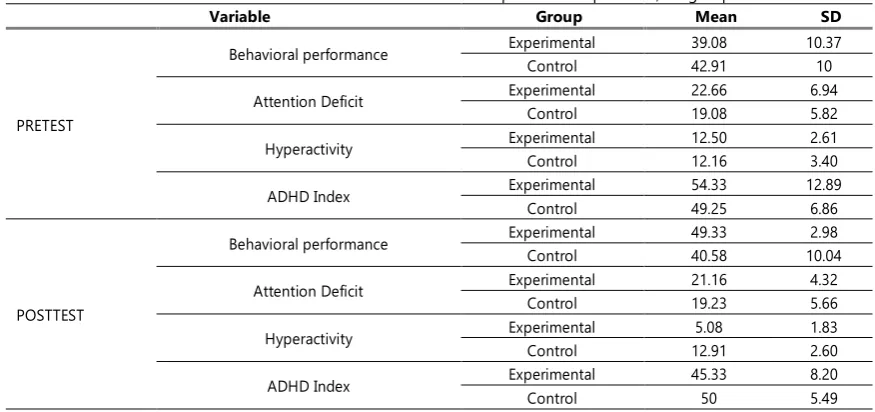
The descriptive results of the study, in either pre-test or post-test is presented for each group in Table 1.
With regards to the design of this study, which has a pre-post-test and control group, analysis of covariance was utilized to analyze the date and to control the pre-test effect. In other words, in order to investigate the effect of behavior parent training on improving behavior problems and reducing the symptoms of ADHD in children, the analysis of covariance was used. The results of each analysis are presented separately in the tables below. This kind of analysis has some assumptions such as the homogeneity of regression slopes between random variables (pre-test) and dependent variables, which in this study the slopes of the regression line in all variables except behavior performance(F=0.453, P< 0.05), were parallel.
In this study, the interaction of group and pre-test for the combined type of attention deficit/hyperactivity disorder (F=0/453, P> 0/05), hyperactivity (F=0.453, P> 0.05), and attention deficit (F=0.453, P>0.05), was not significant. Therefore, one can say that this assumption was met. Homogeneity of variances is one of the other assumptions of this analysis. In order to check the homogeneity of the variances of the two groups in pre-test, post-test and follow-up, the Levene's test was used.
The Levene’s test calculated for the variables are not statistically significant except for the behavior performance (F=0.453, P<0.05), (post-tests; the combined type of attention deficit/hyperactivity disorder (F=0.453, P>0.05), hyperactivity (F=0.453, P>0.05), and attention deficit(F=0.453, P>0.05).Thus, the assumption of homogeneity of variances was also approved. So, with regard to the establishment of the main assumptions of this test, we are permitted to use it.
Table 1. Mean and standard deviation scores in pre-test and post-test, for groups
Variable Group Mean SD
PRETEST
Behavioral performance Experimental 39.08 10.37
Control 42.91 10
Attention Deficit Experimental 22.66 6.94
Control 19.08 5.82
Hyperactivity Experimental 12.50 2.61
Control 12.16 3.40
ADHD Index Experimental 54.33 12.89
Control 49.25 6.86
POSTTEST
Behavioral performance Experimental 49.33 2.98
Control 40.58 10.04
Attention Deficit Experimental 21.16 4.32
Control 19.23 5.66
Hyperactivity Experimental 5.08 1.83
Control 12.91 2.60
ADHD Index Experimental 45.33 8.20
Table2. Descriptive indices of gain score for behavioral performance in experimental and control groups
Group Frequency Mean Standard Deviation
Experimental 12 10.25 11.25
Control 12 2.33 2.53
Table3. Comparison of pre-test and post-test scores in behavioral performance among groups
Group Levene’s test Mean Difference T df Sig
F Sig
Experimental 0.68 0.527 12.55 3.37 22 <0.05
Control
Table5. Results of covariance analysis for ADHD index among experimental and control groups
source Sum of squares df Mean of squares F Sig
Pretest 815.76 1 815.76 66.68 <0.05
Group 330.55 1 330.51 27.02 <0.05
Error 256.90 21 12.23
Total 55734 24
To either approve or reject the first question of the study, the gain score method was used. This was due to the fact that the assumption of the homogeneity of gradients did not meet to allow the use of the covariance test. In the gain score method, the pre-test scores are subtracted from post-test scores and the results of the experimental and control groups are compared using the t-test for the independent groups.
As table 2 shows, the mean score of the experimental group is considerably higher than that of the control group. To examine whether the difference among the two groups was statistically significant, the t-test for the independent groups used.
Table 3 indicates that there is a statistically significant difference between experimental and control groups in behavioral performance scores (P< 0.05 and t= 3.37).
Table 5 indicates that the effect of pre-test on post-test has been statistically significant (F (1, 21) = 66.68 and P<0.05). To examine the effect of group or intervention (behavior modification program training) on the dependent variable (ADHD index), the effect of pre-test, as the covariant factor, should be removed. Results revealed that the effect of group (or intervention) was still statistically significant even after eliminating the effect of the covariant variable (F (1, 21) = 27.02 and P< 0.05). Therefore, one can conclude behavior modification training induced change among the groups.
As mentioned before, to examine the effect of group or intervention (behavior modification training) on the dependent variable (hyperactivity) the effect of pre-test, as the covariant factor, should be omitted. Table 6 indicates that the effect of group or intervention has been significant even after eliminating the effect of the covariant variable (F (1, 21) =69.68 and P<0.05). So, one can say behavior modification training has induced change in groups.
According to table 7, it’s clear that the effect of pre-test has been statistically significant (F (1, 21) = 141.08 and P<0.05). The results indicated the effect of group or intervention has not been statistically significant after the elimination of the effect of the covariant variable (F (1, 21) =0.543 and P<0.470). So one can conclude that the behavior modification program has not induced change in the ‘attention deficit’ variable among the mothers of the experimental group as compared to the mothers of the control group.
Discussion
The findings of this study indicated that providing behavioral trainings for mothers had significantly improved their children’s behavioral performance at home. Many other researchers had also emphasized the effectiveness of training mothers in behavior
Table 6. Results of Covariance Analysis for ‘hyperactivity’ variable in experimental and control groups
source Sum of squares df Mean of squares F Sig
Pretest 2.24 1 2.24 35.63 <0.05
Group 663.67 1 363.67 69.68 <0.05
Error 109.58 21 5.21
Total 2424 24
Table7. Results of Covariance Analysis for ‘attention deficit’ data in experimental and control groups
source Sum of squares Degree of freedom
Mean of squares F ratio Significance level
Pretest 503.61 1 503.62 141.08 <0.05
Group 1.937 1 1.937 0.543 0.470
Error 74.963 21 3.57
modification strategies for bringing about improvements in their children’s behavioral performance, in advance[12, 16, 32, 33]. The effectiveness of such trainings for improving behavioral performance among children can be attributed to the following reasons:
As many of the problem behaviors of children with ADHD are rooted in their interactions with parents (especially mothers) which in turn helps these problems persist over time, having trained the correct ways of how-to-behave to mothers of such children- with whom these children spend their time more than anyone else- as well as having provided a consistent principle of reinforcement and punishment, might have decreased the likelihood of undesirable behaviors in these children. Training attention skills, which also implies inducing changes in the way mothers pay attention to their children and which are among the most important factors for shaping children’s behaviors, also might have fostered more adaptive behaviors in these children. Training beneficial attention skills, such as listening and positive attention skills, during the therapy, might have created the opportunity for mothers to learn how to pay attention to their children without interrupting and asking questions and to learn how they can instill desirable behaviors which they wish their children to increase or continue to have through positive statements. As it has been observed, many of these children’s mothers turn to punitive and aggressive parenting styles in order to manage adverse behaviors accompanying the disorder. This is why it can be argued that training mothers in such skills can have important implications regarding the improvement of children’s behavioral performance at home.
Another finding of the study was that training mothers had been effective for reducing hyperactivity and the ADHD index among their children. This is in line with the results from many other researchers [11, 33].
These trainings focus on the interaction between mothers and their children with the underlying assumption that the child’s mood and mother’s behavior influence each other in an interactive fashion. For example when the mother feels her attempts to bring the child’s aggressive behavior under control is far from successful, she may think her efforts are in vain and her child will never change. Such feelings will most probably influence the parent-child dyadic relationship and may make the mother, on the one hand, to cease her attempts to change the child’s misbehaviors, and the child to resort to ever-increasing misbehaviors. However, providing such trainings for mothers will decrease these type of disappointments in them paving the way for further effectiveness of behavioral interventions. For instance, the ‘behavior description’ skill, which is one of the skills taught at the ‘praise and positive attention’ session, helps parents express the exact behavior they expect of their children in a specific way and, more to that, tells children how exactly they ought to behave to gain rewards. In addition, prior to the didactic sessions, mothers’ punitive measures were inconsistent, inefficient
and in most cases, irrelevant to the child’s misbehavior, and mothers most probably used physical punishment and punishments inappropriate to the child’s developmental level to control his/her misbehaviors. In group sessions, mothers having been warned against the adverse effects of physical punishment and its long-lasting negative outcomes in the child’s future life were instructed correct ways of punishment as well as how to make use of it in order to shape behaviors.
As mentioned earlier, results indicated behavior modification training had not been successful for reducing attention deficit among children with ADHD. This confirms the findings from the other studies suggesting the ineffectiveness of behavioral trainings for reducing inattention among these children [23]. One explanation for this finding could be that inattention, in comparison to other behavioral problems, is more resistant to change against behavioral trainings because of its more biological roots [34]. Evidence attesting to this claim comes from twin studies emphasizing the role of genetic factors in the etiology of attention deficit and its fluctuations. Moreover, researchers say most of the cognitive problems in these children are due to the malfunction of prefrontal cortex. A claim that is corroborated when it is observed stimulant medications such as methylphenidate are effective for treating the disorder, improve the functioning of prefrontal cortex and enhance the efficacy of attention and working memory in these children [14]. The latter findings of the study was inconsistent with some other research studies [11, 32]. This contradiction could result from participants’ motivations and their mental health. It seems training modification strategies to parents identified at schools and to parents who voluntarily refer to clinical centers could yield different results.
Conclusion
Methodological limitations of this study (such as quasi-experimental nature of the study, instruments used and the sampling) hinder generalization of the results to other methods and instruments. Accordingly it is suggested that these limitations get abolished in future studies and other individuals who are in close contact with children, including their fathers and teachers, be incorporated into training sessions so that the problems of these children are better identified and more effectively measured in order to get adopted to alleviate them.
References
1. American, Psychiatric, Association. Diagnostic and statiscal manual of mental disorder: DSM-5. — 5th ed. Washington, DC: American Psychiatric Association2013.
2. Bussing R, Zima B, Mason D, Meyer J. ADHD Knowledge, Perceptions, and Information Sources: Perspectives From a Community Sample of Adolescents and Their Parents. J Adolesc Health. 2012;8:222-30.
3. Willcutt E. The Prevalence of DSM-IV Attention-Deficit/Hyperactivity Disorder: A Meta-Analytic Review. Neurother. 2012;9:490–9.
handbook for diagnosis and treatment (3rdEds.), editor. New York: Guilford Press; 2006.
5. Johnston C. Parenting in adults with attention-deficit/hyperactivity disorder (ADHD). Clin Psychol Rev. 2012;32:215-28.
6. Whalen C, Henker B, Jamner L, Ishikawa S, Floro J, Swindle R. Toward mapping daily challenges of living with ADHD: Maternal and child perspectives using electronic diaries. J Abnorm Child Psychol. 2006;34:115-30.
7. Essau C. Child and Adolescent Psychopathology. New york: Routledge Taylor and francis group. 2006.
8. Fabiano G, Pelham W, Coles E, Gnagy E, Chornis-Tuscano A, OConnor B. A meta-analysis of behavior treatment for attention-deficit /hyperactivity disorder. Clin Psychol Rev. 2008;52:1-12.
9. Johnston C, Jassy J. Attention deficit hyperactivity disorder and oppositional/conduct problem: Link to parent –child interaction. J Canadian Academ Child and Adolesc Psychiatr. 2007;16:74-9.
10. Rogers M, Wiener J, Marton I, Tannock R. Parental involvement in children's learning: Comparing parents of children with and without Attention-Deficit/Hyperactivity Disorder (ADHD). J School Psychol. 2009;47:167-85. 11. Huang H, Chao C, Tu C, Yang P. Behavior Parent training for
Taiwanese parent of children with attention-deficit hyperactivity disorder. Psychiatr Clin Neurosci. 2003;57:275-81.
12. Fabino G, Chacko A, Pelham J, Robb J, Walker K, Arnold F, et al. A comparision of behavior parent training programs for fathers of children with attention-deficit / hyperactivity disorder J Behav Ther. 2008;3:29-48.
13. Nixon R. Treatment of behavior problems in preschoolers: Areview of parent training program. Clin Psychol Rev. 2002;22:525-46.
14. Schroeder C, Gordon B. Assessment and Treatment of Childhood Problems: A Clinician's Guide. New York: Guilford Press; 2002.
15. Barkley R. Taking Charge of ADHD:The Complete, Authoritative Guide for Parents(rev.ed.). New York: Guilford Press; 2000.
16. Hauth-Charlier S, Clement C. Behavioral Parent Training Programs for Parents of Children with ADHD: Practical Consideration and cilinical impilication. Pract Psychol. 2009;15:223-34.
17. Kutcher S, Aman M, Brooks S, Buitelaar J, dalen EV. International consensus on attention-deficit / hyperactivity disorder (ADHD) and disruptive behavior disorder (DBDs): Clinical impilication and treatment practice suggestion. Eur Neuropsychophamacol. 2004;14:11-28.
18. Carr A. The Handbook Of Child and Adolescent Clinical Psychology a Contextual Approach (2nd Ed). New York: Routledge Taylor and Francis group2006.
19. Anastopoulos A, Shaffer S. Attention Deficit/Hyperactivity Disorder. Inc. Eugend walker and Michael, C. Roberts (2001). Handbook of Clinical child Psychiatry. Canada: John Wiley and sons. 2001.
20. Gerdes A, HaackL M, Schneider B. Parental Functioning in Families of Children With ADHD: Evidence for Behavioral Parent Training and Importance of Clinically Meaningful Change. J Attention Disord. 2010;16(2):147-56.
21. Greenhill L, Osman B. Ritalin: Theory and practice. USA: Mary Ann Libert.2000.
22. Semple D, Mash E, Ninowski J, Benzies K. The relation between maternal symptoms of attention-deficit/hyperactivity disorder and mother-infant interaction. J Child Fam Stud. 2011;20:460-72.
23. Weinberg A. Parent training for Attention-deficit hyperactivity disorder: Parent and child outcome. J Clin Psychol. 1999;55(2):907-13.
24. Matos M, Bauermeister J, Bernal G. Parent-child interaction therapy for puerto rican preschool children with ADHD and behavior problems: A pilot efficacy study. Fam Process. 2009;48:233-52.
25. Gall J, Gall M, Borg W. Educational Research: An Introduction (8th Edition) New York. 2010.
26. Conners C, Parker J, Sitarenios A, Epstein J. The Revised Conners’ Parent Rating Scale (CPRS-R):Factor structure, reliability, and criterion validity. J Abnorm Child Psychol. 1998;26:257-68.
27. Goldstein S, Goldstein M. Managing attention deficit hyperactivity disorder in children: A guide for Practioner (2nd ed). New York: Wiley1998.
28. Bjork M, Sand T, Brathen G. Quantitative EEG finding in patients with acute, brief depression psychiatric symptoms: A controlled study from an acute psychiatric department. BMC Psychiatr. 2008;8:22-231.
29. Chabot R, Dimichelr F, Prichep L. The Clinical Role of Computerized EEG In Evaluation And Treatment of Learning And Attention Disorders In Children And Adolescents. J Clin Neuropsychiatr. 2001;13:171-86.
30. Murray D, Bussing R, Fernandez M, W Hou, CW Garvan, Swanson J, Eyberg S. Psychometric properties of teacher SKAMP ratings from a community sample. Asses. 2009;16:193-208.
31. Barkley R. Defiant Children: A Clinician’s Manual for Assessment and Parent training, 2nd edn. Guilford, New York1997.
32. Danforth J, Harvey E, Ulaszek W, Mckee T. The outcome of group parent training for families of children with attention deficit hyper activity disorder and defiant aggression behavior. J Behav Ther Experiment Psychiatr. 2006;37:188-205. 33. LaForett D, Murray D, Kollins S. Psychosocial treatments for
preschool-aged children with attention-deficit hyperactivity disorder. Dev Disabil Res Rev. 2008;14:300-10.