Iranian journal of educational Sociology
(Interdisciplinary Journal of Education)Available online at: http://www.iase-idje.ir/
Volume 2, Number 1, March2019
Analyzing ethical sensitivity: developing on student-teacher
education
Habib Kavandi1, Mansour Marashi2,Jalal Hashemi3, Massoud Safaei Moghaddam4
1. Ph.D. candidate philosophy of education of Shahid Chamran University of Ahvaz, Ahvaz, Iran. 2.Associate professor of Shahid Chamran University of Ahvaz, Ahvaz, Iran.
3.Assistant professor of Shahid Chamran University of Ahvaz, Ahvaz, Iran. 4.professor of Shahid Chamran University of Ahvaz, Ahvaz, Iran
Article history:
Received date: 20 October 2019 Review date: 19 November 2019 Accepted date: 24 November 2019
Abstract
Purpose: The purpose of this study was to identify the concept of ethical sensitivity as an essential component of ethical decision making and provide solutions for teacher students education in order to develop ethical sensitivity. Methodology: This was a fundamental descriptive correlational method. In this study, concept analysis method was used. In this regard, first the preconditions and characteristics of ethical sensitivity, with emphasis on Weaver's studies (2005) was explained, and then, based on these preconditions and attributes, some approaches were presented to develop the teacher students’ education on ethical sensitivity. Findings: Regarding the analysis of ethical sensitivity through the research backgrounds, it can be stated that the purpose of the education and development of this concept is to assist students in accepting and analyzing the views of students, answering them, identifying and interpreting ethical issues, and finally, justify, reflex and anticipate the consequences of its ethical actions, and using methods that are effective in maintaining the student's personality coherence. Conclusion: ethical sensitivity and explaining the methods to develop it on student-teacher education can lead to the behavioral contradiction of the educators and lead to less emphasis of ethical sensitivity among the educators.
Keywords:
ethical sensitivity, student-teacher education.
Please cite this article as: Kavandi H, Marashi M,Hashemi J, Safaei M. (2019). Analyzing ethical sensitivity: developing on
student-teacher education. Iranian journal of educational Sociology. 2(1):134-142.
Corresponding Author Email:[email protected]
1. Introduction
"Ethics", along with traditions, customs, habits and laws and even beyond them, is one of the important factors regulating social life, so that no society can ensure its survival for a long time without ethics Historical accumulated experiences of humankind suggest is far from the item of ethics and its endeavors will suffer irrevocable damage. Thus, thoughtful people and all human societies have always strived for theoretical and practical work of ethics and have tolerated heavy costs (Najarzadegan, 2009: 5). There are many definitions in relation to ethics, but the term “ethics” is means the way of prosperity of a society in the moralization of the human beings of that society (Ahangari, 2007: 12). In fact, morality is defined as a set of internal and spiritual traits of man, which manifests itself as acts and behaviors that arise from the inner mood of mankind (Izadi & et al., 2013: 44). Ethics philosophy is an attempt to achieve a systematic understanding of the nature of morality and what ethics asks of us. The domain of morality is one of the most important and most dynamic philosophical spheres of contemporary era, and this importance above all is based on learning and generality. All people, regardless of the way of life they choose, find a relation to morality. Hence, ethics is one of the components of everyday life, and the general public is involved in it, and the lack of observing some ethical standards raises concerns at the community level (Peikani, 2013: 129).
Ethical decision making refers to the decision-making process in order to identify the issues by analyzing them according to the ethical standard and the decision to do so based on ethical standards (Hassan Pour & et al., 2011: 58). Based on Kolberg’s ethical development theory, ethical decision making involves four components of ethical sensitivity, ethical judgment, ethical motivation and ethical character. Hence, ethical sensitivity is considered as the first element in the process of moral action (Narvaez, Rest & Thoma, 2000; quoted by Imanifar & et al., 2015). Ethical sensitivity can be described as "attention" to the ethical values in an accumulated situation of conflict and self-awareness of the role and position of self in that position (Lutzen, Dahlqvist, Eriksson & Norberg, 2006). This concept means ethical understanding and ethical concerns and interests. Accordingly, a person must be able to distinguish between the right and the wrong, to have this concern and think about it or to discuss with others (Ersoy & Gundogmus, 2003; quoted by Sajjadiyeh, 2015: 97).
In the last decade, attention has also been paid to ethical sensitivity in relation to formal education. In this regard, we can refer to Ebrahimi (2015), Ebrahimi (2013), Gholami & Ebrahimi (2015), chughtai, Jamil & mahboob (2019), Schutte (2017), Nadaraja & Mustafa (2017) researches who agree about the development of theoretical and empirical knowledge of ethical principles and ethical sensitivity among educators and educational managers and surrounding group. In recent years, many scholars have emphasized the existence of an ethical crisis and the need for ethical education in society. Ghaneirad (2014), head of the Iranian Sociological Association, says that the first problem of our society is the ethics issue; Khaniki (2014) believes that the Iranian society faces various levels of crisis and moral corruption, and Farastkhah in the book "We Iranians" writes that various aspects of ethics in the Iranian society are weak and unacceptable (Farastkhah, 2014).
As it was said, it is imperative to address ethical sensitivity and ethics education. In order to be able to educate people who have a strong moral sense to certain situations, ethical education can play a more crucial role. In other words, it can be said that ethical education is performed to make people morally bound and perform moral acts; hence the growth of ethical sensitivity and moral perception refers to the nature of moral education. Often, moral education focuses on teaching freedom, fairness, salvation, and public well-being of others, respect for belief and truth-seeking. In ethics training, family, education, and the media can be more effective than other institutions. This research will emphasize the role of the educational institution. The teaching of ethical virtues to bring man to personal salvation and social welfare is of great importance and the intellectual and ethical development of human beings is actualized based on education and one of the pioneers in this regard is education (Farhud, 2011:3).
One of the special missions of education is ethical development and virtue cultivation in learners; hence, one of the main goals of educating the educator is to train educators who are equipped with ethical sensitivity as an essential component of ethical decision making and apply it in their own teaching philosophy by which they can educate ethical students (Ebrahimi, 2013: 4). In this regard, the present study aims to analyze the concept of "ethical sensitivity", guidelines and educational interventions to develop ethical sensitivity among teacher education students using analytical research method and approach and be inspired of Weawer studies (2016). And this will lead to the ethical growth of students.
2. Methodology
The current research is fundamental and applies on the basis of the goal and it is descriptive and survey which is done through semi - structured deep interview. Ahvaz high school teachers were selected as the population of the study and 20 people were selected as the specialist through using Snowball sampling. Content analysis was employed to organize and categorize the content of the interview.
3. Findings
ethical sensitivity can be considered as a combination of the term ethics and sensitivity. From this perspective, it should be noted that each of these terms plays a role in this conceptual composition. The analysis of this role can be done by examining Weawer (2005) definition of ethical sensitivity. Accordingly, the placement of the term "sensitivity" along with ethics means that it makes ethical action dependent upon a type of competence, the competition that is acquired like other types of sensitivities. Accordingly, using the term "sensitivity" in this combination indicates the ability to grow the precondition skills of ethical behavior. Later, we will examine two concepts of ethics and ethical sensitivity.
Analyze the concept of ethics: Another important aspect of ethical sensitivity is the concept of ethics. Different ethical approaches have given different definitions of it, taking into account different meanings for morality. Despite this difference, there are specific conceptual components in the concept of ethics that is used as position of different approaches. The first conceptual component is of ethics is rule or value. Without a rule or value, ethics is not meaningful because it is considered an ethical affair which is done based on special rule or value. Another notion of ethics is human action. Ethics is meaningless without considering man and his actions. Therefore, this is a human act that is attributed to its ethical or non-ethical nature, and wherever we discuss about ethics, human action is considered. The current concept in ethics is a combination of the conceptual component of human action. The way of different viewpoints of human action and how it is explained will create differences in their explanation of ethical action. For example, when human action from the point of view of behaviorism is reduced to conditional behavior and seen in this form, its requirements are highlighted in ethical education, and sometimes when human intention and its determination in the process of action are considered, his choices are considered to be important from ethical aspects. Hence, the relationship between human action with him is one of the conceptual issues below this concept. A discussion of the institutionalization of morality and ethical traits in human actions can be considered from this perspective. Another aspect of human action, is the effects created in surrounding environment. This environment is either human or non-human. The acts evaluation from its aspect is one of the components of human action that can be considered in ethics issue (Sajjadiyeh, 2015: 94).
It should be noted that the extension of the concept of ethics and its related discussion makes its conceptual-logical analysis with difficulty because the variety of components discussed in different perspectives makes finding the main components as challenging. At the same time, the review of literature on ethical sensitivity shows the adequacy of this analysis. Thus, the constructive components of ethics, as shown in the figure, are related to each other. The structure of the concept of ethical sensitivity: The structure of the concept of ethical sensitivity in this study is analyzed by analyzing the following components: definitions, preconditions and characteristics. Definition: Ethical sensitivity has a futuristic view, and
collective well-being is at the center of its attention (Baron, 1991) and is organized in order to prevent injury to others, loyalty and commitment (Procario-Foley & McLaughlin, 2003).
Ethical sensitivity in people is not all or nothing (yes and no), but it follows a process or continuum in varying degrees, because its components of knowledge and skill grow through action, study, and education, so over the time, the expert becomes sensitive ethically (Baldwin & Bunch, 2000). The attitude that ethical sensitivity is an intrinsic and acquired phenomenon is verified by Weaver (2005) finding that ethical sensitivity has a composite core consisting of inherent affection and acquired components of knowledge, perception, skill, and responsibility. According to researchers in the field of psychology, the cognitive-perceptual component of ethical sensitivity can be enhanced. For example, a person who only sees an image in an obscure form can be guided toward seeing another (Kyte, 1996). Ethical sensitivity can first be mitigated by environmental factors, including socialization, psychotherapy, and human transformation and then it is developed. However, the study of the literature suggests a lack of consensus on the definition of the concept of ethical sensitivity. Weaver (2005) studies have helped to summarize, categorize and integrate various definitions of this concept. According to Weaver, four aspects of ethical sensitivity are more complex among the various definitions of other definitions. First, ethical sensitivity is an emotional aspect of care that focuses on compassion and values of altruism, tolerance, and in general among all humans (as a process that has severity and weakness). Second, ethical sensitivity is an aspect of decision-making, which involves understanding, interpreting the ethical load of a situation. Third, ethical sensitivity is a means of obtaining a more complete understanding of a given position. Fourth, ethical sensitivity is a duty that is preceded by the responsible person’s agency. Accordingly, the following consolidated definition of ethical sensitivity in professional practice is suggested:
The ethical sensitivity of decision-making and wise and compassionate action in the midst of uncertainty is a given careful position, and also includes the ability to predict the consequences of decisions and rely on courage. The circumstances in which their presence is necessary for the formation of the concept or the behavior that distinguishes the occurrence of created attributes. Ethical sensitivity in professional practice requires an uncertainty surrounding from the specialist and being exposed to the suffering cues of patient. Relations between professionals and clients must have the distinctive attributes of receptivity, responsiveness and courage. Receptivity means accepting the views of others. Receptivity means that the specialist can accept the views of many other people even outside of his culture and analyze it with tolerance (Ebrahimi, 2015: 31). Receptivity requires suspension of judgment in order to avoid being caught up in inadequate and wrong ideas (Holland, 1998).
Responsiveness is one’s commitment to respond to what he is doing (Rashidpour & Rahimi Kia, 2005: 23). In fact, Responsiveness is a sense of responsibility in relation to the effects of its actions or its possible actions (Rest, 1986). Ethical courage is to act in accordance with morals and values, without any fear that is, to overcome fear and adhere to values, that is, to act correctly in the face of ethical challenges (Lachman, 2007: 131-133). Thus, it can be stated that courage can be a component of choice; as, one must accept responsibility for the consequences of his or her behavior. From another view, ethical courage can be considered as an essential characteristic of ethical behavior of teachers and experts in dealing with clients.
Table 1. Training ethical sensitivity based on its preconditions (inspired by Weawer & Mitcham, 2016)
Preconditions Interventions
Suffering and vulnerability cues
Discussions about personal, local, national and international ethical examples to inform students of interpersonal, racial, ethnic, and international differences.
Highlighting the social, cultural and value context of students' living environment. Providing strategies for future educators who can identify student problems and learning. Educate the research action approach to the education teachers to discern and treat the personality and educational problems of students.
Receptivity Expose to other cultures, life experiences, and histories.
Group activities enhancing tolerance, having a concern for social justice and respect for differences in order to increase the tolerance of teachers with their students in the future.
Talk about different learning methods and techniques to develop skills and attitudes that lead to collaboration and social responsibility.
Developing listening skills, analyzing and criticizing educators in order to understand, focus and address the needs and concerns of students.
Responsiveness Emphasize the rights and responsibilities of man towards others and job commitments by teaching role teaching techniques to teacher education students in order to be accountable to the students' academic and ethical issues and challenges.
Use of educational opportunities for moral education to raise awareness of ethical issues and build leadership capability among future educational teachers.
Courage Emphasis on the acceptance of the results of professional behavior of teachers in dealing with students.
Support of teachers in order to prefer the benefits of students to their own benefits and that of organization.
Emphasize on the components of selection, responsibility and the presentation of educational services.
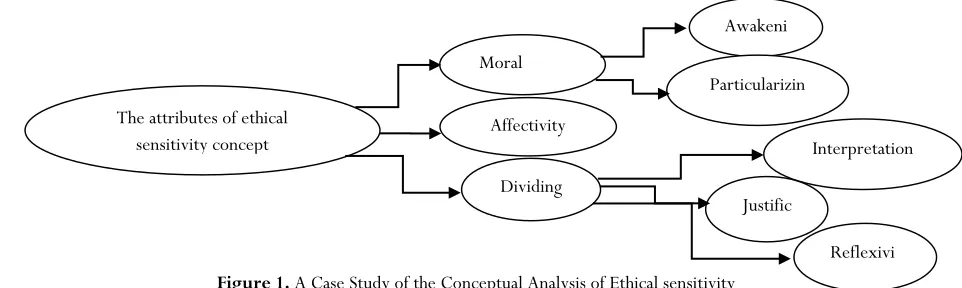
In this section, the main attributes of ethical sensitivity: moral perception, affectivity, and dividing loyalties, including interpretation, justification, and reflection are explained in details.
Figure 1. A Case Study of the Conceptual Analysis of Ethical sensitivity
Awakening is the beginning of an awareness of the ethical nature of a problem. Since awakening depends on something outside theoretical knowledge of the individual and is also self-referential, it can thus be said that awakening is the spontaneous recognition of the moral nature of a problem (Weaver, 2005). Detection of a particular ethical concern in a given position involves perceptual processing of suffering and vulnerability cues. Particularizing is influenced by the clarity of the signs, resources availability, and individual differences in motivation, maturity and experience (Weaver, 2005). An individual trait that causes people to experience different emotional responses in similar situations (Rezaian and Naji, 2009: 51). In fact, it can be stated that affectivity is spontaneous and manifested response to another (Nortvedt, 2003: 226). Interpreting means context-based translation. Interpretation allows for a complete understanding of what is happening in a
Awakeni ng
The attributes of ethical
sensitivity concept Interpretation
Reflexivi ty Dividing
loyaltie s
Moral
perceptio n
Justific ation
Particularizin g Affectivity
situation to verify or reject moral perception. Interpretation may include the conversation between a teacher and a student to examine the difference between what is happening in a situation and what is to be expected (Lerman, 1998). justification means comparing the necessities of a given position with external criteria in order to determine legitimacy. Justifying also means adopting a position that "is adequately close to different positions so that different groups are considered justified" (Norman, 2000: 133).
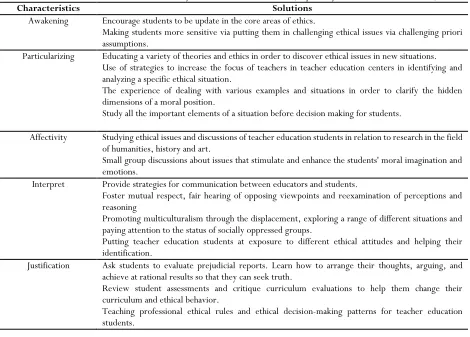
Experts use rethinking to determine their role of care and service. This involves turning itself into an object of interest, in order to distinguish between its motivations, prejudices and preconceptions. In rethinking process, goals, commitments and personal ideals are compared with the needs of a more general position and humanity (Hawkins, 2001). Rethinking helps the experts to correct errors and deficiencies in their knowledge via providing the re-perception of situations and considering the details that are not recognized. Rethinking is lateral thinking process, flexibility and seeking to provide one or more strategies that allow professionals and teachers to be aware of the meaning and interpretation of their work (Peerson, Yong, 2003). The process of reflexivity is at its peak when facing moral challenge; the instructor can boldly make an ethical decision. Finally, it can be stated that continuous re-thinking; make educators sensitive to ethical issues and easier to understand and make decisions more stable. With regard to the attributes of the concept of ethical sensitivity, it can be stated that these attributes are on a continuum behind each other. In fact, it can be stated that until awakening is not created in the teacher, it will not be promoted to particularizing stage. So, in order to rethink for a teacher, he must go through the stages of awakening, particularizing, affectivity, interpretation, and finally justification. As it was said, and explaining the attributes of ethical sensitivity, some strategies are proposed to develop the education of ethical sensitivity among teacher’s education students.
Table 2. The education of ethical sensitivity based on its basic attributes (inspired by Weawer &Mitcham, 2016)
Characteristics Solutions
Awakening Encourage students to be update in the core areas of ethics.
Making students more sensitive via putting them in challenging ethical issues via challenging priori assumptions.
Particularizing Educating a variety of theories and ethics in order to discover ethical issues in new situations. Use of strategies to increase the focus of teachers in teacher education centers in identifying and analyzing a specific ethical situation.
The experience of dealing with various examples and situations in order to clarify the hidden dimensions of a moral position.
Study all the important elements of a situation before decision making for students.
Affectivity Studying ethical issues and discussions of teacher education students in relation to research in the field of humanities, history and art.
Small group discussions about issues that stimulate and enhance the students' moral imagination and emotions.
Interpret Provide strategies for communication between educators and students.
Foster mutual respect, fair hearing of opposing viewpoints and reexamination of perceptions and reasoning
Promoting multiculturalism through the displacement, exploring a range of different situations and paying attention to the status of socially oppressed groups.
Putting teacher education students at exposure to different ethical attitudes and helping their identification.
Justification Ask students to evaluate prejudicial reports. Learn how to arrange their thoughts, arguing, and achieve at rational results so that they can seek truth.
Review student assessments and critique curriculum evaluations to help them change their curriculum and ethical behavior.
Teaching professional ethical rules and ethical decision-making patterns for teacher education students.
Group activities and experimental learning activities (such as scenarios and case studies). Reflexivity Individual and collective processing of ethical issues and humanities.
Reporting from different aspects of a moral position and its criticism to strengthen reflexivity skills. Strengthen the students' thinking power in teacher training centers using Brain storming techniques.
4. Discussion
Regarding the analysis of the concept of ethical sensitivity through the study of the review of literature, it can be stated that the purpose of the education and development of this concept is to assist students in accepting and analyzing the views of students, answering them, identifying and interpreting ethical issues, and Finally, justify, reflex and foresee the consequences of its ethical actions, and take advantage of methods that are effective in maintaining the student's personality coherence(Jafari Sani, Keshavarzi, Seadatee Shamir ,2017). Utilizing the proposed educational strategies, the future educator is enabled to consider the ethical components of a situation and the necessity of action based on conscious judgment. One of the ways in which the future educator is assisted is that he is get rid of universal principles such as social, personal, and kinship traditions and is instead involved in the details of a definite moral situation (Marzi , Seadatee Shamir ,2019).
Regarding what has been considered on in the analysis of the concepts of the growth of educational ethical sensitivity, it can be stated that the formal institution of educating educators by developing small and large groups of discussions, using various teaching methods such as role play, brainstorming, and action research can increase the awareness and recognition of educators from a moral position and increase their patience and tolerance in confronting diverse and opposing views towards fostering the morale of social justice can have great impact.
This will be internalized through the emphasis on the growth of skills such as listening, analyzing and criticizing ethical situations, and paying attention and respect to the discovery of individual differences within the future educators. The above guidelines can lead to the training of educators for analyzing moral situations, thereby helping to identify ethical issues and awareness of their values and students; hence the need for education of education educators is emphasized for responsible, ethical and respectful service for students by respecting them. Educational educators should interact with students through justice and fairness, timely feedback and respect for their relationships with students (seadatee Shamir A, Mazboohi, MARZI. (2019). In another view, educating future educators in the development of ethical sensitivity requires that educators have the necessary skills to facilitate discussion and encourage future educators to group activities such as false play and fiction writing (Seadatee Shamir, Sanee’I Hamzanlouyi (2017). Also, formal education institutions can teach professional ethics rules and explain ethical decision-making patterns to reinforce ethical arguments and discover moral situations, or seek truth (Seadatee Shamir, Tahergholami, Jalai, 2017). This is possible by stimulating imagination and moral feelings, as well as disrupting societal, cultural and individual beliefs marginalizing them can be possible by which the educators can process and reflex ethical issues.
Those who play the role of teaching ethical sensitivity to teacher education students should have the necessary competencies to facilitate students' education (Seadatee Shamir, Kiamanesh, Kadivar, Hamidi, 2010) therefore, it is recommended that educators, intellectual ability, ability to analyze and master technical and methodological approaches to develop this concept among the students and the relevant organization should be careful in choosing these experts (Seadatee Shamir, Mazbohi, 2018).One of the issues that, in turn, can jeopardize the development and teaching of ethical sensitivity in teacher according to many researcher’s education (Taheri, dortaj, delavar, Seadatee Shamir,2019; Tanhaye Reshvanloo, keramati, Seadatee Shamir ,2016) (future educators) is that in practice it is possible to make contradiction between the training practices mentioned in Tables 1 and 2 and the general system missions. This contradiction can be created by emphasizing of the educational system on the technical issues that educators have to enforce it. The existence of competition morale between students, the classification of students in the "smart and
lazy" categories and such terms can make an educator blind to the concerns of all students. Also implicit acceptance and deliberate tolerance of fraud in the provision of school reports to regional education as well as district education to the provincial Education Directorate and mechanization of the education process can make this ethical sensitivity less important (Seadatee Shamir, Najmi, Rezaiee Haghshenas,2018). Hence, such issues can lead to the behavioral contradiction of the educators and lead to less emphasis of ethical sensitivity among the educators.
References
Ahangari F. (2007). History and fundamentals of ethics in Iran and the World. Ethics in Science and Technology; 2(34): 11-22. [In Persian].
Baldwin D C, Bunch W H. (2000). Moral reasoning, professionalism, and the teaching of ethics to orthopedic surgeons. Clinical Orthopedics & Related Research, 2(378): 97-103.
Baron M. (1991). Impartiality and friendship. Ethics, 101: 836-857.
Chughtai M, Jamil B, Mahboob U. (2019). Developing and validating a questionnaire to Measure Ethical Sensitivity of Freshly Graduated Dentists: Journal of the Pakistan Medical Association. 69(4):518-522.
Ebrahimi I. (2013). Preparing and fit a model for the study of ethical sensitivity and its relationship with the teaching of the teachers of the city of Kamyaran. Faculty of Humanities and Social Sciences of Kurdistan University. [in Persian].
Ebrahimi S. (2015). Investigating the predictors of ethical sensitivity in primary school teachers in Sanandaj. Faculty of Humanities and Social Sciences of Kurdistan University. Ethical sensibility. Nursing Philosophy: 4(3): 222-230. [in Persian].
Farastkhah M. (2014). We Iranians (historical and social backgrounds of Iranian moods). Tehran: Ney Publishing. [in Persian]. Farhud D. (2011). Ethics education. Journal of Ethics in Science and Technology, 6(3): 1-6. [in Persian].
Ghaneirad M A. (2014). Meeting of the Professional Ethics of Science in Iran, attended by Sadegh Ainvand, Hadi Khaniki, Dariush Farhud and Mohammad Amin Ghaneirad.
Gholami K, Ebrahimi I. (2015). Designing an Ethical Sensitivity Model and its Relationship with Teaching Teachers. Ethics in science and technology. 12(2): 85-94. [in Persian].
Hawkins G. (2001). The ethics of television. International Journal of Cultural Studies. 4(2): 14-19. Holland M G. (1998). Touching the weights: Moral perception and attention.
Imanifar N, Vaghar Seydin A, Afshar L, Sharifzadeh G R. (2015). Comparison of the effect of teaching ethics to ethical narrative and lecture on ethical sensitivity of nurses. Medical ethics. 9(12): 95-125. [in Persian].
Izadi A, Imani E, Khademi Z, Asadi Noqabi F, et all. (2013). Nurses' moral correlations with their caring behavior. Ethics and Medical History. 6(2): 43-56. [in Persian].
Khaniki H. (2014). Meeting of the Professional Ethics of Science in Iran, attended by Sadegh Ainvand, Hadi Khaniki, Dariush Farhud and Mohammad Amin Ghanaian. Reflected on Iranian Society site, available at http://jameeirani.ir/.
Kyte R. (1996). Moral reasoning as perception: A reading of Carol Gilligan. Hypanthia. 11(3): 97-113. Lachman V. (2007). Moral Courage: A Virtue in need development? Measure Nursing. 16(2): 131-133.
Lerman L G. (1998). Teaching moral perception and moral judgment in legal ethics courses: A dialogue about goals. William & Mary Law Review. 3(9): 457-487.
Lutzen K, Dahlqvist V, Eriksson S, Norberg A. (2006). Developing the concept of sensitivity in health.Nursing Ethics. 13 (2): l0-16.
Nadaraja S R, Mustafa M. (2017). Ethical Sensitivity of Accounting Students: Evidence from Malaysia. International Review of Management and Marketing. 7(1): 373-378.
Najarzadegan F. (2009). Approach to Ethics and Islamic Education. Tehran: Ma'aref Publishing. [in Persian]. Norman R. (2000). Applied ethics: What is applied to what? Utilities. 12(2): 119-136.
Nortvedt P. (2003). Subjectivity and vulnerability: Reflections on the foundation of ethical sensibility. Nursing Philosophy: 4: 222-230.
Peerson A, Yong V. (2003). Reflexivity in nursing: Where is the patient? Where is the nurse? The Australian Journal of Holistic Nursing: 10: 30-45.
Peikani J. (2013). From folk ethics to ethics philosophy. metaphysics. The fifth year, 16: 129-142. [in Persian].
Procario-Foley E G, McLaughlin M T. (2003). A propaedeutic for a framework: Professions Education. British Journal of Education, Society Research. 2(378): 97-103.
Rashidpour A, Rahimi Kia A. (2005). Accountability and Government. Magazine Tadbir. 160: 22-25. [in Persian]. Rest J. (1986). Moral development: Advances in research and theory. New York: Praeger.
Rezaian A, Naji M J. (2009). Excitement and Personality Effects on Job Satisfaction. Management perspective. No. 33 Pages 49-66. [in Persian].
Sajjadiyeh N. (2015). A Review of the Ethical Literacy Approach from the Human Functional Point of View. Magazine Basics of Education. 5(2): 88-109.[in Persian].
Schutte I. (2017). Ethical sensitivity and developing global civic engagement in undergraduate honors students. ter verkrijging van de graad van doctor aan de Universities voor Humanities te Utrecht op gezag van de Rector Magnetics, prof. teaching of ethics to orthopedic surgeons. Clinical Orthopedics & Related.
Weawer k, Mitcham C. (2016). Prospects for Developing Ethical Sensitivity in Nursing, Engineering, and Other Technical Professions Education. British Journal of Education, Society & Behavioral Science. 18(2): 1-18.
Weawer K. (2005). Analysis of the Concept of Ethical Sensitivity. A Thesis Submitted to the Faculty of Graduate Studies and Research in Partial Fulfillment of the Requirements for the Degree of Doctor of Philosophy. Faculty of Nursing Edmonton, Alberta, Canada.
Hassan pour F, Dortaj F, bagheri F, Seadatee Shamir A. (2011) The Effectiveness of Teaching Academic Engagement on psychological Capital Female Students Secondary School. Journal of Instruction and Evaluation. 12(46), 123-140. [In Persian]. Jafari Sani S, Keshavarzi Z, Seadatee Shamir A. (2017). The effects of train composition with brain learning approach based on the
Educational self-efficacy and written ability of students. Iranian journal of educational sociology, 1(3), 56-65. [In Persian]. Marzi S, Seadatee Shamir A. (2019). The Role of Self-efficacy and Happiness in Predicting Self-criticism/reassurance among
Teachers. frooyesh.; 8 (5) :153-162. [In Persian].
Seadatee Shamir A, Mazboohi S. (2019). A confirmatory factor analysis and validation of the forms of self-criticism/reassurance scale among teachers. Quarterly journal of Educational Measurement, 9(34), 133-147. [In Persian].
Seadatee Shamir A, Kiamanesh A, Kadivar P, Ali Hamidi M. (2010). Working memory, reading performance and academic achievement in male monolingual and bilingual students. Educational Innovations, 9(3), 89-124. [in Persian].
Seadatee Shamir A, Mazbohi S. (2018) Predicting the Responsibility of Secondary School Girl Students Based on self-efficacy and spiritual intelligence. Educational Psychology, 14(48): 127-145. [in Persian].
Seadatee Shamir A, Najmi M,Rezaiee Haghshenas M. (2018) The Effectiveness of Reality Therapy Training on Responsibility and Encouragement. Marriage in married students of Azad University. Journal of research in educational systems V.12. Special Issue, P.563-669
Taheri F, Dortaj F, delavar A, Seadatee Shamir A. (2019). The Effectiveness of Mindfulness Program on Academic Engagement: The Mediating roles of Academic Stress and Academic Burnout. Journal of Psychological Studies, 14(4), 157-174. [in Persian]. Tanhaye Reshvanloo F, keramati R, Seadatee Shamir A. (2016). Optimism and self-esteem in adolescent girls: The role of identity
stylesJournal of Applied Psychology, 6(22): 73-90. [in Persian].