in the population sciences published by the Max Planck Institute for Demographic Research Konrad-Zuse Str. 1, D-18057 Rostock · GERMANY www.demographic-research.org
DEMOGRAPHIC RESEARCH
VOLUME 19, ARTICLE 15, PAGES 455-502
PUBLISHED 01 JULY 2008
http://www.demographic-research.org/Volumes/Vol19/15/ DOI: 10.4054/DemRes.2008.19.15
Research Article
England and Wales:
Stable fertility and pronounced
social status differences
Wendy Sigle-Rushton
This publication is part of Special Collection 7: Childbearing Trends and Policies in Europe (http://www.demographic-research.org/special/7/)
© 2008 Sigle-Rushton.
1 Introduction 456
2 Fertility levels and trends 459
2.1 Trends in period fertility and completed family size 459
2.2 The postponement of childbearing 463
2.3 Differential fertility patterns 467
2.3.1 Teenage childbearing 467
2.3.2 Educational differentials 468
2.3.3 Fertility of immigrants and ethnic minority groups 471
3 Fertility related changes in patterns of family formation 473 3.1 The decline in marriage and the rise of cohabitation 473 3.2 A weakening of the link between marriage and childbearing 475
3.3 Divorce and union dissolution 478
3.4 Changes in sexual behaviour, contraceptive use and induced abortion
479
4 Social and population policies 482
4.1 The employment rights of parents 483
4.2 Support for the care of children 485
5 Social and political changes affecting fertility 487
5.1 The labour market 487
5.2 The gender division of unpaid work 490
5.3 Fertility intentions 492
5.4 Family support 494
6 Conclusion 494
England and Wales
1:
Stable fertility and pronounced social status differences
Wendy Sigle-Rushton2
Abstract
For nearly three decades, the total fertility rate in England and Wales has remained high relative to other European countries, and stable at about 1.7 births per woman. In this chapter, we examine trends in both period and cohort fertility throughout the twentieth century, and demonstrate some important differences across demographic and social groups in the timing and quantum of fertility. Breaking with a market-oriented and laissez-faire approach to work and family issues, the last 10 years have seen the introduction of new social and economic policies aimed at providing greater support to families with children. However, the effect of the changes is likely to be limited to families on the lower end of the income scale. Rather than facilitating work and parenthood, some policies create incentives for a traditional gendered division of labour. Fertility appears to have remained stable despite, rather than because of, government actions.
1 The United Kingdom comprises the contiguous regions of Great Britain (England, Wales and Scotland)
along with Northern Ireland. Its political system is relatively complex. To varying degrees, different regions have different legislative powers and different regions take responsibility for collecting and disseminating statistics. As a result, statistical information is sometimes collected and reported for the United Kingdom as a whole (covering Northern Ireland and Great Britain), sometimes just for Great Britain, and, in an increasing number of cases, separately for England and Wales, Scotland and Northern Ireland. This paper focuses predominantly on England and Wales, which account for the majority – more than 85 percent -- of the UK population.
2 Department of Social Policy, London School of Economics and Political Science, Houghton Street, London,
1. Introduction
In 2001 the total fertility rate (TFR) for England and Wales reached an historic low of 1.63. It has, however, increased every year since and in 2006 reached 1.87 -- its highest level since 1980 (Office for National Statistics 2007a). These recent fluctuations have attracted a large amount of media attention, much of which belies the fact that fertility has actually remained fairly stable. In the period since 1980, the average value of the TFR was around 1.76, falling below 1.70 and exceeding 1.83 in only six of the 27 years (see Figure 1 below). Moreover, the total fertility rates in England and Wales have been relatively high within the European context. Recently Sobotka (2004) suggested that England and Wales might, together with the Northern European countries, France and Ireland, form a “high fertility belt” within Europe.
Demographically, England and Wales are well placed to deal with the challenges of population ageing. In each year of the twentieth century, except 1976, the population of the United Kingdom as a whole experienced growth from natural increase, and this looks set to continue. Relatively high fertility combined with high rates of immigration mean that population growth is projected for several decades. The latest population projections for England and Wales estimate that the 2006 population of 53.7 million people will increase by nearly 10 million in the period up to 2031. Longer-term projections show the populations of both England and Wales continuing to rise at least until 2056 (Bray 2008).3 Taking into account planned increases in the state pension age, projections for the UK as a whole suggest that the working age population should continue to grow at least until 2031, although old age support ratios are expected to begin falling from around 2020 (Bray 2008).
Aggregate measures and indicators suggest that the current demographic profile is relatively benign when compared to many other European countries (Sobotka 2004). The demographic situation is somewhat unexpected given the social and political environment. England and Wales have experienced many of the same social changes that work to delay and, perhaps, inhibit fertility in other industrialised countries. Time spent in education has increased, age at first partnership has increased, and cohabiting first partnerships have become increasingly common (Ermisch and Francesconi 2000a). Although fertility within cohabiting unions has increased, fertility rates within marital unions remain at higher levels (Ekert-Jaffe, Joshi, Lynch, Mougin and Rendall 2002; Kiernan 2004). Moreover, getting married and starting a family are no longer so closely
3 Projections for England and Wales have been reported separately, and for small areas such as Wales
timed. Together these trends have worked to increase the mean age at first birthfrom around 24 in the 1960s, to 27.6 in 2005 (see Figure 6 below).4
Although it is aware of the problems associated with low fertility and population ageing, the Government of the United Kingdom remains reluctant to intervene directly to influence fertility outcomes, except to reduce rates of teenage motherhood (Gauthier 1996; Department for Education and Skills 2006). The current UK policy on population, presented to the UN Conference on Population and Development in Cairo in 1994, reads:
The United Kingdom government does not pursue a population policy in the sense of actively trying to influence the overall size of the population, its age-structure, or the components of change except in the field of immigration. Nor has it expressed a view about the size of population, or the age-structure, that would be desirable for the United Kingdom. Its primary concern is for the wellbeing of the population, although it continually monitors demographic trends and developments. The current level of births has not been the cause of general anxiety. The prevailing view is that decisions about fertility and childbearing are for people themselves to make (Office for National Statistics 1993).
Not surprisingly, there is little that could be called pro-natalist in the UK policy frameworks. Compared to other Western European countries, child benefits are low, and the Government remains reluctant to intervene in the labour market (de Henau, Meulders, O’Dorchai, and Périvier 2002; Perrons and Sigle-Rushton 2006). Equal opportunities legislation is strong, but, until recently, there was extremely limited support for mothers’ employment in the form of regulation or the provision of childcare services (Gornick, Meyers and Ross 1997). Nonetheless, female labour market participation has increased since the 1970s, and employment rates of both women and mothers are high (Gregg, Gutierrez and Waldfogel 2003). However, the employment experiences of women with and without caring responsibilities differ considerably. For those in full-time employment, working hours are long relative to the EU-12 countries (Himmelweit and Land 2007). There is no evidence that men reduce their working hours when they become fathers – some studies find that fathers work longer hours on average (Dermott 2006). The economic environment therefore reinforces a gendered division of paid and unpaid work because men’s time is taken up with long hours of work, and caring responsibilities are shifted onto the female partner. The high-intensity work culture increases the costs of parenthood, and creates disincentives for childbearing in dual-earner families, except perhaps amongst the most highly paid
women, who can afford to purchase substitute care (Joshi and Davies 1992; Sigle-Rushton and Waldfogel 2007).
Despite the lack of government intervention, fertility rates in England and Wales have remained stable and high relative to much of Europe (Coleman 2006). There is, however, a good deal of diversity in timing and/or the quantum of fertility across different demographic and social groups. Despite a general trend of postponement, early first childbearing has persisted resulting in a ‘hump’ in the fertility schedule at young ages (Chandola, Coleman and Hiorns 2002; Rendall et al. 2005). Consistently high rates of teenage pregnancy distinguish England and Wales from its Western European counterparts, and are associated with poor outcomes for both the mothers and their children (Bynner and Parsons 1999; Social Exclusion Unit 1999; Hobcraft and Kiernan 2001). Although researchers disagree on the extent to which early motherhood is the outcome of, rather than the precursor to, disadvantage (see, for example, Duncan 2007), there is some evidence of a causal effect on some outcomes, even after attempting to control for selection effects (Ermisch and Pevalin 2003).5 Whether the associations are causal or not, young motherhood can be viewed as an indicator of disadvantage for both the mother and her children. In addition, amongst the less-educated and those with a weak attachment to the labour market, childbearing still often occurs at young ages, and completed family sizes are larger (Rendall and Tomassini 2004). Conversely, those who obtain high levels of education tend to delay their first birth. Conditional on a first birth, they are more likely to have (and move more quickly to) a second birth, but as Berrington (2004) points out, the effect of postponement to first birth is not offset by subsequent acceleration. The completed fertility of highly educated women, particularly those in managerial positions, remains low relative to other women, a pattern not observed in France (Ekert-Jaffe et al. 2002). Finally, the proportion of births to mothers born outside the United Kingdom has increased steadily in recent years. These figures suggest that the costs of reproduction in England and Wales may be falling disproportionately on specific population groups, as reflected in its greater variation in completed family size and high concentration ratios (Coleman 1996; Shkolnikov, Andreev, Houle and Vaupel 2007). A closer examination of fertility patterns in England and Wales might raise questions about whether the current demographic regime is both stable and fair.
5 Although work that tries to isolate the casual effect of becoming a mother before the age of 20 finds little
2. Fertility levels and trends
2.1 Trends in period fertility and completed family size
Although fertility began to decline in England and Wales from about 1875, fertility change during transition, and in the post-transition years, was neither smooth nor homogeneous. Fertility decline began earlier and fell more steeply amongst women of higher social and occupational classes (Haines 1989). Fertility continued to fall during the first decades of the twentieth century. By the 1930s, fertility had dropped to historically low levels, and the TFR remained below two until 1942. Assumptions that the sharp downward trends in fertility would continue unabated led to implausible projections, whereby, under the most optimistic assumptions, the population of England and Wales was projected to be around 28.5 million in 2000 (Hobcraft 1996). In the 1940s, however, fertility began to climb again, and despite the disruption of the second World War and the subsequent period of austerity, the TFR peaked in 1947 at 2.68 births per woman. It subsequently fell to about 2.2 and remained at that level until 1955 (Figure 1). An even more dramatic upturn in fertility followed when, in the late 1950s and 1960s, the TFR began to grow, and, in 1964, reached its highest level in the twentieth century – this time inspiring population projections of 65 million by the year 2000 (Hobcraft 1996). In fact, the mid-year population in 2000 was just under 53 million (Ghee 2001). The 1960s baby boom was followed by an almost equally dramatic baby bust in the 1970s. Since then, the TFR rebounded slightly and has been relatively stable since the early 1980s (Figure 1).
Measures of completed cohort fertility are available for women born from 1920 onward, and are depicted in Figure 1. Completed family size follows a downward U-shaped pattern which, except for the earliest cohorts, tends to track period trends fairly closely. For women born in 1920, completed family size was around two children per woman. Fertility levels increased in each of the subsequent cohorts up until those born between 1934 and 1938. These women were at peak childbearing ages during the 1960s baby boom and had around 2.4 children on average. Completed family size subsequently declined, levelling off for cohorts born between 1954 and 1960 at levels similar to those of the 1920 birth cohort. Women born after 1960 appear to have experienced some further decline. Those born in 1964 and 1965 have had about 1.9 children on average.
Feeney 1998). Counts of the female population by parity, first released in the 1960s, can be used to construct an alternative measure of the TFR, one that takes into account the structure of the population at risk by age and parity (Smallwood 2002b).6 When the total fertility rate is calculated using parity progression ratios (TPPFR7) rather than age specific fertility rates, total period fertility is generally similar but fluctuations are noticeably less extreme during the 1960s baby boom years (Figure 1; see also Murphy and Berrington 1993).
Figure 1: Period and cohort fertility indicators, England and Wales
1.5 1.7 1.9 2.1 2.3 2.5 2.7 2.9 3.1
1948 1953 1958 1963 1968 1973 1978 1983 1988 1993 1998 2003 Year
C
h
ild
re
n
p
e
r
w
o
m
a
n
1920 1925 1930 1935 1940 1945 1950 1955 1960 1965 1970 1975 Cohort
TFR TPPFR Completed Fertility
Source: Smallwood (2002a); Office for National Statistics Birth Statistics FM1 Nos.13, 27–34, Tables 1.4 1.7, 10.2.
Note: TPPFR is the total period parity fertility rate, an alternative measure of TFR calculated using period parity progression ratios. See Smallwood (2002a).
6 Vital statistics only contain information on birth order for children who are born to married mothers, and
even this information is complicated by the way in which information about multiple births is recorded. Estimates of the number of all births by ‘true’ birth order are produced by combining vital registration information with data collected by the General Household Survey (Smallwood 2002a; Office of Population, Censuses and Surveys 1985).
7 The TPPFR is calculated using information on the female population broken down by age and parity. For
The decline in fertility after the 1960s baby boom is due in part to a steady decline in fertility rates, particularly at parities two and higher (Figure 2). The probability of progressing to higher order births fell by around 30 percentage points. In contrast, the probability of having a first or second birth fell far less dramatically. Amongst childless women, the probability of having a first birth fell steadily from just over 90 percent in the 1960s, to about 80 percent in 1982. Similarly, for women of parity one, the probability of a second birth fell by only 8.7 points between 1964 and 1982 (Smallwood 2002a). The 1980s brought a break with past trends. Consistent with the postponement of first births, the first birth probability has continued to fall, but progression from other parities noticeably levelled off (Figure 2).
Figure 2: Period parity progression ratios for England and Wales, 1964–2000
0.0 0.1 0.2 0.3 0.4 0.5 0.6 0.7 0.8 0.9 1.0
1964 1969 1974 1979 1984 1989 1994 1999
a_0 a_1 a_2 a_3 a_4+
Source: Smallwood (2002a).
families. For more recent cohorts, rates of childlessness increased and the proportion having two children began to decrease. Proportions at all other parities remained relatively stable. About 13 percent of women born in 1950 were childless at age 45, up from around 11 percent of the 1940 birth cohort). For women born 10 years later, this increased to 18 percent (Figure 3). Although the shift towards a two-child family observed in earlier cohorts was not entirely reversed, about half of the earlier gains were negated (Office for National Statistics 2006). The predominance of the two-child family and the decline of larger families are similar to trends in other European countries, but it is noteworthy that the distribution of completed fertility amongst women who have recently completely their fertility is more dispersed than in most other countries with relatively high rates of both childlessness and of large families. Only Ireland follows such a distinctively flat parity distribution (Shkolnikov et al. 2007, Table 5).
Figure 3: Percentage distribution of women according to final number of children by birth cohorts 1920-1960
0 5 10 15 20 25 30 35 40 45
1920 1925 1930 1935 1940 1945 1950 1955 1960
Birth cohort
P
e
r
c
e
n
t
childless 1 child 2 children 3 children 4+ children
2.2 The postponement of childbearing
Since the mid-1960s, at the height of the baby boom, the timing of fertility has changed considerably. Slightly less than two-thirds of women aged 15–29 were childless in 1970. By 2000, 75 percent of women aged 15–29 were childless (Smallwood 2002a). Reflecting this trend of postponement, the peak of the age specific fertility schedule has been moving to the right. Since the mid-1970s, fertility rates for women aged 30 and over have been increasing, and, in 2005, age-specific fertility rates between the ages of 30 and 40 were similar to 1965 levels (Figure 4). Recently released data for 2006 suggest this movement to older ages has not abated. The highest birth rate of 99.4 live births per 1,000 women was recorded for the 30–34 age group. Although the fertility rate of women aged 40+ remains low at 11.4 births per 1,000 women, it is more than double what it was in 1986 (Office for National Statistics 2007a).
Figure 4: Age-specific fertility rates in England and Wales, 1965-2005
0 50 100 150 200 250
15 18 21 24 27 30 33 36 39 42 45
P
e
r
th
o
u
s
a
n
d
1965 1970 1975 1985 1995 2005
Source: Smallwood (2002a); Office for National Statistics Birth Statistics FM1 No. 34, Table 10.1.
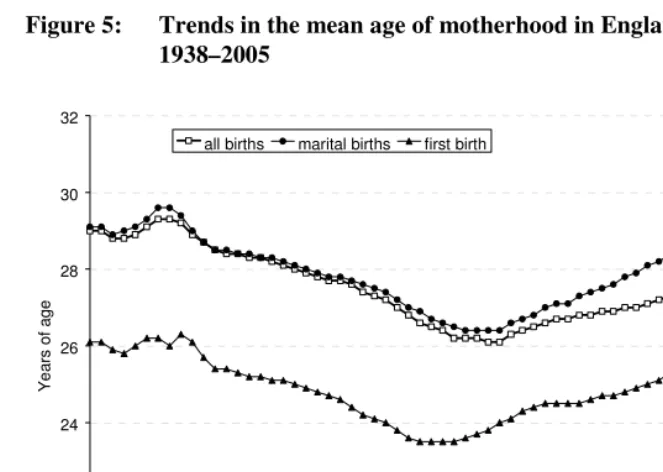
the age at birth at all parities has increased since 1974, but more slowly and less dramatically for non-marital births and births of parity four or higher (Smallwood 2002a; Office of Population, Censuses and Surveys 1985).
Figure 5: Trends in the mean age of motherhood in England and Wales, 1938–2005
20 22 24 26 28 30 32
1938 1943 1948 1953 1958 1963 1968 1973 1978 1983 1988 1993 1998 2003
Y
e
a
rs
o
f
a
g
e
all births marital births first birth
Source: Office for National Statistics Birth Statistics 1837–1983, Historical series FM1 No. 13, and Vol. Nos. 27, 28, 29 and 33, Tables 1.5 and 1.7a; Office of Population, Censuses and Surveys (1985).
gave birth at the youngest ages, and a higher proportion delayed childbearing until after they turn 30 (Rendall et al. 2005).
The effect of these changes becomes more apparent when the age-specific fertility rates for single years of age are added together to produce fertility rates for five-year age groups (Figure 6). The stability of the total fertility rate since the 1980s is due to a decrease in fertility at ages 20 to 29, which is offset by an increase at ages 30 to 40. Fertility at the oldest and youngest ages has remained fairly stable. Since 2000, fertility for those aged 20 to 29 has levelled off. In contrast, for women in their thirties, it has continued to rise. These trends contributed to the recent rise in the TFR between 2001 and 2006 (Office for National Statistics 2007a).
Figure 6: Age-specific fertility rates (per 100 women) for five-year age groups, 1965–2005
0 10 20 30 40 50 60 70 80 90 100
1965 1970 1975 1980 1985 1990 1995 2000 2005
15-19 20-24 25-29 30-34 35-39 40-45
Source: Smallwood (2002a); Office for National Statistics Birth Statistics FM1 No. 34, Table 10.1
Patterns of postponement and recuperation can be observed at a cohort level as well. Figure 7 plots the cumulative fertility, every five years from age 15, of successive cohorts of women, relative to those born in 1950 who had 2.07 children on average. Teenage fertility declined for the next three cohorts, with a cumulative fertility at age 20 of 0.05 (1955 cohort), 0.12 (1960 cohort), and 0.16 (1965 cohort) fewer children. This figure then stabilised for each of the subsequent cohorts at around 0.14 to 0.16 fewer children.
The gap in fertility widened until age 25 for the cohorts born in 1955 and 1965, and until age 30 for each successive cohort with data at that age. Although women born after 1950 never reached the same level of fertility, more than half the gap at age 30 was closed by either age 40 (1955 and 1965 cohort) or age 45 (1960 cohort). Compared to women born in 1950, completed fertility for the 1955 and 1960 birth cohorts was 0.05 to 0.09 fewer births per woman, respectively. Data at age 40 for the 1965 cohort suggest further decline is likely unless fertility increases very steeply over the next five years. However, the convergence of the curves for the 1975, 1980 and 1985 cohorts suggests that patterns of postponement may be stabilising.
Figure 7: Cumulative fertility by age for birth cohorts, compared with women born in 1950
-0.7 -0.6 -0.5 -0.4 -0.3 -0.2 -0.1 0.0 0.1
15 20 25 30 35 40 45
1950 1955 1960 1965 1970 1975 1980 1985
2.3 Differential fertility patterns
Compared to other European countries, fertility rates in England and Wales have remained stable in a context where government support for families, particularly working families, has been improving but remains fairly limited. To some extent, the low fertility that might be expected in this context has materialised, but as we see in this section, only for some groups.
2.3.1 Teenage childbearing
From the 1970s, teenage fertility rates fell only slightly, while the rest of the fertility schedule was shifting more emphatically down and to the right as fertility was being postponed. This trend is reflected in the continuously high and overlapping curves at early ages for the 1985, 1995 and 2005 age-specific fertility rates, characteristic of most English-speaking countries, which have emerged over the past three decades (Chandola et al. 2002; Figure 4). Although there is evidence for the intergenerational transmission of early motherhood in England and Wales (Huerta and Sigle-Rushton 2008), rates of teenage childbearing amongst women who were born to older mothers are high as well, and explain most of the cross-country differences (Rendall 2003).
The Government’s Social Exclusion Unit (1999) considers high teenage pregnancy rates to be due to low aspirations (stemming for high levels of inequality), ignorance about the risks of unprotected sex, and mixed messages about the appropriateness of sexual behaviour. Although the official understanding of the issues surrounding early motherhood, particularly the ignorance of young women, has not gone unquestioned (see for example van Loon 2003; Duncan 2007), data drawn from the Millennium Cohort Study suggest that a large majority of young mothers—86.9 percent of those who gave birth before the age of 18, and 75.9 percent of those who gave birth between the ages of 19 and 21—describe their pregnancy as unplanned (Joshi, Hawkes and Ward 2004, Table 5). This suggests that there is some scope for interventions aimed at giving women more control over the timing of their first conception.
but far more slowly (Statistics for Wales, 2005). Despite some success, the 2004 target was not met, and if current trends continue, it is unlikely that the 2010 target will be met (Wilkinson et al. 2006; see also Teenage Pregnancy Unit 2008).
Although it is likely that an initiative which successfully reduced teenage parenthood would simply result in the postponement of early births to later ages, and that the overall impact on completed family size would be small, it is nonetheless worth noting that teenage childbearing makes a notable contribution to period fertility rates (Figure 6). In 2005, the TFR of 1.80 would have fallen to 1.73 if contributions from those under twenty were halved. All else equal, a substantial reduction in teenage childbearing would have worked to reduce the TFR in the first years of the twenty-first century.
2.3.2 Educational differentials
Although only a few studies have examined differences in fertility by women’s educational qualifications in England and Wales, evidence suggests considerable and widening differentials in the timing of fertility by education level. These differentials reflect both the composition of different educational groups (minority ethnic groups and those from impoverished or low social class backgrounds tend to have lower levels of education) and the link between education and labour market position (Hobcraft 2000; Hobcraft and Kiernan 2001; Robson and Berthoud 2003). The age profile of first birth rates has shifted and flattened for both medium- and high-educated women, both over time and relative to patterns observed in Norway and France. Comparing women born between 1954 and 1958 with those born between 1963 and 1967, Rendall and colleagues (2005) find that, amongst those born in the 1950s, 46.2 percent of medium-educated and 49.1 percent high-medium-educated women had a child between the ages of 21 and 29.8 For those born in the 1960s, the percentage of women giving birth in their twenties had fallen to 41.7 for the medium-educated, and to 37.3 for the high-educated. Additionally, high-educated women in the younger cohort were far less likely to have given birth by age 33 – a fall of more than 10 percentage points (Table 1). In Norway and France, percentages of high-educated women giving birth by age 33 were well over 70 percent. In contrast to the profiles of the medium- and high-educated, amongst low-educated women the age profile of fertility changed little across cohorts. Around 42 percent of low- educated women gave birth before the age of 21 in both cohorts, and
8 Age in this study is measured as age completed during the calendar year. All other data in this chapter are
more than 80 percent gave birth before the age of 33 (Table 1). These patterns suggest that trends in postponement differ substantially by education level.
Table 1: Percentage of women with a child by select ages, by cohort and education level*, 1950s and 1960s cohorts
Age Low education Medium education High education
1950s 1960s 1950s 1960s 1950s 1960s
19 23.8 23.6 10.0 8.0 0.4 0.0
21 41.8 42.6 20.3 17.0 1.8 0.2
25 66.0 67.0 45.9 38.2 16.9 9.9
29 80.3 78.0 66.5 58.7 50.9 37.5
33 84.1 82.3 76.9 72.1 65.3 53.8
Source: Rendall et al. (2005).
Note: * Women’s education level was reported at about age 25.
Research comparing longitudinal data for Great Britain with similar data from Germany, the Netherlands and Sweden tells a similar story about differentials in the timing of birth by level of education. In the 1990s, the mean age at first birth amongst British mothers who were high-educated was five years older than that of mothers with low education – the widest gap observed across all four countries. Fertility patterns in the 1950s and 1960s showed far less differentiation by educational attainment, and most of the subsequent divergence was due to high-educated women postponing their first birth (Gustafsson, Kenjoh, and Wetzels 2002). Although there are clear patterns of postponement, this study does not consider the implications of postponement for childlessness or completed family size. So it is not clear to what extent high-educated women recuperate postponed fertility.
Survey (which covers all of Great Britain), and found that 28 percent of women with the highest educational qualifications were childless. For those with a medium level of education (“intermediate qualifications”), rates of childlessness were only 20 percent. Finally amongst those with no qualifications, only 16 percent were childless in their early forties. One-child families were more common amongst women with high qualifications, so about half of the high-educated had a completed family size of one or less. Conversely, very few women with no qualifications had only one child, and about one in five had a completed family size of four of more children. These studies demonstrate differentials in not just the timing of fertility, but the quantum of fertility by level of education.
Table 2: Proportions of mothers having a second birth and timing of second births, by age at first birth and education level, 1954–58 cohort in England and Wales
age 25 age 30 age35
Percentage having a a second birth
no higher qualifications 93.0 83.5 59.8
higher qualifications 96.0 90.8 73.6
Timing of second births Within 2 years
no higher qualifications 53.4 48.9 45.6
higher qualifications 60.6 56.7 51.7
Within 5 years
no higher qualifications 92.7 91.9 93.6
higher qualifications 95.2 94.7 95.2
Source: Rendall and Smallwood (2003).
salient, especially in a context where support for families is low relative to much of the EU-15. On the other hand, it is possible that fertility that has been increasingly postponed has also been, and will continue to be, increasingly foregone. If this is the case, educational differentials in fertility may have contributed to the upward trend in child poverty rates in the 1980s and 1990s (for a discussion in the US context, see Lichter 1997).
2.3.3 Fertility of immigrants and ethnic minority groups
Information on immigration to England and Wales is limited. The main source of information on the number of international migrants is the International Passenger Survey (IPS) which collects information on place of birth, citizenship and place of origin for a sample of individuals passing through UK ports. In addition, counts of foreign immigrants, broken down by citizenship only, is available from the Home Office Control of Immigration Statistics. However, information on place of birth is available in vital statistics (asked as a voluntary question at the registration of births and deaths since 1969) and census data. Data from the 2001 census indicate that just under nine percent of the population of England and Wales were born outside of the United Kingdom. Finally, the Labour Force Survey contains information on birthplace, citizenship, and date of entry, but for an analysis of small groups the numbers are often insufficient, and samples from several years must be combined in order to obtain statistically significant results (Coleman and Smith 2005).
Registration data from 1971 suggests that 11.3 percent of all births were to women born outside the United Kingdom. Thirty-five years later, 21.9 per cent of births were to women born outside of the United Kingdom (Office for National Statistics 2007b). In the 1980s, more than eight percent of all births were to women who were born in the New Commonwealth or Pakistan. By 2003, this figure had increased to nearly 19 percent of all births (Coleman and Smith 2005). In particular, women born in Pakistan and Bangladesh, many of whom are young mothers and poorly educated as well, have had consistently high levels of fertility (Robson and Berthoud 2003).
TFR for these women was more than twice the national average. In contrast, the fertility of women born in India and the rest of the world is far closer to the national average.
Table 3: Total fertility rate: by country of birth of mother, England and Wales 1981 – 2001
Country of birth of mother 1981 1987 1991 1997 2001
Total 1.8 1.8 1.8 1.7 1.6
United Kingdom1
1.7 1.8 1.8 1.7 1.6
Total outside UK 2.5 2.4 2.3 2.5 2.2
New Commonwealth 2.9 2.8 2.8 3.1 2.8
India 3.1 2.7 2.5 2.3 2.3
Pakistan 4.8 5.3 4.7
Bangladesh 6.5 5.2 5.3 4.8 3.9
East Africa 2.1 1.0 1.9 1.8 1.6
Rest of Africa2
3.4 3.2 2.7 3.5 2.0
Rest of New Commonwealth3
2.3 2.5 1.9 2.9 2.2
Rest of the World 2.0 1.9 1.9 2.1 1.8
Source: Office for National Statistics Birth Statistics FM1 Nos. 22, 24, 26, and 32, Table 9.5 Note: 1 Including Isle of Man and Channel Islands
2 Includes countries listed under Southern Africa and Rest of Africa in Table A of birth statistics, series FM1 No.32
3 Includes countries listed under Far East, Mediterranean, Caribbean and Rest of New Commonwealth in Table A of birth statistics, series FM1 No 32.
The contribution of foreign births to the overall TFR is small, but not trivial. Estimates suggest that, in England and Wales in 2001, the total fertility rate of 1.63 would have fallen to 1.56 if the 17 percent of all births to mothers who had been born outside of the whole United Kingdom were excluded. In 2006, the TFR for the UK as a whole would have fallen by 0.1 births per woman (Office for National Statistics 2007b). Because of increased tempo shortly after migrating9 and data issues10, their longer-term contribution to fertility is more difficult to determine. In any case, net migration is
9 As Toulemon (2006) illustrates, the TFR for migrants can overstate the number of births that migrants are
likely to have because migrants often have particularly high rates of fertility shortly after they have migrated, and lower rates before arriving. These effects will be particularly strong in a context where recent migrants comprise a large share of all migrants.
10 The most recent TFR of 1.87 may be biased upward because of high levels of immigration and poor quality
estimated to have increased by 48 percent between 2003–04 and 2004–05. Although TFRs for UK-born women have increased, high levels of migration and a higher share of new immigrants as a proportion of the foreign born have contributed to the increase in the TFR between 2001 and 2006 (Office for National Statistics 2007b). If current migration trends continue, the contribution of immigrants to period fertility indicators should increase in importance.
3. Fertility related changes in patterns of family formation
3.1 The decline in marriage and the rise of cohabitation
For cohorts born in the first half of the twentieth century, marriage occurred early and was nearly universal. Amongst those born between 1931 and 1951, more than half of men and three-quarters of women were married before the age of 25 (Table 4). By age 50, 11.1 percent of men born in 1951 had never married. For women the figure was even lower. Data for younger cohorts show that marriage was increasingly both postponed and foregone (Murphy and Wang 1999; Bynner et al. 2002; Office for National Statistics 2006). For those cohorts born in 1965, fewer than 30 percent of men and just under half of women were married by age 25. By age 40, over 29 percent of men and 21 percent of women had never married – a substantial increase in non-marriage relative to previous birth cohorts. Turning to the most recent cohorts, young marriage has become even more uncommon. In recent years, mean age at first marriage has increased to over 29 for women, and to 31 for men (Office for National Statistics 2006).
authority housing, which had a large effect from the mid-1980s, meant that there was a limited stock of public accommodation available. Moreover, the available stock was “concentrated in the least salubrious areas and among the most economically and socially disadvantaged groups” (Smith and Ferri 2003: 206). Those making the transition to adulthood in the late 1980s and at the turn of the century faced similar problems with the costs of housing. These conditions, along with less job security and increasing rates of youth unemployment (discussed in more detail in Section 5 below), made leaving the parental home particularly difficult. Data for the UK as a whole indicate that more than 37 percent of men and 18 percent of women aged 20–24 in 1994 were still living with their parents (Aassve, Billari, Mazzuco and Ongaro 2002).
Table 4: Proportions of men and women ever married at select ages, by birth cohort 1931–1985
Age in years
Men 20 25 30 40 50
1931 2.8 52.3 80.9 90.1 91.8
1941 6.3 60.5 83.0 90.8 92.1
1951 9.8 58.5 78.0 87.2 88.9
1961 5.7 38.2 61.5 76.4
1965 3.1 28.9 52.7 70.6
1975 0.9 11.1 31.1
1980 0.7 8.5
1985 0.5
Women 20 25 30 40 50
1931 18.7 75.0 88.9 93.6 94.7
1941 28.0 80.4 90.7 94.9 95.7
1951 30.6 77.4 88.1 92.7 93.6
1961 20.2 57.7 74.3 83.5
1965 12.3 47.3 66.5 78.3
1975 3.9 22.1 44.1
1980 2.8 17.3
1985 2.1
With changes in the transition to adulthood came changes in the nature of first partnership. Specifically, cohabitation replaced direct marriage for a large percentage of young adults (Kiernan 1999). Up until the late 1970s, the prevalence of cohabiting unions was low and the majority of those cohabiting were divorced and separated. Since that time cohabitation has become far more common, and the characteristics of women and men who choose to cohabit has changed. Between 1976 and 1998, the proportion of unmarried women who were cohabiting in Great Britain increased more than threefold, from nine percent to 29 percent, and the percentage of cohabiting women who were never married increased sharply (Haskey 2001). For the cohort born between 1950 and 1962, data drawn from the British Household Panel Survey (BHPS) show that those from high social class backgrounds were more likely to cohabit. For the 1963–76 cohort, cohabitation was more normative, and the association is not significant (Ermisch and Francesconi 2000b). Using the same data source, another analysis reports that, for those born between 1963 and 1967, premarital cohabitation as a first partnership was most common amongst women with degree level qualifications (Kiernan 1999, Table 8). Amongst those who had a first partnership by 1992, only 27 percent of the most highly educated women married directly, whilst over 40 percent of women with lower qualifications reported having done so. Educational differentials have subsequently disappeared. Ermisch (2005) suggests these changes are due to a diffusion of more tolerant attitudes about consensual unions spreading from the more privileged innovators to the wider society. The increasing popularity of unmarried cohabiting unions and their changing character mean that the time spent outside of a partnership in young adulthood has grown, but far less than figures on the postponement of marriage would suggest (Ermisch and Francesconi 2000a).
About half of all cohabitating unions formed by women born in 1970 were subsequently dissolved, and rates of dissolution are higher for those with low levels of education (Ermisch 2005). Nonetheless, in analyses that compared cohorts born in 1958 and 1970, Steele and colleagues (2006) find that having children is associated with relatively greater stability in the younger cohort, and the authors suggest that the distinction between married and cohabiting partnerships with children may be less important now than it was in the past.
3.2 A weakening of the link between marriage and childbearing
between marriage and first birth have become increasingly common. In 1970, 59 percent of all marital first births were to women who had been married one year or less, and nine percent were to women who had been married for five years or more. By 2005, 16 percent of first marital births were to women who had been married five years or more. Moreover, 48 percent of marital first births took place in the first two years – an 11 point decline since 1970 (Table 5).
Figure 8: Annual number of marriages and births, England and Wales, 1938–2004
0 100 200 300 400 500 600 700 800 900 1,000
1938 1943 1948 1953 1958 1963 1968 1973 1978 1983 1988 1993 1998 2003
T
h
o
u
s
a
n
d
s
Marriages All births Marital births Non-marital births
Source: Office for National Statistics Birth Statistics 1837–1983 (Historical series FM1 No 13); FM1 Volume No's 18 and 28 to 33, Tables 1.5 and 2.1.
quickly after marriage. Data on first marriages tell a similar story about changes to the relative timing of marriage and childbirth. In the 1960s, around one in five first marriages were followed by a birth in the next eight months. By 2003, this had decreased to 9.5 percent, although levels and rates of change vary considerably by age at marriage (Table 6).
Table 5: First marital births by duration of the marriage, all married women 1970–2005
Percentage of first marital births by duration of marriage Completed months Completed years All
durations(N) 0–7 8–11 0 1 2 3 4 5 6+
1970 277,407 0.25 0.11 0.36 0.23 0.15 0.10 0.06 0.03 0.06
1975 226,944 0.17 0.08 0.25 0.20 0.17 0.14 0.09 0.06 0.09
1980 240,975 0.16 0.08 0.24 0.20 0.15 0.12 0.09 0.07 0.13
1985 212,017 0.16 0.08 0.24 0.22 0.16 0.11 0.08 0.06 0.13
1990 200,394 0.14 0.09 0.23 0.23 0.16 0.12 0.08 0.06 0.13
1995 168,118 0.10 0.09 0.20 0.24 0.17 0.12 0.08 0.06 0.13
2000 146,509 0.10 0.10 0.20 0.26 0.17 0.11 0.08 0.05 0.13
2005 155,953 0.09 0.11 0.20 0.28 0.18 0.11 0.07 0.05 0.11
Source: Office for National Statistics Birth Statistics 1837–1983 (Historical series FM1 No 13); FM1 Volume No's 18 and 28 to 34, Table 5.1.
Table 6: The percentage of first marriages where a birth occurs within eight months, by age of mother at marriage
Age at Marriage
Under 45 Under 20 Age 20–24 Age 25–29 Age 30–44
1955 14.8 24.3 13.4 10.4 8.1
1960 18.6 33.8 13.6 12.3 9.1
1965 22.3 38.3 15.6 13.5 10.2
1970 20.0 35.4 13.6 11.8 9.9
1975 13.0 23.8 8.1 7.4 7.4
1980 14.0 25.5 9.8 9.6 10.7
1985 13.4 26.8 10.9 10.4 11.0
1990 11.5 24.0 10.4 9.5 11.7
1995 10.1 20.6 10.3 8.3 10.8
2000 9.3 19.9 10.9 7.5 8.8
2003 9.5 20.1 11.2 7.8 9.0
Source: Office for National Statistics Birth Statistics 1837–1983 (Historical series FM1 No 13) Table 1.7; FM1 Volume No's 18 and 28 to 33, Table 1.8.
3.3 Divorce and union dissolution
Secular divorce was first created in 1857. The Matrimonial Causes Act (1937) permitted fault-based divorce on the grounds of adultery, cruelty and desertion of at least three years. There are no reliable statistics on divorce prior to 1950, but it was not until the availability of legal aid in 1950 that divorce became affordable for a significant portion of the British population. The Divorce Reform Act of 1969 introduced divorce by mutual consent with a separation period of at least two years. This was followed shortly after by the Matrimonial Causes Act in 1973, according to which a divorce can be granted if the petitioner has been married for at least one year, and the marriage has “broken down irretrievably”. Irretrievable breakdown is evidenced when one of the following five facts is established as “proof”: adultery of the other spouse, unreasonable behaviour of the other spouse, desertion after two years, separation with mutual consent after two years, or separation with no consent after five years (Smart 1999). In about 70 percent of cases in England and Wales, the divorce petitioner cites adultery or unreasonable behaviour in the petition for divorce (Office for National Statistics 2007c)
In 1995, the government mooted the idea of divorce law reform, and published
implemented. Since then, divorce reform in England and Wales has been in a state of limbo. The law continues to be fault based and, for the most part, based on the Matrimonial Causes Act (Smart 1999).
Although there had been short-lived increases in previous decades, the divorce rate did not begin its consistent and steep upward trend until the early 1960s (Smith 1997). The total divorce rate11 increased from 0.1 to 0.4 between 1960 and 1980. It subsequently stabilised after 1995, at around 0.45. While not the highest in Europe, this rate places England and Wales on the high end of EU countries (Eurostat 2004; Council of Europe 2005).
The net effect of divorce on fertility is difficult to predict. High divorce rates combined with the high rates of dissolution amongst cohabitating couples should work to dampen fertility, but fertility intentions may be revised upward with repartnering to take into account the preferences of the new partner, or because of the desire of newly formed couples to have at least one shared child (Vikat, Thomson and Hoem 1999). This may have countervailing effects. Data from the early 1990s suggest that 45 percent of British women who experienced a divorce gave birth within twelve years of having dissolved their marriages. Interestingly, the woman’s parity at the time of dissolution was not strongly associated with subsequent childbearing. This finding suggests that the decision-making process of previously divorced women differs from that of women who are still in their first marriage, where parity is likely to be a key consideration (Jefferies, Berrington and Diamond 2000).
3.4 Changes in sexual behaviour, contraceptive use and induced abortion
The 1960s and 1970s saw unprecedented change in both sexual behaviour and the control of reproduction. Delayed marriage was not met with similar delays in sexual debut. Data from the Sexual Attitudes and Lifestyles Survey indicate that nearly one in five British women born between 1926 and 1930 had experienced their first sexual intercourse by the age of 20. For this birth cohort, the median age at first intercourse was 23 – about the median age at first marriage. For the cohort born in the second half of the 1950s, the median age had fallen to 19, an age at which fewer than 20 percent were married (Botting and Dunnell 2000). Those born in between these two cohorts engaged in more pre-marital sexual activity at young ages than those born earlier, but did not benefit from good access to contraception. The result was a large number of ‘shotgun marriages’ in the post-war period, as evidenced by the peak in premarital
11 The total divorce rate is a period measure calculated by summing divorce rates by duration of marriage for
conceptions in the 1960s, especially for those under 20, which fell subsequently to 1950s levels by the second half of the 1970s (Hobcraft 1996). These patterns also suggest that contraception and abortion were widely used once they became legally available.
Women reaching adulthood in the 1970s had unprecedented access to reliable contraceptive methods and legal abortion. The contraceptive pill was made available for purchase in January of 1961. At first, contraceptive services were only available to married women and for medical reasons, and their extension to women who were unmarried took place over many years. However, by 1974, the contraceptive pill was provided by the National Health Service to all women free of charge (Hobcraft 1996).
Women first gained legal access to abortion in 1968 (legalised by a new Act of Parliament in 1967). For the first five years, services were limited and rates of use were low (Table 7). As services became more widespread between 1969 and 1974, rates of use more than doubled. Currently, a woman can obtain an abortion in the first 24 weeks of pregnancy (lowered in 1990 from 28 weeks in the original Act), as long as two doctors conclude that a woman’s physical or mental health or her child(ren)’s physical or mental health will be under greater threat if she continues with the pregnancy than if she terminates it. In cases where two doctors decide a woman’s health is gravely threatened if she carries the pregnancy to term, or that the foetus is likely to suffer from severe physical or mental abnormalities, there is no legal time limit. In practice, most abortions take place well within the time limit. In 2006, 89 percent of abortions were carried out within 13 weeks of conception (Department of Health 2007).
Table 7: Frequency of induced abortion in England and Wales, 1969-2005
Year
Number of Abortions
Abortions per 100 conceptions*
All Ages Crude Abortion Rate(15–44)
Standardised Abortion Rate
1969 54,819 5.9 5.3 5.2
1974 162,940 14.6 11.5 11.2
1979 149,746 15.9 12.0 11.5
1984 169,993 17.6 12.8 12.2
1989 183,974 19.9 15.5 15.1
1994 166,876 19.1 14.6 14.6
1999 183,250 21.8 16.2 16.8
2004 194,498 22.5 16.9 17.8
2005 194,353 n.a. 17.0 17.8
2006 201,173 n.a. 17.5 18.3
*Not ending in miscarriage Source: Department of Health (2007).
In 1995, the proportion of conceptions leading to an abortion was, at 19, well above the level observed in many other Western European countries, and similar to those found in Scandinavian countries. At the same time, it was lower than in other English speaking countries where it was legal (Henshaw, Singh and Haas 1999). However, in 1996, the rate of conceptions and the rate of abortion both increased, particularly amongst women aged 20–24. Researchers have linked the sudden increase to a warning issued by the Committee on Safety of Medicines in October 1995 about a link between seven brands of contraceptive pill and thrombosis (Wood, Botting and Dunnell 1997). Despite increasing use of emergency contraception (Botting and Dunnell 2003), abortion rates have continued to increase and, in 2004, 22.5 percent of conceptions leading to either an abortion or a live birth ended in legal abortion. This trend has not been well examined or well explained in the extant research. Although some have suggested that subsequent pill scares are to blame (Summerfield and Babb 2003), there is little evidence that use of contraceptive pills has declined appreciably, even at the time of the 1995 scare (Wood et al. 1997; Taylor, Keyse and Bryant 2006). With the exception of legal abortion, there is little good information on the use of contraceptive services prior to the Family Formation Survey (FFS) of 1976. At that time, the contraceptive pill was the most commonly used method, and about 28 percent of women aged 14–49 were using it (Botting and Dunnell 2000). In 2005, about 24 percent of women used the contraceptive pill, representing just under one-third of women using any method (Table 8).
During the 1970s and 1980s, surgical sterilisation became common in England and Wales, and has remained at high levels since that time (Botting and Dunnell 2000). In line with historic trends, similar proportions of male and female sterilisations were reported in 2005, when nearly 40 percent of women aged 40 and over reported that either they or their partners had been sterilised as a means of contraception. The use of sterilisation for women in their thirties has declined somewhat over time (Taylor et al. 2006). This is most probably due to trends in the postponement of fertility.
Except for condoms, the use of which has increased over time (often used in addition to other methods), the proportions using other types of methods have remained fairly low and stable since the 1970s. Condom use began climbing in the early 1990s, most probably due to concerns about HIV-AIDS. Data collected in 1997 suggest that disease prevention was a motivating factor for 54 percent of men and 62 percent of women who reported having used a condom in the previous 12 months (Botting and Dunnell 2000).
particular – have, at least since the mid-1970s, been used at high levels in young adulthood, after which sterilization becomes increasingly common.
Table 8: Contraceptive methods used in 2005/06, percentages by age group
Age 16–17 18–19 20–24 25–29 30–34 35–39 40–44 45–49 All
Percentage using any modern method 51 67 82 74 78 78 70 75 74 Current method(s) used (those using at least one method)
Non-surgical methods
Pill 61 60 63 47 43 23 15 6 32
Male condom 78 50 43 34 32 26 16 14 28
IUD 0 2 0 6 6 8 9 12 7
Injection/implant 12 21 13 9 6 4 2 1 6
Periodic abstinence 0 0 0 3 3 2 2 0 2
Withdrawal 6 0 4 7 5 4 6 4 5
Other non-surgical 16 6 3 3 8 4 3 7 6
Surgical methods
Sterilized 0 0 1 2 9 18 17 29 13
Partner Sterilized 0 0 1 4 5 15 34 29 15
Percentage not using any method 49 33 18 26 22 22 30 25 26
Reason for not using a method (those not using any method)
No heterosexual relations 96 100 87 65 40 45 42 42 55
Sterile after another operation 0 0 0 5 1 11 23 15 10
Wants to get pregnant 0 0 0 17 30 21 7 4 12
Currently pregnant 4 0 8 6 16 4 1 0 5
Possibly infertile (post-menopausal or other) 0 0 4 4 6 7 15 35 12
Doesn't like contraception 0 0 0 0 2 4 3 0 2
Other reason 0 0 2 3 3 9 8 5 5
N 55 39 154 161 214 270 261 224 1377
Source: Taylor, Keyse and Bryant (2006).
4. Social and population policies
United Kingdom was unique (along with the Netherlands) in that it expected lone mothers to remain at home and care for their children full-time, and provided low levels of income support that enabled them to do so (Millar 1996). But changes in recent years have reflected a marked move towards greater governmental support of families with children, especially when those families are engaged in (low) paid work. Some of the more important aspects of recent policy reforms and developments include improvements to maternity and parental leave entitlements, including a right for parents with small children to request part-time hours (Lewis and Campbell 2007); increases in child benefit12 (counterbalanced for some families by the removal of the lone parent supplement); changes to the tax system that increase incentives for people to take up paid work (Brewer and Shephard 2004); and improved public provision of child care (Brewer, Crawford and Dearden 2005). Although these changes took place fairly recently, we can nonetheless speculate about the likely impact.
4.1 The employment rights of parents
Statutory maternity leave has existed since the 1970s, but it was originally only available to women who had been continuously employed with the same employer for at least two years (five years for women working short part-time hours). A substantial proportion of working women failed to meet this requirement (McRae 1991). Entitlement was only extended to all working mothers in the early 1990s, at which time a two-tiered system of Ordinary Maternity Leave (OML) and Additional Maternity Leave (AML) was put in place (Gregg et al. 2003). Until recently, all women employees were entitled to 26 weeks of OML, and those who had completed 26 weeks continuous employment with their present employer were eligible for a further 26 weeks of AML. For babies due on or after 1 April 2007, job protected maternity leave was extended to one year for all women, regardless of length of service. At the same time, entitlement to Statutory Maternity Pay was extended to 39 weeks. Currently, the first six weeks are paid at 90 percent of earnings, and the remaining 33 weeks are paid at a flat rate of £117.18 per week. The flat rate is more than double what it was in 1997.13 From 2010, paid maternity leave will be extended to one year.14
12 http://www.ifs.org.uk/ff/childben.xls.
13 http://www.direct.gov.uk/en/Employment/Employees/WorkAndFamilies/DG_10029285.
14 http://www.hmrc.gov.uk/statutory-notices/paternity-leave-pay.htm. The goal is to extend entitlements by
Parental leave, an unpaid, individual entitlement consisting of 13 weeks per parent, per child, was first introduced in December 1999.15 In contrast to maternity leave, which has been increasing in length and the generosity of payment, parental leave legislation complies with the minimum required by the EU Directive on Parental Leave, and goes little beyond it (Lewis and Campbell 2007). Leave can be taken in blocks or multiples of one week up until the child is aged five, but parents are not permitted to take more than four weeks of leave per calendar year. All employees with at least one year of continuous employment with their present employer, and who have, or expect to have, parental responsibility for a child are eligible.16 Consistent with its reluctance to impose strong regulations on the labour market or to interfere in ‘private matters’, the Government’s Summary Guidance states that ‘wherever possible employers and employees should make their own agreements about how parental leave will work in a particular workplace.’(Department of Business Enterprise and Regulatory Reform n.d.). Moreover, if employers ‘cannot cope’ they are permitted to postpone a period of leave for up to six months (Department of Business Enterprise and Regulatory Reform n.d.).
Although rights to stay at home to care for a young child have been extended in recent years, the focus has been on providing longer and better paid maternity leaves. Rights for fathers to take leave have been far more limited, although since 2003 they have had the statutory right to two weeks paid paternity leave. In 2010, when paid maternity leave increases to one year, mothers will be able to transfer the last six months of their leave entitlement to fathers, who would be compensated at the flat rate. Not surprisingly, the Government expects take-up to be low. This policy approach, which is unique in Europe, reinforces the traditional gendered division of paid and unpaid work (Lewis and Campbell 2007).
To facilitate the work-life balance of working parents, legislation was also introduced in 2003 that gives parents of children under the age of six (under 18 if the child is disabled) a right to request flexible work in existing jobs. From April 2007, this right to request was extended to those with caring responsibilities for adults as well (Himmelweit and Land 2007). This measure could serve to reduce some of the occupational segregation between full-time and part-time jobs. Research suggests that, thus far, the majority of requests for flexibility have been granted, although mothers are far more likely to make requests, and fathers are more than twice as likely to have their requests turned down (Palmer 2004; Holt and Grainger 2005; Lewis and Campbell 2007). Other national evidence suggests the practice is limited, and only those who think their requests will be granted place a request in the first place (Manning and Petrongolo 2004). Likewise, local labour market studies suggest that flexible working
15 http://www.berr.gov.uk/employment/workandfamilies/parental-leave/index.html.
arrangements are not widespread. Some firms have extended this right to all employees (Chartered Institute of Personnel and Development 2005), but, as the scheme remains discretionary, the decisions that firms make are likely to vary with the state of the labour market. Furthermore, qualitative studies have reported that, in practice, the operation of flexibility on a day-to-day basis rests on decisions made by line managers, irrespective of formal company policy (Perrons 1999, Yeandle, Wigfield, Crompton and Dennett 2002, Standing 2006).
4.2 Support for the care of children
This section discusses recent policy changes, all explicitly aimed at providing better support to families with children. These include expanded provision of government subsidised childcare, as well as increased redistribution through cash transfers and changes to the tax system.
In May 1998, the Government broke with a traditional reliance on the market to provide efficient levels of high quality child care and launched a National Childcare Strategy. The strategy aimed “to ensure good quality, affordable childcare for children aged 0 to 14 in every neighbourhood, including both formal childcare and support for informal arrangements.”17 Although it has been criticised for providing too few places to children under three (Rake 2001), there has been a substantial increase in the number of new childcare places made available since 1997.18 In addition, there has been an expansion in free early education for three- and olds. Currently, all four-year-olds are guaranteed a free early education place if their parents want one, but the hours are part-time, and the minimum provision amounts to just 12.5 hours a week (Rake 2001). Even with minimum hours set to increase19 to 15 by 2010, for many dual-earning families, taking up free early childcare means they must rely on a complex mix of formal, informal and back-up support both for care and transportation between care sites. Logistical requirements of this sort prevent some mothers from taking up paid work (Skinner 2003).
In addition to measures aimed at facilitating work and motherhood, the government has also increased the cash support that it offers to parents, particularly those on low incomes. Child benefit is a universal cash payment made available to all children under the age of 16 and, from April 2006, to families with children aged 16, 17, 18 and 19 who meet education or training requirements.20 The payment is made
17 http://www.surestart.gov.uk/aboutsurestart/about/thesurestartprogramme2/challenge/. 18 Ibid.
19 Ibid.
directly to the main care provider, usually the mother. As of April 2008, the benefit amounts to £18.80 per week for the eldest child, and £12.55 per week for each additional child.21 Compared to other EU-15 countries, the level of child benefit is not generous. Despite above inflation increases in recent years, a fairly recent comparative analysis placed the UK in the lower middle of the ranking for different amounts of household incomes, just above the four Southern European countries (de Henau et al. 2002).
In the late 1990s, the Government introduced a series of targeted tax reforms aimed at providing additional support to families with children. Key policies include an integrated refundable tax credit for out-of-work families and low-paid working families (with a supplement in the first year of a child’s life), and additional benefits for parents working 16 hours or more per week (the Working Tax Credit) (Brewer and Shephard 2004). The effect of these policies has been to make the tax system increasingly less individualised, to increase the incomes of poor families with children, and to increase the number of households eligible for benefits (Sutherland 2005). More than three times as many working age adults were receiving tax credits in 2004/05 as were receiving what was then called the Family Credit in the early 1990s.22 While changes to the tax system have improved the financial situation of many families, there are concerns about the impact of these changes on gender equality. Because eligibility for tax credits is calculated at the household level, the system may tend to discourage second earners, usually the mother, from entering the labour market and accumulating work experience. Hence, tax credits may serve to reinforce the male breadwinning model, and force some women to make difficult choices about combining work and family (Brewer and Shephard 2004).
Taken together, recent changes in both social policy and the labour market should provide limited help to women who want to combine work and childbearing. They should also work to lessen the economic costs of children. But, because the measures, unlike those in many other countries, tend to redistribute resources vertically rather than horizontally, any effects on fertility should disproportionately affect women on lower incomes.23 Because of a strong reliance on means testing and flat rate benefits, moderate- to high-earning women lose a higher proportion of their salary by taking 52 weeks of maternity leave (thirteen weeks of which is unpaid and all but nine at a flat rate). They might be better able to afford the loss of earnings associated with maternity leave, but they still face the possibility of occupational downgrading due to weak
21 http://www.ifs.org.uk/ff/childben.xls.
22 http://www.poverty.org.uk/summary/key%20facts.shtml.
23 Horizontal redistribution takes place within income groups. It is also sometimes used to refer to